


SIST EN 12393-3:2014
(Main)Foods of plant origin - Multiresidue methods for the determination of pesticide residues by GC or LC-MS/MS - Part 3: Determination and confirmatory tests
Foods of plant origin - Multiresidue methods for the determination of pesticide residues by GC or LC-MS/MS - Part 3: Determination and confirmatory tests
This European Standard gives guidance on some recommended techniques for the determination of pesticide residues in foods of plant origin and on confirmatory tests.
The identity of any observed pesticide residue is confirmed, particularly in those cases in which it would appear that the maximum residue limit has been exceeded.
Pflanzliche Lebensmittel - Multiverfahren zur Bestimmung von Pestizidrückständen mit GC oder LC-MS/MS - Teil 3: Verfahren zur Bestimmung und Absicherung
Diese Europäische Norm gibt Leitlinien für einige Techniken zur Ermittlung der Pestizidrückstände in pflanzlichen Lebensmitteln und Absicherung der Ergebnisse.
Die Identität jedes gefundenen Pestizid-Rückstandes wird insbesondere dann bestätigt, wenn der Rückstandshöchstgehalt anscheinend überschritten ist.
Aliments d'origine végétale - Méthodes multirésidus de détermination de résidus de pesticides par CPG ou CL-SM/SM - Partie 3: Détermination et essais de confirmation
La présente Norme européenne énonce des lignes directrices relatives aux techniques recommandées pour la détermination des résidus de pesticides dans les aliments d’origine végétale ainsi qu'aux essais de confirmation.
L’identité de tout résidu de pesticide détecté est confirmée, en particulier lorsqu’il semble que la limite maximale de résidu a été dépassée.
Živila rastlinskega izvora - Multirezidualne metode za določevanje ostankov pesticidov s plinsko kromatografijo ali tekočinsko kromatografijo z masno selektivno detekcijo (LC-MS/MS) - 3. del: Določevanje in potrditveni preskusi
Ta evropski standard vsebuje navodila za nekatere priporočene tehnike za določevanje ostankov pesticidov v živilih rastlinskega izvora in za potrditvene preskuse. Identiteta katerih koli opazovanih ostankov pesticidov je potrjena, zlasti kadar se zdi, da je presežena najvišja mejna vrednost ostankov.
General Information
- Status
- Withdrawn
- Public Enquiry End Date
- 24-May-2012
- Publication Date
- 04-Dec-2013
- Withdrawal Date
- 08-Mar-2026
- Technical Committee
- KŽP - Agricultural food products
- Current Stage
- 9900 - Withdrawal (Adopted Project)
- Start Date
- 06-Mar-2026
- Due Date
- 29-Mar-2026
- Completion Date
- 09-Mar-2026
Relations
- Effective Date
- 01-Jan-2014
- Effective Date
- 28-Jan-2026
- Effective Date
- 28-Jan-2026
- Effective Date
- 28-Jan-2026
- Effective Date
- 28-Jan-2026
- Effective Date
- 28-Jan-2026
Overview
EN 12393-3:2013 (CEN) - “Foods of plant origin - Multiresidue methods for the determination of pesticide residues by GC or LC‑MS/MS - Part 3: Determination and confirmatory tests” - provides guidance on recommended analytical techniques for identifying, quantifying and confirming pesticide residues in plant‑derived foods. The standard emphasizes confirmation of any observed residue, particularly when results suggest that a Maximum Residue Limit (MRL) may have been exceeded. It complements Parts 1 and 2 of EN 12393 and introduces LC‑MS/MS alongside GC and GC‑MS/MS as recommended determination techniques.
Key topics and requirements
- Analytical scope: Identification and quantification using gas chromatography (GC) with selective detectors, GC‑MS / GC‑MS/MS and liquid chromatography with tandem mass spectrometry (LC‑MS/MS).
- Identification criteria:
- Retention time (and retention time ratio to an internal standard).
- Mass spectrometric criteria: typically 3 ions in MS or 2 SRM transitions in MS/MS.
- Use of spectral libraries, isotopic patterns (Cl, Br, S) and high‑resolution MS where applicable.
- Alternative separation/detection (different columns, detectors, derivatisation) for higher certainty.
- Quantification principles:
- Calibrated chromatographic systems with appropriate calibration points and linearity checks.
- Use of matrix‑matched standards, standard addition, internal standards and, where available, stable isotope‑labelled standards to address matrix effects and recovery losses.
- Visual review of chromatograms in addition to software outputs.
- Practical method setup:
- Guidance on GC columns and stationary phases, injector types (split/splitless, PTV), and recommended detectors (ECD, NPD, FPD).
- LC advice: reversed‑phase columns (typical dimensions and UPLC options) and ionisation sources for LC‑MS/MS (ESI, APCI, APPI).
- Annexes A–C provide typical GC, GC‑MS/MS and LC‑MS/MS operating conditions and example parameters.
- Validation and documentation: Any deviations or method variations must be documented and validated; on‑going performance verification is required.
Applications and users
- Who uses it: food testing laboratories, regulatory and enforcement agencies, contract analytical labs, pesticide residue analysts, method developers and quality managers in the food supply chain.
- Practical applications:
- Confirmatory testing when MRL exceedances are suspected.
- Routine multiresidue screening and targeted quantitative analysis in fruits, vegetables and derived plant products.
- Development and standardisation of laboratory procedures for compliance testing and forensic investigations.
Related standards
- EN 12393‑1: General considerations (reagents, apparatus, GC).
- EN 12393‑2: Methods for extraction and clean‑up (extraction workflows M, N, P).
- CEN/TR 15641:2007 - additional LC‑MS/MS guidance referenced by EN 12393‑3.
Keywords: pesticide residues, multiresidue methods, GC‑MS/MS, LC‑MS/MS, food of plant origin, confirmatory tests, MRL, matrix effects, method validation.



Get Certified
Connect with accredited certification bodies for this standard

BSI Group
BSI (British Standards Institution) is the business standards company that helps organizations make excellence a habit.

Bureau Veritas
Bureau Veritas is a world leader in laboratory testing, inspection and certification services.

DNV
DNV is an independent assurance and risk management provider.
Sponsored listings
Frequently Asked Questions
SIST EN 12393-3:2014 is a standard published by the Slovenian Institute for Standardization (SIST). Its full title is "Foods of plant origin - Multiresidue methods for the determination of pesticide residues by GC or LC-MS/MS - Part 3: Determination and confirmatory tests". This standard covers: This European Standard gives guidance on some recommended techniques for the determination of pesticide residues in foods of plant origin and on confirmatory tests. The identity of any observed pesticide residue is confirmed, particularly in those cases in which it would appear that the maximum residue limit has been exceeded.
This European Standard gives guidance on some recommended techniques for the determination of pesticide residues in foods of plant origin and on confirmatory tests. The identity of any observed pesticide residue is confirmed, particularly in those cases in which it would appear that the maximum residue limit has been exceeded.
SIST EN 12393-3:2014 is classified under the following ICS (International Classification for Standards) categories: 67.050 - General methods of tests and analysis for food products; 67.080.01 - Fruits, vegetables and derived products in general. The ICS classification helps identify the subject area and facilitates finding related standards.
SIST EN 12393-3:2014 has the following relationships with other standards: It is inter standard links to SIST EN 12393-3:2009, SIST EN 12393-2:2014, SIST EN 12393-1:2014, SIST EN ISO 13295:2008, SIST EN 12393-2:2009, SIST EN 12396-2:1999. Understanding these relationships helps ensure you are using the most current and applicable version of the standard.
SIST EN 12393-3:2014 is available in PDF format for immediate download after purchase. The document can be added to your cart and obtained through the secure checkout process. Digital delivery ensures instant access to the complete standard document.
Standards Content (Sample)
2003-01.Slovenski inštitut za standardizacijo. Razmnoževanje celote ali delov tega standarda ni dovoljeno.Pflanzliche Lebensmittel - Multiverfahren zur Bestimmung von Pestizidrückständen mit GC oder LC-MS/MS - Teil 3: Verfahren zur Bestimmung und AbsicherungAliments d'origine végétale - Méthodes multirésidus de détermination de résidus de pesticides par CPG ou CL-SM/SM - Partie 3: Détermination et essais de confirmationFoods of plant origin - Multiresidue methods for the determination of pesticide residues by GC or LC-MS/MS - Part 3: Determination and confirmatory tests67.080.01Sadje, zelenjava in njuni proizvodi na splošnoFruits, vegetables and derived products in general67.050Splošne preskusne in analizne metode za živilske proizvodeGeneral methods of tests and analysis for food productsICS:Ta slovenski standard je istoveten z:EN 12393-3:2013SIST EN 12393-3:2014en,fr,de01-januar-2014SIST EN 12393-3:2014SLOVENSKI
STANDARDSIST EN 12393-3:20091DGRPHãþD
EUROPEAN STANDARD NORME EUROPÉENNE EUROPÄISCHE NORM
EN 12393-3
November 2013 ICS 67.050 Supersedes EN 12393-3:2008English Version
Foods of plant origin - Multiresidue methods for the determination of pesticide residues by GC or LC-MS/MS - Part 3: Determination and confirmatory tests
Aliments d'origine végétale - Méthodes multirésidus de détermination de résidus de pesticides par CPG ou CL-SM/SM - Partie 3: Détermination et essais de confirmation Pflanzliche Lebensmittel - Multiverfahren zur Bestimmung von Pestizidrückständen mit GC oder LC-MS/MS - Teil 3: Verfahren zur Bestimmung und Absicherung This European Standard was approved by CEN on 21 September 2013.
CEN members are bound to comply with the CEN/CENELEC Internal Regulations which stipulate the conditions for giving this European Standard the status of a national standard without any alteration. Up-to-date lists and bibliographical references concerning such national standards may be obtained on application to the CEN-CENELEC Management Centre or to any CEN member.
This European Standard exists in three official versions (English, French, German). A version in any other language made by translation under the responsibility of a CEN member into its own language and notified to the CEN-CENELEC Management Centre has the same status as the official versions.
CEN members are the national standards bodies of Austria, Belgium, Bulgaria, Croatia, Cyprus, Czech Republic, Denmark, Estonia, Finland, Former Yugoslav Republic of Macedonia, France, Germany, Greece, Hungary, Iceland, Ireland, Italy, Latvia, Lithuania, Luxembourg, Malta, Netherlands, Norway, Poland, Portugal, Romania, Slovakia, Slovenia, Spain, Sweden, Switzerland, Turkey and United Kingdom.
EUROPEAN COMMITTEE FOR STANDARDIZATION
COMITÉ EUROPÉEN DE NORMALISATION EUROPÄISCHES KOMITEE FÜR NORMUNG
CEN-CENELEC Management Centre:
Avenue Marnix 17,
B-1000 Brussels © 2013 CEN All rights of exploitation in any form and by any means reserved worldwide for CEN national Members. Ref. No. EN 12393-3:2013: ESIST EN 12393-3:2014
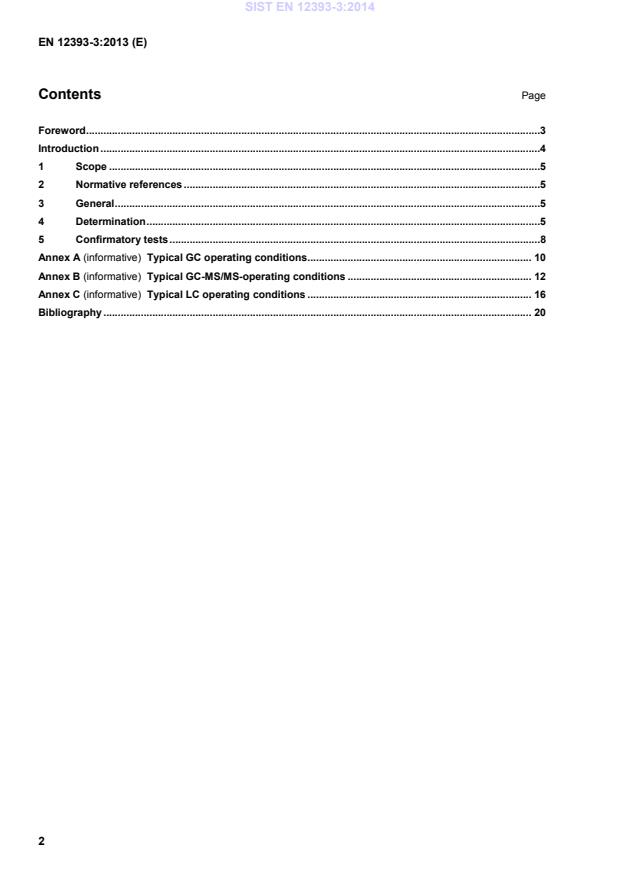
Typical GC operating conditions . 10 Annex B (informative)
Typical GC-MS/MS-operating conditions . 12 Annex C (informative)
Typical LC operating conditions . 16 Bibliography . 20
4.1.1 Identification A number of parameters can be employed to determine the identity of an analyte present in the sample extract. This includes:
a) retention time of the analyte in question (RT) or, even better, the retention time ratio against the ISTD (Rt(A)/Rt(ISTD)) obtained from the same run (the simultaneous use of columns of different polarity improves this type of identification);
b) in case of MS or MS/MS detection, the relative abundance of simultaneously recorded signals (in general 3 ions are required in MS applications and 2 SRM transitions in MS/MS);
c) the application of high resolution mass spectrometry;
d) in case of MS with electron impact ionisation the comparison of the full scan mass spectrum of a suspected peak (when indicated after subtraction of background) with spectral libraries; SIST EN 12393-3:2014
For more information about the required identification criteria, see [1]. 4.1.2 Quantification For quantification, a chromatographic system calibrated with an sufficient number of appropriately distributed calibration points has to be used. The precision of calibration has to fulfil minimum requirements. Make sure that all the measurements are performed within the calibrated range of the system. In exceptional cases only, single-level calibration may be used. It has to be checked that the response of analytes present in complex mixtures does not differ from the response of separate analytes. Mixtures of isomers, degradation products and derivatives of analytes may require special conditions during calibration. For calibration, either standards in solvents or standards prepared in blank matrix (matrix-matched standards) may be used. If matrix effects during GC injection or atmospheric pressure ionisation cannot be excluded, the use of matrix-matched standards or, even better, a quantification by standard addition has to be preferred. To detect instable detector response or such errors, which influence the amount of the analyte in the final extract, one or more internal standards should be added either to extracts or before extraction. To consider specific losses of individual analytes or their matrix effects, stable isotope labelled standards (if available) may be added to the sample before extraction.
All signals automatically identified by software tools may be considered as potential pesticide residues. However, any final quantification of relevant pesticide residues should be based on visual inspection of chromatograms. Before this European Standard can be used to quantify pesticides which are not tested before, a complete initial method validation is required. In all other cases, an on-going performance verification is sufficient to demonstrate the accuracy of the analytical method in a given laboratory.
For more information about the required quantification criteria, see [1] in its current version. 4.2 Gas chromatography (GC) 4.2.1 General The detectors (see EN 12393-1:2013, 3.4) should be properly adjusted, according to the manufacturers' instructions. Variations in detector sensitivity should be checked periodically by verifying the linearity of the calibration curves using standard solutions of pesticides. The measurement may be performed using various instruments, instrument parameters and columns. Some suitable instrument parameters and columns are listed in Annexes A and B.
For suitable experimental conditions of GC-MS measurement, see [2]. For suitable experimental conditions of GC-MS/MS measurement, see [3]. It has been found in practice that equivalent results can be achieved despite the adoption of different GC conditions, and different vendors of instruments. On the other hand, specifying standard GC parameters does not guarantee that the quality of the results generated will be identical. SIST EN 12393-3:2014
equivalent to SE-30, OV-1, OV-101, DB-1, SPB-1, BP-1, HP-1, ULTRA-1, RTx-1, AT-1, CPSil-5, etc. Methyl 5 % phenyl polysiloxane equivalent to SE-54, OV-23, DB-5, SPB-5, BP-5, HP-5MS, ULTRA 2, RTx-5, CPSil-8, VF-5ms, etc.
Methyl 50 % phenyl polysiloxane equivalent to OV-17, DB-17, SPB-7, BP-10, HP-17, RTx-17, AT-50, etc. 6 % Cyanopropylphenyl 94 % methyl polysiloxane equivalent to DB-1301, RTx-1301, HP-1301, etc. Methyl 7 % cyanopropyl 7 % phenyl polysiloxane equivalent to DB-1701, CPSil-19, RTx-1701, AT-1701 OV-1701, CP-SIL-19-CB, BP-10, SPB-7, etc. 50 % Cyanopropyl-phenyl 50 % dimethyl polysiloxane equivalent to SP-2330, CP-Sil 43 CB, OV-225, Rtx-225, BP-225, 007-225, etc.
Polyethylene glycol equivalent to DB-Wax, Supelcowax 10, Super-ox, CPWax-52, Stabilwax, BP-20, HP-20M, AT-Wax, etc.
4.2.3 Injection techniques Various injection techniques are useful such as split/splitless injection or programmed temperature vaporisation (PTV) injection. The applicability of these techniques depends on the apparatus used and on special requirements. 4.2.4 GC determination The measurement may be performed using various columns, instruments, acquisition parameters and GC detectors. Widely used specific detectors are electron capture (ECD), nitrogen-phosphorous (NPD) and flame photometric (FPD) detectors. Nowadays, GC is more often combined with single stage or tandem mass spectrometers (MS or MS/MS). Some instrument parameters and columns are listed in Annexes A and B.
Better selectivity than those obtained with specific detectors or GC-MS is offered by tandem mass spectrometric detection, which allows the selection of intense ions by the first mass filter and the observations of their fragments with the second mass filter.
4.3 Liquid chromatography with tandem-mass spectrometric detection (LC-MS/MS) 4.3.1 General The measurement may be performed using various instruments, instrument parameters and columns.
Some instrument parameters and columns are listed in Annex C.
Beside extensive tuning, the use of tandem mass spectrometry requires for each analyte a substantial set of instrument parameters. For suitable experimental conditions of LC-MS/MS
...
Questions, Comments and Discussion
Ask us and Technical Secretary will try to provide an answer. You can facilitate discussion about the standard in here.
Loading comments...