

oSIST prEN 10131:2027
(Main)Cold rolled uncoated and zinc or zinc-nickel electrolytically coated low carbon and high yield strength steel flat products for cold forming - Tolerances on dimensions and shape
- Abstract
This European Standard applies to cold rolled uncoated and electrolytically zinc or zinc-nickel coated low carbon and high yield strength steel flat products for cold forming with a minimum thickness of 0,35 mm and, unless otherwise agreed at the time of ordering, less than or equal to 3 mm thick, delivered in sheet, wide strip, slit wide strip or cut lengths obtained from slit wide strip or sheet. The concerned standards are EN 10130, EN 10152, EN 10271, EN 10209, EN 10268 and prEN 10338.
It does not apply to cold rolled strip (rolled width < 600 mm) or to flat cold rolled products for which there is a specific standard, in particular the following:
cold rolled non-grain oriented magnetic steel sheet and strip (EN 10106);
semi-processed steel strip for the construction of magnetic circuits (EN 10126 and 10165);
tinplate and ECCS (EN 10202);
blackplate in coils (EN 10205);
cold rolled uncoated non-alloy mild steel narrow strip for cold forming (EN 10139).
- Status
- Not Published
- Public Enquiry End Date
- 14-Jan-2027
- Technical Committee
- IFEK - Ferrous metals
- Current Stage
- 4020 - Public enquire (PE) (Adopted Project)
- Start Date
- 17-Nov-2026
- Due Date
- 06-Apr-2027

oSIST prEN 10131:2027 is SIST’s Slovenian publication of draft European Standard prEN 10131. It covers cold rolled uncoated and electrolytically zinc or zinc-nickel coated low carbon and high yield strength steel flat products for cold forming, and it specifies tolerances on dimensions and shape. The draft is under CEN enquiry and is intended for suppliers and purchasers who need to order, inspect, or accept sheet, wide strip, slit wide strip, and cut lengths against agreed dimensional limits.
What does oSIST prEN 10131:2027 specify?
oSIST prEN 10131:2027 specifies dimensional and shape tolerances for the flat products in its scope, together with the information that has to be supplied when ordering them. The document is structured around purchaser information, forms of supply, thickness, width, length, flatness, out-of-squareness, edge camber, and an alternative way to check sheet geometry.
The scope names related product standards such as EN 10130, EN 10152, EN 10271, EN 10268, EN 10209 and EN 10338. It also states that the tolerances can be used for non-standardized products and for other cold rolled steel flat products with metallic coatings applied in other continuous processes, except hot-dip coating.
| Annex | What it covers |
|---|---|
| Annex A | Thickness tolerances with only positive tolerances, used when the nominal thickness is treated as a minimum |
| Annex B | Thickness tolerances with only negative tolerances, used when the nominal thickness is treated as a maximum |
The main clauses run from Scope and Normative references through Terms and definitions, purchaser information, forms of supply, and the separate tolerance rules for thickness, width, length, flatness, out-of-squareness, edge camber, and superimposition of dimensions.
What are the key requirements of oSIST prEN 10131:2027?
oSIST prEN 10131:2027 turns ordering and inspection into a set of agreed dimensional checks. In practice, the buyer has to state the product form, size, and any special tolerance options up front, and the producer then supplies the material against the matching tolerance tables.
Ordering, designation and options
Clause 4 requires the order designation to state quantity, product type, reference to EN 10131, nominal thickness, nominal width, and nominal length for sheet and cut lengths. Clause 4 also allows specific options to be requested, identified by the symbols S, M, L, FS, CS, or by using Annex A or Annex B.
That matters because the standard does not assume every special tolerance automatically. If the order does not state an option, the product is supplied to the normal specification.
The designation has to be completed by the steel grade designation from the relevant product standard. The examples in Clause 4 show how the EN 10131 reference is combined with the steel designation and any tolerance symbols.
Thickness control
Clause 6 says thickness is measured along the length so that variation along the coil can be assessed. The document also gives measurement guidance: the measurement point should be more than 40 mm from the edges, and for very narrow slit coils or cut lengths the measurement is taken on the middle axis.
The thickness tolerance table is selected according to the specified minimum yield strength or proof strength of the steel grade and the nominal width. This matters because the allowed thickness variation changes with both strength level and width, so the wrong table gives the wrong acceptance limit.
Clause 6 also gives a dispute method. A sample sheet should be measured several times across the width, with edge distances depending on whether the edge is mill edge or trimmed or slit edge, and the measuring method should be agreed for adequate accuracy. A micrometer to EN ISO 3611 is given as an example.
Clauses 5.3 and 5.4 allow the parties to agree on transposed thickness tolerances, where only positive tolerances apply or only negative tolerances apply. Annex A and Annex B provide the corresponding shifted tolerance tables.
Width and length
Clause 7 measures width perpendicular to the longitudinal axis. Sheet and wide strip of width 600 mm and above use one set of tolerances, while slit wide strip and narrow sheet below 600 mm use another.
This distinction matters in production and receiving inspection because the acceptable width depends on both the supplied form and the width band. The document also allows mill edges, large tolerances, normal tolerances, or special tolerances depending on what is ordered.
Clause 8 measures length along one long side of the sheet or cut length. Length tolerances are given for all products covered by the document, with normal and special options.
Flatness and edge geometry
Clause 9 applies flatness tolerances to sheet only. If sheet is ordered non-skin passed, only the normal flatness tolerances apply. Flatness can be checked either against a horizontal surface or with a 1000 mm straightedge.
The flatness tables are grouped by strength class and nominal width, and the special flatness option is identified by FS. For the highest strength class, the flatness values are set by agreement at enquiry and order, so the buyer and producer have to fix the requirement before delivery.
Clause 10 limits out-of-squareness to 1 % of the actual sheet width. Clause 11 limits edge camber, measured on the concave edge, and gives a special CS option for slit wide strip below 600 mm, with a specific limitation that does not apply to high yield strength steels.
Clause 12 offers an alternative check: by agreement, the out-of-squareness and edge camber requirements can be replaced by the condition that a perfect rectangle of the ordered width and length can be superimposed on the delivered sheet. That is useful when the buyer wants a simple fit check instead of separate geometric measurements.
What terms does oSIST prEN 10131:2027 define?
oSIST prEN 10131:2027 defines the main product and geometry terms used in the tolerance rules.
- Nominal (specified) thickness - the ordered thickness of the coated or uncoated product; for coated products, it includes both steel core and coating.
- Wide strip - cold rolled steel flat products with a rolling width of 600 mm or more.
- Slit wide strip - cold rolled steel flat products with a rolling width of 600 mm or more that have been slit to a width below 1 200 mm.
- Special tolerances (S) - a requested tighter tolerance option for thickness, width, or length, depending on the clause.
- Flatness special tolerances (FS) - the special flatness option used for sheet when tighter flatness control is needed.
- Special edge camber tolerance (CS) - the special edge camber option for slit wide strip below 600 mm.
- Out-of-squareness - the orthogonal projection of the transverse edge over a longitudinal edge.
- Edge camber - the maximum distance between a longitudinal edge and a straight edge supported on that edge.
Who uses oSIST prEN 10131:2027?
oSIST prEN 10131:2027 is used by steel producers, service centres, buyers, and quality control staff who order or verify cold rolled flat products. It is also relevant to manufacturers of formed parts who need sheet, wide strip, slit wide strip, or cut lengths to arrive within agreed dimensional limits.
The standard is especially useful in procurement, incoming inspection, and contract review. It helps the parties agree what will be measured, how it will be measured, and which tolerance class applies before material is delivered.
What changed in oSIST prEN 10131:2027 from the previous edition?
oSIST prEN 10131:2027 supersedes EN 10131:2006.
Which standards are used with oSIST prEN 10131:2027?
oSIST prEN 10131:2027 uses EN 10079 for steel product definitions in Clause 3. The scope and bibliography also name the product standards that this tolerance document is used with:
- EN 10130 - cold rolled low carbon steel flat products for cold forming
- EN 10152 - electrolytically zinc coated cold rolled steel flat products for cold forming
- EN 10271 - electrolytically zinc-nickel coated steel flat products
- EN 10268:2006+A1 - cold rolled steel flat products with high yield strength for cold forming
- EN 10209 - cold rolled low carbon steel flat products for vitreous enamelling
- EN 10120 - steel sheet and strip for welded gas cylinders
- EN 10338 - hot rolled and cold rolled non-coated products of multiphase steels for cold forming
- EN ISO 3611 - micrometers for external measurements, cited as an example method for dispute measurements
These references matter because EN 10131 gives the dimensional tolerances, while the companion product standards define the steel grade and delivery condition being ordered.
What does the oSIST prEN 10131:2027 document contain?
oSIST prEN 10131:2027 contains the tolerance tables and the measurement rules needed to apply them. It includes tables for thickness by strength class and width, width tolerances for products above and below 600 mm, length tolerances, and flatness tolerances by yield strength band.
It also contains the transposed thickness tables in Annex A and Annex B, which are used when only positive or only negative thickness tolerances are agreed. Figure 1 illustrates out-of-squareness and edge camber, and Clause 4 includes examples of how to write the product designation on an order.
For practical use, the document gives the checking method as well as the limit values. That makes it suitable for ordering, receiving inspection, dispute resolution, and contract specification of cold rolled flat steel products.
Relations
- Effective Date
- 19-Jan-2023
Get Certified
Connect with accredited certification bodies for this standard

Element Materials Technology
Materials testing and product certification.

Inštitut za kovinske materiale in tehnologije
Institute of Metals and Technology. Materials testing, metallurgical analysis, NDT.
Sponsored listings
Frequently Asked Questions
oSIST prEN 10131:2027 is a draft published by the Slovenian Institute for Standardization (SIST). Its full title is "Cold rolled uncoated and zinc or zinc-nickel electrolytically coated low carbon and high yield strength steel flat products for cold forming - Tolerances on dimensions and shape". This standard covers: This European Standard applies to cold rolled uncoated and electrolytically zinc or zinc-nickel coated low carbon and high yield strength steel flat products for cold forming with a minimum thickness of 0,35 mm and, unless otherwise agreed at the time of ordering, less than or equal to 3 mm thick, delivered in sheet, wide strip, slit wide strip or cut lengths obtained from slit wide strip or sheet. The concerned standards are EN 10130, EN 10152, EN 10271, EN 10209, EN 10268 and prEN 10338. It does not apply to cold rolled strip (rolled width < 600 mm) or to flat cold rolled products for which there is a specific standard, in particular the following: cold rolled non-grain oriented magnetic steel sheet and strip (EN 10106); semi-processed steel strip for the construction of magnetic circuits (EN 10126 and 10165); tinplate and ECCS (EN 10202); blackplate in coils (EN 10205); cold rolled uncoated non-alloy mild steel narrow strip for cold forming (EN 10139).
This European Standard applies to cold rolled uncoated and electrolytically zinc or zinc-nickel coated low carbon and high yield strength steel flat products for cold forming with a minimum thickness of 0,35 mm and, unless otherwise agreed at the time of ordering, less than or equal to 3 mm thick, delivered in sheet, wide strip, slit wide strip or cut lengths obtained from slit wide strip or sheet. The concerned standards are EN 10130, EN 10152, EN 10271, EN 10209, EN 10268 and prEN 10338. It does not apply to cold rolled strip (rolled width < 600 mm) or to flat cold rolled products for which there is a specific standard, in particular the following: cold rolled non-grain oriented magnetic steel sheet and strip (EN 10106); semi-processed steel strip for the construction of magnetic circuits (EN 10126 and 10165); tinplate and ECCS (EN 10202); blackplate in coils (EN 10205); cold rolled uncoated non-alloy mild steel narrow strip for cold forming (EN 10139).
oSIST prEN 10131:2027 is classified under the following ICS (International Classification for Standards) categories: 77.140.50 - Flat steel products and semi-products. The ICS classification helps identify the subject area and facilitates finding related standards.
oSIST prEN 10131:2027 has the following relationships with other standards: It is inter standard links to SIST EN 10131:2006. Understanding these relationships helps ensure you are using the most current and applicable version of the standard.
oSIST prEN 10131:2027 is available in PDF format for immediate download after purchase. The document can be added to your cart and obtained through the secure checkout process. Digital delivery ensures instant access to the complete standard document.
Standards Content (Sample)
SLOVENSKI STANDARD
01-januar-2027
Hladno valjani ploščati proizvodi za hladno oblikovanje, neprevlečeni in pocinkani
ali prevlečeni s cink-nikljem, iz maloogljičnega jekla z veliko napetostjo tečenja -
Mejni odstopki mer in tolerance oblike
Cold rolled uncoated and zinc or zinc-nickel electrolytically coated low carbon and high
yield strength steel flat products for cold forming - Tolerances on dimensions and shape
Kaltgewalzte Flacherzeugnisse ohne Überzug und mit elektrolytischem Zink- oder Zink-
Nickel-Überzug aus weichen Stählen sowie aus Stählen mit höherer Streckgrenze zum
Kaltumformen - Grenzabmaße und Formtoleranzen
Produits plats laminés à froid, non revêtus ou revêtus de zinc ou de zinc-nickel par voie
électrolytique, en acier à bas carbone et en acier à haute limite d'élasticité pour formage
à froid - Tolérances sur les dimensions et sur la forme
Ta slovenski standard je istoveten z: prEN 10131
ICS:
77.140.50 Ploščati jekleni izdelki in Flat steel products and semi-
polizdelki products
2003-01.Slovenski inštitut za standardizacijo. Razmnoževanje celote ali delov tega standarda ni dovoljeno.
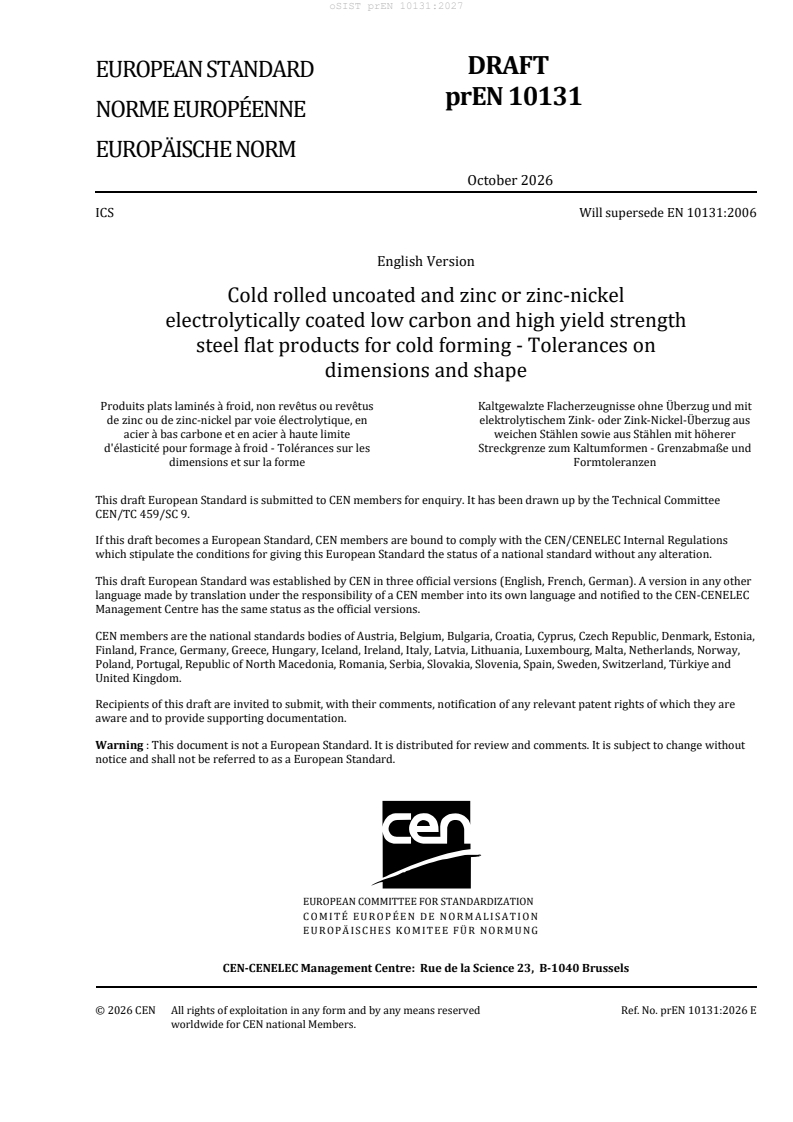
DRAFT
EUROPEAN STANDARD
NORME EUROPÉENNE
EUROPÄISCHE NORM
October 2026
ICS Will supersede EN 10131:2006
English Version
Cold rolled uncoated and zinc or zinc-nickel
electrolytically coated low carbon and high yield strength
steel flat products for cold forming - Tolerances on
dimensions and shape
Produits plats laminés à froid, non revêtus ou revêtus Kaltgewalzte Flacherzeugnisse ohne Überzug und mit
de zinc ou de zinc-nickel par voie électrolytique, en elektrolytischem Zink- oder Zink-Nickel-Überzug aus
acier à bas carbone et en acier à haute limite weichen Stählen sowie aus Stählen mit höherer
d'élasticité pour formage à froid - Tolérances sur les Streckgrenze zum Kaltumformen - Grenzabmaße und
dimensions et sur la forme Formtoleranzen
This draft European Standard is submitted to CEN members for enquiry. It has been drawn up by the Technical Committee
CEN/TC 459/SC 9.
If this draft becomes a European Standard, CEN members are bound to comply with the CEN/CENELEC Internal Regulations
which stipulate the conditions for giving this European Standard the status of a national standard without any alteration.
This draft European Standard was established by CEN in three official versions (English, French, German). A version in any other
language made by translation under the responsibility of a CEN member into its own language and notified to the CEN-CENELEC
Management Centre has the same status as the official versions.
CEN members are the national standards bodies of Austria, Belgium, Bulgaria, Croatia, Cyprus, Czech Republic, Denmark, Estonia,
Finland, France, Germany, Greece, Hungary, Iceland, Ireland, Italy, Latvia, Lithuania, Luxembourg, Malta, Netherlands, Norway,
Poland, Portugal, Republic of North Macedonia, Romania, Serbia, Slovakia, Slovenia, Spain, Sweden, Switzerland, Türkiye and
United Kingdom.
Recipients of this draft are invited to submit, with their comments, notification of any relevant patent rights of which they are
aware and to provide supporting documentation.
Warning : This document is not a European Standard. It is distributed for review and comments. It is subject to change without
notice and shall not be referred to as a European Standard.
EUROPEAN COMMITTEE FOR STANDARDIZATION
COMITÉ EUROPÉEN DE NORMALISATION
EUROPÄISCHES KOMITEE FÜR NORMUNG
CEN-CENELEC Management Centre: Rue de la Science 23, B-1040 Brussels
© 2026 CEN All rights of exploitation in any form and by any means reserved Ref. No. prEN 10131:2026 E
worldwide for CEN national Members.
Page
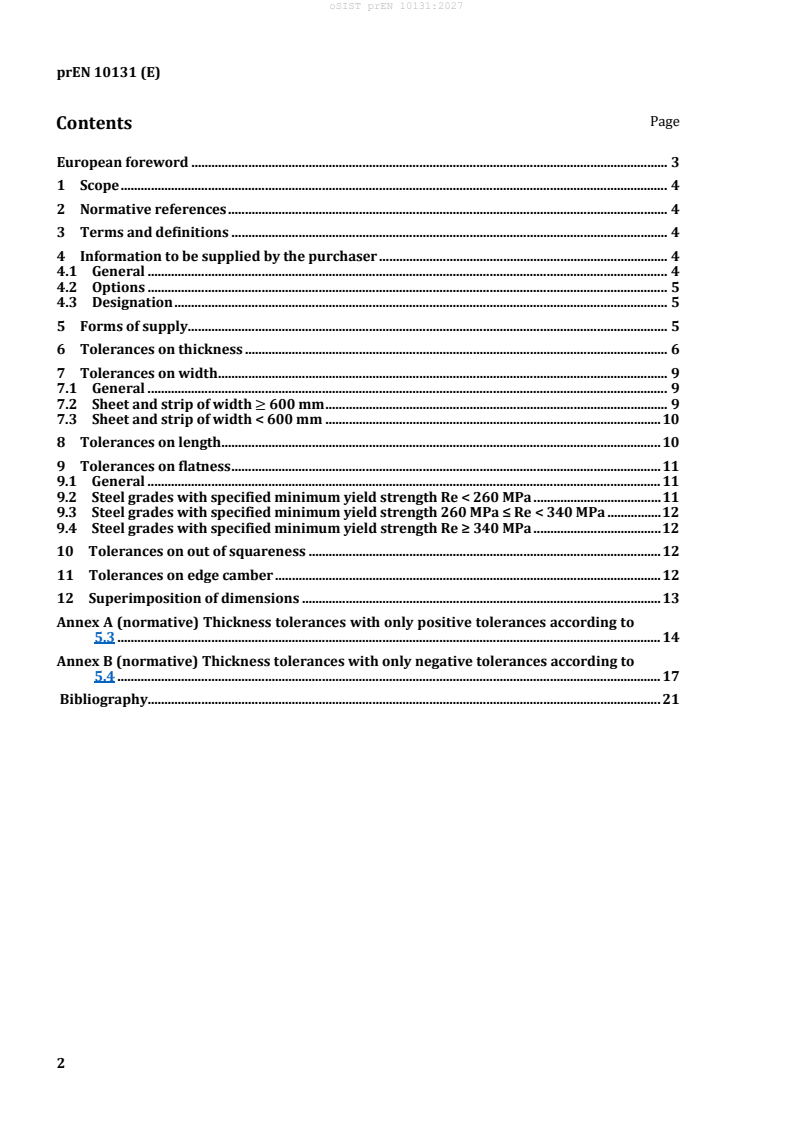
Contents
European foreword . 3
1 Scope . 4
2 Normative references . 4
3 Terms and definitions . 4
4 Information to be supplied by the purchaser . 4
4.1 General . 4
4.2 Options . 5
4.3 Designation . 5
5 Forms of supply . 5
6 Tolerances on thickness . 6
7 Tolerances on width . 9
7.1 General . 9
7.2 Sheet and strip of width ≥ 600 mm . 9
7.3 Sheet and strip of width < 600 mm . 10
8 Tolerances on length . 10
9 Tolerances on flatness . 11
9.1 General . 11
9.2 Steel grades with specified minimum yield strength Re < 260 MPa . 11
9.3 Steel grades with specified minimum yield strength 260 MPa ≤ Re < 340 MPa . 12
9.4 Steel grades with specified minimum yield strength Re ≥ 340 MPa . 12
10 Tolerances on out of squareness . 12
11 Tolerances on edge camber . 12
12 Superimposition of dimensions . 13
Annex A (normative) Thickness tolerances with only positive tolerances according to
5.3 . 14
Annex B (normative) Thickness tolerances with only negative tolerances according to
5.4 . 17
Bibliography. 21
European foreword
This document (prEN 10131:202X) has been prepared by Technical Committee CEN/TC 459/SC 9
"Coated and uncoated flat products to be used for cold forming", the secretariat of which is held by
AFNOR.
This document is currently submitted to the CEN Enquiry.
This document will supersede EN 10131:2006.
1 Scope
This document applies to cold rolled uncoated and electrolytically zinc or zinc-nickel coated low carbon
steel products, steel products with high yield strength steel, low carbon steel flat products for vitreous
enamelling, sheet and strip for welded gas cylinders and multiphase steel flat products for cold forming
with a minimum thickness of 0,20 mm and, unless otherwise agreed at the time of ordering, less than or
equal to 3 mm thick, delivered in sheet, wide strip , slit wide strip or cut lengths obtained from slit wide
strip or sheet. The concerned standards are EN 10130 [1], EN 10152 [2], EN 10271 [3], EN
10268:2006+A1 [4], EN 10209 [5] and cold rolled products in EN 10120 [6] and EN 10338 [7].
The tolerances of this document can also be used for deliveries of non-standardized products.
It also applies to other cold rolled steel flat products with metallic coatings applied in other continuous
processes, e.g. jet vapour deposition, except for hot-dip coating.
2 Normative references
The following documents are referred to in the text in such a way that some or all of their content
constitutes requirements of this document. For dated references, only the edition cited applies. For
undated references, the latest edition of the referenced document (including any amendments) applies.
EN 10079, Definition of steel products
3 Terms and definitions
For the purposes of this document, the following terms and definitions given in EN 10079 and the
following apply.
• ISO Online browsing platform: available at http://www.iso.org/obp
• IEC Electropedia: available at http://www.electropedia.org/
3.1
nominal (specified) thickness
ordered thickness of the coated or uncoated product
Note 1 to entry: In the case of coated products, nominal thickness includes steel core and coating.
3.2
wide strip
cold rolled steel flat products with a rolling width ≥ 600 mm
3.3
slit wide strip
cold rolled steel flat products with a rolling width ≥ 600 mm, slit to a width less than 1 200 mm
4 Information to be supplied by the purchaser
4.1 General
Products related to this document shall be designated in the following order (see also Clause 5):
a) quantity to be delivered;
b) type of product (sheet, wide strip (3.2) , slit wide strip (3.3) or cut length);
c) reference to this document i.e. EN 10131;
d) nominal thickness (3.1) in millimetres;
e) nominal width in millimetres;
f) nominal length in millimetres (sheets and cut lengths only);
4.2 Options
A number of options are specified in this document and listed below. If the purchaser does not indicate
the wish to implement any of these options, the products shall be supplied in accordance with the
normal specification of this document (see 4.1 and 5.1 ).
a) whether the products are to be supplied with special tolerances on thickness, add letter S (see
Clause 6 )
b) whether the products are to be supplied with: - mill edges tolerances on width, add letter M, -
large tolerances on width, add letter L, - special tolerances on width, add letter S (see Clause 7 );
c) whether the products are to be supplied with special tolerances on length (sheets and cut lengths
only), add letter S (see Clause 8);
d) whether the products are to be supplied with special tolerances on flatness, add symbol FS (see
Clause 9);
e) whether the products are to be supplied with special tolerances on camber, add symbol CS (see
Clause 11);
f) whether the products are to be supplied with transposed tolerances in accordance with Annex A
or Annex B .
4.3 Designation
The product designation in accordance with 4.1 and 4.2 shall be followed by the complete designation
of the steel ordered (e.g. according to EN 10130 [1] ).
EXAMPLE 1 100 tonnes of wide strip (3.2) according to this document of nominal thickness (3.1) 1,20 mm,
nominal width of 1 500 mm in steel DC04-A-m as specified in EN 10130 [1] :
100 t wide strip (3.2) EN 10131-1,20x1500
Steel EN 10130 [1] -DC04-A-m
EXAMPLE 2 50 sheets according to this document of nominal thickness (3.1) 0,80 mm ordered with special
thickness tolerance (S), nominal width of 1 200 mm with special tolerances on width (S), nominal length of 2 500
mm and with special tolerances on flatness (FS) in steel DC06-B-g as specified in EN 10130 [1] :
50 sheets EN 10131-0,80Sx1200Sx2500FS
Steel EN 10130 [1] -DC06-B-g
EXAMPLE 3 30 tonnes of wide strip (3.2) according to this document of nominal thickness (3.1) 0,80 mm
ordered with transposed tolerances on the positive side, nominal width of 1000 mm with large tolerances on width
(L) in steel HC340LA as specified in EN 10268:2006+A1 [4] :
30 t wide strip (3.2) EN 10131 0,80x1000L with thickness tolerances from Annex A
Steel EN 10268:2006+A1 [4] -HC340LA
5 Forms of supply
5.1 Flat products according to this document may be delivered as follows:
a) with normal or special thickness tolerances (see Table 1, Table 2, Table 3 and Table 4);
b) with mill edges, large, normal or special width tolerances (see Table 5 and Table 6);
c) with normal or special length tolerances for sheet or cut lengths (see Table 7);
d) with normal or special flatness tolerances for sheet or cut lengths (see Table 8 and Table 9);
e) with normal or special tolerances on camber for slit strip of width less than 600 mm (see Clause
11).
5.2 In the absence of information on the order in respect of the condition of delivery given in 5.1 the
flat products shall be delivered with normal tolerances on thickness, width, length, flatness and camber.
5.3 Whether the minimum thickness of the product shall be the nominal thickness (3.1) and the full
range of the thickness tolerance from Table 1, Table 2, Table 3 and Table 4 (transposition of tolerances)
shall be valid only as a positive tolerance, manufacturer and purchaser may agree that only positive
thickness tolerances apply. These transposed thickness tolerances are given in Annex A, see Table A.1,
Table A.2, Table A.3 and Table A.4 .
5.4 Whether the maximal thickness of the product shall be the nominal thickness (3.1) and the full
range of the thickness tolerance from Table 1, Table 2, Table 3 and Table 4 (transposition of tolerances)
shall be valid only as a negative tolerance, manufacturer and purchaser may agree that only negative
thickness tolerances apply. These transposed thickness tolerances are given inAnnex B, see .Table B.1 ,
Table B.2 , Table B.3 and Table B.4
6 Tolerances on thickness
The thickness shall be measured along the length so that its variation along the coil can be determined.
Thickness variation over the strip width is controlled by restricting the thickness profile of hot rolled
strip.
NOTE 1 There are two examples for used measurement methods for measuring the thickness of steel strip:
- Radio absorption measurement (X-ray or Isotope) determines the mass per surface area via radiation absorption
and calculates the thickness using the material density. Characteristics of these measurement methods include:
high accuracy, suitability for closed-loop control systems, works well with oil/emulsion or coatings, and high strip
speed. For a stable measurement, the variation in the source's strength over time and the dependence of
absorption depends on the steel type. Regular calibration of the measurement with calibration plates exists.
- Laser optical thickness measurement measures geometric distance between the top and bottom of the strip using
laser triangulation This measurement is characterized by: high resolution, sensitive to vibrations/oil, especially
suitable for thin strip/foil, often applied near finishing or coating lines.
The position of the measurement shall be located more than 40 mm from the edges.
In the case of slit coils or cut lengths having a width of 80 mm or below, the position of the measurement
shall be at the middle axis.
The tolerances on thickness shall be as given in Table 1, Table 2, Table 3 and Table 4 and apply over the
whole length.
The correct Table 1, Table 2, Table 3 or Table 4 shall be selected in accordance with the specified
minimum yield strength or proof strength of the steel grade in question.
NOTE 2 Depending on the steel grade, the material can show a pronounced yield phenomenon and have a
yield strength or it is characterized by a proof strength.
The thickness tolerances of steel grades in EN 10130 [1] and EN 10152 [2] are specified in Table 1 .
Tolerances tighter than special tolerances may be agreed at the time of enquiry and order.
In the event of a dispute, a sample sheet should be measured at least three times across the width of the
strip. The minimum distance from the edge should be at least 40 mm for mill edges and at least 25 mm
for trimmed/slit edges. A method with sufficient accuracy, relative to the thickness tolerance of the
supplied strip, shall be agreed between manufacturer and customer. As example, a micrometer can be
used for this purpose (See EN ISO 3611 [8] ).
Table 1 — Tolerances on thickness for steel grades with a specified minimum yield strength R
e
a
< 260 MPa
Dimensions in millimetres
b b
nominal Normal tolerances for a nominal width w Special tolerances (S) for a nominal width w
thickness
(3.1)
≤ 1 200 > 1 200 to ≤ > 1 500 ≤ 1 200 > 1 200 to ≤ > 1 500
1 500 1 500
= 0,20 to ± 0,03 ± 0,04 ± 0,05 ± 0,020 ± 0,025 ± 0,030
0,40
> 0,40 to ± 0,03 ± 0,04 ± 0,05 ± 0,025 ± 0,030 ± 0,035
0,60
> 0,60 to ± 0,04 ± 0,05 ± 0,06 ± 0,030 ± 0,035 ± 0,040
0,80
> 0,80 to ± 0,05 ± 0,06 ± 0,07 ± 0,035 ± 0,040 ± 0,050
1,00
> 1,00 to ± 0,06 ± 0,07 ± 0,08 ± 0,040 ± 0,050 ± 0,060
1,20
> 1,20 to ± 0,08 ± 0,09 ± 0,10 ± 0,050 ± 0,060 ± 0,070
1,60
> 1,60 to ± 0,10 ± 0,11 ± 0,12 ± 0,060 ± 0,070 ± 0,080
2,00
> 2,00 to ± 0,12 ± 0,13 ± 0,14 ± 0,080 ± 0,090 ± 0,100
2,50
> 2,50 to ± 0,15 ± 0,15 ± 0,16 ± 0,100 ± 0,110 ± 0,120
3,00
a 2
1 MPa = 1 N/mm
b
The thickness tolerances in the region of cold rolled welds may be increased by a maximum of 50 % over
a length of 10 metres. This increase is applicable to all thicknesses and, unless otherwise agreed at the time of
enquiry and order, to normal and special tolerances over or under.
Table 2 — Tolerances on thickness for steel grades with a specified minimum yield strength
a
260 MPa ≤ R < 340 MPa
e
Dimensions in millimetres
b b
nominal Normal tolerances for a nominal width w Special tolerances (S) for a nominal width w
thickness
(3.1)
≤ 1 200 > 1 200 to ≤ > 1 500 ≤ 1 200 > 1 200 to ≤ > 1 500
1 500 1 500
= 0,20 to ± 0,04 ± 0,05 ± 0,06 ± 0,025 ± 0,030 ± 0,035
0,40
> 0,40 to ± 0,04 ± 0,05 ± 0,06 ± 0,030 ± 0,035 ± 0,040
0,60
> 0,60 to ± 0,05 ± 0,06 ± 0,07 ± 0,035 ± 0,040 ± 0,050
0,80
> 0,80 to ± 0,06 ± 0,07 ± 0,08 ± 0,040 ± 0,050 ± 0,060
1,00
> 1,00 to ± 0,07 ± 0,08 ± 0,10 ± 0,050 ± 0,060 ± 0,070
1,20
> 1,20 to ± 0,09 ± 0,11 ± 0,12 ± 0,060 ± 0,070 ± 0,080
1,60
> 1,60 to ± 0,12 ± 0,13 ± 0,14 ± 0,070 ± 0,080 ± 0,100
2,00
> 2,00 to ± 0,14 ± 0,15 ± 0,16 ± 0,100 ± 0,110 ± 0,120
2,50
> 2,50 to ± 0,17 ± 0,18 ± 0,18 ± 0,120 ± 0,130 ± 0,140
3,00
a 2
1 MPa = 1 N/mm
b
The thickness tolerances in the region of cold rolled welds may be increased by a maximum of 50 % over
a length of 10 metres. This increase is applicable to all thicknesses and, unless otherwise agreed at the time of
enquiry and order, to normal and special tolerances over or under.
Table 3 — Tolerances on thickness for steel grades with a specified minimum yield strength
a
340 MPa ≤ R < 420 MPa
e
Dimensions in millimetres
b b
nominal Normal tolerances for a nominal width w Special tolerances (S) for a nominal width w
thickness
(3.1)
≤ 1 200 > 1 200 to ≤ > 1 500 ≤ 1 200 > 1 200 to ≤ > 1 500
1 500 1 500
= 0,35 to ± 0,04 ± 0,05 ± 0,
...