


SIST EN 50128:2011/A2:2020
(Amendment)Railway applications - Communication, signalling and processing systems - Software for railway control and protection systems
Railway applications - Communication, signalling and processing systems - Software for railway control and protection systems
Unchanged with respect to the current edition EN 50128:2011.
Scope of the amendment:
- Alignment with EN 50126-1:2017, EN 50126-2:2017 and EN 50129:2018 together with minor corrections
Bahnanwendungen - Telekommunikationstechnik, Signaltechnik und Datenverarbeitungssysteme - Software für Eisenbahnsteuerungs- und Überwachungssysteme
Applications ferroviaires - Systèmes de signalisation, de télécommunication et de traitement - Logiciels pour systèmes de commande et de protection ferroviaire
Železniške naprave - Komunikacijski, signalni in procesni sistemi - Programska oprema za železniške krmilne in zaščitne sisteme - Dopolnilo A2
General Information
- Status
- Published
- Public Enquiry End Date
- 29-Jun-2019
- Publication Date
- 06-Sep-2020
- Technical Committee
- ŽEN - Electrical applications for railways
- Current Stage
- 6060 - National Implementation/Publication (Adopted Project)
- Start Date
- 10-Aug-2020
- Due Date
- 15-Oct-2020
- Completion Date
- 07-Sep-2020
Relations
- Effective Date
- 17-Sep-2018
- Effective Date
- 01-Mar-2024
Overview
EN 50128:2011/A2:2020 is a CENELEC amendment for software used in railway control and protection systems. It maintains the original EN 50128:2011 scope while aligning terminology, definitions and requirements with EN 50126-1:2017, EN 50126-2:2017 and EN 50129:2018. The amendment clarifies lifecycle activities (verification, validation, assessment, quality assurance), updates tool and language guidance, and introduces the concept of Basic Integrity in place of SIL 0.
Key topics and technical requirements
- Scope and alignment: Amendment brings EN 50128 into conformity with EN 50126-1/2 and EN 50129, and corrects technical ambiguities.
- Terminology updates: Definitions for error, fault, failure, safety-related software, validation and verification have been revised for consistency with RAMS terminology.
- Basic Integrity: All references to SIL 0 are replaced by Basic Integrity, and software with safety impact below SIL 1 must meet Basic Integrity requirements.
- Lifecycle documentation: New/updated outputs and plans are emphasized, including the Software Planning Verification Report, Software Quality Assurance Plan, Software Configuration Management Plan, Software Verification/Validation Plans and Software Maintenance Plan.
- Verification & validation: Verifier and Validator roles are clarified (independence expectations; Validator may also act as Verifier but outputs must be reviewed by another competent person). Validation output reporting requirements were simplified.
- Software assessment & QA: Independent safety assessment concept is reinforced; some verification/assessment report items were removed or restructured to match the updated approach.
- Support tools and languages: Stronger guidance for tool qualification (class T3 tools). Evidence for tool trustworthiness can include history of successful use, tool validation, tool diversity, compliance with derived integrity levels, or equivalent mitigations.
- FPGA/CPLD guidance: For user-programmable integrated circuits, this amendment points to EN 50129:2018 Annex F for guidance.
Applications and users
This standard is intended for organizations involved in the railway software lifecycle:
- Railway system integrators and signalling suppliers
- Software developers and architects for train control and protection systems
- Safety managers, independent assessors and quality assurance teams
- National safety authorities and project managers overseeing RAMS compliance
Practical uses include setting software lifecycle processes, tool qualification strategies, defining verification/validation responsibilities, and preparing documentation for safety approval.
Related standards
- EN 50126-1:2017 (RAMS – Generic RAMS Process)
- EN 50126-2:2017 (RAMS – Systems Approach to Safety)
- EN 50129:2018 (Safety related electronic systems for signalling)
- ISO/IEC and ISO 9000/9001 series referenced for quality management and software engineering guidance
Keywords: EN 50128, railway software standard, Basic Integrity, software verification, software validation, RAMS, EN 50126, EN 50129, signalling software, tool validation, FPGA guidance.

Frequently Asked Questions
SIST EN 50128:2011/A2:2020 is a amendment published by the Slovenian Institute for Standardization (SIST). Its full title is "Railway applications - Communication, signalling and processing systems - Software for railway control and protection systems". This standard covers: Unchanged with respect to the current edition EN 50128:2011. Scope of the amendment: - Alignment with EN 50126-1:2017, EN 50126-2:2017 and EN 50129:2018 together with minor corrections
Unchanged with respect to the current edition EN 50128:2011. Scope of the amendment: - Alignment with EN 50126-1:2017, EN 50126-2:2017 and EN 50129:2018 together with minor corrections
SIST EN 50128:2011/A2:2020 is classified under the following ICS (International Classification for Standards) categories: 35.240.60 - IT applications in transport; 45.020 - Railway engineering in general. The ICS classification helps identify the subject area and facilitates finding related standards.
SIST EN 50128:2011/A2:2020 has the following relationships with other standards: It is inter standard links to SIST EN 50128:2011, SIST EN 50716:2024. Understanding these relationships helps ensure you are using the most current and applicable version of the standard.
SIST EN 50128:2011/A2:2020 is associated with the following European legislation: EU Directives/Regulations: 2008/57/EC, 2016/797/EU; Standardization Mandates: M/483. When a standard is cited in the Official Journal of the European Union, products manufactured in conformity with it benefit from a presumption of conformity with the essential requirements of the corresponding EU directive or regulation.
SIST EN 50128:2011/A2:2020 is available in PDF format for immediate download after purchase. The document can be added to your cart and obtained through the secure checkout process. Digital delivery ensures instant access to the complete standard document.
Standards Content (Sample)
SLOVENSKI STANDARD
01-oktober-2020
Železniške naprave - Komunikacijski, signalni in procesni sistemi - Programska
oprema za železniške krmilne in zaščitne sisteme - Dopolnilo A2
Railway applications - Communication, signalling and processing systems - Software for
railway control and protection systems
Bahnanwendungen - Telekommunikationstechnik, Signaltechnik und
Datenverarbeitungssysteme - Software für Eisenbahnsteuerungs- und
Überwachungssysteme
Applications ferroviaires - Systèmes de signalisation, de télécommunication et de
traitement - Logiciels pour systèmes de commande et de protection ferroviaire
Ta slovenski standard je istoveten z: EN 50128:2011/A2:2020
ICS:
35.240.60 Uporabniške rešitve IT v IT applications in transport
prometu
45.020 Železniška tehnika na Railway engineering in
splošno general
2003-01.Slovenski inštitut za standardizacijo. Razmnoževanje celote ali delov tega standarda ni dovoljeno.
EUROPEAN STANDARD EN 50128:2011/A2
NORME EUROPÉENNE
EUROPÄISCHE NORM
July 2020
ICS 35.240.60; 45.020; 93.100
English Version
Railway applications - Communication, signalling and processing
systems - Software for railway control and protection systems
Applications ferroviaires - Systèmes de signalisation, de Bahnanwendungen - Telekommunikationstechnik,
télécommunication et de traitement - Logiciels pour Signaltechnik und Datenverarbeitungssysteme - Software
systèmes de commande et de protection ferroviaire für Eisenbahnsteuerungs- und Überwachungssysteme
This amendment A2 modifies the European Standard EN 50128:2011; it was approved by CENELEC on 2020-06-22. CENELEC members
are bound to comply with the CEN/CENELEC Internal Regulations which stipulate the conditions for giving this amendment the status of a
national standard without any alteration.
Up-to-date lists and bibliographical references concerning such national standards may be obtained on application to the CEN-CENELEC
Management Centre or to any CENELEC member.
This amendment exists in three official versions (English, French, German). A version in any other language made by translation under the
responsibility of a CENELEC member into its own language and notified to the CEN-CENELEC Management Centre has the same status as
the official versions.
CENELEC members are the national electrotechnical committees of Austria, Belgium, Bulgaria, Croatia, Cyprus, the Czech Republic,
Denmark, Estonia, Finland, France, Germany, Greece, Hungary, Iceland, Ireland, Italy, Latvia, Lithuania, Luxembourg, Malta, the
Netherlands, Norway, Poland, Portugal, Republic of North Macedonia, Romania, Serbia, Slovakia, Slovenia, Spain, Sweden, Switzerland,
Turkey and the United Kingdom.
European Committee for Electrotechnical Standardization
Comité Européen de Normalisation Electrotechnique
Europäisches Komitee für Elektrotechnische Normung
CEN-CENELEC Management Centre: Rue de la Science 23, B-1040 Brussels
© 2020 CENELEC All rights of exploitation in any form and by any means reserved worldwide for CENELEC Members.
Ref. No. EN 50128:2011/A2:2020 E
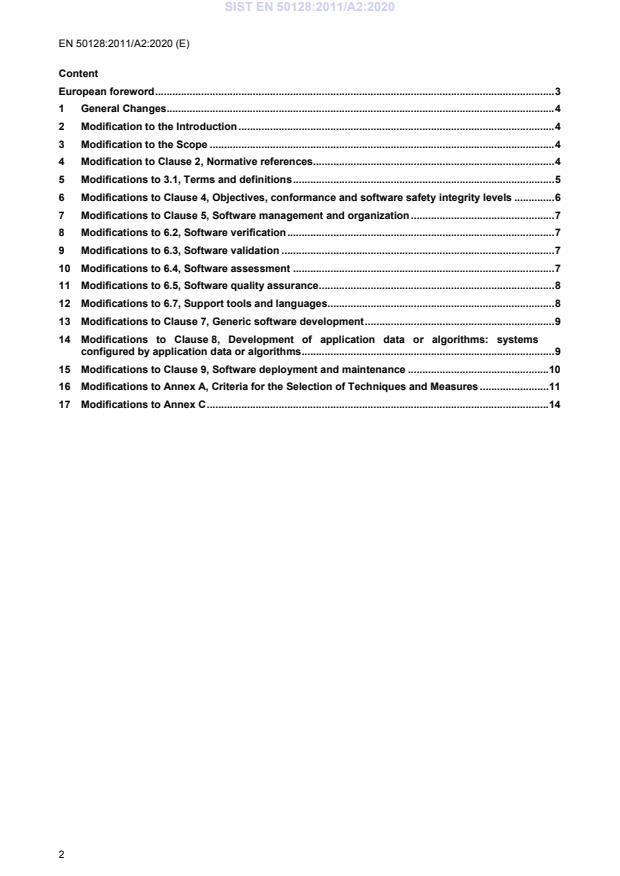
Content
European foreword . 3
1 General Changes. 4
2 Modification to the Introduction . 4
3 Modification to the Scope . 4
4 Modification to Clause 2, Normative references . 4
5 Modifications to 3.1, Terms and definitions . 5
6 Modifications to Clause 4, Objectives, conformance and software safety integrity levels . 6
7 Modifications to Clause 5, Software management and organization . 7
8 Modifications to 6.2, Software verification . 7
9 Modifications to 6.3, Software validation . 7
10 Modifications to 6.4, Software assessment . 7
11 Modifications to 6.5, Software quality assurance . 8
12 Modifications to 6.7, Support tools and languages. 8
13 Modifications to Clause 7, Generic software development . 9
14 Modifications to Clause 8, Development of application data or algorithms: systems
configured by application data or algorithms . 9
15 Modifications to Clause 9, Software deployment and maintenance . 10
16 Modifications to Annex A, Criteria for the Selection of Techniques and Measures . 11
17 Modifications to Annex C . 14
European foreword
This document (EN 50128:2011/A2:2020) has been prepared by SC 9XA, “Communication, signalling and
processing systems”, of Technical Committee CENELEC TC 9X, “Electrical and electronic applications for
railways”.
The following dates are fixed:
• latest date by which this document has to be (dop) 2021-06-22
implemented at national level by publication of
an identical national standard or by
endorsement
• latest date by which the national standards (dow) 2023-06-22
conflicting with this document have to be
withdrawn
The EN 50128:2011 standard was amended to align with EN 50126-1:2017, EN 50126-2:2017 and
EN 50129:2018. In addition, some technical mistakes were corrected and some clarifications were added.
This European Standard should be read in conjunction with EN 50126-1:2017 “Railway applications –
The specification and demonstration of Reliability, Availability, Maintainability and Safety (RAMS) – Part 1:
Generic RAMS Process”, EN 50126-2:2017 “Railway applications – The specification and demonstration of
Reliability, Availability, Maintainability and Safety (RAMS) – Part 2: Systems Approach to Safety” and
EN 50129:2018 “Railway applications – Communication, signalling and processing systems – Safety related
electronic systems for signalling”.
1 General Changes
All occurrences of SIL 0 within EN 50128:2011 are replaced with Basic Integrity (EN 50126-1:2017, 3.7).
All occurrences of safety function(s) are replaced with safety-related function(s).
Use of the term “EN 50126-1” is replaced by “EN 50126-1 and EN 50126-2”.
The term “assessment” in the standard means “independent safety assessment” as per definition of
EN 50126-1:2017, 3.33.
All statements qualified by the words “software safety integrity level” are applicable also to Basic Integrity.
2 Modification to the Introduction
The following paragraph is added at the end of the Introduction:
This European Standard does not specify the requirements for the development, implementation,
maintenance and/or operation of security policies or security services needed to meet security requirements
that may be needed by the safety-related system. IT security can affect not only the operation but also the
functional safety of a system. For IT security, appropriate IT security standards should be applied.
NOTE IEC/ISO standards that address IT security in depth are ISO 27000 series, ISO/IEC TR 19791 and the
IEC 62443 series.
3 Modification to the Scope
The following subclause 1.10 is added:
1.10 For the development of User Programmable Integrated Circuits (e.g. FPGA and CPLD) guidance is
provided in EN 50129:2018, Annex F.
4 Modification to Clause 2, Normative references
Replace the list of normative references by the following:
EN 50126-1:2017, Railway applications – The specification and demonstration of Reliability, Availability,
Maintainability and Safety (RAMS) – Part 1: Generic RAMS Process
EN 50126-2:2017, Railway applications – The specification and demonstration of Reliability, Availability,
Maintainability and Safety (RAMS) – Part 2: Systems Approach to Safety
EN 50129:2018, Railway applications – Communication, signalling and processing systems – Safety related
electronic systems for signalling
EN ISO 9000:2015, Quality management systems – Fundamentals and vocabulary
EN ISO 9001:2015, Quality management systems – Requirements
ISO/IEC 90003:2014, Software engineering – Guidelines for the application of ISO 9001 to computer
software
ISO/IEC 25000 series, Systems and software engineering – Systems and software Quality Requirements
and Evaluation
5 Modifications to 3.1, Terms and definitions
Replace 3.1.9 (deleted) with:
3.1.51
error,
defect, mistake or inaccuracy that could result in a deviation from the intended performance or behaviour of
the software
Note 1 to entry: definition is derived from EN 50126-1:2017, 3.20 and adapted for software (caused by systematic fault,
e.g. human error, in line with EN 50126-1:2017 3.20 Note 2).
3.1.52
fault
abnormal condition that could lead to an error in a system
Note 1 to entry: A fault in software is systematic.
[SOURCE: IEC 60050-821:2017, 821-11-20, modified – The note 1 to entry has been modified.]
Replace 3.1.10 with:
3.1.10
failure,
loss of ability to perform as required
Note 1 to entry: “Failure” is an event, as distinguished from “fault”, which is a state.
[SOURCE: IEC 60050-821:2017, 821-11-19, modified – The notes 1 and 2 have been omitted. A new note 1
to entry has been added.]
Replace 3.1.17 with:
3.1.17
pre-existing software
software developed prior to the application currently in question
Note 1 to entry: This includes commercial off-the-shelf software, open-source software and software previously
developed but not in accordance with this European Standard.
[SOURCE: EN 50126-1:2017, 3.43, modified – The end of the definition has been moved to the note 1 to
entry.]
Definition 3.1.26 replaced by:
3.1.26
risk,
combination of expected frequency of loss and the expected degree of severity of that loss
[SOURCE: EN 50126-1:2017, 3.57]
Definition 3.1.27 replaced by:
3.1.27
safety
freedom from unacceptable risk
[SOURCE: IEC 60050-903:2013, 903-01-19]
Definition 3.1.28 replaced by:
3.1.28
safety authority
body responsible for delivering the authorization for the operation of the safety-related system
[SOURCE: IEC 60050-821:2017, 821-12-52]
Remove the term 3.1.29 and its definition (see also General Changes).
Definition 3.1.30 replaced by:
3.1.30
safety-related software
software which performs safety-related functions
[SOURCE: IEC 60050-821:2017, 821-12-60, modified – “safety functions” has been replaced with “safety-
related functions”.]
Definition 3.1.46 replaced by:
3.1.46
validation
confirmation, through the provision of objective evidence, that the requirements for a specific intended use or
application have been fulfilled
Note 1 to entry: The term “validated” is used to designate the corresponding status.
Note 2 to entry: The use conditions for validation can be real or simulated.
Note 3 to entry: In design and development, validation concerns the process of examining an item to determine
conformity with user needs.
Note 4 to entry: intentionally deleted
Note 5 to entry: Multiple validations can be carried out if there are different intended uses.
[SOURCE: IEC 60050-192:2015, 192-01-18, modified – The note 4 is not relevant for software]
Definition 3.1.48 replaced by:
3.1.48
verification
confirmation, through the provision of objective evidence, that specified requirements have been fulfilled
Note 1 to entry: The term “verified” is used to designate the corresponding status.
Note 2 to entry: Design verification is the application of tests and appraisals to assess conformity of a design to the
specified requirement.
Note 3 to entry: Verification is conducted at various life cycle phases of development, examining the system and its
constituents to determine conformity to the requirements specified at the beginning of that life cycle phase.
[SOURCE: IEC 60050-192:2015, 192-01-17, modified – The note 3 to entry has been modified.]
Add the following 3.1.50 (in line with EN 50126-1):
3.1.50
safety-related
carries responsibility for safety
[SOURCE: IEC 60050-821:2017, 821-01-73]
6 Modifications to Clause 4, Objectives, conformance and software safety integrity
levels
4.4 is replaced by:
4.4 At least the Basic Integrity requirements of this European Standard shall be fulfilled for the software part
of functions that have a safety impact below SIL 1.
NOTE Basic Integrity requirements can also be used for development of non safety-related software.
7 Modifications to Clause 5, Software management and organization
In 5.1.2.10 bullet n) replace as follows:
n) A person who is Validator may also perform the role of Verifier, but still maintaining independence from
the Project Manager. In this case, as for all other development activities, the Validator/Verifier outputs
shall be reviewed by another competent person.
In 5.1.2.11 bullet m) replace as follows:
m) A person who is Validator may also perform the role of Verifier, Integrator and Tester. In this case, as for
all other development activities, the Validator/Verifier outputs shall be reviewed by another competent
person.
8 Modifications to 6.2, Software verification
In 6.2.3, Output documents, Bullet 3) is replaced by:
3) Software Planning Verification Report
In 6.2.4, Requirements, 6.2.4.10 is replaced by:
6.2.4.10 A Software Planning Verification Report shall be written, under the responsibility of the Verifier,
on the basis of the input documents from 6.2.2. The Software Planning Verification Report shall be reviewed
by the Validator.
The requirement in 6.2.4.11 refers to the Software Planning Verification Report.
6.2.4.11 is replaced by:
6.2.4.11 Once the software plans have been established (Software Quality Assurance Plan, Software
Configuration Management Plan, Software Verification Plan, Software Validation Plan, and Software
Maintenance Plan) verification shall confirm
a) that the software plans meet the general requirements for readability and traceability in 5.3.2.7 to
5.3.2.10 and in 6.5.4.14 to 6.5.4.17 as well as the specific requirements in 6.2.4.3 to 6.2.4.9,
b) the internal consistency of the software plans,
c) the coherency of the software plans.
The results shall be recorded in a Software Planning Verification Report.
9 Modifications to 6.3, Software validation
In 6.3.3, Output documents:
Remove 3) Software Validation Verification Report
Remove 6.3.4.12, 6.3.4.13 and 6.3.4.14
10 Modifications to 6.4, Software assessment
In 6.4.3, Output documents:
Remove 3) Software Assessment Verification Report
...
Questions, Comments and Discussion
Ask us and Technical Secretary will try to provide an answer. You can facilitate discussion about the standard in here.
Loading comments...