

SIST EN 13409:2002
(Main)Methods of test for hydraulic setting floor smoothing and/or levelling compounds - Determination of setting time
- Abstract
This European Standard specifies the measurement of setting time of a hydraulic setting smoothing and/or levelling compound which is referred to as "smoothing and/or levelling compound", after mixing.
- Status
- Published
- Publication Date
- 31-Aug-2002
- Technical Committee
- IPMA - Polimer materials and products
- Current Stage
- 6060 - National Implementation/Publication (Adopted Project)
- Start Date
- 01-Sep-2002
- Due Date
- 01-Sep-2002
- Completion Date
- 01-Sep-2002

SIST EN 13409:2002 is the Slovenian standard identical to EN 13409:2002, published by SIST and prepared by CEN. It specifies a laboratory method for measuring the setting time of a hydraulic setting floor smoothing and/or levelling compound after mixing. The method is aimed at people who need a repeatable way to compare products and record initial and final setting times.
What does SIST EN 13409:2002 specify?
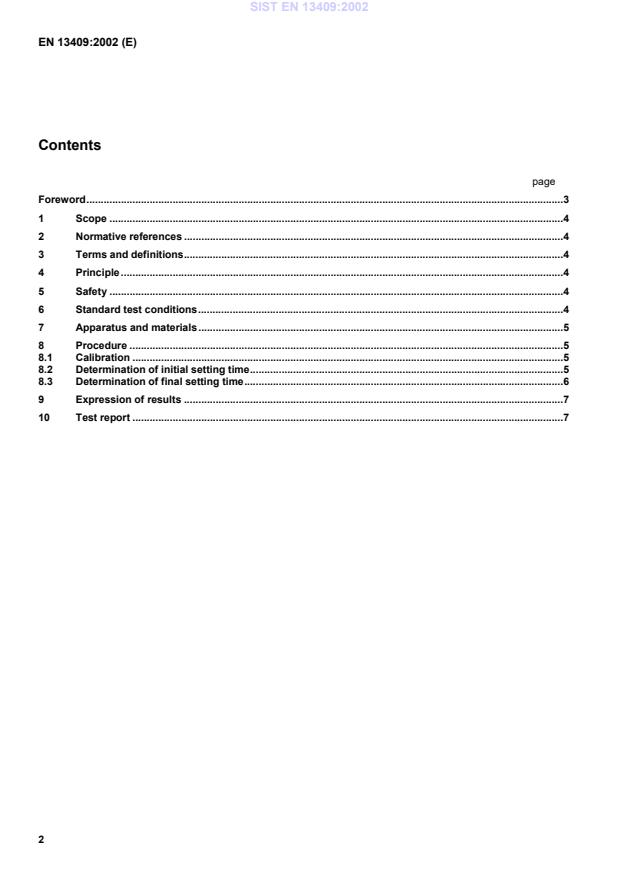
SIST EN 13409:2002 specifies how to measure the setting time of a hydraulic setting smoothing and/or levelling compound after mixing. The document is organized as a test method with clauses for scope, normative references, terms and definitions, principle, safety, test conditions, apparatus and materials, procedure, expression of results, and test report.
The standard relies on a defined mixing procedure, fixed environmental conditions, and a Vicat-type penetration test. In practice, this means the result is not just a time reading - it is a controlled laboratory measurement that depends on the same preparation and test conditions for every sample.
What are the key requirements of SIST EN 13409:2002?
SIST EN 13409:2002 requires the setting time to be determined by observing needle penetration into the mixed compound. Clause 4 states the principle clearly: the setting time is recorded from the time needed to reach a given penetration value. This matters because the method compares materials by a physical penetration endpoint rather than by visual judgment.
Standard conditions and sample preparation
Clause 6 sets the standard test conditions at 23 ± 2 C and 50 ± 5 % relative humidity, in accordance with ISO 554, and requires the materials and apparatus to be stored under those conditions during the test. The test area must also have air circulation below 0,2 m/s. In practice, the laboratory environment can affect setting behavior, so these controls are needed for comparable results.
Clause 8 requires the compound to be mixed using EN 1937 and then filled immediately into the mould without undue compaction or vibration. The surface is levelled flush with the mould. This means the test starts from a consistent specimen, which is important when comparing batches or products.
Apparatus
Clause 7 specifies a Vicat apparatus in accordance with EN 196-3, fitted with a steel needle of defined size and a total moving mass of 300 ± 1 g. It also specifies a hard-rubber truncated-cone mould, a plane glass plate, and a timer accurate to 1 s. The apparatus requirements matter because the penetration result depends on the needle geometry, mass, and vertical movement.
Initial and final setting time
Clause 8.2 defines the determination of initial setting time by repeated penetrations at convenient intervals until the reading reaches (4 ± 1) mm. Clause 8.3 continues the test until the needle first penetrates only 0,5 mm, which is the final setting point. In practice, the operator needs to repeat the test near the end point more frequently so the transition is not missed.
Calibration and result expression
Clause 8.1 requires calibration of the Vicat apparatus before testing by setting the pointer to zero with the needle resting on the base plate. Clause 9 then states how to express the results: initial and final setting times are the elapsed times from the end of mixing, rounded to the nearest minute. This gives a simple reportable result that can be used in product specification or quality control.
Test report
Clause 10 requires the report to identify the standard, the compound designation, the date of manufacture and/or batch number if known, the liquid-to-powder proportions, the mixing method and total mixing time, the initial and final setting times, any deviations from the method, and the test date. That information is what makes the result traceable and useful for audits or comparisons.
What terms does SIST EN 13409:2002 define?
SIST EN 13409:2002 defines setting as the transition from plastic to solid state, identified by initial and final penetration times. In practice, this is the change the test is measuring.
Initial setting time is the elapsed time from the end of mixing until the compound reaches the specified first penetration endpoint. It shows when the material begins to lose workability.
Final setting time is the elapsed time from the end of mixing until the needle first penetrates only 0,5 mm. It shows when the material has essentially set.
Vicat apparatus is the penetration device used with the specified needle and moving mass. It provides the measurable action that turns setting into a repeatable test result.
Smoothing and/or levelling compound is the hydraulic setting floor material under test. That is the product family this method is intended for.
Standard test conditions are the controlled temperature, humidity, and air movement conditions required by the method. They reduce variation between laboratories.
Who uses SIST EN 13409:2002?
SIST EN 13409:2002 is used by testing laboratories, manufacturers of floor smoothing and/or levelling compounds, and quality control staff who need a common way to measure setting time. It is also relevant to product development and conformity assessment where batches or formulations must be compared under the same procedure.
Which standards are used with SIST EN 13409:2002?
SIST EN 13409:2002 uses EN 1937 for the standard mixing procedure and for the compound preparation referenced in the test. It uses EN 196-3 for the Vicat apparatus and the related setting-time testing context. It uses ISO 554 for the conditioning and testing atmosphere.
What does the SIST EN 13409:2002 document contain?
SIST EN 13409:2002 contains the full test method, including the principle of needle penetration, the safety note, the required test atmosphere, and the apparatus specifications for the Vicat device, needle, mould, and timer. It also includes the step-by-step procedure for calibration, initial setting time, and final setting time.
The document gives the exact way to repeat penetrations, how to approach the end point, and how to read the scale. A figure shows the Vicat apparatus arrangement for the setting-time test. The final clause lists the items that must appear in the test report so the result can be traced and checked.
Relations
- Effective Date
- 25-Aug-2026
- Effective Date
- 28-Jan-2026
- Effective Date
- 28-Jan-2026
- Effective Date
- 28-Jan-2026
- Effective Date
- 08-May-2024
Get Certified
Connect with accredited certification bodies for this standard

DIBt (Deutsches Institut für Bautechnik)
German Institute for Building Technology.
DIN CERTCO
DIN Group product certification.

Aboma Certification B.V.
Specialized in construction, metal, and transport sectors.
Sponsored listings
Frequently Asked Questions
SIST EN 13409:2002 is a standard published by the Slovenian Institute for Standardization (SIST). Its full title is "Methods of test for hydraulic setting floor smoothing and/or levelling compounds - Determination of setting time". This standard covers: This European Standard specifies the measurement of setting time of a hydraulic setting smoothing and/or levelling compound which is referred to as "smoothing and/or levelling compound", after mixing.
This European Standard specifies the measurement of setting time of a hydraulic setting smoothing and/or levelling compound which is referred to as "smoothing and/or levelling compound", after mixing.
SIST EN 13409:2002 is classified under the following ICS (International Classification for Standards) categories: 91.100.99 - Other construction materials. The ICS classification helps identify the subject area and facilitates finding related standards.
SIST EN 13409:2002 has the following relationships with other standards: It is inter standard links to SIST ISO 554:1995, SIST EN 915:1996, SIST EN 1937:2000, SIST EN 196-3:2017, oSIST prEN 13409:2026. Understanding these relationships helps ensure you are using the most current and applicable version of the standard.
SIST EN 13409:2002 is available in PDF format for immediate download after purchase. The document can be added to your cart and obtained through the secure checkout process. Digital delivery ensures instant access to the complete standard document.
Standards Content (Sample)
2003-01.Slovenski inštitut za standardizacijo. Razmnoževanje celote ali delov tega standarda ni dovoljeno.UDYOLþQRPrüfverfahren für hydraulisch erhärtende Boden-Spachtelmassen - Bestimmung der AbbindezeitMéthodes d'essai pour les mortiers de lissage et/ou d'égalisation a prise hydraulique - Détermination du temps de priseMethods of test for hydraulic setting floor smoothing and/or levelling compounds - Determination of setting time91.100.99Drugi gradbeni materialiOther construction materialsICS:Ta slovenski standard je istoveten z:EN 13409:2002SIST EN 13409:2002en01-september-2002SIST EN 13409:2002SLOVENSKI
STANDARD
EUROPEAN STANDARDNORME EUROPÉENNEEUROPÄISCHE NORMEN 13409March 2002ICS 91.100.99English versionMethods of test for hydraulic setting floor smoothing and/orlevelling compounds - Determination of setting timeMéthodes d'essai pour les mortiers de lissage et/oud'égalisation à prise hydraulique - Détermination du tempsde prisePrüfverfahren für hydraulisch erhärtende Boden-Spachtelmassen - Bestimmung der AbbindezeitThis European Standard was approved by CEN on 30 December 2001.CEN members are bound to comply with the CEN/CENELEC Internal Regulations which stipulate the conditions for giving this EuropeanStandard the status of a national standard without any alteration. Up-to-date lists and bibliographical references concerning such nationalstandards may be obtained on application to the Management Centre or to any CEN member.This European Standard exists in three official versions (English, French, German). A version in any other language made by translationunder the responsibility of a CEN member into its own language and notified to the Management Centre has the same status as the officialversions.CEN members are the national standards bodies of Austria, Belgium, Czech Republic, Denmark, Finland, France, Germany, Greece,Iceland, Ireland, Italy, Luxembourg, Malta, Netherlands, Norway, Portugal, Spain, Sweden, Switzerland and United Kingdom.EUROPEAN COMMITTEE FOR STANDARDIZATIONCOMITÉ EUROPÉEN DE NORMALISATIONEUROPÄISCHES KOMITEE FÜR NORMUNGManagement Centre: rue de Stassart, 36
B-1050 Brussels© 2002 CENAll rights of exploitation in any form and by any means reservedworldwide for CEN national Members.Ref. No. EN 13409:2002 ESIST EN 13409:2002
...