


SIST ISO 15767:2012
Workplace atmospheres - Controlling and characterizing uncertainty in weighing collected aerosols
Workplace atmospheres - Controlling and characterizing uncertainty in weighing collected aerosols
ISO 15767:2009 provides recommendations for controlling the analytical uncertainty associated with aerosol collection medium instability, where collection medium or collection substrate includes any article used to collect particles (e.g. filter or foam material) as well as those supporting elements which must be analysed by weighing.
ISO 15767:2009 is applicable to results compiled both from the literature and, if necessary and feasible, through laboratory experiment. Expected uncertainty associated with given aerosol capture methods is quantified where possible. Recommendations as to materials to be used are given. Means of minimizing uncertainty arising from instability are provided. Recommendations for the weighing procedure are given. A procedure for estimating weighing uncertainty is described. Finally, recommendations are given for the reporting of measured mass, including an uncertainty component and limits of detection and quantification.
Air des lieux de travail - Contrôle et caractérisation de l'incertitude de pesée des aérosols collectés
L'ISO 15767:2009 fournit des recommandations pour le contrôle des incertitudes analytiques liées à l'instabilité des supports de collecte d'aérosols, dans lesquelles le support ou substrat de collecte inclut tout objet utilisé pour recueillir des particules (par exemple un filtre ou un matériau en mousse) ainsi que les éléments connexes soumis à l'analyse par pesée.
L'ISO 15767:2009 est applicable aux résultats compilés à partir de sources bibliographiques et, lorsque cela est nécessaire et dans la mesure du possible, à partir d'expériences en laboratoire. Chaque fois que possible, l'incertitude prévisible liée aux méthodes de prélèvement d'aérosols est quantifiée. Des recommandations sur les matériaux à utiliser sont données. Des moyens permettant de réduire au minimum l'incertitude liée à l'instabilité sont fournis. Des recommandations sont données pour le mode opératoire de pesée. Une procédure d'estimation de l'incertitude de pesée est décrite. Enfin, des recommandations sont données pour établir un compte rendu de la pesée effectuée, comprenant une composante d'incertitude et les limites de détection et de quantification.
Zrak na delovnem mestu - Pregled in opis napak pri tehtanju zbranih aerosolov
Ta mednarodni standard določa priporočila za pregled analitskih napak, povezanih z nestabilnostjo medija za zbiranje aerosola, pri čemer medij ali substrat za zbiranje vključuje kateri koli artikel za zbiranje delcev (npr. filter ali penasto snov) in podporne elemente, ki jih je treba stehtati.
Ta mednarodni standard se uporablja za rezultate, zbrane iz literature in z laboratorijskimi preskusi, če je to potrebno in izvedljivo. Pričakovane napake, povezane s podanimi metodami za zbiranje aerosola, se kvantificirajo, če je mogoče. Podana so priporočila o materialih, ki jih je treba uporabiti. Navedena so sredstva za zmanjšanje napak zaradi nestabilnosti. Podana so priporočila za postopek tehtanja. Opisan je postopek za oceno napak pri tehtanju. Nazadnje so podana priporočila za poročanje o izmerjeni masi, vključno s sestavino napak ter mejama odkrivanja in kvantifikacije.
General Information
- Status
- Published
- Public Enquiry End Date
- 19-Jan-2011
- Publication Date
- 12-Mar-2012
- Technical Committee
- KAZ - Air quality
- Current Stage
- 6060 - National Implementation/Publication (Adopted Project)
- Start Date
- 13-Mar-2012
- Due Date
- 18-May-2012
- Completion Date
- 13-Mar-2012
Relations
- Effective Date
- 01-Apr-2012
Overview
ISO 15767:2009 - Workplace atmospheres: Controlling and characterizing uncertainty in weighing collected aerosols provides recommendations to control and quantify analytical uncertainty when using gravimetric methods to determine aerosol mass on collection substrates (filters, foams, cassettes). The standard addresses instability of collection media, methods to minimize weighing errors, procedures to estimate weighing uncertainty, and guidance for reporting measured mass including limits of detection (LOD) and limits of quantification (LOQ).
Key topics and technical requirements
- Sources of weight instability: moisture sorption, electrostatic effects, volatile compounds, handling damage and buoyancy changes.
- Material selection and pre-treatment: recommendations on non‑sorptive or treated substrates and consideration of trade-offs (e.g., hydrophobicity vs conductivity).
- Blanks and corrections: use of field blanks and lab blanks to correct for substrate instability and to account for double-weighing uncertainty.
- Weighing procedure and equipment: guidance on balance selection, environmental controls, conditioning times, weighing sequence and sample handling to reduce variability.
- Transport and packaging: recommended packaging and tests to maintain sample integrity during transport from field to laboratory.
- Uncertainty quantification: procedure to estimate the uncertainty component (uw) for aerosol mass; definitions of LOD (three times estimated standard deviation) and LOQ (ten times estimated standard deviation) as applied to gravimetric aerosol analysis.
- Annexes: normative and informative annexes cover calculation of uncertainty components, interpretation of LOD/LOQ, method evaluation examples, transportation integrity testing, and balance uncertainty checks.
Practical applications and users
ISO 15767:2009 is practical for professionals involved in workplace air monitoring and aerosol measurement:
- Occupational hygienists performing gravimetric sampling for exposure assessment.
- Analytical and testing laboratories implementing validated weighing procedures and uncertainty estimation.
- Manufacturers of sampling media and cassettes designing low‑sorption, low‑electrostatic substrates.
- Regulatory agencies and accreditation bodies requiring standardized reporting of measured mass with uncertainty, LOD and LOQ.
- Researchers compiling literature or performing laboratory evaluations of aerosol capture methods.
This standard improves confidence in gravimetric aerosol results, supports accurate exposure assessments, and helps laboratories meet quality and reporting expectations for workplace atmospheres and air quality monitoring.
Related standards
- ISO/IEC Guide 98-3 (GUM) for general principles of measurement uncertainty.
- Other ISO standards on workplace atmospheres and air quality monitoring (see ISO technical committees for specific references).



ISO 15767:2009 - Workplace atmospheres -- Controlling and characterizing uncertainty in weighing collected aerosols

ISO 15767:2009 - Air des lieux de travail -- Contrôle et caractérisation de l'incertitude de pesée des aérosols collectés
Frequently Asked Questions
SIST ISO 15767:2012 is a standard published by the Slovenian Institute for Standardization (SIST). Its full title is "Workplace atmospheres - Controlling and characterizing uncertainty in weighing collected aerosols". This standard covers: ISO 15767:2009 provides recommendations for controlling the analytical uncertainty associated with aerosol collection medium instability, where collection medium or collection substrate includes any article used to collect particles (e.g. filter or foam material) as well as those supporting elements which must be analysed by weighing. ISO 15767:2009 is applicable to results compiled both from the literature and, if necessary and feasible, through laboratory experiment. Expected uncertainty associated with given aerosol capture methods is quantified where possible. Recommendations as to materials to be used are given. Means of minimizing uncertainty arising from instability are provided. Recommendations for the weighing procedure are given. A procedure for estimating weighing uncertainty is described. Finally, recommendations are given for the reporting of measured mass, including an uncertainty component and limits of detection and quantification.
ISO 15767:2009 provides recommendations for controlling the analytical uncertainty associated with aerosol collection medium instability, where collection medium or collection substrate includes any article used to collect particles (e.g. filter or foam material) as well as those supporting elements which must be analysed by weighing. ISO 15767:2009 is applicable to results compiled both from the literature and, if necessary and feasible, through laboratory experiment. Expected uncertainty associated with given aerosol capture methods is quantified where possible. Recommendations as to materials to be used are given. Means of minimizing uncertainty arising from instability are provided. Recommendations for the weighing procedure are given. A procedure for estimating weighing uncertainty is described. Finally, recommendations are given for the reporting of measured mass, including an uncertainty component and limits of detection and quantification.
SIST ISO 15767:2012 is classified under the following ICS (International Classification for Standards) categories: 13.040.30 - Workplace atmospheres. The ICS classification helps identify the subject area and facilitates finding related standards.
SIST ISO 15767:2012 has the following relationships with other standards: It is inter standard links to SIST ISO 15767:2004. Understanding these relationships helps ensure you are using the most current and applicable version of the standard.
SIST ISO 15767:2012 is available in PDF format for immediate download after purchase. The document can be added to your cart and obtained through the secure checkout process. Digital delivery ensures instant access to the complete standard document.
Standards Content (Sample)
SLOVENSKI STANDARD
01-april-2012
Zrak na delovnem mestu - Pregled in opis napak pri tehtanju zbranih aerosolov
Workplace atmospheres - Controlling and characterizing uncertainty in weighing
collected aerosols
Air des lieux de travail - Contrôle et caractérisation de l'incertitude de pesée des aérosols
collectés
Ta slovenski standard je istoveten z: ISO 15767:2009
ICS:
13.040.30 Kakovost zraka na delovnem Workplace atmospheres
mestu
2003-01.Slovenski inštitut za standardizacijo. Razmnoževanje celote ali delov tega standarda ni dovoljeno.
INTERNATIONAL ISO
STANDARD 15767
Second edition
2009-06-01
Workplace atmospheres —
Controlling and characterizing
uncertainty in weighing collected
aerosols
Air des lieux de travail — Contrôle et caractérisation de l'incertitude de
pesée des aérosols collectés
Reference number
©
ISO 2009
PDF disclaimer
This PDF file may contain embedded typefaces. In accordance with Adobe's licensing policy, this file may be printed or viewed but
shall not be edited unless the typefaces which are embedded are licensed to and installed on the computer performing the editing. In
downloading this file, parties accept therein the responsibility of not infringing Adobe's licensing policy. The ISO Central Secretariat
accepts no liability in this area.
Adobe is a trademark of Adobe Systems Incorporated.
Details of the software products used to create this PDF file can be found in the General Info relative to the file; the PDF-creation
parameters were optimized for printing. Every care has been taken to ensure that the file is suitable for use by ISO member bodies. In
the unlikely event that a problem relating to it is found, please inform the Central Secretariat at the address given below.
© ISO 2009
All rights reserved. Unless otherwise specified, no part of this publication may be reproduced or utilized in any form or by any means,
electronic or mechanical, including photocopying and microfilm, without permission in writing from either ISO at the address below or
ISO's member body in the country of the requester.
ISO copyright office
Case postale 56 • CH-1211 Geneva 20
Tel. + 41 22 749 01 11
Fax + 41 22 749 09 47
E-mail copyright@iso.org
Web www.iso.org
Published in Switzerland
ii © ISO 2009 – All rights reserved
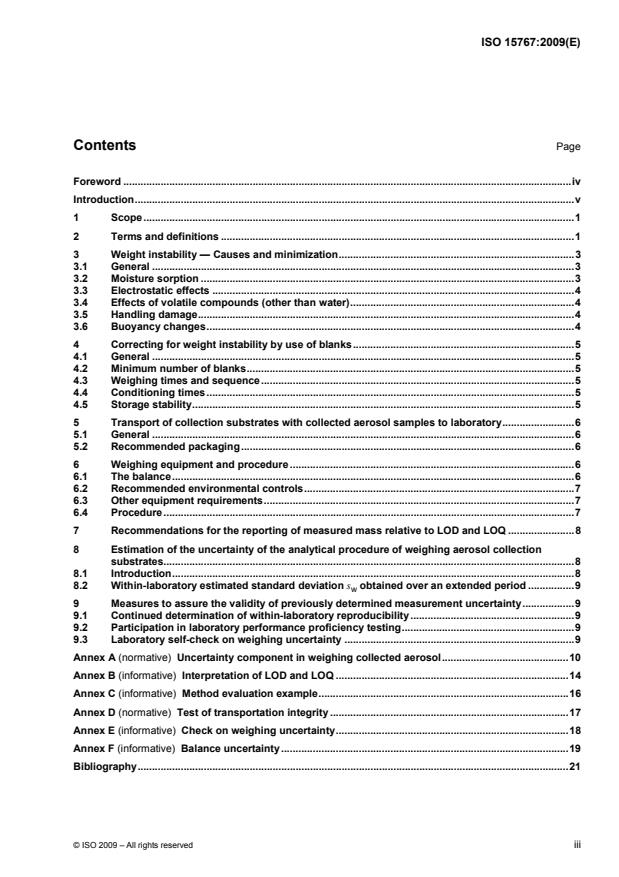
Contents Page
Foreword .iv
Introduction.v
1 Scope.1
2 Terms and definitions .1
3 Weight instability — Causes and minimization.3
3.1 General .3
3.2 Moisture sorption .3
3.3 Electrostatic effects .4
3.4 Effects of volatile compounds (other than water).4
3.5 Handling damage.4
3.6 Buoyancy changes.4
4 Correcting for weight instability by use of blanks.5
4.1 General .5
4.2 Minimum number of blanks.5
4.3 Weighing times and sequence.5
4.4 Conditioning times .5
4.5 Storage stability.5
5 Transport of collection substrates with collected aerosol samples to laboratory.6
5.1 General .6
5.2 Recommended packaging.6
6 Weighing equipment and procedure .6
6.1 The balance.6
6.2 Recommended environmental controls.7
6.3 Other equipment requirements.7
6.4 Procedure.7
7 Recommendations for the reporting of measured mass relative to LOD and LOQ .8
8 Estimation of the uncertainty of the analytical procedure of weighing aerosol collection
substrates.8
8.1 Introduction.8
8.2 Within-laboratory estimated standard deviation s obtained over an extended period .9
w
9 Measures to assure the validity of previously determined measurement uncertainty.9
9.1 Continued determination of within-laboratory reproducibility.9
9.2 Participation in laboratory performance proficiency testing.9
9.3 Laboratory self-check on weighing uncertainty .9
Annex A (normative) Uncertainty component in weighing collected aerosol.10
Annex B (informative) Interpretation of LOD and LOQ .14
Annex C (informative) Method evaluation example.16
Annex D (normative) Test of transportation integrity .17
Annex E (informative) Check on weighing uncertainty.18
Annex F (informative) Balance uncertainty.19
Bibliography.21
Foreword
ISO (the International Organization for Standardization) is a worldwide federation of national standards bodies
(ISO member bodies). The work of preparing International Standards is normally carried out through ISO
technical committees. Each member body interested in a subject for which a technical committee has been
established has the right to be represented on that committee. International organizations, governmental and
non-governmental, in liaison with ISO, also take part in the work. ISO collaborates closely with the
International Electrotechnical Commission (IEC) on all matters of electrotechnical standardization.
International Standards are drafted in accordance with the rules given in the ISO/IEC Directives, Part 2.
The main task of technical committees is to prepare International Standards. Draft International Standards
adopted by the technical committees are circulated to the member bodies for voting. Publication as an
International Standard requires approval by at least 75 % of the member bodies casting a vote.
Attention is drawn to the possibility that some of the elements of this document may be the subject of patent
rights. ISO shall not be held responsible for identifying any or all such patent rights.
ISO 15767 was prepared by Technical Committee ISO/TC 146, Air quality, Subcommittee SC 2, Workplace
atmospheres.
This second edition cancels and replaces the first edition (ISO 15767:2003), which has been technically
revised.
iv © ISO 2009 – All rights reserved
Introduction
Assessment of airborne aerosol hazards in occupational settings entails sampling onto a collection substrate,
followed by analysis of the collected material. The weight of the collection substrate is generally many times
(10 to 20, or more) larger than the aerosol sample. Weighing the aerosol sample is therefore actually the
differential weighing of the substrate, where the aerosol sample is essentially a disturbance of the substrate.
The result is generally an estimated concentration of a hazardous material in the air. The uncertainty in such
estimates depends on several factors, one of which relates to the specific type of analysis employed.
This International Standard deals with a specific type of analysis which finds the most general application in
the sampling of aerosols, namely the weighing of sampled material. Gravimetric analysis, though apparently
simple, is subject to uncertainty arising from instability in the mass of the sampling medium and other
elements which must be weighed. An example is provided by aerosol samplers designed to collect particles
so as to agree with the inhalable aerosol sampling convention. For some sampler types, the filter and cassette
are weighed together to make estimates. Therefore, uncertainty may result if the cassette, for example,
absorbs or loses water between the weighings required for a concentration estimation. This International
Standard describes such uncertainty and provides solutions for minimization.
INTERNATIONAL STANDARD ISO 15767:2009(E)
Workplace atmospheres — Controlling and characterizing
uncertainty in weighing collected aerosols
1 Scope
This International Standard provides recommendations for controlling the analytical uncertainty associated
with aerosol collection medium instability, where collection medium or collection substrate includes any article
used to collect particles (e.g. filter or foam material) as well as those supporting elements which must be
analysed by weighing.
This International Standard is applicable to results compiled both from the literature and, if necessary and
feasible, through laboratory experiment. Expected uncertainty associated with given aerosol capture methods
is quantified where possible. Recommendations as to materials to be used are given. Means of minimizing
uncertainty arising from instability are provided. Recommendations for the weighing procedure are given. A
procedure for estimating weighing uncertainty is described. Finally, recommendations are given for the
reporting of measured mass, including an uncertainty component and limits of detection and quantification.
2 Terms and definitions
For the purposes of this document, the following terms and definitions apply.
2.1
aerosol sample
aerosol particles collected onto the collection substrate or sampling cassette
2.2
collection substrate
aerosol sampling filter, foam, impaction plate or other deposition plate designed for subsequent analysis, with
whatever mounting, e.g. a sampling cassette, if used, analysed (weighed) as a single item together with the
collected aerosol sample, if present
NOTE As an example of the converse, the 25 mm or 37 mm plastic filter holder often used for “total dust” sampling in
either its closed-face or open-face version is not part of the collection substrate in the definition above, since it is not
weighed.
2.3
substrate holder
cassette primarily designed to hold a collection substrate (of any kind) and for which only the deposit on the
collection substrate is analysed (weighed)
2.4
filter holder
substrate holder designed to hold a filter and for which only the filter deposit is analysed (weighed)
2.5
sampling cassette
collection substrate together with whatever mounting that is used and analysed (weighed) as a single unit
2.6
equilibration time
time constant dependent on the type of collection substrate and characterizing an approximately exponentially
damped approach of the mass of an aerosol collection medium to a constant value
NOTE 1 The constant can be defined as the mean difference of the mass from equilibrium per mean rate of mass loss
or gain, averaging over any time interval.
NOTE 2 There may be important instances in which several independent time constants are required to describe the
approach to equilibrium.
NOTE 3 Equilibration times range from seconds to weeks.
2.7
field blank
blank collection substrate that undergoes the same handling as the collection substrate plus aerosol sample,
including conditioning and loading into the samplers or transport containers, as well as transportation between
the lab and sampling site, but without being exposed to sampling
2.8
lab blank
blank collection substrate that never leaves the laboratory, but undergoes the same handling as the collection
substrate plus aerosol sample, including conditioning and loading into the samplers or transport containers
2.9
blank collection substrate
collection medium or substrate taken from the same batch as the sampling medium, but unexposed to sampling
2.10
limit of detection
LOD
three times the estimated standard deviation of the mass of the aerosol sample, accounting for the double
weighing (exposed vs. unexposed) and for the uncertainty associated with any correction blanks used
NOTE The value of LOD, as defined here, does not take into account sources of variability beyond weighing.
2.11
false positive rate
fraction of incorrect assertions of the presence of an aerosol sample on a substrate
NOTE Annex B describes how to estimate, on the basis of the method evaluation, the false positive rate in such
assertions.
2.12
limit of quantification
LOQ
ten times the estimated standard deviation of the mass of the aerosol sample
NOTE The value of LOQ can be used as a threshold value to assure accurate measurement of a substance. For
details, see Annex B.
2.13
uncertainty component
u
w
estimated standard deviation of the mass of the aerosol sample
NOTE See Annex A and ISO/IEC Guide 98-3 for details.
2 © ISO 2009 – All rights reserved
3 Weight instability — Causes and minimization
3.1 General
Weight instability of collection substrates can be attributed to several causes (see References [1] to [14]). The
following subclauses address the more important of these.
3.2 Moisture sorption
3.2.1 Moisture sorption is the most common cause of weight instability. Water can be directly collected by
the filter or foam or other collection substrate material that is weighed. Water sorption by any part of the
sampling system which is weighed must be suspected as well. For example, the sampling cassette itself, if
[1]
weighed, can be the cause of significant uncertainty .
3.2.2 The effects of water sorption can be reduced by using non-sorptive materials. However, there may
exist specific sampling needs for which a hydrophobic material is not feasible. Table 1 presents a list of
common aerosol collection substrates with different water sorption features.
Table 1 — Water sorption characteristics of some aerosol sampling media
Water sorption
Collection substrate or cassette type
Very low Low High Very high
Cellulose fibre filter *
Glass fibre filter *
Quartz fibre filter *
Cellulose ester membrane filter *
Polytetrafluoroethylene filter *
PVC membrane filter *
Polycarbonate filter *
Silver membrane filter *
Polyurethane foam *
Greased Mylar impaction collection substrate *
Greased aluminium foil impaction collection substrate *
Carbon-filled resin *
Aluminium cassette *
Stainless steel cassette *
NOTE 1 References [2] to [4] provide further details. Also, Reference [5] reports that filters of evidently the same
material, but originating from different manufacturers, can have widely differing variabilities.
[9]
NOTE 2 There is generally a trade-off between hydrophobicity and conductivity in many materials . Therefore, one
must be aware of the possibility of creating sampling problems when reducing hygroscopicity.
NOTE 3 Pre-treatments of collection substrates, such as greasing, can also affect water sorption.
3.3 Electrostatic effects
Electrostatic effects are a common source of weighing problems. These effects can usually be minimized by
discharging the collection substrate through the use of a plasma ion source or a radioactive source
immediately before weighing or during weighing. Using conductive materials may reduce such problems. (See
also Reference [7].)
3.4 Effects of volatile compounds (other than water)
[3]
3.4.1 Volatile compounds can be present in unused collection media , or can be adsorbed onto media
during sampling.
3.4.2 Desorption of volatiles from unused media can be controlled, for example, by heating or oxygen
plasma treatment prior to conditioning and weighing. Alternatively, losses may be compensated by the use of
blanks (see Clause 4).
3.4.3 When volatile materials collected during sampling constitute part of the intended aerosol sample,
standardized written procedures are required to ensure that any losses are minimized or at least controlled,
for example by conditioning under tightly specified conditions.
3.4.4 When volatile materials collected during sampling are not part of the intended aerosol sample, it may
be difficult to eliminate them if weighing is the only form of analysis. Non-sorptive media should preferably be
used.
3.5 Handling damage
3.5.1 If friable collection substrates such as quartz filters are used, procedures are needed to control
mechanical damage.
3.5.2 The air-sampling equipment should be designed so that the collection substrate is not damaged
during assembly and disassembly.
3.5.3 Flat-tipped forceps are recommended for handling filters. Non-oxidizing metal tins may be used to
weigh delicate collection substrates without direct handling.
3.5.4 Parts to be weighed shall not be touched with the hands, unless gloved.
3.5.5 Gloves, if used, shall leave no residue on what is weighed.
3.5.6 Handling shall take place in a clean environment, to avoid contamination.
3.6 Buoyancy changes
[8]
Corrections for air buoyancy , equal to the density of air multiplied by the air volume displaced, are not
necessary for small objects, such as a 37 mm diameter membrane filter. However, there may exist
circumstances (e.g. if an entire sampling cassette was weighed without the use of correcting blanks) in which
the object to be weighed is so large that buoyancy must be corrected. For example, if the volume weighed
exceeds 0,1 cm , then correction would be required in order to weigh down to 0,01 mg, if pressure changes in
the order of 10 % between weighings are expected (e.g. at different altitudes). If such a correction is
necessary, the atmospheric pressure and temperature at the time of weighing should be recorded.
4 © ISO 2009 – All rights reserved
4 Correcting for weight instability by use of blanks
4.1 General
4.1.1 Many approaches to controlling weight instability exist (see References [15] to [25]). The use of
blanks is the most important practical tool for reducing uncertainty due to weight instability. Correction for
weight instability depends on the specific application and should follow a written procedure. The general
principles are as follows. Blank sampling media are exposed, as closely as possible, to the same conditions
as the active sampling media, without actually drawing air through. Correction is effected by subtracting the
average blank mass change from the mass change of the active collection substrates plus aerosol samples.
Of course, if the atmosphere to be sampled contains water (or other volatile) droplets which are weighed, then
the use of blanks alone cannot correct. Similarly, water adsorbed by the aerosol sample itself may require
special attention, for example if the water adsorbed is to be measured. Blanks shall be matched to the
samplers used, e.g. if the sampler contains a filter within a sampling cassette which is weighed, the blank shall
be the same type of filter within the same type of cassette.
4.1.2 An alternative procedure employs matched-weight filters consisting of two pre-selected nearly equal-
weight filters, one placed in front of the other, with the downstream filter employed as blank. Requiring only
two rather than four mass measurements, the collected mass is estimated simply by subtracting the filter
masses following sampling. Analysis of uncertainty is similar to the presentation here, but also involves
estimation of the uncertainty of the filter matching done prior to sampling.
4.1.3 In another approach to eliminate the burden of blank handling (at the expense of high LOD), the
equilibrium filter mass in terms of humidity is initially modelled. Mass estimates are subsequently corrected
[26]
knowing the humidity at the application weighing .
4.2 Minimum number of blanks
Generally, at least one blank is recommended for every 10 samplers. Measurement schemes in current use
require between one and four blanks per batch. See Annex A for advantages of multiple blanks.
4.3 Weighing times and sequence
Blanks shall be interspersed with samples, before and after use, so as to detect systematic variations in
weighing or substrate mass (e.g. due to sorption or evaporation of a contaminant during weighing).
4.4 Conditioning times
Conditioning times for reaching equilibrium with the weighing environment may vary from a few hours to
several weeks or more, depending on the specific sampling media. Typically, for workplace sampling using
filters, overnight conditioning is satisfactory. For sampling media with longer conditioning times, correction
through the use of blank collection substrates is particularly important.
4.5 Storage stability
Unused collection substrates shall be stored, prior to weighing and conditioning, in a clean laboratory, whose
environmental conditions do not differ greatly from the environment of the balance. Pre-weighed collection
substrates shall be stored together with weighed blanks and used in any case within the assigned shelf-life.
The assigned shelf-life and storage requirements shall be documented as part of a written weighing procedure.
NOTE Shelf-life depends on the collection substrate material, storage conditions, cassette material and required
LOQ or LOD.
Archived collection substrates plus aerosol samples shall be stored together with weighed blanks in a clean
laboratory whose environmental conditions do not differ too greatly from the environment of the balance. Note
that transfers of mass between filters and cassettes could occur where these media are stored together.
5 Transport of collection substrates with collected aerosol samples to laboratory
5.1 General
The transportation of substrates with collected aerosol samples shall form part of a written procedure. The
transport procedure shall be validated to ensure that significant losses do not occur. Follow the test method
given in Annex D.
The main problems occurring during handling and transport of sampling media are described below.
⎯ With collection substrates designed to be separated from the substrate holder, dust can migrate from the
collection substrate to the transport container, and hence be lost.
⎯ On the other hand, contamination of the sampling cassette can be a significant source of uncertainty, as
this type of cassette is itself weighed.
⎯ If a cover lid is not supplied, dust can be lost from the cassette to the transport container.
⎯ Dust can migrate from the substrate holder to the collection substrate.
NOTE Transportation losses are discussed in References [15] and [16].
5.2 Recommended packaging
5.2.1 Each collection substrate that is not mounted in a sampling cassette shall be transported in a Petri
dish, tin or a similar closed container that prevents contact with the surface of the collection medium.
5.2.2 Sampling cassettes (i.e. with mounted filters) should preferably have cover lids during transport. If the
aerosol sample consists of all the dust deposited inside the sampling cassette (with filter), then the dust which
migrates during transport from the cassette to the cover lid shall also be weighed.
5.2.3 The sealed collection substrates shall be transported in a suitable container or package. The floor,
ceiling and walls of the container should be lined with a spongy material (preferably electrically conducting)
which may absorb some mechanical shock and thus protect the aerosol samples during transport.
5.2.4 The aerosol samples shall be protected from excessive heating or cooling during transport.
NOTE 1 Special procedures are generally used for the transport of unstable particles or biological materials.
NOTE 2 If there is a possibility for dust to be lost from the collection substrate, the losses can be recovered by
transporting the collection substrate within a container that can itself be weighed.
6 Weighing equipment and procedure
6.1 The balance
The balance should be matched to the task. The choice of balance depends on the desired limits of
quantification for the application (see Clause 7) and on the maximum tare masses of the collection substrates
to be weighed.
Workplace-air sampling typically requires a balance capable of weighing to a resolution of 1 µg or 10 µg. The
balance shall be regularly calibrated using reference masses traceable to International Standards.
NOTE The performance of different balances was compared and reported in Reference [5]. In one experiment,
repeat weighings of 25 mm filters were made with filters stored between weighings in ventilated tins with conditions not
strictly controlled. A balance weighing to 1 µg (six figures) was compared to a balance weighing to 10 µg (five figures). It
was concluded that using a 1 µg balance approximately halves the standard deviation of repeat weighing compared with a
10 µg balance. Intra-day standard deviation was smaller than the inter-day deviation and is expected to be of greater
importance when blanks are used to correct inter-day variation in the balance room (see also Reference [11]).
6 © ISO 2009 – All rights reserved
6.2 Recommended environmental controls
6.2.1 Equilibration and weighing shall be carried out under the same conditions, i.e. in the same room or
chamber. Environmental control can be achieved in different ways:
⎯ by means of a balance room containing the balance and the weighing personnel;
⎯ by means of an environmentally-controlled chamber containing the balance, sited within a clean
laboratory.
NOTE It may be possible to achieve an adequate level of environmental control without the need for active air
conditioning. However, the quality of the gravimetric analysis depends strongly on the quality of the environmental control.
6.2.2 For sensitive (i.e. hygroscopic) aerosol samples or substrates, temperature and humidity control in the
weighing chamber or balance room are important. In these cases, temperature should be maintained constant
within ± 2 °C of the set point, and humidity should be constant to within ± 5 % relative humidity (RH) at the
target temperature. The target temperature and humidity should be in the range of operating conditions
recommended by the manufacturer of the balance [e.g. (20 ± 2) °C and (50 ± 5) % RH]. Very dry atmospheres
(e.g. < 20 % RH) are to be avoided, as electrostatic build-up on whatever is to be weighed is more likely in
such conditions. The environmental controls shall be capable of compensating for heat and humidity sources,
[3]
such as people working in the room or electrically-powered instruments in the room .
NOTE Air conditioning in a weighing chamber is not necessary, e.g. filtered laboratory air can be fed into a positive-
pressure chamber.
6.2.3 The particulate content of the balance room or chamber air should be minimized by filtration [e.g. by
high efficiency particulate air (HEPA) filtration].
6.2.4 Fresh air should be supplied, in accordance with the health and comfort requirements of personnel
working in the balance room or laboratory. Turbulent air movement generated by ventilation or humidity
control in the balance room or chamber should be minimal, so as not to affect the balance reading.
6.3 Other equipment requirements
The balance should be located in an area which is free from excessive vibration [e.g. due to lifts (elevators) or
rotating machinery]. A massive weighing table (e.g. one made of 200 kg of marble) is one means to dampen
ambient vibration. The area should be away from doors, windows, air ducts, and sources of radiant energy
such as direct sunlight or ovens. The electrical supply to the balance should be stable, and the balance should
not be located near sources of strong electromagnetic radiation.
6.4 Procedure
6.4.1 The weighing procedure shall be documented.
6.4.2 Equilibration to the temperature and humidity of the balance room or chamber shall take place for a
period appropriate to the substrates and aerosol samples. The substrates and collected aerosol samples shall
be kept in clean containers but open to the atmosphere so that equilibration can occur.
NOTE Desiccation prior to equilibration is sometimes used to remove excess water from substrates or aerosol
samples taken in a humid environment. (See also References [26] to [29].)
6.4.3 Elimination (if possible) of static electricity from the collection substrates and aerosol samples is
extremely important, and should be done immediately prior to placement of collection substrates on the
balance pan. Alternatively, a static eliminator can be placed inside the balance chamber.
6.4.4 The balance reading shall not be recorded until after it has stabilized.
6.4.5 Re-zero the balance as determined necessary.
NOTE A defective collection substrate can sometimes be identified by an abnormal initial mass.
7 Recommendations for the reporting of measured mass relative to LOD and LOQ
Details on reporting weights depend on the specific application. The following is an example of a minimal
reporting policy.
7.1 If the measured mass is above the limit of quantification (LOQ, Annexes A to C), then it should be
reported.
7.2 If the result falls between the limit of detection (LOD, Annexes A to C) and LOQ, then it should be
reported that the measured mass is between the values of LOD and LOQ, and the measured mass is reported
as well.
7.3 If the measured mass falls below the value of the LOD, it should be reported that the estimate is below
the value of the LOD.
NOTE 1 If the value of the LOD is exceeded, then the false-positive rate in asserting detection is < 1 %, if the method is
evaluated with as many degrees of freedom (25) as in the examples in Annexes A to C.
NOTE 2 In some applications, a series of measured masses, each below the value of the LOD, may be of help, e.g. in
asserting the presence of mass over the entire series, even if the individual measurements are too small to assert
detection with confidence. Applications such as these employ actual measured values (even if negative).
7.4 LOD and LOQ values shall be determined and shall be given in the report. Annexes A to C contain
suitable procedures for these determinations.
7.5 The uncertainty component u shall be given in the report (see Clause 8).
w
8 Estimation of the uncertainty of the analytical procedure of weighing aerosol
collection substrates
8.1 Introduction
8.1.1 The uncertainty u of weighing shall be taken as the within-laboratory estimated standard deviation s
w w
in a mass of the aerosol sample, including any blank correction.
8.1.2 As indicated in Annex F, the uncertainty associated with the calibration of the balance itself is
generally negligible.
8.1.3 The quantity u is an uncertainty component to be combined with other uncertainty components to
w
give combined (u ) and expanded uncertainties (U, traditionally taken as 2 × u ) of the whole measurement
c c
(see ISO/IEC Guide 98-3 and EN 482). Variability, aside from the weighing, can arise from several sources:
⎯ sampling pump-flowrate bias;
⎯ flow fluctuation (in the case of sampling with internal aerodynamic separation);
⎯ variation in sampler physical dimensions;
⎯ electrostatic effects on sampling; or
⎯ bias relative to the appropriate sampling convention.
8.1.4 At low loadings, if the gravimetric variability dominates the uncertainty from other sources, then
u → u .
c w
8 © ISO 2009 – All rights reserved
8.2 Within-laboratory estimated standard deviation s obtained over an extended period
w
8.2.1 This shall be determined according to the method described in Annex A, and especially
Equations (A.3) to (A.5). The test batches shall be spread out evenly throughout the year during which the
laboratory usually weighs collection substrates.
NOTE If almost no weighing occurs during the summer months, this period does not need to be investigated.
8.2.2 All collection substrates shall be treated exactly as collection substrates intended for sampling are
treated.
8.2.3 The duration between the pre-weighing and post-weighing for each batch of the test shall be identical
to nominal (maximum) shelf-life that the laboratory has determined for this collection substrate.
8.2.4 Between the pre-weighing and the post-weighing, the collection substrates shall be placed in the
ordinary transport package used by the laboratory, as if they were to be transported away from the laboratory.
The transport package, with the test collection substrates, shall be placed outside the weighing room/box for
the time period between the weighings.
8.2.5 If the collection substrates are not mounted into samplers by the weighing laboratory after pre-
weighing, each collection substrate shall be mounted once in a sampler for a period identical to a
recommended sampling time, i.e. usually 4 h to 8 h, during this part of the test.
9 Measures to assure the validity of previously determined measurement
uncertainty
9.1 Continued determination of within-laboratory reproducibility
Each year, at least one of the batches of the experiment described in A.3 should be performed anew. The
batch in the original data, whose pre-weighing and post-weighing months correspond best to those of the new
batch, shall be deleted from the data and replaced with the data from the new batch.
9.2 Participation in laboratory performance proficiency testing
If, there exists a group of laboratories considered acceptable for weighing specific aerosol collection
substrates, then generally the group will establish a laboratory performance proficiency testing scheme with
mandatory participation required of each laboratory.
9.3 Laboratory self-check on weighing uncertainty
A laboratory wishing to check weighing uncertainty can, for example, follow the method described in Annex E.
Annex A
(normative)
Uncertainty component in weighing collected aerosol
A.1 Symbols and abbreviated terms
The following symbols and abbreviated terms are used in both this annex and Annex B.
A coverage defining an interval about true values containing measured values at a specified rate
b batch index (1, …, B)
B number of collection substrate batches in method evaluation
f collection substrate index (1, …, F)
F number of collection substrates (e.g. filters) in each batch tested in method evaluation
LOD value of the limit of detection: 3 × s , expressed in micrograms
w
LOQ value of the limit of quantification: 10 × s , expressed in micrograms
w
N number of blanks per collection substrate set
b
s estimate of the standard deviation σ
s estimate of the standard deviation σ
w w
u combined uncertainty (including uncertainty sources beyond weighing) (see A.2.1)
c
u uncertainty component in weighing collected aerosols: taken as the standard deviation estimate s ,
w w
expressed in micrograms
U expanded uncertainty (including uncertainty sources beyond weighing) (see A.2.1)
α false-positive detection rate (see Annex B)
β mean collection substrate mass change during evaluation experiment
∆m collection substrate mass change, expressed in micrograms
fb
ε collection substrate mass change residual random variable with variance σ , expressed in
fb
micrograms
ε collection substrate mass change random variable representing inter-batch variability, expressed in
b
micrograms
γ complement of the method evaluation confidence
ν number of degrees of freedom in method evaluation
σ uncorrectable (e.g. via blank correction) standard deviation in (single) mass-change measurement,
expressed in micrograms
σ standard deviation in collected mass determination, expressed in micrograms
w
Φ cumulative normal function
χ chi-squared random variable
χ
chi-squared quantile
γ ν
,
10 © ISO 2009 – All rights reserved
A.2 The uncertainty component u in mass estimates
w
A.2.1 General
The variance σ in any collected mass estimate depends on the number of blanks (preferably field blanks)
w
used to correct for correlated sampling medium variation. The collected mass uncertainty u is taken as equal
w
to the estimate s of the standard deviation σ . The estimate s is determined, as outlined in this annex,
w w w
through an extensive evaluation of blanks. In addition to the uncertainty component u (equal to s ), the
w w
estimate s is important for computing the limit of detection LOD (3 × s ) and the limit of quantification LOQ
w w
(10 × s ).
w
Annex B interprets the meaning of LOD in terms of the rate of false-positive mass detection assertions at a
specific confidence in the method evaluation. Similarly, Annex B interprets the meaning of LOQ in terms of the
coverage, as known at a given confidence in the system evaluation. Annex C provides a worked example of
how the method evaluation is analysed.
A.2.2 No blanks
Because of excessive uncertainty, a measurement scheme with no blanks is generally not to be used
(however, see 4.1.3 and Reference [26]). Aside from the fact that the variance σ may be excessive, its
w
estimation is difficult. A large number of replicate measurements would need to be carried out on separate
days. Between measurements, the blanks would be exposed to environments of expected application, so as
to include realistic effects of environment on collection substrate. From such a set of measurements, the
uncertainty component u can be estimated. Because of the difficulty in covering all or most environments of
w
intended use, the confidence in the estimate can be low. In addition to uncertainty in individual weighings, bias
between pre- and post-weighing of substrates can be significant and difficult to characterize.
A.2.3 One or more blanks
In the case where N blanks per active sampling are used, the variance is given by
b
2 2
σ = σ [1 + (1 / N )] (A.1)
w b
The quantity σ is the uncorrectable variance associated with each mass difference measurement requiring
two balance readings (before and after exposure). The first term of Equation (A.1) reflects the fact that the
aerosol sample is present for a single balance reading only. The factor 1 / N quantifies how the blank mass-
b
change is more accurately known using multiple blanks, which therefore can reduce the overall variance to a
degree, at the cost of weighing extra blanks. Furthermore, at N = 2, a protocol could be established for
b
voiding an aerosol sample if the blank values differ excessively. Also, at N = 3, one of the blanks could be
b
eliminated, if it is an outlier.
NOTE 1 A “balance reading” may actually consist of the mean of several readings for minimizing uncertainty in the
operation of the balance.
NOTE 2 Laboratory blanks are sometimes used instead of field blanks, if it can be verified that the weight of the lab
blanks is constant over time and that that the weighing variance is representative of field conditions.
A.3 Determination of the uncorrectable mass-change standard deviation s
The variance σ required in Equation (A.1) is estimated through a set of method evaluation experiments. One
approach to the estimation of σ is presented here. Equivalent schemes can be devised. Condition and weigh a
batch of at least six, but preferably of the order of ten, blank collection substrates. Place the collection
substrates in clean transport containers or sampling heads and remove them from the balance room or
weighing chamber for a suitable period as prescribed in 8.2. If the expected handling and sampling
environment is suspected of affecting the sampling medium, then all the collection substrates should be
placed in such an environment (without exposure to dust) for a normal sampling period. Repeat with at least
four additional batches of blank collection substrates. Typically, five different test batches spread over the year
(see 8.2) would be required at a minimum.
Suppose then that a number F (e.g. 6) of collection substrates are weighed twice in each of the B (e.g. 5)
batches, giving a s
...
INTERNATIONAL ISO
STANDARD 15767
Second edition
2009-06-01
Workplace atmospheres —
Controlling and characterizing
uncertainty in weighing collected
aerosols
Air des lieux de travail — Contrôle et caractérisation de l'incertitude de
pesée des aérosols collectés
Reference number
©
ISO 2009
PDF disclaimer
This PDF file may contain embedded typefaces. In accordance with Adobe's licensing policy, this file may be printed or viewed but
shall not be edited unless the typefaces which are embedded are licensed to and installed on the computer performing the editing. In
downloading this file, parties accept therein the responsibility of not infringing Adobe's licensing policy. The ISO Central Secretariat
accepts no liability in this area.
Adobe is a trademark of Adobe Systems Incorporated.
Details of the software products used to create this PDF file can be found in the General Info relative to the file; the PDF-creation
parameters were optimized for printing. Every care has been taken to ensure that the file is suitable for use by ISO member bodies. In
the unlikely event that a problem relating to it is found, please inform the Central Secretariat at the address given below.
© ISO 2009
All rights reserved. Unless otherwise specified, no part of this publication may be reproduced or utilized in any form or by any means,
electronic or mechanical, including photocopying and microfilm, without permission in writing from either ISO at the address below or
ISO's member body in the country of the requester.
ISO copyright office
Case postale 56 • CH-1211 Geneva 20
Tel. + 41 22 749 01 11
Fax + 41 22 749 09 47
E-mail copyright@iso.org
Web www.iso.org
Published in Switzerland
ii © ISO 2009 – All rights reserved
Contents Page
Foreword .iv
Introduction.v
1 Scope.1
2 Terms and definitions .1
3 Weight instability — Causes and minimization.3
3.1 General .3
3.2 Moisture sorption .3
3.3 Electrostatic effects .4
3.4 Effects of volatile compounds (other than water).4
3.5 Handling damage.4
3.6 Buoyancy changes.4
4 Correcting for weight instability by use of blanks.5
4.1 General .5
4.2 Minimum number of blanks.5
4.3 Weighing times and sequence.5
4.4 Conditioning times .5
4.5 Storage stability.5
5 Transport of collection substrates with collected aerosol samples to laboratory.6
5.1 General .6
5.2 Recommended packaging.6
6 Weighing equipment and procedure .6
6.1 The balance.6
6.2 Recommended environmental controls.7
6.3 Other equipment requirements.7
6.4 Procedure.7
7 Recommendations for the reporting of measured mass relative to LOD and LOQ .8
8 Estimation of the uncertainty of the analytical procedure of weighing aerosol collection
substrates.8
8.1 Introduction.8
8.2 Within-laboratory estimated standard deviation s obtained over an extended period .9
w
9 Measures to assure the validity of previously determined measurement uncertainty.9
9.1 Continued determination of within-laboratory reproducibility.9
9.2 Participation in laboratory performance proficiency testing.9
9.3 Laboratory self-check on weighing uncertainty .9
Annex A (normative) Uncertainty component in weighing collected aerosol.10
Annex B (informative) Interpretation of LOD and LOQ .14
Annex C (informative) Method evaluation example.16
Annex D (normative) Test of transportation integrity .17
Annex E (informative) Check on weighing uncertainty.18
Annex F (informative) Balance uncertainty.19
Bibliography.21
Foreword
ISO (the International Organization for Standardization) is a worldwide federation of national standards bodies
(ISO member bodies). The work of preparing International Standards is normally carried out through ISO
technical committees. Each member body interested in a subject for which a technical committee has been
established has the right to be represented on that committee. International organizations, governmental and
non-governmental, in liaison with ISO, also take part in the work. ISO collaborates closely with the
International Electrotechnical Commission (IEC) on all matters of electrotechnical standardization.
International Standards are drafted in accordance with the rules given in the ISO/IEC Directives, Part 2.
The main task of technical committees is to prepare International Standards. Draft International Standards
adopted by the technical committees are circulated to the member bodies for voting. Publication as an
International Standard requires approval by at least 75 % of the member bodies casting a vote.
Attention is drawn to the possibility that some of the elements of this document may be the subject of patent
rights. ISO shall not be held responsible for identifying any or all such patent rights.
ISO 15767 was prepared by Technical Committee ISO/TC 146, Air quality, Subcommittee SC 2, Workplace
atmospheres.
This second edition cancels and replaces the first edition (ISO 15767:2003), which has been technically
revised.
iv © ISO 2009 – All rights reserved
Introduction
Assessment of airborne aerosol hazards in occupational settings entails sampling onto a collection substrate,
followed by analysis of the collected material. The weight of the collection substrate is generally many times
(10 to 20, or more) larger than the aerosol sample. Weighing the aerosol sample is therefore actually the
differential weighing of the substrate, where the aerosol sample is essentially a disturbance of the substrate.
The result is generally an estimated concentration of a hazardous material in the air. The uncertainty in such
estimates depends on several factors, one of which relates to the specific type of analysis employed.
This International Standard deals with a specific type of analysis which finds the most general application in
the sampling of aerosols, namely the weighing of sampled material. Gravimetric analysis, though apparently
simple, is subject to uncertainty arising from instability in the mass of the sampling medium and other
elements which must be weighed. An example is provided by aerosol samplers designed to collect particles
so as to agree with the inhalable aerosol sampling convention. For some sampler types, the filter and cassette
are weighed together to make estimates. Therefore, uncertainty may result if the cassette, for example,
absorbs or loses water between the weighings required for a concentration estimation. This International
Standard describes such uncertainty and provides solutions for minimization.
INTERNATIONAL STANDARD ISO 15767:2009(E)
Workplace atmospheres — Controlling and characterizing
uncertainty in weighing collected aerosols
1 Scope
This International Standard provides recommendations for controlling the analytical uncertainty associated
with aerosol collection medium instability, where collection medium or collection substrate includes any article
used to collect particles (e.g. filter or foam material) as well as those supporting elements which must be
analysed by weighing.
This International Standard is applicable to results compiled both from the literature and, if necessary and
feasible, through laboratory experiment. Expected uncertainty associated with given aerosol capture methods
is quantified where possible. Recommendations as to materials to be used are given. Means of minimizing
uncertainty arising from instability are provided. Recommendations for the weighing procedure are given. A
procedure for estimating weighing uncertainty is described. Finally, recommendations are given for the
reporting of measured mass, including an uncertainty component and limits of detection and quantification.
2 Terms and definitions
For the purposes of this document, the following terms and definitions apply.
2.1
aerosol sample
aerosol particles collected onto the collection substrate or sampling cassette
2.2
collection substrate
aerosol sampling filter, foam, impaction plate or other deposition plate designed for subsequent analysis, with
whatever mounting, e.g. a sampling cassette, if used, analysed (weighed) as a single item together with the
collected aerosol sample, if present
NOTE As an example of the converse, the 25 mm or 37 mm plastic filter holder often used for “total dust” sampling in
either its closed-face or open-face version is not part of the collection substrate in the definition above, since it is not
weighed.
2.3
substrate holder
cassette primarily designed to hold a collection substrate (of any kind) and for which only the deposit on the
collection substrate is analysed (weighed)
2.4
filter holder
substrate holder designed to hold a filter and for which only the filter deposit is analysed (weighed)
2.5
sampling cassette
collection substrate together with whatever mounting that is used and analysed (weighed) as a single unit
2.6
equilibration time
time constant dependent on the type of collection substrate and characterizing an approximately exponentially
damped approach of the mass of an aerosol collection medium to a constant value
NOTE 1 The constant can be defined as the mean difference of the mass from equilibrium per mean rate of mass loss
or gain, averaging over any time interval.
NOTE 2 There may be important instances in which several independent time constants are required to describe the
approach to equilibrium.
NOTE 3 Equilibration times range from seconds to weeks.
2.7
field blank
blank collection substrate that undergoes the same handling as the collection substrate plus aerosol sample,
including conditioning and loading into the samplers or transport containers, as well as transportation between
the lab and sampling site, but without being exposed to sampling
2.8
lab blank
blank collection substrate that never leaves the laboratory, but undergoes the same handling as the collection
substrate plus aerosol sample, including conditioning and loading into the samplers or transport containers
2.9
blank collection substrate
collection medium or substrate taken from the same batch as the sampling medium, but unexposed to sampling
2.10
limit of detection
LOD
three times the estimated standard deviation of the mass of the aerosol sample, accounting for the double
weighing (exposed vs. unexposed) and for the uncertainty associated with any correction blanks used
NOTE The value of LOD, as defined here, does not take into account sources of variability beyond weighing.
2.11
false positive rate
fraction of incorrect assertions of the presence of an aerosol sample on a substrate
NOTE Annex B describes how to estimate, on the basis of the method evaluation, the false positive rate in such
assertions.
2.12
limit of quantification
LOQ
ten times the estimated standard deviation of the mass of the aerosol sample
NOTE The value of LOQ can be used as a threshold value to assure accurate measurement of a substance. For
details, see Annex B.
2.13
uncertainty component
u
w
estimated standard deviation of the mass of the aerosol sample
NOTE See Annex A and ISO/IEC Guide 98-3 for details.
2 © ISO 2009 – All rights reserved
3 Weight instability — Causes and minimization
3.1 General
Weight instability of collection substrates can be attributed to several causes (see References [1] to [14]). The
following subclauses address the more important of these.
3.2 Moisture sorption
3.2.1 Moisture sorption is the most common cause of weight instability. Water can be directly collected by
the filter or foam or other collection substrate material that is weighed. Water sorption by any part of the
sampling system which is weighed must be suspected as well. For example, the sampling cassette itself, if
[1]
weighed, can be the cause of significant uncertainty .
3.2.2 The effects of water sorption can be reduced by using non-sorptive materials. However, there may
exist specific sampling needs for which a hydrophobic material is not feasible. Table 1 presents a list of
common aerosol collection substrates with different water sorption features.
Table 1 — Water sorption characteristics of some aerosol sampling media
Water sorption
Collection substrate or cassette type
Very low Low High Very high
Cellulose fibre filter *
Glass fibre filter *
Quartz fibre filter *
Cellulose ester membrane filter *
Polytetrafluoroethylene filter *
PVC membrane filter *
Polycarbonate filter *
Silver membrane filter *
Polyurethane foam *
Greased Mylar impaction collection substrate *
Greased aluminium foil impaction collection substrate *
Carbon-filled resin *
Aluminium cassette *
Stainless steel cassette *
NOTE 1 References [2] to [4] provide further details. Also, Reference [5] reports that filters of evidently the same
material, but originating from different manufacturers, can have widely differing variabilities.
[9]
NOTE 2 There is generally a trade-off between hydrophobicity and conductivity in many materials . Therefore, one
must be aware of the possibility of creating sampling problems when reducing hygroscopicity.
NOTE 3 Pre-treatments of collection substrates, such as greasing, can also affect water sorption.
3.3 Electrostatic effects
Electrostatic effects are a common source of weighing problems. These effects can usually be minimized by
discharging the collection substrate through the use of a plasma ion source or a radioactive source
immediately before weighing or during weighing. Using conductive materials may reduce such problems. (See
also Reference [7].)
3.4 Effects of volatile compounds (other than water)
[3]
3.4.1 Volatile compounds can be present in unused collection media , or can be adsorbed onto media
during sampling.
3.4.2 Desorption of volatiles from unused media can be controlled, for example, by heating or oxygen
plasma treatment prior to conditioning and weighing. Alternatively, losses may be compensated by the use of
blanks (see Clause 4).
3.4.3 When volatile materials collected during sampling constitute part of the intended aerosol sample,
standardized written procedures are required to ensure that any losses are minimized or at least controlled,
for example by conditioning under tightly specified conditions.
3.4.4 When volatile materials collected during sampling are not part of the intended aerosol sample, it may
be difficult to eliminate them if weighing is the only form of analysis. Non-sorptive media should preferably be
used.
3.5 Handling damage
3.5.1 If friable collection substrates such as quartz filters are used, procedures are needed to control
mechanical damage.
3.5.2 The air-sampling equipment should be designed so that the collection substrate is not damaged
during assembly and disassembly.
3.5.3 Flat-tipped forceps are recommended for handling filters. Non-oxidizing metal tins may be used to
weigh delicate collection substrates without direct handling.
3.5.4 Parts to be weighed shall not be touched with the hands, unless gloved.
3.5.5 Gloves, if used, shall leave no residue on what is weighed.
3.5.6 Handling shall take place in a clean environment, to avoid contamination.
3.6 Buoyancy changes
[8]
Corrections for air buoyancy , equal to the density of air multiplied by the air volume displaced, are not
necessary for small objects, such as a 37 mm diameter membrane filter. However, there may exist
circumstances (e.g. if an entire sampling cassette was weighed without the use of correcting blanks) in which
the object to be weighed is so large that buoyancy must be corrected. For example, if the volume weighed
exceeds 0,1 cm , then correction would be required in order to weigh down to 0,01 mg, if pressure changes in
the order of 10 % between weighings are expected (e.g. at different altitudes). If such a correction is
necessary, the atmospheric pressure and temperature at the time of weighing should be recorded.
4 © ISO 2009 – All rights reserved
4 Correcting for weight instability by use of blanks
4.1 General
4.1.1 Many approaches to controlling weight instability exist (see References [15] to [25]). The use of
blanks is the most important practical tool for reducing uncertainty due to weight instability. Correction for
weight instability depends on the specific application and should follow a written procedure. The general
principles are as follows. Blank sampling media are exposed, as closely as possible, to the same conditions
as the active sampling media, without actually drawing air through. Correction is effected by subtracting the
average blank mass change from the mass change of the active collection substrates plus aerosol samples.
Of course, if the atmosphere to be sampled contains water (or other volatile) droplets which are weighed, then
the use of blanks alone cannot correct. Similarly, water adsorbed by the aerosol sample itself may require
special attention, for example if the water adsorbed is to be measured. Blanks shall be matched to the
samplers used, e.g. if the sampler contains a filter within a sampling cassette which is weighed, the blank shall
be the same type of filter within the same type of cassette.
4.1.2 An alternative procedure employs matched-weight filters consisting of two pre-selected nearly equal-
weight filters, one placed in front of the other, with the downstream filter employed as blank. Requiring only
two rather than four mass measurements, the collected mass is estimated simply by subtracting the filter
masses following sampling. Analysis of uncertainty is similar to the presentation here, but also involves
estimation of the uncertainty of the filter matching done prior to sampling.
4.1.3 In another approach to eliminate the burden of blank handling (at the expense of high LOD), the
equilibrium filter mass in terms of humidity is initially modelled. Mass estimates are subsequently corrected
[26]
knowing the humidity at the application weighing .
4.2 Minimum number of blanks
Generally, at least one blank is recommended for every 10 samplers. Measurement schemes in current use
require between one and four blanks per batch. See Annex A for advantages of multiple blanks.
4.3 Weighing times and sequence
Blanks shall be interspersed with samples, before and after use, so as to detect systematic variations in
weighing or substrate mass (e.g. due to sorption or evaporation of a contaminant during weighing).
4.4 Conditioning times
Conditioning times for reaching equilibrium with the weighing environment may vary from a few hours to
several weeks or more, depending on the specific sampling media. Typically, for workplace sampling using
filters, overnight conditioning is satisfactory. For sampling media with longer conditioning times, correction
through the use of blank collection substrates is particularly important.
4.5 Storage stability
Unused collection substrates shall be stored, prior to weighing and conditioning, in a clean laboratory, whose
environmental conditions do not differ greatly from the environment of the balance. Pre-weighed collection
substrates shall be stored together with weighed blanks and used in any case within the assigned shelf-life.
The assigned shelf-life and storage requirements shall be documented as part of a written weighing procedure.
NOTE Shelf-life depends on the collection substrate material, storage conditions, cassette material and required
LOQ or LOD.
Archived collection substrates plus aerosol samples shall be stored together with weighed blanks in a clean
laboratory whose environmental conditions do not differ too greatly from the environment of the balance. Note
that transfers of mass between filters and cassettes could occur where these media are stored together.
5 Transport of collection substrates with collected aerosol samples to laboratory
5.1 General
The transportation of substrates with collected aerosol samples shall form part of a written procedure. The
transport procedure shall be validated to ensure that significant losses do not occur. Follow the test method
given in Annex D.
The main problems occurring during handling and transport of sampling media are described below.
⎯ With collection substrates designed to be separated from the substrate holder, dust can migrate from the
collection substrate to the transport container, and hence be lost.
⎯ On the other hand, contamination of the sampling cassette can be a significant source of uncertainty, as
this type of cassette is itself weighed.
⎯ If a cover lid is not supplied, dust can be lost from the cassette to the transport container.
⎯ Dust can migrate from the substrate holder to the collection substrate.
NOTE Transportation losses are discussed in References [15] and [16].
5.2 Recommended packaging
5.2.1 Each collection substrate that is not mounted in a sampling cassette shall be transported in a Petri
dish, tin or a similar closed container that prevents contact with the surface of the collection medium.
5.2.2 Sampling cassettes (i.e. with mounted filters) should preferably have cover lids during transport. If the
aerosol sample consists of all the dust deposited inside the sampling cassette (with filter), then the dust which
migrates during transport from the cassette to the cover lid shall also be weighed.
5.2.3 The sealed collection substrates shall be transported in a suitable container or package. The floor,
ceiling and walls of the container should be lined with a spongy material (preferably electrically conducting)
which may absorb some mechanical shock and thus protect the aerosol samples during transport.
5.2.4 The aerosol samples shall be protected from excessive heating or cooling during transport.
NOTE 1 Special procedures are generally used for the transport of unstable particles or biological materials.
NOTE 2 If there is a possibility for dust to be lost from the collection substrate, the losses can be recovered by
transporting the collection substrate within a container that can itself be weighed.
6 Weighing equipment and procedure
6.1 The balance
The balance should be matched to the task. The choice of balance depends on the desired limits of
quantification for the application (see Clause 7) and on the maximum tare masses of the collection substrates
to be weighed.
Workplace-air sampling typically requires a balance capable of weighing to a resolution of 1 µg or 10 µg. The
balance shall be regularly calibrated using reference masses traceable to International Standards.
NOTE The performance of different balances was compared and reported in Reference [5]. In one experiment,
repeat weighings of 25 mm filters were made with filters stored between weighings in ventilated tins with conditions not
strictly controlled. A balance weighing to 1 µg (six figures) was compared to a balance weighing to 10 µg (five figures). It
was concluded that using a 1 µg balance approximately halves the standard deviation of repeat weighing compared with a
10 µg balance. Intra-day standard deviation was smaller than the inter-day deviation and is expected to be of greater
importance when blanks are used to correct inter-day variation in the balance room (see also Reference [11]).
6 © ISO 2009 – All rights reserved
6.2 Recommended environmental controls
6.2.1 Equilibration and weighing shall be carried out under the same conditions, i.e. in the same room or
chamber. Environmental control can be achieved in different ways:
⎯ by means of a balance room containing the balance and the weighing personnel;
⎯ by means of an environmentally-controlled chamber containing the balance, sited within a clean
laboratory.
NOTE It may be possible to achieve an adequate level of environmental control without the need for active air
conditioning. However, the quality of the gravimetric analysis depends strongly on the quality of the environmental control.
6.2.2 For sensitive (i.e. hygroscopic) aerosol samples or substrates, temperature and humidity control in the
weighing chamber or balance room are important. In these cases, temperature should be maintained constant
within ± 2 °C of the set point, and humidity should be constant to within ± 5 % relative humidity (RH) at the
target temperature. The target temperature and humidity should be in the range of operating conditions
recommended by the manufacturer of the balance [e.g. (20 ± 2) °C and (50 ± 5) % RH]. Very dry atmospheres
(e.g. < 20 % RH) are to be avoided, as electrostatic build-up on whatever is to be weighed is more likely in
such conditions. The environmental controls shall be capable of compensating for heat and humidity sources,
[3]
such as people working in the room or electrically-powered instruments in the room .
NOTE Air conditioning in a weighing chamber is not necessary, e.g. filtered laboratory air can be fed into a positive-
pressure chamber.
6.2.3 The particulate content of the balance room or chamber air should be minimized by filtration [e.g. by
high efficiency particulate air (HEPA) filtration].
6.2.4 Fresh air should be supplied, in accordance with the health and comfort requirements of personnel
working in the balance room or laboratory. Turbulent air movement generated by ventilation or humidity
control in the balance room or chamber should be minimal, so as not to affect the balance reading.
6.3 Other equipment requirements
The balance should be located in an area which is free from excessive vibration [e.g. due to lifts (elevators) or
rotating machinery]. A massive weighing table (e.g. one made of 200 kg of marble) is one means to dampen
ambient vibration. The area should be away from doors, windows, air ducts, and sources of radiant energy
such as direct sunlight or ovens. The electrical supply to the balance should be stable, and the balance should
not be located near sources of strong electromagnetic radiation.
6.4 Procedure
6.4.1 The weighing procedure shall be documented.
6.4.2 Equilibration to the temperature and humidity of the balance room or chamber shall take place for a
period appropriate to the substrates and aerosol samples. The substrates and collected aerosol samples shall
be kept in clean containers but open to the atmosphere so that equilibration can occur.
NOTE Desiccation prior to equilibration is sometimes used to remove excess water from substrates or aerosol
samples taken in a humid environment. (See also References [26] to [29].)
6.4.3 Elimination (if possible) of static electricity from the collection substrates and aerosol samples is
extremely important, and should be done immediately prior to placement of collection substrates on the
balance pan. Alternatively, a static eliminator can be placed inside the balance chamber.
6.4.4 The balance reading shall not be recorded until after it has stabilized.
6.4.5 Re-zero the balance as determined necessary.
NOTE A defective collection substrate can sometimes be identified by an abnormal initial mass.
7 Recommendations for the reporting of measured mass relative to LOD and LOQ
Details on reporting weights depend on the specific application. The following is an example of a minimal
reporting policy.
7.1 If the measured mass is above the limit of quantification (LOQ, Annexes A to C), then it should be
reported.
7.2 If the result falls between the limit of detection (LOD, Annexes A to C) and LOQ, then it should be
reported that the measured mass is between the values of LOD and LOQ, and the measured mass is reported
as well.
7.3 If the measured mass falls below the value of the LOD, it should be reported that the estimate is below
the value of the LOD.
NOTE 1 If the value of the LOD is exceeded, then the false-positive rate in asserting detection is < 1 %, if the method is
evaluated with as many degrees of freedom (25) as in the examples in Annexes A to C.
NOTE 2 In some applications, a series of measured masses, each below the value of the LOD, may be of help, e.g. in
asserting the presence of mass over the entire series, even if the individual measurements are too small to assert
detection with confidence. Applications such as these employ actual measured values (even if negative).
7.4 LOD and LOQ values shall be determined and shall be given in the report. Annexes A to C contain
suitable procedures for these determinations.
7.5 The uncertainty component u shall be given in the report (see Clause 8).
w
8 Estimation of the uncertainty of the analytical procedure of weighing aerosol
collection substrates
8.1 Introduction
8.1.1 The uncertainty u of weighing shall be taken as the within-laboratory estimated standard deviation s
w w
in a mass of the aerosol sample, including any blank correction.
8.1.2 As indicated in Annex F, the uncertainty associated with the calibration of the balance itself is
generally negligible.
8.1.3 The quantity u is an uncertainty component to be combined with other uncertainty components to
w
give combined (u ) and expanded uncertainties (U, traditionally taken as 2 × u ) of the whole measurement
c c
(see ISO/IEC Guide 98-3 and EN 482). Variability, aside from the weighing, can arise from several sources:
⎯ sampling pump-flowrate bias;
⎯ flow fluctuation (in the case of sampling with internal aerodynamic separation);
⎯ variation in sampler physical dimensions;
⎯ electrostatic effects on sampling; or
⎯ bias relative to the appropriate sampling convention.
8.1.4 At low loadings, if the gravimetric variability dominates the uncertainty from other sources, then
u → u .
c w
8 © ISO 2009 – All rights reserved
8.2 Within-laboratory estimated standard deviation s obtained over an extended period
w
8.2.1 This shall be determined according to the method described in Annex A, and especially
Equations (A.3) to (A.5). The test batches shall be spread out evenly throughout the year during which the
laboratory usually weighs collection substrates.
NOTE If almost no weighing occurs during the summer months, this period does not need to be investigated.
8.2.2 All collection substrates shall be treated exactly as collection substrates intended for sampling are
treated.
8.2.3 The duration between the pre-weighing and post-weighing for each batch of the test shall be identical
to nominal (maximum) shelf-life that the laboratory has determined for this collection substrate.
8.2.4 Between the pre-weighing and the post-weighing, the collection substrates shall be placed in the
ordinary transport package used by the laboratory, as if they were to be transported away from the laboratory.
The transport package, with the test collection substrates, shall be placed outside the weighing room/box for
the time period between the weighings.
8.2.5 If the collection substrates are not mounted into samplers by the weighing laboratory after pre-
weighing, each collection substrate shall be mounted once in a sampler for a period identical to a
recommended sampling time, i.e. usually 4 h to 8 h, during this part of the test.
9 Measures to assure the validity of previously determined measurement
uncertainty
9.1 Continued determination of within-laboratory reproducibility
Each year, at least one of the batches of the experiment described in A.3 should be performed anew. The
batch in the original data, whose pre-weighing and post-weighing months correspond best to those of the new
batch, shall be deleted from the data and replaced with the data from the new batch.
9.2 Participation in laboratory performance proficiency testing
If, there exists a group of laboratories considered acceptable for weighing specific aerosol collection
substrates, then generally the group will establish a laboratory performance proficiency testing scheme with
mandatory participation required of each laboratory.
9.3 Laboratory self-check on weighing uncertainty
A laboratory wishing to check weighing uncertainty can, for example, follow the method described in Annex E.
Annex A
(normative)
Uncertainty component in weighing collected aerosol
A.1 Symbols and abbreviated terms
The following symbols and abbreviated terms are used in both this annex and Annex B.
A coverage defining an interval about true values containing measured values at a specified rate
b batch index (1, …, B)
B number of collection substrate batches in method evaluation
f collection substrate index (1, …, F)
F number of collection substrates (e.g. filters) in each batch tested in method evaluation
LOD value of the limit of detection: 3 × s , expressed in micrograms
w
LOQ value of the limit of quantification: 10 × s , expressed in micrograms
w
N number of blanks per collection substrate set
b
s estimate of the standard deviation σ
s estimate of the standard deviation σ
w w
u combined uncertainty (including uncertainty sources beyond weighing) (see A.2.1)
c
u uncertainty component in weighing collected aerosols: taken as the standard deviation estimate s ,
w w
expressed in micrograms
U expanded uncertainty (including uncertainty sources beyond weighing) (see A.2.1)
α false-positive detection rate (see Annex B)
β mean collection substrate mass change during evaluation experiment
∆m collection substrate mass change, expressed in micrograms
fb
ε collection substrate mass change residual random variable with variance σ , expressed in
fb
micrograms
ε collection substrate mass change random variable representing inter-batch variability, expressed in
b
micrograms
γ complement of the method evaluation confidence
ν number of degrees of freedom in method evaluation
σ uncorrectable (e.g. via blank correction) standard deviation in (single) mass-change measurement,
expressed in micrograms
σ standard deviation in collected mass determination, expressed in micrograms
w
Φ cumulative normal function
χ chi-squared random variable
χ
chi-squared quantile
γ ν
,
10 © ISO 2009 – All rights reserved
A.2 The uncertainty component u in mass estimates
w
A.2.1 General
The variance σ in any collected mass estimate depends on the number of blanks (preferably field blanks)
w
used to correct for correlated sampling medium variation. The collected mass uncertainty u is taken as equal
w
to the estimate s of the standard deviation σ . The estimate s is determined, as outlined in this annex,
w w w
through an extensive evaluation of blanks. In addition to the uncertainty component u (equal to s ), the
w w
estimate s is important for computing the limit of detection LOD (3 × s ) and the limit of quantification LOQ
w w
(10 × s ).
w
Annex B interprets the meaning of LOD in terms of the rate of false-positive mass detection assertions at a
specific confidence in the method evaluation. Similarly, Annex B interprets the meaning of LOQ in terms of the
coverage, as known at a given confidence in the system evaluation. Annex C provides a worked example of
how the method evaluation is analysed.
A.2.2 No blanks
Because of excessive uncertainty, a measurement scheme with no blanks is generally not to be used
(however, see 4.1.3 and Reference [26]). Aside from the fact that the variance σ may be excessive, its
w
estimation is difficult. A large number of replicate measurements would need to be carried out on separate
days. Between measurements, the blanks would be exposed to environments of expected application, so as
to include realistic effects of environment on collection substrate. From such a set of measurements, the
uncertainty component u can be estimated. Because of the difficulty in covering all or most environments of
w
intended use, the confidence in the estimate can be low. In addition to uncertainty in individual weighings, bias
between pre- and post-weighing of substrates can be significant and difficult to characterize.
A.2.3 One or more blanks
In the case where N blanks per active sampling are used, the variance is given by
b
2 2
σ = σ [1 + (1 / N )] (A.1)
w b
The quantity σ is the uncorrectable variance associated with each mass difference measurement requiring
two balance readings (before and after exposure). The first term of Equation (A.1) reflects the fact that the
aerosol sample is present for a single balance reading only. The factor 1 / N quantifies how the blank mass-
b
change is more accurately known using multiple blanks, which therefore can reduce the overall variance to a
degree, at the cost of weighing extra blanks. Furthermore, at N = 2, a protocol could be established for
b
voiding an aerosol sample if the blank values differ excessively. Also, at N = 3, one of the blanks could be
b
eliminated, if it is an outlier.
NOTE 1 A “balance reading” may actually consist of the mean of several readings for minimizing uncertainty in the
operation of the balance.
NOTE 2 Laboratory blanks are sometimes used instead of field blanks, if it can be verified that the weight of the lab
blanks is constant over time and that that the weighing variance is representative of field conditions.
A.3 Determination of the uncorrectable mass-change standard deviation s
The variance σ required in Equation (A.1) is estimated through a set of method evaluation experiments. One
approach to the estimation of σ is presented here. Equivalent schemes can be devised. Condition and weigh a
batch of at least six, but preferably of the order of ten, blank collection substrates. Place the collection
substrates in clean transport containers or sampling heads and remove them from the balance room or
weighing chamber for a suitable period as prescribed in 8.2. If the expected handling and sampling
environment is suspected of affecting the sampling medium, then all the collection substrates should be
placed in such an environment (without exposure to dust) for a normal sampling period. Repeat with at least
four additional batches of blank collection substrates. Typically, five different test batches spread over the year
(see 8.2) would be required at a minimum.
Suppose then that a number F (e.g. 6) of collection substrates are weighed twice in each of the B (e.g. 5)
batches, giving a set of measured mass differences {∆m }, f = 1, …, F; b = 1, …, B. Then, ∆m is modelled
fb fb
via:
∆m = β + ε + ε (A.2)
fb b fb
The various quantities in Equation (A.2) are interpreted as follows. The constant β is a mean mass gain over
all the blanks. ε is a random variable with zero mean and assumed normal distribution, expressing the inter-
b
batch variability. Finally, ε , the term of real interest, is the only remaining quantity upon forming the difference
fb
of one collection substrate's mass measurement, relative to a difference in blank collection substrate masses
within the same batch. ε is approximated as normally distributed about zero, with standard deviation σ. Note
fb
that σ involves uncorrelated medium instability as well as balance uncertainty and therefore will generally
exceed the value appropriate to a standard mass difference.
NOTE 1 Interaction between filter, foam or cassette dimensional variations and environmental change is assumed to
be negligible.
NOTE 2 The uncertainty of weighing can vary from season to season.
Each batch b provides its own estimate s of σ via:
b
21− 2
sF=−(1) (∆m −∆m)
(A.3)
bf∑b .b
where the summation is over f d
...
NORME ISO
INTERNATIONALE 15767
Deuxième édition
2009-06-01
Air des lieux de travail — Contrôle et
caractérisation de l'incertitude de pesée
des aérosols collectés
Workplace atmospheres — Controlling and characterizing uncertainty in
weighing collected aerosols
Numéro de référence
©
ISO 2009
PDF – Exonération de responsabilité
Le présent fichier PDF peut contenir des polices de caractères intégrées. Conformément aux conditions de licence d'Adobe, ce fichier
peut être imprimé ou visualisé, mais ne doit pas être modifié à moins que l'ordinateur employé à cet effet ne bénéficie d'une licence
autorisant l'utilisation de ces polices et que celles-ci y soient installées. Lors du téléchargement de ce fichier, les parties concernées
acceptent de fait la responsabilité de ne pas enfreindre les conditions de licence d'Adobe. Le Secrétariat central de l'ISO décline toute
responsabilité en la matière.
Adobe est une marque déposée d'Adobe Systems Incorporated.
Les détails relatifs aux produits logiciels utilisés pour la création du présent fichier PDF sont disponibles dans la rubrique General Info
du fichier; les paramètres de création PDF ont été optimisés pour l'impression. Toutes les mesures ont été prises pour garantir
l'exploitation de ce fichier par les comités membres de l'ISO. Dans le cas peu probable où surviendrait un problème d'utilisation,
veuillez en informer le Secrétariat central à l'adresse donnée ci-dessous.
DOCUMENT PROTÉGÉ PAR COPYRIGHT
© ISO 2009
Droits de reproduction réservés. Sauf prescription différente, aucune partie de cette publication ne peut être reproduite ni utilisée sous
quelque forme que ce soit et par aucun procédé, électronique ou mécanique, y compris la photocopie et les microfilms, sans l'accord écrit
de l'ISO à l'adresse ci-après ou du comité membre de l'ISO dans le pays du demandeur.
ISO copyright office
Case postale 56 • CH-1211 Geneva 20
Tel. + 41 22 749 01 11
Fax + 41 22 749 09 47
E-mail copyright@iso.org
Web www.iso.org
Publié en Suisse
ii © ISO 2009 – Tous droits réservés
Sommaire Page
Avant-propos .iv
Introduction.v
1 Domaine d'application .1
2 Termes et définitions .1
3 Instabilité du poids — Causes et minimisation.3
3.1 Généralités .3
3.2 Adsorption d'humidité .3
3.3 Effets électrostatiques.4
3.4 Effets dus aux composés volatils (autres que l'eau).4
3.5 Détériorations dues aux manipulations.4
3.6 Variations dues à la poussée d'Archimède .4
4 Corrections liées à l'instabilité du poids par l'utilisation de blancs .5
4.1 Généralités .5
4.2 Nombre minimal de blancs.5
4.3 Durée et séquence des pesées .5
4.4 Durée de conditionnement .5
4.5 Stabilité au cours de l'entreposage.5
5 Transport des substrats de collecte avec les échantillons d'aérosol recueillis jusqu'au
laboratoire .6
5.1 Généralités .6
5.2 Recommandations concernant l'emballage .6
6 Équipement et mode opératoire de pesée.7
6.1 Balance.7
6.2 Contrôles environnementaux recommandés .7
6.3 Autres exigences liées aux équipements .8
6.4 Mode opératoire.8
7 Recommandations sur la consignation de la masse mesurée par rapport aux limites LOD
et LOQ.8
8 Estimation de l'incertitude du mode opératoire d'analyse par pesée de substrats de
collecte d'aérosols .9
8.1 Introduction.9
8.2 Écart-type intralaboratoire estimé s obtenu sur une période prolongée.9
w
9 Mesures permettant de garantir la validité de l'incertitude de mesure déterminée
précédemment .10
9.1 Détermination continue de la reproductibilité intralaboratoire .10
9.2 Participation aux essais d'aptitude et d'évaluation des performances d'un laboratoire.10
9.3 Auto-contrôle de l'exactitude de pesée par le laboratoire .10
Annexe A (normative) Composante d'incertitude de la pesée des aérosols collectés .11
Annexe B (informative) Interprétation des limites LOD et LOQ .15
Annexe C (informative) Exemple d'évaluation de méthode.17
Annexe D (normative) Essai d'intégrité pendant le transport.18
Annexe E (informative) Contrôle de l'incertitude de pesée .20
Annexe F (informative) Incertitude de la balance .21
Bibliographie.23
Avant-propos
L'ISO (Organisation internationale de normalisation) est une fédération mondiale d'organismes nationaux de
normalisation (comités membres de l'ISO). L'élaboration des Normes internationales est en général confiée
aux comités techniques de l'ISO. Chaque comité membre intéressé par une étude a le droit de faire partie du
comité technique créé à cet effet. Les organisations internationales, gouvernementales et non
gouvernementales, en liaison avec l'ISO participent également aux travaux. L'ISO collabore étroitement avec
la Commission électrotechnique internationale (CEI) en ce qui concerne la normalisation électrotechnique.
Les Normes internationales sont rédigées conformément aux règles données dans les Directives ISO/CEI,
Partie 2.
La tâche principale des comités techniques est d'élaborer les Normes internationales. Les projets de Normes
internationales adoptés par les comités techniques sont soumis aux comités membres pour vote. Leur
publication comme Normes internationales requiert l'approbation de 75 % au moins des comités membres
votants.
L'attention est appelée sur le fait que certains des éléments du présent document peuvent faire l'objet de
droits de propriété intellectuelle ou de droits analogues. L'ISO ne saurait être tenue pour responsable de ne
pas avoir identifié de tels droits de propriété et averti de leur existence.
L'ISO 15767 a été élaborée par le comité technique ISO/TC 146, Qualité de l'air, sous-comité SC 2,
Atmosphères des lieux de travail.
Cette deuxième édition annule et remplace la première édition (ISO 15767:2003), qui a fait l'objet d'une
révision technique.
iv © ISO 2009 – Tous droits réservés
Introduction
L'évaluation des risques liés aux aérosols en suspension dans l'air en milieu professionnel nécessite le
prélèvement sur un substrat de collecte, suivi d'une analyse, des matières recueillies. Le poids du substrat de
collecte est en général plusieurs fois (10 à 20 fois, voire plus) supérieur à celui de l'échantillon d'aérosol. En
conséquence, la pesée de l'échantillon d'aérosol est en réalité une pesée différentielle du substrat, où
l'échantillon d'aérosol est essentiellement une anomalie du substrat. Le résultat obtenu est généralement une
estimation de la concentration des matières nocives dans l'air. L'incertitude de telles estimations repose sur
plusieurs facteurs, dont l'un est lié au type spécifique d'analyse employé.
La présente Norme internationale traite d'un type d'analyse particulier, à savoir la pesée du matériau prélevé,
qui est appliqué de façon très générale dans le prélèvement des aérosols. L'analyse gravimétrique, bien que
simple en apparence, est propice aux incertitudes en raison de l'instabilité de la masse du support de
prélèvement et des autres éléments à peser. Le cas se présente par exemple avec les dispositifs de
prélèvement d'aérosols conçus pour recueillir des particules conformément à la convention d'échantillonnage
des aérosols inhalables. Dans certains cas, les dispositifs de prélèvement comprennent un filtre et une
cassette pesés ensemble pour permettre les estimations. Ainsi, par exemple, l'absorption ou la déperdition
d'eau dans la cassette entre les différentes pesées requises pour estimer une concentration peut donner lieu
à des incertitudes. La présente Norme internationale décrit les incertitudes de ce type et fournit des solutions
visant à les réduire au minimum.
NORME INTERNATIONALE ISO 15767:2009(F)
Air des lieux de travail — Contrôle et caractérisation de
l'incertitude de pesée des aérosols collectés
1 Domaine d'application
La présente Norme internationale fournit des recommandations pour le contrôle des incertitudes analytiques
liées à l'instabilité des supports de collecte d'aérosols, dans lesquelles le support ou substrat de collecte inclut
tout objet utilisé pour recueillir des particules (par exemple un filtre ou un matériau en mousse) ainsi que les
éléments connexes soumis à l'analyse par pesée.
La présente Norme internationale est applicable aux résultats compilés à partir de sources bibliographiques et,
lorsque cela est nécessaire et dans la mesure du possible, à partir d'expériences en laboratoire. Chaque fois
que possible, l'incertitude prévisible liée aux méthodes de prélèvement d'aérosols est quantifiée. Des
recommandations sur les matériaux à utiliser sont données. Des moyens permettant de réduire au minimum
l'incertitude liée à l'instabilité sont fournis. Des recommandations sont données pour le mode opératoire de
pesée. Une procédure d'estimation de l'incertitude de pesée est décrite. Enfin, des recommandations sont
données pour établir un compte rendu de la pesée effectuée, comprenant une composante d'incertitude et les
limites de détection et de quantification.
2 Termes et définitions
Pour les besoins du présent document, les termes et définitions suivants s'appliquent.
2.1
échantillon d'aérosol
particules d'aérosols recueillies sur le substrat de collecte ou la cassette de prélèvement
2.2
substrat de collecte
filtre de prélèvement des aérosols, mousse, plaque d'impaction ou autre plaque de dépôt conçue en vue
d'une analyse ultérieure, et tout accessoire de montage associé, par exemple une cassette de prélèvement, si
elle est utilisée, analysés (pesés) en tant qu'élément unique avec l'échantillon d'aérosol recueilli s'il est
présent
NOTE À titre de contre-exemple, le porte-filtre plastique de 25 mm ou 37 mm fréquemment utilisé pour prélever les
«poussières totales», disponible en version à face fermée ou face ouverte, ne fait pas partie du substrat de collecte tel
que défini ci-dessus, puisqu'il n'est pas pris en compte dans la pesée.
2.3
porte-substrat
cassette essentiellement conçue pour retenir un substrat de collecte (de tout type) et pour laquelle seul le
dépôt sur le substrat de collecte est analysé (pesé)
2.4
porte-filtre
porte-substrat conçu pour retenir un filtre et pour lequel seul le dépôt sur le filtre est analysé (pesé)
2.5
cassette de prélèvement
substrat de collecte, et tout accessoire de montage associé, utilisés et analysés (pesés) en tant qu'élément
unique
2.6
temps d'équilibrage
constante temporelle dépendant du type de substrat de collecte et caractérisant une approche de la masse
d'un support de collecte d'aérosol, s'amortissant de façon approximativement exponentielle jusqu'à une valeur
constante
NOTE 1 La constante peut être définie comme le rapport de la différence moyenne entre la masse obtenue à l'équilibre
et le taux moyen de perte ou de gain de masse, déterminés sur une période quelconque.
NOTE 2 Dans certaines situations importantes, plusieurs constantes de temps indépendantes peuvent être requises
pour décrire une approche de l'équilibre.
NOTE 3 Le temps d'équilibrage varie de quelques secondes à plusieurs semaines.
2.7
blanc de terrain
substrat de collecte à blanc soumis aux mêmes manipulations que le substrat de collecte plus l'échantillon
d'aérosol, incluant une phase de conditionnement et nécessitant une mise en place dans les dispositifs de
prélèvement ou récipients de transport, ainsi que l'acheminement entre le laboratoire et le site de prélèvement,
sans être exposé au prélèvement
2.8
blanc de laboratoire
substrat de collecte à blanc que l'on ne sort jamais du laboratoire mais qui est soumis aux mêmes
manipulations que le substrat de collecte plus l'échantillon d'aérosol, incluant une phase de conditionnement
et nécessitant une mise en place dans les dispositifs de prélèvement ou récipients de transport
2.9
substrat de collecte à blanc
support ou substrat de collecte provenant du même lot que le support de prélèvement, mais non exposé au
prélèvement
2.10
limite de détection
LOD
trois fois l'écart-type estimé de la masse de l'échantillon d'aérosol, en tenant compte de la double pesée
(exposé et non exposé) et de l'incertitude liée à la correction de blanc
NOTE La valeur de la LOD, telle que définie dans le présent document, ne prend pas en compte les sources de
variabilité autres que la pesée.
2.11
taux de faux positifs
fraction de déterminations incorrectes de la présence d'un échantillon d'aérosol sur un substrat
NOTE L'Annexe B décrit le mode d'estimation du taux de faux positifs de ces déterminations, sur la base de
l'évaluation de la méthode.
2.12
limite de quantification
LOQ
dix fois l'écart-type estimé de la masse de l'échantillon d'aérosol
NOTE La valeur de la LOQ peut être utilisée comme valeur seuil de garantie pour la précision du mesurage d'une
substance. Voir les détails à l'Annexe B.
2.13
composante d'incertitude
u
w
écart-type estimé de la masse de l'échantillon d'aérosol
NOTE Pour plus de détails, voir l'Annexe A et le Guide ISO/CEI 98-3.
2 © ISO 2009 – Tous droits réservés
3 Instabilité du poids — Causes et minimisation
3.1 Généralités
L'instabilité du poids des substrats de collecte peut être attribuée à plusieurs causes (voir
Références [1] à [14]). Les plus importantes sont décrites dans les paragraphes qui suivent.
3.2 Adsorption d'humidité
3.2.1 L'adsorption d'humidité est la cause la plus fréquente d'instabilité du poids. L'eau peut être prélevée
directement sur le filtre, la mousse ou tout autre matériau de substrat de collecte pesé. L'adsorption d'eau
dans une partie quelconque du système de prélèvement pesé peut également être soupçonnée. Par exemple
[1]
la cassette elle-même peut, si elle est pesée, être à l'origine d'une incertitude significative .
3.2.2 Les effets de l'adsorption d'eau peuvent être réduits par l'emploi de matériaux non adsorbants.
Toutefois, les besoins liés à certains prélèvements ne permettent pas l'emploi de matériaux hydrophobes. Le
Tableau 1 présente une liste de substrats de collecte d'aérosols courants, ayant des propriétés adsorbantes
différentes vis-à-vis de l'eau.
Tableau 1 — Propriétés adsorbantes vis-à-vis de l'eau de quelques supports
de prélèvement d'aérosols
Adsorption d'eau
Type de substrat de collecte ou type de cassette
Très faible Faible Élevée Très élevée
Filtre en fibre de cellulose *
Filtre en fibre de verre *
Filtre en fibre de quartz *
Filtre membrane en ester de cellulose *
Filtre en polytétrafluoroéthylène *
Filtre membrane PVC *
Filtre en polycarbonate *
Filtre membrane argent *
Mousse de polyuréthanne *
Substrat de collecte par impaction en Mylar graissé *
Substrat de collecte par impaction sur feuille d'aluminium
*
graissée
Résine chargée en carbone *
Cassette en aluminium *
Cassette en inox *
NOTE 1 Les Références [2] à [4] comportent des détails supplémentaires. Par ailleurs, la Référence [5] établit que les
filtres réputés constitués du même matériau mais provenant de fabricants divers peuvent présenter des caractéristiques
très inégales.
[9]
NOTE 2 Pour de nombreux matériaux, il existe un compromis entre l'hydrophobicité et la conductivité . Néanmoins, il
faut tenir compte du fait que la réduction de l'hygroscopicité peut engendrer des problèmes de prélèvement.
NOTE 3 Le pré-traitement des substrats de collecte, tel qu'un graissage, peut également influer sur l'adsorption d'eau.
3.3 Effets électrostatiques
Les effets électrostatiques sont une source fréquente de problèmes lors des pesées. Ces effets peuvent
généralement être minimisés par l'élimination des charges électriques, via une source ionique à plasma ou
une source radioactive immédiatement avant la pesée ou pendant celle-ci. Ces problèmes peuvent être
réduits par l'usage de matériaux conducteurs (voir également la Référence [7]).
3.4 Effets dus aux composés volatils (autres que l'eau)
[3]
3.4.1 Des substances volatiles peuvent être présentes sur certains supports de collecte vierges ou
introduites par adsorption sur le support pendant le prélèvement.
3.4.2 La désorption des substances volatiles du support inutilisé peut être contrôlée, par exemple à l'aide
d'un traitement thermique ou d'un traitement par plasma à oxygène avant le conditionnement et la pesée. Par
ailleurs, les pertes peuvent être compensées par l'utilisation de blancs (voir Article 4).
3.4.3 Lorsque les matières volatiles collectées lors du prélèvement font partie de l'échantillon d'aérosol, des
procédures normalisées écrites sont nécessaires pour garantir que les pertes éventuelles sont minimisées ou,
au minimum, contrôlées, par exemple grâce à un conditionnement dans des conditions rigoureusement
spécifiées.
3.4.4 Lorsque les matières volatiles recueillies lors du prélèvement ne font pas partie de l'échantillon
d'aérosol, leur élimination peut être difficile si la pesée constitue l'unique forme d'analyse. Il convient d'utiliser
de préférence des supports non adsorbants.
3.5 Détériorations dues aux manipulations
3.5.1 Si les substrats de collecte utilisés sont friables, comme les filtres en fibre de quartz, des procédures
sont requises pour éviter les détériorations d'origine mécanique.
3.5.2 Il convient que l'équipement de prélèvement de l'air soit conçu de sorte que le substrat de collecte ne
subisse aucune détérioration lors du montage et du démontage.
3.5.3 L'utilisation de pinces à embouts plats est recommandée pour manipuler les filtres. Les substrats de
collecte délicats peuvent être pesés sans manipulation directe, dans des récipients en métal inoxydable.
3.5.4 Les éléments pesés ne doivent pas être manipulés avec les doigts, sauf si les mains sont gantées.
3.5.5 Si des gants sont utilisés, ils ne doivent laisser aucun résidu sur les éléments pesés.
3.5.6 La manipulation doit avoir lieu dans un environnement propre, pour éviter les contaminations.
3.6 Variations dues à la poussée d'Archimède
[8]
Les corrections liées à la poussée d'Archimède , égale à la masse volumique de l'air multipliée par le
volume d'air déplacé, ne sont pas nécessaires pour les objets de petite taille tels que les filtres à membrane
de 37 mm de diamètre. Toutefois, dans certaines circonstances (par exemple si une cassette de prélèvement
entière est pesée sans recourir à une correction de blanc), le volume de l'objet pesé est tel qu'une
compensation de la poussée atmosphérique est nécessaire. Si, par exemple, le volume pesé est supérieur à
0,1 cm , une correction est requise pour permettre des pesées allant jusqu'à 0,01 mg, en cas de variation de
pression prévue de l'ordre de 10 % entre chaque pesée (par exemple à différentes altitudes). Lorsqu'une telle
correction est nécessaire, il convient de consigner la pression atmosphérique et la température au moment de
la pesée.
4 © ISO 2009 – Tous droits réservés
4 Corrections liées à l'instabilité du poids par l'utilisation de blancs
4.1 Généralités
4.1.1 Plusieurs approches pour contrôler l'instabilité du poids existent (voir Références [15] à [25]).
L'utilisation de blancs est la principale solution pratique pour réduire l'incertitude due à l'instabilité du poids. La
correction de l'instabilité du poids dépendant de chaque application particulière, il convient qu'elle soit faite
suivant une procédure écrite. Le principe général est le suivant. Des supports de prélèvement à blanc sont
exposés à des conditions aussi proches que possible de celles du support de prélèvement actif, sans
toutefois procéder à un pompage d'air. La correction est appliquée en soustrayant le changement de masse
moyen du blanc du changement de masse relevé sur les substrats de collecte plus échantillons d'aérosol
actifs. Bien entendu, dans le cas d'échantillons contenant des gouttelettes d'eau (ou autres substances
volatiles) qui sont pesées, l'usage de blancs seuls ne permet aucune correction. De la même manière, l'eau
adsorbée par l'échantillon d'aérosol lui-même peut exiger une attention particulière, par exemple dans le cas
où l'eau adsorbée doit être mesurée. Les blancs doivent être adaptés aux dispositifs de prélèvement utilisés;
par exemple, si le dispositif d'échantillonnage comporte un filtre contenu dans la cassette pesée, le blanc doit
être constitué d'un filtre de même type contenu dans le même type de cassette.
4.1.2 Une autre méthode utilise des filtres de poids appariés et consiste à superposer deux filtres
présélectionnés de poids quasiment identiques, le filtre aval étant employé comme blanc. Deux mesurages
seulement étant nécessaires, au lieu de quatre, la masse collectée est estimée simplement en soustrayant les
masses des filtres après le prélèvement. L'analyse de l'incertitude est similaire à la présentation faite ici mais
implique également l'estimation de l'incertitude liée à l'appariement du filtre effectué avant le prélèvement.
4.1.3 Dans une autre méthode visant à supprimer la contrainte d'une manipulation de blancs (aux dépens
d'une LOD élevée), la masse du filtre à l'équilibre en termes d'humidité est initialement modélisée.
[26]
Connaissant l'humidité au moment de la pesée , les estimations de masse sont ensuite corrigées.
4.2 Nombre minimal de blancs
Il est généralement conseillé d'utiliser au moins un blanc pour dix dispositifs de prélèvement. Les procédures
de mesurage courantes nécessitent l'emploi d'un à quatre blancs par lot. Pour connaître les avantages liés à
l'emploi de plusieurs blancs, voir l'Annexe A.
4.3 Durée et séquence des pesées
Des blancs doivent être intercalés entre les supports utilisés pour le prélèvement, avant et après utilisation,
afin de détecter les variations systématiques de la pesée ou de la masse du substrat (dues, par exemple, à
l'adsorption ou à l'évaporation d'un contaminant durant la pesée).
4.4 Durée de conditionnement
La durée de conditionnement nécessaire à l'obtention d'un équilibre dans l'environnement de pesée peut
varier de quelques heures à plusieurs semaines, voire plus, suivant le support de prélèvement spécifique. En
règle générale, une durée de conditionnement égale à une nuit est satisfaisante pour le prélèvement sur les
lieux de travail utilisant des filtres. Lorsque le support de prélèvement nécessite une durée de
conditionnement plus longue, l'usage de substrats de collecte à blanc pour corriger les erreurs est
particulièrement important.
4.5 Stabilité au cours de l'entreposage
Les substrats de collecte non utilisés doivent être entreposés, avant leur pesée et leur conditionnement, dans
un laboratoire propre, dont les conditions environnementales ne sont pas trop éloignées de celles de
l'environnement de la balance. Les substrats de collecte soumis à une pesée initiale doivent être conservés
au même endroit que les blancs pesés et doivent être utilisés, dans tous les cas, au cours de leur durée de
conservation. Les exigences concernant la durée de conservation et l'entreposage doivent faire l'objet d'une
documentation incluse dans le mode opératoire de pesée.
NOTE La durée de conservation dépend du matériau constitutif du substrat de collecte, des conditions d'entreposage,
du matériau de la cassette et des valeurs de LOQ ou LOD requises.
Les substrats de collecte plus échantillons d'aérosol archivés doivent être conservés avec les blancs pesés,
dans un laboratoire propre dont les conditions environnementales ne sont pas trop éloignées de celles de
l'environnement de la balance. Il est à noter que des transferts de masse peuvent se produire entre les filtres
et les cassettes, lorsque ces supports sont entreposés au même endroit.
5 Transport des substrats de collecte avec les échantillons d'aérosol recueillis
jusqu'au laboratoire
5.1 Généralités
Le transport des substrats avec les échantillons d'aérosol recueillis doit faire l'objet d'une procédure écrite. La
procédure de transport doit être validée, afin de garantir qu'aucune perte significative ne peut avoir lieu.
Suivre la méthode d'essai indiquée à l'Annexe D.
Les principales difficultés liées à la manipulation et au transport de supports de prélèvement sont décrites ci-
dessous.
⎯ Dans le cas de substrats de collecte conçus pour être séparés du porte-substrat, des poussières peuvent
migrer du substrat de collecte vers le récipient de transport et, en conséquence, être perdues.
⎯ Par ailleurs, la contamination de la cassette de prélèvement peut être une source d'incertitude
significative car ce type de cassette est lui-même pesé.
⎯ Si aucun couvercle n'est fourni, des poussières peuvent être perdues suite à une migration de la cassette
vers le récipient de transport.
⎯ Des poussières peuvent migrer du porte-substrat vers le substrat de collecte.
NOTE Les pertes durant le transport sont traitées dans les Références [15] et [16].
5.2 Recommandations concernant l'emballage
5.2.1 Tout substrat de collecte non contenu dans une cassette de prélèvement doit être transporté dans
une boîte de Petri, un récipient métallique ou un récipient clos similaire qui empêche tout contact avec la
surface du support de collecte.
5.2.2 Il convient, de préférence, que les cassettes de prélèvement (dont les filtres sont installés) soient
munies de couvercles durant le transport. Si l'échantillon d'aérosol est constitué de poussières déposées à
l'intérieur de la cassette de prélèvement (équipée d'un filtre), les poussières qui ont migré de la cassette sur le
couvercle durant le transport doivent également être pesées.
5.2.3 Les substrats de collecte scellés doivent être transportés dans un récipient ou un emballage
approprié. Il convient de protéger le fond, le sommet et les parois du récipient avec un matériau spongieux (de
préférence conducteur) capable d'absorber une partie des chocs mécaniques et donc de protéger les
échantillons d'aérosol durant le transport.
5.2.4 Les échantillons d'aérosol doivent, durant le transport, être protégés des excès de chaleur et de froid.
NOTE 1 Des procédures particulières sont requises pour le transport de particules instables ou de matières
biologiques.
NOTE 2 Lorsque des poussières sont susceptibles de se détacher du substrat de collecte, les pertes peuvent être
récupérées en transportant le substrat de collecte dans un récipient pouvant lui-même être pesé.
6 © ISO 2009 – Tous droits réservés
6 Équipement et mode opératoire de pesée
6.1 Balance
Il convient d'utiliser une balance adaptée à la tâche exécutée. Le choix de la balance dépend des limites de
quantification souhaitées pour l'application (voir Article 7), ainsi que de la tare maximale des substrats de
collecte à peser.
Le prélèvement d'air sur les lieux de travail nécessite généralement une balance capable d'effectuer des
pesées avec une résolution de 1 µg ou 10 µg. La balance doit être étalonnée régulièrement à l'aide de
masses de référence pouvant être reliées à des étalons internationaux.
NOTE Les performances de différentes balances ont été comparées et présentées dans la Référence [5]. Au cours
de l'une des expériences, des pesées répétées de filtres de 25 mm ont été effectuées avec des filtres entreposés, entre
chaque pesée, dans des boîtes métalliques ventilées, dans des conditions strictement contrôlées. Les résultats d'une
balance précise à 1 µg (précision à six chiffres) ont été comparés à ceux d'une balance précise à 10 µg (précision à cinq
chiffres). Il a été constaté qu'une balance précise à 1 µg présentait un écart-type sur les pesées successives égal à
environ la moitié de celui mesuré avec une balance précise à 10 µg. L'écart-type mesuré sur une journée est inférieur à
l'écart inter-journalier et augmente généralement lorsque des blancs sont utilisés pour corriger l'écart-type inter-journalier
dans la salle de balances (voir également la Référence [11]).
6.2 Contrôles environnementaux recommandés
6.2.1 L'équilibrage et la pesée doivent être effectués dans les mêmes conditions, c'est-à-dire dans la même
pièce ou la même chambre. Le contrôle environnemental peut être effectué de plusieurs manières:
⎯ dans une salle accueillant la balance et le personnel qui effectue la pesée;
⎯ dans une chambre à environnement contrôlé contenant la balance, dans un laboratoire propre.
NOTE L'obtention d'un niveau de contrôle environnemental adéquat ne nécessite parfois aucun conditionnement
actif de l'air. Cependant, la qualité de l'analyse gravimétrique dépend fortement du contrôle appliqué à l'environnement.
6.2.2 Dans le cas d'échantillons d'aérosol ou substrats sensibles (c'est-à-dire hygroscopiques), il est
important de contrôler la température et l'humidité de la chambre de pesée ou de la salle des balances. Il
convient, dans ce cas, de maintenir une température constante à ± 2 °C par rapport à la valeur de consigne,
ainsi qu'une humidité relative (HR) constante à ± 5 % à la température cible. Il convient que les valeurs cibles
de température et d'humidité soient comprises dans les limites des conditions d'utilisation préconisées par le
fabricant de la balance [par exemple (20 ± 2) °C et (50 ± 5) % HR]. Les atmosphères excessivement sèches
(par exemple < 20 % HR) doivent être évitées, car de telles conditions favorisent l'accumulation de charges
électrostatiques sur tout matériau pesé. Les contrôles environnementaux doivent permettre de compenser les
effets des sources de chaleur et d'humidité que représentent par exemple les personnes travaillant dans le
[3]
local ou les instruments électriques que celui-ci contient .
NOTE Aucune climatisation n'est requise dans une chambre de pesée; l'air de laboratoire filtré peut, par exemple,
être introduit dans une chambre à pression positive.
6.2.3 Il convient de réduire au minimum, au moyen d'un filtrage, la teneur en particules dans l'air de la salle
des balances ou de la chambre [par exemple à l'aide d'un filtre HEPA (filtre à particules à haute efficacité)].
6.2.4 Il convient de renouveler l'air conformément aux exigences de santé et de confort du personnel
travaillant dans la salle des balances ou le laboratoire. Il convient de réduire au minimum les turbulences d'air
engendrées par le système de ventilation ou de contrôle de l'humidité dans la salle des balances ou la
chambre, afin qu'elles n'aient pas d'influence sur les indications de la balance.
6.3 Autres exigences liées aux équipements
Il convient de placer la balance dans une zone exempte de vibrations excessives (provoquées, par exemple,
par des ascenseurs ou des machines rotatives). Une table de pesage lourde (telle qu'une table en marbre de
200 kg) constitue un moyen d'amortir les vibrations ambiantes. Il convient que cette zone soit éloignée des
portes, fenêtres, conduites d'air et sources d'énergie rayonnante telles que la lumière solaire directe ou des
fours. Il convient que l'alimentation électrique de la balance soit stable et que la balance ne soit pas située à
proximité de puissantes sources de rayonnement électromagnétique.
6.4 Mode opératoire
6.4.1 Le mode opératoire de pesée doit faire l'objet d'une documentation.
6.4.2 L'équilibrage de l'échantillon par rapport à la température et l'humidité de la salle des balances ou de
la chambre doit être effectué pendant une durée adaptée aux substrats et aux échantillons d'aérosol. Les
substrats et échantillons d'aérosol recueillis doivent être conservés dans des récipients propres mais ouverts
à l'air libre, afin que l'équilibrage puisse avoir lieu.
NOTE Un séchage est parfois pratiqué avant l'équilibrage, afin d'éliminer l'excédent d'eau des substrats ou
échantillons d'aérosol prélevés en environnement humide (voir également les Références [26] à [29]).
6.4.3 L'élimination (si possible) de l'électricité statique dans les substrats de collecte et échantillons
d'aérosol est extrêmement importante, et il convient d'y procéder immédiatement avant de déposer les
substrats de collecte sur le plateau de la balance. Il est également possible de placer un dispositif antistatique
dans la chambre contenant la balance.
6.4.4 L'indication de la balance ne doit pas être enregistrée avant la stabilisation de cette dernière.
6.4.5 La balance doit être réinitialisée lorsque cela est jugé nécessaire.
NOTE Un substrat de collecte défectueux peut parfois être repéré par une masse initiale anormale.
7 Recommandations sur la consignation de la masse mesurée par rapport aux
limites LOD et LOQ
Les détails relatifs à la consignation du poids dépendent de l'application spécifique. Un exemple de règles
minimales en matière de consignation est donné ci-après.
7.1 Si la masse mesurée dépasse la limite de quantification (LOQ, voir Annexes A à C), il convient de le
consigner.
7.2 Si le résultat obtenu est compris entre la limite de détection (LOD, voir Annexes A à C) et la valeur de
LOQ, il convient de mentionner que la masse mesurée est comprise entre les valeurs de LOD et LOQ et la
masse mesurée est également consignée.
7.3 Si la masse mesurée est inférieure à la valeur de LOD, il convient de mentionner que l'estimation est
inférieure à la valeur de LOD.
NOTE 1 En cas de dépassement de la valeur de LOD, le taux de fiabilité de la confirmation de détection est inférieur à
1 % si la méthode est évaluée avec le nombre de degrés de liberté (25) spécifié dans les exemples des Annexes A à C.
NOTE 2 Dans certaines applications, une série de masses mesurées inférieures à la valeur de LOD peut être utile, par
exemple pour confirmer la présence d'une masse sur la série entière, même lorsque les mesurages individuels sont trop
faibles pour garantir la détection. Pour de telles applications, les valeurs réellement mesurées sont utilisées (même si
elles sont négatives).
7.4 Les valeurs de LOD et de LOQ doivent être déterminées et mentionnées dans le rapport. Les
Annexes A à C contiennent des procédures appropriées pour ces déterminations.
7.5 La composante d'incertitude u doit être consignée dans le rapport (voir Article 8).
w
8 © ISO 2009 – Tous droits réservés
8 Estimation de l'incertitude du mode opératoire d'analyse par pesée de substrats
de collecte d'aérosols
8.1 Introduction
8.1.1 L'incertitude de pesée u doit être considérée comme l'écart-type intralaboratoire estimé s d'une
w w
masse de l'échantillon d'aérosol, y compris toute correction de blanc.
8.1.2 Comme indiqué à l'Annexe F, l'incertitude associée à l'étalonnage de la balance elle-même est
généralement négligeable.
8.1.3 La grandeur u est une composante d'incertitude devant être combinée à d'autres composantes
w
d'incertitude pour obtenir l'incertitude composée (u ) et l'incertitude élargie (U, habituellement considérée
c
comme égale à 2 × u ) de la mesure totale (voir le Guide ISO/CEI 98-3 et l'EN 482). En dehors de la pesée, la
c
variabilité peut avoir plusieurs origines:
⎯ le biais du débit de la pompe de prélèvement;
⎯ la fluctuation du débit (dans le cas d'un prélèvement avec séparation aérodynamique interne);
⎯ la variation des dimensions physiques du dispositif de prélèvement;
⎯ les effets électrostatiques affectant le prélèvement; ou
⎯ le biais constaté par rapport à la convention d'échantillonnage appropriée.
8.1.4 Si, pour de petites quantités, la variabilité gravimétrique domine l'incertitude provenant des autres
sources, alors u → u .
c w
8.2 Écart-type intralaboratoire estimé s obtenu sur une période prolongée
w
8.2.1 Il doit être déterminé conformément à la méthode décrite à l'Annexe A, et notamment les
Équations (A.3) à (A.5). Les lots d'essai doivent être répartis uniformément sur l'année au cours de laquelle le
laboratoire effectue généralement des pesées de substrats de collecte.
NOTE Si pratiquement aucune pesée n'est effectuée durant les mois d'été, il n'est pas nécessaire d'étudier cette
période.
8.2.2 Tous les substrats de collecte doivent être traités exactement de la même manière que ceux destinés
au prélèvement.
8.2.3 Pour chaque lot de l'essai, la durée entre la pesée initiale et la pesée finale doit être identique à la
durée de conservation nominale (maximale) déterminée par le laboratoire pour ce substrat de collecte.
8.2.4 Entre la pesée initiale et la pesée finale, les substrats de collecte doivent être placés dans un
emballage ordinaire utilisé par le laboratoire, comme s'ils devaient être transportés hors du laboratoire.
L'emballage contenant les substrats de collecte d'essai doit être placé à l'extérieur de la salle/chambre de
pesée pendant la période entre les pesées.
8.2.5 Si, après la pesée initiale, les substrats de collecte ne sont pas installés dans des dispositifs de
prélèvement par le laboratoire qui effectue les pesées, chaque substrat de collecte doit être installé une fois
dans un dispositif de prélèvement, pendant une durée identique à la durée de prélèvement recommandée,
c'est-à-dire 4 h à 8 h en général, pendant cette partie de l'essai.
9 Mesures permettant de garantir la validité de l'incertitude de mesure déterminée
précédemment
9.1 Détermination continue de la reproductibilité intralaboratoire
Tous les ans, il convient de soumettre à nouveau à essai au moins l'un des lots employés lors de l'expérience
décrite en A.3. Dans les données initiales, le lot dont les mois de pesée initiale et de pesée finale
correspondent le mieux à ceux du nouveau lot doit être supprimé des données et remplacé par les données
du nouveau lot.
9.2 Participation aux essais d'aptitude et d'évaluation des performances d'un laboratoire
S'il existe un groupe de laboratoires considérés comme acceptables pour la pesée de substrats spécifiques
de collecte d’aérosol, alors le groupe mettra généralement en place un programme d’essais d’aptitude
exigeant la participation obligatoire de chaque laboratoire.
9.3 Auto-contrôle de l'exactitude de pesée par le laboratoire
Un laboratoire souhaitant vérifier l'incertitude des pesées qu'il réalise peut, par exemple, suivre la méthode
décrite à l'Annexe E.
10 © ISO 2009 – Tous droits réservés
Annexe A
(normative)
Composante d'incertitude de la pesée des aérosols collectés
A.1 Symboles et termes abrégés
Les symboles et termes abrégés suivants sont utilisés dans la présente annexe et dans l'Annexe B.
A couverture définissant un intervalle concernant les valeurs vraies contenant des valeurs mesurées à
un taux spécifié
b indice de lot (1, …, B)
B nombre de lots de substrat de collecte utilisés pour évaluer la méthode
f indice du substrat de collecte (1, …, F)
F nombre de substrats de collecte (par exemple de filtres) dans chaque lot soumis à essai pour
l'évaluation de la méthode
LOD valeur de la limite de détection: 3 × s , exprimée en microgrammes
w
LOQ valeur de la limite de quantification: 10 × s , exprimée en microgrammes
w
N nombre d'échantillons à blanc par série de substrats de collecte
b
s estimation de l'écart-type σ
s estimation de l'écart-type σ
w w
u incertitude composée (comprenant les sources d'incertitude autres que la pesée) (voir A.2.1)
c
u composante d'incertitude de la pesée des aérosols recueillis, prise comme l'estimation de l'écart-type
w
s exprimée en microgrammes
w
U incertitude élargie (comprenant les sources d'incertitude autres que la pesée) (voir A.2.1)
α taux de détection de faux positifs (voir Annexe B)
β variation moyenne de la masse du substrat de collecte durant l'expérience d'évaluation
∆m variation de la masse du substrat de collecte, exprimée en microgrammes
fb
ε variable aléatoire résiduelle du changement de masse du substrat de collecte, de variance σ ,
fb
exprimée en microgrammes
ε variable aléatoire
...
Questions, Comments and Discussion
Ask us and Technical Secretary will try to provide an answer. You can facilitate discussion about the standard in here.
Loading comments...