

SIST ISO 11174:2025
(Main)Workplace air - Determination of particulate cadmium and cadmium compounds - Flame and electrothermal atomic absorption spectrometric method
General Information
- Abstract
This document specifies a method for the determination of the mass concentration of particulate cadmium and cadmium compounds in workplace air, using either flame or electrothermal atomic absorption spectrometry.
The sample digestion procedure specified in 10.2.2 has been validated for a selection of cadmium compounds and pigments and glass enamels containing cadmium.
The analytical method has been validated for the determination of masses of 10 ng to 600 ng of cadmium per sample using electrothermal atomic absorption spectrometry, and 0,15 µg to 96 µg of cadmium per sample using flame atomic absorption spectrometry. The concentration range for cadmium in air for which this procedure is applicable is determined in part by the sampling procedure selected by the user.
The method is applicable to personal sampling of the inhalable or respirable fraction of airborne particles, as defined in ISO 7708, and to stationary sampling.
- Status
- Published
- Public Enquiry End Date
- 02-Feb-2025
- Publication Date
- 03-Mar-2025
- Technical Committee
- KAZ - Air quality
- Current Stage
- 6060 - National Implementation/Publication (Adopted Project)
- Start Date
- 10-Feb-2025
- Due Date
- 17-Apr-2025
- Completion Date
- 04-Mar-2025



Overview
ISO 11174:2023 - Workplace air: Determination of particulate cadmium and cadmium compounds - Flame and electrothermal atomic absorption spectrometric method - specifies a validated analytical procedure for measuring the mass concentration of particulate cadmium and cadmium compounds in workplace air. The standard covers sample collection (personal or stationary) for inhalable or respirable fractions (as defined in ISO 7708), sample digestion, and analysis by either flame atomic absorption spectrometry (FAAS) or electrothermal atomic absorption spectrometry (ETAAS).
Key practical points:
- Sample substrates: typical filter or foam samplers for inhalable/respirable fractions.
- Sample digestion: nitric acid procedure (diluted 1+1 then concentrated by heating) validated for a range of cadmium compounds, pigments and glass enamels.
- Analysis: FAAS at 228.8 nm or ETAAS with background correction; hollow cathode or electrodeless discharge lamps are used.
- Validated mass ranges: ETAAS - 10 ng to 600 ng Cd per sample; FAAS - 0.15 µg to 96 µg Cd per sample.
- Warning: cadmium is toxic and a suspected human carcinogen; appropriate PPE and controls are required.
Key Topics and Requirements
- Sampling methodology: Personal or stationary sampling; collection characteristics, flow rate, sampling period, and handling of sampler wall deposits are addressed. Sampling targets either inhalable or respirable fractions (ISO 7708).
- Sample preparation: Defined sample dissolution/digestion (see clause 10.2.2) using nitric acid and controlled evaporation and dilution to produce the test solution.
- Instrumental analysis: Procedures for calibration, preparation of calibration solutions, and measurement by FAAS or ETAAS (including use of matrix modifiers and graphite tube atomization for ETAAS).
- Performance parameters: Instrumental detection limits, working range, method detection limits and validated mass ranges for both techniques.
- Quality and reporting: Requirements reference ISO/IEC 17025 competence, documentation of test report content, and method performance evaluation (precision, detection limits).
- Safety: Explicit warning about cadmium toxicity and requirement for protective measures.
Applications and Users
ISO 11174:2023 is designed for:
- Industrial hygienists and occupational health professionals monitoring worker exposures.
- Analytical laboratories performing workplace air analyses and reporting results in compliance with regulatory or corporate exposure limits.
- Regulatory agencies and safety program managers assessing control measures in industries such as battery manufacturing, metal processing, electronics, pigments, glass enamels, mining, and construction.
- Employers and consultants implementing exposure assessment, compliance monitoring and control validation.
Practical benefits include standardized sampling/analysis, traceable results within validated ranges, and guidance to support exposure assessment and risk management.
Related Standards
- ISO 7708 - Particle size fraction definitions for health-related sampling
- ISO/IEC 17025 - Laboratory competence
- ISO 18158 - Workplace air terminology
- ISO 20581 / ISO 21832 - Workplace air measurement requirements and evaluation of measuring procedures
Keywords: ISO 11174:2023, workplace air, cadmium, cadmium compounds, atomic absorption spectrometry, flame AAS, electrothermal AAS, inhalable respirable sampling, occupational exposure monitoring.
Relations
- Effective Date
- 01-Apr-2025
Get Certified
Connect with accredited certification bodies for this standard

ECOCERT
Organic and sustainability certification.

CIS Institut d.o.o.
Personal Protective Equipment (PPE) certification body. Notified Body NB-2890 for EU Regulation 2016/425 PPE.

Eurofins Food Testing Global
Global leader in food, environment, and pharmaceutical product testing.
Sponsored listings
Frequently Asked Questions
SIST ISO 11174:2025 is a standard published by the Slovenian Institute for Standardization (SIST). Its full title is "Workplace air - Determination of particulate cadmium and cadmium compounds - Flame and electrothermal atomic absorption spectrometric method". This standard covers: This document specifies a method for the determination of the mass concentration of particulate cadmium and cadmium compounds in workplace air, using either flame or electrothermal atomic absorption spectrometry. The sample digestion procedure specified in 10.2.2 has been validated for a selection of cadmium compounds and pigments and glass enamels containing cadmium. The analytical method has been validated for the determination of masses of 10 ng to 600 ng of cadmium per sample using electrothermal atomic absorption spectrometry, and 0,15 µg to 96 µg of cadmium per sample using flame atomic absorption spectrometry. The concentration range for cadmium in air for which this procedure is applicable is determined in part by the sampling procedure selected by the user. The method is applicable to personal sampling of the inhalable or respirable fraction of airborne particles, as defined in ISO 7708, and to stationary sampling.
This document specifies a method for the determination of the mass concentration of particulate cadmium and cadmium compounds in workplace air, using either flame or electrothermal atomic absorption spectrometry. The sample digestion procedure specified in 10.2.2 has been validated for a selection of cadmium compounds and pigments and glass enamels containing cadmium. The analytical method has been validated for the determination of masses of 10 ng to 600 ng of cadmium per sample using electrothermal atomic absorption spectrometry, and 0,15 µg to 96 µg of cadmium per sample using flame atomic absorption spectrometry. The concentration range for cadmium in air for which this procedure is applicable is determined in part by the sampling procedure selected by the user. The method is applicable to personal sampling of the inhalable or respirable fraction of airborne particles, as defined in ISO 7708, and to stationary sampling.
SIST ISO 11174:2025 is classified under the following ICS (International Classification for Standards) categories: 13.040.30 - Workplace atmospheres; 71.040.50 - Physicochemical methods of analysis. The ICS classification helps identify the subject area and facilitates finding related standards.
SIST ISO 11174:2025 has the following relationships with other standards: It is inter standard links to SIST ISO 11174:1997. Understanding these relationships helps ensure you are using the most current and applicable version of the standard.
SIST ISO 11174:2025 is available in PDF format for immediate download after purchase. The document can be added to your cart and obtained through the secure checkout process. Digital delivery ensures instant access to the complete standard document.
Standards Content (Sample)
SLOVENSKI STANDARD
01-april-2025
Nadomešča:
SIST ISO 11174:1997
Zrak na delovnem mestu - Določanje kadmijevega prahu in kadmijevih spojin -
Plamenska in elektrotermična atomska absorpcijska spektrometrijska metoda
Workplace air - Determination of particulate cadmium and cadmium compounds - Flame
and electrothermal atomic absorption spectrometric method
Air des lieux de travail - Détermination du cadmium particulaire et des composés
particulaires du cadmium - Méthode par spectrométrie d'absorption atomique dans la
flamme et méthode par spectrométrie d'absorption atomique avec atomisation
électrothermique
Ta slovenski standard je istoveten z: ISO 11174:2023
ICS:
13.040.30 Kakovost zraka na delovnem Workplace atmospheres
mestu
71.040.50 Fizikalnokemijske analitske Physicochemical methods of
metode analysis
2003-01.Slovenski inštitut za standardizacijo. Razmnoževanje celote ali delov tega standarda ni dovoljeno.
INTERNATIONAL ISO
STANDARD 11174
Second edition
2023-05
Workplace air — Determination
of particulate cadmium and
cadmium compounds — Flame and
electrothermal atomic absorption
spectrometric method
Reference number
© ISO 2023
All rights reserved. Unless otherwise specified, or required in the context of its implementation, no part of this publication may
be reproduced or utilized otherwise in any form or by any means, electronic or mechanical, including photocopying, or posting on
the internet or an intranet, without prior written permission. Permission can be requested from either ISO at the address below
or ISO’s member body in the country of the requester.
ISO copyright office
CP 401 • Ch. de Blandonnet 8
CH-1214 Vernier, Geneva
Phone: +41 22 749 01 11
Email: copyright@iso.org
Website: www.iso.org
Published in Switzerland
ii
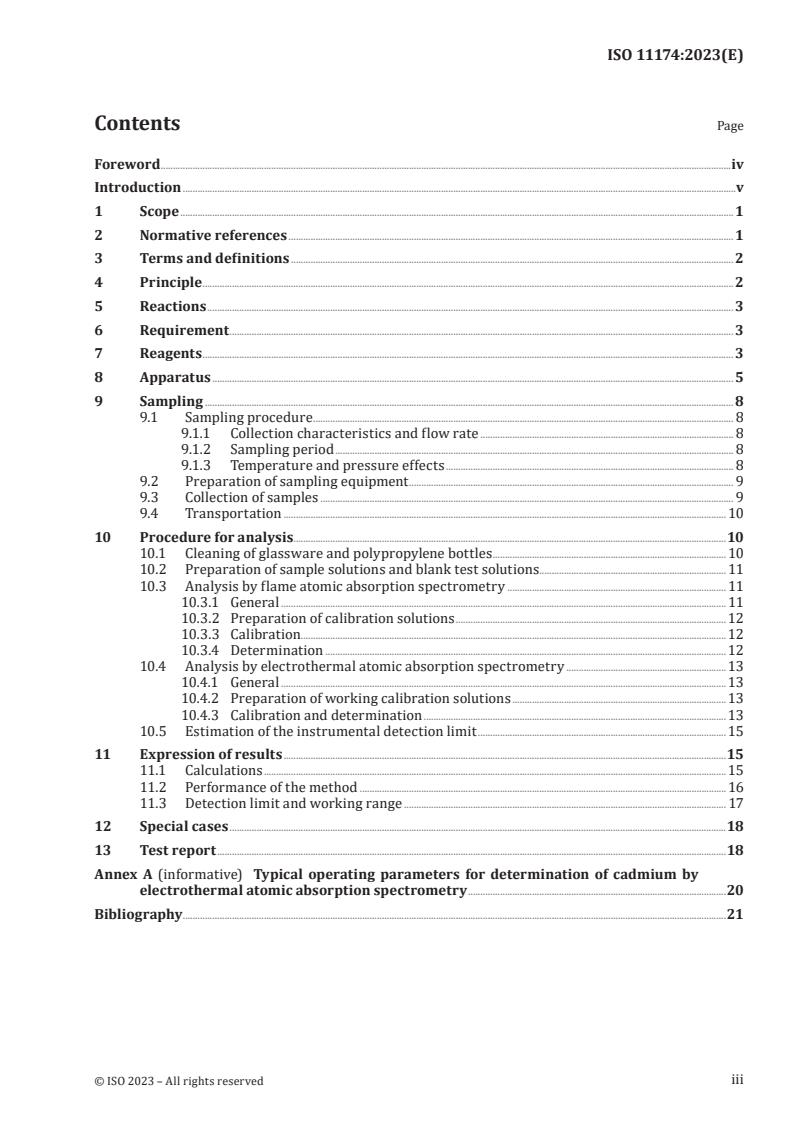
Contents Page
Foreword .iv
Introduction .v
1 Scope . 1
2 Normative references . 1
3 Terms and definitions . 2
4 Principle . 2
5 Reactions . 3
6 Requirement . 3
7 Reagents . 3
8 Apparatus . 5
9 Sampling . 8
9.1 Sampling procedure . 8
9.1.1 Collection characteristics and flow rate . 8
9.1.2 Sampling period . 8
9.1.3 Temperature and pressure effects . 8
9.2 Preparation of sampling equipment . 9
9.3 Collection of samples . 9
9.4 Transportation . 10
10 Procedure for analysis.10
10.1 Cleaning of glassware and polypropylene bottles . 10
10.2 Preparation of sample solutions and blank test solutions . 11
10.3 Analysis by flame atomic absorption spectrometry . 11
10.3.1 General . 11
10.3.2 Preparation of calibration solutions .12
10.3.3 Calibration . . .12
10.3.4 Determination .12
10.4 Analysis by electrothermal atomic absorption spectrometry .13
10.4.1 General .13
10.4.2 Preparation of working calibration solutions .13
10.4.3 Calibration and determination . 13
10.5 Estimation of the instrumental detection limit . 15
11 Expression of results .15
11.1 Calculations . 15
11.2 Performance of the method . 16
11.3 Detection limit and working range . 17
12 Special cases .18
13 Test report .18
Annex A (informative) Typical operating parameters for determination of cadmium by
electrothermal atomic absorption spectrometry .20
Bibliography .21
iii
Foreword
ISO (the International Organization for Standardization) is a worldwide federation of national standards
bodies (ISO member bodies). The work of preparing International Standards is normally carried out
through ISO technical committees. Each member body interested in a subject for which a technical
committee has been established has the right to be represented on that committee. International
organizations, governmental and non-governmental, in liaison with ISO, also take part in the work.
ISO collaborates closely with the International Electrotechnical Commission (IEC) on all matters of
electrotechnical standardization.
The procedures used to develop this document and those intended for its further maintenance are
described in the ISO/IEC Directives, Part 1. In particular, the different approval criteria needed for the
different types of ISO document should be noted. This document was drafted in accordance with the
editorial rules of the ISO/IEC Directives, Part 2 (see www.iso.org/directives).
ISO draws attention to the possibility that the implementation of this document may involve the use
of (a) patent(s). ISO takes no position concerning the evidence, validity or applicability of any claimed
patent rights in respect thereof. As of the date of publication of this document, ISO had not received
notice of (a) patent(s) which may be required to implement this document. However, implementers are
cautioned that this may not represent the latest information, which may be obtained from the patent
database available at www.iso.org/patents. ISO shall not be held responsible for identifying any or all
such patent rights.
Any trade name used in this document is information given for the convenience of users and does not
constitute an endorsement.
For an explanation of the voluntary nature of standards, the meaning of ISO specific terms and
expressions related to conformity assessment, as well as information about ISO's adherence to
the World Trade Organization (WTO) principles in the Technical Barriers to Trade (TBT), see
www.iso.org/iso/foreword.html.
This document was prepared by Technical Committee ISO/TC 146, Air quality, Subcommittee SC 2,
Workplace atmospheres.
This second edition cancels and replaces the first edition (ISO 11174:1996), which has been technically
revised.
The main changes are as follows:
— a reference for handling of sampler wall deposits has been added;
— references and definitions have been updated;
— additional editorial changes have been made.
Any feedback or questions on this document should be directed to the user’s national standards body. A
complete listing of these bodies can be found at www.iso.org/members.html.
iv
Introduction
The health of workers in many industries, such as mining, metal refining, battery manufacture,
foundries, electronics and construction, is at risk through exposure by inhalation of particulate
cadmium and cadmium compounds. Industrial hygienists and other public health professionals need
to determine the effectiveness of measures taken to control workers' exposure, and this is generally
achieved by making workplace air measurements. This document provides a method for making valid
exposure measurements for cadmium. It is of benefit to: agencies concerned with health and safety
at work, industrial hygienists and other public health professionals, analytical laboratories, industrial
users and workers of metals and metalloids, etc.
The execution of its provisions and the interpretation of the results obtained is entrusted to
appropriately qualified and experienced people.
v
INTERNATIONAL STANDARD ISO 11174:2023(E)
Workplace air — Determination of particulate cadmium
and cadmium compounds — Flame and electrothermal
atomic absorption spectrometric method
WARNING — Cadmium and cadmium compounds are toxic and are suspected human
[1]
carcinogens . Avoid any exposure by inhalation. Personal protection (e.g. an effective
respirator) shall be used in all cases where exposure to cadmium or cadmium compounds is
possible.
1 Scope
This document specifies a method for the determination of the mass concentration of particulate
cadmium and cadmium compounds in workplace air, using either flame or electrothermal atomic
absorption spectrometry.
[2,3]
The sample digestion procedure specified in 10.2.2 has been validated for a selection of cadmium
compounds and pigments and glass enamels containing cadmium.
[2]
The analytical method has been validated for the determination of masses of 10 ng to 600 ng of
cadmium per sample using electrothermal atomic absorption spectrometry, and 0,15 µg to 96 µg of
[3]
cadmium per sample using flame atomic absorption spectrometry. The concentration range for
cadmium in air for which this procedure is applicable is determined in part by the sampling procedure
selected by the user.
The method is applicable to personal sampling of the inhalable or respirable fraction of airborne
particles, as defined in ISO 7708, and to stationary sampling.
2 Normative references
The following documents are referred to in the text in such a way that some or all of their content
constitutes requirements of this document. For dated references, only the edition cited applies. For
undated references, the latest edition of the referenced document (including any amendments) applies.
ISO 648, Laboratory glassware — Single-volume pipettes
ISO 1042, Laboratory glassware — One-mark volumetric flasks
ISO 3585, Borosilicate glass 3.3 — Properties
ISO 3696, Water for analytical laboratory use — Specification and test methods
ISO 7708, Air quality — Particle size fraction definitions for health-related sampling
ISO 8655-1, Piston-operated volumetric apparatus — Part 1: Terminology, general requirements and user
recommendations
ISO 8655-2, Piston-operated volumetric apparatus — Part 2: Pipettes
ISO 8655-5, Piston-operated volumetric apparatus — Part 5: Dispensers
ISO 8655-6, Piston-operated volumetric apparatus — Part 6: Gravimetric reference measurement
procedure for the determination of volume
ISO 13137, Workplace atmospheres — Pumps for personal sampling of chemical and biological agents —
Requirements and test methods
ISO/IEC 17025, General requirements for the competence of testing and calibration laboratories
ISO 18158, Workplace air — Terminology
ISO 20581, Workplace air — General requirements for the performance of procedures for the measurement
of chemical agents
ISO 21832, Workplace air — Metals and metalloids in airborne particles — Requirements for evaluation of
measuring procedures
3 Terms and definitions
For the purposes of this document, the terms and definitions given in ISO 18158 and the following apply.
ISO and IEC maintain terminology databases for use in standardization at the following addresses:
— ISO Online browsing platform: available at https:// www .iso .org/ obp
— IEC Electropedia: available at https:// www .electropedia .org/
3.1
exposure by inhalation
situation in which a chemical agent is present in air which is inhaled by a person
3.2
sample dissolution
process of obtaining a solution containing all analytes of interest from a sample, which might or might
not involve complete dissolution of the sample
[10]
[SOURCE: ISO 15202-2:2020 , 3.1]
3.3
sample solution
solution prepared from a sample by the process of sample dissolution (3.2)
[10]
[SOURCE: ISO 15202-2:2020 , 3.2]
3.4
test solution
blank solution or sample solution (3.3) that has been subjected to all operations required to bring it into
a state in which it is ready for analysis
[10]
[SOURCE: ISO 15202-2:2020 , 3.3, modified — Note 1 to entry has been deleted.]
4 Principle
4.1 Particulate cadmium and cadmium compounds are collected by drawing a measured volume of
air through a sampling substrate (8.2), such as a filter or foam, mounted in a sampler (8.1) designed to
collect either the inhalable fraction of airborne particles or the respirable fraction of airborne particles,
as appropriate.
4.2 A test solution is prepared by treating the sampling substrate (8.2) and collected sample with
5 ml of nitric acid diluted 1 + 1 (7.3), heating on a hotplate until about 1 ml of concentrated nitric acid
(7.2) solution remains, allowing the solution to cool and then diluting to 10 ml with water (7.1).
4.3 The test solution is analysed for cadmium by aspirating into the oxidizing air/acetylene flame
of an atomic absorption spectrometer (8.6.5) equipped with a cadmium hollow cathode lamp or
electrodeless discharge lamp. Absorbance measurements are made at 228,8 nm and results are
obtained by the analytical curve technique.
4.4 For accurate determination when the concentration of cadmium in the solution is low, the
analysis can be repeated using electrothermal atomic absorption spectrometry. Aliquots of the test
solution and a matrix-modifier solution are injected onto a solid, pyrolytic graphite platform mounted
in a pyrolytically coated graphite tube, and after the drying and sample ashing stages the sample is
atomized electrothermally. Absorbance measurements are made at 228,8 nm with background
correction and results are obtained by the analytical-curve technique.
5 Reactions
In general, the majority of particulate cadmium compounds which are commonly found in samples of
2+
workplace air are converted to water-soluble cadmium ions (Cd ) by the sample digestion procedure
specified in 10.2.2. However, if there is any doubt about the effectiveness of this procedure for digestion
of particulate cadmium compounds which can be present in the test atmosphere, investigate this before
[10]
proceeding with the method. For instance, other digestion methods described in ISO 15202-2 can be
suitable.
6 Requirement
The measuring procedure shall comply with the performance requirements specified in ISO 20581,
ISO 21832, and any relevant international, European or national standard which specifies performance
requirements for procedures for measuring chemical agents in workplace air.
7 Reagents
During the analysis, use only reagents of analytical grade, and only water as specified in 7.1.
7.1 Water, complying with the requirements for ISO 3696 grade 2 water (electrical conductivity less
than 0,1 mS/m and resistivity greater than 0,01 MΩ·m at 25 °C).
The concentration of cadmium in the water shall be less than 0,01 μg/ml.
It is recommended that the water used be obtained from a water purification system that delivers
ultrapure water having a resistivity greater than 0,18 MΩ·m (usually expressed by manufacturers of
water purification systems as 18 MΩ·cm).
7.2 Nitric acid (HNO ), concentrated, ρ = 1,42 g/ml, 69 % (m/m) to 71 % (m/m).
The concentration of cadmium shall be less than 0,01 µg/ml.
WARNING — Concentrated nitric acid is corrosive and oxidizing, and nitric acid fumes are
irritant. Avoid exposure by contact with the skin or eyes, or by inhalation of fumes. Personal
protective equipment (e.g. gloves, face shield or safety spectacles) shall be used when working
with the concentrated or diluted nitric acid, and concentrated nitric acid shall be used in a fume
hood.
7.3 Nitric acid, diluted 1 + 1.
Carefully add 500 ml of concentrated nitric acid (7.2) to 450 ml of water (7.1) in a 2 l beaker. Swirl to
mix, allow to cool and quantitatively transfer to a 1 000 ml one-mark volumetric flask (8.6.1.7). Dilute
to the mark with water, stopper and mix thoroughly.
7.4 Nitric acid, diluted 1 + 9.
Pour approximately 800 ml of water (7.1) into a 1 000 ml one-mark volumetric flask (8.6.1.7). Carefully
add 100 ml of concentrated nitric acid (7.2) to the flask and swirl to mix. Allow to cool, dilute to the
mark with water, stopper and mix thoroughly.
7.5 Hydrofluoric acid (HF), concentrated, ρ ≈ 1,16 g/ml (about 48 % mass fraction), if required (see
10.2.2), for digestion of samples containing lead silicates.
The concentration of cadmium in the HF shall be less than 0,1 μg/ml.
WARNING — Concentrated hydrofluoric acid and hydrogen fluoride vapour are extremely toxic
and intensely corrosive. Diluted hydrofluoric acid can also cause serious and painful burns, and
it is possible that these burns will not be felt until up to 24 h after contact. Avoid exposure by
contact with the skin or the eyes, or by inhalation of the vapour. Use of personal protection (e.g.
impermeable gloves, face shield or safety glasses) is essential when working with concentrated
or diluted hydrofluoric acid, and concentrated hydrofluoric acid should be used in a fume
hood. It is essential that hydrofluoric acid antidote gel containing calcium gluconate is readily
available to workers, both during and for 24 h after use of hydrofluoric acid.
7.6 Cadmium stock standard solution, corresponding to 1 000 mg of Cd per litre.
7.6.1 Use a commercially available cadmium standard solution at a concentration of 1 000 mg/l.
Observe the manufacturer's expiry date or recommended shelf-life.
Alternatively, prepare a cadmium standard solution according to the procedure specified in 7.6.2.
7.6.2 Accurately weigh 1 000 g ± 0,001 g of cadmium metal, 99,9 % of Cd, into a 50 ml beaker
(8.6.1.1), add 20 ml of the nitric acid diluted 1 + 1 (7.3), cover with a watch glass (8.6.1.4) and heat to
approximately 150 °C on the hotplate (8.6.4) in a fume hood until the metal is completely dissolved.
Remove the beaker from the hotplate, allow to cool, quantitatively transfer the solution to a 1 000 ml
one-mark volumetric flask (8.6.1.7), dilute to the mark with water (7.1), stopper and mix thoroughly.
This solution can be stored in a polypropylene bottle (8.6.2.2) for up to one year.
7.7 Cadmium working standard solution A, corresponding to 100 mg of Cd per litre.
Using a pipette (8.6.3.1), accurately add 10,0 ml of stock cadmium solution (7.6) to a 100 ml one-mark
volumetric flask (8.6.1.7). Add 1 ml of concentrated nitric acid (7.2), dilute to the mark with water (7.1),
stopper and mix thoroughly.
This solution can be stored in a polypropylene bottle (8.6.2.2) for up to one month.
7.8 Cadmium working standard solution B, corresponding to 1 mg of Cd per litre.
Using a pipette (8.6.3.1), accurately add 100 µl of cadmium stock solution (7.6) to a 100 ml one-mark
volumetric flask (8.6.1.7). Add 1 ml of nitric acid (7.2), dilute to the mark with water (7.1), stopper and
mix thoroughly.
This solution can be stored in a polypropylene bottle (8.6.2.2) for up to one month.
7.9 Matrix-modifier solution, corresponding to 10 g of NH H PO per litre of water (7.1).
4 2 4
Weigh 1,00 g of ammonium dihydrogen phosphate (NH H PO ) into a 250 ml beaker (8.6.1.1). Add
4 2 4
50 ml of water (7.1) and swirl to dissolve. Add 10 ml of concentrated nitric acid (7.2), swirl to mix, and
quantitatively transfer the solution to a 100 ml one-mark volumetric flask (8.6.1.7). Dilute to the mark
with water, stopper and mix thoroughly.
If modifications are needed to optimize the matrix-modifier solution, these modifications should be
described in the test report (Clause 13).
7.10 Laboratory detergent solution, suitable for cleaning samplers (8.1) and laboratory apparatus,
diluted with water (7.1) according to the manufacturer's instructions.
7.11 Air, high-purity, compressed and filtered.
7.12 Acetylene, in a compressed gas cylinder.
7.13 Argon, supplied in a cylinder or as a cryogenic fluid.
This gas is required if the analysis is carried out by electrothermal atomic absorption spectrometry
(see 10.3.4.6).
8 Apparatus
8.1 Samplers, for collection of the inhalable fraction or the respirable fraction of airborne particles
(see 9.1.1) as defined in ISO 7708, suitable for use with the sampling substrates (8.2) and compatible
with the sampling pumps (8.3) used.
NOTE 1 A number of different terms are used to describe samplers designed for collection of the inhalable
fraction of airborne particles, for example, sampling heads, filter holders, filter cassettes and air monitoring
[9]
cassettes (see ISO 15202-1 ).
NOTE 2 In general, the collection characteristics of inhalable samplers are such that particulate material
collected on the filter sampling substrate is the inhalable or respirable fraction of airborne particles, and any
deposited on the internal surfaces of the sampler is not of interest. However, some samplers are designed such
that airborne particles which pass through the entry orifice(s) constitute the inhalable or respirable fraction;
in which case any particulate material deposited on the internal surfaces of the sampler is part of the sample.
Certain samplers of this type incorporate an internal filter cassette or cartridge which can be removed from the
[4]
sampler to enable this material to be easily recovered. See ASTM D8358 for further information on inclusion of
sampler internal wall deposits.
NOTE 3 Cyclone samplers are typically used for collection of personal samples of the respirable fraction of
airborne particles.
NOTE 4 Samplers manufactured in non-conducting material have electrostatic properties which can influence
representative sampling. Samplers manufactured from conducting material can reduce electrostatic influences.
8.2 Sampling substrates, such as filters or foams, soluble using the sample digestion procedure
specified in 10.2.2, and with a retentivity not less than 99 % for particles of median aerodynamic
diameter 0,3 µm (see ISO 7708).
The cadmium content shall be less than 0,001 µg per sampling substrate.
NOTE Mixed cellulose ester membrane filters of 0,8 µm to 1,2 µm pore size are generally the most suitable.
Cellulose (paper) filters can have a retentivity below 99 % and are therefore unsuitable. Neither glass-fibre nor
quartz-fibre filters are dissolved by the sample digestion procedure specified in 10.2.2, but this can be modified
to permit their use. Furthermore, such filters can have high metal background which can cause interference in
highly sensitive analysis.
8.3 Sampling pumps, conforming to the specifications of ISO 13137.
8.4 Flowmeter, portable, capable of measuring the appropriate flow rate (see 9.1.1) to within ±5 %,
and calibrated against a primary standard, i.e. a flowmeter of which the accuracy is traceable to
national standards.
The calibration of the flowmeter shall be checked against a primary standard, i.e. a flowmeter whose
accuracy is traceable to national standards. If appropriate (see 9.1.3.2), record the atmospheric
temperature and pressure at which the calibration of the flowmeter was checked.
It is recommended that the flowmeter used be capable of measuring the volumetric flow rate to within
±2 % or better.
8.5 Ancillary equipment
8.5.1 Flexible tubing, of a diameter suitable for making a leak-proof connection from the samplers
(8.1) to the sampling pumps (8.3).
8.5.2 Belts or harnesses, to which the sampling pumps (8.3) can conveniently be fixed for personal
sampling (except where the sampling pumps are small enough to fit inside worker's pockets).
8.5.3 Flat-tipped forceps, for loading and unloading sampling substrates (8.2) into samplers (8.1).
8.5.4 Transport cassettes, or similar, if required to transport samples for laboratory analysis.
To avoid potential contamination after sample collection, it is advisable to leave sampling substrates
(8.2) within the sample holders during transportation of samples.
8.5.5 Barometer, suitable for measurement of atmospheric pressure, if required (see 9.1.3).
8.5.6 Thermometer, minimum temperature range of 0 °C to 50 °C, with graduated divisions of 1 °C
or less, for measurement of atmospheric temperature.
For applications at temperatures below freezing, the range of the thermometer shall extend to the
appropriate desired range.
A hygrometer can also be used for measurement of relative humidity, if desired.
8.6 Analytical or laboratory apparatus
Ordinary laboratory apparatus, and:
8.6.1 Glassware, made of borosilicate glass 3.3 complying with the requirements of ISO 3585.
It is preferable to reserve a set of glassware for analysis of cadmium by this method. It is possible that
heavily contaminated glassware in general usage will not be satisfactorily cleaned using the procedure
specified in 10.1.4.
8.6.1.1 Beakers, capacity 50 ml, for digestion of sampling substrates (8.2), and for preparation of the
cadmium stock standard solution (7.6).
If hydrofluoric acid (7.5) is used to assist in sample dissolution, use of plastic heatable beakers (8.6.2.1)
that are resistant to corrosion by HF should be used.
8.6.1.2 Beakers, capacity 250 ml, for preparation of the matrix-modifier solution (7.9).
8.6.1.3 Beakers, capacity 2 l, for preparation of nitric acid diluted 1 + 1 (7.3).
8.6.1.4 Watch glasses, to fit the 50 ml beakers (8.6.1.1).
8.6.1.5 Single volume pipettes, complying with the requirements of ISO 648, as an alternative to
piston-operated volumetric apparatus (8.6.3).
8.6.1.6 Measuring cylinders, of capacities between 10 ml and 1 l.
8.6.1.7 One-mark volumetric flasks, of capacities between 10 ml and 1 000 ml, complying with the
requirements of ISO 1042.
8.6.2 Plastic labware, including the following:
8.6.2.1 Heatable beakers, beaker covers, etc., if required, made of a material that is resistant
to corrosion by hydrofluoric acid (7.5); e.g. a fluorocarbon polymer such as polytetrafluoroethylene
(PTFE), and suitable for performing dissolutions using hydrofluoric acid.
NOTE If resistance to corrosion by HF is not needed, beakers and beaker covers can be made of glassware
(8.6.1).
8.6.2.2 Polypropylene bottles, of capacities from 100 ml to 1 000 ml.
Bottles made of alternative plastics can be used, provided that they are suitable for the intended use
(see 7.6.2, 7.6 and 7.7). However, the use of bottles made of coloured plastics should be avoided, since
some contain cadmium pigments which can release cadmium when in contact with nitric acid solutions.
8.6.3 Piston-operated volumetric instruments, complying with the requirements of ISO 8655-1
and tested in accordance with ISO 8655-6.
8.6.3.1 Pipetters, complying with the requirements of ISO 8655-2, as an alternative to single volume
pipettes (8.6.1.5), for the preparation of standard solutions, calibration solutions and dilution of
samples.
8.6.3.2 Dispensers, complying with the requirements of ISO 8655-5, for dispensing acids.
8.6.4 Hot plate, thermostatically controlled, capable of maintaining a surface temperature of
approximately 150 °C, for hot plate procedures.
NOTE The efficiency of thermostatted hotplates is sometimes deficient, and the surface temperature
can also vary considerably with position on a hotplate with a large surface area. It can therefore be useful to
characterize the performance of the hotplate before use.
8.6.5 Atomic absorption spectrometer, fitted with an air-acetylene burner supplied with
compressed air (7.11) and acetylene (7.12), and equipped with either a cadmium hollow cathode lamp
or electrodeless discharge lamp.
If sample dissolution is carried out with the aid of hydrofluoric acid (7.5) (see 10.2.2), the atomic
absorption spectrometer shall be compatible with hydrofluoric acid.
If electrothermal atomic absorption is to be carried out (see 10.3.4.6), the atomic absorption
spectrometer shall be capable of carrying out simultaneous background correction at 228,8 nm, either
by using a continuous source such as a deuterium lamp to measure non-specific attenuation, or by using
[5]
Zeeman or Smith-Hieftje background correction systems .
8.6.6 Electrothermal atomiser, fitted with a solid, pyrolytic graphite platform mounted in a
pyrolytically coated graphite tube, supplied with argon (7.13) as a purge gas, and equipped with an
autosampler capable of injecting microlitre volumes onto the platform.
NOTE Some manufacturers of atomic absorption spectrometers (8.6.5) use an alternative design of
electrothermal atomiser to achieve a constant temperature environment during atomisation, and some use
aerosol deposition as a means of sample introduction. The use of such accessories is acceptable, but it is possible
that the performance of the method will be different from that given in 11.2.
8.6.7 Disposable autosampler cups, made of polystyrene or other suitable plastics, for use in the
autosampler used with the electrothermal atomiser (8.6.6).
It is recommended to avoid the use of autosampler cups made of coloured plastics, since some contain
cadmium pigments which can release cadmium in contact with nitric acid solutions.
8.6.8 Analytical balance, capable, of weighing to ±0,1 µg.
8.6.9 Disposable gloves, impermeable, to avoid the possibility of contamination from the hands and
to protect them from contact with toxic and corrosive substances. Polyvinyl chloride (PVC) gloves are
suitable.
9 Sampling
9.1 Sampling procedure
9.1.1 Collection characteristics and flow rate
Select a sampler (8.1) suitable for collection of either the inhalable fraction or the respirable fraction
of airborne particles, as defined in ISO 7708, and use at the flow rate at which the sampler exhibits the
required collection characteristics.
National occupational exposure limits for cadmium and cadmium compounds typically apply to the
inhalable or respirable fraction of airborne particles.
NOTE Both inhalable and respirable samplers are typically used at flow rates of around 2 l/min (it is
advisable to refer to the manufacturer's recommendations). Some samplers enable flow rates of up to 10 l/min.
9.1.2 Sampling period
Select a sampling period of appropriate duration (2 h minimum), using any available information
about the work process and test atmosphere, so that the amount of cadmium collected is within the
recommended working range of the method. For example, use a sampling period that relates to the
reference period (such as 8 h).
In order to estimate a sampling period of appropriate duration, it is necessary to consider the flow
rate used (see 9.1.1) and the anticipated concentration of cadmium in the test atmosphere. When low
cadmium-in-air concentrations are anticipated, the lower limit of the working range of the method (see
11.3.2) should be taken into consideration. For example, to determine cadmium in air at a concentration
of 0,5 µg/m using flame atomic absorption spectrometry, the minimum sampling time at a flow rate of
2 1/min is 8 h. When high cadmium-in-air concentrations are anticipated, the sampling time should not
be long enough to risk overloading the sampling substrate (8.2) with particulate matter.
9.1.3 Temperature and pressure effects
9.1.3.1 Consider whether it is necessary to recalculate the mass concentration of cadmium in air
to reference conditions of temperature and pressure in order to comply with national standards and
[6]
regulations (see ISO 8756 ). If appropriate, measure and record the atmospheric temperature and
pressure throughout the sampling period (see 9.3.2, 9.3.3 and 9.3.5) and use the equation given in
11.1.3 to apply the necessary correction.
NOTE Cadmium-in-air concentrations are generally stated for the actual environmental conditions
(temperature, pressure) at the workplace.
9.1.3.2 The indicated flow rate of certain types of flowmeter is dependent upon temperature and
pressure. Therefore, refer to the manufacturer's directions for the particular flowmeter used, and
consider whether it is necessary to make a correction to take into account any difference between the
atmospheric temperature and pressure at the time of calibration of the flowmeter and at the time of
sampling. Make such a correction if it is considered possible that an error of greater than ±5 % will
be introduced by not doing so. If a correction is to be made, measure and record the atmospheric
temperature and pressure at which the flowmeter (8.4) was calibrated.
NOTE An example of temperature and pressure correction for the indicated flow rate is given in 11.1.2, for a
flowmeter of variable area with constant pressure drop.
9.2 Preparation of sampling equipment
Perform the following in an area where cadmium contamination is known to be low.
9.2.1 Clean the samplers (8.1) before use. Disassemble the samplers, soak in laboratory detergent
solution (7.10), rinse thoroughly with water (7.1), wipe with absorptive tissue and allow to dry before
reassembly.
9.2.2 Load the sampling substrates (8.2), such as filters or foams, into clean, dry samplers (8.1) using
clean, flat-tipped forceps (8.5.3). Connect each loaded sampler to a sampling pump (8.3) using flexible
tubing (8.5.1), ensuring that no leaks can occur. Switch on the sampling pump, attach the calibrated
flowmeter (8.4) to the sampler so that it measures the flow through the sampler inlet orifice(s), and set
the appropriate flow rate (see 9.1.1) with an accuracy of ±5 %. Switch off the sampling pump and seal
the sampler with its protective cover or plug to prevent contamination with cadmium during transport
to the sampling position.
If necessary, based on the type of sampling pump, warm the pump up (it is recommended to refer to the
manufacturer's instructions).
9.3 Collection of samples
9.3.1 For personal sampling, fix the sampler (8.1) to the lapel of the worker, in the breathing zone
and as close to the mouth and nose as is reasonably practicable. Then, either place the sampling pump
(8.3) in a convenient pocket or attach it to the worker in a manner that causes minimum inconvenience,
for example, to a belt (8.5.2) around the waist. For stationary sampling, position the sampler at the
sampling site.
NOTE The breathing zone has been defined in ISO 18158 as the space around the worker's face from where
he takes his breath. For technical purposes, a more precise definition can be provided, as follows: hemisphere
(generally accepted to be 0,3 m in radius) extending in front of the human face, centred on the midpoint of a line
joining the ears; the base of the hemisphere is a plane through this line, the top of the head and the larynx.
9.3.2 When ready to begin sampling, remove the protective cover or plug from the sampler (8.1)
and switch on the sampling pump. Record the time at the start of the sampling period and, if the
sampling pump has an elapsed time indicator, set this to zero. If appropriate (see 9.1.3.1), measure
the atmospheric temperature and pressure at the start of the sampling period using the thermometer
(8.5.6) and barometer (8.5.5) and record the measured values.
NOTE If desired, relative humidity can be measured by using a hygrometer.
9.3.3 Since it is possible for the sampling substrate (8.2) to become clogged, monitor the performance
of the sampler (8.1) frequently, a minimum of once per hour. Measure the flow rate with an accuracy
of ±5 % using the calibrated flowmeter (8.4) and, if appropriate (see 9.1.3.1), measure the atmospheric
temperature using the thermometer (8.5.6) and the atmospheric pressure using the barometer (8.5.5).
Record the measured values.
NOTE Regular observation of the flow-fault indicator is an acceptable means of ensuring that the flow rate
of a flow-stabilized sampling pump is maintained satisfactorily, provided that the flow-fault indicator indicates
malfunction when the flow rate is outside ±5 % of the nominal value.
9.3.4 Terminate sampling and consider the sample to be invalid if the flow rate is not maintained to
within ±5 % of the nominal value throughout the sampling period.
9.3.5 At the end of the sampling period (see 9.1.2), measure the flow rate with an accuracy of ±5 %
using the calibrated flowmeter (8.4), switch off the sampling pump (8.3) and record the flow rate and
the time. Also observe the reading on the elapsed time indicator, if fitted, and consider the sample to
be invalid if the reading on the elapsed time indicator and the timed interval between switching the
sampling pump on and off do not agree to within ±5 %, since this can suggest that the sampling pump
has not been operating throughout the sampling period. Reseal the sampler (8.1) with its protective
cover or plug and disconnect it from the sampling pump. If appropriate (see 9.1.3.1), measure the
atmospheric temperature and pressure at the end of the sampling period using the thermometer (8.5.6)
and barometer (8.5.5) and record the measured values.
9.3.6 Carefully record the sample identity and all relevant sampling data (see Clause 13). Calculate
the mean flow rate by averaging the flow-rate measurements taken throughout the sampling period,
and, if appropriate (see 9.1.3.1), calculate the mean atmospheric temperature and pressure. Calculate
the volume of air sampled, in litres, at atmospheric temperature and pressure, by multiplying the mean
flow rate, in litres per minute, by the sampling time, in minutes.
9.3.7 With each batch of 10 samples, submit for analysis at least two unused filters sampling
substrates (8.2) from the same lot as used for sample collection. Subject these blank sampling substrates
to exactly the same handling procedure as the samples, but do not draw air through them.
9.4 Transportation
Perform the following in an area where cadmium contamination is known to be low.
9.4.1 For samplers (8.1) which collect the required fraction of airborne particles on the sampling
substrate (8.2), remove the sampling substrate from each sampler using clean flat-tipped forceps
(8.5.3), place in a labelled transpor
...
INTERNATIONAL ISO
STANDARD 11174
Second edition
2023-05
Workplace air — Determination
of particulate cadmium and
cadmium compounds — Flame and
electrothermal atomic absorption
spectrometric method
Reference number
© ISO 2023
All rights reserved. Unless otherwise specified, or required in the context of its implementation, no part of this publication may
be reproduced or utilized otherwise in any form or by any means, electronic or mechanical, including photocopying, or posting on
the internet or an intranet, without prior written permission. Permission can be requested from either ISO at the address below
or ISO’s member body in the country of the requester.
ISO copyright office
CP 401 • Ch. de Blandonnet 8
CH-1214 Vernier, Geneva
Phone: +41 22 749 01 11
Email: copyright@iso.org
Website: www.iso.org
Published in Switzerland
ii
Contents Page
Foreword .iv
Introduction .v
1 Scope . 1
2 Normative references . 1
3 Terms and definitions . 2
4 Principle . 2
5 Reactions . 3
6 Requirement . 3
7 Reagents . 3
8 Apparatus . 5
9 Sampling . 8
9.1 Sampling procedure . 8
9.1.1 Collection characteristics and flow rate . 8
9.1.2 Sampling period . 8
9.1.3 Temperature and pressure effects . 8
9.2 Preparation of sampling equipment . 9
9.3 Collection of samples . 9
9.4 Transportation . 10
10 Procedure for analysis.10
10.1 Cleaning of glassware and polypropylene bottles . 10
10.2 Preparation of sample solutions and blank test solutions . 11
10.3 Analysis by flame atomic absorption spectrometry . 11
10.3.1 General . 11
10.3.2 Preparation of calibration solutions .12
10.3.3 Calibration . . .12
10.3.4 Determination .12
10.4 Analysis by electrothermal atomic absorption spectrometry .13
10.4.1 General .13
10.4.2 Preparation of working calibration solutions .13
10.4.3 Calibration and determination . 13
10.5 Estimation of the instrumental detection limit . 15
11 Expression of results .15
11.1 Calculations . 15
11.2 Performance of the method . 16
11.3 Detection limit and working range . 17
12 Special cases .18
13 Test report .18
Annex A (informative) Typical operating parameters for determination of cadmium by
electrothermal atomic absorption spectrometry .20
Bibliography .21
iii
Foreword
ISO (the International Organization for Standardization) is a worldwide federation of national standards
bodies (ISO member bodies). The work of preparing International Standards is normally carried out
through ISO technical committees. Each member body interested in a subject for which a technical
committee has been established has the right to be represented on that committee. International
organizations, governmental and non-governmental, in liaison with ISO, also take part in the work.
ISO collaborates closely with the International Electrotechnical Commission (IEC) on all matters of
electrotechnical standardization.
The procedures used to develop this document and those intended for its further maintenance are
described in the ISO/IEC Directives, Part 1. In particular, the different approval criteria needed for the
different types of ISO document should be noted. This document was drafted in accordance with the
editorial rules of the ISO/IEC Directives, Part 2 (see www.iso.org/directives).
ISO draws attention to the possibility that the implementation of this document may involve the use
of (a) patent(s). ISO takes no position concerning the evidence, validity or applicability of any claimed
patent rights in respect thereof. As of the date of publication of this document, ISO had not received
notice of (a) patent(s) which may be required to implement this document. However, implementers are
cautioned that this may not represent the latest information, which may be obtained from the patent
database available at www.iso.org/patents. ISO shall not be held responsible for identifying any or all
such patent rights.
Any trade name used in this document is information given for the convenience of users and does not
constitute an endorsement.
For an explanation of the voluntary nature of standards, the meaning of ISO specific terms and
expressions related to conformity assessment, as well as information about ISO's adherence to
the World Trade Organization (WTO) principles in the Technical Barriers to Trade (TBT), see
www.iso.org/iso/foreword.html.
This document was prepared by Technical Committee ISO/TC 146, Air quality, Subcommittee SC 2,
Workplace atmospheres.
This second edition cancels and replaces the first edition (ISO 11174:1996), which has been technically
revised.
The main changes are as follows:
— a reference for handling of sampler wall deposits has been added;
— references and definitions have been updated;
— additional editorial changes have been made.
Any feedback or questions on this document should be directed to the user’s national standards body. A
complete listing of these bodies can be found at www.iso.org/members.html.
iv
Introduction
The health of workers in many industries, such as mining, metal refining, battery manufacture,
foundries, electronics and construction, is at risk through exposure by inhalation of particulate
cadmium and cadmium compounds. Industrial hygienists and other public health professionals need
to determine the effectiveness of measures taken to control workers' exposure, and this is generally
achieved by making workplace air measurements. This document provides a method for making valid
exposure measurements for cadmium. It is of benefit to: agencies concerned with health and safety
at work, industrial hygienists and other public health professionals, analytical laboratories, industrial
users and workers of metals and metalloids, etc.
The execution of its provisions and the interpretation of the results obtained is entrusted to
appropriately qualified and experienced people.
v
INTERNATIONAL STANDARD ISO 11174:2023(E)
Workplace air — Determination of particulate cadmium
and cadmium compounds — Flame and electrothermal
atomic absorption spectrometric method
WARNING — Cadmium and cadmium compounds are toxic and are suspected human
[1]
carcinogens . Avoid any exposure by inhalation. Personal protection (e.g. an effective
respirator) shall be used in all cases where exposure to cadmium or cadmium compounds is
possible.
1 Scope
This document specifies a method for the determination of the mass concentration of particulate
cadmium and cadmium compounds in workplace air, using either flame or electrothermal atomic
absorption spectrometry.
[2,3]
The sample digestion procedure specified in 10.2.2 has been validated for a selection of cadmium
compounds and pigments and glass enamels containing cadmium.
[2]
The analytical method has been validated for the determination of masses of 10 ng to 600 ng of
cadmium per sample using electrothermal atomic absorption spectrometry, and 0,15 µg to 96 µg of
[3]
cadmium per sample using flame atomic absorption spectrometry. The concentration range for
cadmium in air for which this procedure is applicable is determined in part by the sampling procedure
selected by the user.
The method is applicable to personal sampling of the inhalable or respirable fraction of airborne
particles, as defined in ISO 7708, and to stationary sampling.
2 Normative references
The following documents are referred to in the text in such a way that some or all of their content
constitutes requirements of this document. For dated references, only the edition cited applies. For
undated references, the latest edition of the referenced document (including any amendments) applies.
ISO 648, Laboratory glassware — Single-volume pipettes
ISO 1042, Laboratory glassware — One-mark volumetric flasks
ISO 3585, Borosilicate glass 3.3 — Properties
ISO 3696, Water for analytical laboratory use — Specification and test methods
ISO 7708, Air quality — Particle size fraction definitions for health-related sampling
ISO 8655-1, Piston-operated volumetric apparatus — Part 1: Terminology, general requirements and user
recommendations
ISO 8655-2, Piston-operated volumetric apparatus — Part 2: Pipettes
ISO 8655-5, Piston-operated volumetric apparatus — Part 5: Dispensers
ISO 8655-6, Piston-operated volumetric apparatus — Part 6: Gravimetric reference measurement
procedure for the determination of volume
ISO 13137, Workplace atmospheres — Pumps for personal sampling of chemical and biological agents —
Requirements and test methods
ISO/IEC 17025, General requirements for the competence of testing and calibration laboratories
ISO 18158, Workplace air — Terminology
ISO 20581, Workplace air — General requirements for the performance of procedures for the measurement
of chemical agents
ISO 21832, Workplace air — Metals and metalloids in airborne particles — Requirements for evaluation of
measuring procedures
3 Terms and definitions
For the purposes of this document, the terms and definitions given in ISO 18158 and the following apply.
ISO and IEC maintain terminology databases for use in standardization at the following addresses:
— ISO Online browsing platform: available at https:// www .iso .org/ obp
— IEC Electropedia: available at https:// www .electropedia .org/
3.1
exposure by inhalation
situation in which a chemical agent is present in air which is inhaled by a person
3.2
sample dissolution
process of obtaining a solution containing all analytes of interest from a sample, which might or might
not involve complete dissolution of the sample
[10]
[SOURCE: ISO 15202-2:2020 , 3.1]
3.3
sample solution
solution prepared from a sample by the process of sample dissolution (3.2)
[10]
[SOURCE: ISO 15202-2:2020 , 3.2]
3.4
test solution
blank solution or sample solution (3.3) that has been subjected to all operations required to bring it into
a state in which it is ready for analysis
[10]
[SOURCE: ISO 15202-2:2020 , 3.3, modified — Note 1 to entry has been deleted.]
4 Principle
4.1 Particulate cadmium and cadmium compounds are collected by drawing a measured volume of
air through a sampling substrate (8.2), such as a filter or foam, mounted in a sampler (8.1) designed to
collect either the inhalable fraction of airborne particles or the respirable fraction of airborne particles,
as appropriate.
4.2 A test solution is prepared by treating the sampling substrate (8.2) and collected sample with
5 ml of nitric acid diluted 1 + 1 (7.3), heating on a hotplate until about 1 ml of concentrated nitric acid
(7.2) solution remains, allowing the solution to cool and then diluting to 10 ml with water (7.1).
4.3 The test solution is analysed for cadmium by aspirating into the oxidizing air/acetylene flame
of an atomic absorption spectrometer (8.6.5) equipped with a cadmium hollow cathode lamp or
electrodeless discharge lamp. Absorbance measurements are made at 228,8 nm and results are
obtained by the analytical curve technique.
4.4 For accurate determination when the concentration of cadmium in the solution is low, the
analysis can be repeated using electrothermal atomic absorption spectrometry. Aliquots of the test
solution and a matrix-modifier solution are injected onto a solid, pyrolytic graphite platform mounted
in a pyrolytically coated graphite tube, and after the drying and sample ashing stages the sample is
atomized electrothermally. Absorbance measurements are made at 228,8 nm with background
correction and results are obtained by the analytical-curve technique.
5 Reactions
In general, the majority of particulate cadmium compounds which are commonly found in samples of
2+
workplace air are converted to water-soluble cadmium ions (Cd ) by the sample digestion procedure
specified in 10.2.2. However, if there is any doubt about the effectiveness of this procedure for digestion
of particulate cadmium compounds which can be present in the test atmosphere, investigate this before
[10]
proceeding with the method. For instance, other digestion methods described in ISO 15202-2 can be
suitable.
6 Requirement
The measuring procedure shall comply with the performance requirements specified in ISO 20581,
ISO 21832, and any relevant international, European or national standard which specifies performance
requirements for procedures for measuring chemical agents in workplace air.
7 Reagents
During the analysis, use only reagents of analytical grade, and only water as specified in 7.1.
7.1 Water, complying with the requirements for ISO 3696 grade 2 water (electrical conductivity less
than 0,1 mS/m and resistivity greater than 0,01 MΩ·m at 25 °C).
The concentration of cadmium in the water shall be less than 0,01 μg/ml.
It is recommended that the water used be obtained from a water purification system that delivers
ultrapure water having a resistivity greater than 0,18 MΩ·m (usually expressed by manufacturers of
water purification systems as 18 MΩ·cm).
7.2 Nitric acid (HNO ), concentrated, ρ = 1,42 g/ml, 69 % (m/m) to 71 % (m/m).
The concentration of cadmium shall be less than 0,01 µg/ml.
WARNING — Concentrated nitric acid is corrosive and oxidizing, and nitric acid fumes are
irritant. Avoid exposure by contact with the skin or eyes, or by inhalation of fumes. Personal
protective equipment (e.g. gloves, face shield or safety spectacles) shall be used when working
with the concentrated or diluted nitric acid, and concentrated nitric acid shall be used in a fume
hood.
7.3 Nitric acid, diluted 1 + 1.
Carefully add 500 ml of concentrated nitric acid (7.2) to 450 ml of water (7.1) in a 2 l beaker. Swirl to
mix, allow to cool and quantitatively transfer to a 1 000 ml one-mark volumetric flask (8.6.1.7). Dilute
to the mark with water, stopper and mix thoroughly.
7.4 Nitric acid, diluted 1 + 9.
Pour approximately 800 ml of water (7.1) into a 1 000 ml one-mark volumetric flask (8.6.1.7). Carefully
add 100 ml of concentrated nitric acid (7.2) to the flask and swirl to mix. Allow to cool, dilute to the
mark with water, stopper and mix thoroughly.
7.5 Hydrofluoric acid (HF), concentrated, ρ ≈ 1,16 g/ml (about 48 % mass fraction), if required (see
10.2.2), for digestion of samples containing lead silicates.
The concentration of cadmium in the HF shall be less than 0,1 μg/ml.
WARNING — Concentrated hydrofluoric acid and hydrogen fluoride vapour are extremely toxic
and intensely corrosive. Diluted hydrofluoric acid can also cause serious and painful burns, and
it is possible that these burns will not be felt until up to 24 h after contact. Avoid exposure by
contact with the skin or the eyes, or by inhalation of the vapour. Use of personal protection (e.g.
impermeable gloves, face shield or safety glasses) is essential when working with concentrated
or diluted hydrofluoric acid, and concentrated hydrofluoric acid should be used in a fume
hood. It is essential that hydrofluoric acid antidote gel containing calcium gluconate is readily
available to workers, both during and for 24 h after use of hydrofluoric acid.
7.6 Cadmium stock standard solution, corresponding to 1 000 mg of Cd per litre.
7.6.1 Use a commercially available cadmium standard solution at a concentration of 1 000 mg/l.
Observe the manufacturer's expiry date or recommended shelf-life.
Alternatively, prepare a cadmium standard solution according to the procedure specified in 7.6.2.
7.6.2 Accurately weigh 1 000 g ± 0,001 g of cadmium metal, 99,9 % of Cd, into a 50 ml beaker
(8.6.1.1), add 20 ml of the nitric acid diluted 1 + 1 (7.3), cover with a watch glass (8.6.1.4) and heat to
approximately 150 °C on the hotplate (8.6.4) in a fume hood until the metal is completely dissolved.
Remove the beaker from the hotplate, allow to cool, quantitatively transfer the solution to a 1 000 ml
one-mark volumetric flask (8.6.1.7), dilute to the mark with water (7.1), stopper and mix thoroughly.
This solution can be stored in a polypropylene bottle (8.6.2.2) for up to one year.
7.7 Cadmium working standard solution A, corresponding to 100 mg of Cd per litre.
Using a pipette (8.6.3.1), accurately add 10,0 ml of stock cadmium solution (7.6) to a 100 ml one-mark
volumetric flask (8.6.1.7). Add 1 ml of concentrated nitric acid (7.2), dilute to the mark with water (7.1),
stopper and mix thoroughly.
This solution can be stored in a polypropylene bottle (8.6.2.2) for up to one month.
7.8 Cadmium working standard solution B, corresponding to 1 mg of Cd per litre.
Using a pipette (8.6.3.1), accurately add 100 µl of cadmium stock solution (7.6) to a 100 ml one-mark
volumetric flask (8.6.1.7). Add 1 ml of nitric acid (7.2), dilute to the mark with water (7.1), stopper and
mix thoroughly.
This solution can be stored in a polypropylene bottle (8.6.2.2) for up to one month.
7.9 Matrix-modifier solution, corresponding to 10 g of NH H PO per litre of water (7.1).
4 2 4
Weigh 1,00 g of ammonium dihydrogen phosphate (NH H PO ) into a 250 ml beaker (8.6.1.1). Add
4 2 4
50 ml of water (7.1) and swirl to dissolve. Add 10 ml of concentrated nitric acid (7.2), swirl to mix, and
quantitatively transfer the solution to a 100 ml one-mark volumetric flask (8.6.1.7). Dilute to the mark
with water, stopper and mix thoroughly.
If modifications are needed to optimize the matrix-modifier solution, these modifications should be
described in the test report (Clause 13).
7.10 Laboratory detergent solution, suitable for cleaning samplers (8.1) and laboratory apparatus,
diluted with water (7.1) according to the manufacturer's instructions.
7.11 Air, high-purity, compressed and filtered.
7.12 Acetylene, in a compressed gas cylinder.
7.13 Argon, supplied in a cylinder or as a cryogenic fluid.
This gas is required if the analysis is carried out by electrothermal atomic absorption spectrometry
(see 10.3.4.6).
8 Apparatus
8.1 Samplers, for collection of the inhalable fraction or the respirable fraction of airborne particles
(see 9.1.1) as defined in ISO 7708, suitable for use with the sampling substrates (8.2) and compatible
with the sampling pumps (8.3) used.
NOTE 1 A number of different terms are used to describe samplers designed for collection of the inhalable
fraction of airborne particles, for example, sampling heads, filter holders, filter cassettes and air monitoring
[9]
cassettes (see ISO 15202-1 ).
NOTE 2 In general, the collection characteristics of inhalable samplers are such that particulate material
collected on the filter sampling substrate is the inhalable or respirable fraction of airborne particles, and any
deposited on the internal surfaces of the sampler is not of interest. However, some samplers are designed such
that airborne particles which pass through the entry orifice(s) constitute the inhalable or respirable fraction;
in which case any particulate material deposited on the internal surfaces of the sampler is part of the sample.
Certain samplers of this type incorporate an internal filter cassette or cartridge which can be removed from the
[4]
sampler to enable this material to be easily recovered. See ASTM D8358 for further information on inclusion of
sampler internal wall deposits.
NOTE 3 Cyclone samplers are typically used for collection of personal samples of the respirable fraction of
airborne particles.
NOTE 4 Samplers manufactured in non-conducting material have electrostatic properties which can influence
representative sampling. Samplers manufactured from conducting material can reduce electrostatic influences.
8.2 Sampling substrates, such as filters or foams, soluble using the sample digestion procedure
specified in 10.2.2, and with a retentivity not less than 99 % for particles of median aerodynamic
diameter 0,3 µm (see ISO 7708).
The cadmium content shall be less than 0,001 µg per sampling substrate.
NOTE Mixed cellulose ester membrane filters of 0,8 µm to 1,2 µm pore size are generally the most suitable.
Cellulose (paper) filters can have a retentivity below 99 % and are therefore unsuitable. Neither glass-fibre nor
quartz-fibre filters are dissolved by the sample digestion procedure specified in 10.2.2, but this can be modified
to permit their use. Furthermore, such filters can have high metal background which can cause interference in
highly sensitive analysis.
8.3 Sampling pumps, conforming to the specifications of ISO 13137.
8.4 Flowmeter, portable, capable of measuring the appropriate flow rate (see 9.1.1) to within ±5 %,
and calibrated against a primary standard, i.e. a flowmeter of which the accuracy is traceable to
national standards.
The calibration of the flowmeter shall be checked against a primary standard, i.e. a flowmeter whose
accuracy is traceable to national standards. If appropriate (see 9.1.3.2), record the atmospheric
temperature and pressure at which the calibration of the flowmeter was checked.
It is recommended that the flowmeter used be capable of measuring the volumetric flow rate to within
±2 % or better.
8.5 Ancillary equipment
8.5.1 Flexible tubing, of a diameter suitable for making a leak-proof connection from the samplers
(8.1) to the sampling pumps (8.3).
8.5.2 Belts or harnesses, to which the sampling pumps (8.3) can conveniently be fixed for personal
sampling (except where the sampling pumps are small enough to fit inside worker's pockets).
8.5.3 Flat-tipped forceps, for loading and unloading sampling substrates (8.2) into samplers (8.1).
8.5.4 Transport cassettes, or similar, if required to transport samples for laboratory analysis.
To avoid potential contamination after sample collection, it is advisable to leave sampling substrates
(8.2) within the sample holders during transportation of samples.
8.5.5 Barometer, suitable for measurement of atmospheric pressure, if required (see 9.1.3).
8.5.6 Thermometer, minimum temperature range of 0 °C to 50 °C, with graduated divisions of 1 °C
or less, for measurement of atmospheric temperature.
For applications at temperatures below freezing, the range of the thermometer shall extend to the
appropriate desired range.
A hygrometer can also be used for measurement of relative humidity, if desired.
8.6 Analytical or laboratory apparatus
Ordinary laboratory apparatus, and:
8.6.1 Glassware, made of borosilicate glass 3.3 complying with the requirements of ISO 3585.
It is preferable to reserve a set of glassware for analysis of cadmium by this method. It is possible that
heavily contaminated glassware in general usage will not be satisfactorily cleaned using the procedure
specified in 10.1.4.
8.6.1.1 Beakers, capacity 50 ml, for digestion of sampling substrates (8.2), and for preparation of the
cadmium stock standard solution (7.6).
If hydrofluoric acid (7.5) is used to assist in sample dissolution, use of plastic heatable beakers (8.6.2.1)
that are resistant to corrosion by HF should be used.
8.6.1.2 Beakers, capacity 250 ml, for preparation of the matrix-modifier solution (7.9).
8.6.1.3 Beakers, capacity 2 l, for preparation of nitric acid diluted 1 + 1 (7.3).
8.6.1.4 Watch glasses, to fit the 50 ml beakers (8.6.1.1).
8.6.1.5 Single volume pipettes, complying with the requirements of ISO 648, as an alternative to
piston-operated volumetric apparatus (8.6.3).
8.6.1.6 Measuring cylinders, of capacities between 10 ml and 1 l.
8.6.1.7 One-mark volumetric flasks, of capacities between 10 ml and 1 000 ml, complying with the
requirements of ISO 1042.
8.6.2 Plastic labware, including the following:
8.6.2.1 Heatable beakers, beaker covers, etc., if required, made of a material that is resistant
to corrosion by hydrofluoric acid (7.5); e.g. a fluorocarbon polymer such as polytetrafluoroethylene
(PTFE), and suitable for performing dissolutions using hydrofluoric acid.
NOTE If resistance to corrosion by HF is not needed, beakers and beaker covers can be made of glassware
(8.6.1).
8.6.2.2 Polypropylene bottles, of capacities from 100 ml to 1 000 ml.
Bottles made of alternative plastics can be used, provided that they are suitable for the intended use
(see 7.6.2, 7.6 and 7.7). However, the use of bottles made of coloured plastics should be avoided, since
some contain cadmium pigments which can release cadmium when in contact with nitric acid solutions.
8.6.3 Piston-operated volumetric instruments, complying with the requirements of ISO 8655-1
and tested in accordance with ISO 8655-6.
8.6.3.1 Pipetters, complying with the requirements of ISO 8655-2, as an alternative to single volume
pipettes (8.6.1.5), for the preparation of standard solutions, calibration solutions and dilution of
samples.
8.6.3.2 Dispensers, complying with the requirements of ISO 8655-5, for dispensing acids.
8.6.4 Hot plate, thermostatically controlled, capable of maintaining a surface temperature of
approximately 150 °C, for hot plate procedures.
NOTE The efficiency of thermostatted hotplates is sometimes deficient, and the surface temperature
can also vary considerably with position on a hotplate with a large surface area. It can therefore be useful to
characterize the performance of the hotplate before use.
8.6.5 Atomic absorption spectrometer, fitted with an air-acetylene burner supplied with
compressed air (7.11) and acetylene (7.12), and equipped with either a cadmium hollow cathode lamp
or electrodeless discharge lamp.
If sample dissolution is carried out with the aid of hydrofluoric acid (7.5) (see 10.2.2), the atomic
absorption spectrometer shall be compatible with hydrofluoric acid.
If electrothermal atomic absorption is to be carried out (see 10.3.4.6), the atomic absorption
spectrometer shall be capable of carrying out simultaneous background correction at 228,8 nm, either
by using a continuous source such as a deuterium lamp to measure non-specific attenuation, or by using
[5]
Zeeman or Smith-Hieftje background correction systems .
8.6.6 Electrothermal atomiser, fitted with a solid, pyrolytic graphite platform mounted in a
pyrolytically coated graphite tube, supplied with argon (7.13) as a purge gas, and equipped with an
autosampler capable of injecting microlitre volumes onto the platform.
NOTE Some manufacturers of atomic absorption spectrometers (8.6.5) use an alternative design of
electrothermal atomiser to achieve a constant temperature environment during atomisation, and some use
aerosol deposition as a means of sample introduction. The use of such accessories is acceptable, but it is possible
that the performance of the method will be different from that given in 11.2.
8.6.7 Disposable autosampler cups, made of polystyrene or other suitable plastics, for use in the
autosampler used with the electrothermal atomiser (8.6.6).
It is recommended to avoid the use of autosampler cups made of coloured plastics, since some contain
cadmium pigments which can release cadmium in contact with nitric acid solutions.
8.6.8 Analytical balance, capable, of weighing to ±0,1 µg.
8.6.9 Disposable gloves, impermeable, to avoid the possibility of contamination from the hands and
to protect them from contact with toxic and corrosive substances. Polyvinyl chloride (PVC) gloves are
suitable.
9 Sampling
9.1 Sampling procedure
9.1.1 Collection characteristics and flow rate
Select a sampler (8.1) suitable for collection of either the inhalable fraction or the respirable fraction
of airborne particles, as defined in ISO 7708, and use at the flow rate at which the sampler exhibits the
required collection characteristics.
National occupational exposure limits for cadmium and cadmium compounds typically apply to the
inhalable or respirable fraction of airborne particles.
NOTE Both inhalable and respirable samplers are typically used at flow rates of around 2 l/min (it is
advisable to refer to the manufacturer's recommendations). Some samplers enable flow rates of up to 10 l/min.
9.1.2 Sampling period
Select a sampling period of appropriate duration (2 h minimum), using any available information
about the work process and test atmosphere, so that the amount of cadmium collected is within the
recommended working range of the method. For example, use a sampling period that relates to the
reference period (such as 8 h).
In order to estimate a sampling period of appropriate duration, it is necessary to consider the flow
rate used (see 9.1.1) and the anticipated concentration of cadmium in the test atmosphere. When low
cadmium-in-air concentrations are anticipated, the lower limit of the working range of the method (see
11.3.2) should be taken into consideration. For example, to determine cadmium in air at a concentration
of 0,5 µg/m using flame atomic absorption spectrometry, the minimum sampling time at a flow rate of
2 1/min is 8 h. When high cadmium-in-air concentrations are anticipated, the sampling time should not
be long enough to risk overloading the sampling substrate (8.2) with particulate matter.
9.1.3 Temperature and pressure effects
9.1.3.1 Consider whether it is necessary to recalculate the mass concentration of cadmium in air
to reference conditions of temperature and pressure in order to comply with national standards and
[6]
regulations (see ISO 8756 ). If appropriate, measure and record the atmospheric temperature and
pressure throughout the sampling period (see 9.3.2, 9.3.3 and 9.3.5) and use the equation given in
11.1.3 to apply the necessary correction.
NOTE Cadmium-in-air concentrations are generally stated for the actual environmental conditions
(temperature, pressure) at the workplace.
9.1.3.2 The indicated flow rate of certain types of flowmeter is dependent upon temperature and
pressure. Therefore, refer to the manufacturer's directions for the particular flowmeter used, and
consider whether it is necessary to make a correction to take into account any difference between the
atmospheric temperature and pressure at the time of calibration of the flowmeter and at the time of
sampling. Make such a correction if it is considered possible that an error of greater than ±5 % will
be introduced by not doing so. If a correction is to be made, measure and record the atmospheric
temperature and pressure at which the flowmeter (8.4) was calibrated.
NOTE An example of temperature and pressure correction for the indicated flow rate is given in 11.1.2, for a
flowmeter of variable area with constant pressure drop.
9.2 Preparation of sampling equipment
Perform the following in an area where cadmium contamination is known to be low.
9.2.1 Clean the samplers (8.1) before use. Disassemble the samplers, soak in laboratory detergent
solution (7.10), rinse thoroughly with water (7.1), wipe with absorptive tissue and allow to dry before
reassembly.
9.2.2 Load the sampling substrates (8.2), such as filters or foams, into clean, dry samplers (8.1) using
clean, flat-tipped forceps (8.5.3). Connect each loaded sampler to a sampling pump (8.3) using flexible
tubing (8.5.1), ensuring that no leaks can occur. Switch on the sampling pump, attach the calibrated
flowmeter (8.4) to the sampler so that it measures the flow through the sampler inlet orifice(s), and set
the appropriate flow rate (see 9.1.1) with an accuracy of ±5 %. Switch off the sampling pump and seal
the sampler with its protective cover or plug to prevent contamination with cadmium during transport
to the sampling position.
If necessary, based on the type of sampling pump, warm the pump up (it is recommended to refer to the
manufacturer's instructions).
9.3 Collection of samples
9.3.1 For personal sampling, fix the sampler (8.1) to the lapel of the worker, in the breathing zone
and as close to the mouth and nose as is reasonably practicable. Then, either place the sampling pump
(8.3) in a convenient pocket or attach it to the worker in a manner that causes minimum inconvenience,
for example, to a belt (8.5.2) around the waist. For stationary sampling, position the sampler at the
sampling site.
NOTE The breathing zone has been defined in ISO 18158 as the space around the worker's face from where
he takes his breath. For technical purposes, a more precise definition can be provided, as follows: hemisphere
(generally accepted to be 0,3 m in radius) extending in front of the human face, centred on the midpoint of a line
joining the ears; the base of the hemisphere is a plane through this line, the top of the head and the larynx.
9.3.2 When ready to begin sampling, remove the protective cover or plug from the sampler (8.1)
and switch on the sampling pump. Record the time at the start of the sampling period and, if the
sampling pump has an elapsed time indicator, set this to zero. If appropriate (see 9.1.3.1), measure
the atmospheric temperature and pressure at the start of the sampling period using the thermometer
(8.5.6) and barometer (8.5.5) and record the measured values.
NOTE If desired, relative humidity can be measured by using a hygrometer.
9.3.3 Since it is possible for the sampling substrate (8.2) to become clogged, monitor the performance
of the sampler (8.1) frequently, a minimum of once per hour. Measure the flow rate with an accuracy
of ±5 % using the calibrated flowmeter (8.4) and, if appropriate (see 9.1.3.1), measure the atmospheric
temperature using the thermometer (8.5.6) and the atmospheric pressure using the barometer (8.5.5).
Record the measured values.
NOTE Regular observation of the flow-fault indicator is an acceptable means of ensuring that the flow rate
of a flow-stabilized sampling pump is maintained satisfactorily, provided that the flow-fault indicator indicates
malfunction when the flow rate is outside ±5 % of the nominal value.
9.3.4 Terminate sampling and consider the sample to be invalid if the flow rate is not maintained to
within ±5 % of the nominal value throughout the sampling period.
9.3.5 At the end of the sampling period (see 9.1.2), measure the flow rate with an accuracy of ±5 %
using the calibrated flowmeter (8.4), switch off the sampling pump (8.3) and record the flow rate and
the time. Also observe the reading on the elapsed time indicator, if fitted, and consider the sample to
be invalid if the reading on the elapsed time indicator and the timed interval between switching the
sampling pump on and off do not agree to within ±5 %, since this can suggest that the sampling pump
has not been operating throughout the sampling period. Reseal the sampler (8.1) with its protective
cover or plug and disconnect it from the sampling pump. If appropriate (see 9.1.3.1), measure the
atmospheric temperature and pressure at the end of the sampling period using the thermometer (8.5.6)
and barometer (8.5.5) and record the measured values.
9.3.6 Carefully record the sample identity and all relevant sampling data (see Clause 13). Calculate
the mean flow rate by averaging the flow-rate measurements taken throughout the sampling period,
and, if appropriate (see 9.1.3.1), calculate the mean atmospheric temperature and pressure. Calculate
the volume of air sampled, in litres, at atmospheric temperature and pressure, by multiplying the mean
flow rate, in litres per minute, by the sampling time, in minutes.
9.3.7 With each batch of 10 samples, submit for analysis at least two unused filters sampling
substrates (8.2) from the same lot as used for sample collection. Subject these blank sampling substrates
to exactly the same handling procedure as the samples, but do not draw air through them.
9.4 Transportation
Perform the following in an area where cadmium contamination is known to be low.
9.4.1 For samplers (8.1) which collect the required fraction of airborne particles on the sampling
substrate (8.2), remove the sampling substrate from each sampler using clean flat-tipped forceps
(8.5.3), place in a labelled transport cassette (8.5.4) and close with a lid.
9.4.2 For samplers (8.1) which have an internal cassette, remove the cassette from each sampler,
fasten with the transport clip supplied by the manufacturer, and label appropriately.
9.4.3 For samplers (8.1) designed such that airborne particles which pass through the entry orifice(s)
constitute the inhalable (or respirable) fraction, but which do not have an internal cassette, and for
samplers of the disposable cassette type, transport samples to the laboratory in the samplers in which
they were collected.
9.4.4 Transport the transport cassettes (8.5.4) or samplers (8.1) (see 9.4.3) in a container which has
been designed to prevent damage to the samples in transit and which has been labelled to assure proper
handling.
10 Procedure for analysis
10.1 Cleaning of glassware and polypropylene bottles
10.1.1 Before use, clean all glassware to remove any residual grease or chemicals, by soaking in
laboratory detergent solution (7.10) and then rinsing thoroughly with water (7.1).
10.1.2 After initial cleaning (see 10.1.1), clean all beakers used in the sample digestion procedure
specified in 10.2.2 with hot nitric acid. Fill to one-third capacity with concentrated nitric acid (7.2),
cover with a watch glass (8.6.1.4), heat to approximately 150 °C on the hotplate (8.6.4) in a fume hood
for 1 h, allow to cool, and then rinse thoroughly with water (7.1).
...