


SIST EN 1559-5:2017
(Main)Founding - Technical conditions of delivery - Part 5: Additional requirements for magnesium alloy castings
Founding - Technical conditions of delivery - Part 5: Additional requirements for magnesium alloy castings
This part of EN 1559 specifies the additional technical delivery conditions for castings, see EN 1753 and cast anodes, see EN 12438 made from magnesium alloys.
This part of EN 1559 applies to magnesium alloy castings produced in sand or permanent moulds or by pressure die casting, centrifugal casting, continuous casting or investment casting.
This part of EN 1559 does not apply to ingots, bars, billets (or other shapes) for further reprocessing, such as re-melting or extrusion.
Gießereiwesen - Technische Lieferbedingungen - Teil 5: Zusätzliche Anforderungen an Gussstücke aus Magnesiumlegierungen
Dieser Teil von EN 1559 legt die zusätzlichen Technischen Lieferbedingungen für Gussstücke (siehe EN 1753) und Gussanoden (siehe EN 12438) aus Magnesiumlegierungen fest.
Dieser Teil von EN 1559 gilt für Gussstücke aus Magnesiumlegierungen die nach dem Sand-, Kokillen-, Druck-, Schleuder-, Strang- oder Feingießverfahren hergestellt werden.
Dieser Teil von EN 1559 gilt nicht für Blockmetalle, Stangen, Barren (oder andere Formen) für die Weiterverarbeitung wie z. B. Wiedereinschmelzen oder Extrudieren.
Fonderie - Conditions techniques de fourniture - Partie 5 : Spécifications complémentaires pour les pièces moulées en alliage de magnésium
La présente partie de l’EN 1559 spécifie les conditions techniques supplémentaires pour la fourniture de pièces
moulées (voir l’EN 1753) et les anodes coulées (voir l’EN 12438) en alliages de magnésium.
La présente partie de l’EN 1559 s’applique aux pièces moulées en alliage de magnésium produites par coulée en
sable, en coquille, sous pression, par centrifugation, par coulée continue ou à modèle perdu.
La présente partie de l’EN 1559 ne s’applique pas aux lingots, barres et billettes (ou autres formes) destinés à des
opérations de retraitement telles que la refonte ou l’extrusion.
Livarstvo - Tehnični dobavni pogoji - 5. del: Dodatne zahteve za ulitke iz magnezijevih zlitin
Ta del standarda EN 1559 določa dodatne tehnične dobavne pogoje za ulitke (glej standard EN 1753) in lite anode (glej standard EN 12438), izdelane iz magnezijevih zlitin.
Ta del standarda EN 1559 se uporablja za ulitke iz magnezijevih zlitin, izdelane v peskastih ali trajnih kalupih ali s postopkom tlačnega, centrifugalnega, neprekinjenega ali vložnega litja.
Ta del standarda EN 1559 se ne uporablja za ingote, drogove, palice (ali druge oblike) za nadaljnjo predelavo, na primer za pretaljenje ali iztiskanje.
General Information
- Status
- Published
- Public Enquiry End Date
- 29-Sep-2015
- Publication Date
- 13-Mar-2017
- Technical Committee
- IFEK - Ferrous metals
- Current Stage
- 6060 - National Implementation/Publication (Adopted Project)
- Start Date
- 09-Mar-2017
- Due Date
- 14-May-2017
- Completion Date
- 14-Mar-2017
Relations
- Effective Date
- 08-Mar-2017
- Effective Date
- 01-Sep-2015
Overview
SIST EN 1559-5:2017 is a European standard developed by CEN focusing on the technical delivery conditions for magnesium alloy castings. As Part 5 of the EN 1559 series, it specifies additional requirements tailored for magnesium alloy castings produced through various casting methods such as sand casting, permanent moulds, pressure die casting, centrifugal casting, continuous casting, and investment casting.
This standard serves as a complement to EN 1559-1:2011 (General technical delivery conditions) and provides guidance on contractual arrangements, manufacturing processes, chemical and mechanical property requirements, inspection, marking, and packaging specific to magnesium alloy castings. Not applicable to ingots, billets, bars, or other intermediate forms intended for reprocessing, it aims to support manufacturers and purchasers with clear, standardized technical conditions.
Key Topics
Scope and Application: Defines its applicability exclusively to magnesium alloy castings, excluding raw materials such as ingots or billets.
Designations and Marking: Specifies alloy designation by material numbers or symbols according to EN 1754, supplemented with symbols indicating casting process and temper/heat treatment condition - e.g., "-T4" for temper or "-F-D" for casting process.
Manufacturing Process: Covers a wide range including sand casting, die casting, centrifugal, continuous, and investment casting methods, ensuring comprehensive applicability across foundry technologies.
Material Requirements:
- Chemical Composition: Confirms compliance with applicable material standards and outlines additional determinations if agreed upon.
- Mechanical Properties: Establishes performance requirements to ensure reliability and functionality.
- Non-Destructive Testing (NDT): Mandates surface and internal quality checks via liquid penetrant testing, radiographic testing, or other agreed methods, following EN ISO standards such as EN ISO 3452-1 and EN ISO 5579.
Condition of Castings: Addresses surface conditions, possible impregnation to eliminate leaks, grain structure assessments both macroscopically and microscopically, and density evaluations to verify casting soundness.
Inspection and Testing: Defines sampling, test unit formation, inspection frequency, and protocols for retesting, including procedures for resolving disagreements on chemical composition through referee analysis.
Packaging and Surface Protection: Specifies requirements for preserving casting quality during handling and transport.
Complaints Handling: Provides a framework for addressing quality disputes.
Applications
SIST EN 1559-5:2017 is particularly valuable to:
Foundries producing magnesium alloy castings aiming to meet consistent technical standards across European markets.
Manufacturers and purchasers negotiating clear contractual terms for magnesium castings with standardized technical delivery conditions.
Quality assurance engineers implementing testing regimes and inspection protocols to ensure casting quality and compliance.
Design engineers specifying appropriate materials and casting techniques with traceable designation and temper controls in automotive, aerospace, electronics, and lightweight structural components industries benefiting from magnesium alloys’ superior strength-to-weight ratio.
Suppliers of cast anodes requiring adherence to EN 12438 alongside these supplementary conditions.
Related Standards
SIST EN 1559-5:2017 complements and references several important standards:
- EN 1559-1:2011 – Founding: General technical delivery conditions applicable to all castings.
- EN 1753 – Magnesium alloy ingots and castings.
- EN 12438 – Magnesium alloys for cast anodes.
- EN 1754 – Designation system for magnesium anodes, ingots, and castings.
- EN 1370, EN 1371-1, EN 1371-2 – Surface condition and liquid penetrant testing.
- prEN 12681 series – Radiographic testing techniques.
- EN ISO 3452-1 – Penetrant testing general principles.
- EN ISO 5579 – Radiographic testing of metallic materials.
This interconnected framework ensures that magnesium alloy castings meet stringent European quality and performance standards, facilitating harmonized trade, improved reliability, and enhanced safety across industries.
By following the guidelines set out in SIST EN 1559-5:2017, stakeholders can ensure magnesium alloy castings meet rigorous quality, safety, and performance requirements, supporting high-value applications and fostering trust in supply chain agreements.



Frequently Asked Questions
SIST EN 1559-5:2017 is a standard published by the Slovenian Institute for Standardization (SIST). Its full title is "Founding - Technical conditions of delivery - Part 5: Additional requirements for magnesium alloy castings". This standard covers: This part of EN 1559 specifies the additional technical delivery conditions for castings, see EN 1753 and cast anodes, see EN 12438 made from magnesium alloys. This part of EN 1559 applies to magnesium alloy castings produced in sand or permanent moulds or by pressure die casting, centrifugal casting, continuous casting or investment casting. This part of EN 1559 does not apply to ingots, bars, billets (or other shapes) for further reprocessing, such as re-melting or extrusion.
This part of EN 1559 specifies the additional technical delivery conditions for castings, see EN 1753 and cast anodes, see EN 12438 made from magnesium alloys. This part of EN 1559 applies to magnesium alloy castings produced in sand or permanent moulds or by pressure die casting, centrifugal casting, continuous casting or investment casting. This part of EN 1559 does not apply to ingots, bars, billets (or other shapes) for further reprocessing, such as re-melting or extrusion.
SIST EN 1559-5:2017 is classified under the following ICS (International Classification for Standards) categories: 77.150.20 - Magnesium products. The ICS classification helps identify the subject area and facilitates finding related standards.
SIST EN 1559-5:2017 has the following relationships with other standards: It is inter standard links to SIST EN 1559-5:2000, SIST EN 1559-5:2000. Understanding these relationships helps ensure you are using the most current and applicable version of the standard.
SIST EN 1559-5:2017 is available in PDF format for immediate download after purchase. The document can be added to your cart and obtained through the secure checkout process. Digital delivery ensures instant access to the complete standard document.
Standards Content (Sample)
2003-01.Slovenski inštitut za standardizacijo. Razmnoževanje celote ali delov tega standarda ni dovoljeno.Gießereiwesen - Technische Lieferbedingungen - Teil 5: Zusätzliche Anforderungen an Gussstücke aus MagnesiumlegierungenFonderie - Conditions techniques de fourniture - Partie 5 : Spécifications complémentaires pour les pièces moulées en alliage de magnésiumFounding - Technical conditions of delivery - Part 5: Additional requirements for magnesium alloy castings77.150.20Magnezijevi izdelkiMagnesium productsICS:Ta slovenski standard je istoveten z:EN 1559-5:2017SIST EN 1559-5:2017en,fr,de01-maj-2017SIST EN 1559-5:2017SLOVENSKI
STANDARDSIST EN 1559-5:20001DGRPHãþD
EUROPEAN STANDARD NORME EUROPÉENNE EUROPÄISCHE NORM
EN 1559-5
March
t r s y ICS
y yä s w rä t r Supersedes EN
s w w {æ wã s { { yEnglish Version
Founding æ Technical conditions of delivery æ Part
wã Additional requirements for magnesium alloy castings Fonderie æ Conditions techniques de fourniture æ Partie
w ã Spécifications complémentaires pour les pièces moulées en alliages de magnésium
Gießereiwesen æ Technische Lieferbedingungen æ Teil
wã Zusätzliche Anforderungen an Gussstücke aus Magnesiumlegierungen This European Standard was approved by CEN on
x January
t r s yä
egulations which stipulate the conditions for giving this European Standard the status of a national standard without any alterationä Upætoædate lists and bibliographical references concerning such national standards may be obtained on application to the CENæCENELEC Management Centre or to any CEN memberä
translation under the responsibility of a CEN member into its own language and notified to the CENæCENELEC Management Centre has the same status as the official versionsä
CEN members are the national standards bodies of Austriaá Belgiumá Bulgariaá Croatiaá Cyprusá Czech Republicá Denmarká Estoniaá Finlandá Former Yugoslav Republic of Macedoniaá Franceá Germanyá Greeceá Hungaryá Icelandá Irelandá Italyá Latviaá Lithuaniaá Luxembourgá Maltaá Netherlandsá Norwayá Polandá Portugalá Romaniaá Serbiaá Slovakiaá Sloveniaá Spainá Swedená Switzerlandá Turkey and United Kingdomä
EUROPEAN COMMITTEE FOR STANDARDIZATION COMITÉ EUROPÉEN DE NORMALISATION EUROPÄISCHES KOMITEE FÜR NORMUNG
CEN-CENELEC Management Centre:
Avenue Marnix 17,
B-1000 Brussels
t r s y CEN All rights of exploitation in any form and by any means reserved worldwide for CEN national Membersä Refä Noä EN
s w w {æ wã t r s y ESIST EN 1559-5:2017
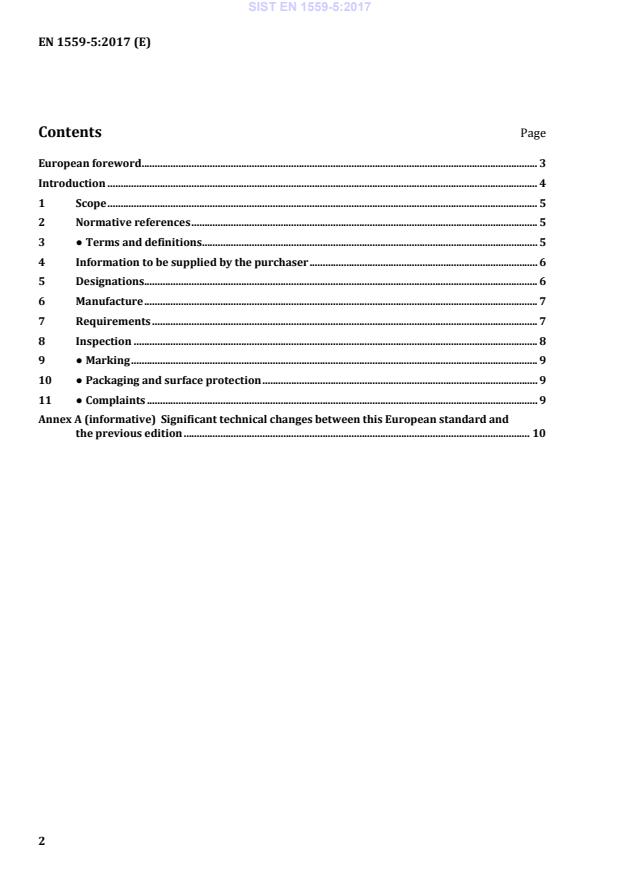
Significant technical changes between this European standard and the previous edition . 10
...
Questions, Comments and Discussion
Ask us and Technical Secretary will try to provide an answer. You can facilitate discussion about the standard in here.
Loading comments...