

SIST EN 13163:2013+A2:2017
(Main)Thermal insulation products for buildings - Factory made expanded polystyrene (EPS) products - Specification
General Information
- Abstract
This European Standard specifies the requirements for factory made expanded polystyrene products, with or without rigid or flexible facings or coatings, which are used for the thermal insulation of buildings. The products are manufactured in the form of boards or rolls or other preformed ware (flat, tapered, tongue and grooves, shiplap, profiled etc.).
Products covered by this standard are also used for sound insulation and in prefabricated thermal insulation systems and composite panels; the performance of systems incorporating these products is not covered.
This standard describes product characteristics and includes procedures for testing, evaluation of conformity, marking and labelling.
This standard does not specify the required class or level of a given property to be achieved by a product to demonstrate fitness for purpose in a particular application. The classes and levels required for a given application are to be found in regulations or non-conflicting standards.
Products with a declared thermal resistance lower than 0,25 m²⋅K/W or a declared thermal conductivity at 10 °C greater than 0,060 W/(m⋅K) are not covered by this standard.
This standard does not cover in-situ insulation products (covered by EN 16025-1 and -2), products intended to be used for the insulation of building equipment and industrial installations (covered by EN 14309), products intended to be used in civil engineering applications (covered by EN 14933) and products intended to be used in beam and block systems in floors (covered by EN 15037-4).
- Status
- Published
- Publication Date
- 28-Nov-2016
- Technical Committee
- TOP - Thermal insulation
- Current Stage
- 6060 - National Implementation/Publication (Adopted Project)
- Start Date
- 17-Nov-2016
- Due Date
- 22-Jan-2017
- Completion Date
- 29-Nov-2016

Overview
SIST EN 13163:2013+A2:2017 is a European standard issued by SIST that sets out requirements for factory-made expanded polystyrene (EPS) products used for thermal insulation in buildings. The standard covers both rigid and flexible faced or coated EPS products, which are typically manufactured in forms such as boards, rolls, and preformed ware with a variety of profiles (e.g. flat, tapered, tongue and groove, shiplap). These EPS products play a vital role in improving a building's energy efficiency and acoustic properties.
The scope of SIST EN 13163:2013+A2:2017 explicitly excludes in-situ insulation products and EPS products intended for industrial, civil engineering, or specific structural uses, which are addressed by other related standards. It does, however, provide guidance on crucial product characteristics, quality controls, marking, labelling, and conformity assessment-but it does not set minimum performance classes or levels for specific building applications (these are defined elsewhere, such as in building regulations).
Key Topics
Product Types Covered:
- EPS insulation boards
- EPS rolls
- Preformed EPS ware (e.g. profiled, tongue-and-groove)
Primary Characteristics Specified:
- Thermal performance: Declared thermal resistance and conductivity (products with thermal resistance below 0.25 m²·K/W or conductivity above 0.060 W/(m·K) at 10°C are excluded)
- Physical properties: Length, width, thickness, squareness, flatness
- Mechanical performance: Compressive strength, bending strength, tensile strength perpendicular to faces, dimensional stability
- Fire performance: Reaction to fire requirements and marking
- Durability characteristics: Water absorption, freeze-thaw resistance, compressive creep, deformation under load
Quality Assurance and Compliance:
- Procedures for sampling, testing, and factory production control (FPC)
- Assessment and verification of constancy of performance (AVCP)
- Clear requirements for marking and labelling for traceability and compliance
Applications
EPS products covered by this standard are widely used in building construction for their robust thermal insulation properties. Typical applications include:
- External and internal wall insulation
- Roof and ceiling insulation
- Floor insulation (including floating floors)
- Sound insulation in certain configurations
- Prefabricated insulation panels and composite building elements
By following SIST EN 13163:2013+A2:2017, manufacturers, designers, and contractors ensure that EPS insulation products meet consistent quality and safety standards. This contributes to better energy efficiency, building comfort, and compliance with the European Construction Products Regulation (CPR).
Related Standards
For professionals specifying or working with EPS thermal insulation, the following related standards should also be considered:
- EN 16025-1 and -2: In-situ insulation products
- EN 14309: Insulation for building equipment and industrial installations
- EN 14933: EPS for civil engineering applications
- EN 15037-4: EPS in beam and block floor systems
Other important harmonized standards in the series for factory-made insulation products include:
- EN 13162: Mineral wool (MW) products
- EN 13164: Extruded polystyrene foam (XPS) products
- EN 13165: Rigid polyurethane foam (PU) products
- EN 13166 – EN 13171: Specifications for phenolic foam (PF), cellular glass (CG), wood wool (WW), expanded perlite board (EPB), expanded cork (ICB), and wood fibre (WF) thermal insulation
Practical Value
Adherence to SIST EN 13163:2013+A2:2017 assures stakeholders that EPS thermal insulation products are manufactured, tested, and supplied in accordance with current European standards. This enables high energy performance in buildings, compliance with legislative and regulatory frameworks, and confidence in product reliability for all parties involved in construction and renovation projects. The standard's focus on product characteristics, assessment procedures, and quality control supports safe installation and long-term durability of thermal insulation systems, contributing to overall building sustainability and occupant comfort.
Relations
- Effective Date
- 01-Jan-2017
- Effective Date
- 09-Feb-2026
- Effective Date
- 04-Feb-2026
- Effective Date
- 28-Jan-2026
- Effective Date
- 28-Jan-2026
- Effective Date
- 28-Jan-2026
- Effective Date
- 28-Jan-2026
- Effective Date
- 28-Jan-2026
- Effective Date
- 28-Jan-2026
- Effective Date
- 28-Jan-2026
- Effective Date
- 28-Jan-2026
- Effective Date
- 28-Jan-2026
- Effective Date
- 28-Jan-2026
- Effective Date
- 28-Jan-2026
- Effective Date
- 28-Jan-2026
Get Certified
Connect with accredited certification bodies for this standard

DIBt (Deutsches Institut für Bautechnik)
German Institute for Building Technology.
DIN CERTCO
DIN Group product certification.

Aboma Certification B.V.
Specialized in construction, metal, and transport sectors.
Sponsored listings
Frequently Asked Questions
SIST EN 13163:2013+A2:2017 is a standard published by the Slovenian Institute for Standardization (SIST). Its full title is "Thermal insulation products for buildings - Factory made expanded polystyrene (EPS) products - Specification". This standard covers: This European Standard specifies the requirements for factory made expanded polystyrene products, with or without rigid or flexible facings or coatings, which are used for the thermal insulation of buildings. The products are manufactured in the form of boards or rolls or other preformed ware (flat, tapered, tongue and grooves, shiplap, profiled etc.). Products covered by this standard are also used for sound insulation and in prefabricated thermal insulation systems and composite panels; the performance of systems incorporating these products is not covered. This standard describes product characteristics and includes procedures for testing, evaluation of conformity, marking and labelling. This standard does not specify the required class or level of a given property to be achieved by a product to demonstrate fitness for purpose in a particular application. The classes and levels required for a given application are to be found in regulations or non-conflicting standards. Products with a declared thermal resistance lower than 0,25 m²⋅K/W or a declared thermal conductivity at 10 °C greater than 0,060 W/(m⋅K) are not covered by this standard. This standard does not cover in-situ insulation products (covered by EN 16025-1 and -2), products intended to be used for the insulation of building equipment and industrial installations (covered by EN 14309), products intended to be used in civil engineering applications (covered by EN 14933) and products intended to be used in beam and block systems in floors (covered by EN 15037-4).
This European Standard specifies the requirements for factory made expanded polystyrene products, with or without rigid or flexible facings or coatings, which are used for the thermal insulation of buildings. The products are manufactured in the form of boards or rolls or other preformed ware (flat, tapered, tongue and grooves, shiplap, profiled etc.). Products covered by this standard are also used for sound insulation and in prefabricated thermal insulation systems and composite panels; the performance of systems incorporating these products is not covered. This standard describes product characteristics and includes procedures for testing, evaluation of conformity, marking and labelling. This standard does not specify the required class or level of a given property to be achieved by a product to demonstrate fitness for purpose in a particular application. The classes and levels required for a given application are to be found in regulations or non-conflicting standards. Products with a declared thermal resistance lower than 0,25 m²⋅K/W or a declared thermal conductivity at 10 °C greater than 0,060 W/(m⋅K) are not covered by this standard. This standard does not cover in-situ insulation products (covered by EN 16025-1 and -2), products intended to be used for the insulation of building equipment and industrial installations (covered by EN 14309), products intended to be used in civil engineering applications (covered by EN 14933) and products intended to be used in beam and block systems in floors (covered by EN 15037-4).
SIST EN 13163:2013+A2:2017 is classified under the following ICS (International Classification for Standards) categories: 91.100.60 - Thermal and sound insulating materials. The ICS classification helps identify the subject area and facilitates finding related standards.
SIST EN 13163:2013+A2:2017 has the following relationships with other standards: It is inter standard links to SIST EN 13163:2013+A1:2015, SIST ISO 16269-6:2006, SIST EN ISO 11925-2:2026, SIST EN 12089:2013, SIST EN 29052-1:1997, SIST EN 15715:2010, SIST EN ISO 16536:2019, SIST EN 13172:2012, SIST EN ISO 9229:2008, SIST EN 13820:2004, SIST EN 1603:2013, SIST EN 1605:2013, SIST EN 1607:2013, SIST EN ISO 1716:2018, SIST EN 13501-1:2019. Understanding these relationships helps ensure you are using the most current and applicable version of the standard.
SIST EN 13163:2013+A2:2017 is associated with the following European legislation: EU Directives/Regulations: 305/2011; Standardization Mandates: M/103. When a standard is cited in the Official Journal of the European Union, products manufactured in conformity with it benefit from a presumption of conformity with the essential requirements of the corresponding EU directive or regulation.
SIST EN 13163:2013+A2:2017 is available in PDF format for immediate download after purchase. The document can be added to your cart and obtained through the secure checkout process. Digital delivery ensures instant access to the complete standard document.
Standards Content (Sample)
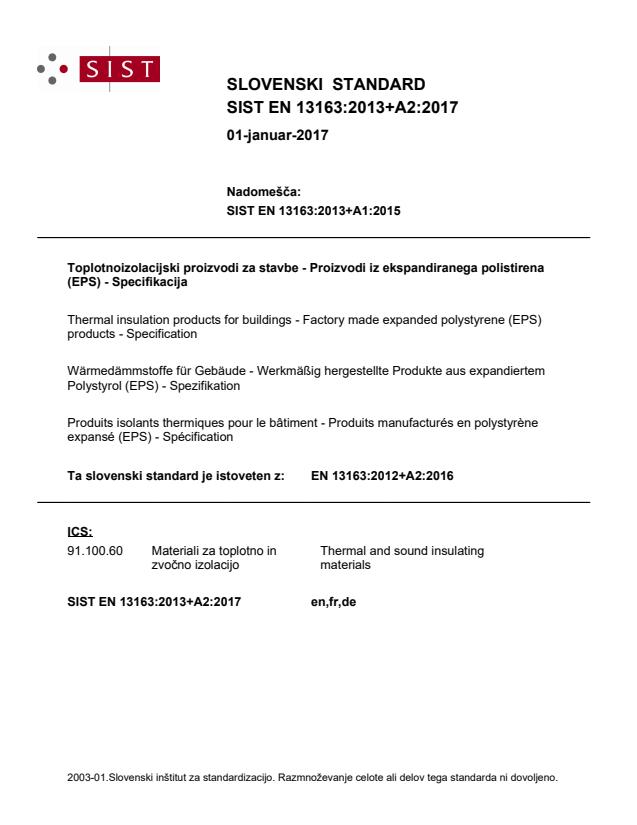
2003-01.Slovenski inštitut za standardizacijo. Razmnoževanje celote ali delov tega standarda ni dovoljeno.Toplotnoizolacijski proizvodi za stavbe - Proizvodi iz ekspandiranega polistirena (EPS) - SpecifikacijaWärmedämmstoffe für Gebäude - Werkmäßig hergestellte Produkte aus expandiertem Polystyrol (EPS) - SpezifikationProduits isolants thermiques pour le bâtiment - Produits manufacturés en polystyrène expansé (EPS) - SpécificationThermal insulation products for buildings - Factory made expanded polystyrene (EPS) products - Specification91.100.60Thermal and sound insulating materialsICS:Ta slovenski standard je istoveten z:EN 13163:2012+A2:2016SIST EN 13163:2013+A2:2017en,fr,de01-januar-2017SIST EN 13163:2013+A2:2017SLOVENSKI
STANDARDSIST EN 13163:2013+A1:20151DGRPHãþD
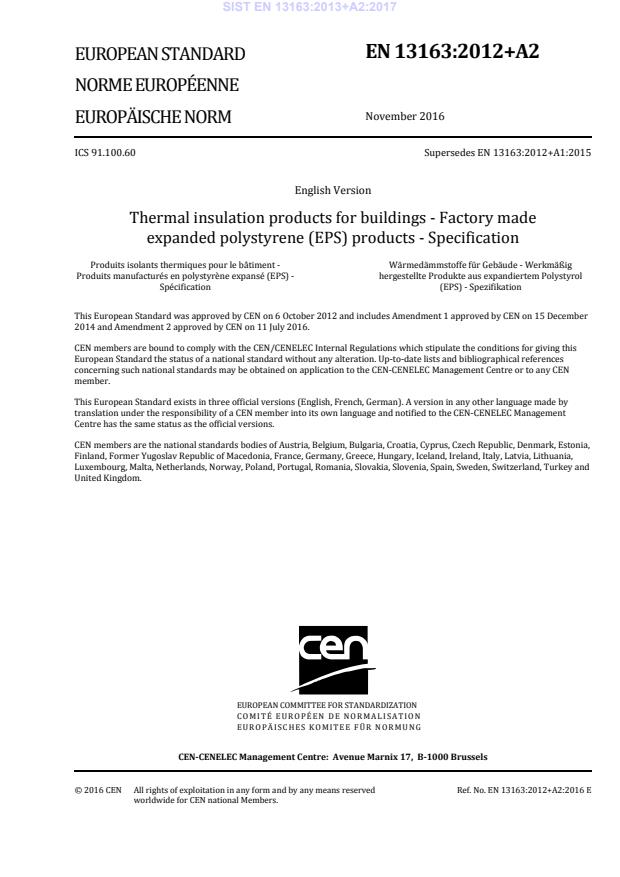
EUROPEAN STANDARD NORME EUROPÉENNE EUROPÄISCHE NORM
EN 13163:2012+A2
November 2016 ICS 91.100.60 Supersedes EN 13163:2012+A1:2015
English Version
Thermal insulation products for buildings - Factory made expanded polystyrene (EPS) products - Specification
Produits isolants thermiques pour le bâtiment - Produits manufacturés en polystyrène expansé (EPS) - Spécification
Wärmedämmstoffe für Gebäude - Werkmäßig hergestellte Produkte aus expandiertem Polystyrol (EPS) - Spezifikation This European Standard was approved by CEN on 6 October 2012 and includes Amendment 1 approved by CEN on 15 December 2014 and Amendment 2 approved by CEN on 11 July 2016.
CEN members are bound to comply with the CEN/CENELEC Internal Regulations which stipulate the conditions for giving this European Standard the status of a national standard without any alteration. Up-to-date lists and bibliographical references concerning such national standards may be obtained on application to the CEN-CENELEC Management Centre or to any CEN member.
This European Standard exists in three official versions (English, French, German). A version in any other language made by translation under the responsibility of a CEN member into its own language and notified to the CEN-CENELEC Management Centre has the same status as the official versions.
CEN members are the national standards bodies of Austria, Belgium, Bulgaria, Croatia, Cyprus, Czech Republic, Denmark, Estonia, Finland, Former Yugoslav Republic of Macedonia, France, Germany, Greece, Hungary, Iceland, Ireland, Italy, Latvia, Lithuania, Luxembourg, Malta, Netherlands, Norway, Poland, Portugal, Romania, Slovakia, Slovenia, Spain, Sweden, Switzerland, Turkey and United Kingdom.
EUROPEAN COMMITTEE FOR STANDARDIZATION
COMITÉ EUROPÉEN DE NORMALISATION
EUROPÄISCHES KOMITEE FÜR NORMUNG
CEN-CENELEC Management Centre:
Avenue Marnix 17,
B-1000 Brussels © 2016 CEN All rights of exploitation in any form and by any means reserved worldwide for CEN national Members. Ref. No. EN 13163:2012+A2:2016 E SIST EN 13163:2013+A2:2017
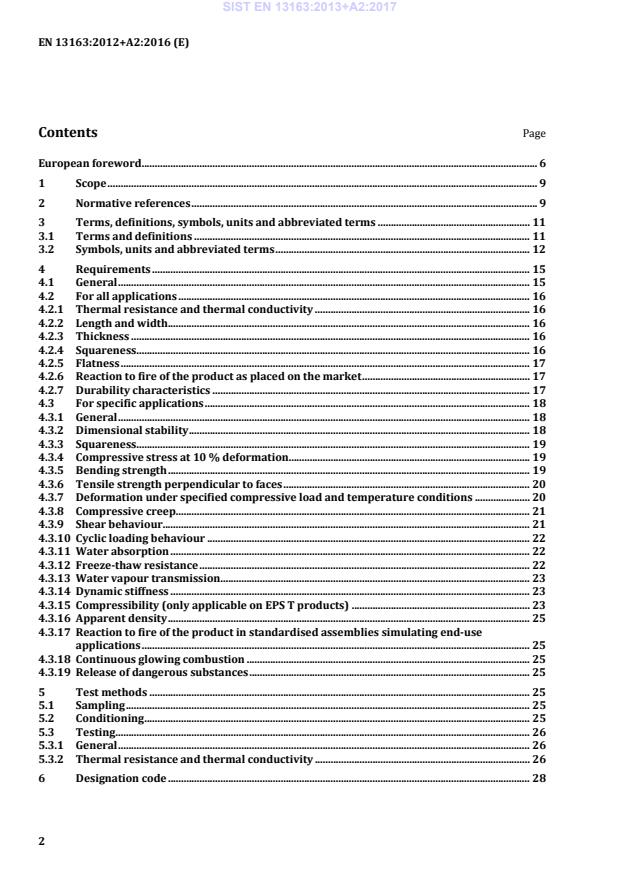
Determination of the declared values of thermal resistance and thermal conductivity . 32 A.1 General . 32 A.2 Input data . 32 A.3 Declared values . 32 A.3.1 General . 32 A.3.2 Case where thermal resistance and thermal conductivity are declared . 32 A.3.3 Case where thermal resistance is declared . 33 Annex B (normative)
!Product type determination" (!PTD") and factory production control (FPC) . 34 B.1 !Product type determination" and factory production control . 34 B.2 Indirect testing for factory production control . 39 B.2.1 General . 39 B.2.2 Compressive stress at 10 % deformation . 39 B.2.3 Thermal conductivity . 40 B.2.4 Thickness effect . 41 B.2.5 Dynamic stiffness . 41 Annex C
(normative)
Product classification . 42 Annex D (normative)
Multi layered EPS products . 44 D.1 General . 44 D.2 Requirements . 44 D.2.1 For all applications. 44 D.2.2 For specific applications . 45 D.3 Test methods . 45 D.4 Evaluation of conformity . 45 Annex E (informative)
Verification of the reaction to fire classification of raw materials . 46 E.1 General . 46 E.2 Material covered by this annex . 46 E.3 Preparation of samples . 46 E.4 !Product type determination" for EPS raw material . 46 E.5 Factory Production Control for EPS raw material . 47 E.5.1 General . 47 E.5.2 Testing frequency . 47 E.6 Certification of conformity for EPS raw material . 47 E.6.1 Bodies involved in the evaluation of conformity procedure . 47 E.6.2 Test specimens . 47 E.6.3 !Product type determination" . 47 E.7 Continuous surveillance of EPS raw material . 48 E.7.1 Production . 48 E.7.2 Factory production control . 48 E.8 Material certificate for EPS raw material. 48 E.9 Requirement for raw material supply . 49 E.9.1 Declaration for the raw material supply . 49 E.9.2 Labelling. 49 Annex F (informative)
Additional properties . 50 SIST EN 13163:2013+A2:2017
!Clauses of this European Standard addressing the provisions of the EU Construction Products Regulation" . 54 Bibliography . 65
Tables Table 1 — Classes of dimensional tolerances . 17 Table 2 — Dimensional stability under specified temperature or specified temperature and humidity conditions . 18 Table 3 — Levels for compressive stress at 10 % deformation. 19 Table 4 — Levels for bending strength . 20 Table 5 — Levels of deformation under specified compressive load and temperature conditions . 21 Table 6 — Levels for dynamic stiffness . 23 Table 7 — Classes for thickness tolerances . 24 Table 8 — Levels for compressibility . 24 Table 9 — Test methods, test specimens and conditions . 27 Table A.1 — Values for k for one sided 90 % tolerance interval with a confidence level of 90 % . 33 Table B.1 — Number of tests for !PTD" and minimum product testing frequencies . 34 Table B.2 — Minimum product testing frequencies for the reaction to fire characteristics . 37 Table C.1 — Classification of EPS products . 42 Table C.2 — Classification EPS products with acoustical properties . 43 Table E.1 — Testing frequency of raw material . 48 Table F.1 — Correlation between bending strength and shear strength . 51 Table F.2 —Tabulated values of water vapour diffusion resistance index and water vapour permeability . 52 Table ZA.1 — Relevant clauses for factory made expanded polystyrene and intended use . 55 Table ZA.2 — Systems of AVCP . 56 Table ZA.3.1 — Assignment of AVCP tasks for factory made expanded polystyrene products under system 1 for reaction to fire and system 3 (see Table ZA.2) . 57 Table ZA.3.2 — Assignment of AVCP tasks for factory made expanded polystyrene products under system 3 (see Table ZA.2) . 58 Table ZA.3.3 — Assignment of AVCP tasks for factory made expanded polystyrene products under combined system 4 for reaction to fire and system 3 (see Table ZA.2) . 59 SIST EN 13163:2013+A2:2017
Figures Figure B.1 — Relationship between compressive stress at 10 % deformation and apparent density for indirect testing . 40 Figure F.1 — Example of a relationship between thermal conductivity (at 50 mm reference thickness and 10 °C mean temperature) apparent density for indirect testing of non infrared absorbing EPS . 53 Figure ZA.1 — #Example CE marking information$ . 64
is the prediction interval 1 b is the width mm b0 is a regression coefficient kPa b1 is a regression coefficient kPa·m³/kg c is the compressibility mm d is the thickness mm
is the water vapour permeability mg/(Pa„h„m) dB is the thickness under a load of 2 kPa after removal of an additional load of 48 kPa mm dL is the thickness under a load of 250 Pa mm dN is the nominal thickness of the product mm ds is the thickness of the test specimen mm SIST EN 13163:2013+A2:2017
is the water vapour diffusion resistance factor 1 n is the number of test results 1 a is the apparent density kg/m³ mean is the mean density kg/m³ R90/90=is the 90 % fractile with a confidence level of 90 % for the thermal resistance m²„K/W RD is the declared thermal resistance m²„K/W Ri is one test result of thermal resistance m²„K/W Rmean is the mean thermal resistance m²„K/W RU is the design value of thermal resistance m²„K/W s' is the dynamic stiffness MN/m³ 10 is the compressive stress at 10 % deformation kPa 10, mean is the mean compressive stress at 10 % deformation kPa 10, pred is the predicted compressive stress at 10 % deformation with a prediction interval of 90 % kPa b is the bending strength kPa SIST EN 13163:2013+A2:2017
is the shear strength kPa WdV is the water absorption by diffusion % Wlp is the long-term water absorption by partial immersion kg/m² Wlt is the long-term water absorption by total immersion % Wv is the additional water absorption % X0 is the initial deformation after 60 s from the beginning of the loading mm X=is the deformation at time t (total thickness reduction) mm Z is the water vapour resistance m²„h„Pa/mg
BS is the symbol of the declared level for bending strength CC (i1/i2/y) c is the symbol of the declared level for compressive creep CP is the symbol of the declared level for compressibility CS(10) is the symbol of the declared level for compressive stress at 10 % deformation DS(N) is the symbol of the declared class for dimensional stability under constant normal laboratory conditions DS(23,90); DS(70,-); DS(70,90) is the symbol of the declared level for dimensional stability under specified temperature and humidity conditions DLT(5) is the symbol of the declared level for dimensional stability under load and temperature conditions FTCD is the symbol of the declared class for freeze-thaw resistance when using samples prepared by water absorption by diffusion FTCI is the symbol of the declared class for freeze-thaw resistance when using samples prepared by long term water absorption by total immersion GM is the symbol of the declared level for shear modulus L is the symbol of the declared class for length tolerances SIST EN 13163:2013+A2:2017
TC is the symbol for the declared class for thickness tolerance of EPS T products$ TR is the symbol of the declared level for tensile strength perpendicular to faces W is the symbol of the declared class for width tolerance WD(V) is the symbol of the declared level for water absorption by diffusion WL(P) is the symbol of the declared level for long term water absorption by partial immersion WL(T) is the symbol of the declared level for long term water absorption by total immersion Z is the symbol of the declared water vapour resistance value Abbreviated terms used in this standard: EPS is Expanded PolyStyrene !PTD is Product Type Determination (previously named ITT for Initial Type Test)" FPC is Factory Production Control RtF is Reaction to Fire !AVCP is Assessment and Verification of Constancy of Performance (previously named attestation of conformity) DoP is Declaration of Performance ThIB is Thermal Insulation for Buildings VCP is Verification of Constancy of Performance (previously named evaluation of conformity)" 4 Requirements 4.1 General Product properties shall be assessed in accordance with Clause 5. To comply with this standard, products shall meet the requirements of 4.2, and the requirements of 4.3 as appropriate. NOTE Information on additional properties is given in Annex F. For multi-layered products, additional requirements are given in Annex D. One test result for a product property is the average of the measured values on the number of test specimens given in Table 9. SIST EN 13163:2013+A2:2017
for products of uniform thickness, the thermal resistance, RD, shall always be declared. The thermal conductivity, D, shall be declared where possible. Where appropriate, for products of non-uniform thickness (i.e. for sloped, tapered or shape moulded non flat products) only the thermal conductivity, D, shall be declared; — the declared thermal resistance, RD, and the declared thermal conductivity, D, shall be given as limit values representing at least 90 % of the production, determined with a confidence level of 90 %; — the statistical value of the thermal conductivity, 90/90, shall be rounded upwards to the nearest 0,001 W/(m„K) and declared as D in levels with steps of 0,001 W/(m„K); — the declared thermal resistance, RD, shall be calculated from the nominal thickness, dN, or dL in case of pr
...