

SIST EN 13428:2004
(Main)Packaging - Requirements specific to manufacturing and composition - Prevention by source reduction
General Information
- Abstract
This European Standard specifies a procedure for assessment of packaging to ensure that the weight and/or volume of its material content is at the minimum commensurate with the maintenance of :
-functionality throughout the supply and user chain ;
-safety and hygiene for both product and user/consumer ;
-acceptability of the packed product to the user/consumer.
This European Standard also specifies the methodology and procedure for determining the presence of the four heavy metals named in article 11 of the packaging and packaging waste Directive 94/62/EC and for determining the presence and minimisation of any dangerous substances or preparations if they are present in packaging and are likely to be released into the environment as a result of waste management operations. The procedures are referenced in CR 13695-1 and CR 13695-2.
NOTE The substitution of one packaging material by another is not a basis for source reduction.
This standard cannot by itself provide presumption of conformity. The procedure for applying this standard is contained in EN 13427.
- Status
- Published
- Publication Date
- 31-Aug-2004
- Technical Committee
- EPO - Packaging - sales and grouped
- Current Stage
- 6060 - National Implementation/Publication (Adopted Project)
- Start Date
- 01-Sep-2004
- Due Date
- 01-Sep-2004
- Completion Date
- 01-Sep-2004
94/62/EC - Packaging and packaging wasteOJ Ref: C 44 OJ Date: 19-Feb-2005


Overview
EN 13428:2004 - Packaging: Requirements specific to manufacturing and composition - Prevention by source reduction (CEN) defines a systematic procedure for assessing packaging so that its weight and/or volume is kept to the minimum necessary while maintaining product functionality, safety/hygiene and consumer acceptability. The standard also sets the methodology for detecting the four heavy metals listed in Article 11 of Directive 94/62/EC and for assessing and minimising any dangerous substances or preparations that could be released during waste management operations.
Key topics and technical requirements
- Source reduction principle: a structured assessment to ensure packaging material is reduced only to the point that functionality, safety and acceptability are not compromised. (Note: swapping one material for another is not, by itself, source reduction.)
- Critical area identification: define performance criteria that prevent further reduction of weight/volume without impairing packaging function.
- Assessment procedure: documentation-based self-assessment covering product protection, manufacturing, filling, logistics, presentation, user acceptance, safety and legislation.
- Heavy metals testing: methodology for determining presence of the four heavy metals referenced in Directive 94/62/EC; procedures referenced in CR 13695‑1 and CEN/TR 13695‑2.
- Dangerous substances minimisation: process for identifying preparations/substances in packaging and demonstrating minimisation where they could be released during waste handling (normative and informative guidance included).
- Conformity demonstration: describes evidence and records needed to show compliance; however EN 13428 by itself does not provide presumption of conformity - EN 13427 contains the procedure for applying this standard within a conformity framework.
Applications and who uses it
EN 13428 is intended for:
- Packaging designers and material engineers aiming to optimise weight/volume
- Manufacturers of primary, secondary and tertiary packaging
- Suppliers placing packed products on the EU market who must meet Directive 94/62/EC requirements
- Compliance officers, sustainability managers and product stewardship teams conducting packaging assessments or preparing technical dossiers Practical uses include internal design reviews, supplier audits, documentation for conformity assessment, and inputs to environmental impact reduction programs and packaging waste minimisation strategies.
Related standards (and references)
- EN 13427 - Requirements for the use of European Standards in packaging and packaging waste (application procedure)
- EN 13193 - Packaging and the Environment - Terminology
- CR 13695‑1 and CEN/TR 13695‑2 - Methods for measuring the four heavy metals and other dangerous substances
- EU Directive 94/62/EC (Packaging and Packaging Waste)
EN 13428:2004 helps organisations balance packaging efficiency, regulatory compliance and environmental objectives through a clear, documented approach to source reduction and hazardous-substance minimisation. Keywords: EN 13428:2004, packaging, source reduction, heavy metals, packaging waste, Directive 94/62/EC, packaging assessment.
Relations
- Effective Date
- 01-Sep-2004
- Effective Date
- 28-Jan-2026
- Effective Date
- 28-Jan-2026
- Effective Date
- 28-Jan-2026
- Effective Date
- 28-Jan-2026
- Effective Date
- 28-Jan-2026
- Effective Date
- 28-Jan-2026
Get Certified
Connect with accredited certification bodies for this standard

BRCGS (Brand Reputation Compliance Global Standards)
Global food safety and quality standards owner.
CIS Institut d.o.o.
Personal Protective Equipment (PPE) certification body. Notified Body NB-2890 for EU Regulation 2016/425 PPE.

Kiwa BDA Testing
Building and construction product certification.
Sponsored listings
Frequently Asked Questions
SIST EN 13428:2004 is a standard published by the Slovenian Institute for Standardization (SIST). Its full title is "Packaging - Requirements specific to manufacturing and composition - Prevention by source reduction". This standard covers: This European Standard specifies a procedure for assessment of packaging to ensure that the weight and/or volume of its material content is at the minimum commensurate with the maintenance of : -functionality throughout the supply and user chain ; -safety and hygiene for both product and user/consumer ; -acceptability of the packed product to the user/consumer. This European Standard also specifies the methodology and procedure for determining the presence of the four heavy metals named in article 11 of the packaging and packaging waste Directive 94/62/EC and for determining the presence and minimisation of any dangerous substances or preparations if they are present in packaging and are likely to be released into the environment as a result of waste management operations. The procedures are referenced in CR 13695-1 and CR 13695-2. NOTE The substitution of one packaging material by another is not a basis for source reduction. This standard cannot by itself provide presumption of conformity. The procedure for applying this standard is contained in EN 13427.
This European Standard specifies a procedure for assessment of packaging to ensure that the weight and/or volume of its material content is at the minimum commensurate with the maintenance of : -functionality throughout the supply and user chain ; -safety and hygiene for both product and user/consumer ; -acceptability of the packed product to the user/consumer. This European Standard also specifies the methodology and procedure for determining the presence of the four heavy metals named in article 11 of the packaging and packaging waste Directive 94/62/EC and for determining the presence and minimisation of any dangerous substances or preparations if they are present in packaging and are likely to be released into the environment as a result of waste management operations. The procedures are referenced in CR 13695-1 and CR 13695-2. NOTE The substitution of one packaging material by another is not a basis for source reduction. This standard cannot by itself provide presumption of conformity. The procedure for applying this standard is contained in EN 13427.
SIST EN 13428:2004 is classified under the following ICS (International Classification for Standards) categories: 13.030.99 - Other standards related to wastes; 55.020 - Packaging and distribution of goods in general. The ICS classification helps identify the subject area and facilitates finding related standards.
SIST EN 13428:2004 has the following relationships with other standards: It is inter standard links to SIST EN 13428:2001, SIST CR 13695-1:2001, SIST EN 13193:2001, SIST EN 13427:2004, SIST-TP CEN/TR 13695-2:2019, SIST EN 13431:2004, SIST-TP CEN/TR 13695-2:2005. Understanding these relationships helps ensure you are using the most current and applicable version of the standard.
SIST EN 13428:2004 is associated with the following European legislation: EU Directives/Regulations: 2021-01-1053, 94/62/EC, EUR-PUB, TP141; Standardization Mandates: M/317. When a standard is cited in the Official Journal of the European Union, products manufactured in conformity with it benefit from a presumption of conformity with the essential requirements of the corresponding EU directive or regulation.
SIST EN 13428:2004 is available in PDF format for immediate download after purchase. The document can be added to your cart and obtained through the secure checkout process. Digital delivery ensures instant access to the complete standard document.
Standards Content (Sample)
SLOVENSKI STANDARD
01-september-2004
Nadomešča:
SIST EN 13428:2001
Embalaža - Posebne zahteve za proizvodnjo in sestavo - Preventiva z
zmanjševanjem pri izvoru
Packaging - Requirements specific to manufacturing and composition - Prevention by
source reduction
Verpackung - Spezifische Anforderungen an die Herstellung und Zusammensetzung -
Ressourcenschonung durch Verpackungsminimierung
Emballage - Exigences spécifiques a la fabrication et a la composition - Prévention par la
réduction a la source
Ta slovenski standard je istoveten z: EN 13428:2004
ICS:
13.030.99 Drugi standardi v zvezi z Other standards related to
odpadki wastes
55.020 Pakiranje in distribucija blaga Packaging and distribution of
na splošno goods in general
2003-01.Slovenski inštitut za standardizacijo. Razmnoževanje celote ali delov tega standarda ni dovoljeno.
EUROPEAN STANDARD
EN 13428
NORME EUROPÉENNE
EUROPÄISCHE NORM
July 2004
ICS 13.030.99; 55.020 Supersedes EN 13428:2000
English version
Packaging - Requirements specific to manufacturing and
composition - Prevention by source reduction
Emballage - Exigences spécifiques à la fabrication et à la Verpackung - Spezifische Anforderungen an die
composition - Prévention par la réduction à la source Herstellung und Zusammensetzung - Ressourcenschonung
durch Verpackungsminimierung
This European Standard was approved by CEN on 5 May 2004.
CEN members are bound to comply with the CEN/CENELEC Internal Regulations which stipulate the conditions for giving this European
Standard the status of a national standard without any alteration. Up-to-date lists and bibliographical references concerning such national
standards may be obtained on application to the Central Secretariat or to any CEN member.
This European Standard exists in three official versions (English, French, German). A version in any other language made by translation
under the responsibility of a CEN member into its own language and notified to the Central Secretariat has the same status as the official
versions.
CEN members are the national standards bodies of Austria, Belgium, Cyprus, Czech Republic, Denmark, Estonia, Finland, France,
Germany, Greece, Hungary, Iceland, Ireland, Italy, Latvia, Lithuania, Luxembourg, Malta, Netherlands, Norway, Poland, Portugal, Slovakia,
Slovenia, Spain, Sweden, Switzerland and United Kingdom.
EUROPEAN COMMITTEE FOR STANDARDIZATION
COMITÉ EUROPÉEN DE NORMALISATION
EUROPÄISCHES KOMITEE FÜR NORMUNG
Management Centre: rue de Stassart, 36 B-1050 Brussels
© 2004 CEN All rights of exploitation in any form and by any means reserved Ref. No. EN 13428:2004: E
worldwide for CEN national Members.
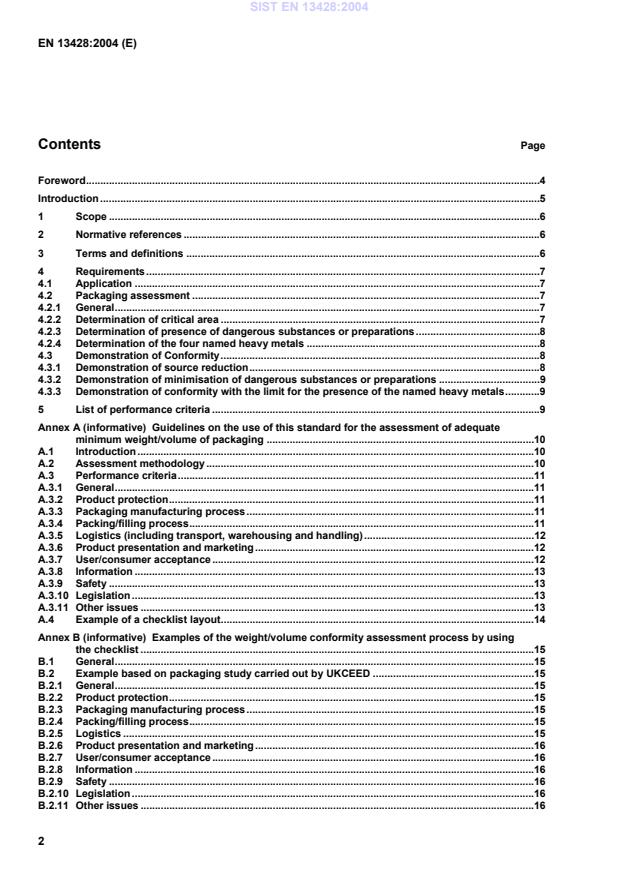
Contents Page
Foreword.4
Introduction .5
1 Scope .6
2 Normative references .6
3 Terms and definitions .6
4 Requirements.7
4.1 Application .7
4.2 Packaging assessment .7
4.2.1 General.7
4.2.2 Determination of critical area .7
4.2.3 Determination of presence of dangerous substances or preparations.8
4.2.4 Determination of the four named heavy metals .8
4.3 Demonstration of Conformity.8
4.3.1 Demonstration of source reduction.8
4.3.2 Demonstration of minimisation of dangerous substances or preparations .9
4.3.3 Demonstration of conformity with the limit for the presence of the named heavy metals.9
5 List of performance criteria .9
Annex A (informative) Guidelines on the use of this standard for the assessment of adequate
minimum weight/volume of packaging .10
A.1 Introduction.10
A.2 Assessment methodology .10
A.3 Performance criteria.11
A.3.1 General.11
A.3.2 Product protection.11
A.3.3 Packaging manufacturing process.11
A.3.4 Packing/filling process.11
A.3.5 Logistics (including transport, warehousing and handling).12
A.3.6 Product presentation and marketing.12
A.3.7 User/consumer acceptance .12
A.3.8 Information .13
A.3.9 Safety .13
A.3.10 Legislation .13
A.3.11 Other issues .13
A.4 Example of a checklist layout.14
Annex B (informative) Examples of the weight/volume conformity assessment process by using
the checklist .15
B.1 General.15
B.2 Example based on packaging study carried out by UKCEED .15
B.2.1 General.15
B.2.2 Product protection.15
B.2.3 Packaging manufacturing process.15
B.2.4 Packing/filling process.15
B.2.5 Logistics .15
B.2.6 Product presentation and marketing.16
B.2.7 User/consumer acceptance .16
B.2.8 Information .16
B.2.9 Safety .16
B.2.10 Legislation .16
B.2.11 Other issues .16
B.3 Example based on a packaging study carried out by Fachvereinigung
Behälterglasindustrie e.V .18
B.3.1 General .18
B.3.2 Product protection .18
B.3.3 Packaging manufacturing process.18
B.3.4 Packing/filling process .19
B.3.5 Logistics.19
B.3.6 Product presentation and marketing.19
B.3.7 User/consumer acceptance.19
B.3.8 Information.19
B.3.9 Safety.19
B.3.10 Legislation.19
B.3.11 Other issues.19
Annex C (normative) Minimisation of Dangerous Substances or Preparations and Demonstration
of Conformity .21
C.1 Objective.21
C.2 Determination of the substances or preparations to be minimised .21
C.3 Conformity with the minimisation requirement.22
Annex D (informative) Decision Tree - Minimisation of Dangerous Substances or Preparations
and Demonstration of Conformity .23
Annex ZA (informative) Relationship between this European Standard and the essential
requirements of EU Directive 94/62/EC .24
Bibliography.25
Foreword
This document (EN 13428:2004) has been prepared by Technical Committee CEN/TC 261 “Packaging”, the
secretariat of which is held by AFNOR.
This European Standard shall be given the status of a national standard, either by publication of an identical
text or by endorsement, at the latest by January 2005, and conflicting national standards shall be withdrawn at
the latest by January 2005.
This document supersedes EN 13428:2000.
This document has been prepared under a mandate given to CEN by the European Commission and the
European Free Trade Association, and supports essential requirements of EU Directive(s).
For relationship with EU Directive(s), see informative Annex ZA, which is an integral part of this document.
This standard forms one of a series of standards and reports prepared under Mandate M 200 rev.3 and the
Second Standardisation Mandate M317 given to CEN by the European Commission and the European Free
Trade Association to support the European Council and Parliament Directive on Packaging and Packaging
Waste [94/62/EC]. The procedure for applying this standard in conjunction with the other mandated standards
and reports is specified in EN 13427.
According to the CEN/CENELEC Internal Regulations, the national standards organizations of the following
countries are bound to implement this European Standard : Austria, Belgium, Cyprus, Czech Republic,
Denmark, Estonia, Finland, France, Germany, Greece, Hungary, Iceland, Ireland, Italy, Latvia, Lithuania,
Luxembourg, Malta, Netherlands, Norway, Poland, Portugal, Slovakia, Slovenia, Spain, Sweden, Switzerland
and United Kingdom.
Introduction
The Directive on Packaging and Packaging Waste (94/62/EC) defines requirements for the manufacturing and
composition of packaging. This document amplifies these requirements with respect to reduction of packaging
at source and the minimisation of dangerous substances or preparations as they may arise from waste
management operations. The European Standard EN 13427 provides a framework within which this and four
other standards may be used together to support a claim that a packaging is in compliance with the essential
requirements for packaging to be placed on the market as required by the Directive.
NOTE The Directive 94/62/EC is amended by European Parliament and Council Directive 2004/12/EC of 11
February 2004.
The purpose of packaging is the containment, protection, handling, delivery and presentation of products. A
major role is prevention of product damage and/or product waste. Reduction of packaging at source is one of
several options for reducing the amount of used packaging for final disposal. In order to save resources and
minimise waste, the whole system in which the packaging takes part should be optimised.
This document presents a framework for self-assessment to determine whether the requirements of this
standard have been met. Its approach is similar to that of systems standards such as the EN ISO 9000 series
or an environmental management system such as EN ISO 14001.
1 Scope
This document specifies a procedure for assessment of packaging to ensure that the weight and/or volume of
its material content is at the minimum commensurate with the maintenance of :
functionality throughout the supply and user chain ;
safety and hygiene for both product and user/consumer ;
acceptability of the packed product to the user/consumer.
This document also specifies the methodology and procedure for determining the presence of the four heavy
metals named in article 11 of the packaging and packaging waste Directive 94/62/EC and for determining the
presence and minimisation of any dangerous substances or preparations if they are present in packaging and
are likely to be released into the environment as a result of waste management operations. The procedures
are referenced in CR 13695-1 and CEN/TR 13695-2.
NOTE The substitution of one packaging material by another is not a basis for source reduction.
This document cannot by itself provide presumption of conformity. The procedure for applying this document
is contained in EN 13427.
2 Normative references
The following referenced documents are indispensable for the application of this document. For dated
references, only the edition cited applies. For undated references, the latest edition of the referenced
document (including any amendments) applies.
EN 13193, Packaging – Packaging and the Environment – Terminology.
EN 13427, Packaging – Requirements for the use of European Standards in the field of packaging and
packaging waste.
CR 13695-1:2000, Packaging – Requirements for measuring and verifying the four heavy metals and other
dangerous substances present in packaging, and their release into the environment – Part 1 : Requirements
for measuring and verifying the four heavy metals present in packaging.
CEN/TR 13695–2:2004, Packaging – Requirements for measuring and verifying the four heavy metals and
other dangerous substances present in packaging, and their release into the environment – Part 2 :
Requirements for measuring and verifying dangerous substances present in packaging and their release into
the environment.
3 Terms and definitions
For the purposes of this document, the terms and definitions given in EN 13193 and the following apply.
3.1
prevention by source reduction
process for the achievement of a minimum adequate weight and/or volume, for identical requirements, of
primary and/or secondary and/or tertiary packaging, when performance and user acceptability remain
unchanged and/or adequate, thereby minimising the impact on the environment
3.2
critical area for source reduction
specific performance criterion which prevents further reduction of weight and/or volume of the packaging
without endangering functional performance, safety and user/consumer acceptability
3.3
supplier
entity responsible for placing packaging or packed product on the market [EN 13427]
3.4
substances
chemical elements and their compounds in the natural state or obtained by any production process, including
any additive necessary to preserve the stability of the product, and any impurity deriving from the production
process used, but excluding any solvent which may be separated without affecting the stability of the
substance or changing its composition [67/548/EEC]
3.5
preparations
mixtures or solutions composed of two or more substances [67/548/EEC]
3.6
safety data sheets
documentation provided by any person established within the community who is responsible for placing a
dangerous substance or preparation on the market, whether the manufacturer, importer or distributor.
Documentation to be provided to any recipient who is a professional user of the substance or preparation and
to contain the information required of the dangerous substance or preparation [91/155/EEC]
NOTE 1 Article 1 of Directive 2001/58/EC amending Directive 91/155/EEC and the implementation of Directives
67/548/EEC and 1999/45/EC requires that the person who is responsible for placing a substance or preparation classified
as dangerous on the market shall supply the recipient who is a professional user with a safety data sheet.
NOTE 2 Article 3 of Directive 91/155/EEC on Safety Data Sheets defines the content of the 16 obligatory headings.
Information on the composition of a preparation in dangerous substances is given in heading 2. Heading 12
(ecotoxicology) requires the description of the most important characteristic likely to have an effect on the environment
owing to the nature of the substance or preparation and likely methods of use. Information of the same kind shall be
supplied for dangerous products arising from the degradation of substances or preparations
4 Requirements
4.1 Application
The application of this document to any particular packaging shall be as specified in EN 13427.
4.2 Packaging assessment
4.2.1 General
The supplier shall be able to demonstrate by the determination of a critical area that the minimum adequate
amount of weight and/or volume of the packaging have been reached taking into account all the "performance
criteria" included in Clause 5 (see 4.2.2).
The supplier shall be able to demonstrate that substances or preparations classified as dangerous to the
environment and assigned with the symbol 'N' (see 4.2.3) present in the packaging components have been
minimised in accordance with Annex C. Annex D provides a basis for this assessment.
The supplier shall be able to demonstrate that any presence of the four named heavy metals (lead, cadmium,
mercury, and hexavalent chromium) in the packaging components does not exceed the specified limits (see
4.2.4).
4.2.2 Determination of critical area
The supplier shall evaluate the complete list of relevant criteria developed as a result of 4.2.1 to determine the
"critical area" which will govern the achievable limit for source reduction. See Annex A.2 for guidance.
The identification of the critical area shall be the basis of complying with this document for minimisation. If no
critical area has been identified the packaging is not in compliance with the requirements of this document and
the potential for (further) source reduction is to be investigated.
4.2.3 Determination of presence of dangerous substances or preparations
The supplier shall determine with the use of the relevant safety data sheets if there is a presence of
dangerous substances or preparations :
as so classified with the symbol 'N' in the EC Directives - the dangerous substance Directive 67/548/EEC
(and its amendments) and dangerous preparation Directive 1999/45/EC ; and
as likely to be present in emissions, ash or leachate when packaging or residues from management
operations or packaging waste are incinerated or landfilled.
NOTE For example, the packaging manufacturer should receive from its supplier of dangerous substances or
preparations a safety data sheet as detailed in Clause 3.6.
The heading "composition/information on ingredients" should indicate the concentration or concentration range
of substances presenting an environmental hazard within the meaning of Directive 67/548/EEC, if they are present in
concentrations equal to or greater than those laid down in the table set out in article 3(3) of Directive 1999/45/EC (unless
lower limits are given in Annex I to Directive 67/548/EEC, or in Annexes II, III or V to Directive 1999/45/EC).
The packaging manufacturer can calculate and so measure the presence of dangerous substances in its
packaging on the basis of information associated with the packaging formulation and manufacturing process.
4.2.4 Determination of the four named heavy metals
The supplier shall determine by means of measurement and/or calculation and/or upstream information and
data if there is a presence of heavy metals (lead, cadmium, mercury, and hexavalent chromium) in the
packaging component as so classified in the EC packaging and packaging waste Directive 94/62/EC article 11.
4.3 Demonstration of Conformity
4.3.1 Demonstration of source reduction
The supplier shall :
prepare on request a statement of conformity to 4.2.1 and 4.2.2;
document the relevant data or other information that has been used to develop the list of relevant
performance criteria and in particular to establish the nature and effects of the critical elements ;
use a checklist as the basis for the statement of conformity (such as examples in Annex B) or its own
documentation providing that all performance criteria listed in Clause 5 are covered.
4.3.2 Demonstration of minimisation of dangerous substances or preparations
The supplier shall :
prepare on request a statement of conformity to 4.2.1 and 4.2.3;
document that relevant safety data sheets and subsequent process information have been used to
identify the possible presence of dangerous substances or preparation in the packaging components and
likely to be present in emissions, ash or leachate ;
if the presence of any dangerous substance or preparation has been identified document the relevant
data and subsequent process information used to demonstrate that minimisation has been achieved
against the performance criteria listed in Clause 5 using the methodology detailed in the normative Annex
C of this document.
4.3.3 Demonstration of conformity with the limit for the presence of the named heavy metals
The supplier shall :
determine that the aggregate presence does not exceed the concentration, specified in the Directive
94/62/EC except where derogations exist ;
record the results using the methodology in CR 13695-1:2000, Clause 8.
5 List of performance criteria
Product protection ;
packaging manufacturing process ;
packing/filling process ;
logistics (including transport, warehousing and handling) ;
product presentation and marketing ;
user/consumer acceptance ;
information ;
safety ;
legislation ;
other issues.
Annex A
(informative)
Guidelines on the use of this standard for the assessment of adequate
minimum weight/volume of packaging
A.1 Introduction
More detailed information is given in this Annex A in order to guide the person or persons using this document.
It can be used in the assessment of existing packaging or as an aid in the normal dialogue between supplier
and customer in agreeing a specification for new packaging.
Clause A.2 is about methodology, it describes the different phases of the assessment process.
Clause A.3 reviews the 10 specific performance criteria and gives a few examples of important requirements
which may be relevant to a given package.
Clause A.4 provides an example of a checklist layout to assist the assessment process and recording.
Annex B gives two examples of fully completed assessment checklists and their supporting reports together
with explanatory documents which support the completion of the checklists.
The "prevention by source reduction" process will aim at achieving a minimum adequate weight and/or volume
of a given packaging, and hence packaging waste, without increasing product damage and product waste.
The assessment checklist may be used to record the major decisive findings of this "prevention by source
reduction" process.
The prevention by source reduction is an ongoing process involving design and operational experience which
will provide useful information to determine critical areas.
A.2 Assessment methodology
The purpose of the assessment process for "prevention by source reduction", which may be documented by
completion of a checklist (such as in A.4 ), is to assure that :
all opportunities within the same packaging material (refer to Note of the Scope) for "prevention by source
reduction" towards achieving a m
...