


SIST EN 14161:2011+A1:2015
(Main)Petroleum and natural gas industries - Pipeline transportation systems (ISO 13623:2009 modified)
Petroleum and natural gas industries - Pipeline transportation systems (ISO 13623:2009 modified)
This European Standard specifies requirements and gives recommendations for the design, materials, construction, testing, operation, maintenance and abandonment of pipeline systems used for transportation in the petroleum and natural gas industries.
It applies to pipeline systems on land (see exclusion below) and offshore, connecting wells, production plants, process plants, refineries and storage facilities, including any section of a pipeline constructed within the boundaries of such facilities for the purpose of its connection. The extent of pipeline systems covered by this European Standard is illustrated in Figure 1.
This European Standard applies to rigid, metallic pipelines. It is not applicable for flexible pipelines or those constructed from other materials, such as glass-reinforced plastics.
This European Standard is applicable to all new pipeline systems and can be applied to modifications made to existing ones. It is not intended that it apply retroactively to existing pipeline systems.
It describes the functional requirements of pipeline systems and provides a basis for their safe design, construction, testing, operation, maintenance and abandonment.
On-land supply systems used by the European gas supply industry from the input of gas into the on-land transmission network up to the inlet connection of gas appliances are excluded from the scope of this European Standard.
Erdöl- und Erdgasindustrie - Rohrleitungstransportsysteme (ISO 13623:2009 modifiziert)
!Diese Europäische Norm legt Anforderungen fest und enthält Empfehlungen hinsichtlich Konstruktion, Werkstoffen, Bauausführung, Prüfung, Betrieb, Instandhaltung und Stilllegung (Aufgabe) von Rohrleitungs-systemen, die in der Erdöl- und Erdgasindustrie für Transportzwecke verwendet werden.
Sie gilt für Rohrleitungssysteme an Land (siehe nachstehende Ausnahme) und Offshore, bei Anschlussbohrungen, in Produktionsanlagen, Prozessanlagen, Raffinerien und für Speichereinheiten, einschließlich aller Rohrleitungsabschnitte, die innerhalb solcher Einrichtungen zu deren Verbindung verwendet werden. Der Umfang der in dieser Europäischen Norm behandelten Rohrleitungssysteme ist in Bild 1 dargestellt.
Diese Europäische Norm gilt für starre Rohrleitungen aus Metall. Sie gilt nicht für flexible Rohrleitungen oder Rohr¬leitungen aus anderen Werkstoffen, z. B. glasfaserverstärkte Kunststoffe.
Diese Europäische Norm gilt für alle neuen Rohrleitungssysteme und kann für die an den vorhandenen Rohrleitungssystemen durchgeführten Änderungen angewendet werden. Eine rückwirkende Anwendung auf vorhandene Rohrleitungssysteme ist nicht beabsichtigt.
Sie beschreibt die funktionellen Anforderungen an Rohrleitungssysteme und dient als Grundlage für deren sichere Konstruktion, Bauausführung, Prüfung, Betrieb, Instandhaltung und Stilllegung (Aufgabe).
Versorgungssysteme an Land, die von der Europäischen Gasversorgungsindustrie benutzt werden, sind vom Anwendungsbereich dieser Norm ausgeschlossen, ausgenommen von der Einspeisung des Erdgases in die Rohrleitungstransportsysteme an Land bis zum Eingangsanschluss gasbetriebener Endgeräte."
Industries du pétrole et du gaz naturel - Systèmes de transport par conduites (ISO 13623:2009 modifiée)
!La présente Norme européenne spécifie des exigences et fournit des recommandations relatives à la conception, au choix des matériaux, à la construction, aux essais, à l'exploitation, à la maintenance et à l'abandon des systèmes de conduites utilisés pour le transport dans les industries du pétrole et du gaz naturel.
Elle s'applique aux systèmes de conduites à terre (à l'exclusion des éléments ci-dessous) et en mer, assurant les liaisons entre puits producteurs, unités de production, installations de traitement, raffineries et installations de stockage, y compris tout tronçon de conduite construit dans les limites de ces installations en vue de leur raccordement aux autres installations. L'étendue des systèmes de conduites couverts par la présente Norme européenne est illustrée à la Figure 1.
La présente Norme européenne s'applique uniquement aux conduites métalliques rigides. Elle n'est pas applicable aux conduites flexibles ni aux conduites constituées d'autres matériaux tels que les plastiques renforcés de fibres de verre.
La présente Norme européenne est applicable à tous les nouveaux systèmes de conduites et peut être appliquée aux modifications apportées aux systèmes existants. Elle n'est pas destinée à s'appliquer rétroactivement aux systèmes de conduites existants.
Elle définit les exigences fonctionnelles applicables aux systèmes de conduites et fournit une base pour effectuer de façon sûre la conception, la construction, les essais, l'exploitation, la maintenance et l'abandon de ces systèmes.
Les systèmes d'alimentation terrestres utilisés dans l'industrie d'alimentation en gaz européenne, à partir de l'entrée du gaz dans le réseau de transmission terrestre jusqu'au raccord d'entrée des appareils à gaz, sont exclus du domaine d'application de la présente Norme européenne."
Industrija nafte in zemeljskega plina - Transportni cevovodni sistemi (ISO 13623:2009, spremenjen)
General Information
- Status
- Published
- Publication Date
- 26-May-2015
- Technical Committee
- I13 - Imaginarni 13
- Current Stage
- 6060 - National Implementation/Publication (Adopted Project)
- Start Date
- 14-May-2015
- Due Date
- 19-Jul-2015
- Completion Date
- 27-May-2015
Relations
- Effective Date
- 01-Jul-2015
- Effective Date
- 28-Jan-2026
- Refers
SIST EN ISO 7051:2011 - Cross-recessed raised countersunk (oval) head tapping screws (ISO 7051:2011) - Effective Date
- 28-Jan-2026
- Effective Date
- 28-Jan-2026
- Effective Date
- 28-Jan-2026
- Effective Date
- 28-Jan-2026
- Effective Date
- 28-Jan-2026
- Effective Date
- 28-Jan-2026
- Effective Date
- 28-Jan-2026
- Effective Date
- 28-Jan-2026
- Effective Date
- 28-Jan-2026
- Effective Date
- 28-Jan-2026
- Effective Date
- 28-Jan-2026
- Effective Date
- 28-Jan-2026
- Effective Date
- 28-Jan-2026
Overview
SIST EN 14161:2011+A1:2015 is a European Standard developed by the European Committee for Standardization (CEN) for the petroleum and natural gas industries, focusing specifically on pipeline transportation systems. This standard is an adoption and modification of ISO 13623:2009 and establishes comprehensive requirements and recommendations for the design, materials, construction, testing, operation, maintenance, and abandonment of rigid metallic pipelines used in the transport of petroleum and natural gas. It is applicable to both onshore (excluding specific gas supply systems) and offshore pipeline systems that interconnect production wells, plants, refineries, and storage facilities.
EN 14161 ensures that pipeline systems are managed with high standards of safety, reliability, and environmental protection, while respecting the regulatory diversity across European nations. It supports industry stakeholders in building and maintaining pipeline infrastructure that meets global best practices and statutory obligations.
Key Topics
- Design and Materials: Specifies critical requirements for system definition, hydraulic analysis, pressure control, route selection, load analysis, stability, integrity monitoring, and selection of appropriate pipe materials and coatings.
- Construction and Testing: Covers procedures for site preparation (on land and offshore), welding and joining, pipe laying and installation, as-built surveys, testing methods, acceptance criteria, and recordkeeping.
- Operation and Maintenance: Describes management principles, operational procedures, preventive and corrective maintenance, life extension strategies, monitoring programs, and abandonment practices for pipeline systems.
- Corrosion Management: Outlines requirements for internal and external corrosion evaluation, mitigation and monitoring, and documentation of corrosion management activities to ensure pipeline integrity.
- Safety and Environment: Emphasizes health, safety, and environmental protection throughout the pipeline lifecycle, including hazard identification, public safety measures, risk assessment, and emergency procedures.
- Functional Requirements: Defines objectives and processes for commissioning, establishing maximum allowable operating pressures, incorporating isolation valves, and ensuring compatibility of connected systems.
Applications
SIST EN 14161:2011+A1:2015 is a vital resource for a range of stakeholders in the petroleum and gas sectors, including:
- Pipeline operators and owners: Ensures the safety, integrity, and compliance of new and modified pipeline systems.
- Design and engineering firms: Provides guidance for conceptual and detailed design, material selection, and risk assessment in both greenfield and brownfield projects.
- Construction contractors: Informs construction, welding, installation, and testing procedures to meet European and international quality requirements.
- Maintenance and integrity teams: Offers methodologies for on-going inspection, monitoring, repair, life extension, and abandonment plans.
- Regulatory authorities: Helps verify compliance with European health, safety, and environmental regulations in pipeline infrastructure projects.
- Manufacturers and suppliers: Assists in the supply of compliant pipeline materials, components, coatings, and related technology suitable for petroleum and gas industry applications.
This standard applies specifically to rigid metallic pipelines. It does not cover flexible pipelines, pipelines made from alternative materials (such as glass-reinforced plastics), or on-land gas supply systems used by the European gas supply industry from the transmission network input up to the inlet of gas appliances.
Related Standards
Organizations implementing SIST EN 14161:2011+A1:2015 often reference the following related standards:
- ISO 13623: Petroleum and natural gas industries - Pipeline transportation systems (basis for EN 14161).
- ISO 3183: Steel pipes for pipeline transportation systems.
- ISO 15589 (Parts 1 & 2): Cathodic protection of pipelines (on-land and offshore).
- ISO 13847: Welding of pipelines.
- ISO 14313 and ISO 14723: Pipeline and subsea pipeline valves.
- IEC 60079 Series: Explosive atmospheres - area classification and electrical installation safety.
- API 620, API 650: Storage tank construction and design.
- ASME B16.5, ASME Boiler and Pressure Vessel Code: Flange and vessel construction relevant to pipeline stations and ancillary equipment.
By implementing SIST EN 14161:2011+A1:2015, operators and engineers can enhance the safety, performance, and regulatory compliance of pipeline systems in the petroleum and natural gas sectors, supporting reliable and environmentally responsible energy infrastructure across Europe.

Get Certified
Connect with accredited certification bodies for this standard

Element Materials Technology
Materials testing and product certification.

ABS Group Brazil
ABS Group certification services in Brazil.

ABS Quality Evaluations Inc.
American Bureau of Shipping quality certification.
Sponsored listings
Frequently Asked Questions
SIST EN 14161:2011+A1:2015 is a standard published by the Slovenian Institute for Standardization (SIST). Its full title is "Petroleum and natural gas industries - Pipeline transportation systems (ISO 13623:2009 modified)". This standard covers: This European Standard specifies requirements and gives recommendations for the design, materials, construction, testing, operation, maintenance and abandonment of pipeline systems used for transportation in the petroleum and natural gas industries. It applies to pipeline systems on land (see exclusion below) and offshore, connecting wells, production plants, process plants, refineries and storage facilities, including any section of a pipeline constructed within the boundaries of such facilities for the purpose of its connection. The extent of pipeline systems covered by this European Standard is illustrated in Figure 1. This European Standard applies to rigid, metallic pipelines. It is not applicable for flexible pipelines or those constructed from other materials, such as glass-reinforced plastics. This European Standard is applicable to all new pipeline systems and can be applied to modifications made to existing ones. It is not intended that it apply retroactively to existing pipeline systems. It describes the functional requirements of pipeline systems and provides a basis for their safe design, construction, testing, operation, maintenance and abandonment. On-land supply systems used by the European gas supply industry from the input of gas into the on-land transmission network up to the inlet connection of gas appliances are excluded from the scope of this European Standard.
This European Standard specifies requirements and gives recommendations for the design, materials, construction, testing, operation, maintenance and abandonment of pipeline systems used for transportation in the petroleum and natural gas industries. It applies to pipeline systems on land (see exclusion below) and offshore, connecting wells, production plants, process plants, refineries and storage facilities, including any section of a pipeline constructed within the boundaries of such facilities for the purpose of its connection. The extent of pipeline systems covered by this European Standard is illustrated in Figure 1. This European Standard applies to rigid, metallic pipelines. It is not applicable for flexible pipelines or those constructed from other materials, such as glass-reinforced plastics. This European Standard is applicable to all new pipeline systems and can be applied to modifications made to existing ones. It is not intended that it apply retroactively to existing pipeline systems. It describes the functional requirements of pipeline systems and provides a basis for their safe design, construction, testing, operation, maintenance and abandonment. On-land supply systems used by the European gas supply industry from the input of gas into the on-land transmission network up to the inlet connection of gas appliances are excluded from the scope of this European Standard.
SIST EN 14161:2011+A1:2015 is classified under the following ICS (International Classification for Standards) categories: 75.200 - Petroleum products and natural gas handling equipment. The ICS classification helps identify the subject area and facilitates finding related standards.
SIST EN 14161:2011+A1:2015 has the following relationships with other standards: It is inter standard links to SIST EN 14161:2011, oSIST prEN 15315:2005, SIST EN ISO 7051:2011, SIST EN 15194:2009, SIST EN ISO 10140-3:2010/oprA3:2013, SIST EN ISO 7050:2011, SIST EN ISO 16610-21:2012, SIST EN 14893:2007/AC:2007, SIST EN 681-1:2000/A3:2005, SIST-TS CEN/TS 15379:2007, SIST EN ISO 23125:2010/A1:2012, SIST EN 15316-1:2007, SIST EN 15316-4-1:2008, SIST EN 2267-002:2015, SIST EN ISO 14880-1:2005. Understanding these relationships helps ensure you are using the most current and applicable version of the standard.
SIST EN 14161:2011+A1:2015 is available in PDF format for immediate download after purchase. The document can be added to your cart and obtained through the secure checkout process. Digital delivery ensures instant access to the complete standard document.
Standards Content (Sample)
2003-01.Slovenski inštitut za standardizacijo. Razmnoževanje celote ali delov tega standarda ni dovoljeno.Industrija nafte in zemeljskega plina - Transportni cevovodni sistemi (ISO 13623:2009, spremenjen)Erdöl- und Erdgasindustrie - Rohrleitungstransportsysteme (ISO 13623:2009 modifiziert)Industries du pétrole et du gaz naturel - Systèmes de transport par conduites (ISO 13623:2009 modifiée)Petroleum and natural gas industries - Pipeline transportation systems (ISO 13623:2009 modified)75.200Petroleum products and natural gas handling equipmentICS:Ta slovenski standard je istoveten z:EN 14161:2011+A1:2015SIST EN 14161:2011+A1:2015en,fr,de01-julij-2015SIST EN 14161:2011+A1:2015SLOVENSKI
STANDARDSIST EN 14161:20111DGRPHãþD
EUROPEAN STANDARD NORME EUROPÉENNE EUROPÄISCHE NORM
EN 14161:2011+A1
April 2015 ICS 75.200 Supersedes EN 14161:2011English Version
Petroleum and natural gas industries - Pipeline transportation systems (ISO 13623:2009 modified)
Industries du pétrole et du gaz naturel - Systèmes de transport par conduites (ISO 13623:2009 modifiée)
Erdöl- und Erdgasindustrie - Rohrleitungstransportsysteme (ISO 13623:2009 modifiziert) This European Standard was approved by CEN on 3 June 2011 and includes Amendment 1 approved by CEN on 5 March 2015.
CEN members are bound to comply with the CEN/CENELEC Internal Regulations which stipulate the conditions for giving this European Standard the status of a national standard without any alteration. Up-to-date lists and bibliographical references concerning such national standards may be obtained on application to the CEN-CENELEC Management Centre or to any CEN member.
This European Standard exists in three official versions (English, French, German). A version in any other language made by translation under the responsibility of a CEN member into its own language and notified to the CEN-CENELEC Management Centre has the same status as the official versions.
CEN members are the national standards bodies of Austria, Belgium, Bulgaria, Croatia, Cyprus, Czech Republic, Denmark, Estonia, Finland, Former Yugoslav Republic of Macedonia, France, Germany, Greece, Hungary, Iceland, Ireland, Italy, Latvia, Lithuania, Luxembourg, Malta, Netherlands, Norway, Poland, Portugal, Romania, Slovakia, Slovenia, Spain, Sweden, Switzerland, Turkey and United Kingdom.
EUROPEAN COMMITTEE FOR STANDARDIZATION
COMITÉ EUROPÉEN DE NORMALISATION EUROPÄISCHES KOMITEE FÜR NORMUNG
CEN-CENELEC Management Centre:
Avenue Marnix 17,
B-1000 Brussels © 2015 CEN All rights of exploitation in any form and by any means reserved worldwide for CEN national Members. Ref. No. EN 14161:2011+A1:2015 ESIST EN 14161:2011+A1:2015
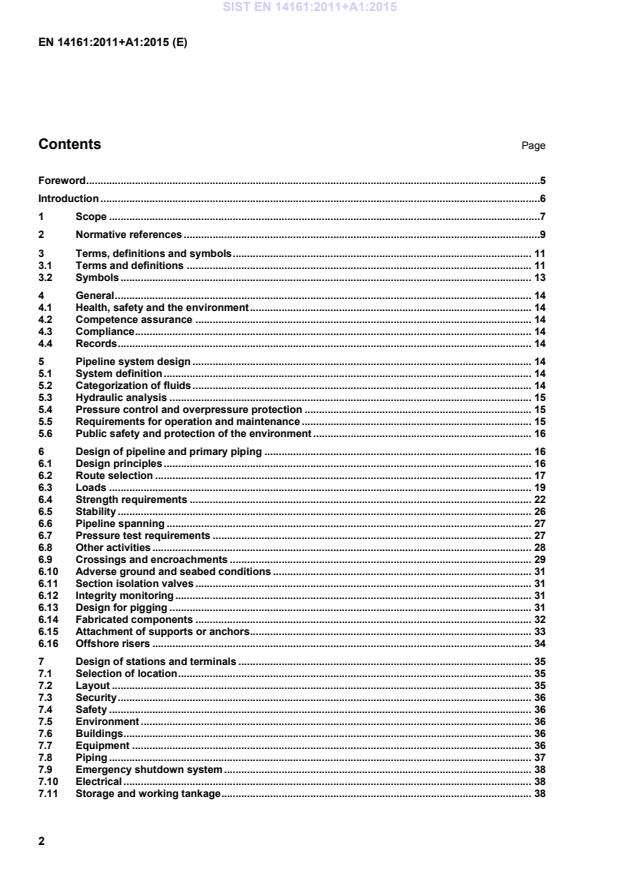
Safety evaluation of pipelines . 79 A.1 Introduction . 79 A.2 General requirements . 79 SIST EN 14161:2011+A1:2015
Supplementary requirements for public safety of pipelines for category D and E fluids on land . 83 B.1 Objective . 83 B.2 Location classification . 83 B.3 Population density . 84 B.4 Concentration of people . 84 B.5 Maximum hoop stress . 84 B.6 Pressure test requirements . 85 Annex C (informative)
Pipeline route selection process . 86 C.1 Limits . 86 C.2 Constraints . 86 C.3 Preferred corridors of interest . 86 C.4 Detailed routing . 86 Annex D (informative)
Examples of factors for routing considerations . 87 Annex E (informative)
Scope of procedures for operation, maintenance and emergencies . 89 E.1 Operating procedures . 89 E.2 Maintenance procedures . 89 E.3 Emergency procedures . 90 Annex F (informative)
Records and documentation . 91 Bibliography . 92
Where the expression “International Standard” is used, it is understood as “European Standard”. According to the CEN-CENELEC Internal Regulations, the national standards organizations of the following countries are bound to implement this European Standard: Austria, Belgium, Bulgaria, Croatia, Cyprus, Czech Republic, Denmark, Estonia, Finland, Former Yugoslav Republic of Macedonia, France, Germany, Greece, Hungary, Iceland, Ireland, Italy, Latvia, Lithuania, Luxembourg, Malta, Netherlands, Norway, Poland, Portugal, Romania, Slovakia, Slovenia, Spain, Sweden, Switzerland, Turkey and the United Kingdom.
Standardisation of the materials, equipment and offshore structures used in the drilling, production, transport by pipelines and processing of liquid and gaseous hydrocarbons within the petroleum, petrochemical and natural gas industries, excluding on-land supply systems used by the gas supply industry excluding gas infrastructure from the input of gas into the on-shore transmission network up to the inlet connection of gas appliances. (covered by CEN/TC234) and those aspects of offshore structures covered by IMO requirements (ISO/TC8). The standardisation is to be achieved wherever possible by the adoption of ISO standards. !Resulting from these resolutions, "on-land supply systems used by the European gas supply industry from the input of gas into the on-land transmission network up to the inlet connection of gas appliances" are excluded from the scope of ISO 13623:2009 for the European adoption by CEN/TC 12."
It applies to pipeline systems on land (see exclusion below) and offshore, connecting wells, production plants, process plants, refineries and storage facilities, including any section of a pipeline constructed within the boundaries of such facilities for the purpose of its connection. The extent of pipeline systems covered by this European Standard is illustrated in Figure 1.
This European Standard applies to rigid, metallic pipelines. It is not applicable for flexible pipelines or those constructed from other materials, such as glass-reinforced plastics.
This European Standard is applicable to all new pipeline systems and can be applied to modifications made to existing ones. It is not intended that it apply retroactively to existing pipeline systems.
It describes the functional requirements of pipeline systems and provides a basis for their safe design, construction, testing, operation, maintenance and abandonment. On-land supply systems used by the European gas supply industry from the input of gas into the on-land transmission network up to the inlet connection of gas appliances are excluded from the scope of this European Standard." SIST EN 14161:2011+A1:2015
Key 1 wellsite 5 pump station 9 depot 2 gathering station, treatment plant or process plant 6 valve station 10 distribution 3 liquid 7 tankage 11 compressor station 4 gas 8 refinery 12 pressure-reduction station
Pipeline elements covered by this International Standard
Connections with other facilities. The pipeline system should include an isolation valve at connections with
other facilities and at branches.
Pipeline elements not covered by this International Standard.
Station/plant area, offshore installation not covered by this International Standard.
Station/plant area covered by this International Standard.
NOTE The pipeline system should include an isolation valve at connections with other facilities and at branches. Figure 1 — Extent of pipeline systems covered by this International Standard SIST EN 14161:2011+A1:2015
Part 14: Electrical installations design, selection and erection API1)
620, Design and Construction of Large, Welded, Low-Pressure Storage Tanks API 650, Welded Steel Tanks for Oil Storage ASME B16.5, Pipe Flanges and Flanged Fittings — NPS 1/2 Through NPS 24 ASME Boiler and Pressure Vessel Code, Section VIII, Division I, Rules for Construction of Pressure Vessels (BPVC) MSS2) SP-25, Standard Marking System for Valves, Fittings, Flanges and Unions MSS SP-44, Steel Pipeline Flanges NFPA3) 30, Flammable and Combustible Liquids Code NFPA 220, Standard on Types of Building Construction
1) American Petroleum Institute, 1220 L Street, Northwest Washington, DC 20005-4070, USA. 2) Manufacturer’s Standardization Society of the Valve and Fittings Industry, 127 Park Street, N.E., Vienna, VA 22180, USA. 3) National Fire Protection Association, 1 Batterymarch Park, PO Box 9101, Quincy, MA 02269-9101, USA. SIST EN 14161:2011+A1:2015
Gases or liquids not specifically included by name should be classified in the category containing fluids most closely similar in hazard potential to those quoted. If the category is not clear, the more hazardous category shall be assumed. 5.3 Hydraulic analysis The hydraulics of the pipeline system should be analysed to demonstrate that the system can safely transport the fluids for the design conditions specified in 5.1, and to identify and determine the constraints and requirements for its operation. This analysis should cover steady-state and transient operating conditions. NOTE Examples of constraints and operational requirements are allowances for pressure surges, prevention of blockage such as caused by the formation of hydrates and wax deposition, measures to prevent unacceptable pressure losses from higher viscosities at lower operating temperatures, measures for the control of liquid slug volumes in multi-phase fluid transport, flow regime for internal corrosion control, erosional velocities and avoidance of slack line operations. 5.4 Pressure control and overpressure protection Provisions such as pressure-control valves or automatic shutdown of pressurizing equipment shall be installed, or procedures implemented, if the operating pressure can exceed the maximum allowable operating pressure anywhere in the pipeline system. Such provisions or procedures shall prevent the operating pressure from exceeding MAOP under normal steady-state conditions. Overpressure protection, such as relief or source-isolation valves, shall be provided if necessary to prevent incidental pressures exceeding the limits specified in 6.3.2.2 anywhere in the pipeline system. 5.5 Requirements for operation and maintenance The requirements for the operation and maintenance of the pipeline system shall be established and documented for use in the design and the preparation of procedures for operations and maintenance. Aspects for which requirements should be specified include: requirements for identification of pipelines, stations and fluids transported; principles for system control, including consideration of manning levels and instrumentation; location and hierarchy of control centres; voice and data communications; corrosion management; SIST EN 14161:2011+A1:2015
...
Questions, Comments and Discussion
Ask us and Technical Secretary will try to provide an answer. You can facilitate discussion about the standard in here.
Loading comments...