

SIST EN 13210-2:2021
(Main)Child care articles - Part 2: Children's harnesses incorporating backpacks and reins - Safety requirements and test methods
General Information
- Abstract
This document specifies the minimum safety requirements and test methods for children's harnesses incorporating backpacks and/or toys with a leading rein for restraining children when walking, with the ability to walk competently and for use up to 48 months of age.
If the product has other functions not covered in this document, the relevant European standard can be consulted.
- Status
- Published
- Public Enquiry End Date
- 04-May-2019
- Publication Date
- 11-Jan-2021
- Technical Committee
- OTR - Child use and care article
- Current Stage
- 6060 - National Implementation/Publication (Adopted Project)
- Start Date
- 03-Dec-2020
- Due Date
- 07-Feb-2021
- Completion Date
- 12-Jan-2021


Overview
EN 13210-2:2020 - published by CEN - defines minimum safety requirements and test methods for children's harnesses that incorporate backpacks and/or toys with a leading rein. The standard applies to harnesses intended to restrain children who can walk competently, for use up to 48 months of age. It replaces the earlier EN 13210:2004 and works alongside Part 1 where applicable. If a product has additional functions not covered here, other relevant European standards should be consulted.
Key topics and technical requirements
- Scope and definitions: Clear terminology for harness components (waist belt, shoulder straps, chest strap, grab handle, leading rein, backpack, toy).
- Age and use: Intended for children able to walk competently, up to 48 months.
- Materials & chemical safety: Migration limits for surface materials tested in accordance with EN 71-3:2019 (chemical hazards).
- Thermal hazards / flammability:
- No surface flash when tested.
- Maximum rate of spread of flame: 50 mm/s, using methods from EN 71-2.
- Mechanical safety & protection:
- No touch-and-close (hook-and-loop) fasteners allowed on harness or leading rein.
- Minimum width for waist, chest and shoulder straps: 19 mm.
- Shoulder strap fixing points must not move more than 120 mm apart (inside edges).
- Leading rein maximum overall length: 1 200 mm (including carer attachment at most onerous position).
- Cords, ribbons and ties: maximum free length 220 mm when stretched by 25 N (limits entanglement risk).
- Structural integrity tests:
- Dynamic loading using a test mass assembly (total mass 12 kg, dynamic mass 5 kg dropped 300 mm) repeated 5 times to ensure stitching, rivets and adjustment mechanisms (max slippage 20 mm) remain intact and functional.
- Grab-handle and leading-rein specific test setups described with test dummy and roller apparatus.
- Test equipment & tolerances: Detailed specifications for test dummy, spring stiffness, shackles, and measurement tolerances.
Applications
- Product design and development of harness-backpack combos, safety harnesses with reins and toy-integrated harnesses.
- Type testing and conformity assessment by test laboratories to demonstrate compliance before market launch.
- Quality control and supplier verification for manufacturers and importers.
- Regulatory guidance for retailers, child safety auditors, and standards bodies evaluating product safety for infants and toddlers.
Who uses this standard
- Manufacturers and designers of child care articles
- Certification and testing laboratories
- Compliance officers, product safety engineers, and regulatory authorities
- Retailers and procurement teams sourcing child restraint harnesses
Related standards
- EN 13210-1:2020 (other child care article requirements)
- EN 71-1 (toy mechanical/physical safety)
- EN 71-2 (toy flammability)
- EN 71-3:2019 (migration of certain elements)
Keywords: EN 13210-2:2020, children's harnesses, backpack harness, leading rein, safety requirements, test methods, CEN, child care articles.
Relations
- Effective Date
- 01-Feb-2021
- Effective Date
- 04-Feb-2026
- Effective Date
- 28-Jan-2026
- Effective Date
- 28-Jan-2026
- Effective Date
- 28-Jan-2026
- Effective Date
- 28-Jan-2026
- Effective Date
- 28-Jan-2026
Frequently Asked Questions
SIST EN 13210-2:2021 is a standard published by the Slovenian Institute for Standardization (SIST). Its full title is "Child care articles - Part 2: Children's harnesses incorporating backpacks and reins - Safety requirements and test methods". This standard covers: This document specifies the minimum safety requirements and test methods for children's harnesses incorporating backpacks and/or toys with a leading rein for restraining children when walking, with the ability to walk competently and for use up to 48 months of age. If the product has other functions not covered in this document, the relevant European standard can be consulted.
This document specifies the minimum safety requirements and test methods for children's harnesses incorporating backpacks and/or toys with a leading rein for restraining children when walking, with the ability to walk competently and for use up to 48 months of age. If the product has other functions not covered in this document, the relevant European standard can be consulted.
SIST EN 13210-2:2021 is classified under the following ICS (International Classification for Standards) categories: 97.190 - Equipment for children. The ICS classification helps identify the subject area and facilitates finding related standards.
SIST EN 13210-2:2021 has the following relationships with other standards: It is inter standard links to SIST EN 13210:2005, SIST EN 71-1:2026, SIST EN 71-1:2015+A1:2018, SIST EN 71-3:2019, SIST EN 71-2:2011+A1:2014, SIST EN 14988:2017, SIST EN 14988:2017+A1:2020. Understanding these relationships helps ensure you are using the most current and applicable version of the standard.
SIST EN 13210-2:2021 is associated with the following European legislation: Standardization Mandates: M/264. When a standard is cited in the Official Journal of the European Union, products manufactured in conformity with it benefit from a presumption of conformity with the essential requirements of the corresponding EU directive or regulation.
SIST EN 13210-2:2021 is available in PDF format for immediate download after purchase. The document can be added to your cart and obtained through the secure checkout process. Digital delivery ensures instant access to the complete standard document.
Standards Content (Sample)
SLOVENSKI STANDARD
01-februar-2021
Nadomešča:
SIST EN 13210:2005
Izdelki za otroke - 2. del: Otroški pasovi, ki so del nahrbtnika, in vajeti - Varnostne
zahteve in preskusne metode
Child care articles - Part 2: Children's harnesses incorporating backpacks and reins -
Safety requirements and test methods
Artikel für Säuglinge und Kleinkinder - Teil 2: Sicherheitsgeschirre einschließlich
Rucksäcken und Zügeln - Sicherheitsanforderungen und Prüfverfahren
Articles de puériculture - Partie 2 : Harnais équipés de sacs à dos et de laisses de
promenade pour enfants - Exigences de sécurité et méthodes d’essai
Ta slovenski standard je istoveten z: EN 13210-2:2020
ICS:
97.190 Otroška oprema Equipment for children
2003-01.Slovenski inštitut za standardizacijo. Razmnoževanje celote ali delov tega standarda ni dovoljeno.
EN 13210-2
EUROPEAN STANDARD
NORME EUROPÉENNE
November 2020
EUROPÄISCHE NORM
ICS 97.190 Supersedes EN 13210:2004
English Version
Child care articles - Part 2: Children's harnesses
incorporating backpacks and reins - Safety requirements
and test methods
Articles de puériculture - Partie 2 : Harnais équipés de Artikel für Säuglinge und Kleinkinder - Teil 2:
sacs à dos et de laisses de promenade pour enfants - Sicherheitsgeschirre mit integrierten Rucksäcken und
Exigences de sécurité et méthodes d'essai Zügeln - Sicherheitsanforderungen und Prüfverfahren
This European Standard was approved by CEN on 17 August 2020.
CEN members are bound to comply with the CEN/CENELEC Internal Regulations which stipulate the conditions for giving this
European Standard the status of a national standard without any alteration. Up-to-date lists and bibliographical references
concerning such national standards may be obtained on application to the CEN-CENELEC Management Centre or to any CEN
member.
This European Standard exists in three official versions (English, French, German). A version in any other language made by
translation under the responsibility of a CEN member into its own language and notified to the CEN-CENELEC Management
Centre has the same status as the official versions.
CEN members are the national standards bodies of Austria, Belgium, Bulgaria, Croatia, Cyprus, Czech Republic, Denmark, Estonia,
Finland, France, Germany, Greece, Hungary, Iceland, Ireland, Italy, Latvia, Lithuania, Luxembourg, Malta, Netherlands, Norway,
Poland, Portugal, Republic of North Macedonia, Romania, Serbia, Slovakia, Slovenia, Spain, Sweden, Switzerland, Turkey and
United Kingdom.
EUROPEAN COMMITTEE FOR STANDARDIZATION
COMITÉ EUROPÉEN DE NORMALISATION
EUROPÄISCHES KOMITEE FÜR NORMUNG
CEN-CENELEC Management Centre: Rue de la Science 23, B-1040 Brussels
© 2020 CEN All rights of exploitation in any form and by any means reserved Ref. No. EN 13210-2:2020 E
worldwide for CEN national Members.
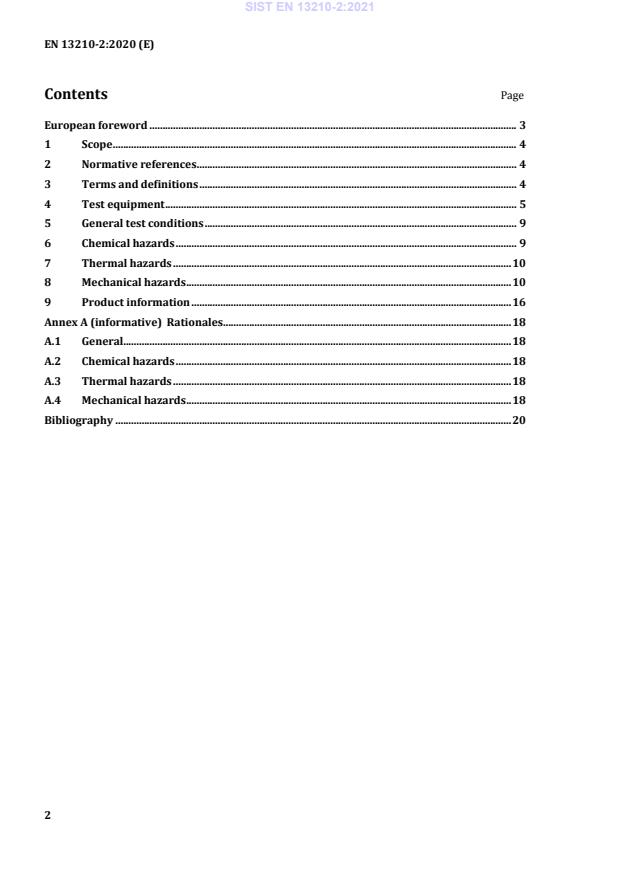
Contents Page
European foreword . 3
1 Scope . 4
2 Normative references . 4
3 Terms and definitions . 4
4 Test equipment . 5
5 General test conditions . 9
6 Chemical hazards . 9
7 Thermal hazards . 10
8 Mechanical hazards . 10
9 Product information . 16
Annex A (informative) Rationales . 18
A.1 General. 18
A.2 Chemical hazards . 18
A.3 Thermal hazards . 18
A.4 Mechanical hazards . 18
Bibliography . 20
European foreword
This document (EN 13210-2:2020) has been prepared by Technical Committee CEN/TC 252 “Child care
articles”, the secretariat of which is held by AFNOR.
This European Standard shall be given the status of a national standard, either by publication of an
identical text or by endorsement, at the latest by May 2021, and conflicting national standards shall be
withdrawn at the latest by May 2021.
Attention is drawn to the possibility that some of the elements of this document may be the subject of
patent rights. CEN shall not be held responsible for identifying any or all such patent rights.
This document, together with EN 13210-1:2020, supersedes EN 13210:2004.
This document has been prepared under mandate M/264 given to CEN by the European Commission and
the European Free Trade Association.
According to the CEN-CENELEC Internal Regulations, the national standards organisations of the
following countries are bound to implement this European Standard: Austria, Belgium, Bulgaria, Croatia,
Cyprus, Czech Republic, Denmark, Estonia, Finland, France, Germany, Greece, Hungary, Iceland, Ireland,
Italy, Latvia, Lithuania, Luxembourg, Malta, Netherlands, Norway, Poland, Portugal, Republic of North
Macedonia, Romania, Serbia, Slovakia, Slovenia, Spain, Sweden, Switzerland, Turkey and the United
Kingdom.
1 Scope
This document specifies the minimum safety requirements and test methods for children's harnesses
incorporating backpacks and/or toys with a leading rein for restraining children when walking, with the
ability to walk competently and for use up to 48 months of age.
If the product has other functions not covered in this document, the relevant European standard can be
consulted.
2 Normative references
The following documents are referred to in the text in such a way that some or all of their content
constitutes requirements of this document. For dated references, only the edition cited applies. For
undated references, the latest edition of the referenced document (including any amendments) applies.
EN 71-1, Safety of toys - Part 1: Mechanical and physical properties
EN 71-2:2011+A1:2014, Safety of toys - Part 2: Flammability
EN 71-3:2019, Safety of toys - Part 3: Migration of certain elements
3 Terms and definitions
For the purposes of this document, the following terms and definitions apply.
ISO and IEC maintain terminological databases for use in standardization at the following addresses:
• IEC Electropedia: available at http://www.electropedia.org/
• ISO Online browsing platform: available at https://www.iso.org/obp
3.1
harness with backpack or toy
restraint system designed to fit around the child’s torso comprising a strap or fabric assembly or a
combination of both incorporating a storage bag or toy, a grab handle and/or attachment point(s) for a
leading rein (3.8)
Note 1 to entry: See Figure 1.
3.2
backpack
storage bag worn on the child’s back
3.3
toy
toy, clothed or unclothed, with soft body surfaces and filled with soft materials, readily allowing
compression of the main part of the toy with the hand or useable as a storage bag, or a combination of
both, attached to a harness or with an integral harness and worn on the child’s back
Figure 1 — Example of a harness incorporating a backpack
3.4
waist belt
part of the harness which passes around the child’s torso
3.5
shoulder straps
parts of the harness which pass over each shoulder of the child
3.6
chest strap
strap(s) or a fastening system or combination of both which is attached to the shoulder straps and
positioned across the front of the child’s torso
3.7
grab handle
short strap fixed at both ends at the top of the backpack/toy
3.8
leading rein
single continuous strap which is attached at a single point to the harness/backpack/toy with a wrist loop
or a hand grip to be held by the carer
4 Test equipment
4.1 Test frame
Rigid test frame comprising:
— two horizontal members against which the test dummy top eyebolt and bottom clamp may be secured
by bolts or clamps;
— 75 mm diameter convey belt roller positioned with a horizontal gap of (250 ± 10) mm between the
test dummy and roller. It shall be possible to adjust the height of the roller and/or the horizontal
members supporting the test dummy;
— height adjustable dynamic mass release mechanism (See Figure 2).
Dimensions in millimetres
Key
1 horizontal members
2 test dummy
3 roller
4 dynamic mass release mechanism
Figure 2 — Test frame
4.2 Test dummy
Dummy comprising:
— bag 300 mm wide and 470 mm long filled with dry compacted sand, so that the whole constitutes a
rigid form (see Figure 3);
— inside the closed end of the bag is a rectangular metal bar, 260 mm long, 25 mm high and 6 mm wide
connected at the centre of its length to an eyebolt passing through an eyelet;
— the open end of the bag shall be sewn closed 50 mm from the bottom of the bag and clamped between
two rectangular bars, of minimum dimensions 400 mm long, 25 mm high and 6 mm wide each with
four holes drilled with the centres 160 mm and 180 mm from the centre of the bar and secured with
nuts and bolts through the inner holes. Additional holes may be drilled in the bar to ensure that the
bag is securely clamped. The outer holes enable the bottom of the dummy to be secured to the
horizontal beam of the test frame.
Dimensions in millimetres
Key
1 eyebolt
2 bag
3 clamp
Figure 3 — Test dummy
4.3 Test mass assembly
4.3.1 General
Assembly that includes shackles, spring, static mass and dynamic mass. The total mass of the assembly
shall be (12 ± 0,1) kg.
The dynamic mass shall be (5 ± 0,05) kg and be capable of falling freely from a height of 300 mm (see
Figure 4).
Dimensions in millimetres
Key
1 top shackles
2 suspension bar
3 shackle
4 spring
5 dynamic mass
6 release mechanism
7 test frame
8 static mass
Figure 4 — Test mass assembly
4.3.2 Spring
A spring with the following characteristics shall be used to support the static and dynamic mass from the
suspension bar:
Stiffness (28 000 ± 10 %) N/M;
Diameter of wire 3 mm;
External diameter 16 mm;
Length without load 45mm ± 5 mm.
4.3.3 Shackles
Shackles shall have a diameter of 10 mm at the roundest end.
4.3.4 Release mechanism
Bar or rod supported by the test frame which is withdrawn to release the dynamic mass.
4.3.5 Grab handle test strap
A piece of (47 ± 3) mm wide webbing with a loop sewn into each end. The length of the strap including
loops shall be (1 200 ± 50) mm.
NOTE Vehicle seat belt webbing fits this criteria.
5 General test conditions
5.1 General
The tests shall be carried out in the order that they are listed in this document and on one sample, unless
otherwise stated.
5.2 Tolerances
Unless stated otherwise, all forces, masses and dimensions of the test equipment shall have tolerances as
follows:
— forces ± 5 %;
— masses ± 0,5 %;
— dimensions ± 0,5 mm.
6 Chemical hazards
A separate unconditioned sample shall be used for this test.
Migration of elements from s
...