

oSIST prEN 10106:2026
(Main)Magnetics materials - Cold rolled non-oriented electrical steel strip and sheet delivered in the fully processed state
- Abstract
This document specifies cold-rolled non-oriented electrical steel strip and sheet in nominal thicknesses of 0,35 mm, 0,50 mm, 0,65 mm and 1,00 mm. In particular, it specifies general requirements, the magnetic properties, geometric characteristics and tolerances, technological characteristics as well as the inspection procedure.
This document applies to materials supplied in the fully annealed condition intended for the construction of magnetic circuits. It does not apply to semi-processed material.
These magnetic materials correspond to EN 60404-1:2017, Class C.21.
- Status
- Not Published
- Public Enquiry End Date
- 04-Sep-2026
- Technical Committee
- IFEK - Ferrous metals
- Current Stage
- 4020 - Public enquire (PE) (Adopted Project)
- Start Date
- 14-Jul-2026
- Due Date
- 01-Dec-2026
- Completion Date
- 07-Sep-2026
oSIST prEN 10106:2026 is a CEN draft European Standard for cold-rolled non-oriented electrical steel strip and sheet delivered in the fully processed state. It specifies the product grades, magnetic properties, geometric characteristics, technological characteristics, and inspection procedure for material intended for magnetic circuits. The document is written for manufacturers, purchasers, and test laboratories that need a common basis for ordering, checking, and accepting these electrical steel products.
What does oSIST prEN 10106:2026 specify?
oSIST prEN 10106:2026 specifies cold-rolled non-oriented electrical steel strip and sheet in nominal thicknesses of 0,35 mm, 0,50 mm, 0,65 mm and 1,00 mm. It applies to material supplied in the fully annealed condition for the construction of magnetic circuits, and it excludes semi-processed material.
The document is organized into clauses on scope, normative references, terms and definitions, classification and designation, purchaser information, general requirements, technical requirements, inspection and testing, marking, labelling and packaging, and complaints. It also has three informative annexes.
| Annex | What it covers |
|---|---|
| Annex A | Non-specified magnetic properties, for guidance |
| Annex B | Density determination |
| Annex C | Minimum stacking factor for coated products |
What are the key requirements of oSIST prEN 10106:2026?
Ordering and designation
Clause 5 sets out the information the purchaser has to provide, including quantity, product form, EN 10106, steel name or number, coil direction, coil internal diameter, dimensions, insulation coating details, and the inspection procedure. In practice, this means the order must define both the product and how it will be checked.
Clause 4 links each grade to its maximum specific total loss and nominal thickness, and it gives the structure of the steel name and steel number. This matters because the designation tells suppliers and users which loss level and thickness they are buying.
General supply conditions
Clause 6 leaves the production process and chemical composition to the manufacturer. The document also fixes the form of supply - sheets in bundles and strip in coils - while letting the parties agree bundle mass, coil mass, external diameter, and related packing limits.
Clause 6 also covers delivery condition, surface condition, and suitability for cutting. The material is normally supplied without insulation or with insulation on one or both sides in accordance with EN 10342, so the buyer needs to state coating needs clearly if the product will be stacked, bonded, or further processed.
Magnetic properties
Clause 7.1 requires magnetic properties to be measured in accordance with EN 60404-2. Table 1 sets the minimum magnetic polarization, maximum specific total loss at 1,5 T and 50 Hz, the range for anisotropy of loss, and related data for each grade.
For specific total loss, the table values apply in the aged condition, and the document allows an agreed requirement for test pieces cut only parallel or only perpendicular to the rolling direction. In practice, this matters when a user wants to compare rolling and transverse performance or when the design is sensitive to losses in service.
For coated products, the coating mass has to be taken into account when determining magnetic properties. Annex A gives guidance values for other magnetic conditions, which can help with internal comparison or product development.
Geometric characteristics and tolerances
Clause 7.2 covers thickness, width, length, edge camber, edge wave, and residual curvature. The document gives different width tolerances for slit edges and as-rolled edges, and it limits the extra thickness caused by welds.
The geometry checks matter because electrical steel is often slit, cut, stacked, and punched into laminations. Small deviations can affect nesting, waste, and downstream processing.
Residual curvature has two methods in EN 10251:2024, vertical and horizontal, and the vertical method is the default unless agreed otherwise. That gives the parties a defined way to assess flatness in the rolling direction.
Technological characteristics and coatings
Clause 7.3 deals with density, stacking factor, number of bends, deviation from the shearing line, and insulation coating properties. Density is not specified as a single fixed value, but conventional values are used for calculations and other values may be agreed.
The stacking factor values in Table 1 apply to products without insulation coating, while coated products use Annex C. This matters because the coating changes how much steel is present in a stack, which affects machine design and loss calculations.
Clause 7.3 also links coating qualification and test methods to CEN/TR 17856, EN IEC 60404-11, EN IEC 60404-12, and CEN/TR 18048. In practice, this gives users a route for checking insulation resistance, thermal endurance, and, for self-bonding coatings, mechanical behavior.
Inspection and acceptance
Clause 8 allows orders with or without specific inspection, but even an order without specific inspection still requires an inspection document giving the specific total loss. When specific inspection is ordered, the material is divided into acceptance units, and testing is carried out per acceptance unit.
Sampling and specimen preparation are detailed for magnetic tests, geometric checks, stacking factor, and reverse bend testing. Retests are also defined: if a result fails, the test is repeated on double the number of specimens from other parts of the acceptance unit.
What terms does oSIST prEN 10106:2026 define?
- edge wave (wave factor) - A flatness variation that appears as waves at a slit edge after trimming or slitting, described by the relation between wave height and wave length.
- residual curvature - A permanent curvature in the rolling direction seen in an unwound strip or sheet.
- edge camber - The largest distance between a longitudinal edge and the line joining the two ends of the measured edge length.
- number of bends - The count of alternating bends in the reverse bend test before the first visible crack in the base metal or sudden fracture.
- deviation from the shearing line - The greatest distance between the two cut edges of a sample sheared through the middle width parallel to rolling.
- acceptance unit - The coil or equivalent production lot treated as one unit through rolling and heat-treatment for inspection and test purposes.
Who uses oSIST prEN 10106:2026?
oSIST prEN 10106:2026 is used by producers of electrical steel strip and sheet, by slitters and processors, and by purchasers who order material for magnetic circuits. It is also used by manufacturers of electrical machines and other laminated magnetic assemblies.
Quality managers and test laboratories use it for inspection planning, sampling, Epstein frame measurements, reverse bend testing, and dimensional checks. Buyers use it to specify grade, coating, coil form, packaging, and inspection documents before placing an order.
What changed in oSIST prEN 10106:2026 from the previous edition?
oSIST prEN 10106:2026 will supersede EN 10106:2015. The foreword states that the main changes are updated normative references and definitions, a more detailed list of options, replacement of the word “defects” with “imperfections”, updated technical requirements, and editorial improvements throughout the document.
Which standards are used with oSIST prEN 10106:2026?
| Standard | What it contributes |
|---|---|
| EN 10021 | General technical delivery conditions and complaint handling |
| EN 10027-1 | Steel names |
| EN 10027-2 | Steel numbers |
| EN 10204 | Inspection documents |
| EN 10251:2024 | Methods for geometrical characteristics, camber, wave, and residual curvature |
| EN 10342 | Classification of surface insulations |
| EN 60404-2 | Epstein frame measurement of magnetic properties |
| EN IEC 60404-11 | Surface insulation resistance |
| EN IEC 60404-12 | Thermal endurance of insulation coatings |
| EN IEC 60404-13 | Resistivity, density, and stacking factor |
| EN ISO 7799 | Reverse bend test |
| IEC 60050-121 | Electromagnetism vocabulary |
| IEC 60050-221 | Magnetic materials vocabulary |
The document also points to CEN/TR 17856 for coating-property evaluation and CEN/TR 18048 for self-bonding coating properties. The scope also refers to EN 60404-1:2017, Class C.21.
What does the oSIST prEN 10106:2026 document contain?
oSIST prEN 10106:2026 contains the grade classification and designation system, including the naming format for non-oriented electrical steel. It includes tables for magnetic property limits, thickness tolerances, width tolerances, stacking factor, density, and minimum number of bends.
The document also gives specimen preparation and test methods for the Epstein frame, reverse bend testing, thickness measurement, width measurement, and checks for camber, wave, and residual curvature. These methods are used for routine inspection, acceptance testing, and dispute resolution.
Its annexes add guidance values for non-specified magnetic properties, a density formula, and stacking-factor values for coated products. Figures and formulas support the geometric and magnetic measurements without requiring the reader to derive methods from scratch.
Relations
- Effective Date
- 19-Nov-2025
Get Certified
Connect with accredited certification bodies for this standard

Element Materials Technology
Materials testing and product certification.

Inštitut za kovinske materiale in tehnologije
Institute of Metals and Technology. Materials testing, metallurgical analysis, NDT.
Sponsored listings
Frequently Asked Questions
oSIST prEN 10106:2026 is a draft published by the Slovenian Institute for Standardization (SIST). Its full title is "Magnetics materials - Cold rolled non-oriented electrical steel strip and sheet delivered in the fully processed state". This standard covers: This document specifies cold-rolled non-oriented electrical steel strip and sheet in nominal thicknesses of 0,35 mm, 0,50 mm, 0,65 mm and 1,00 mm. In particular, it specifies general requirements, the magnetic properties, geometric characteristics and tolerances, technological characteristics as well as the inspection procedure. This document applies to materials supplied in the fully annealed condition intended for the construction of magnetic circuits. It does not apply to semi-processed material. These magnetic materials correspond to EN 60404-1:2017, Class C.21.
This document specifies cold-rolled non-oriented electrical steel strip and sheet in nominal thicknesses of 0,35 mm, 0,50 mm, 0,65 mm and 1,00 mm. In particular, it specifies general requirements, the magnetic properties, geometric characteristics and tolerances, technological characteristics as well as the inspection procedure. This document applies to materials supplied in the fully annealed condition intended for the construction of magnetic circuits. It does not apply to semi-processed material. These magnetic materials correspond to EN 60404-1:2017, Class C.21.
oSIST prEN 10106:2026 is classified under the following ICS (International Classification for Standards) categories: 77.140.50 - Flat steel products and semi-products. The ICS classification helps identify the subject area and facilitates finding related standards.
oSIST prEN 10106:2026 has the following relationships with other standards: It is inter standard links to SIST EN 10106:2016. Understanding these relationships helps ensure you are using the most current and applicable version of the standard.
oSIST prEN 10106:2026 is available in PDF format for immediate download after purchase. The document can be added to your cart and obtained through the secure checkout process. Digital delivery ensures instant access to the complete standard document.
Standards Content (Sample)
SLOVENSKI STANDARD
01-september-2026
Magnetni materiali - Hladno valjana neorientirana elektropločevina in trakovi,
dobavljeni v končnem stanju
Magnetics materials - Cold rolled non-oriented electrical steel strip and sheet delivered in
the fully processed state
Magnetische Werkstoffe - Kaltgewalztes nicht kornorientiertes Elektroband und -blech im
schlussgeglühten Zustand
Matériaux magnétiques - Bandes et tôles magnétiques en acier à grains non orientés
laminées à froid et livrées à l'état fini
Ta slovenski standard je istoveten z: prEN 10106
ICS:
77.140.50 Ploščati jekleni izdelki in Flat steel products and semi-
polizdelki products
2003-01.Slovenski inštitut za standardizacijo. Razmnoževanje celote ali delov tega standarda ni dovoljeno.
DRAFT
EUROPEAN STANDARD
NORME EUROPÉENNE
EUROPÄISCHE NORM
June 2026
ICS 77.140.50 Will supersede EN 10106:2015
English Version
Magnetics materials - Cold rolled non-oriented electrical
steel strip and sheet delivered in the fully processed state
Matériaux magnétiques - Bandes et tôles magnétiques Magnetische Werkstoffe - Kaltgewalztes nicht
en acier à grains non orientés laminées à froid et kornorientiertes Elektroband und -blech im
livrées à l'état fini schlussgeglühten Zustand
This draft European Standard is submitted to CEN members for enquiry. It has been drawn up by the Technical Committee
CEN/TC 459/SC 8.
If this draft becomes a European Standard, CEN members are bound to comply with the CEN/CENELEC Internal Regulations
which stipulate the conditions for giving this European Standard the status of a national standard without any alteration.
This draft European Standard was established by CEN in three official versions (English, French, German). A version in any other
language made by translation under the responsibility of a CEN member into its own language and notified to the CEN-CENELEC
Management Centre has the same status as the official versions.
CEN members are the national standards bodies of Austria, Belgium, Bulgaria, Croatia, Cyprus, Czech Republic, Denmark, Estonia,
Finland, France, Germany, Greece, Hungary, Iceland, Ireland, Italy, Latvia, Lithuania, Luxembourg, Malta, Netherlands, Norway,
Poland, Portugal, Republic of North Macedonia, Romania, Serbia, Slovakia, Slovenia, Spain, Sweden, Switzerland, Türkiye and
United Kingdom.
Recipients of this draft are invited to submit, with their comments, notification of any relevant patent rights of which they are
aware and to provide supporting documentation.
Warning : This document is not a European Standard. It is distributed for review and comments. It is subject to change without
notice and shall not be referred to as a European Standard.
EUROPEAN COMMITTEE FOR STANDARDIZATION
COMITÉ EUROPÉEN DE NORMALISATION
EUROPÄISCHES KOMITEE FÜR NORMUNG
CEN-CENELEC Management Centre: Rue de la Science 23, B-1040 Brussels
© 2026 CEN All rights of exploitation in any form and by any means reserved Ref. No. prEN 10106:2026 E
worldwide for CEN national Members.
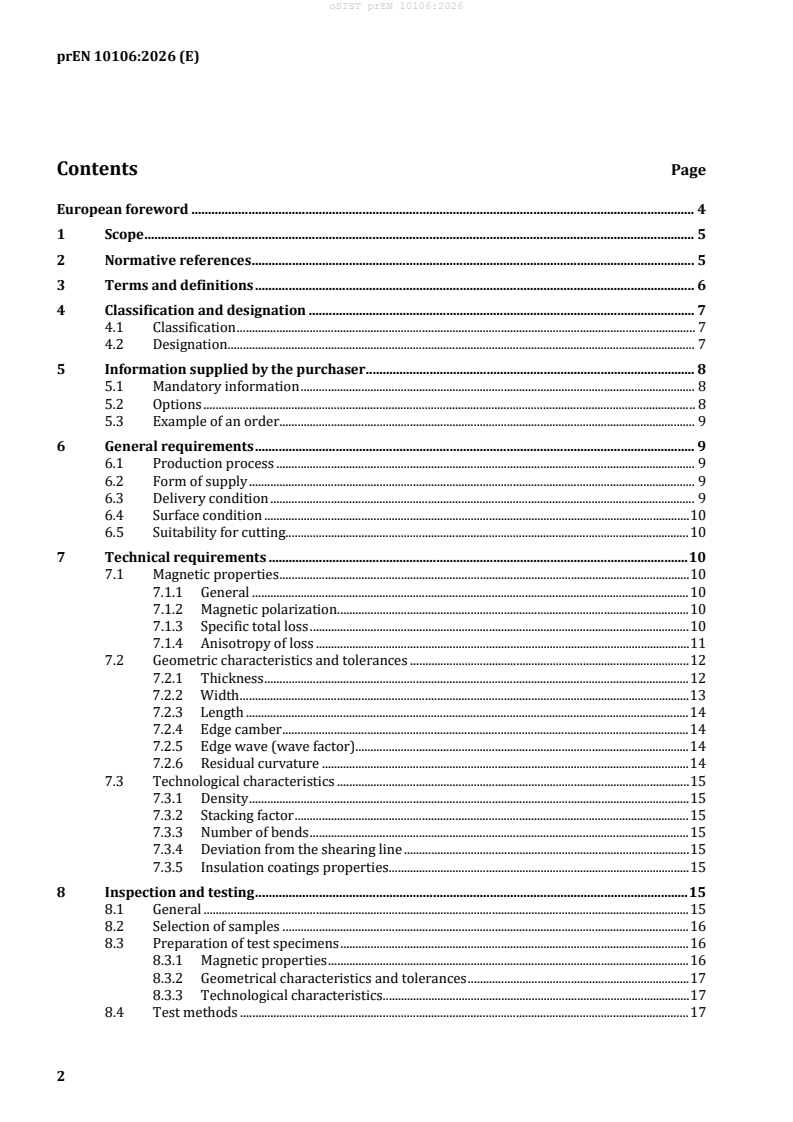
Contents Page
European foreword . 4
1 Scope . 5
2 Normative references . 5
3 Terms and definitions . 6
4 Classification and designation . 7
4.1 Classification . 7
4.2 Designation . 7
5 Information supplied by the purchaser . 8
5.1 Mandatory information . 8
5.2 Options . 8
5.3 Example of an order . 9
6 General requirements . 9
6.1 Production process . 9
6.2 Form of supply . 9
6.3 Delivery condition . 9
6.4 Surface condition . 10
6.5 Suitability for cutting . 10
7 Technical requirements . 10
7.1 Magnetic properties . 10
7.1.1 General . 10
7.1.2 Magnetic polarization . 10
7.1.3 Specific total loss . 10
7.1.4 Anisotropy of loss . 11
7.2 Geometric characteristics and tolerances . 12
7.2.1 Thickness . 12
7.2.2 Width . 13
7.2.3 Length . 14
7.2.4 Edge camber . 14
7.2.5 Edge wave (wave factor). 14
7.2.6 Residual curvature . 14
7.3 Technological characteristics . 15
7.3.1 Density . 15
7.3.2 Stacking factor . 15
7.3.3 Number of bends . 15
7.3.4 Deviation from the shearing line . 15
7.3.5 Insulation coatings properties . 15
8 Inspection and testing . 15
8.1 General . 15
8.2 Selection of samples . 16
8.3 Preparation of test specimens . 16
8.3.1 Magnetic properties . 16
8.3.2 Geometrical characteristics and tolerances . 17
8.3.3 Technological characteristics . 17
8.4 Test methods . 17
8.4.1 General . 17
8.4.2 Magnetic properties . 17
8.4.3 Geometrical characteristics and tolerances . 18
8.4.4 Technological characteristics . 18
8.5 Retests . 19
9 Marking, labelling and packaging . 19
10 Complaints . 19
Annex A (informative) Non-specified magnetic properties . 20
Annex B (informative) Density determination . 21
Annex C (informative) Minimum stacking factor for coated products . 22
Bibliography . 23
European foreword
This document (prEN 10106:2026) has been prepared by Technical Committee CEN/TC 459/SC 8 “Steel
sheet and strip for electrical applications”, the secretariat of which is held by DIN.
This document is currently submitted to the CEN Enquiry.
This document will supersede EN 10106:2015.
— the normative references and the definitions have been updated;
— the list of options is more detailed (see 5.2);
— “defects” has been replaced by “imperfections”;
— technical requirements have been updated (see Clause 7);
— throughout the document, editorial changes have been made to improve the quality of the text.
1 Scope
This document specifies cold-rolled non-oriented electrical steel strip and sheet in nominal thicknesses
of 0,35 mm, 0,50 mm, 0,65 mm and 1,00 mm. In particular, it specifies general requirements, the
magnetic properties, geometric characteristics and tolerances, technological characteristics as well as the
inspection procedure.
This document applies to materials supplied in the fully annealed condition intended for the construction
of magnetic circuits. It does not apply to semi-processed material.
These magnetic materials correspond to EN 60404-1:2017, Class C.21.
2 Normative references
The following documents are referred to in the text in such a way that some or all of their content
constitutes requirements of this document. For dated references, only the edition cited applies. For
undated references, the latest edition of the referenced document (including any amendments) applies.
EN 10021, General technical delivery conditions for steel products
EN 10027-1, Designation systems for steels — Part 1: Steel names
EN 10027-2, Designation systems for steels — Part 2: Numerical system
EN 10204, Metallic products — Types of inspection documents
EN 10251:2024, Magnetic materials — Methods of determination of the geometrical characteristics of
electrical steel sheet and strip
EN 10342, Magnetic materials — Classification of surface insulations of electrical steel sheet, strip and
laminations
EN 60404-2, Magnetic materials — Part 2: Methods of measurement of the magnetic properties of electrical
steel strip and sheet by means of an Epstein frame (IEC 60404-2)
EN IEC 60404-11, Magnetic materials — Part 11: Methods of measurement of the surface insulation
resistance of electrical steel strip and sheet (IEC 60404-11)
EN IEC 60404-12, Magnetic materials — Part 12: Methods of test for the assessment of the thermal
endurance of surface insulation coatings on electrical steel strip and sheet (IEC 60404-12)
EN IEC 60404-13, Magnetic materials — Part 13: Methods of measurement of resistivity, density and
stacking factor of electrical steel strip and sheet (IEC 60404-13)
EN ISO 7799, Metallic materials — Sheet and strip 3 mm thick or less — Reverse bend test (ISO 7799)
IEC 60050-121, International Electrotechnical Vocabulary — Chapter 121: Electromagnetism
IEC 60050-221, International Electrotechnical Vocabulary — Chapter 221: Magnetic materials and
components
3 Terms and definitions
For the purposes of this document, the terms and definitions given in IEC 60050-121 and IEC 60050-221
and the following apply.
ISO and IEC maintain terminology databases for use in standardization at the following addresses:
— ISO Online browsing platform: available at https://www.iso.org/obp/
— IEC Electropedia: available at https://www.electropedia.org/
3.1
edge wave
wave factor
variation of flatness of a length of strip or sheet taking a form of waves at the slit edge of the product after
longitudinal side trimming or slitting of the product; characterised by the wave factor, i.e. by the relation
of the height of the wave to its length
Note 1 to entry: For examples of waves, see Figure 1.
[SOURCE: EN 10251:2024, definition 3.1]
Key
1 flat surface
2 sheet
3 rolling direction
h height of wave (mm)
l length of wave (mm)
Figure 1 — Example of wave
3.2
residual curvature
variations of flatness of a length of unwound strip or a sheet taking a permanent curvature in the direction
of rolling of the product
[SOURCE: EN 10251:2024, definition 3.2]
3.3
edge camber
greatest distance between a longitudinal edge of a length of strip or a sheet and the line joining the two
extremities of the measured length of this edge
Note 1 to entry: See Figure 2.
[SOURCE: EN 10251:2024, definition 3.3]
Figure 2 — Verification of the edge camber
3.4
number of bends
counts of alternate bends in the reverse bend test prior to the appearance of the first crack in the base
metal of the specimen visible to the naked eye or prior to when sudden failure occurs by fracture
3.5
deviation from the shearing line
greatest distance between corresponding points on the two cut edges of a length of strip or a sheet
sheared in the middle of the width, in parallel to the rolling direction of the product, which may
characterise the internal stresses of the material
4 Classification and designation
4.1 Classification
The grades covered by this document are classified according to the value of the maximum specific total
loss in watts per kilogram and according to the nominal thickness of the material (0,35 mm, 0,50 mm,
0,65 mm and 1,00 mm).
4.2 Designation
For the steel grades covered by this document, the steel names are allocated in accordance with
EN 10027-1. The steel numbers are allocated in accordance with EN 10027-2.
The steel name comprises the following in the order given:
a) capital letter M for electrical steel;
b) number of one hundred times the specified value of maximum specific total loss at 50 Hz, in watts per
kilogram and corresponding to the nominal product thickness, at 1,5 T;
c) one hundred times the nominal thickness of the material, in millimetres;
d) characteristic letter A for non-oriented electrical sheet or strip supplied in the fully processed state.
EXAMPLE Non-oriented electrical steel sheet or strip with a maximum specific total loss at 1,5 T of 2,50 W/kg
at 50 Hz, a nominal thickness of 0,35 mm, supplied in the fully processed state: M250–35A.
5 Information supplied by the purchaser
5.1 Mandatory information
For material to adequately comply with the requirements of this document, the purchaser shall include
the following information in their enquiry or order:
a) the quantity required;
b) the type of product (strip or sheet);
c) the number of this document, i.e. EN 10106;
d) the steel name or number (see 4.2);
e) the direction of coils, axis horizontal (h) or vertical (v) (see 6.2);
f) the internal diameter of coil (see 6.2);
g) any limitation on the mass of a bundle of sheets or of a coil or limitation of external diameter (see
6.2);
h) any limitation of the mass of the packing unit (see 6.2);
i) the presence and type of insulation coating (see 6.3);
j) the dimensions of strips or sheets required, including any limitation on the external diameter of a coil
(see 6.2 and 7.2.2);
k) the inspection procedure required including the nature of the related document (see 8.1).
5.2 Options
The following options may be agreed at the time of enquiry and order. lf the purchaser does not indicate
his wish to implement one of these options, the products shall be supplied in accordance with the basis
specification of this document (see 5.1).
1) permissibility of welds or interleaves and their optional marking (see 6.2);
2) insulation coating properties (see 6.3);
3) specific total loss only applicable for longitudinal or transverse test pieces (see 7.1.3);
c
4) density determination (see Table 1, Footnote and Annex B);
5) minus tolerances for nominal width (see Table 3);
6) specific inspection (see 8.1);
7) type of acceptance unit (see 8.1);
8) higher number of strips for Epstein test (see Table 4);
9) marking of the products (see Clause 9).
5.3 Example of an order
18 t strip with 0,35 mm thickness in accordance with EN 10106, made of steel grade M270-35A, delivered
in coils with a width of 1 000 mm and a maximum mass of 3 500 kg, vertical coil axis (v), with specific
inspection, inspection report 3.1 in accordance with EN 10204:
18 t – strip – EN 10106 — M270-35A – 1000 mm – max. 3500 kg – v – 3.1
6 General requirements
6.1 Production process
The production process of the steel and its chemical composition are left to the discretion of the
manufacturer.
6.2 Form of supply
For sheets the material is supplied in bundles and for strip the material is supplied in coils.
The mass of bundles of sheets or the mass and/or the external diameter of coils shall be agreed at the
time of enquiry and order.
The mass of the package unit shall be agreed at the time of enquiry and order.
The recommended value for the internal diameter of coils is approximately 508 mm or 610 mm.
The strip shall be of constant width and wound in such a way that the edges are superimposed in a regular
manner and that the side faces of the coil are substantially flat.
The coils shall be sufficiently tightly wound so that they do not collapse under their own weight.
The strip may exhibit welds or interleaves resulting from the removal of defective zones if agreed
between the manufacturer and the purchaser at the time of enquiry and order (see 5.2, option 1). If
necessary, the marking of welds or interleaves may be agreed between the manufacturer and the
purchaser at the time of enquiry and order.
For coils containing repair welds or interleaves, each part of the strip shall be of the same grade.
The edges of parts welded together shall not be so much out of alignment as to affect further processing
of the product.
Sheets that make up each bundle shall be stacked so that the side faces are substantially flat and
approximately perpendicular to the top face.
6.3 Delivery condition
The products are usually supplied either without insulation or with insulation on one or both sides in
accordance with EN 10342. When the product is supplied with insulation, the nature of the insulation, its
thickness and properties, the stacking factor and their verification shall be agreed at the time of enquiry
and order (see 5.2, Option 2) and in accordance with the values stated in Table C.1.
6.4 Surface condition
1)
The surfaces shall be smooth and clean, free from grease and rust . Dispersed imperfections such as
scratches, blisters, cracks, etc. are only permitted if the products are within the tolerances on thickness
and if these defects are not detrimental to the correct use of the supplied material.
For products supplied with insulation coating, the coating shall be sufficiently adherent so that it does
not become detached during manufacturing operations. During the reverse bend test (see 8.4.4.2), the
coating shall not become detached after a bend of 90°. If the coating becomes detached during the test,
the piece from which the sample of the product from which the test specimen was taken shall be subjected
to a shearing test. By shearing the sample with well sharpened tools, a detachment of large pieces of the
coating shall not be admissible. However, some slight chipping of the coating at the sheared edges shall
be tolerated.
If the product is to be immersed in a fluid or is to be given an additional coating or impregnation, an
agreement initiated by the purchaser should be reached with the supplier to ensure compatibility
between the fluid and the surface insulation coating.
CEN/TR 17856 and CEN/TR 18048 describe all the relevant measurement procedures for coating
properties.
6.5 Suitability for cutting
The product shall be suitable for cutting or punching without causing premature wear of the tools. The
product shall be suitable for cutting or punching accurately into the usual shapes when appropriate
cutting or punching tools and technologies are used.
7 Technical requirements
7.1 Magnetic properties
7.1.1 General
The properties defined in 7.1.2 to 7.1.4 are applicable to products in the delivery conditions defined in
6.3. The magnetic properties shall be measured in accordance with EN 60404-2.
For products supplied with insulation coating, the mass of the coating should be taken into account to
determine the magnetic properties.
7.1.2 Magnetic polarization
The specified minimum values of peak magnetic polarization at the peak magnetic field strengths H of
2 500 A/m, 5 000 A/m and 10 000 A/m at 50 Hz shall be as given in Table 1.
7.1.3 Sp
...