

SIST EN 857:2026
(Main)Rubber hoses and hose assemblies - Wire braid reinforced compact type for hydraulic applications - Specification
General Information
- Abstract
This document specifies requirements for two types of wire braid reinforced compact hoses and hose assemblies of nominal bore from 6 to 76, types 1SC and 2SC.
They are suitable for use with:
— hydraulic fluids in accordance with ISO 6743 4 with the exception with the exception of all flame retardant HFD fluids at temperatures ranging from −40 °C to +100 °C;
— water-based fluids at temperatures ranging from −40 °C to +70 °C;
— water at temperatures ranging from 0 °C to +70 °C.
The hoses are not suitable for use with castor oil based nor phosphoric ester-based fluids.
This document does not include requirements for end fittings. It is limited to the performance of hoses and hose assemblies.
NOTE Requirements for hydraulic hoses for underground mining are covered in other documents.
- Status
- Published
- Public Enquiry End Date
- 30-Dec-2024
- Publication Date
- 07-May-2026
- Technical Committee
- IPMA - Polimer materials and products
- Current Stage
- 6060 - National Implementation/Publication (Adopted Project)
- Start Date
- 04-May-2026
- Due Date
- 09-Jul-2026
- Completion Date
- 08-May-2026

Overview
SIST EN 857:2026 specifies the requirements and performance characteristics for two types of wire braid reinforced compact rubber hoses and hose assemblies-types 1SC and 2SC-used in hydraulic applications. The standard covers hoses with nominal bores ranging from 6 mm to 76 mm. These hoses are engineered for conveying hydraulic fluids (as per ISO 6743-4, excluding HFD flame retardant fluids), water-based fluids, and water within defined temperature ranges. The standard ensures high reliability and safety in fluid transfer systems, particularly in hydraulics, by focusing on hose integrity, durability, and compatibility with common hydraulic fluids.
Key Topics
Types of Hoses:
- Type 1SC: Single wire braid reinforced, compact design.
- Type 2SC: Dual wire braid reinforced, enhanced pressure capabilities.
Temperature Compatibility:
- Hydraulic fluids (excluding HFD) from −40 °C to +100 °C.
- Water-based fluids from −40 °C to +70 °C.
- Water from 0 °C to +70 °C.
- Not suitable for castor oil or phosphoric ester-based fluids.
Hose Construction:
- Oil and water-resistant synthetic rubber lining.
- One or two steel wire braids (depending on type).
- Durable synthetic rubber cover for weather and abrasion resistance.
Dimensions and Tolerances:
- Comprehensive requirements for inside/outside diameter, concentricity, and wall thickness.
- Defined tolerances ensure consistency in hydraulic systems.
Performance Criteria:
- Hydrostatic, burst, and proof pressure requirements.
- Minimum bend radius for flexibility without kinking.
- Resistance to abrasion, ozone, vacuum, and various fluids.
- No end fitting requirements included; focus is solely on hose and assembly performance.
Marking and Identification:
- Details for manufacturer, hose type, bore, working pressure, and production date.
- Clear marking aids in traceability and compliance verification.
Applications
Wire braid reinforced compact hoses specified by SIST EN 857:2026 are critical in a wide range of hydraulic applications where space and weight savings, flexibility, and robust pressure performance are required:
Industrial and Mobile Hydraulics:
Used in hydraulic power units, presses, injection molding machines, and mobile equipment such as excavators, cranes, and agricultural machinery.Hydraulic Transmission Systems:
Suitable for high-pressure hydraulic circuits, lifting equipment, and fluid transfer lines.Construction and Agricultural Machinery:
Ideal for tight installations where compact hose dimensions are beneficial.Maintenance and Replacement:
Standardized requirements simplify sourcing and replacement in repair, retrofit, or new installation contexts.
The standard is not applicable for hoses intended for underground mining or for use with HFD fluids or special chemical fluids where other specifications apply.
Related Standards
To ensure comprehensive compliance and safe use, SIST EN 857:2026 is closely related to several international and European standards:
- ISO 6743-4: Hydraulic fluid classifications.
- EN ISO 1402: Hydrostatic testing for hoses and assemblies.
- EN ISO 4671: Methods of measuring hose dimensions.
- EN ISO 6803: Hydraulic-pressure impulse testing.
- EN ISO 7233: Vacuum resistance determination.
- EN ISO 7326: Ozone resistance under static conditions.
- EN ISO 8033: Adhesion between hose components.
- ISO 1817: Effect of liquids on vulcanized or thermoplastic rubber.
- ISO/TS 20444: Abrasion resistance of hose covers.
These references support manufacturers, engineers, and quality assurance teams in establishing reliable, efficient, and safe hydraulic systems using wire braid reinforced compact hoses standardized under SIST EN 857:2026.
Relations
- Effective Date
- 06-May-2026
- Effective Date
- 06-May-2026
- Effective Date
- 06-May-2026
- Effective Date
- 06-May-2026
- Effective Date
- 06-May-2026
- Effective Date
- 06-May-2026
- Effective Date
- 06-May-2026
- Effective Date
- 06-May-2026
- Effective Date
- 29-Apr-2026
- Effective Date
- 29-Apr-2026
- Effective Date
- 29-Apr-2026
- Effective Date
- 29-Apr-2026
- Effective Date
- 29-Apr-2026
- Effective Date
- 29-Apr-2026
- Effective Date
- 29-Apr-2026
Get Certified
Connect with accredited certification bodies for this standard

Institut za varilstvo d.o.o. (Welding Institute)
Slovenia's leading welding institute since 1952. ISO 3834, EN 1090, pressure equipment certification, NDT personnel, welder qualification. Only IIW Au
Sponsored listings
Frequently Asked Questions
SIST EN 857:2026 is a standard published by the Slovenian Institute for Standardization (SIST). Its full title is "Rubber hoses and hose assemblies - Wire braid reinforced compact type for hydraulic applications - Specification". This standard covers: This document specifies requirements for two types of wire braid reinforced compact hoses and hose assemblies of nominal bore from 6 to 76, types 1SC and 2SC. They are suitable for use with: — hydraulic fluids in accordance with ISO 6743 4 with the exception with the exception of all flame retardant HFD fluids at temperatures ranging from −40 °C to +100 °C; — water-based fluids at temperatures ranging from −40 °C to +70 °C; — water at temperatures ranging from 0 °C to +70 °C. The hoses are not suitable for use with castor oil based nor phosphoric ester-based fluids. This document does not include requirements for end fittings. It is limited to the performance of hoses and hose assemblies. NOTE Requirements for hydraulic hoses for underground mining are covered in other documents.
This document specifies requirements for two types of wire braid reinforced compact hoses and hose assemblies of nominal bore from 6 to 76, types 1SC and 2SC. They are suitable for use with: — hydraulic fluids in accordance with ISO 6743 4 with the exception with the exception of all flame retardant HFD fluids at temperatures ranging from −40 °C to +100 °C; — water-based fluids at temperatures ranging from −40 °C to +70 °C; — water at temperatures ranging from 0 °C to +70 °C. The hoses are not suitable for use with castor oil based nor phosphoric ester-based fluids. This document does not include requirements for end fittings. It is limited to the performance of hoses and hose assemblies. NOTE Requirements for hydraulic hoses for underground mining are covered in other documents.
SIST EN 857:2026 is classified under the following ICS (International Classification for Standards) categories: 23.040.70 - Hoses and hose assemblies; 23.100.40 - Piping and couplings. The ICS classification helps identify the subject area and facilitates finding related standards.
SIST EN 857:2026 has the following relationships with other standards: It is inter standard links to SIST EN ISO 7326:2016, SIST EN ISO 10619-2:2021, SIST EN ISO 7233:2021, SIST EN ISO 6803:2017, SIST EN ISO 4671:2022, SIST EN ISO 8033:2017, SIST EN ISO 1402:2021, SIST EN 853:2026, SIST EN 13675:2004+A1:2010, SIST EN 13204:2005+A1:2012, SIST EN 13204:2016, SIST EN 996:2000+A3:2009, SIST EN 1804-3:2006+A1:2010, SIST EN 1552:2004, SIST EN 14653-1:2005. Understanding these relationships helps ensure you are using the most current and applicable version of the standard.
SIST EN 857:2026 is available in PDF format for immediate download after purchase. The document can be added to your cart and obtained through the secure checkout process. Digital delivery ensures instant access to the complete standard document.
Standards Content (Sample)
SLOVENSKI STANDARD
01-junij-2026
Gumene cevi in cevni priključki - Z jeklenim kordom ojačene trdne hidravlične cevi
- Specifikacija
Rubber hoses and hose assemblies - Wire braid reinforced compact type for hydraulic
applications - Specification
Gummischläuche und -schlauchleitungen - Kompakthydraulikschläuche mit
Drahtgeflechteinlage - Spezifikation
Tuyaux et flexibles en caoutchouc - Type hydraulique compact avec armature de fils
métalliques - Spécification
Ta slovenski standard je istoveten z: EN 857:2026
ICS:
23.040.70 Gumene cevi in armature Hoses and hose assemblies
23.100.40 Cevna napeljava in sklopke Piping and couplings
2003-01.Slovenski inštitut za standardizacijo. Razmnoževanje celote ali delov tega standarda ni dovoljeno.
EN 857
EUROPEAN STANDARD
NORME EUROPÉENNE
April 2026
EUROPÄISCHE NORM
ICS 23.100.40 Supersedes EN 857:2015
English Version
Rubber hoses and hose assemblies - Wire braid reinforced
compact type for hydraulic applications - Specification
Tuyaux et flexibles en caoutchouc - Type hydraulique Gummischläuche und -schlauchleitungen -
compact avec armature de fils métalliques - Kompakthydraulikschläuche mit Drahtgeflechteinlage -
Spécification Spezifikation
This European Standard was approved by CEN on 13 March 2026.
CEN members are bound to comply with the CEN/CENELEC Internal Regulations which stipulate the conditions for giving this
European Standard the status of a national standard without any alteration. Up-to-date lists and bibliographical references
concerning such national standards may be obtained on application to the CEN-CENELEC Management Centre or to any CEN
member.
This European Standard exists in three official versions (English, French, German). A version in any other language made by
translation under the responsibility of a CEN member into its own language and notified to the CEN-CENELEC Management
Centre has the same status as the official versions.
CEN members are the national standards bodies of Austria, Belgium, Bulgaria, Croatia, Cyprus, Czech Republic, Denmark, Estonia,
Finland, France, Germany, Greece, Hungary, Iceland, Ireland, Italy, Latvia, Lithuania, Luxembourg, Malta, Netherlands, Norway,
Poland, Portugal, Republic of North Macedonia, Romania, Serbia, Slovakia, Slovenia, Spain, Sweden, Switzerland, Türkiye and
United Kingdom.
EUROPEAN COMMITTEE FOR STANDARDIZATION
COMITÉ EUROPÉEN DE NORMALISATION
EUROPÄISCHES KOMITEE FÜR NORMUNG
CEN-CENELEC Management Centre: Rue de la Science 23, B-1040 Brussels
© 2026 CEN All rights of exploitation in any form and by any means reserved Ref. No. EN 857:2026 E
worldwide for CEN national Members.
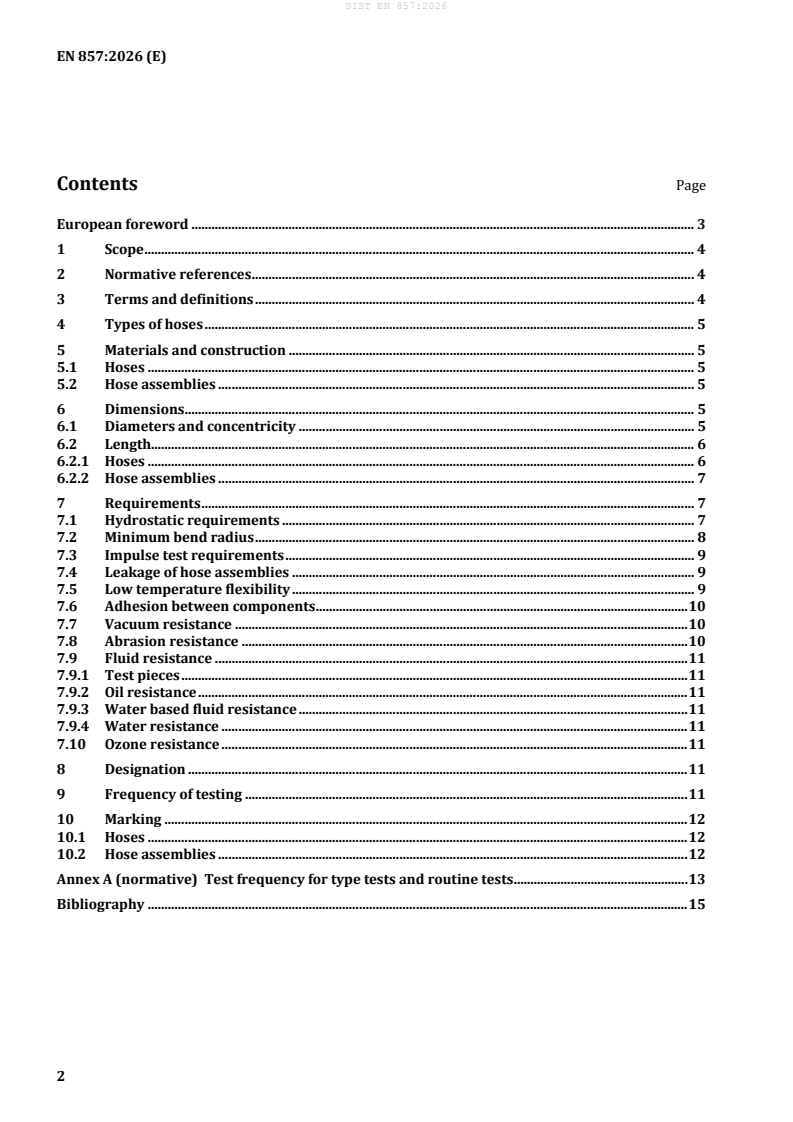
Contents Page
European foreword . 3
1 Scope . 4
2 Normative references . 4
3 Terms and definitions . 4
4 Types of hoses . 5
5 Materials and construction . 5
5.1 Hoses . 5
5.2 Hose assemblies . 5
6 Dimensions. 5
6.1 Diameters and concentricity . 5
6.2 Length. 6
6.2.1 Hoses . 6
6.2.2 Hose assemblies . 7
7 Requirements . 7
7.1 Hydrostatic requirements . 7
7.2 Minimum bend radius . 8
7.3 Impulse test requirements . 9
7.4 Leakage of hose assemblies . 9
7.5 Low temperature flexibility . 9
7.6 Adhesion between components . 10
7.7 Vacuum resistance . 10
7.8 Abrasion resistance . 10
7.9 Fluid resistance . 11
7.9.1 Test pieces . 11
7.9.2 Oil resistance . 11
7.9.3 Water based fluid resistance . 11
7.9.4 Water resistance . 11
7.10 Ozone resistance . 11
8 Designation . 11
9 Frequency of testing . 11
10 Marking . 12
10.1 Hoses . 12
10.2 Hose assemblies . 12
Annex A (normative) Test frequency for type tests and routine tests . 13
Bibliography . 15
European foreword
This document (EN 857:2026) has been prepared by Technical Committee CEN/TC 218 “Rubber and
plastics hoses and hose assemblies”, the secretariat of which is held by BSI.
This European Standard shall be given the status of a national standard, either by publication of an
identical text or by endorsement, at the latest by October 2026, and conflicting national standards shall
be withdrawn at the latest by October 2026.
Attention is drawn to the possibility that some of the elements of this document may be the subject of
patent rights. CEN shall not be held responsible for identifying any or all such patent rights.
This document supersedes EN 857:2015.
This document includes the following significant technical changes with respect to EN 857:2015:
— updated normative references;
— added big sizes on 2SC hose type;
— tolerances for inside diameter in Table 1;
— Table 7 added;
— Annex A deleted;
— Annex C deleted.
Any feedback and questions on this document should be directed to the users’ national standards body.
A complete listing of these bodies can be found on the CEN website.
According to the CEN-CENELEC Internal Regulations, the national standards organisations of the
following countries are bound to implement this European Standard: Austria, Belgium, Bulgaria, Croatia,
Cyprus, Czech Republic, Denmark, Estonia, Finland, France, Germany, Greece, Hungary, Iceland, Ireland,
Italy, Latvia, Lithuania, Luxembourg, Malta, Netherlands, Norway, Poland, Portugal, Republic of North
Macedonia, Romania, Serbia, Slovakia, Slovenia, Spain, Sweden, Switzerland, Türkiye and the United
Kingdom.
1 Scope
This document specifies requirements for two types of wire braid reinforced compact hoses and hose
assemblies of nominal bore from 6 to 76, types 1SC and 2SC.
They are suitable for use with:
— hydraulic fluids in accordance with ISO 6743-4 with the exception with the exception of all flame
retardant HFD fluids at temperatures ranging from −40 °C to +100 °C;
— water-based fluids at temperatures ranging from −40 °C to +70 °C;
— water at temperatures ranging from 0 °C to +70 °C.
The hoses are not suitable for use with castor oil based nor phosphoric ester-based fluids.
This document does not include requirements for end fittings. It is limited to the performance of hoses
and hose assemblies.
NOTE Requirements for hydraulic hoses for underground mining are covered in other documents.
2 Normative references
The following documents are referred to in the text in such a way that some or all of their content
constitutes requirements of this document. For dated references, only the edition cited applies. For
undated references, the latest edition of the referenced document (including any amendments) applies.
EN ISO 1402, Rubber and plastics hoses and hose assemblies — Hydrostatic testing (ISO 1402)
EN ISO 4671, Rubber and plastics hoses and hose assemblies — Methods of measurement of the dimensions
of hoses and the lengths of hose assemblies (ISO 4671)
EN ISO 6803, Rubber or plastics hoses and hose assemblies — Hydraulic-pressure impulse test without
flexing (ISO 6803)
EN ISO 7233, Rubber and plastics hoses and hose assemblies — Determination of resistance to vacuum
(ISO 7233)
EN ISO 7326:2016, Rubber and plastics hoses — Assessment of ozone resistance under static conditions
(ISO 7326:2016)
EN ISO 8033:2017, Rubber and plastics hoses — Determination of adhesion between components
(ISO 8033:2016)
EN ISO 10619-2:2021, Rubber and plastics hoses and tubing — Measurement of flexibility and stiffness —
Part 2: Bending tests at sub-ambient temperatures (ISO 10619-2:2021)
ISO 1817:2024, Rubber, vulcanized or thermoplastic — Determination of the effect of liquids
ISO/TS 20444, Rubber and plastics hoses — Determination of abrasion resistance of the outer cover
3 Terms and definitions
No terms and definitions are listed in this document.
ISO and IEC maintain terminology databases for use in standardization at the following addresses:
— IEC Electropedia: available at https://www.electropedia.org/
— ISO Online browsing platform: available at https://www.iso.org/obp
4 Types of hoses
Two types of hoses are specified:
1) type 1SC – hoses with a single braid of wire reinforcement;
2) type 2SC – hoses with two braids of wire reinforcement.
Hoses and hose assemblies are not be operated outside the limits of this document.
5 Materials and construction
5.1 Hoses
Hoses shall consist of an oil and water-resistant synthetic rubber lining, one or two braid of steel wire,
and an oil and weather resistant synthetic rubber cover. Each braid wire shall be separated by an
insulating layer of synthetic rubber.
5.2 Hose assemblies
Hose assemblies shall only be manufactured with those hose fittings whose functionality has been
verified in accordance with 7.1, 7.3, 7.4 and 7.5 of this document. The manufacturer’s instructions shall
be followed for the preparation and fabrication of hose assemblies.
6 Dimensions
6.1 Diameters and concentricity
The diameters of the hoses shall be measured in accordance with EN ISO 4671 and as such shall conform
to the values in Table 1.
------
...