

ASTM D6330-20
(Practice)Standard Practice for Determination of Volatile Organic Compounds (Excluding Formaldehyde) Emissions from Wood-Based Panels Using Small Environmental Chambers Under Defined Test Conditions
General Information
- Abstract
SIGNIFICANCE AND USE
4.1 The effects of VOC sources on the indoor air quality in buildings have not been well established. One basic requirement that has emerged from indoor air quality studies is the need for well-characterized test data on the emission factors of VOCs from building materials. Standard test method and procedure are a requirement for the comparison of emission factor data from different products.
4.2 This practice describes a procedure for using a small environmental test chamber to determine the emission factors of VOCs from wood-based panels over a specified period of time. A pre-screening analysis procedure is also provided to identify the VOCs emitted from the products, to determine the appropriate GC-MS or GC-FID analytical procedure, and to estimate required sampling volume for the subsequent environmental chamber testing.
4.3 Test results obtained using this practice provide a basis for comparing the VOC emission characteristics of different wood-based panel products. The emission data can be used to inform manufacturers of the VOC emissions from their products. The data can also be used to identify building materials with reduced VOC emissions over the time interval of the test.
4.4 While emission factors determined by using this practice can be used to compare different products, the concentrations measured in the chamber shall not be considered as the resultant concentrations in an actual indoor environment.
SCOPE
1.1 The practice measures the volatile organic compounds (VOC), excluding formaldehyde, emitted from manufactured wood-based panels. A pre-screening analysis is used to identify the VOCs emitted from the panel. Emission factors (that is, emission rates per unit surface area) for the VOCs of interest are then determined by measuring the concentrations in a small environmental test chamber containing a specimen. The test chamber is ventilated at a constant air change rate under the standard environmental conditions. For formaldehyde determination, see Test Method D6007.
1.2 This practice describes a test method that is specific to the measurement of VOC emissions from newly manufactured individual wood-based panels, such as particleboard, plywood, and oriented strand board (OSB), for the purpose of comparing the emission characteristics of different products under the standard test condition. For general guidance on conducting small environmental chamber tests, see Guide D5116.
1.3 VOC concentrations in the environmental test chamber are determined by adsorption on an appropriate single adsorbent tube or multi-adsorbent tube, followed by thermal desorption and combined gas chromatograph/mass spectrometry (GC-MS) or gas chromatograph/flame ionization detection (GC-FID). The air sampling procedure and the analytical method recommended in this practice are generally valid for the identification and quantification of VOCs with saturation vapor pressure between 500 and 0.01 kPa at 25°C, depending on the selection of adsorbent(s).
Note 1: VOCs being captured by an adsorbent tube depend on the adsorbent(s) and sampling procedure selected (see Practice D6196). The user should have a thorough understanding of the limitations of each adsorbent used. Although canisters can be used to sample VOCs, this standard is limited to sampling VOCs from the chamber air using adsorbent tubes.
1.4 The emission factors determined using the above procedure describe the emission characteristics of the specimen under the standard test condition. These data can be used directly to compare the emission characteristics of different products and to estimate the emission rates up to one month after the production. They shall not be used to predict the emission rates over longer periods of time (that is, more than one month) or under different environmental conditions.
1.5 Emission data from chamber tests can be used for predicting the impact of wood-based panels on the VOC concentrations...
- Status
- Published
- Publication Date
- 29-Feb-2020
- Technical Committee
- D22 - Air Quality
- Drafting Committee
- D22.05 - Indoor Air
Buy Documents
ASTM D6330-20 - Standard Practice for Determination of Volatile Organic Compounds (Excluding Formaldehyde) Emissions from Wood-Based Panels Using Small Environmental Chambers Under Defined Test Conditions
REDLINE ASTM D6330-20 - Standard Practice for Determination of Volatile Organic Compounds (Excluding Formaldehyde) Emissions from Wood-Based Panels Using Small Environmental Chambers Under Defined Test Conditions
Overview
ASTM D6330-20 establishes a standardized practice for determining emissions of volatile organic compounds (VOCs), excluding formaldehyde, from wood-based panels under defined environmental conditions using small environmental chambers. Developed by ASTM Committee D22 on Air Quality, this standard enables accurate measurement of emission factors, supports comparative assessments between products, and guides manufacturers and stakeholders on VOC emission characteristics in wood panel products such as particleboard, plywood, and oriented strand board (OSB).
As concerns about indoor air quality and VOC exposure rise, this practice provides a reliable framework for quantifying and benchmarking VOC emissions from building materials, contributing to improved product transparency and healthier indoor environments.
Key Topics
- Scope: Measurement of VOC emissions, excluding formaldehyde, from newly manufactured individual wood-based panels using a defined environmental chamber method.
- Pre-screening Analysis: Initial identification of VOCs emitted by the product informs optimal test settings and selection of analytical techniques (GC-MS or GC-FID).
- Environmental Chamber Testing: Samples are placed in small chambers maintained at standard temperature and humidity, with controlled air exchange to simulate typical indoor conditions.
- Sampling and Analysis: VOCs are collected on adsorbent tubes, thermally desorbed, and analyzed via gas chromatography-mass spectrometry (GC-MS) or gas chromatography-flame ionization detection (GC-FID).
- Data Utility and Limitations: Results provide a basis for comparing products, estimating emission rates up to one month post-production, and identifying lower-emitting materials. Emission data reflect behavior under standard test conditions and may not predict actual indoor concentrations or long-term performance.
- Quality and Calibration: Emphasizes robust sample handling, system calibration, and instrument performance checks to ensure data accuracy and repeatability.
Applications
ASTM D6330-20 supports a range of practical applications in the evaluation and control of VOC emissions from wood-based building materials:
- Product Development and QA: Manufacturers use the standard to assess and minimize VOC emissions, enhance product performance, and comply with regulatory and indoor air quality requirements.
- Comparative Assessments: Allows comparison of emission characteristics between different panel products or production batches, supporting procurement and material selection decisions.
- Certification and Labeling: Underpins voluntary environmental certification schemes and eco-labels targeting low-emitting materials.
- Occupant Health: Helps architects, designers, and building owners choose products that contribute to healthier indoor environments by verifying emissions are within acceptable limits.
- Research: Provides a methodological basis for academic and industry research on material emissions, VOC control technologies, and emission mechanisms.
Related Standards
ASTM D6330-20 references and aligns with several other standards and guidelines relevant to VOC emission testing:
- ASTM D6007: Test Method for Determining Formaldehyde Concentrations in Air from Wood Products Using a Small-Scale Chamber (for formaldehyde testing).
- ASTM D5116: Guide for Small-Scale Environmental Chamber Determinations of Organic Emissions from Indoor Materials/Products (general chamber test guidance).
- ASTM D6196: Practice for Choosing Sorbents, Sampling Parameters, and Thermal Desorption Analytical Conditions for Monitoring Volatile Organic Chemicals in Air.
- ISO 17025:2017: General Requirements for the Competence of Testing and Calibration Laboratories.
- EPA TO-17: Determination of Volatile Organic Compounds in Ambient Air Using Active Sampling Onto Sorbent Tubes.
- ASTM D1356: Terminology Relating to Sampling and Analysis of Atmospheres.
ASTM D6330-20 provides a critical tool for stakeholders seeking to characterize, reduce, and communicate VOC emissions from wood-based panels and to support safer, healthier, and more sustainable building environments. By following this standard, organizations ensure robust, comparable data that enhance product quality and protect indoor air quality.
Relations
- Effective Date
- 01-Mar-2020
- Effective Date
- 01-Sep-2020
- Effective Date
- 15-Mar-2020
- Effective Date
- 01-Nov-2017
- Effective Date
- 01-Nov-2015
- Effective Date
- 15-Oct-2015
- Effective Date
- 01-Jul-2015
- Effective Date
- 01-Dec-2014
- Effective Date
- 01-May-2014
- Effective Date
- 15-Jan-2014
- Effective Date
- 01-Apr-2010
- Effective Date
- 01-Apr-2010
- Effective Date
- 01-Apr-2010
- Effective Date
- 01-Mar-2009
- Effective Date
- 01-Oct-2008
Buy Documents
ASTM D6330-20 - Standard Practice for Determination of Volatile Organic Compounds (Excluding Formaldehyde) Emissions from Wood-Based Panels Using Small Environmental Chambers Under Defined Test Conditions
REDLINE ASTM D6330-20 - Standard Practice for Determination of Volatile Organic Compounds (Excluding Formaldehyde) Emissions from Wood-Based Panels Using Small Environmental Chambers Under Defined Test Conditions
Get Certified
Connect with accredited certification bodies for this standard

ECOCERT
Organic and sustainability certification.

CIS Institut d.o.o.
Personal Protective Equipment (PPE) certification body. Notified Body NB-2890 for EU Regulation 2016/425 PPE.

Eurofins Food Testing Global
Global leader in food, environment, and pharmaceutical product testing.
Sponsored listings
Frequently Asked Questions
ASTM D6330-20 is a standard published by ASTM International. Its full title is "Standard Practice for Determination of Volatile Organic Compounds (Excluding Formaldehyde) Emissions from Wood-Based Panels Using Small Environmental Chambers Under Defined Test Conditions". This standard covers: SIGNIFICANCE AND USE 4.1 The effects of VOC sources on the indoor air quality in buildings have not been well established. One basic requirement that has emerged from indoor air quality studies is the need for well-characterized test data on the emission factors of VOCs from building materials. Standard test method and procedure are a requirement for the comparison of emission factor data from different products. 4.2 This practice describes a procedure for using a small environmental test chamber to determine the emission factors of VOCs from wood-based panels over a specified period of time. A pre-screening analysis procedure is also provided to identify the VOCs emitted from the products, to determine the appropriate GC-MS or GC-FID analytical procedure, and to estimate required sampling volume for the subsequent environmental chamber testing. 4.3 Test results obtained using this practice provide a basis for comparing the VOC emission characteristics of different wood-based panel products. The emission data can be used to inform manufacturers of the VOC emissions from their products. The data can also be used to identify building materials with reduced VOC emissions over the time interval of the test. 4.4 While emission factors determined by using this practice can be used to compare different products, the concentrations measured in the chamber shall not be considered as the resultant concentrations in an actual indoor environment. SCOPE 1.1 The practice measures the volatile organic compounds (VOC), excluding formaldehyde, emitted from manufactured wood-based panels. A pre-screening analysis is used to identify the VOCs emitted from the panel. Emission factors (that is, emission rates per unit surface area) for the VOCs of interest are then determined by measuring the concentrations in a small environmental test chamber containing a specimen. The test chamber is ventilated at a constant air change rate under the standard environmental conditions. For formaldehyde determination, see Test Method D6007. 1.2 This practice describes a test method that is specific to the measurement of VOC emissions from newly manufactured individual wood-based panels, such as particleboard, plywood, and oriented strand board (OSB), for the purpose of comparing the emission characteristics of different products under the standard test condition. For general guidance on conducting small environmental chamber tests, see Guide D5116. 1.3 VOC concentrations in the environmental test chamber are determined by adsorption on an appropriate single adsorbent tube or multi-adsorbent tube, followed by thermal desorption and combined gas chromatograph/mass spectrometry (GC-MS) or gas chromatograph/flame ionization detection (GC-FID). The air sampling procedure and the analytical method recommended in this practice are generally valid for the identification and quantification of VOCs with saturation vapor pressure between 500 and 0.01 kPa at 25°C, depending on the selection of adsorbent(s). Note 1: VOCs being captured by an adsorbent tube depend on the adsorbent(s) and sampling procedure selected (see Practice D6196). The user should have a thorough understanding of the limitations of each adsorbent used. Although canisters can be used to sample VOCs, this standard is limited to sampling VOCs from the chamber air using adsorbent tubes. 1.4 The emission factors determined using the above procedure describe the emission characteristics of the specimen under the standard test condition. These data can be used directly to compare the emission characteristics of different products and to estimate the emission rates up to one month after the production. They shall not be used to predict the emission rates over longer periods of time (that is, more than one month) or under different environmental conditions. 1.5 Emission data from chamber tests can be used for predicting the impact of wood-based panels on the VOC concentrations...
SIGNIFICANCE AND USE 4.1 The effects of VOC sources on the indoor air quality in buildings have not been well established. One basic requirement that has emerged from indoor air quality studies is the need for well-characterized test data on the emission factors of VOCs from building materials. Standard test method and procedure are a requirement for the comparison of emission factor data from different products. 4.2 This practice describes a procedure for using a small environmental test chamber to determine the emission factors of VOCs from wood-based panels over a specified period of time. A pre-screening analysis procedure is also provided to identify the VOCs emitted from the products, to determine the appropriate GC-MS or GC-FID analytical procedure, and to estimate required sampling volume for the subsequent environmental chamber testing. 4.3 Test results obtained using this practice provide a basis for comparing the VOC emission characteristics of different wood-based panel products. The emission data can be used to inform manufacturers of the VOC emissions from their products. The data can also be used to identify building materials with reduced VOC emissions over the time interval of the test. 4.4 While emission factors determined by using this practice can be used to compare different products, the concentrations measured in the chamber shall not be considered as the resultant concentrations in an actual indoor environment. SCOPE 1.1 The practice measures the volatile organic compounds (VOC), excluding formaldehyde, emitted from manufactured wood-based panels. A pre-screening analysis is used to identify the VOCs emitted from the panel. Emission factors (that is, emission rates per unit surface area) for the VOCs of interest are then determined by measuring the concentrations in a small environmental test chamber containing a specimen. The test chamber is ventilated at a constant air change rate under the standard environmental conditions. For formaldehyde determination, see Test Method D6007. 1.2 This practice describes a test method that is specific to the measurement of VOC emissions from newly manufactured individual wood-based panels, such as particleboard, plywood, and oriented strand board (OSB), for the purpose of comparing the emission characteristics of different products under the standard test condition. For general guidance on conducting small environmental chamber tests, see Guide D5116. 1.3 VOC concentrations in the environmental test chamber are determined by adsorption on an appropriate single adsorbent tube or multi-adsorbent tube, followed by thermal desorption and combined gas chromatograph/mass spectrometry (GC-MS) or gas chromatograph/flame ionization detection (GC-FID). The air sampling procedure and the analytical method recommended in this practice are generally valid for the identification and quantification of VOCs with saturation vapor pressure between 500 and 0.01 kPa at 25°C, depending on the selection of adsorbent(s). Note 1: VOCs being captured by an adsorbent tube depend on the adsorbent(s) and sampling procedure selected (see Practice D6196). The user should have a thorough understanding of the limitations of each adsorbent used. Although canisters can be used to sample VOCs, this standard is limited to sampling VOCs from the chamber air using adsorbent tubes. 1.4 The emission factors determined using the above procedure describe the emission characteristics of the specimen under the standard test condition. These data can be used directly to compare the emission characteristics of different products and to estimate the emission rates up to one month after the production. They shall not be used to predict the emission rates over longer periods of time (that is, more than one month) or under different environmental conditions. 1.5 Emission data from chamber tests can be used for predicting the impact of wood-based panels on the VOC concentrations...
ASTM D6330-20 is classified under the following ICS (International Classification for Standards) categories: 13.040.99 - Other standards related to air quality; 71.100.50 - Wood-protecting chemicals; 79.060.01 - Wood-based panels in general. The ICS classification helps identify the subject area and facilitates finding related standards.
ASTM D6330-20 has the following relationships with other standards: It is inter standard links to ASTM D6330-98(2014), ASTM D1356-20a, ASTM D1356-20, ASTM D5116-17, ASTM D6196-15, ASTM D1356-15a, ASTM D1356-15, ASTM D1356-14b, ASTM D1356-14a, ASTM D1356-14, ASTM D5116-10, ASTM D1356-05(2010), ASTM D1914-95(2010), ASTM D6196-03(2009), ASTM D6007-02(2008). Understanding these relationships helps ensure you are using the most current and applicable version of the standard.
ASTM D6330-20 is available in PDF format for immediate download after purchase. The document can be added to your cart and obtained through the secure checkout process. Digital delivery ensures instant access to the complete standard document.
Standards Content (Sample)
This international standard was developed in accordance with internationally recognized principles on standardization established in the Decision on Principles for the
Development of International Standards, Guides and Recommendations issued by the World Trade Organization Technical Barriers to Trade (TBT) Committee.
Designation:D6330 −20
Standard Practice for
Determination of Volatile Organic Compounds (Excluding
Formaldehyde) Emissions from Wood-Based Panels Using
Small Environmental Chambers Under Defined Test
Conditions
This standard is issued under the fixed designation D6330; the number immediately following the designation indicates the year of
original adoption or, in the case of revision, the year of last revision.Anumber in parentheses indicates the year of last reapproval.A
superscript epsilon (´) indicates an editorial change since the last revision or reapproval.
1. Scope 1.4 The emission factors determined using the above pro-
cedure describe the emission characteristics of the specimen
1.1 The practice measures the volatile organic compounds
under the standard test condition. These data can be used
(VOC), excluding formaldehyde, emitted from manufactured
directly to compare the emission characteristics of different
wood-basedpanels.Apre-screeninganalysisisusedtoidentify
products and to estimate the emission rates up to one month
the VOCs emitted from the panel. Emission factors (that is,
after the production. They shall not be used to predict the
emission rates per unit surface area) for the VOCs of interest
emission rates over longer periods of time (that is, more than
arethendeterminedbymeasuringtheconcentrationsinasmall
one month) or under different environmental conditions.
environmental test chamber containing a specimen. The test
chamber is ventilated at a constant air change rate under the 1.5 Emission data from chamber tests can be used for
standard environmental conditions. For formaldehyde predicting the impact of wood-based panels on the VOC
determination, see Test Method D6007. concentrations in buildings by using an appropriate indoor air
quality model, which is beyond the scope of this practice.
1.2 This practice describes a test method that is specific to
the measurement ofVOC emissions from newly manufactured 1.6 The values stated in SI units shall be regarded as the
individualwood-basedpanels,suchasparticleboard,plywood, standard (see IEEE/ASTM SI-10).
andorientedstrandboard(OSB),forthepurposeofcomparing
1.7 This standard does not purport to address all of the
the emission characteristics of different products under the
safety concerns, if any, associated with its use. It is the
standard test condition. For general guidance on conducting
responsibility of the user of this standard to establish appro-
small environmental chamber tests, see Guide D5116.
priate safety, health, and environmental practices and deter-
1.3 VOC concentrations in the environmental test chamber mine the applicability of regulatory limitations prior to use.
For specified hazard statements see Section 6.
are determined by adsorption on an appropriate single adsor-
benttubeormulti-adsorbenttube,followedbythermaldesorp- 1.8 This international standard was developed in accor-
dance with internationally recognized principles on standard-
tionandcombinedgaschromatograph/massspectrometry(GC-
MS) or gas chromatograph/flame ionization detection (GC- ization established in the Decision on Principles for the
Development of International Standards, Guides and Recom-
FID). The air sampling procedure and the analytical method
recommended in this practice are generally valid for the mendations issued by the World Trade Organization Technical
Barriers to Trade (TBT) Committee.
identificationandquantificationofVOCswithsaturationvapor
pressure between 500 and 0.01 kPa at 25°C, depending on the
selection of adsorbent(s). 2. Referenced Documents
2.1 ASTM Standards:
NOTE 1—VOCs being captured by an adsorbent tube depend on the
adsorbent(s) and sampling procedure selected (see Practice D6196). The
D1356Terminology Relating to Sampling and Analysis of
user should have a thorough understanding of the limitations of each
Atmospheres
adsorbent used. Although canisters can be used to sample VOCs, this
D1914PracticeforConversionUnitsandFactorsRelatingto
standard is limited to sampling VOCs from the chamber air using
Sampling and Analysis of Atmospheres
adsorbent tubes.
ThispracticeisunderthejurisdictionofASTMCommitteeD22onAirQuality
and is the direct responsibility of Subcommittee D22.05 on Indoor Air. For referenced ASTM standards, visit the ASTM website, www.astm.org, or
Current edition approved March 1, 2020. Published May 2020. Originally contact ASTM Customer Service at service@astm.org. For Annual Book of ASTM
approved in 1998. Last previous edition approved in 2014 as D6330–98 (2014). Standards volume information, refer to the standard’s Document Summary page on
DOI: 10.1520/D6330-20. the ASTM website.
Copyright © ASTM International, 100 Barr Harbor Drive, PO Box C700, West Conshohocken, PA 19428-2959. United States
D6330−20
D5116Guide for Small-Scale Environmental Chamber De- 3.2.7 wood-based panel test specimen, n—a specimen of a
terminationsofOrganicEmissionsfromIndoorMaterials/ panel cut from an original wood-based panel sample, such as
Products particleboard, oriented strand board (OSB), or plywood.
D6007TestMethodforDeterminingFormaldehydeConcen-
4. Significance and Use
trations in Air from Wood Products Using a Small-Scale
Chamber
4.1 The effects of VOC sources on the indoor air quality in
D6196Practice for Choosing Sorbents, Sampling Param-
buildings have not been well established. One basic require-
eters and Thermal Desorption Analytical Conditions for
ment that has emerged from indoor air quality studies is the
Monitoring Volatile Organic Chemicals in Air
need for well-characterized test data on the emission factors of
E355PracticeforGasChromatographyTermsandRelation-
VOCs from building materials. Standard test method and
ships
procedure are a requirement for the comparison of emission
IEEE/ASTM SI-10Standard for Use of the International
factor data from different products.
System of Units (SI): The Modern Metric System
4.2 This practice describes a procedure for using a small
2.2 Other Standard:
environmental test chamber to determine the emission factors
EPA TO-17Determination of Volatile Organic Compounds
of VOCs from wood-based panels over a specified period of
in Ambient Air Using Active Sampling Onto Sorbent
time. A pre-screening analysis procedure is also provided to
Tubes, Compendium of Methods for the Determination of
identify the VOCs emitted from the products, to determine the
Toxic Organic Compounds in Ambient Air
appropriate GC-MS or GC-FID analytical procedure, and to
ISO 17025:2017General Requirements for the Competence
estimate required sampling volume for the subsequent envi-
of Testing and Calibration Laboratories
ronmental chamber testing.
3. Terminology 4.3 Test results obtained using this practice provide a basis
for comparing the VOC emission characteristics of different
3.1 Definitions—For definitions and terms that are com-
wood-based panel products. The emission data can be used to
monly used, refer to Terminology D1356 and Practice E355.
inform manufacturers of the VOC emissions from their prod-
For definitions and terms related to test methods using small-
ucts. The data can also be used to identify building materials
scale environmental chamber, refer to Guide D5116. For an
with reducedVOC emissions over the time interval of the test.
explanation of units, symbols, and conversion factors, refer to
Practice D1914.
4.4 While emission factors determined by using this prac-
tice can be used to compare different products, the concentra-
3.2 Definitions of Terms Specific to This Standard:
tions measured in the chamber shall not be considered as the
3.2.1 environmental enclosure, n—a container or space in
resultant concentrations in an actual indoor environment.
which the environmental test chamber(s) is placed. The enclo-
sure has controlled temperature and relative humidity.
5. Apparatus
2 3
3.2.2 loading ratio (m /m ), n—the total exposed surface
5.1 This practice requires the use of an environmental
area of each test specimen divided by the net air volume of the
chamber test system, an air sample collection system, and a
environmental test chamber.
chemicalanalysissystem.Ageneralguideforconductingsmall
3.2.3 nominal time constant (t ),n— the inverse of the air
n
environmental chamber tests is provided in Guide D5116. The
change rate.
following paragraphs describe the requirements that are spe-
3.2.4 pre-screening analysis, n—a procedure for identifying
cific to this practice:
theVOCsemittedfromatestspecimen.Theresultsareusedto
5.2 Environmental Chamber Testing System—The system
determine the appropriate GC-MS or GC-FID analytical
shall include an environmental test chamber, an environmental
method for subsequent dynamic chamber tests.
enclosure, equipment for supplying clean and conditioned air
3.2.5 standard environmental test chamber condition, n—a
to the chamber, and outlet fittings for sampling the air
test condition of temperature at 23 6 0.5°C, relative humidity
exhausted from the chamber. Fig. 1 illustrates an example of
(RH) at 50 6 5%, air change rate per hour in the chamber at
such systems. All materials and components in contact with
1 6 0.03 ACH, and chamber loading ratio at 0.40 6 0.01
panel specimen or air stream from the chamber inlet to sample
2 3
m /m .
collection point shall be chemically inert and accessible for
3.2.5.1 Discussion—The VOC emission rates for wood-
cleaning. Suitable materials include stainless steel and glass.
based panel products are generally controlled by VOC diffu-
All gaskets and flexible components shall be made from
sions within the material. The airflow condition (air velocity
chemically inert materials.
and turbulence) over the test specimen has minimal effect on
5.2.1 Environmental Test Chamber—The chamber should
the emission rates; therefore, it is not specified in the standard
have a volume of 0.05 m with the interior dimensions of 0.5
test condition.
mby0.4mby0.25mhigh.Achamberwithadifferentsizeand
3.2.6 tracer gas, n—a gaseous compound that is neither shapemayalsobeusedifthesamestandardenvironmentaltest
emitted by the wood-based panel nor present in the supply air chamber conditions (see 3.2.5) can be maintained. The cham-
to the chamber. It can be used to determine the mixing ber shall include a supply air system having an inlet port with
characteristics of the environmental test chamber, and it distributed openings to assist mixing between the supply air
provides a cross-check of the air change rate measurements. and chamber air and an outlet port with distributed exhaust
D6330−20
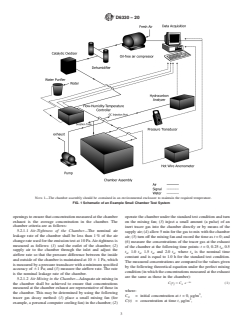
NOTE 1—The chamber assembly should be contained in an environmental enclosure to maintain the required temperature.
FIG. 1Schematic of an Example Small Chamber Test System
openingstoensurethatconcentrationmeasuredatthechamber operate the chamber under the standard test condition and turn
exhaust is the average concentration in the chamber. The
on the mixing fan; (3) inject a small amount (a pulse) of an
chamber criteria are as follows:
inert tracer gas into the chamber directly or by means of the
5.2.1.1 Air-Tightness of the Chamber—The nominal air
supplyair;(4)allow5minforthegastomixwiththechamber
leakage rate of the chamber shall be less than 1% of the air
air;(5)turnoffthemixingfanandrecordthetimeas t=0;and
change rate used for the emission test at 10 Pa.Air-tightness is
(6) measure the concentrations of the tracer gas at the exhaust
measured as follows: (1) seal the outlet of the chamber; (2)
of the chamber at the following time points: t = 0, 0.25 t , 0.5
n
supply air to the chamber through the inlet and adjust the
t , 1.0 t , 1.5 t , and 2.0 t , where t is the nominal time
n n n n n
airflow rate so that the pressure difference between the inside
constant and is equal to 1.0 h for the standard test condition.
and outside of the chamber is maintained at 10 6 1 Pa, which
Themeasuredconcentrationsarecomparedtothevaluesgiven
ismeasuredbyapressuretransducerwithaminimumspecified
by the following theoretical equation under the perfect mixing
accuracy of 61 Pa; and (3) measure the airflow rate. The rate
condition(inwhichtheconcentrationsmeasuredattheexhaust
is the nominal leakage rate of the chamber.
are the same as those in the chamber):
5.2.1.2 Air Mixing in the Chamber—Adequateairmixingin
2Nt
C t 5 C e (1)
the chamber shall be achieved to ensure that concentrations ~ !
measured at the chamber exhaust are representative of those in
where:
the chamber. This may be determined by using the following
C = initial concentration at t = 0, µg/m ,
tracer gas decay method: (1) place a small mixing fan (for
C(t) = concentration at time t, µg/m ,
example, a personal computer cooling fan) in the chamber; (2)
D6330−20
holdershallbedesignedtominimizetheemissionsfromedges
N = air change rate, 1/h, and
and non-testing surface of the specimen. A design example is
t = time from the start of the air purging, h.
shown in Fig. 2.
The maximum difference between the measured and calcu-
5.2.1.4 Sink Effect—Thechamberandspecimenholdershall
latedtheoreticalvaluesshallbewithin 65%ofthetheoretical
have minimum sink effect. The recovery factor determined by
value. The above mixing test shall be conducted with a
simulated test specimen placed in the chamber. the following procedure shall be higher than 95% for decane:
(1) seal the supply inlet and exhaust of the chamber; (2) inject
NOTE 2—The above test method is a simplified version of the decay
5 µg of vaporized decane into the chamber; (3) take an air
methoddescribedinGuideD5116.Alternatively,themethodofdetermin-
sample from the chamber exhaust at 5 min after the injection,
ing adequate air mixing described in Guide D5116 may also be used to
check the mixing condition in the chamber.
andrecordthisconcentrationastheinitialconcentrationC and
the time as t=0;(4)at t = 0, begin purging the air through the
5.2.1.3 Sample Specimen Holder—A sample specimen
holder shall be used to hold the test specimen so that only the chamber at t = 0 under standard test conditions; (5) take air
samples from the chamber exhaust at the following times after
test surface of the specimen is exposed to the chamber air.The
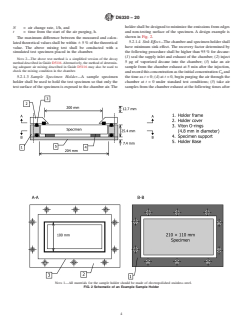
NOTE 1—All materials for the sample holder should be made of electropolished stainless steel.
FIG. 2Schematic of an Example Sample Holder
D6330−20
thestartofpurging: t1=0.25 t , t2=0.5 t , t3=1.0 t , t4=1.5 TVOC (as defined in 5.4.5.4) concentration ≤10 µg/m ,
n n n
t , t5 = 2.0 t , t6 = 3.0 t , t7 = 4.5 t , t8=6 t , t9=8 t , and Concentration of any individual VOC ≤ 0.5 µg/m ,
n n n n n n
t10=10 t , where t is the nominal time constant and is equal Particulate concentration ≤ 100 particles/m of 0.5-µm
n n
to 1.0 h for the standard test condition; and (6) calculate the diameter or larger, and
recovery factor (RF) as follows: Ozone concentration ≤ 3 µg/m .
n21 Atypical clean air supply system should include the follow-
N
RF 5 @C~t !1C~t !#~t 2 t !100% (2)
ing components (see Fig. 1):
( i i11 i11 i
2C
i50
5.2.3.1 An air pump(s) or an oil-free compressor capable of
where:
supplying air at a rate of 1.0 chamber volume per hour. A
RF = recovery factor, %,
particulate filter shall be installed on the air intake.
N = air change rate, 1/h,
5.2.3.2 A dehumidifier (for example, a desiccant drier)
C = initial concentration at t = 0, µg/m ,
0 capable of keeping the relative humidity below 45% RH.
C(t) = concentrationattime t,µg/m (i=0,1,2,.,10),and
i i
5.2.3.3 A catalytic oxidizer or equivalent air purifier (for
t = time from the start of the air purging, h.
i
example, activated carbon filter) capable of removing organic
The above sink effect test should be conducted after the
compounds so that the concentrations of TVOC and any
3 3
mixing condition in the chamber has been verified (see individual VOCs are below 10 µg/m and 0.5 µg/m , respec-
5.2.1.2).
tively.
5.2.3.4 An air conditioning device and an airflow controller
NOTE 3—The concentration decay is usually close to the first-order
–N/t
capable of controlling the airflow rate, temperature, and
exponential decay curve (that is, C(t)/C =e ). The above sampling
time intervals are chosen such that the amount of concentration decrease relative humidity of the supply air at 1.0 6 0.03ACH, 23.0 6
during each sampling interval will be similar.
0.5°C and 50 6 5% RH, respectively. Deionized water (or
equivalent) shall be used in the humidification.
5.2.1.5 The environmental test chamber shall be contained
5.2.3.5 An exhaust air pump and an airflow controller for
in an environmental enclosure (see 5.2.2).
controlling the pressure in the chamber. The airflow controller
5.2.1.6 The background concentration of the environmental
shallbeadjustedsothattheairpressureinthechamberwillbe
test chamber is measured at the chamber exhaust. The back-
positiverelativetoairpressureoutsidethechamberdespitethe
ground concentration shall meet the following criteria: (1)20
fluctuationsintheambientairpressure.Atypicalpressuretobe
µg/m or ⁄6 of the lowest concentration to be measured,
maintainedinthechamberis10 65Parelativetotheambient
whichever is lower, for TVOC (total volatile organic
pressure outside of the chamber.
compounds),and(2)1µg/m or ⁄6ofthelowestconcentrations
5.2.3.6 Sensors and a recording system for monitoring
to be measured, whichever is lower, for individual VOCs.
airflowrate,temperature,relativehumidity,andpressureinside
NOTE 4—Conventionally, the minimum quantifiable concentration is
the environmental test chamber.
determined by:
5.3 Air Sampling System—The system shall include an
C 5 c110 s (3)
min
adsorbent tube, a mechanical pump, and an airflow controller,
where:
which can measure and control the airflow rate through the
C = the minimum quantifiable concentration,
min sampling system to within 65% of a specified value. All
c = the mean background concentration, and
system components between the chamber and the adsorbent
s = the standard deviation of the background concentration during
tube shall be constructed of chemically inert materials.
the test period.
5.3.1 Theadsorbenttubeshouldbeconnectedasclosetothe
For simplicity, it may be assumed that s = 0.5 c.As a result, C =6
min
chamber exhaust as possible by using a short (<0.15 m from
c.
NOTE 5—The 20 µg/m limit set for TVOC in chamber air is the
the environmental enclosure) stainless steel or PTFE tube/
minimum level of cleanliness that a test chamber system shall have.
connector. The pump shall be operated in vacuum mode
5.2.2 Environmental Enclosure—The enclosure is the sur- downstreamoftheadsorbenttubetoavoidcontaminationofair
samples by the pump.
roundingenvironmentofthetestchamberthatcanmaintainthe
temperatureat23.0 60.5°Candrelativehumidityat50 65% 5.3.2 ForeffectivecollectionsofVOCsintheexhaustairof
RH during the period of loading the test specimen, and the test chamber, an appropriate single or multi-layered adsor-
maintain the temperature at 23.0 6 0.5°C during the entire bent tube should be used depending on the VOCs to be
testing period. Once the chamber door is closed, the relative measured.
humidity in the chamber is maintained by the air supply to the
5.3.3 Samplingoftheexhaustairshallnotaffectthecontrol
chamber. A temperature (23.0 6 0.5°C) and humidity (50 6 of airflow rate to the test chamber. The airflow controller for
5% RH) controlled room is found to be adequate for this
the exhaust air pump shall be adjusted before air sampling so
purpose. Otherwise, a stand-alone structure has to be built as thattheairpressureinthechamberwillremainpositiveduring
the environmental enclosure.
the sample collection period.Asampling flow rate of less than
5.2.3 Clean Air Supply System—The system shall be ca- one third of the total supply airflow rate to the test chamber is
pable of supplying a controlled flow of clean air into the test recommendedtoavoidexcessivedepressurizationinthecham-
chamber. Concentrations measured at the chamber inlet shall ber during the sampling period. The manufacturer’s recom-
meet the following criteria at an airflow rate ≥1.0 chamber mendationsforproperuseofadsorbenttubesshallbefollowed
volume per hour: for selecting the sampling airflow rate and for the sampling
D6330−20
period to avoid breakthrough of VOCs. Air sample volumes checking deviates less than 610% from the initial calibration
(that is, sampling flow rate times the sampling period) should line, the initial calibration line shall be used to calculate the
be determined by (1) the safe sampling volume (SSV, see massconcentrations.Otherwise,theproblemshallbeidentified
Practice D6196) of the least retained VOC, (2) concentrations and the system fully re-calibrated as in the initial calibration
to be measured, (3) and detection limits of the analytical (see 5.4.5).
method. Proper air sample volumes may be determined by use 5.4.5.2 If GC-MS system is used for the quantification,
of data from the pre-screening analysis (see 8.1).
dailycalibrationshallbeconductedattwoconcentrationlevels
(that is, a two-point calibration) as a minimum. The low point
5.4 Chemical Analysis System—The chemical analysis sys-
should be where the linearity of the calibration curve starts or
tem shall include a thermal desorption unit connected to a
ten times the method detection limit, whichever is higher. The
GC-MS system or a GC-FID system. EPA TO-17 may be
highpointshouldbewherethelinearityofthecalibrationcurve
consulted for general procedures of determining VOCs in air
ends or the anticipated highest concentration in the samples,
sample. For the analysis of air samples, laboratories should be
whichever is lower. Results of this daily calibration shall be
operating under the quality principles and requirements de-
used to calculate the concentrations if they deviate less than
scribedinISO17025:2017.Thechemicalanalysissystemthat
10%fromthepreviousdayandlessthan25%fromtheinitial
is specific to this practice is as follows:
calibration. Otherwise, the problem shall be identified and the
5.4.1 A single or multi-tube thermal desorption (TD) unit
system fully re-calibrated as in the initial calibration (see
shallhavedesorptionefficiencyofgreaterthan90%forVOCs
5.4.5).
of interest in general, and 100 6 5% for toluene, decane, and
dodecane at 50 ng per compound per tube. Desorption effi-
NOTE 6—Different calibration practices are specified for GC-FID (see
5.4.5.1) and GC-MS (see 5.4.5.2) system because a GC-MS system is
ciency should be determined by comparing results from
usually subject to more day to day variations than a GC-FID system.
thermal desorption with direct GC injection.
5.4.2 GC-MS system can be used for both identification of 5.4.5.3 If the testing objective is to measure the emission
VOCs in the pre-screening analysis and quantification of the factors of target individual compound, the TD-GC-MS or
VOCs in emissions from the environmental chamber tests. TD-GC-FID system shall be calibrated for each individual
5.4.2.1 For identification of VOCs, the GC-MS is operated compound with standards of the same compound.
in the scan mode and shall be capable of scanning the mass 5.4.5.4 If the testing objective is to measure TVOC
range from 15 to 350 amu (atomic mass unit). The measured concentration, the TD-GC-FID system or TD-GC-MS system
mass spectrum shall be compared to those in a standard mass shall be calibrated by using toluene as the reference standard.
spectrum library to identify the individual VOCs detected. The result shall be reported as the concentration of toluene
Selected VOCs of interest shall be confirmed by spiking with
equivalent TVOC-by-GC-FID or TVOC-by-GC-MS, depend-
the corresponding standards (see 8.1)
...
This document is not an ASTM standard and is intended only to provide the user of an ASTM standard an indication of what changes have been made to the previous version. Because
it may not be technically possible to adequately depict all changes accurately, ASTM recommends that users consult prior editions as appropriate. In all cases only the current version
of the standard as published by ASTM is to be considered the official document.
Designation: D6330 − 98 (Reapproved 2014) D6330 − 20
Standard Practice for
Determination of Volatile Organic Compounds (Excluding
Formaldehyde) Emissions from Wood-Based Panels Using
Small Environmental Chambers Under Defined Test
Conditions
This standard is issued under the fixed designation D6330; the number immediately following the designation indicates the year of
original adoption or, in the case of revision, the year of last revision. A number in parentheses indicates the year of last reapproval. A
superscript epsilon (´) indicates an editorial change since the last revision or reapproval.
1. Scope
1.1 The practice measures the volatile organic compounds (VOC), excluding formaldehyde, emitted from manufactured
wood-based panels. A pre-screening analysis is used to identify the VOCs emitted from the panel. Emission factors (that is,
emission rates per unit surface area) for the VOCs of interest are then determined by measuring the concentrations in a small
environmental test chamber containing a specimen. The test chamber is ventilated at a constant air change rate under the standard
environmental conditions. For formaldehyde determination, see Test Method D6007.
1.2 This practice describes a test method that is specific to the measurement of VOC emissions from newly manufactured
individual wood-based panels, such as particleboard, plywood, and oriented strand board (OSB), for the purpose of comparing the
emission characteristics of different products under the standard test condition. For general guidance on conducting small
environmental chamber tests, see Guide D5116.
1.3 VOC concentrations in the environmental test chamber are determined by adsorption on an appropriate single adsorbent tube
or multi-adsorbent tube, followed by thermal desorption and combined gas chromatograph/mass spectrometry (GC/MS)(GC-MS)
or gas chromatograph/flame ionization detection (GC/FID).(GC-FID). The air sampling procedure and the analytical method
recommended in this practice are generally valid for the identification and quantification of VOCs with saturation vapor pressure
between 500 and 0.01 kPa at 25°C, depending on the selection of adsorbent(s).
NOTE 1—VOCs being captured by an adsorbent tube depend on the adsorbent(s) and sampling procedure selected (see Practice D6196). The user should
have a thorough understanding of the limitations of each adsorbent used. Although canisters can be used to sample VOCs, this standard is limited to
sampling VOCs from the chamber air using adsorbent tubes.
1.4 The emission factors determined using the above procedure describe the emission characteristics of the specimen under the
standard test condition. These data can be used directly to compare the emission characteristics of different products and to estimate
the emission rates up to one month after the production. They shall not be used to predict the emission rates over longer periods
of time (that is, more than one month) or under different environmental conditions.
1.5 Emission data from chamber tests can be used for predicting the impact of wood-based panels on the VOC concentrations
in buildings by using an appropriate indoor air quality model, which is beyond the scope of this practice.
1.6 The values stated in SI units shall be regarded as the standard (see IEEE/ASTM SI-10).
1.7 This standard does not purport to address all of the safety concerns, if any, associated with its use. It is the responsibility
of the user of this standard to establish appropriate safety, health, and environmental practices and determine the applicability of
regulatory limitations prior to use. For specified hazard statements see Section 6.
1.8 This international standard was developed in accordance with internationally recognized principles on standardization
established in the Decision on Principles for the Development of International Standards, Guides and Recommendations issued
by the World Trade Organization Technical Barriers to Trade (TBT) Committee.
This practice is under the jurisdiction of ASTM Committee D22 on Air Quality and is the direct responsibility of Subcommittee D22.05 on Indoor Air.
Current edition approved Nov. 1, 2014March 1, 2020. Published November 2014May 2020. Originally approved in 1998. Last previous edition approved in 20082014
as D6330 – 98 (2008).(2014). DOI: 10.1520/D6330-98R14.10.1520/D6330-20.
Copyright © ASTM International, 100 Barr Harbor Drive, PO Box C700, West Conshohocken, PA 19428-2959. United States
D6330 − 20
2. Referenced Documents
2.1 ASTM Standards:
D1356 Terminology Relating to Sampling and Analysis of Atmospheres
D1914 Practice for Conversion Units and Factors Relating to Sampling and Analysis of Atmospheres
D5116 Guide for Small-Scale Environmental Chamber Determinations of Organic Emissions from Indoor Materials/Products
D6007 Test Method for Determining Formaldehyde Concentrations in Air from Wood Products Using a Small-Scale Chamber
D6196 Practice for Choosing Sorbents, Sampling Parameters and Thermal Desorption Analytical Conditions for Monitoring
Volatile Organic Chemicals in Air
E355 Practice for Gas Chromatography Terms and Relationships
E741 Test Method for Determining Air Change in a Single Zone by Means of a Tracer Gas Dilution
IEEE/ASTM SI-10 Standard for Use of the International System of Units (SI): The Modern Metric System
2.2 Other Standard:
EPA TO-17 Determination of Volatile Organic Compounds in Ambient Air Using Active Sampling Onto Sorbent Tubes,
Compendium of Methods for the Determination of Toxic Organic Compounds in Ambient Air
ISO 17025:2017 General Requirements for the Competence of Testing and Calibration Laboratories
3. Terminology
3.1 Definitions—For definitions and terms that are commonly used, refer to Terminology D1356 and Practice E355. For
definitions and terms related to test methods using small-scale environmental chamber, refer to Guide D5116. For an explanation
of units, symbols, and conversion factors, refer to Practice D1914.
3.2 Definitions of Terms Specific to This Standard:
3.2.1 environmental enclosure—enclosure, n—a container or space in which the environmental test chamber(s) is placed. The
enclosure has controlled temperature and relative humidity.
2 3
3.2.2 loading ratio (m /m )—), n—the total exposed surface area of each test specimen divided by the net air volume of the
environmental test chamber.
3.2.3 nominal time constant (t )),—n— the time required to obtain one air change in the environmental test chamber, which is
n
equal to the inverse of the air change rate.
3.2.4 pre-screening analysis—analysis, n—a procedure for identifying the VOCs emitted from a test specimen. The results are
used to determine the appropriate GC/MSGC-MS or GC/FIDGC-FID analytical method for subsequent dynamic chamber tests.
3.2.5 standard environmental test chamber condition—condition, n—a test condition of temperature at 23 6 0.5°C, relative
humidity (RH) at 50 6 5 %, air change rate per hour in the chamber at 1 6 0.03 ACH, and chamber loading ratio at 0.40 6 0.01
2 3
m /m .
3.2.5.1 Discussion—
The VOC emission rates for wood-based panel products are generally controlled by VOC diffusions within the material. The
airflow condition (air velocity and turbulence) over the test specimen has minimal effect on the emission rates; therefore, it is not
specified in the standard test condition.
3.2.6 tracer gas—gas, n—a gaseous compound that is neither emitted by the wood-based panel nor present in the supply air to
the chamber. It can be used to determine the mixing characteristics of the environmental test chamber, and it provides a cross-check
of the air change rate measurements.
3.2.7 TVOC—total concentration of all the individual volatile organic compounds (VOC) captured from air by a given sorbent,
or a given combination of several sorbents, thermally desorbed into and eluted from a given gas chromatographic system and
measured by a given detector. For VOC definition, see Terminology D1356.
3.2.7.1 Discussion—
The measured value of TVOC will depend on the collection and desorption efficiency of the sorbent trap, the efficiency of transfer
to the GC column, the type and size of the GC column, the GC temperature program and other chromatographic parameters, and
the type of GC detector. One way to report TVOC values is recommended in 8.2.7.6.
3.2.7 wood-based panel test specimen—specimen, n—a specimen of a panel cut from an original wood-based panel sample, such
as particleboard, oriented strand board (OSB), or plywood.
For referenced ASTM standards, visit the ASTM website, www.astm.org, or contact ASTM Customer Service at service@astm.org. For Annual Book of ASTM Standards
volume information, refer to the standard’s Document Summary page on the ASTM website.
D6330 − 20
4. Significance and Use
4.1 The effects of VOC sources on the indoor air quality in buildings have not been well established. One basic requirement
that has emerged from indoor air quality studies is the need for well-characterized test data on the emission factors of VOCs from
building materials. Standard test method and procedure are a requirement for the comparison of emission factor data from different
products.
4.2 This practice describes a procedure for using a small environmental test chamber to determine the emission factors of VOCs
from wood-based panels over a specified period of time. A pre-screening analysis procedure is also provided to identify the VOCs
emitted from the products, to determine the appropriate GC/MSGC-MS or GC/FIDGC-FID analytical procedure, and to estimate
required sampling volume for the subsequent environmental chamber testing.
4.3 Test results obtained using this practice provide a basis for comparing the VOC emission characteristics of different
wood-based panel products. The emission data can be used to inform manufacturers of the VOC emissions from their products.
The data can also be used to identify building materials with reduced VOC emissions over the time interval of the test.
4.4 While emission factors determined by using this practice can be used to compare different products, the concentrations
measured in the chamber shall not be considered as the resultant concentrations in an actual indoor environment.
5. Apparatus
5.1 This practice requires the use of an environmental chamber test system, an air sample collection system, and a chemical
analysis system. A general guide for conducting small environmental chamber tests is provided in Guide D5116. The following
paragraphs describe the requirements that are specific to this practice:
5.2 Environmental Chamber Testing System—The system shall include an environmental test chamber, an environmental
enclosure, equipment for supplying clean and conditioned air to the chamber, and outlet fittings for sampling the air exhausted from
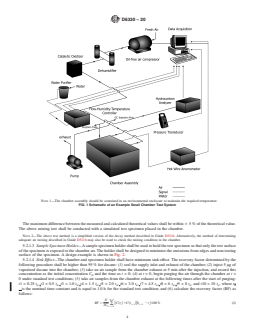
the chamber. Fig. 1 illustrates an example of such systems. All materials and components in contact with panel specimen or air
stream from the chamber inlet to sample collection point shall be chemically inert and accessible for cleaning. Suitable materials
include stainless steel and glass. All gaskets and flexible components shall be made from chemically inert materials.
5.2.1 Environmental Test Chamber—The chamber should have a volume of 0.05 m with the interior dimensions of 0.5 m by
0.4 m by 0.25-m 0.25 m high. A chamber with a different size and shape may also be used if the same standard environmental test
chamber conditions (see 3.2.5) can be maintained. The chamber shall include a supply air system having an inlet port with
distributed openings to assist mixing between the supply air and chamber air and an outlet port with distributed exhaust openings
to ensure that concentration measured at the chamber exhaust is the average concentration in the chamber. The chamber criteria
are as follows:
5.2.1.1 Air-Tightness of the Chamber—The nominal air leakage rate of the chamber shall be less than 1 % of the air change rate
used for the emission test at 10 Pa. Air-tightness is measured as follows: (1) seal the outlet of the chamber; (2) supply air to the
chamber through the inlet and adjust the airflow rate so that the pressure difference between the inside and outside of the chamber
is maintained at 10 6 1 Pa, which is measured by a pressure transducer with a minimum specified accuracy of 61 Pa; and (3)
measure the airflow rate. The rate is the nominal leakage rate of the chamber.
5.2.1.2 Air Mixing in the Chamber—Adequate air mixing in the chamber shall be achieved to ensure that concentrations
measured at the chamber exhaust are representative of those in the chamber. This may be determined by using the following tracer
gas decay method: (1) place a small mixing fan (for example, a personal computer cooling fan) in the chamber; (2) operate the
chamber under the standard test condition and turn on the mixing fan; (3) inject a small amount (a pulse) of an inert tracer gas
into the chamber directly or by means of the supply air; (4) allow 5 min for the gas to mix with the chamber air; (5) turn off the
mixing fan and record the time as t = 0; and (6) measure the concentrations of the tracer gas at the exhaust of the chamber at the
following time points: t = 0, 0.25 t , 0.5 t , 1.0 t , 1.5 t , and 2.0 t , where t is the nominal time constant and is equal to 1.0 h
n n n n n n
for the standard test condition. The measured concentrations are compared to the values given by the following theoretical equation
under the perfect mixing condition (in which the concentrations measured at the exhaust are the same as those in the chamber):
2Nt
C 5 C e (1)
~t! 0
2Nt
C t 5 C e (1)
~ !
where:
C = initial concentration at t=0, μg/m ,
C = initial concentration at t = 0, μg/m ,
C = concentration at time t, μg/m ,
(t)
C(t) = concentration at time t, μg/m ,
–1
N = air change rate, h , and
N = air change rate, 1/h, and
t = time from the start of the air purging, h.
D6330 − 20
NOTE 1—The chamber assembly should be contained in an environmental enclosure to maintain the required temperature.
FIG. 1 Schematic of an Example Small Chamber Test System
The maximum difference between the measured and calculated theoretical values shall be within 6 5 % of the theoretical value.
The above mixing test shall be conducted with a simulated test specimen placed in the chamber.
NOTE 2—The above test method is a simplified version of the decay method described in Guide D5116. Alternatively, the method of determining
adequate air mixing described in Guide D5116 may also be used to check the mixing condition in the chamber.
5.2.1.3 Sample Specimen Holder—A sample specimen holder shall be used to hold the test specimen so that only the test surface
of the specimen is exposed to the chamber air. The holder shall be designed to minimize the emissions from edges and non-testing
surface of the specimen. A design example is shown in Fig. 2.
5.2.1.4 Sink Effect—The chamber and specimen holder shall have minimum sink effect. The recovery factor determined by the
following procedure shall be higher than 95 % for decane: (1) seal the supply inlet and exhaust of the chamber; (2) inject 5 μg of
vaporized decane into the chamber; (3) take an air sample from the chamber exhaust at 5 min after the injection, and record this
concentration as the initial concentration C and the time as t = 0; (4) at t = 0, begin purging the air through the chamber at t =
0 under standard test conditions; (5) take air samples from the chamber exhaust at the following times after the start of purging:
t1 = 0.25 t , t2 = 0.5 t , t3 = 1.0 t , t4 = 1.5 t , t5 = 2.0 t , t6 = 3.0 t , t7 = 4.5 t , t8 = 6 t , t9 = 8 t , and t10 = 10 t , where t
n n n n n n n n n n n
is the nominal time constant and is equal to 1.0 h for the standard test condition; and (6) calculate the recovery factor (RF) as
n
follows:
n21
N
RF 5 @C~t !1C~t !#~t 2 t !100 % (2)
( i i11 i11 i
2C
i50
D6330 − 20
NOTE 1—All materials for the sample holder should be made of electropolished stainless steel.
FIG. 2 Schematic of an Example Sample Holder
where:
RF = recovery factor, %,
–1
N = air change rate, h ,
N = air change rate, 1/h,
C = initial concentration at t=0, μg/m ,
C = initial concentration at t = 0, μg/m ,
C(t ) = concentration at time t , μg/m (i=0, 1, 2, ., 10), and
i i
C(t ) = concentration at time t , μg/m (i = 0, 1, 2, ., 10), and
i i
t = time from the start of the air purging, h.
i
The above sink effect test should be conducted after the mixing condition in the chamber has been verified (see 5.2.1.2).
–N/t
NOTE 3—The concentration decay is usually close to the first-order exponential decay curve (that is, C(t)/C = e ). The above sampling time intervals
are chosen such that the amount of concentration decrease during each sampling interval will be similar.
5.2.1.5 The environmental test chamber shall be contained in an environmental enclosure (see 5.2.2).
D6330 − 20
5.2.1.6 The background concentration of the environmental test chamber is measured at the chamber exhaust. The background
concentration shall meet the following criteria: (1) 20 μg/m or ⁄6 of the lowest concentration to be measured, whichever is lower,
for TVOC, TVOC (total volatile organic compounds), and (2) 1 μg/m or ⁄6 of the lowest concentrations to be measured,
whichever is lower, for individual VOCs.
NOTE 4—Conventionally, the minimum quantifiable concentration is determined by:
C 5 c110 s (3)
min
where:
C = the minimum quantifiable concentration,
min
c = the mean background concentration, and
s = the standard deviation of the background concentration during the test period.
For simplicity, it may be assumed that s = 0.5 c. As a result, C = 6 c.
min
NOTE 5—The 20 μg/m limit set for TVOC in chamber air is the minimum level of cleanliness that a test chamber system shall have.
5.2.2 Environmental Enclosure—The enclosure is the surrounding environment of the test chamber that can maintain the
temperature at 23.0 6 0.5°C and relative humidity at 50 6 5 % RH during the period of loading the test specimen, and maintain
the temperature at 23.0 6 0.5°C during the entire testing period. Once the chamber door is closed, the relative humidity in the
chamber is maintained by the air supply to the chamber. A temperature (23.0 6 0.5°C) and humidity (50 6 5 % RH) controlled
room is found to be adequate for this purpose. Otherwise, a stand-alone structure has to be built as the environmental enclosure.
5.2.3 Clean Air Supply System—The system shall be capable of supplying a controlled flow of clean air into the test chamber.
Concentrations measured at the chamber inlet shall meet the following criteria at an airflow rate ≥ 1.0 ≥1.0 chamber volume per
hour:
TVOC (as defined in 5.4.5.4) concentration ≤ 10 μg/m ,
TVOC (as defined in 5.4.5.4) concentration ≤10 μg/m ,
Concentration of any individual VOC ≤ 0.5 μg/m ,
Particulate concentration ≤ 100 particles/m of 0.5-μm diameter or larger, and
Ozone concentration ≤ 3 μg/m .
Concentration of any individual VOC ≤ 0.5 μg/m ,
Particulate concentration ≤ 100 particles/m of 0.5-μm diameter or larger, and
Ozone concentration ≤ 3 μg/m .
A typical clean air supply system should include the following components (see Fig. 1):
5.2.3.1 An air pump(s) or an oil-free compressor capable of supplying air at a rate of 1.0 chamber volume per hour. A particulate
filter shall be installed on the air intake.
5.2.3.2 A dehumidifier (for example, a desiccant drier) capable of keeping the relative humidity below 45 % RH.
5.2.3.3 A catalytic oxidizer or equivalent air purifier (for example, activated carbon filter) capable of removing organic
3 3
compounds so that the concentrations of TVOC and any individual VOCs are below 10 μg/m and 0.5 μg/m , respectively.
5.2.3.4 An air conditioning device and an airflow controller capable of controlling the airflow rate, temperature, and relative
humidity of the supply air at 1.0 6 0.03 ACH, 23.0 6 0.5°C and 50 6 5 % RH, respectively. Deionized water (or equivalent) shall
be used in the humidification.
5.2.3.5 An exhaust air pump and an airflow controller for controlling the pressure in the chamber. The airflow controller shall
be adjusted so that the air pressure in the chamber will be positive relative to air pressure outside the chamber despite the
fluctuations in the ambient air pressure. A typical pressure to be maintained in the chamber is 10 6 5 Pa relative to the ambient
pressure outside of the chamber.
5.2.3.6 Sensors and a recording system for monitoring airflow rate, temperature, relative humidity, and pressure inside the
environmental test chamber.
5.3 Air Sampling System—The system shall include an adsorbent tube, a mechanical pump, and an airflow controller, which can
measure and control the airflow rate through the sampling system to within 65 % of a specified value. All system components
between the chamber and the adsorbent tube shall be constructed of chemically inert materials.
5.3.1 The adsorbent tube should be connected as close to the chamber exhaust as possible by using a short (<0.15 m from the
environmental enclosure) stainless steel or PTFE tube/connector. The pump shall be operated in vacuum mode downstream of the
adsorbent tube to avoid contamination of air samples by the pump.
5.3.2 For effective collections of VOCs in the exhaust air of the test chamber, an appropriate single or multi-layered adsorbent
tube should be used depending on the VOCs to be measured.
5.3.3 Sampling of the exhaust air shall not affect the control of airflow rate to the test chamber. The airflow controller for the
exhaust air pump shall be adjusted before air sampling so that the air pressure in the chamber will remain positive during the
sample collection period. A sampling flow rate of less than one third of the total supply airflow rate to the test chamber is
recommended to avoid excessive depressurization in the chamber during the sampling period. The manufacturer’s recommenda-
tions for proper use of adsorbent tubes shall be followed for selecting the sampling airflow rate and for the sampling period to avoid
breakthrough of VOCs. Air sample volumes (that is, sampling flow rate times the sampling period) should be determined by (1)
D6330 − 20
the safe sampling volume (SSV, see Practice D6196) of the least retained VOC, (2) concentrations to be measured, (3) and
detection limits of the analytical method. Proper air sample volumes may be determined by use of data from the pre-screening
analysis (see 8.1).
5.4 Chemical Analysis System—The chemical analysis system shall include a thermal desorption unit connected to a
GC/MSGC-MS system or a GC/FIDGC-FID system. EPA TO-17 may be consulted for general procedures of determining VOCs
in air sample. For the analysis of air samples, laboratories should be operating under the quality principles and requirements
described in ISO 17025: 2017. The chemical analysis system that is specific to this practice is as follows:
5.4.1 A single or multi-tube thermal desorption (TD) unit shall have desorption efficiency of greater than 90 % for VOCs of
interest in general, and 100 6 5 % for toluene, decane, and dodecane at 50 ng per compound per tube. Desorption efficiency should
be determined by comparing results from thermal desorption with direct GC injection.
5.4.2 GC/MSGC-MS system can be used for both identification of VOCs in the pre-screening analysis and quantification of the
VOCs in emissions from the environmental chamber tests.
5.4.2.1 For identification of VOCs, the GC/MSGC-MS is operated in the scan mode and shall be capable of scanning the mass
range from 15 to 350 amu (atomic mass unit). The measured mass spectrum shall be compared to those in a standard mass spectrum
library to identify the individual VOCs detected. Selected VOCs of interest shall be confirmed by spiking with the corresponding
standards (see 8.1).
5.4.2.2 For quantification of individual VOCs of interest, the GC/MSGC-MS system shall be operated in the scan mode or in
the selected ion monitoring (SIM) modes. If SIM mode is selected, at lest three ions shall be monitored for each VOC of interest.
Other conditions used in 5.4.2.1 shall be maintained.
5.4.3 GC/FIDGC-FID system can be used for quantification of VOCs of interest as an alternative to GC/MS.GC-MS. The
identification of the VOCs of interest in a GC/FIDGC-FID chromatogram shall be confirmed by GC/MSGC-MS analysis and by
spiking with the corresponding standards (see 8.1).
5.4.4 Optimal operating conditions (GC column and temperature program) shall be determined for GC/MSGC-MS and
GC/FIDGC-FID system based on data from the pre-screening analysis (see 8.1).
5.4.5 Chemical and analytical system shall be properly calibrated for quantitative analysis. Initial calibration of GC/MSGC-MS
or GC/FIDGC-FID system shall be completed before testing each type of product material. Initial calibration shall be conducted
by analyzing standards of selected VOCs (or toluene for TVOC, see 5.4.5.4) at different concentrations. At least five different
concentrations covering anticipated VOC concentration range in the test are needed for such calibration. The user of this practice
shall dem
...