

ASTM D6700-19
(Guide)Standard Guide for Use of Scrap Tires as Tire-Derived Fuel
General Information
- Abstract
SIGNIFICANCE AND USE
4.1 When considering the specification of fuels for a boiler, issues to evaluate are the fuel’s combustion characteristics, handling and feeding logistics, environmental concerns, and ash residue considerations. A thorough understanding of these issues is required to engineer the combustion unit for power and steam generation; however, TDF has demonstrated compatible characteristics allowing it to serve as a supplemental fuel in existing combustion units based on cumulative experience in many facilities originally designed for traditional fossil fuels, or wood wastes, or both. When used as a supplemental energy resource in existing units, TDF usage is generally limited to blend ratios in the 10 to 30 % range based on energy input. This limit is due to its high heat release rate and low moisture content, which differ significantly from other solid fuels such as wood, refuse-derived fuel, coal, and petroleum coke.
4.2 New combustion units dedicated to the use of TDF (or whole tires) as the sole fuel source are rare. The generation and availability of scrap tires are ultimately determined by market conditions for new tires and the depletion rate of scrap tire inventories (stockpiles). Scrap tires account for approximately 1 % of the municipal solid waste stream. Based on a national scrap tire generation rate, there are roughly 2.5 to 3 million tons (annually available for all uses to include fuel, crumb rubber, engineering projects, and so forth). Some dedicated combustion units have been built, however, competition for the scrap tires as other existing sources begin to use TDF will determine the ultimate viability of these facilities. Although most regions can supply TDF demand as a supplemental fuel, a dedicated boiler in the range of 500 000 lb/h (227 000 kg/h) steaming capacity would require over 66 000 scrap tires/day to meet its fuel demand. Such demand may strain a region's ability to supply and put the fuel supply at risk. Some design projects have incorpora...
SCOPE
1.1 This guide covers and provides guidance for the material recovery of scrap tires for their fuel value. The conversion of a whole scrap tire into a chipped formed for use as a fuel produces a product called tire-derived fuel (TDF). This recovery guide has moved from a pioneering concept in the early 1980s to a proven and continuous use in the United States with industrial and utility applications.
1.2 Combustion units engineered to use solid fuels, such as coal or wood, or both, are fairly numerous throughout the U.S. Many of these units are now using TDF even though they were not specifically designed to burn TDF. It is clear that TDF has combustion characteristics similar to other carbon-based solid fuels. Similarities led to pragmatic testing in existing combustion units. Successful testing led to subsequent acceptance of TDF as a supplemental fuel when blended with conventional fuels in existing combustion devices. Changes required to modify appropriate existing combustion units to accommodate TDF range from none to relatively minor. The issues of proper applications and specifications are critical to successful utilization of this alternative energy resource.
1.3 This guide explains TDF’s use when blended and combusted under normal operating conditions with originally specified fuels. Whole-tire combustion for energy recovery is not discussed herein, since whole-tire usage does not require tire processing to a defined fuel specification.
1.4 The values stated in inch-pound units are to be regarded as standard. The values given in parentheses are mathematical conversions to SI units that are provided for information only and are not considered standard.
1.5 This standard does not purport to address all of the safety concerns, if any, associated with its use. It is the responsibility of the user of this standard to establish appropriate safety, health, and environmental practices and determine the appli...
- Status
- Published
- Publication Date
- 31-Jan-2019
- Technical Committee
- D34 - Waste Management
- Drafting Committee
- D34.03 - Treatment, Recovery and Reuse
Overview
ASTM D6700-19: Standard Guide for Use of Scrap Tires as Tire-Derived Fuel provides comprehensive guidelines for the recovery and use of scrap tires as fuel, known as tire-derived fuel (TDF). Established by ASTM International, this guide is crucial for organizations seeking sustainable energy solutions, alternative fuel sources, and responsible scrap tire management.
With the increasing demand for renewable and waste-derived energy, TDF has emerged as a viable supplemental fuel alongside traditional fossil fuels such as coal and wood. This standard covers the processing, specification, and application of TDF in industrial and utility-scale combustion systems, ensuring that TDF is used efficiently, economically, and with due attention to safety and environmental considerations.
Key Topics
Scrap Tire to TDF Conversion
- TDF is produced by shredding and processing scrap tires into chips or shreds suitable for combustion.
- Typical TDF products may vary in size (often 1 to 4 inches) and can be processed to reduce wire content as needed for specific boiler designs.
TDF Combustion Characteristics
- TDF features a high energy content compared to many traditional fuels.
- Its low moisture content (typically 1-3%) and relatively high volatile matter make it an efficient source of supplemental energy.
- TDF is typically blended with coal, wood, or other solid fuels at ratios of 10-30% by energy input to balance combustion and handling properties.
Boiler Compatibility and Handling
- Many existing solid fuel combustion units can accommodate TDF with minimal or no modification.
- Key considerations include fuel feed systems, ash handling, and the presence or removal of steel wire from tire chips.
- Ash content and combustion residues depend on the degree of wire removal and the original tire composition.
Environmental and Operational Factors
- The use of TDF may contribute to solving regional scrap tire disposal problems and provide environmental benefits such as reduced sulfur emissions compared to some coals or petcoke.
- Handling and storage recommendations are provided to mitigate operational risks such as wire accumulation, slagging, and ash handling challenges.
Applications
ASTM D6700-19 is widely applicable to:
- Power Generation: Supplementing coal or wood in industrial and utility boilers for steam and power production.
- Cement and Lime Kilns: TDF can be substituted or blended with traditional fuels in kilns; inherent wire in TDF may serve as a valuable iron source in cement manufacturing.
- Waste Management Facilities: Organizations seeking sustainable solutions for scrap tire piles can use TDF to recover energy and minimize landfill burdens.
- Regional and Municipal Solid Waste Programs: Supports efforts to divert scrap tires from landfill through energy recovery.
The standard is also valuable for combustion unit designers, operators, and energy planners who are considering alternative fuel integration.
Related Standards
The following standards are referenced in conjunction with ASTM D6700-19 for analysis, quality control, and performance:
- ASTM D2013: Practice for preparing coal samples for analysis
- ASTM D3172 - D3176: Practices and test methods for analysis of coal and coke (moisture, ash, volatile matter, sulfur, carbon, hydrogen, nitrogen)
- ASTM D4239: Method for sulfur analysis in coal and coke using high-temperature combustion
- ASTM D4749: Sieve analysis for granular fuel particle sizing
- ASTM E873: Test method for bulk density of densified particulate biomass fuels
Professionals utilizing the ASTM D6700 standard should refer to these related documents to ensure accurate characterization and quality assurance when integrating TDF into combustion systems.
By adopting ASTM D6700-19, organizations can optimize renewable energy strategies, promote scrap tire recycling, and contribute to sustainable waste management solutions through the responsible and efficient use of tire-derived fuel.
Relations
- Effective Date
- 01-Feb-2019
- Effective Date
- 01-Apr-2024
- Effective Date
- 01-Dec-2023
- Effective Date
- 01-Nov-2023
- Refers
ASTM D3175-20 - Standard Test Method for Volatile Matter in the Analysis Sample of Coal and Coke - Effective Date
- 01-Feb-2020
- Refers
ASTM E873-82(2019) - Standard Test Method for Bulk Density of Densified Particulate Biomass Fuels - Effective Date
- 01-Apr-2019
- Refers
ASTM D3175-18 - Standard Test Method for Volatile Matter in the Analysis Sample of Coal and Coke - Effective Date
- 01-Dec-2018
- Effective Date
- 01-Nov-2018
- Effective Date
- 01-Sep-2018
- Effective Date
- 01-Sep-2017
- Effective Date
- 15-May-2017
- Refers
ASTM D3173/D3173M-17 - Standard Test Method for Moisture in the Analysis Sample of Coal and Coke - Effective Date
- 01-Feb-2017
- Refers
ASTM D3175-17 - Standard Test Method for Volatile Matter in the Analysis Sample of Coal and Coke - Effective Date
- 01-Feb-2017
- Effective Date
- 01-Nov-2016
- Effective Date
- 01-Feb-2016
Get Certified
Connect with accredited certification bodies for this standard

DIN CERTCO
DIN Group product certification.

Smithers Quality Assessments
US management systems and product certification.
Sponsored listings
Frequently Asked Questions
ASTM D6700-19 is a guide published by ASTM International. Its full title is "Standard Guide for Use of Scrap Tires as Tire-Derived Fuel". This standard covers: SIGNIFICANCE AND USE 4.1 When considering the specification of fuels for a boiler, issues to evaluate are the fuel’s combustion characteristics, handling and feeding logistics, environmental concerns, and ash residue considerations. A thorough understanding of these issues is required to engineer the combustion unit for power and steam generation; however, TDF has demonstrated compatible characteristics allowing it to serve as a supplemental fuel in existing combustion units based on cumulative experience in many facilities originally designed for traditional fossil fuels, or wood wastes, or both. When used as a supplemental energy resource in existing units, TDF usage is generally limited to blend ratios in the 10 to 30 % range based on energy input. This limit is due to its high heat release rate and low moisture content, which differ significantly from other solid fuels such as wood, refuse-derived fuel, coal, and petroleum coke. 4.2 New combustion units dedicated to the use of TDF (or whole tires) as the sole fuel source are rare. The generation and availability of scrap tires are ultimately determined by market conditions for new tires and the depletion rate of scrap tire inventories (stockpiles). Scrap tires account for approximately 1 % of the municipal solid waste stream. Based on a national scrap tire generation rate, there are roughly 2.5 to 3 million tons (annually available for all uses to include fuel, crumb rubber, engineering projects, and so forth). Some dedicated combustion units have been built, however, competition for the scrap tires as other existing sources begin to use TDF will determine the ultimate viability of these facilities. Although most regions can supply TDF demand as a supplemental fuel, a dedicated boiler in the range of 500 000 lb/h (227 000 kg/h) steaming capacity would require over 66 000 scrap tires/day to meet its fuel demand. Such demand may strain a region's ability to supply and put the fuel supply at risk. Some design projects have incorpora... SCOPE 1.1 This guide covers and provides guidance for the material recovery of scrap tires for their fuel value. The conversion of a whole scrap tire into a chipped formed for use as a fuel produces a product called tire-derived fuel (TDF). This recovery guide has moved from a pioneering concept in the early 1980s to a proven and continuous use in the United States with industrial and utility applications. 1.2 Combustion units engineered to use solid fuels, such as coal or wood, or both, are fairly numerous throughout the U.S. Many of these units are now using TDF even though they were not specifically designed to burn TDF. It is clear that TDF has combustion characteristics similar to other carbon-based solid fuels. Similarities led to pragmatic testing in existing combustion units. Successful testing led to subsequent acceptance of TDF as a supplemental fuel when blended with conventional fuels in existing combustion devices. Changes required to modify appropriate existing combustion units to accommodate TDF range from none to relatively minor. The issues of proper applications and specifications are critical to successful utilization of this alternative energy resource. 1.3 This guide explains TDF’s use when blended and combusted under normal operating conditions with originally specified fuels. Whole-tire combustion for energy recovery is not discussed herein, since whole-tire usage does not require tire processing to a defined fuel specification. 1.4 The values stated in inch-pound units are to be regarded as standard. The values given in parentheses are mathematical conversions to SI units that are provided for information only and are not considered standard. 1.5 This standard does not purport to address all of the safety concerns, if any, associated with its use. It is the responsibility of the user of this standard to establish appropriate safety, health, and environmental practices and determine the appli...
SIGNIFICANCE AND USE 4.1 When considering the specification of fuels for a boiler, issues to evaluate are the fuel’s combustion characteristics, handling and feeding logistics, environmental concerns, and ash residue considerations. A thorough understanding of these issues is required to engineer the combustion unit for power and steam generation; however, TDF has demonstrated compatible characteristics allowing it to serve as a supplemental fuel in existing combustion units based on cumulative experience in many facilities originally designed for traditional fossil fuels, or wood wastes, or both. When used as a supplemental energy resource in existing units, TDF usage is generally limited to blend ratios in the 10 to 30 % range based on energy input. This limit is due to its high heat release rate and low moisture content, which differ significantly from other solid fuels such as wood, refuse-derived fuel, coal, and petroleum coke. 4.2 New combustion units dedicated to the use of TDF (or whole tires) as the sole fuel source are rare. The generation and availability of scrap tires are ultimately determined by market conditions for new tires and the depletion rate of scrap tire inventories (stockpiles). Scrap tires account for approximately 1 % of the municipal solid waste stream. Based on a national scrap tire generation rate, there are roughly 2.5 to 3 million tons (annually available for all uses to include fuel, crumb rubber, engineering projects, and so forth). Some dedicated combustion units have been built, however, competition for the scrap tires as other existing sources begin to use TDF will determine the ultimate viability of these facilities. Although most regions can supply TDF demand as a supplemental fuel, a dedicated boiler in the range of 500 000 lb/h (227 000 kg/h) steaming capacity would require over 66 000 scrap tires/day to meet its fuel demand. Such demand may strain a region's ability to supply and put the fuel supply at risk. Some design projects have incorpora... SCOPE 1.1 This guide covers and provides guidance for the material recovery of scrap tires for their fuel value. The conversion of a whole scrap tire into a chipped formed for use as a fuel produces a product called tire-derived fuel (TDF). This recovery guide has moved from a pioneering concept in the early 1980s to a proven and continuous use in the United States with industrial and utility applications. 1.2 Combustion units engineered to use solid fuels, such as coal or wood, or both, are fairly numerous throughout the U.S. Many of these units are now using TDF even though they were not specifically designed to burn TDF. It is clear that TDF has combustion characteristics similar to other carbon-based solid fuels. Similarities led to pragmatic testing in existing combustion units. Successful testing led to subsequent acceptance of TDF as a supplemental fuel when blended with conventional fuels in existing combustion devices. Changes required to modify appropriate existing combustion units to accommodate TDF range from none to relatively minor. The issues of proper applications and specifications are critical to successful utilization of this alternative energy resource. 1.3 This guide explains TDF’s use when blended and combusted under normal operating conditions with originally specified fuels. Whole-tire combustion for energy recovery is not discussed herein, since whole-tire usage does not require tire processing to a defined fuel specification. 1.4 The values stated in inch-pound units are to be regarded as standard. The values given in parentheses are mathematical conversions to SI units that are provided for information only and are not considered standard. 1.5 This standard does not purport to address all of the safety concerns, if any, associated with its use. It is the responsibility of the user of this standard to establish appropriate safety, health, and environmental practices and determine the appli...
ASTM D6700-19 is classified under the following ICS (International Classification for Standards) categories: 83.160.01 - Tyres in general. The ICS classification helps identify the subject area and facilitates finding related standards.
ASTM D6700-19 has the following relationships with other standards: It is inter standard links to ASTM D6700-01(2013), ASTM D3176-24, ASTM D3176-15(2023), ASTM D5681-23, ASTM D3175-20, ASTM E873-82(2019), ASTM D3175-18, ASTM D5681-18, ASTM D4239-18, ASTM D5681-17, ASTM D4239-17, ASTM D3173/D3173M-17, ASTM D3175-17, ASTM D5681-16a, ASTM D5681-16. Understanding these relationships helps ensure you are using the most current and applicable version of the standard.
ASTM D6700-19 is available in PDF format for immediate download after purchase. The document can be added to your cart and obtained through the secure checkout process. Digital delivery ensures instant access to the complete standard document.
Standards Content (Sample)
This international standard was developed in accordance with internationally recognized principles on standardization established in the Decision on Principles for the
Development of International Standards, Guides and Recommendations issued by the World Trade Organization Technical Barriers to Trade (TBT) Committee.
Designation: D6700 − 19
Standard Guide for
Use of Scrap Tires as Tire-Derived Fuel
This standard is issued under the fixed designation D6700; the number immediately following the designation indicates the year of
original adoption or, in the case of revision, the year of last revision. A number in parentheses indicates the year of last reapproval. A
superscript epsilon (´) indicates an editorial change since the last revision or reapproval.
1. Scope 1.6 This international standard was developed in accor-
dance with internationally recognized principles on standard-
1.1 This guide covers and provides guidance for the mate-
ization established in the Decision on Principles for the
rial recovery of scrap tires for their fuel value. The conversion
Development of International Standards, Guides and Recom-
of a whole scrap tire into a chipped formed for use as a fuel
mendations issued by the World Trade Organization Technical
produces a product called tire-derived fuel (TDF). This recov-
Barriers to Trade (TBT) Committee.
ery guide has moved from a pioneering concept in the early
1980s to a proven and continuous use in the United States with
2. Referenced Documents
industrial and utility applications.
2.1 ASTM Standards:
1.2 Combustion units engineered to use solid fuels, such as
D2013/D2013M Practice for Preparing Coal Samples for
coal or wood, or both, are fairly numerous throughout the U.S.
Analysis
Many of these units are now usingTDF even though they were
D2361 Test Method for Chlorine in Coal (Withdrawn 2008)
not specifically designed to burn TDF. It is clear that TDF has
D2795 Test Methods for Analysis of Coal and Coke Ash
combustion characteristics similar to other carbon-based solid
(Withdrawn 2001)
fuels. Similarities led to pragmatic testing in existing combus-
D3172 Practice for Proximate Analysis of Coal and Coke
tion units. Successful testing led to subsequent acceptance of
D3173/D3173M Test Method for Moisture in the Analysis
TDF as a supplemental fuel when blended with conventional
Sample of Coal and Coke
fuels in existing combustion devices. Changes required to
D3174 Test Method forAsh in theAnalysis Sample of Coal
modify appropriate existing combustion units to accommodate
and Coke from Coal
TDF range from none to relatively minor. The issues of proper
D3175 Test Method for Volatile Matter in the Analysis
applications and specifications are critical to successful utili-
Sample of Coal and Coke
zation of this alternative energy resource.
D3176 Practice for Ultimate Analysis of Coal and Coke
1.3 This guide explains TDF’s use when blended and
D3177 Test Methods forTotal Sulfur in theAnalysis Sample
combusted under normal operating conditions with originally of Coal and Coke (Withdrawn 2012)
specified fuels. Whole-tire combustion for energy recovery is
D3178 Test Methods for Carbon and Hydrogen in the
not discussed herein, since whole-tire usage does not require Analysis Sample of Coal and Coke (Withdrawn 2007)
tire processing to a defined fuel specification.
D3179 Test Methods for Nitrogen in theAnalysis Sample of
Coal and Coke (Withdrawn 2008)
1.4 The values stated in inch-pound units are to be regarded
D3682 Test Method for Major and Minor Elements in
as standard. The values given in parentheses are mathematical
Combustion Residues from Coal Utilization Processes
conversions to SI units that are provided for information only
D4239 Test Method for Sulfur in the Analysis Sample of
and are not considered standard.
Coal and Coke Using High-Temperature Tube Furnace
1.5 This standard does not purport to address all of the
Combustion
safety concerns, if any, associated with its use. It is the
D4326 Test Method for Major and Minor Elements in Coal
responsibility of the user of this standard to establish appro-
and Coke Ash By X-Ray Fluorescence
priate safety, health, and environmental practices and deter-
D4749 Test Method for Performing the Sieve Analysis of
mine the applicability of regulatory limitations prior to use.
Coal and Designating Coal Size
1 2
This guide is under the jurisdiction of ASTM Committee D34 on Waste For referenced ASTM standards, visit the ASTM website, www.astm.org, or
Management and is the direct responsibility of Subcommittee D34.03 on Treatment, contact ASTM Customer Service at service@astm.org. For Annual Book of ASTM
Recovery and Reuse. Standards volume information, refer to the standard’s Document Summary page on
Current edition approved Feb. 1, 2019. Published February 2019. Originally the ASTM website.
approved in 2001. Last previous edition approved in 2013 as D6700 – 01 (2013). The last approved version of this historical standard is referenced on
DOI: 10.1520/D6700-19. www.astm.org.
Copyright © ASTM International, 100 Barr Harbor Drive, PO Box C700, West Conshohocken, PA 19428-2959. United States
D6700 − 19
D5468 Test Method for Gross Calorific and Ash Value of 3.2.12 standard size specification, n—the size specifications
Waste Materials (Withdrawn 2016) with the broadest application when blending with other solid
D5681 Terminology for Waste and Waste Management fuels and requiring minimal adjustments or retrofits to existing
D5865 Test Method for Gross Calorific Value of Coal and solid fuel combustion units.
Coke
3.2.13 supplemental fuel, n—a combustible material that
E873 Test Method for Bulk Density of Densified Particulate
displaces a portion of traditional fuel source. It refers to the
Biomass Fuels
product being used in conjunction with another conventional
F538 Terminology Relating to the Characteristics and Per-
fuel but typically not as a sole fuel supply.
formance of Tires
3.2.14 tire-derived fuel (TDF), n—a product made from
2.2 EPA Standards:
scrap tires to exact specifications of a system designed to
SW-846-5050 Bomb Preparation Method for Solid Waste
accept a tire-derived fuel as primary or supplemental fuel
SW-846-9056 Determination of Inorganic Anions by Ion
source.
Chromatography
3.2.15 wire, n—in a tire, high-tensile, brass-plated steel
wire, coated with a special adhesion-promoting compound,
3. Terminology
used as tire reinforcement as belts, beads, or radial tire plies.
3.1 Definitions—Fordefinitionsofgeneraltermsusedinthis
3.2.16 wire free, n—TDF that is free of all inherent wire.
guide, refer to Terminologies D5681 and F538 on waste
3.2.17 X minus, n—a designation of sample particle size,
management and tires, respectively
with Dimension X indicating the upper limit or maximum size
3.2 Definitions of Terms Specific to This Standard:
of particles passing through a sieve or screen opening upon
3.2.1 bead wire, n—a high-tensile steel wire, surrounded by
which is cumulatively retained less than or equal to 1 % of the
rubber, which forms the bead of a tire that provides a firm
sample. For example, a sample designated as “2 in. (5 cm)
contact to the rim.
minus” would pass a 2-in. screen opening with less than or
3.2.2 chip size, n—the dimension of size-reduced rubber
equal to 1 % of the sample retained.
particles resulting from the processing of whole tires.
4. Significance and Use
3.2.3 combustion, n—the chemical reaction of a material
through rapid oxidation with the evolution of heat and light.
4.1 When considering the specification of fuels for a boiler,
3.2.4 combustion unit, n—anynumberofdevicestoproduce issues to evaluate are the fuel’s combustion characteristics,
handling and feeding logistics, environmental concerns, and
or release energy for the beneficial purpose of production by
burning a fuel to include, but not limited to, units such as ash residue considerations. A thorough understanding of these
issues is required to engineer the combustion unit for power
industrial power boilers, electrical utility generating boilers,
and cement kilns. and steam generation; however, TDF has demonstrated com-
patible characteristics allowing it to serve as a supplemental
3.2.5 energy value, n—the assignment of a value to the
fuel in existing combustion units based on cumulative experi-
tire-derivedfuelasmeasuredinBritishthermalunitsperpound
ence in many facilities originally designed for traditional fossil
or calories per gram.
fuels, or wood wastes, or both. When used as a supplemental
3.2.6 fuel value, n—the heat content, as measured in British
energy resource in existing units, TDF usage is generally
thermal units (Btu)/lb or cal/g.
limited to blend ratios in the 10 to 30 % range based on energy
3.2.7 new tire, n—a tire that has never been mounted on a
input. This limit is due to its high heat release rate and low
rim.
moisture content, which differ significantly from other solid
fuels such as wood, refuse-derived fuel, coal, and petroleum
3.2.8 relatively wire free, n—TDF that has a bead wire
coke.
contentnotgreaterthan1%byweight,andatotalwirecontent
of2%or less by weight.
4.2 New combustion units dedicated to the use of TDF (or
3.2.9 rubber, n—an elastomer, generally implying natural whole tires) as the sole fuel source are rare.The generation and
rubber,butusedlooselytomeananyelastomer,vulcanizedand availability of scrap tires are ultimately determined by market
not vulcanized. By definition, rubber is a material that is conditions for new tires and the depletion rate of scrap tire
capable of recovering from large deformations quickly and inventories (stockpiles). Scrap tires account for approximately
forcibly and can be, or already is, modified to a state in which 1 % of the municipal solid waste stream. Based on a national
it is essentially insoluble in a boiling solvent. scrap tire generation rate, there are roughly 2.5 to 3 million
tons (annually available for all uses to include fuel, crumb
3.2.10 scrap tire, n—a rubber tire that is no longer used for
rubber, engineering projects, and so forth). Some dedicated
its originally intended application.
combustion units have been built, however, competition for the
3.2.11 screen, n—an apparatus for separating sizes of gran-
scrap tires as other existing sources begin to use TDF will
ules.
determine the ultimate viability of these facilities. Although
most regions can supply TDF demand as a supplemental fuel,
a dedicated boiler in the range of 500 000 lb/h (227 000 kg/h)
AvailablefromUnitedStatesEnvironmentalProtectionAgency(EPA),William
steaming capacity would require over 66 000 scrap tires/day to
Jefferson Clinton Bldg., 1200 Pennsylvania Ave., NW, Washington, DC 20460,
http://www.epa.gov. meet its fuel demand. Such demand may strain a region’s
D6700 − 19
ability to supply and put the fuel supply at risk. Some design 5. Tire-Derived Fuel Analysis – General Description
projects have incorporated TDF as a supplemental fuel with
5.1 TDF is defined as a fuel source derived from the
wood, coal, coke, sludge, or some combination of multiple
processing of scrap tires into rubber chips with a range in size
fuels where demand is consistent with supply availability.
and metal content. Processing may include shredding,
chopping, classification, recycling, granulation, wire/fabric
4.3 Itisimportanttounderstandwhatobjectivesmayleadto
separation, and other technologies. Size normally varies in a
TDF’s choice as a supplemental fuel in existing power units.
range from 1 in. (2.5 cm) to 4 in. (10.2 cm). Metal content
Several model objectives may be as follows:
ranges from wire free, to relatively wire free, to only bead wire
4.3.1 To increase boiler efficiency in a co-fired boiler using
removed, to no wire removed. TDF’s tolerable wire content is
wood, sludge, and coal;
determined by a combustion unit’s design considerations.
4.3.2 To procure a competitively priced fuel;
TDF’s wire removal is determined by production process
4.3.3 To supplement limited supplies of an existing fuel;
capabilities. Some combustion units such as cement kilns can
4.3.4 To use a high-quality fuel;
tolerate all inherent wire, so no removal is necessary. In
4.3.5 Toachieveenvironmentalbenefitsbyusingafuelwith
circumstances where no effort is made to remove wire, TDF
arelativelylowsulfurcontentincomparisontocertaincoalsor
mustbecleanlycutwithminimalexposedwireprotrusionfrom
petroleum coke, and;
the chips to facilitate mechanical handling.
4.3.6 To provide a public and social benefit that solves a
5.2 Unless temperatures in a combustion unit are sufficient
regional solid waste problem.
to oxidize the wire, the energy contribution from the wire is
4.4 Boilers generally are engineered around fuels that will
nominalandwillaccountforalowerproductenergyvaluethan
be available through the amortized life of the power unit.
that of either a wire-free or relatively wire-free TDF product.
BoilerdesigndiscussionsherearelimitedasTDFstandardsize
Cement kilns typically burn at sufficient temperatures to
specifications have been developed to ensure TDF’s perfor-
oxidize the wire and benefit from both the energy release from
mance in existing systems. TDF is mined from the solid waste
oxidation and the resultant iron oxide that becomes a critical
stream as a whole tire, then engineered via processing tech-
component in cement chemistry. Depending on the amount of
niques to fit a new or existing combustion unit. A major
wire removed, the TDF has an energy content ranging from
modification or re-engineering of the combustion unit to
14 000 to 15 500 Btu/lb (7770 to 8600 cal/g).
accommodateTDFnormallywouldmakeitsuseuneconomical
5.3 Combustion efficiency for TDF generally is understood
as a supplemental fuel. TDF’s use is economically dependent
to be in the 80 % range. TDF represents an ideal fuel source in
on the following two issues:
that its moisture content is low (1 to 3 %), and its energy value
4.4.1 A combustion unit’s existing ability to use the fuel
is high. Low moisture content uses less energy for moisture
without modification (other than minor operational changes in
vaporization and lowers combustion gas mass flow rate. TDF
oxygen grate speed adjustments, and feed/material handling)
has a volatile content of roughly 66 %, which indicates rapid
and,
heat release. Relatively low ash content (3 to 5 %) maximizes
4.4.2 The ability of a supplier to economically collect,
heat absorption and decreases ash disposal costs. As rubber is
process, and transport TDF to the combustion unit.
non-absorbent, moisture swings during seasonal periods of
4.5 Once an economic decision has been made to develop rainfall in ambient weather conditions are limited to a range of
1 to 8 %.The smaller theTDF chip size, the greater the storage
TDF as a fuel source for a particular unit, issues of fuel
specifications including size, proximate and ultimate analysis, pilesurfaceareaanditsconcomitantabilitytoholdmoistureon
combustion characteristics, and environmental concerns must its surface. Table 1 identifies the energy content of common
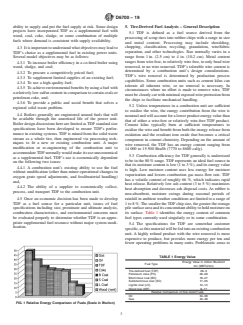
be evaluated properly to determine whether TDF is an appro- fuel types currently used singularly or in some combination.
priate supplemental fuel resource without major system modi-
5.4 The specifications for TDF are somewhat customer
fication.
specific,asthismaterialwillbefedintoanexistingcombustion
unit. A highly refined product with the wire removed is more
expensive to produce, but provides more energy per ton and
fewer operating problems in many units. Problematic areas to
TABLE 1 Energy Value
Energy Value in million Btu/short
Fuel Type
ton (MBTU/ton)
Tire-derived fuel (TDF) 28–3
Petroleum coke (PC) 26–28
Bituminous coal (BC) 18–27
Subbituminous coal (SC) 17–25
Lignite coal (LC) 12–14
Wood fuel (WF) 8–17
Relative Comparison of Non-Solid Fuels
Oil 34–38
Gas 42–48
FIG. 1 Relative Energy Comparison of Fuels (Scale in Btu/ton)
D6700 − 19
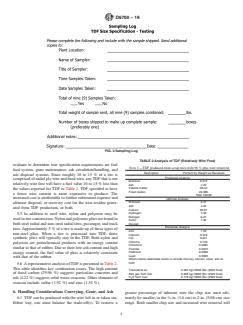
FIG. 2 Sampling Log
TABLE 2 Analysis of TDF (Relatively Wire Free)
evaluate to determine true specification requirements are fuel
NOTE 1—TDF produced from scrap tires with 96 % plus wire removed.
feed system, grate maintenance, ash circulation/handling, and
Description Percent by Weight as Received
ash disposal systems. Since roughly 10 to 15 % of a tire is
Proximate Analysis
comprisedofradialplywireandbeadwire,anyTDFthatisnot
Moisture 0.474
relatively wire free will have a fuel value 10 to 15 % less than
Ash 4.22
Volatile matter 65.34
the values reported for TDF in Table 1. TDF specified to have
Fixed carbon 29.966
a lower wire content is more expensive to produce. The
Total 100.00
increased cost is attributable to further refinement expense and
Ultimate Analysis
Moisture 0.47
ultimate disposal, or recovery cost for the wire residue gener-
Ash 4.22
ated from TDF production, or both.
Carbon 89.51
Hydrogen 7.59
5.5 In addition to steel wire, nylon and polyester may be
Nitrogen 0.27
usedintireconstruction.Nylonandpolyesterpliesarefoundin
Sulfur 1.92
Oxygen . . .
both steel radial and non-steel radial tires, passenger, and truck
Elemental Analysis
tires.Approximately 3 % of a tire is made up of these types of
Zinc 1.52
non-steel plies. When a tire is processed into TDF, these
Calcium 0.378
Iron 0.321
synthetic plies will typically stay in the TDF. Both nylon and
Chlorine 0.149
polyester are petrochemical products with an energy content
Chromium 0.0097
similar to that of rubber. Due to their low ash content and high
Fluoride 0.0010
energy content, the fuel value of plies is relatively consistent Cadmium 0.0006
Lead 0.0065
with that of the rubber.
Others below detectable levels to include mercury, barium, silver, and so
forth
5.6 ArepresentativeanalysisofTDFispresentedinTable2.
This table identifies key combustion issues. The high amount
Theoretical air 3.362 kg/10000 Btu (2520 Kcal)
of fixed carbon (29.96 %) suggests particulate concerns and
Wet gas from fuel 0.266 kg/10000 Btu (2520 Kcal)
H O from fuel 0.179 kg/10000 Btu (2520 Kcal)
ash (4.22 %) suggests solid waste concerns. Other elements of
concern include sulfur (1.92 %) and zinc (1.52 %).
6. Handling Considerations Conveying, Grate, and Ash
greater percentage of inherent wire the chip size must ulti-
6.1 TDF can be produced with the wire left in or taken out. mately be smaller, in the ⁄8-in. (1.6 cm) to 2-in. (5.08 cm) size
Either way, one must balance the trade-off(s). To remove a range. Both smaller chip size and increased wire removal will
D6700 − 19
add to the cost of producing TDF. Smaller chip requires sufficient temperature is achieved, normally above iron’s
increased mechanical production time. Wire residue may be kindling point of about 1500 °F (815 °C). In any event, it will
landfilled or recovered, adding to production costs. Wire remain on the grate as either wire or iron oxide unless
recovery potential is dependent on regional, market, and under-fired air velocity through the grate is sufficient to entrain
quality factors, but market value may not fully offset recovery the fine wire with the air flow. Iron will not fume, but it will
costs. generate heat if converted to the iron oxide form, roughly
3000 Btu⁄lb (1665 cal/g). It is unlikely that grate temperatures
6.2 Wire Removal Precludes the Following Potential Prob-
in stoker boilers will exceed 1000 °F (538 °C) without other
lems:
significant grate problems developing.
6.2.1 Wires protruding fromTDF may cause chips to clump
together, causing distribution problems.TDF is not as flowable 6.6 Asacasestudytoillustratepotentialproblemswithwire
in a fluid bed combustor, a pilot facility tested a 100 % wire-in
when long strands of exposed wire are present.
6.2.2 Wiresprotrudingfromarubberchipmaycatchonfuel rubber chip for developmental evaluations. These tests were
conducted for a large midwestern utility that currently is using
conveying systems.
a commercially scaled unit for power production and was
6.2.3 Wires may trip any metal detector used to protect the
seeking to introduce tire-derived fuel, wire in, as a standard
combustion unit from metal contamination.
fuelsource.Thepilotplantinitiallyhadbeenequippedwiththe
6.2.4 Wires in rubber chips would either be captured or
standard sparge pipe/dual cone air distributor and bed cleans-
rejected by magnet(s) used to protect the combustion unit from
ing system. When running with 100 % tire chips, it was
metal contamination. Fixed magnets will require greater fre-
discovered that the bed draw-down capabilities were impaired
quency of cleaning.
by the
...
This document is not an ASTM standard and is intended only to provide the user of an ASTM standard an indication of what changes have been made to the previous version. Because
it may not be technically possible to adequately depict all changes accurately, ASTM recommends that users consult prior editions as appropriate. In all cases only the current version
of the standard as published by ASTM is to be considered the official document.
Designation: D6700 − 01 (Reapproved 2013) D6700 − 19
Standard PracticeGuide for
Use of Scrap Tires as Tire-Derived Fuel
This standard is issued under the fixed designation D6700; the number immediately following the designation indicates the year of
original adoption or, in the case of revision, the year of last revision. A number in parentheses indicates the year of last reapproval. A
superscript epsilon (´) indicates an editorial change since the last revision or reapproval.
1. Scope
1.1 This practice covers and provides guidance for the material recovery of scrap tires for their fuel value. The conversion of
a whole scrap tire into a chipped formed for use as a fuel produces a product called tire-derived fuel (TDF). This recovery practice
has moved from a pioneering concept in the early 1980s to a proven and continuous use in the United States with industrial and
utility applications.
1.2 Combustion units engineered to use solid fuels, such as coal or wood or both, are fairly numerous throughout the U.S. Many
of these units are now using TDF even though they were not specifically designed to burn TDF. It is clear that TDF has combustion
characteristics similar to other carbon-based solid fuels. Similarities led to pragmatic testing in existing combustion units.
Successful testing led to subsequent acceptance of TDF as a supplemental fuel when blended with conventional fuels in existing
combustion devices. Changes required to modify appropriate existing combustion units to accommodate TDF range from none to
relatively minor. The issues of proper applications and specifications are critical to successful utilization of this alternative energy
resource.
1.3 This practice explains TDF’s use when blended and combusted under normal operating conditions with originally specified
fuels. Whole tire combustion for energy recovery is not discussed herein since whole tire usage does not require tire processing
to a defined fuel specification.
1.4 The values stated in inch-pound units are to be regarded as standard. The values given in parentheses are mathematical
conversions to SI units that are provided for information only and are not considered standard.
1.5 This standard does not purport to address all of the safety concerns, if any, associated with its use. It is the responsibility
of the user of this standard to establish appropriate safety and health practices and determine the applicability of regulatory
limitations prior to use.
2. Referenced Documents
2.1 ASTM Standards:
D2013 Practice for Preparing Coal Samples for Analysis
D2361 Test Method for Chlorine in Coal (Withdrawn 2008)
D2795 Test Methods for Analysis of Coal and Coke Ash (Withdrawn 2001)
D3172 Practice for Proximate Analysis of Coal and Coke
D3173 Test Method for Moisture in the Analysis Sample of Coal and Coke
D3174 Test Method for Ash in the Analysis Sample of Coal and Coke from Coal
D3175 Test Method for Volatile Matter in the Analysis Sample of Coal and Coke
D3176 Practice for Ultimate Analysis of Coal and Coke
D3177 Test Methods for Total Sulfur in the Analysis Sample of Coal and Coke (Withdrawn 2012)
D3178 Test Methods for Carbon and Hydrogen in the Analysis Sample of Coal and Coke (Withdrawn 2007)
D3179 Test Methods for Nitrogen in the Analysis Sample of Coal and Coke (Withdrawn 2008)
D3682 Test Method for Major and Minor Elements in Combustion Residues from Coal Utilization Processes
D4239 Test Method for Sulfur in the Analysis Sample of Coal and Coke Using High-Temperature Tube Furnace Combustion
This practiceguide is under the jurisdiction of ASTM Committee D34 on Waste Management and is the direct responsibility of Subcommittee D34.03 on Treatment,
Recovery and Reuse.
Current edition approved Feb. 1, 2013Feb. 1, 2019. Published February 2013February 2019. Originally approved in 2001. Last previous edition approved in 20062013
as D6700D6700 – 01 (2013).-01 (2006). DOI: 10.1520/D6700-01R13.10.1520/D6700-19.
For referenced ASTM standards, visit the ASTM website, www.astm.org, or contact ASTM Customer Service at service@astm.org. For Annual Book of ASTM Standards
volume information, refer to the standard’s Document Summary page on the ASTM website.
The last approved version of this historical standard is referenced on www.astm.org.
Copyright © ASTM International, 100 Barr Harbor Drive, PO Box C700, West Conshohocken, PA 19428-2959. United States
D6700 − 19
D4326 Test Method for Major and Minor Elements in Coal and Coke Ash By X-Ray Fluorescence
D4749 Test Method for Performing the Sieve Analysis of Coal and Designating Coal Size
D5468 Test Method for Gross Calorific and Ash Value of Waste Materials (Withdrawn 2016)
D5865 Test Method for Gross Calorific Value of Coal and Coke
E873 Test Method for Bulk Density of Densified Particulate Biomass Fuels
2.2 Other Standards:
SW-846–5050 Bomb Calorimeter Preparation
SW-846–9056 Ion Chromatography
3. Terminology
3.1 Definitions:
3.1.1 all season radial, n—a highway tire designed to meet the weather conditions in all seasons of the year, that meets the
Rubber Manufacturers Association definition of a mud and snow tire.
3.1.2 altered tire, n—a scrap tire which has been modified so that it is no longer capable of retaining air, holding water, or being
used on a vehicle.
3.1.3 analysis, n—the activity to determine the proximate and ultimate analysis, fuel value and size specification of TDF.
3.1.4 bead, n—the anchoring part of the tire, which is shaped to fit the rim. The bead is constructed of high tensile steel wires
wrapped by the plies.
3.1.5 bead wire, n—a high tensile steel wire, surrounded by rubber, which forms the bead of a tire that provides a firm contact
to the rim.
3.1.6 bear claw, n—the rough-edged bead wire sticking out from a shredded tire.
3.1.7 belt, n—an assembly of rubber coated fabric or wire used to reinforce a tire’s tread area. In radial tires, also constrains
the outside diameter against inflation pressure and centrifugal force.
3.1.8 belt wire, n—a brass-plated high tensile steel wire cord used in the steel belts.
3.1.9 bias ply tires, n—a tire built with two or more casing plies, which cross each other in the crown at an angle of 30 to 45°
to the tread centerline.
3.1.10 body, n—tire structure not including the tread portion of the tire. (See also casing and carcass.)
3.1.11 carcass, n—See casing.
3.1.12 casing, n—the basic tire structure excluding the tread. (See also carcass.)
3.1.13 chip size, n—the range of rubber particle sizes resulting from the processing of whole tires.
3.1.14 chipped tire, n—a classified scrap tire particle that has a basic geometrical shape, which generally is 2 in. (5.08 cm) or
smaller and has most of the bead wire removed. Also referred to as a tire chip.
3.1.15 chopped tire, n—a scrap tire that is cut into relatively large pieces of unspecified dimensions.
3.1.16 classifier, n—equipment designed to separate oversized tire shreds from the desired size.
3.1.17 combustion, n—the chemical reaction of a material through rapid oxidation with the evolution of heat and light.
3.1.18 combustion unit, n—any number of devices to produce or release energy for the beneficial purpose of production by
burning a fuel to include, but not limited to, units such as industrial power boilers, electrical utility generating boilers, and cement
kilns.
3.1.19 commercial tire, n—truck and industrial tires.
3.1.20 compound, n—a mixture of blended chemicals tailored to meet the needs of the specific components of the tire.
3.1.21 converted tire, n—a scrap tire that has been processed into a usable commodity other than a tire.
3.1.22 cords, n—the strands of wire or fabric that form the plies and belts in a tire.
3.1.23 dewired, n—the absence of exposed wire on the perimeter of the tire chips. Belt wire typically remains in the chip, but
it is embedded in the chip.
3.1.24 discarded tires, n—a worn or damaged tire that has been removed from a vehicle.
3.1.25 end user, n—the facility which utilizes the heat content or other forms of energy from the combustion of scrap tires (for
energy recovery). The last entity who uses the tire, in whatever form, to make a product or provide a service with economic value
(for other uses).
3.1.26 energy recovery, n—a process by which all or part of the tire is utilized as fuel (TDF) to recover its entire value.
3.1.27 energy value, n—the assignment of a value to the tire-derived fuel as measured in British thermal units per pound or
calories per gram.
D6700 − 19
3.1.28 fabric, n—textiles cords used in tire manufacturing.
3.1.29 fishhooks, n—strands of belt or bead wire exposed from a processed scrap tire or an individual piece of belt or bead wire.
(See also bear claw).
3.1.30 fluff, n—the fibrous, nonrubber, nonmetal portion of a tire that remains after the scrap tire is processed (that is, cotton,
rayon, polyester, fiberglass, or nylon).
3.1.31 fuel value, n—the heat content, as measured in British thermal units (Btu)/lb or cal/g.
3.1.32 hair, n—wire protruding from the perimeter of a tire chip or shred. (See also fishhooks ).
3.1.33 heavy-duty tires, n—tires weighing more than 40 lb (18.1 kg), used on trucks, buses, and off the road vehicles in
heavy-duty applications.
3.1.34 horsetail, n—a rough piece of shredded tire with a width of 2 to 4 in. (5.1 to 10.2 cm) and a length greater than 6 in.
(15.2 cm).
3.1.35 innerliner, n—the layer or layers of rubber laminated to the inside of a tire and which meets the Rubber Manufacturers
Association definition of a mud and snow tire.
3.1.36 light duty tires, n—tires weighing less than 40 lb (18.2 kg), used on passenger cars and light trucks.
3.1.37 light truck tires, n—tires with a rim diameter of 16 to 19.5 in. (40.6 to 49.5 cm), manufactured specifically for light truck
use.
3.1.38 logger tires, n—a special tire designed for the logging industry.
3.1.39 minus, n—the sieve designating the upper limit or maximum size shall be the sieve of the series with the largest opening
upon which is cumulatively retained a total of less than or equal to 1 % of the sample.
3.1.40 mucker tire, n—a flotation type of tire specifically designed for use in soft grounds.
3.1.41 natural rubber, n—the material processed from the spa (latex) of Hevaca Brasiliensis (rubber tree).
3.1.42 new tire, n—a tire that has never been mounted on a rim.
3.1.43 nominal, n—commonly used to refer to the average size product (chip) that comprises 50 % or more of the throughput
in a scrap tire processing operation. It should be noted that any scrap tire processing operation also would generate products (chips)
above and below the “nominal” range of the machine.
3.1.44 off the road tire (OTR), n—tire designed primarily for use on unpaved roads or where no roads exist, built for ruggedness
and traction rather than for speed.
3.1.45 passenger car tires, n—a tire with less than an 18 in. (45.7 cm) rim diameter for use on cars only.
3.1.46 pneumatic tires, n—a tire that depends on the compressed air it holds to carry the load. It differs from a solid tire in which
the tire itself carriers the load.
3.1.47 processed tire, n—a scrap tire that has been altered, converted, or size reduced.
3.1.48 passenger tire equivalent (PTE), n—a measurement of mixed passenger and truck tires, where five passenger tires are
equal to one truck tire.
3.1.49 radial tire, n—a tire constructed so that the ply cords extend from bead to bead at a 90° angle to the centerline of the
road.
3.1.50 rim, n—the metal support for the tire and tube assembly on the wheel.
3.1.51 rip-shear shredders, n—a tire shredder designed to reduce a scrap tire to pieces. The size and shape of the rubber particle
is dependent on the processing action of the shredder (that is, by cutting blades, rotary shear, or rip shear).
3.1.52 rough shred, n—a piece of a shredded tire that is larger than 2 in. (5.1 cm) by 2 in (5.1 cm) by 2 in. (5.1 cm), but smaller
than 30 in. (76.2 cm) by 2 in. (5.1 cm) by 4 in. (10.2 cm).
3.1.53 rubber, n—an elastomer, generally implying natural rubber, but used loosely to mean any elastomer, vulcanized and
unvulcanized. By definition, rubber is a material that is capable of recovering from large deformations quickly and forcibly and
can be, or already is, modified to a state in which it is essentially insoluable in a boiling solvent.
3.1.54 scrap tire processing, n—any method of size reducing whole scrap tires to facilitate recycling, energy recovery or
disposal.
3.1.55 screen, n—an apparatus for separating sizes of granules.
3.1.56 secondary material, n—fragments or finished products or leftovers from a manufacturing process which converts a
primary material into a commodity of economic value.
3.1.57 sectioned tire, n—a tire that has been cut into at least two parts.
3.1.58 shred sizing, n—generally refers to the process of particles passing through a rated screen opening rather than those
which are retained on the screen. Examples include:
D6700 − 19
3.1.58.1 1 by 1 in. (2.5 by 2.5 cm), n—a sized reduced scrap tire, with all dimensions 1 in. (2.5 cm) maximum.
3.1.58.2 2 by 2 in. (5.1 by 5.1 cm), n—a size reduced scrap tire, with all dimensions 2 in. (5.1 cm) maximum.
3.1.58.3 X in. minus, n—sized reduced scrap tires, the maximum size of any piece has a dimension no larger than X plus 1 in.
(X plus 2.5 cm), but 95 % of which is less than X in. (2.54 X cm) in any dimension (that is, 1 in. (2.5 cm) minus; 2 in. (5.1 cm)
minus; 3 in. (7.6 cm) minus, and so forth).
3.1.59 shredded rubber, n—pieces of scrap tires resulting from mechanical processing.
3.1.60 shredded tire, n—a size reduced scrap tire. The reduction in size was accomplished by a mechanical processing device,
commonly referred to as a shredder.
3.1.61 shredder, n—a machine used to reduce whole tires to pieces.
3.1.62 sidewall, n—the side of a tire between the tread shoulder and the rim bead.
3.1.63 single pass shred, n—a shredded tire that has been processed by one pass through a shear type shredder and the resulting
pieces have not been classified by size.
3.1.64 specifications, n—written requirement for processes, materials or equipment.
3.1.65 squirrel foot, n—exposed, rough pieces of belt or bead wire. (See also fishhooks).
3.1.66 steel belt, n—rubber coated steel cords that run diagonally under the tread of steel radial tires and extend across the tire
approximately the width of the tread. The stiffness of the belts provides good handling, tread wear and penetration resistance.
3.1.67 supplemental fuel, n—a combustible material that displaces a portion of traditional fuel source. It refers to the product
being used in conjunction with another conventional fuel but typically not as a sole fuel supply.
3.1.68 TDF, n—See tire-derived fuel.
3.1.69 tire, n—a continuous solid or pneumatic rubber covering encircling the wheel of a vehicle.
3.1.70 tire chip, n—See chipped tire.
3.1.71 tire-derived fuel, n—the end product of a process that converts whole scrap tires into a specific chipped form. This
specified product then would be capable of being used as fuel.
3.1.72 tire shreds, n—See shredded tire.
3.1.73 tread, n—that portion of the tire which contacts the road.
3.1.74 tread rubber, n—compounded, natural, or synthetic rubber, which is placed on a buffed casing and vulcanized to it to
provide a new wearing surface.
3.1.75 trommel, n—a mechanical device that sorts size-reduced scrap tires.
3.1.76 truck tire, n—tires with a rim diameter of 20 in. (50.8 cm) or larger.
3.1.77 used tire, n—a tire removed from a vehicle’s rim, which cannot be described legally as new, but which is structurally
intact and has a tread depth greater than the legal limit. This tire can be remounted onto another vehicle’s rim without repair.
3.1.78 waste tire, n—a tire that is no longer capable of being used for its original purpose, but has been disposed of in such a
manner that it can not be used for any other purpose.
3.1.79 whole tire, n—a scrap tire that has been removed from a rim, but has not been processed.
3.1.80 wires, n—high tensile, brass plated steel wires, coated with a special adhesion-promoting compound, that are used as tire
reinforcement. Belts or radial tires plies and beads are common uses.
3.2 Definitions of Terms Specific to This Standard:
3.2.1 quality control, n—the activity to collect samples of TDF, prepare the samples for testing, and to test the samples to
determine compliance with size and fuel value specifications.
3.2.2 relatively wire free, n—TDF that has a bead wire content nor greater than 1 % by weight, and a total wire content of 2
% or less by weight.
3.2.3 scrap tire, n—a pneumatic rubber tire discarded because it no longer has value as a new tire, but can be either reused and
processed for similar applications as new or processed for other applications not associated with its originally intended use. A tire
that no longer can be used for its original purpose, due to wear or damage.
3.2.4 standard size specification, n—the size specifications with the broadest application when blending with other solid fuels
and requiring minimal adjustments or retrofits to existing solid fuel combustion units.
3.2.5 variable size specification, n—the size specification that would differ from the standard size specification and usually is
specific to uniquely qualified applications where either a standard specification is too restrictive, or where a standard specification
is inadequate, or both. Variation may occur in size requirement, wire removal requirement, or both.
3.2.6 wire free, n—TDF that is free of all inherent wire.
D6700 − 19
4. Significance and Use
4.1 When considering the specification of fuels for a boiler, issues to evaluate are the fuel’s combustion characteristics, handling
and feeding logistics, environmental concerns, and ash residue considerations. A thorough understanding of these issues is required
to engineer the combustion unit for power and steam generation; however, TDF has demonstrated compatible characteristics
allowing it to serve as a supplemental fuel in existing combustion units based on cumulative experience in many facilities
originally designed for traditional fossil fuels, or wood wastes, or both. When used as a supplemental energy resource in existing
units, TDF usage is generally limited to blend ratios in the 10-30 % range based on energy input. This limit is due to its high heat
release rate and low moisture content, which differ significantly from other solid fuels, such as wood, refuse derived fuel, coal and
petroleum coke.
4.2 New combustion units dedicated to the use of TDF (or whole tires) as the sole fuel source are rare. The generation and
availability of scrap tires is ultimately determined by market conditions for new tires and the depletion rate of scrap tire inventories
(stockpiles). Scrap tires account for approximately 1 % of the municipal solid waste stream. Based on a national scrap tire
generation rate, there are roughly 2.5 to 3 million tons (annually available for all uses to include fuel, crumb rubber, engineering
projects, and so forth). Some dedicated combustion units have been built, however, competition for the scrap tires as other existing
sources begin to use TDF will determine the ultimate viability of these facilities. Although most regions can supply TDF demand
as a supplemental fuel, a dedicated boiler in the range of 500,000 lb/h (227,000 kg/h) steaming capacity would require over 66 000
scrap tires/day to meet its fuel demand. Such demand may strain a region’s ability to supply and put the fuel supply at risk. Some
design projects have incorporated TDF as a supplemental fuel with wood, coal, coke, sludge, or some combination of multiple fuels
where demand is consistent with supply availability.
4.3 It is important to understand what objectives may lead to TDF’s choice as a supplemental fuel in existing power units.
Several model objectives may be as follows:
4.3.1 To increase boiler efficiency in a co-fired boiler using wood, sludge, and coal;
4.3.2 To procure a competitively priced fuel;
4.3.3 To supplement limited supplies of an existing fuel;
4.3.4 To use a high quality fuel;
4.3.5 To achieve environmental benefits by using a fuel with a relatively low sulfur content in comparison to certain coals or
petroleum coke, and;
4.3.6 To provide a public and social benefit that solves a regional solid waste problem.
4.4 Boilers generally are engineered around fuels that will be available through the amortized life of the power unit. Boiler
design discussions here are limited as TDF standard size specifications have been developed to assure TDF’s performance in
existing systems. TDF is mined from the solid waste stream as a whole tire, then engineered via processing techniques to fit a new
or existing combustion unit. A major modification or re-engineering of the combustion unit to accommodate TDF normally would
make its use uneconomical as a supplemental fuel. TDF’s use is economically dependent on the following two issues.
4.4.1 A combustion unit’s existing ability to use the fuel without modification (other than minor operational changes in oxygen
grate speed adjustments, and feed/material handling) and,
4.4.2 The ability of a supplier to economically collect, process and transport TDF to the combustion unit.
4.5 Once an economic decision has been made to develop TDF as a fuel source for a particular unit, issues of fuel specifications
including size, proximate and ultimate analysis, combustion characteristics and environmental concerns must be evaluated properly
to determine whether TDF is an appropriate supplemental fuel resource without major system modification.
5. Tire-Derived Fuel Analysis—General Description
5.1 TDF is defined as a scrap tire that is shredded and processed into a rubber chip with a range in size and metal content. Size
normally varies in a range from 1 in. (2.5 cm) to 4 in. (10.2 cm). Metal content ranges from wire free, to relatively wire free, to
FIG. 1 Relative Energy Comparison of Fuels (Scale in Btu/ton)
D6700 − 19
only bead wire removed, to no wire removed. TDF’s tolerable wire content is determined by a combustion unit’s design
considerations. TDF’s wire removal is determined by production process capabilities. Some combustion units such as cement kilns
can tolerate all inherent wire, so no removal is necessary. Circumstance where no effort is made to remove wire, TDF must be
cleanly cut with minimal exposed wire protrusion from the chips to facilitate mechanical handling.
5.2 Unless temperatures in a combustion unit are sufficient to oxidize the wire, the energy contribution from the wire is
nonexistent and will account for a lower product energy value than that of either a wire free or relatively wire free TDF product.
Cement kilns typically burn at sufficient temperatures to oxidize the wire and benefit from both the energy release from oxidation
and the resultant iron oxide that becomes a critical component in cement chemistry. Depending on the amount of wire removed,
the TDF has an energy content ranging from 14,000 to 15 500 Btu/lb (7770 to 8600 cal/g).
5.3 Combustion efficiency for TDF generally is understood to be in the 80 % range. TDF represents an ideal fuel source in that
its moisture content is low (1-3 %), and its energy value is high. Low moisture content uses less energy for moisture vaporization
and lowers combustion gas mass flow rate. TDF has a volatile content of roughly 66 %, which indicates rapid heat release.
Relatively low ash content (3-5 %) maximizes heat absorption and decreases ash disposal costs. As rubber is non-absorbent,
moisture swings during seasonal periods of rainfall in ambient weather conditions are limited to a range of 1-8 %. The smaller the
TDF chip size, the greater the storage pile surface area and its concomitant ability to hold moisture on its surface. Table 1 identifies
the energy content of common fuel types currently used singularly or in some combination.
5.4 The specifications for TDF are somewhat customer specific as this material will be fed into an existing combustion unit. A
highly refined product with the wire removed is more expensive to produce, but provides more energy per ton and fewer operating
problems in many units. Problematic areas to evaluate to determine true specification requirements are fuel feed system, grate
maintenance, ash circulation/handling, and ash disposal systems. Since roughly 10-15 % of a tire is comprised of radial and bead
wire, any TDF that is not relatively wire free will have a fuel value 10-15 % less than the values reported for TDF in Table 1. TDF
specified to have a lower wire content is more expensive to produce. The increased cost is attributable to further refinement expense
and ultimate disposal, or recovery cost for the wire residue generated from TDF production, or both.
5.5 In addition to radial steel wire, nylon and polyester may be used in tire construction. Nylon and polyester plies are found
in both steel radial and non-steel radial tires, passenger, truck, and off the road tires. Approximately 3 % of a tire is made up of
these types of non-steel plies. When a tire is processed into TDF, these synthetic plies will typically stay in the TDF. Both nylon
and polyester are petrochemical products with an energy content similar to that of rubber. Due to the plies’ extremely low ash and
high energy content, its fuel value is relatively consistent with that of the rubber.
5.6 A representative analysis of TDF is presented in Table 2. This table identifies key combustion issues. The high amount of
fixed carbon (29.96 %) suggests particulate concerns and ash (4.22 %) suggests solid waste concerns. Other elements of concern
include sulfur (1.92 %) and zinc (1.52 %).
6. Handling Considerations Conveying, Grate, and Ash
6.1 TDF can be produced with the wire left in or taken out. Either way, one must balance the trade off(s). To remove a greater
percentage of inherent wire the chip size must ultimately be smaller, in the ⁄8 in. (1.6 cm) to 2 in. (5.08 cm) size range. Both smaller
TABLE 1 Energy Content
Energy Content (million Btu/short
Fuel Type
ton)
Tire-derived fuel (TDF) 28-31 MBtu/ton
Petroleum coke (PC) 26-28 MBtu/ton
Bituminous coal (BC) 18-27 MBtu/ton
Subbituminous coal (SC) 17-25 MBtu/ton
Lignite coal (LC) 12-14 MBtu/ton
Wood fuel (WF) 8-17 MBtu/ton
Relative Comparison of Non Solid Fuels
Oil 34-38 MBtu/ton
Gas 42-48 MBtu/ton
TABLE 1 Energy Value
Energy Value in million Btu/short
Fuel Type
ton (MBTU/ton)
Tire-derived fuel (TDF) 28–3
Petroleum coke (PC) 26–28
Bituminous coal (BC) 18–27
Subbituminous coal (SC) 17–25
Lignite coal (LC) 12–14
Wood fuel (WF) 8–17
Relative Comparison of Non-Solid Fuels
Oil 34–38
Gas 42–48
D6700 − 19
FIG. 2 Sampling Log
TABLE 2 Analysis of TDF (Relatively Wire Free)
NOTE 1—TDF produced from scrap tires with 96 % plus wire removed.
Description Percent by Weight as Received
Proximate Analysis
Moisture 0.474
Ash 4.22
Volatile matter 65.34
Fixed carbon 29.966
Total 100.00
Ultimate Analysis
Moisture 0.47
Ash 4.22
Carbon 89.51
Hydrogen 7.59
Nitrogen 0.27
Sulfur 1.92
Oxygen . . .
Elemental Mineral Analysis
Elemental Analysis
Zinc 1.52
Calcium 0.378
Iron 0.321
Chlorine 0.149
Chromium 0.0097
Fluoride 0.0010
Cadmium 0.0006
Lead 0.0065
Others below detectable levels to include mercury, barium, silver, and so
forth
Theoretical air 3.362 kg/10000 Btu (2520 Kcal)
Wet gas from fuel 0.266 kg/10000 Btu (2520 Kcal)
H O from fuel 0.179 kg/10000 Btu (2520 Kcal)
chip size and increased wire removal will add to the cost of production TDF. Smaller chip requires increases mechanical production
D6700 − 19
time. Wire residue may be landfilled or recovered, adding to production costs. Wire recovery potential is dependent on regional,
market, and quality factors, but market value may not fully offset recovery costs.
6.2 Wire Removal Precludes the Following Potential Problems:
6.2.1 Wire protruding from TDF may clump the chips together causing distribution problems.
6.2.2 Wire protruding from a rubber chip may stick on fuel conveying systems.
6.2.3 Wire may trip any metal detector used to protect the combustion unit from metal contamination. Fixed magnets will
require greater frequency of cleaning.
6.2.4 Wire in rubber chips would either be captured or rejected by magnet(s) used to protect the combustion unit from metal
contamination.
6.2.5 In the case of a moving grate, the wire may fall between the grate slats (posing a risk to grate keys), or lodge between
the slats (potentially chipping the grate upon its return on the underside if caught in a pinch point), or both.
6.2.6 Significant amounts of wire may slag on the grate. There is a higher risk of this occurring on fixed grate combustion units.
6.2.7 Wire may cause problems in ash handling systems by plugging conveying systems or problems in storage bins by
clumping or nesting.
6.2.8 Wire will add to the total volume of ash disposal and may complicate disposal opportunities such as land spreading.
6.2.9 In a fluid bed boiler, wire may compromise ash removal by plugging, bridging, nesting, or a combination thereof.
6.2.10 Significant amounts of wire may increase erosion in a circulating fluidized bed if wire becomes entrained in the
circulating bed medium.
6.2.11 TDF is not as flowable when long strands of exposed wire are present.
6.3 The ash content of TDF is from 3-5 % with the wire removed. If all the wire remains, the ash content of TDF typically is
14-18 %. A TDF specification requiring all the bead wire and 50 % of the radial wire to be removed should preclude problems
identified in 6.2.1 through 6.2.11, and should achieve a standard size specification that is relatively wire free. Specific or unique
boiler designs considered on a case by case basis to preclude problems as noted.
6.4 Tire wire consists of 99.9 % iron. Left in the TDF, bead wire (heavy wire encased in rubber that holds the tire on its wheel
rim) will remain in its wire form with very little or no change as its mass is too great and the grate or bed temperature is insufficient
to cause oxidation. If significant quantities accumulate and temperatures are hot enough, partial oxidation may occur which can
lead to agglomeration where contact points with other wire strands may fuse together.
6.5 All bead wire essentially becomes part of the grate ash. Iron’s melting point is approximately 2800°F (1537°C). Radial wire
has essentially the same iron content as bead wire, but has a much smaller diameter. This wire may or may not oxidize. Due to
its low mass, rapid oxidation will occur if sufficient temperature is achieved, normally above iron’s kindling point of about 1500°F
(815°C). In any event, it will remain on the grate as either wire or iron oxide unless under-fired air velocity through the grate is
sufficient to entrain the fine wire with the air flow. Iron will not fume, but it will generate heat if converted to the iron oxide form,
roughly 3,000 Btu/lb (1,665 cal/g). It is unlikely that grate temperatures in stoker boilers will exceed 1000°F (538°C) without other
significant grate problems developing.
6.6 As a case study to illustrate potential problems with wire in a fluid bed combustor, a pilot facility tested a 100 % wire-in
rubber chip for developmental evaluations. These tests were conducted for a large midwestern utility that currently is using a
commercially scaled unit for power production and was seeking to introduce tire-derived fuel, wire in, as a standard fuel source.
The pilot plant initially had been equipped with the standard spargepipe/dual cone air distributor and bed cleansing system. When
running with 100 % tire chips, it was discovered that the bed draw down capabilities were impaired by the hang-up of wires in
the holes of the inner cone. After two days of operation, all of the holes were plugged. Ultimately, retrofits made to the pilot plant
to accommodate the wire in material included a conical air distributor to keep everything in the conical section fluidized and
remove restrictions to bed material flow where the wire could accumulate. Subsequently, long term use of a relatively wire free
TDF has been developed in several fluid bed combustors without retrofits.
6.7 TDF in a size range of 2 in. (5.08 cm) minus is normally compatible with wood fuel and stoker coal in conveying to
conventional stoker boilers, thus allowing for easy introduction onto an existing feeding systems. Large pieces of rubber may be
rejected or sent to a hammer mill for further size reduction via screening systems used to reject oversized coal or wood fuel if such
systems are in place. Oversized pieces should be avoided under these circumstances due to a hammer mill’s or coal crusher’s
difficulty in processing tire chips.
6.8 A storage pile of TDF can mimic coal in appearance from a distance, but does not create dusting concerns when left in the
open, unprotected. TDF storage piles, if of sufficient size, may experience heating problems similar to coal piles. Storage
management should be similar to that of coal to preclude heating problems.
7. Combustion
7.1 One way of optimizing combustion of TDF is to address the size of the tire pieces and ultimately its distribution on the grate.
Even distribution on the grate will occur if the current solid fuel stoker is achieving even distribution with historical fuels and if
D6700 − 19
TDF is close in size and bulk density to historical fuel(s) so that it mimics fuel handling characteristics. Free flowing TDF has a
3 3
bulk density in the range of 25 to 30 lb/ft (4-4.8 g/cm ).
7.2 Although one could produce a rubber particle small enough to fire in a pulverized coal boiler with a blended mix of
TDF/coal, the cost to process TDF to meet a pulverized coal specification would be prohibitive. An electrical utility (Otter Tail
Power at Big Stone, SD) currently fires a 2 in. (5.08 cm) TDF in a cyclone boiler which specifies a 0.25 in. (0.64 cm) coal. A
cyclone boiler reaches temperatures in excess of 2500°F (1371°C). This environment may allow for the oxidation of all steel wire.
Significant increases in iron oxide may cause operating problems. A bead wire free TDF appears to succeed in keeping
concentrations below the boilers threshold limit.
7.3 Smaller sized TDF consists of an aggregate of odd shape pieces, many of which have significant flat surfaces. Little or no
segregation has been noted in its blending and conveying with conventional fuels. One concern has been that on occasion, dense
angular TDF chips may bounce off the side walls of the boiler and land near the dump end of the grate thus precluding complete
combustion before entering the ash handling system. This is more of an issue with traveling grate boilers as the grate movement
will dump the unburned, burning or partially burnt rubber into the ash collection and handling system. Concerns here may be
addressed by adjusting the stoker’s projection of solid fuel into the boiler. This correction may not always be possible. Smaller
sizing of the TDF also may correct the problem. As TDF’s mass is reduced, ambient conditions in the boiler may exert greater
influence as TDF’s own inertia generated by the stoker system may not be great enough to overcome the air turbulence in the boiler.
These fuel feed issues are not applicable to fluid bed combustors.
7.4 In the case of traveling grates, larger pieces of TDF may need a longer residence time on the grate to achieve complete
combustion, requiring adjustment of grate speed. Larger pieces of rubber chips [greater than 2 in. (5.08 cm)], may lack sufficient
inertia from the stoker to achieve proper distribution. In some cases, it has been observed that larger pieces of TDF prematurely
fall to one area on the grate and may cause hot spots on the grate or slagging. Again, a smaller TDF size specification will provide
for shorter combustion times and reduce or preclude the need for grate speed adjustments other than to maintain an adequate ash
layer on the grate for insulation purposes. Grate insulating issues are more important where TDF replaces higher ash content coal,
thus reducing the volume of ash. Although grate temperature variation from traditional fuel burning has been minimal when adding
TDF, it remains important to maintain under fire air flow as the high volatile, low moisture content of the TDF will increase radiant
heat transfer back to the grate. It is this radiant heat from combustion of TDF and its high volatile fraction within the combustion
zone that assists in the combustion of high moisture fuels, such as sludge.
7.5 Recent operating experience with TDF in fluid bed combustors has enhanced our understanding of TDF use in these units.
The following considerations are important to note (7.5.1 and 7.5.2 also would have application to stoker boilers.)
7.5.1 Air Distributor and Bed Letdown/Cleansing System—Wire from TDF will accumulate in the lower portion of the bed.
Large accumulations may lead to bed defluidization and clinker formation. Design features to preferentially remove wire from the
bed would include sloped air distributors, sparge pipes, and directional nozzles. A specification requiring wire free or relatively
wire free TDF would preclude the need for a system to remove the wire.
7.5.2 Heat Transfer Surface Allocation—If TDF is being considered as a supplemental fuel to blend with a lower Btu fuel such
as wood waste, the quantity will be limited by the surface area of the combustor relative to the heating value and moisture content
of the fuel for which the unit was designed. This is similar to the grate heat release limitations in a stoker boiler. The effective heat
transfer surface in the bed or furnace is fixed. Thus, a constant amount of heat absorption occurs at a given bed temperature
regardless of the fuel. As certain combustors have most of its surface allocated in the convection pass or heat recovery area, this
would limit the amount of tire fuel that could be fired without exceeding limits on bed temperature. Changing bed depth or bed
density may allow for a greater feed rate of TDF by increasing the amount of bed or furnace heat absorption.
7.5.3 Gas and Particle Residence Time—Units designed with long furnace gas residence times, overfire or secondary air systems
and flyash reinjection are better suited to completely combust TDF.
8. Sampling and Analysis
8.1 A typical, multiple use, size specification for TDF that currently is fed to many of the power units, alluded to in the overview
as 2 in. (5.08 cm) minus is identified in Table 3. This size specification also has been successfully applied to pneumatic conveyance
into lime and cement kilns while maintaining complete combustion and kiln product quality. Applications in lime kilns are end
product quality specific.
8.2 The determination of TDF size distribution is well defined through the analysis performed via modified Test Method D4749.
The analysis to perform for wire content has been developed as follows:
8.2.1 Collect a random No. 5 sample of TDF (see Test Method E873).
8.2.2 Send to a lab with the ability to grind the entire sample into at least 0.25 in. (0.635 cm) particle size. This additional
refinement will liberate (separate) remaining inherent wire from rubber particles.
8.2.3 Qualified laboratories will separate wire from rubber magnetically.
8.2.4 Each product will be weighed and reporting will include total weight of wire and rubber and wire weight reported as a
percentage of total.
D6700 − 19
TABLE 3 Sieve Analysis—Random Analysis – Random Sample of
2-in. Minus 2 in. TDF
NOTE 1—Analysis performed to Test Method D4749.
Sieve Opening
Percent Passing
Sieve Analysis
(in.) (cm)
not reported 3 7.6
not reported 2 5.4
96 1 ⁄2 3.8
62 1 2.5
32 ⁄4 1.9
20 ⁄8 1.6
10 ⁄2 1.3
2.1 ⁄16 0.5
8.3 Historically, TDF wire content analysis was conducted in the laboratory by taking a sample, burning the rubber,
magnetically separating the wire, and then conducting a weight analysis described in 8.2 – 8.2.4. Problems associated with this
practice are as follows:
8.3.1 Combustion of a No. 5 sample created concern for resultant air quality issues.
8.3.2 Fine radial wire may oxidize and loose mass, which would affect the accuracy of residual wire weight and reporting.
8.3.3 A typical, multiple use, relatively wire free specification for TDF that currently is fed to several power units alluded to
in the overview wire content, is identified in Table 4. This wire content analysis evaluates compliance with a relatively wire free
specification. The wire extraction process for scrap tires is mechanical. Historical test results show a normal variability of TDF
wire content up to plus or minus 1 % of the relatively wire free standard.
9. Fuel Analysis
9.1 Routine fuel analysis reporting is a requirement by some combustion unit operators or their compliance agencies; however,
due to the consistent chemistry of scrap tires, frequent analysis has been rare. Most requests have been limited to the initial air
quality permit addendum phase for a combustion unit to include TDF as a normally permitted fuel. Evolving permit compliance
strategies may increase the frequency of fuel analysis. Evolving tire chemistry also may increase the frequency of analysis. Several
methods of fuel analysis exist. Some significant differences exist that can produce misleading results. If oxygen is of concern, it
should be measured directly. Laboratories typically calculate oxygen as the difference between the total sample mass and that of
the other major elements. To establish consistency in reporting, especially if changing laboratories for analysis, the methods are
recommended in Table 5.
9.2 A critical component of accurate analysis is the initial sample collection and preparation. A scrap tire, although appearing
homogeneous, has differences in chemistry make up specific to its sections, that is, tread rubber, sidewall rubber, tire interior liner
(bladder), and so forth.
9.3 When collecting and preparing a sample for analysis, it is important that the sample represent an appropriate aggregate of
the whole tire’s chemistry, and subsequently, that the laboratory analyze that aggregate. To accomplish this goal, sample
preparation for the lab should be similar to that for wire analysis. By processing the TDF sample into a 0.25 in. (0.64 cm) minus,
the small particle size assures a well mixed sample for laboratory analysis. This effort precludes a lab from selecting only one or
two larger chips to process (mill) and analyze, representing only one or two components of the tire rather than its entire makeup.
A better opportunity also exists to include a representative mix of tire types, that is, passenger, truck, or off road within the analysis.
10. Random Sampling
10.1 Protocol is critical to assure a representative sample of current TDF production. A representative sample will minimize
variability due to individual tire chemistry, tire types, and product size through a normal production day. Once collected, the sample
will be sent for sieve analysis. The sample also will be used to extract a sub-sample for any proximate, ultimate and wire analysis
after the sieve analysis. The following is an outline sampling protocol for TDF, pulling the sample from current day’s production
inventory that is typically a cone-shaped pile accumulated at the end of the production discharge conveyor.
11. Protocol Outline for TDF Sampling Based on Test Method E873
11.1 The TDF pile should be selected as required and labeled for data sampling.
11.2 Identify nine points on the pile.
TABLE 4 Wire Analysis—Random Analysis – Random Sample of
2-in. Minus 2 in. TDF
Wire Content, % 0.91
D6700 − 19
TABLE 5 Methods and Units for Fuel Characterization
Coal Standards
Bulk density, lb/cf, kg/m Test Method E873
Bulk density, lb/cf (kg/m ) Test Method E873
Calorific value
Btu ⁄lb, MJ/kg Test Method D5865, Test Method D5468
Proximate composition Practice D3172
Moisture Practice D2013, Test Method D3173
Practice D2013/D2013M, Test Method
Moisture
...