


ASTM D8252-23
(Test Method)Standard Test Method for Vanadium and Nickel in Crude and Residual Oil by X-ray Spectrometry
Standard Test Method for Vanadium and Nickel in Crude and Residual Oil by X-ray Spectrometry
SIGNIFICANCE AND USE
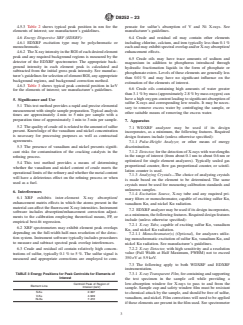
5.1 This test method provides a rapid and precise elemental measurement with simple sample preparation. Typical analysis times are approximately 4 min to 5 min per sample with a preparation time of approximately 1 min to 3 min per sample.
5.2 The quality of crude oil is related to the amount of sulfur present. Knowledge of the vanadium and nickel concentration is necessary for processing purposes as well as contractual agreements.
5.3 The presence of vanadium and nickel presents significant risks for contamination of the cracking catalysts in the refining process.
5.4 This test method provides a means of determining whether the vanadium and nickel content of crude meets the operational limits of the refinery and whether the metal content will have a deleterious effect on the refining process or when used as a fuel.
SCOPE
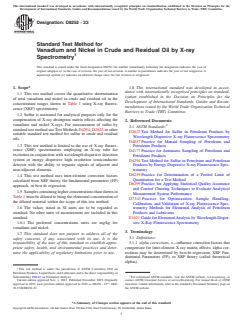
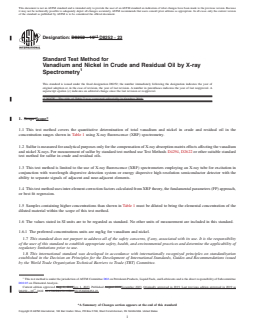
1.1 This test method covers the quantitative determination of total vanadium and nickel in crude and residual oil in the concentration ranges shown in Table 1 using X-ray fluorescence (XRF) spectrometry.
1.2 Sulfur is measured for analytical purposes only for the compensation of X-ray absorption matrix effects affecting the vanadium and nickel X-rays. For measurement of sulfur by standard test method use Test Methods D4294, D2622 or other suitable standard test method for sulfur in crude and residual oils.
1.3 This test method is limited to the use of X-ray fluorescence (XRF) spectrometers employing an X-ray tube for excitation in conjunction with wavelength dispersive detection system or energy dispersive high resolution semiconductor detector with the ability to separate signals of adjacent and near-adjacent elements.
1.4 This test method uses inter-element correction factors calculated from XRF theory, the fundamental parameters (FP) approach, or best fit regression.
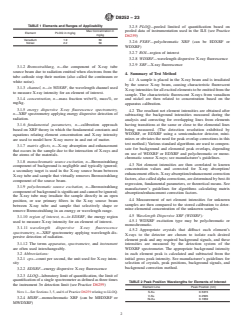
1.5 Samples containing higher concentrations than shown in Table 1 must be diluted to bring the elemental concentration of the diluted material within the scope of this test method.
1.6 The values stated in SI units are to be regarded as standard. No other units of measurement are included in this standard.
1.6.1 The preferred concentrations units are mg/kg for vanadium and nickel.
1.7 This standard does not purport to address all of the safety concerns, if any, associated with its use. It is the responsibility of the user of this standard to establish appropriate safety, health, and environmental practices and determine the applicability of regulatory limitations prior to use.
1.8 This international standard was developed in accordance with internationally recognized principles on standardization established in the Decision on Principles for the Development of International Standards, Guides and Recommendations issued by the World Trade Organization Technical Barriers to Trade (TBT) Committee.
General Information
- Status
- Published
- Publication Date
- 31-Oct-2023
- Technical Committee
- D02 - Petroleum Products, Liquid Fuels, and Lubricants
- Drafting Committee
- D02.03 - Elemental Analysis
Relations
- Effective Date
- 01-Nov-2023
- Effective Date
- 01-Dec-2023
- Effective Date
- 01-Jul-2023
- Effective Date
- 01-Nov-2023
Overview
ASTM D8252-23: Standard Test Method for Vanadium and Nickel in Crude and Residual Oil by X-ray Spectrometry provides a rapid and precise method for determining the concentration of vanadium and nickel in crude and residual oils using X-ray fluorescence (XRF) spectrometry. Developed by ASTM International, this standard supports efficient quality control, operational decision-making, and compliance in the petroleum industry. The method offers fast analysis times-typically 4 to 5 minutes per sample, with minimal sample preparation (1 to 3 minutes)-and is designed for use with wavelength dispersive (WDXRF) or energy dispersive (EDXRF) X-ray spectrometers.
Key Topics
Applicability:
- Designed for quantitative determination of vanadium (1.9–50 mg/kg) and nickel (2.2–50 mg/kg) in crude and residual oils.
- XRF spectrometers using X-ray tube excitation are required, with either wavelength or energy dispersive detection.
Significance:
- Monitoring vanadium and nickel is crucial, as these metals impact refinery catalyst performance and can affect contractual agreements for crude quality.
- High levels of vanadium and nickel can lead to contamination of catalytic cracking units and degrade refining processes.
Procedure Outline:
- Sample preparation using X-ray transparent films and standardized cups.
- Instrument calibration with certified reference materials or carefully prepared in-house standards.
- Analytical correction for matrix effects, including X-ray absorption/enhancement and spectral overlaps.
- Use of empirical regression or fundamental parameter approaches for calibration.
Results Reporting:
- Results are reported as total mass fraction concentrations in mg/kg.
- Repeatability and reproducibility are well-established, supporting interlaboratory consistency.
Safety and Compliance:
- Users must ensure compliance with X-ray and chemical handling safety standards.
- The method was developed in accordance with WTO principles for international standards.
Applications
ASTM D8252-23 is widely used in the following contexts:
- Refinery Operations:
- Determines if crude or residual oil meets processing requirements for vanadium and nickel content, helping to prevent catalyst poisoning and protect equipment.
- Quality Assurance:
- Used in contract verification and quality control laboratories to ensure the elemental composition of petroleum feedstocks aligns with buyer and regulatory specifications.
- Environmental Compliance:
- Assists in monitoring trace metals to meet environmental regulations when oils are used as fuels.
Industrial Benefits:
- Reduces risk of equipment fouling and extended downtime due to high metal contaminants.
- Enables reliable, high-throughput screening of production batches with minimal sample handling.
- Supports contractual certainty and avoids disputes via standardized measurement practices.
Related Standards
For comprehensive elemental analysis in petroleum products, the following ASTM standards are often used in conjunction:
- ASTM D2622 - Sulfur in Petroleum Products by Wavelength Dispersive X-ray Fluorescence Spectrometry
- ASTM D4294 - Sulfur in Petroleum and Petroleum Products by Energy Dispersive X-ray Fluorescence Spectrometry
- ASTM D4057 / D4177 - Manual and Automatic Sampling of Petroleum and Petroleum Products
- ASTM D6259 - Determination of a Pooled Limit of Quantitation for a Test Method
- ASTM D6299 - Statistical Quality Assurance and Control Charting Techniques
- ASTM D7343 - XRF Spectrometry Methods for Petroleum Products and Lubricants
- ASTM E1621 - Guide for Elemental Analysis by WDXRF
Keywords: vanadium, nickel, crude oil, residual oil, X-ray spectrometry, X-ray fluorescence, XRF, EDXRF, WDXRF, ASTM D8252, petroleum quality, refinery catalyst protection, elemental analysis.
Buy Documents
ASTM D8252-23 - Standard Test Method for Vanadium and Nickel in Crude and Residual Oil by X-ray Spectrometry
REDLINE ASTM D8252-23 - Standard Test Method for Vanadium and Nickel in Crude and Residual Oil by X-ray Spectrometry
Get Certified
Connect with accredited certification bodies for this standard

ABS Quality Evaluations Inc.
American Bureau of Shipping quality certification.

Element Materials Technology
Materials testing and product certification.

ABS Group Brazil
ABS Group certification services in Brazil.
Sponsored listings
Frequently Asked Questions
ASTM D8252-23 is a standard published by ASTM International. Its full title is "Standard Test Method for Vanadium and Nickel in Crude and Residual Oil by X-ray Spectrometry". This standard covers: SIGNIFICANCE AND USE 5.1 This test method provides a rapid and precise elemental measurement with simple sample preparation. Typical analysis times are approximately 4 min to 5 min per sample with a preparation time of approximately 1 min to 3 min per sample. 5.2 The quality of crude oil is related to the amount of sulfur present. Knowledge of the vanadium and nickel concentration is necessary for processing purposes as well as contractual agreements. 5.3 The presence of vanadium and nickel presents significant risks for contamination of the cracking catalysts in the refining process. 5.4 This test method provides a means of determining whether the vanadium and nickel content of crude meets the operational limits of the refinery and whether the metal content will have a deleterious effect on the refining process or when used as a fuel. SCOPE 1.1 This test method covers the quantitative determination of total vanadium and nickel in crude and residual oil in the concentration ranges shown in Table 1 using X-ray fluorescence (XRF) spectrometry. 1.2 Sulfur is measured for analytical purposes only for the compensation of X-ray absorption matrix effects affecting the vanadium and nickel X-rays. For measurement of sulfur by standard test method use Test Methods D4294, D2622 or other suitable standard test method for sulfur in crude and residual oils. 1.3 This test method is limited to the use of X-ray fluorescence (XRF) spectrometers employing an X-ray tube for excitation in conjunction with wavelength dispersive detection system or energy dispersive high resolution semiconductor detector with the ability to separate signals of adjacent and near-adjacent elements. 1.4 This test method uses inter-element correction factors calculated from XRF theory, the fundamental parameters (FP) approach, or best fit regression. 1.5 Samples containing higher concentrations than shown in Table 1 must be diluted to bring the elemental concentration of the diluted material within the scope of this test method. 1.6 The values stated in SI units are to be regarded as standard. No other units of measurement are included in this standard. 1.6.1 The preferred concentrations units are mg/kg for vanadium and nickel. 1.7 This standard does not purport to address all of the safety concerns, if any, associated with its use. It is the responsibility of the user of this standard to establish appropriate safety, health, and environmental practices and determine the applicability of regulatory limitations prior to use. 1.8 This international standard was developed in accordance with internationally recognized principles on standardization established in the Decision on Principles for the Development of International Standards, Guides and Recommendations issued by the World Trade Organization Technical Barriers to Trade (TBT) Committee.
SIGNIFICANCE AND USE 5.1 This test method provides a rapid and precise elemental measurement with simple sample preparation. Typical analysis times are approximately 4 min to 5 min per sample with a preparation time of approximately 1 min to 3 min per sample. 5.2 The quality of crude oil is related to the amount of sulfur present. Knowledge of the vanadium and nickel concentration is necessary for processing purposes as well as contractual agreements. 5.3 The presence of vanadium and nickel presents significant risks for contamination of the cracking catalysts in the refining process. 5.4 This test method provides a means of determining whether the vanadium and nickel content of crude meets the operational limits of the refinery and whether the metal content will have a deleterious effect on the refining process or when used as a fuel. SCOPE 1.1 This test method covers the quantitative determination of total vanadium and nickel in crude and residual oil in the concentration ranges shown in Table 1 using X-ray fluorescence (XRF) spectrometry. 1.2 Sulfur is measured for analytical purposes only for the compensation of X-ray absorption matrix effects affecting the vanadium and nickel X-rays. For measurement of sulfur by standard test method use Test Methods D4294, D2622 or other suitable standard test method for sulfur in crude and residual oils. 1.3 This test method is limited to the use of X-ray fluorescence (XRF) spectrometers employing an X-ray tube for excitation in conjunction with wavelength dispersive detection system or energy dispersive high resolution semiconductor detector with the ability to separate signals of adjacent and near-adjacent elements. 1.4 This test method uses inter-element correction factors calculated from XRF theory, the fundamental parameters (FP) approach, or best fit regression. 1.5 Samples containing higher concentrations than shown in Table 1 must be diluted to bring the elemental concentration of the diluted material within the scope of this test method. 1.6 The values stated in SI units are to be regarded as standard. No other units of measurement are included in this standard. 1.6.1 The preferred concentrations units are mg/kg for vanadium and nickel. 1.7 This standard does not purport to address all of the safety concerns, if any, associated with its use. It is the responsibility of the user of this standard to establish appropriate safety, health, and environmental practices and determine the applicability of regulatory limitations prior to use. 1.8 This international standard was developed in accordance with internationally recognized principles on standardization established in the Decision on Principles for the Development of International Standards, Guides and Recommendations issued by the World Trade Organization Technical Barriers to Trade (TBT) Committee.
ASTM D8252-23 is classified under the following ICS (International Classification for Standards) categories: 75.040 - Crude petroleum; 75.160.20 - Liquid fuels. The ICS classification helps identify the subject area and facilitates finding related standards.
ASTM D8252-23 has the following relationships with other standards: It is inter standard links to ASTM D8252-19e1, ASTM D6299-23a, ASTM D6299-23e1, ASTM D7343-20. Understanding these relationships helps ensure you are using the most current and applicable version of the standard.
ASTM D8252-23 is available in PDF format for immediate download after purchase. The document can be added to your cart and obtained through the secure checkout process. Digital delivery ensures instant access to the complete standard document.
Standards Content (Sample)
This international standard was developed in accordance with internationally recognized principles on standardization established in the Decision on Principles for the
Development of International Standards, Guides and Recommendations issued by the World Trade Organization Technical Barriers to Trade (TBT) Committee.
Designation: D8252 − 23
Standard Test Method for
Vanadium and Nickel in Crude and Residual Oil by X-ray
Spectrometry
This standard is issued under the fixed designation D8252; the number immediately following the designation indicates the year of
original adoption or, in the case of revision, the year of last revision. A number in parentheses indicates the year of last reapproval. A
superscript epsilon (´) indicates an editorial change since the last revision or reapproval.
1. Scope* 1.8 This international standard was developed in accor-
dance with internationally recognized principles on standard-
1.1 This test method covers the quantitative determination
ization established in the Decision on Principles for the
of total vanadium and nickel in crude and residual oil in the
Development of International Standards, Guides and Recom-
concentration ranges shown in Table 1 using X-ray fluores-
mendations issued by the World Trade Organization Technical
cence (XRF) spectrometry.
Barriers to Trade (TBT) Committee.
1.2 Sulfur is measured for analytical purposes only for the
compensation of X-ray absorption matrix effects affecting the
2. Referenced Documents
vanadium and nickel X-rays. For measurement of sulfur by
2.1 ASTM Standards:
standard test method use Test Methods D4294, D2622 or other
D2622 Test Method for Sulfur in Petroleum Products by
suitable standard test method for sulfur in crude and residual
Wavelength Dispersive X-ray Fluorescence Spectrometry
oils.
D4057 Practice for Manual Sampling of Petroleum and
1.3 This test method is limited to the use of X-ray fluores-
Petroleum Products
cence (XRF) spectrometers employing an X-ray tube for
D4177 Practice for Automatic Sampling of Petroleum and
excitation in conjunction with wavelength dispersive detection
Petroleum Products
system or energy dispersive high resolution semiconductor
D4294 Test Method for Sulfur in Petroleum and Petroleum
detector with the ability to separate signals of adjacent and
Products by Energy Dispersive X-ray Fluorescence Spec-
near-adjacent elements.
trometry
D6259 Practice for Determination of a Pooled Limit of
1.4 This test method uses inter-element correction factors
Quantitation for a Test Method
calculated from XRF theory, the fundamental parameters (FP)
D6299 Practice for Applying Statistical Quality Assurance
approach, or best fit regression.
and Control Charting Techniques to Evaluate Analytical
1.5 Samples containing higher concentrations than shown in
Measurement System Performance
Table 1 must be diluted to bring the elemental concentration of
D7343 Practice for Optimization, Sample Handling,
the diluted material within the scope of this test method.
Calibration, and Validation of X-ray Fluorescence Spec-
1.6 The values stated in SI units are to be regarded as trometry Methods for Elemental Analysis of Petroleum
Products and Lubricants
standard. No other units of measurement are included in this
standard. E1621 Guide for Elemental Analysis by Wavelength Disper-
sive X-Ray Fluorescence Spectrometry
1.6.1 The preferred concentrations units are mg/kg for
vanadium and nickel.
3. Terminology
1.7 This standard does not purport to address all of the
3.1 Definitions:
safety concerns, if any, associated with its use. It is the
3.1.1 alpha corrections, n—influence correction factors that
responsibility of the user of this standard to establish appro-
compensate for inter-element X-ray matrix effects; alpha cor-
priate safety, health, and environmental practices and deter-
rections may be determined by best-fit regression, XRF Fun-
mine the applicability of regulatory limitations prior to use.
damental Parameters (FP), or XRF theory (called theoretical
alphas).
This test method is under the jurisdiction of ASTM Committee D02 on
Petroleum Products, Liquid Fuels, and Lubricants and is the direct responsibility of
Subcommittee D02.03 on Elemental Analysis. For referenced ASTM standards, visit the ASTM website, www.astm.org, or
Current edition approved Nov. 1, 2023. Published November 2023. Originally contact ASTM Customer Service at service@astm.org. For Annual Book of ASTM
ɛ1
approved in 2019. Last previous edition approved in 2019 as D8252 – 19 . DOI: Standards volume information, refer to the standard’s Document Summary page on
10.1520/D8252-23. the ASTM website.
*A Summary of Changes section appears at the end of this standard
Copyright © ASTM International, 100 Barr Harbor Drive, PO Box C700, West Conshohocken, PA 19428-2959. United States
D8252 − 23
TABLE 1 Elements and Ranges of Applicability
3.2.5 PLOQ—pooled limited of quantification based on
Max Concentration in pooled data of instrumentation used in the ILS (see Practice
Element PLOQ in mg/kg
mg/kg
D6259)
Vanadium 1.9 50
3.2.6 PXRF—polychromatic XRF (can be EDXRF or
Nickel 2.2 50
WDXRF)
3.2.7 ROI—region of interest
3.2.8 WDXRF—wavelength dispersive X-ray fluorescence
3.2.9 XRF—X-ray fluorescence
3.1.2 Bremsstrahlung, n—the component of X-ray tube
source beam due to radiation emitted when electrons from the
4. Summary of Test Method
tube cathode stop their motion (also called the continuum or
4.1 A sample is placed in the X-ray beam and is irradiated
white noise).
by the source X-ray beam, causing characteristic fluorescent
3.1.3 channel, n—in WDXRF, the wavelength channel used
X-ray intensities for all excited elements to be emitted from the
to measure X-ray intensity for an element of interest.
sample. The characteristic fluorescent X-rays from vanadium
3.1.4 concentration, n—mass fraction wt/wt%, mass%, or
and nickel are then related to concentration based on the
mg/kg.
apparatus calibration.
3.1.5 energy dispersive X-ray fluorescence spectrometry,
4.2 The resultant net element intensities are obtained after
n—XRF spectrometry applying energy dispersive detection of
subtracting the background intensities measured during the
radiation.
analysis and correcting for overlapping lines from elements
having transitions at the same or close to the elemental lines
3.1.6 fundamental parameters, n—calibration approach
being measured. (The detection resolution exhibited by
based on XRF theory in which the fundamental constants and
WDXRF, or EDXRF using a semiconductor detector, mini-
equations relating element concentration and X-ray intensity
mizes or obviates the need for peak overlap corrections in this
are used to model how X-ray move in and out of matter.
test method.) Various standard algorithms are used to compen-
3.1.7 matrix effects, n—X-ray absorption and enhancement
sate for background and elemental peak overlaps, depending
that occurs in the sample due to the interaction of X-rays and
on use of WDXRF or EDXRF and polychromatic or mono-
the atoms of the materials.
chromatic source X-rays; see manufacturer’s guidelines.
3.1.8 monochromatic source excitation, n—Bremsstrahlung
4.3 Net element intensities are then correlated to known
component of background is negligible and typically ignored;
concentration values and corrected for X-ray absorption/
a secondary target is used in the X-ray source beam between
enhancement effects. X-ray absorption/enhancement correction
X-ray tube and sample that virtually removes Bremsstrahlung
factors, also called alpha corrections, are determined by best-fit
component of the source beam.
regression, fundamental parameters, or theoretical means. See
3.1.9 polychromatic source excitation, n—Bremsstrahlung
manufacturer’s guidelines for algorithms calculating matrix
component of background is significant and cannot be ignored;
absorption/enhancement correction factors.
the X-ray tube may irradiate the sample directly in an open
4.4 Measurement of net element intensities for unknown
position, or use primary filters in the X-ray source beam
samples are then compared to the stored calibration to deter-
between X-ray tube and sample that selectively shape or
mine elemental concentration of the unknown samples.
remove Bremsstrahlung in an energy or wavelength range.
4.5 Wavelength Dispersive XRF (WDXRF):
3.1.10 region of interest, n—in EDXRF, the energy region
4.5.1 WDXRF excitation type may be polychromatic or
used to measure X-ray intensity for an element of interest.
monochromatic.
3.1.11 wavelength dispersive X-ray fluorescence
4.5.2 Appropriate crystals that diffract each element’s
spectrometry, n—XRF spectrometry applying wavelength dis-
X-rays to the detector are chosen to isolate each desired
persive detection of radiation.
element peak and any required background signals, and these
3.1.12 The terms apparatus, spectrometer, and instrument
intensities are measured by the detection system of the
are often used interchangeably.
WDXRF spectrometer. The appropriate background intensity
3.2 Abbreviations:
in each element peak is calculated and subtracted from the
3.2.1 cps—count per second, the unit used for X-ray inten- initial gross peak intensity. See manufacturer’s guidelines for
sity
selection of crystals, peak positions, background signals, and
background correction method.
3.2.2 EDXRF—energy dispersive X-ray fluorescence
3.2.3 LLOQ—laboratory limit of quantification, the limit of
quantification of a single spectrometer as defined as three times
TABLE 2 Peak Position Wavelengths for Elements of Interest
the instrument 3σ detection limit (see Practice D6259)
Element Line Peak Position (nm)
S-Kα 0.5373
NOTE 1—See Sections 3, 5, and 6 of Practice D6259 relating to LLOQ.
V-Kα 0.2505
3.2.4 MXRF—monochromatic XRF (can be MEDXRF or
Ni-Kα 0.1659
MWDXRF)
D8252 − 23
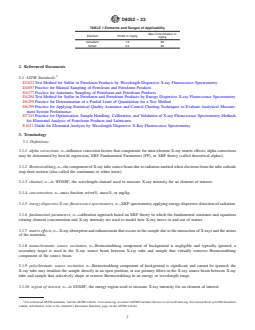
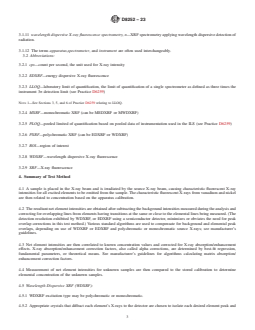
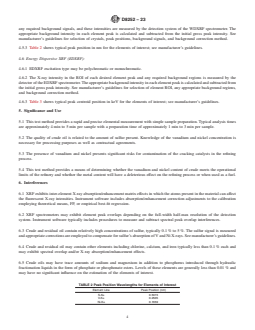
4.5.3 Table 2 shows typical peak position in nm for the pensate for sulfur’s absorption of V and Ni X-rays. See
elements of interest; see manufacturer’s guidelines. manufacturer’s guidelines.
4.6 Energy Dispersive XRF (EDXRF): 6.4 Crude and residual oil may contain other elements
4.6.1 EDXRF excitation type may be polychromatic or including chlorine, calcium, and iron typically less than 0.1 %
monochromatic. each and may exhibit spectral overlap and/or X-ray absorption/
4.6.2 The X-ray intensity in the ROI of each desired element enhancement effects.
peak and any required background regions is measured by the
6.5 Crude oils may have trace amounts of sodium and
detector of the EDXRF spectrometer. The appropriate back-
magnesium in addition to phosphorus introduced through
ground intensity in each element peak is calculated and
hydraulic fractionation liquids in the form of phosphate or
subtracted from the initial gross peak intensity. See manufac-
phosphonate esters. Levels of these elements are generally less
turer’s guidelines for selection of element ROI, any appropriate
than 0.01 % and may have no significant influence on the
background regions, and background correction method.
estimation of the elements of interest.
4.6.3 Table 3 shows typical peak centroid position in keV
6.6 Crude oils containing high amounts of water greater
for the elements of interest; see manufacturer’s guidelines.
than 3.1 % by mass (approximately 2.8 % by mass oxygen) can
have a high oxygen content leading to significant absorption of
5. Significance and Use
sulfur X-rays and corresponding low results. It may be neces-
5.1 This test method provides a rapid and precise elemental
sary to remove excess water by centrifuging the sample, or
measurement with simple sample preparation. Typical analysis
other suitable means of removing the excess water.
times are approximately 4 min to 5 min per sample with a
preparation time of approximately 1 min to 3 min per sample.
7. Apparatus
5.2 The quality of crude oil is related to the amount of sulfur
7.1 WDXRF analyzer may be used if its design
present. Knowledge of the vanadium and nickel concentration
incorporates, as a minimum, the following features. Required
is necessary for processing purposes as well as contractual
design features include (unless otherwise specified):
agreements.
7.1.1 Pulse-Height Analyzer, or other means of energy
discrimination.
5.3 The presence of vanadium and nickel presents signifi-
7.1.2 Detector, for the detection of X-rays with wavelengths
cant risks for contamination of the cracking catalysts in the
in the range of interest (from about 0.1 nm to about 0.6 nm or
refining process.
optimized for single element analyzers). Typically sealed gas
5.4 This test method provides a means of determining
proportional counter, flow gas proportional counter, or scintil-
whether the vanadium and nickel content of crude meets the
lation counter is used.
operational limits of the refinery and whether the metal content
7.1.3 Analyzing Crystals—The choice of analyzing crystals
will have a deleterious effect on the refining process or when
is made based on the element to be determined. The same
used as a fuel.
crystals must be used for measuring calibration standards and
unknown samples.
6. Interferences
7.1.4 Excitation Source, X-ray tube and any required pri-
6.1 XRF exhibits inter-element X-ray absorption/
mary filters or monochromator, capable of exciting sulfur Kα,
enhancement matrix effects in which the atoms present in the
vanadium Kα, and nickel Kα radiation.
material can affect the fluorescent X-ray intensities. Instrument
7.2 EDXRF analyzer may be used if its design incorporates,
software includes absorption/enhancement correction adjust-
as a minimum, the following features. Required design features
ments to the calibration employing theoretical means, FP, or
include (unless otherwise specified):
empirical best-fit regression.
7.2.1 X-ray Tube, capable of exciting sulfur Kα, vanadium
6.2 XRF spectrometers may exhibit element peak overlaps
Kα, and nickel Kα radiation.
depending on the full-width half-max resolution of the detec-
7.2.1.1 Monochromator(s) (Optional), for analyzers utiliz-
tion system. Instrument software typically includes procedures
ing monochromatic excitation of sulfur Kα, vanadium Kα, and
to measure and subtract spectral peak overlap interferences.
nickel Kα radiation. See manufacturer’s guidelines.
7.2.2 X-ray Detector, with high sensitivity and a resolution
6.3 Crude and residual oil contain relatively high concen-
value (Full Width at Half Maximum, FWHM) not to exceed
trations of sulfur, typically 0.1 % to 5 %. The sulfur signal is
350 eV at 5.9 keV.
measured and appropriate corrections are employed to com-
7.3 The following apply to both WDXRF and EDXRF
instrumentation.
7.3.1 X-ray Transparent Film, for containing and supporting
TABLE 3 Energy Positions for Peak Centroids for Elements of
Interest
the test specimen in the sample cell while providing a
Centroid Peak of Region of low-absorption window for X-rays to pass to and from the
Element Line
Interest (keV)
sample. Sample cup and safety window film must be resistant
S-Kα 2.307
to chemical attack by the sample, and should be free of sulfur,
V-Kα 4.949
vanadium, and nickel. Film corrections will need to be applied
Ni-Kα 7.472
if these elements are present in the film used. See spectrometer
D8252 − 23
manufacturer’s guidelines for film type and thickness that gives blends and their uncertainties are characterized by the certify-
X-ray transparency required to achieve PLOQ and statistics of ing body. Calibration standards may also be made in-house
this test method. Typical films include 4 μm polypropylene, using careful gravimetric procedure and verifying final mass
6.0 μm or 3.5 μm Mylar (polyester), or 3 μm Etnom (trade- fraction concentrations using an acceptable
...
This document is not an ASTM standard and is intended only to provide the user of an ASTM standard an indication of what changes have been made to the previous version. Because
it may not be technically possible to adequately depict all changes accurately, ASTM recommends that users consult prior editions as appropriate. In all cases only the current version
of the standard as published by ASTM is to be considered the official document.
´1
Designation: D8252 − 19 D8252 − 23
Standard Test Method for
Vanadium and Nickel in Crude and Residual Oil by X-ray
Spectrometry
This standard is issued under the fixed designation D8252; the number immediately following the designation indicates the year of
original adoption or, in the case of revision, the year of last revision. A number in parentheses indicates the year of last reapproval. A
superscript epsilon (´) indicates an editorial change since the last revision or reapproval.
ε NOTE—The title of Table 7 was corrected editorially in October 2019.
1. Scope Scope*
1.1 This test method covers the quantitative determination of total vanadium and nickel in crude and residual oil in the
concentration ranges shown in Table 1 using X-ray fluorescence (XRF) spectrometry.
1.2 Sulfur is measured for analytical purposes only for the compensation of X-ray absorption matrix effects affecting the vanadium
and nickel X-rays. For measurement of sulfur by standard test method use Test Methods D4294, D2622 or other suitable standard
test method for sulfur in crude and residual oils.
1.3 This test method is limited to the use of X-ray fluorescence (XRF) spectrometers employing an X-ray tube for excitation in
conjunction with wavelength dispersive detection system or energy dispersive high resolution semiconductor detector with the
ability to separate signals of adjacent and near-adjacent elements.
1.4 This test method uses inter-element correction factors calculated from XRF theory, the fundamental parameters (FP) approach,
or best fit regression.
1.5 Samples containing higher concentrations than shown in Table 1 must be diluted to bring the elemental concentration of the
diluted material within the scope of this test method.
1.6 The values stated in SI units are to be regarded as standard. No other units of measurement are included in this standard.
1.6.1 The preferred concentrations units are mg/kg for vanadium and nickel.
1.7 This standard does not purport to address all of the safety concerns, if any, associated with its use. It is the responsibility
of the user of this standard to establish appropriate safety, health, and environmental practices and determine the applicability of
regulatory limitations prior to use.
1.8 This international standard was developed in accordance with internationally recognized principles on standardization
established in the Decision on Principles for the Development of International Standards, Guides and Recommendations issued
by the World Trade Organization Technical Barriers to Trade (TBT) Committee.
This test method is under the jurisdiction of ASTM Committee D02 on Petroleum Products, Liquid Fuels, and Lubricants and is the direct responsibility of Subcommittee
D02.03 on Elemental Analysis.
Current edition approved Aug. 1, 2019Nov. 1, 2023. Published August 2019November 2023. Originally approved in 2019. Last previous edition approved in 2019 as
ɛ1
D8252 – 19 . DOI: 10.1520/D8252-19E01.10.1520/D8252-23.
*A Summary of Changes section appears at the end of this standard
Copyright © ASTM International, 100 Barr Harbor Drive, PO Box C700, West Conshohocken, PA 19428-2959. United States
D8252 − 23
TABLE 1 Elements and Ranges of Applicability
Max Concentration in
Element PLOQ in mg/kg
mg/kg
Vanadium 1.9 50
Nickel 2.2 50
2. Referenced Documents
2.1 ASTM Standards:
D2622 Test Method for Sulfur in Petroleum Products by Wavelength Dispersive X-ray Fluorescence Spectrometry
D4057 Practice for Manual Sampling of Petroleum and Petroleum Products
D4177 Practice for Automatic Sampling of Petroleum and Petroleum Products
D4294 Test Method for Sulfur in Petroleum and Petroleum Products by Energy Dispersive X-ray Fluorescence Spectrometry
D6259 Practice for Determination of a Pooled Limit of Quantitation for a Test Method
D6299 Practice for Applying Statistical Quality Assurance and Control Charting Techniques to Evaluate Analytical Measure-
ment System Performance
D7343 Practice for Optimization, Sample Handling, Calibration, and Validation of X-ray Fluorescence Spectrometry Methods
for Elemental Analysis of Petroleum Products and Lubricants
E1621 Guide for Elemental Analysis by Wavelength Dispersive X-Ray Fluorescence Spectrometry
3. Terminology
3.1 Definitions:
3.1.1 alpha corrections, n—influence correction factors that compensate for inter-element X-ray matrix effects; alpha corrections
may be determined by best-fit regression, XRF Fundamental Parameters (FP), or XRF theory (called theoretical alphas).
3.1.2 Bremsstrahlung, n—the component of X-ray tube source beam due to radiation emitted when electrons from the tube cathode
stop their motion (also called the continuum or white noise).
3.1.3 channel, n—in WDXRF, the wavelength channel used to measure X-ray intensity for an element of interest.
3.1.4 concentration, n—mass fraction wt/wt%, mass%, or mg/kg.
3.1.5 energy dispersive X-ray fluorescence spectrometry, n—XRF spectrometry applying energy dispersive detection of radiation.
3.1.6 fundamental parameters, n—calibration approach based on XRF theory in which the fundamental constants and equations
relating element concentration and X-ray intensity are used to model how X-ray move in and out of matter.
3.1.7 matrix effects, n—X-ray absorption and enhancement that occurs in the sample due to the interaction of X-rays and the atoms
of the materials.
3.1.8 monochromatic source excitation, n—Bremsstrahlung component of background is negligible and typically ignored; a
secondary target is used in the X-ray source beam between X-ray tube and sample that virtually removes Bremsstrahlung
component of the source beam.
3.1.9 polychromatic source excitation, n—Bremsstrahlung component of background is significant and cannot be ignored; the
X-ray tube may irradiate the sample directly in an open position, or use primary filters in the X-ray source beam between X-ray
tube and sample that selectively shape or remove Bremsstrahlung in an energy or wavelength range.
3.1.10 region of interest, n—in EDXRF, the energy region used to measure X-ray intensity for an element of interest.
For referenced ASTM standards, visit the ASTM website, www.astm.org, or contact ASTM Customer Service at service@astm.org. For Annual Book of ASTM Standards
volume information, refer to the standard’s Document Summary page on the ASTM website.
D8252 − 23
3.1.11 wavelength dispersive X-ray fluorescence spectrometry, n—XRF spectrometry applying wavelength dispersive detection of
radiation.
3.1.12 The terms apparatus,spectrometer, and instrument are often used interchangeably.
3.2 Abbreviations:
3.2.1 cps—count per second, the unit used for X-ray intensity
3.2.2 EDXRF—energy dispersive X-ray fluorescence
3.2.3 LLOQ—laboratory limit of quantification, the limit of quantification of a single spectrometer as defined as three times the
instrument 3σ detection limit (see Practice D6259)
NOTE 1—See Sections 3, 5, and 6 of Practice D6259 relating to LLOQ.
3.2.4 MXRF—monochromatic XRF (can be MEDXRF or MWDXRF)
3.2.5 PLOQ—pooled limited of quantification based on pooled data of instrumentation used in the ILS (see Practice D6259)
3.2.6 PXRF—polychromatic XRF (can be EDXRF or WDXRF)
3.2.7 ROI—region of interest
3.2.8 WDXRF—wavelength dispersive X-ray fluorescence
3.2.9 XRF—X-ray fluorescence
4. Summary of Test Method
4.1 A sample is placed in the X-ray beam and is irradiated by the source X-ray beam, causing characteristic fluorescent X-ray
intensities for all excited elements to be emitted from the sample. The characteristic fluorescent X-rays from vanadium and nickel
are then related to concentration based on the apparatus calibration.
4.2 The resultant net element intensities are obtained after subtracting the background intensities measured during the analysis and
correcting for overlapping lines from elements having transitions at the same or close to the elemental lines being measured. (The
detection resolution exhibited by WDXRF, or EDXRF using a semiconductor detector, minimizes or obviates the need for peak
overlap corrections in this test method.) Various standard algorithms are used to compensate for background and elemental peak
overlaps, depending on use of WDXRF or EDXRF and polychromatic or monochromatic source X-rays; see manufacturer’s
guidelines.
4.3 Net element intensities are then correlated to known concentration values and corrected for X-ray absorption/enhancement
effects. X-ray absorption/enhancement correction factors, also called alpha corrections, are determined by best-fit regression,
fundamental parameters, or theoretical means. See manufacturer’s guidelines for algorithms calculating matrix absorption/
enhancement correction factors.
4.4 Measurement of net element intensities for unknown samples are then compared to the stored calibration to determine
elemental concentration of the unknown samples.
4.5 Wavelength Dispersive XRF (WDXRF):
4.5.1 WDXRF excitation type may be polychromatic or monochromatic.
4.5.2 Appropriate crystals that diffract each element’s X-rays to the detector are chosen to isolate each desired element peak and
D8252 − 23
any required background signals, and these intensities are measured by the detection system of the WDXRF spectrometer. The
appropriate background intensity in each element peak is calculated and subtracted from the initial gross peak intensity. See
manufacturer’s guidelines for selection of crystals, peak positions, background signals, and background correction method.
4.5.3 Table 2 shows typical peak position in nm for the elements of interest; see manufacturer’s guidelines.
4.6 Energy Dispersive XRF (EDXRF):
4.6.1 EDXRF excitation type may be polychromatic or monochromatic.
4.6.2 The X-ray intensity in the ROI of each desired element peak and any required background regions is measured by the
detector of the EDXRF spectrometer. The appropriate background intensity in each element peak is calculated and subtracted from
the initial gross peak intensity. See manufacturer’s guidelines for selection of element ROI, any appropriate background regions,
and background correction method.
4.6.3 Table 3 shows typical peak centroid position in keV for the elements of interest; see manufacturer’s guidelines.
5. Significance and Use
5.1 This test method provides a rapid and precise elemental measurement with simple sample preparation. Typical analysis times
are approximately 4 min to 5 min per sample with a preparation time of approximately 1 min to 3 min per sample.
5.2 The quality of crude oil is related to the amount of sulfur present. Knowledge of the vanadium and nickel concentration is
necessary for processing purposes as well as contractual agreements.
5.3 The presence of vanadium and nickel presents significant risks for contamination of the cracking catalysts in the refining
process.
5.4 This test method provides a means of determining whether the vanadium and nickel content of crude meets the operational
limits of the refinery and whether the metal content will have a deleterious effect on the refining process or when used as a fuel.
6. Interferences
6.1 XRF exhibits inter-element X-ray absorption/enhancement matrix effects in which the atoms present in the material can affect
the fluorescent X-ray intensities. Instrument software includes absorption/enhancement correction adjustments to the calibration
employing theoretical means, FP, or empirical best-fit regression.
6.2 XRF spectrometers may exhibit element peak overlaps depending on the full-width half-max resolution of the detection
system. Instrument software typically includes procedures to measure and subtract spectral peak overlap interferences.
6.3 Crude and residual oil contain relatively high concentrations of sulfur, typically 0.1 % to 5 %. The sulfur signal is measured
and appropriate corrections are employed to compensate for sulfur’s absorption of V and Ni X-rays. See manufacturer’s guidelines.
6.4 Crude and residual oil may contain other elements including chlorine, calcium, and iron typically less than 0.1 % each and
may exhibit spectral overlap and/or X-ray absorption/enhancement effects.
6.5 Crude oils may have trace amounts of sodium and magnesium in addition to phosphorus introduced through hydraulic
fractionation liquids in the form of phosphate or phosphonate esters. Levels of these elements are generally less than 0.01 % and
may have no significant influence on the estimation of the elements of interest.
TABLE 2 Peak Position Wavelengths for Elements of Interest
Element Line Peak Position (nm)
S-Kα 0.5373
V-Kα 0.2505
Ni-Kα 0.1659
D8252 − 23
TABLE 3 Energy Positions for Peak Centroids for Elements of
Interest
Centroid Peak of Region of
Element Line
Interest (keV)
S-Kα 2.307
V-Kα 4.949
Ni-Kα 7.472
6.6 Crude oils containing high amounts of water greater than 3.1 mass% (approximately 2.8 mass% 3.1 % by mass (approximately
2.8 % by mass oxygen) can have a high oxygen content leading to significant absorption of sulfur X-rays and corresponding low
results. It may be necessary to remove excess water by centrifuging the sample, or other suitable means of removing the excess
water.
7. Apparatus
7.1 WDXRF analyzer may be used if its design incorporates, as a minimum, the following features. Required design features
include (unless otherwise specified):
7.1.1 Pulse-Height Analyzer, or other means of energy discrimination.
7.1.2 Detector, for the detection of X-rays with wavelengths in the range of interest (from about 0.1 nm to about 0.6 nm or
optimized for single element analyzers). Typically sealed gas proportional counter, flow gas proportional counter, or scintillation
counter is used.
7.1.3 Analyzing Crystals—The choice of analyzing crystals is made based on the element to be determined. The same crystals must
be used for measuring calibration standards and unknown samples.
7.1.4 Excitation Source, X-ray tube and any required primary filters or monochromator, capable of exciting sulfur Kα, vanadium
Kα, and nickel Kα radiation.
7.2 EDXRF analyzer may be used if its design incorporates, as a minimum, the following features. Required design features
include (unless otherwise specified):
7.2.1 X-ray Tube, capable of exciting sulfur Kα, vanadium Kα, and nickel Kα radiation.
7.2.1.1 Monochromator(s) (Optional), for analyzers utilizing monochromatic excitation of sulfur Kα, vanadium Kα, and nickel Kα
radiation. See manufacturer’s guidelines.
7.2.2 X-ray Detector, with high sensitivity and a resolution value (Full Width at Half Maximum, FWHM) not to exceed 350 eV
at 5.9 keV.
7.3 The following apply to both WDXRF and EDXRF instrumentation.
7.3.1 X-ray Transparent Film, for containing and supporting the test specimen in the sample cell while providing a low-absorption
window for X-rays to pass to and from the sample. Sample cup and safety window film must be resistant to chemical attack by
the sample, and should be free of sulfur, vanadium, and nickel. Film corrections will need to be applied if these elements are
present in the film used. See spectrometer manufacturer’s guidelines for film type and thickness that gives X-ray transparency
required to achieve PLOQ and statistics of this test method. Typical films include 4 μm polypropylene, 6.0 μm or 3.5 μm Mylar
(polyester), or 3 μm Etnom (trademarked).
7.3.2 Sample Cup specimen holder compatible with the sample and the geometry of the XRF spectrometer. A disposable cell is
recommended. The sample cell should not leak when fitted with X-ra
...
Questions, Comments and Discussion
Ask us and Technical Secretary will try to provide an answer. You can facilitate discussion about the standard in here.
Loading comments...