

ASTM F1566-14(2021)
(Test Method)Standard Test Methods for Evaluation of Innersprings, Boxsprings, Mattresses or Mattress Sets
General Information
- Abstract
SIGNIFICANCE AND USE
4.1 Two separate test methods are outlined for use in evaluation of (1) mattress components, innersprings and boxsprings and (2) mattresses and mattress sets.
4.2 Component innerspring and boxspring test methods include measurements of firmness, firmness retention, durability, and effect of impact.
4.3 Mattress and mattress set test methods include measurements of firmness, firmness retention, durability, effect of impact, and height change.
4.4 One or more of the test methods shall be used separately or in combination to provide for appropriate evaluations.
4.5 Any variation from test procedure should be noted on the appropriate test form and in the end results as notification of variance.
SCOPE
1.1 These test methods cover recognized methods for testing mattress innersprings, boxsprings, and finished mattresses or mattress sets, or both, to ensure uniformity of results.
1.2 These test methods are applicable to un-upholstered mattress core units including but not limited to innersprings, air chambers, and foam cores, un-upholstered foundations including but not limited to boxspring and build up foundations, finished foundations and mattress constructions. Data developed is for comparative analysis with no pass/fail criteria applicable.
1.3 The durability test (Section 7), impact test (Section 8) and firmness retention test/surface deformation (Section 9) require upholstered samples. Firmness testing may be ran on un-upholstered components, innerspring units and flexible boxsprings (6.1 through 6.4), or finished mattresses or mattress sets (6.5 through 6.8). A standardized upholstery package is specified if evaluating a mattress core or un-upholstered foundation. These test methods are intended to be used on newly manufactured products..
1.4 The values stated in SI units are to be regarded as standard. The values given in parentheses after SI units are provided for information only and are not considered standard.
1.5 This standard does not purport to address all of the safety concerns, if any, associated with its use. It is the responsibility of the user of this standard to establish appropriate safety, health, and environmental practices and determine the applicability of regulatory limitations prior to use.
1.6 This international standard was developed in accordance with internationally recognized principles on standardization established in the Decision on Principles for the Development of International Standards, Guides and Recommendations issued by the World Trade Organization Technical Barriers to Trade (TBT) Committee.
- Status
- Published
- Publication Date
- 31-Dec-2020
- Technical Committee
- F15 - Consumer Products
- Drafting Committee
- F15.32 - Innersprings and Boxsprings
Overview
ASTM F1566-14(2021) is a recognized international standard from ASTM International that specifies standard test methods for the evaluation of innersprings, boxsprings, mattresses, and mattress sets. The purpose of this standard is to provide uniform, comparative data on key physical properties such as firmness, durability, impact resistance, firmness retention, and surface deformation for both components and finished products in the bedding industry. This document is widely utilized by manufacturers, testing laboratories, and quality assurance teams to assess and compare the performance of bedding products in a systematic and standardized manner.
Key Topics
Firmness Testing
Includes standardized procedures to measure the firmness of mattress cores, innersprings, flexible boxsprings, and finished mattresses or mattress sets. Measurements are designed for both upholstered and un-upholstered components.Durability Assessment
Standardized cycles and forces are applied to mattresses and boxsprings to evaluate their endurance and ability to maintain structural integrity and comfort over prolonged use.Impact Testing
Evaluates how products withstand sudden and concentrated forces, simulating scenarios such as jumping or dropping heavy objects on mattresses or boxsprings.Firmness Retention and Surface Deformation
Determines how well a mattress or foundation retains its original firmness and shape after repeated use, measuring surface changes and permanent deformation.Height Measurement
Includes procedures to record and compare any changes in product height before and after testing, indicating structural resilience or failure.Data Reporting and Comparisons
The test results are intended for comparative analysis - there are no pass/fail criteria, enabling objective benchmarking between products or batches.
Applications
ASTM F1566-14(2021) is essential for:
Manufacturers:
Ensures product consistency, supports new product development, and provides data to benchmark against industry norms or competitor offerings.Quality Control Laboratories:
Supplies repeatable methods for in-house or third-party verification of product quality and compliance with buyer or regulatory requirements.Product Development:
Assists engineers and designers in evaluating the performance of new materials, constructions, or designs for innersprings, boxsprings, and mattress sets.Comparative Assessment:
Provides actionable, comparative data for procurement teams, retailers, or regulatory bodies assessing products from various suppliers.International Trade and Compliance:
Enables alignment with internationally accepted testing practices, supporting global market access and regulatory adherence, in accordance with WTO TBT principles.
Related Standards
ASTM E4 - Practices for Force Verification of Testing Machines:
Specifies calibration and verification practices to ensure the accuracy of testing machines used in mattress and bedding evaluation.Other ASTM Bedding Standards:
Standards covering flammability, dimensional stability, and other related properties that complement the evaluation framework provided by ASTM F1566-14(2021).International Bedding Standards:
Additional relevant guidance may be found in ISO, EN, and other national or international bedding standards, especially for market-specific requirements.
Practical Value
Using ASTM F1566-14(2021) allows stakeholders in the bedding industry to:
- Maintain high standards of product performance and durability.
- Facilitate product improvements based on reliable, comparable test outcomes.
- Support claims of product quality with objective and reproducible data.
- Foster transparency and trust with customers and regulatory authorities through standardized reporting.
- Enhance efficiencies by reducing product returns and complaints relating to firmness or durability issues.
By implementing these standard test methods, organizations uphold product consistency and gain a competitive edge in the bedding market through proven quality and performance.
Relations
- Effective Date
- 01-Jun-2014
- Effective Date
- 01-Jun-2010
- Effective Date
- 01-Nov-2009
- Effective Date
- 01-Apr-2009
- Effective Date
- 01-Dec-2008
- Effective Date
- 01-Jan-2007
- Effective Date
- 10-Aug-2003
- Effective Date
- 10-Nov-2002
- Effective Date
- 10-Apr-2001
- Effective Date
- 10-Apr-2001
Frequently Asked Questions
ASTM F1566-14(2021) is a standard published by ASTM International. Its full title is "Standard Test Methods for Evaluation of Innersprings, Boxsprings, Mattresses or Mattress Sets". This standard covers: SIGNIFICANCE AND USE 4.1 Two separate test methods are outlined for use in evaluation of (1) mattress components, innersprings and boxsprings and (2) mattresses and mattress sets. 4.2 Component innerspring and boxspring test methods include measurements of firmness, firmness retention, durability, and effect of impact. 4.3 Mattress and mattress set test methods include measurements of firmness, firmness retention, durability, effect of impact, and height change. 4.4 One or more of the test methods shall be used separately or in combination to provide for appropriate evaluations. 4.5 Any variation from test procedure should be noted on the appropriate test form and in the end results as notification of variance. SCOPE 1.1 These test methods cover recognized methods for testing mattress innersprings, boxsprings, and finished mattresses or mattress sets, or both, to ensure uniformity of results. 1.2 These test methods are applicable to un-upholstered mattress core units including but not limited to innersprings, air chambers, and foam cores, un-upholstered foundations including but not limited to boxspring and build up foundations, finished foundations and mattress constructions. Data developed is for comparative analysis with no pass/fail criteria applicable. 1.3 The durability test (Section 7), impact test (Section 8) and firmness retention test/surface deformation (Section 9) require upholstered samples. Firmness testing may be ran on un-upholstered components, innerspring units and flexible boxsprings (6.1 through 6.4), or finished mattresses or mattress sets (6.5 through 6.8). A standardized upholstery package is specified if evaluating a mattress core or un-upholstered foundation. These test methods are intended to be used on newly manufactured products.. 1.4 The values stated in SI units are to be regarded as standard. The values given in parentheses after SI units are provided for information only and are not considered standard. 1.5 This standard does not purport to address all of the safety concerns, if any, associated with its use. It is the responsibility of the user of this standard to establish appropriate safety, health, and environmental practices and determine the applicability of regulatory limitations prior to use. 1.6 This international standard was developed in accordance with internationally recognized principles on standardization established in the Decision on Principles for the Development of International Standards, Guides and Recommendations issued by the World Trade Organization Technical Barriers to Trade (TBT) Committee.
SIGNIFICANCE AND USE 4.1 Two separate test methods are outlined for use in evaluation of (1) mattress components, innersprings and boxsprings and (2) mattresses and mattress sets. 4.2 Component innerspring and boxspring test methods include measurements of firmness, firmness retention, durability, and effect of impact. 4.3 Mattress and mattress set test methods include measurements of firmness, firmness retention, durability, effect of impact, and height change. 4.4 One or more of the test methods shall be used separately or in combination to provide for appropriate evaluations. 4.5 Any variation from test procedure should be noted on the appropriate test form and in the end results as notification of variance. SCOPE 1.1 These test methods cover recognized methods for testing mattress innersprings, boxsprings, and finished mattresses or mattress sets, or both, to ensure uniformity of results. 1.2 These test methods are applicable to un-upholstered mattress core units including but not limited to innersprings, air chambers, and foam cores, un-upholstered foundations including but not limited to boxspring and build up foundations, finished foundations and mattress constructions. Data developed is for comparative analysis with no pass/fail criteria applicable. 1.3 The durability test (Section 7), impact test (Section 8) and firmness retention test/surface deformation (Section 9) require upholstered samples. Firmness testing may be ran on un-upholstered components, innerspring units and flexible boxsprings (6.1 through 6.4), or finished mattresses or mattress sets (6.5 through 6.8). A standardized upholstery package is specified if evaluating a mattress core or un-upholstered foundation. These test methods are intended to be used on newly manufactured products.. 1.4 The values stated in SI units are to be regarded as standard. The values given in parentheses after SI units are provided for information only and are not considered standard. 1.5 This standard does not purport to address all of the safety concerns, if any, associated with its use. It is the responsibility of the user of this standard to establish appropriate safety, health, and environmental practices and determine the applicability of regulatory limitations prior to use. 1.6 This international standard was developed in accordance with internationally recognized principles on standardization established in the Decision on Principles for the Development of International Standards, Guides and Recommendations issued by the World Trade Organization Technical Barriers to Trade (TBT) Committee.
ASTM F1566-14(2021) is classified under the following ICS (International Classification for Standards) categories: 97.140 - Furniture. The ICS classification helps identify the subject area and facilitates finding related standards.
ASTM F1566-14(2021) has the following relationships with other standards: It is inter standard links to ASTM E4-14, ASTM E4-10, ASTM E4-09a, ASTM E4-09, ASTM E4-08, ASTM E4-07, ASTM E4-03, ASTM E4-02, ASTM E4-01, ASTM E4-99. Understanding these relationships helps ensure you are using the most current and applicable version of the standard.
ASTM F1566-14(2021) is available in PDF format for immediate download after purchase. The document can be added to your cart and obtained through the secure checkout process. Digital delivery ensures instant access to the complete standard document.
Standards Content (Sample)
This international standard was developed in accordance with internationally recognized principles on standardization established in the Decision on Principles for the
Development of International Standards, Guides and Recommendations issued by the World Trade Organization Technical Barriers to Trade (TBT) Committee.
Designation: F1566 − 14 (Reapproved 2021)
Standard Test Methods for
Evaluation of Innersprings, Boxsprings, Mattresses or
Mattress Sets
This standard is issued under the fixed designation F1566; the number immediately following the designation indicates the year of
original adoption or, in the case of revision, the year of last revision. A number in parentheses indicates the year of last reapproval. A
superscript epsilon (´) indicates an editorial change since the last revision or reapproval.
1. Scope 2. Referenced Documents
1.1 These test methods cover recognized methods for test- 2.1 ASTM Standards:
ing mattress innersprings, boxsprings, and finished mattresses E4 Practices for Force Verification of Testing Machines
or mattress sets, or both, to ensure uniformity of results.
3. Terminology
1.2 These test methods are applicable to un-upholstered
3.1 Definitions:
mattresscoreunitsincludingbutnotlimitedtoinnersprings,air
3.1.1 boxspring unit, n—foundationforthemattressconsist-
chambers, and foam cores, un-upholstered foundations includ-
ing of wire spring elements mounted on a frame.
ing but not limited to boxspring and build up foundations,
finished foundations and mattress constructions. Data devel- 3.1.2 boxspring, upholstered, n—foundationforthemattress
oped is for comparative analysis with no pass/fail criteria
consisting of wire spring elements mounted on a frame,
applicable. generally upholstered and covered on top and sides with
ticking, and bottom with a dust cover.
1.3 The durability test (Section 7), impact test (Section 8)
3.1.3 foundation, n—support base for a finished mattress
and firmness retention test/surface deformation (Section 9)
require upholstered samples. Firmness testing may be ran on generally upholstered and covered on top and sides with
ticking, and bottom with a dust cover.
un-upholstered components, innerspring units and flexible
boxsprings (6.1 through 6.4), or finished mattresses or mattress
3.1.4 innerspring unit, n—interconnection of wire spring
sets (6.5 through 6.8). A standardized upholstery package is
elements other than mounting on a frame that forms a single
specified if evaluating a mattress core or un-upholstered
unit that can be incorporated into a mattress.
foundation. These test methods are intended to be used on
3.1.5 mattress, innerspring, n—any mattress containing an
newly manufactured products.
innerspring unit.
1.4 The values stated in SI units are to be regarded as
3.1.6 posturized innerspring, n—innerspring assembly hav-
standard. The values given in parentheses after SI units are
ing a varying coil density or varying wire gauge.
provided for information only and are not considered standard.
3.1.7 mattress, n—finished, assembled mattress core with
1.5 This standard does not purport to address all of the
upholstery package and cover.
safety concerns, if any, associated with its use. It is the
3.1.8 mattress core, n—innermost support core of a mattress
responsibility of the user of this standard to establish appro-
upon which upholstery is affixed.
priate safety, health, and environmental practices and deter-
3.1.9 mattressset,n—finishedmattressandfoundationcom-
mine the applicability of regulatory limitations prior to use.
bination.
1.6 This international standard was developed in accor-
dance with internationally recognized principles on standard-
3.1.10 upholstery, n—combination of materials designed to
ization established in the Decision on Principles for the
cover and add support or comfort, or both, to a mattress core.
Development of International Standards, Guides and Recom-
mendations issued by the World Trade Organization Technical 4. Significance and Use
Barriers to Trade (TBT) Committee.
4.1 Two separate test methods are outlined for use in
evaluation of (1) mattress components, innersprings and box-
springs and (2) mattresses and mattress sets.
These test methods are under the jurisdiction of ASTM Committee F15 on
Consumer Products and are the direct responsibility of Subcommittee F15.32 on
Innersprings and Boxsprings. For referenced ASTM standards, visit the ASTM website, www.astm.org, or
Current edition approved Jan. 1, 2021. Published January 2021. Originally contact ASTM Customer Service at service@astm.org. For Annual Book of ASTM
approved in 1994. Last previous edition approved in 2014 as F1566 – 14. DOI: Standards volume information, refer to the standard’s Document Summary page on
10.1520/F1566-14R21. the ASTM website.
Copyright © ASTM International, 100 Barr Harbor Drive, PO Box C700, West Conshohocken, PA 19428-2959. United States
F1566 − 14 (2021)
FIG. 1 Firmness Platen
4.2 Component innerspring and boxspring test methods 6.2.3 Deflection Device—For use in determining deflection,
include measurements of firmness, firmness retention, thatis,rulerorelectronicdeviceaccurateto1mm( ⁄32in.)with
durability, and effect of impact. minimum stroke of 101.6 mm (4 in.).
4.3 Mattress and mattress set test methods include measure- 6.3 Test Procedure:
ments of firmness, firmness retention, durability, effect of
6.3.1 Place specimen directly onto a rigid, flat surface.
impact, and height change.
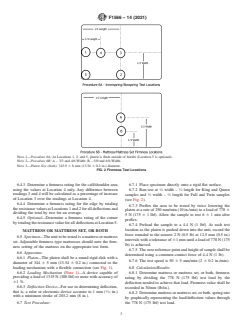
6.3.2 At each specimen location as shown in Fig. 2 Proce-
dure 2A with the platen applied, the zero reference point shall
4.4 One or more of the test methods shall be used separately
be determined using common contact force of 4.4 N (1 lb).
or in combination to provide for appropriate evaluations.
6.3.3 Run tests at four separate locations as shown in Fig. 2
4.5 Any variation from test procedure should be noted on
Procedure 6A. Location 5 being optional.
the appropriate test form and in the end results as notification
of variance.
INNERSPRING
6.3.4 At each test location as the platen is pushed down into
5. Conditioning
the unit, measure the force rounded to the nearest 2 N (0.5 lb)
5.1 Before testing, condition units for a minimum of8hat
at depths of 12.5, 25, 38, 50, 63, and 76 mm (0.5, 1, 1.5, 2, 2.5,
23 6 2.8°C (73.4 6 5°F) in a flat position.
and 3 in.) with a tolerance of 61mm(6 0.04 in.) from the top
surface of the innerspring unit.
6. Firmness Rating
FLEXIBLE FOUNDATION
FIRMNESS RATING FOR INNERSPRING AND
6.3.4.1 At each test location as the platen is pushed down
FLEXIBLE FOUNDATION
into the unit, measure the force rounded to the nearest 2 N (0.5
6.1 Specimen—The unit to be tested is an un-upholstered
lb) at depths of 12.5 and 25 mm (0.5 and 1 in.) with a tolerance
mattress core or flexible foundation unit. Adjustable firmness
of 61mm(6 0.04 in.) from the top surface of the flexible
type cores should note the firmness setting of the core on the
foundation.
appropriate test form.
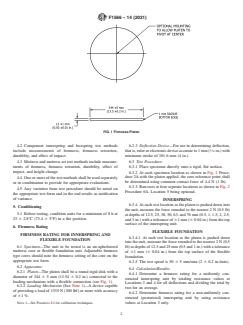
6.3.5 The test speed is 50 6 5 mm/min (2 6 0.2 in./min).
6.2 Apparatus:
6.4 Calculation/Results:
6.2.1 Platen—The platen shall be a round rigid disk with a
6.4.1 Determine a firmness rating for a uniformly con-
diameter of 344 6 5 mm (13.54 6 0.2 in.) connected to the
structed innerspring unit by totaling resistance values at
loading mechanism with a flexible connection (see Fig. 1).
Locations 3 and 4 for all deflections and dividing the total by
6.2.2 Loading Mechanism (See Note 1)—A device capable
two for an average.
of providing a load of 1335 N (300 lbf) or more with accuracy
6.4.2 Determine firmness rating for a non-uniformly con-
of 61%.
structed (posturized) innerspring unit by using resistance
NOTE 1—See Practices E4 for calibration techniques. values at Location 3 only.
F1566 − 14 (2021)
NOTE 1—Procedure 6A: At Locations 1, 2, and 5, platen is flush outside of border (Location 5 is optional).
NOTE 2—Procedure 6B: A – 3/3 and 4/6 Width; B – 5/0 and 6/6 Width.
NOTE 3—Platen Size (both): 343.9 6 8 mm (13.54 6 0.2 in.) diameter.
FIG. 2 Firmness Test Locations
6.4.3 Determine a firmness rating for the calf/shoulder area 6.7.1 Place specimen directly onto a rigid flat surface.
1 1
using the values at Location 4 only. Any difference between
6.7.2 Run test at ⁄4 width – ⁄2 length for King and Queen
readings 3 and 4 will be calculated as a percentage of increase 1 1
samples and ⁄2 width – ⁄2 length for Full and Twin samples
of Location 3 over the readings at Location 4.
(see Fig. 2).
6.4.4 Determine a firmness rating for the edge by totaling
6.7.3 Preflex the area to be tested by twice lowering the
theresistancevaluesatLocations1and2foralldeflectionsand
platen at a rate of 250 mm/min (10 in./min) to a load of 778 6
dividing the total by two for an average.
5 N (175 6 1 lbf). Allow the sample to rest 6 6 1 min after
6.4.5 Optional—Determine a firmness rating of the corner
preflex.
bytotalingtheresistancevalueforalldeflectionsatLocation5.
6.7.4 Preload the sample to a 4.4 N (1 lbf). At each test
location as the platen is pushed down into the unit, record the
MATTRESS OR MATTRESS SET, OR BOTH
force rounded to the nearest 2 N (0.5 lb) at 12.5 mm (0.5 in.)
6.5 Specimen—Theunittobetestedisamattressormattress
intervals with a tolerance of 61 mm until a load of 778 N (175
set. Adjustable firmness type mattresses should note the firm-
lb) is achieved.
ness setting of the mattress on the appropriate test form.
6.7.5 The zero reference point and height of sample shall be
6.6 Apparatus:
determined using a common contact force of 4.4 N (1 lb).
6.6.1 Platen—The platen shall be a round rigid disk with a
6.7.6 The test speed is 50 6 5 mm/min (2 6 0.2 in./min).
diameter of 344 6 5 mm (13.54 6 0.2 in.) connected to the
loading mechanism with a flexible connection (see Fig. 1). 6.8 Calculation/Results:
6.6.2 Loading Mechanism (Note 1)—A device capable of
6.8.1 Determine mattress or mattress set, or both, firmness
providing a load of 1335 N (300 lbf) or more with accuracy of
rating by dividing the 778 N (175 lbf) test load by the
61%.
deflection needed to achieve that load. Firmness value shall be
6.6.3 Deflection Device—For use in determining deflection,
recorded in N/mm (lb/in.).
that is, a ruler or electronic device accurate to 1 mm ( ⁄32 in.)
6.8.2 Determinemattressormattressset,orboth,springrate
with a minimum stroke of 203.2 mm (8 in.).
by graphically representing the load/deflection values through
6.7 Test Procedure: the 778 N (175 lbf) test load.
F1566 − 14 (2021)
NOTE 1—Total Mass: 109 6 4 kg (240 6 10 lb).
FIG. 3 Roller
6.8.3 Optional—Alternate positions may be ran for com- directly over the pad and attached to the spring and wood
parative analysis. assembly,usingtechniquescommonlyacceptedbythebedding
industry.
7. Durability Test
7.1.5 For direct comparative analysis of component testing,
mattress and foundation constructions may be altered. All
INNERSPRING OR BOXSPRING, OR BOTH
compared product must be mated with a like mattress or
7.1 Specimen—Any innerspring or boxspring, or both.
foundation constructions.
7.1.1 When testing mattress componetry, innerspring, a
7.1.6 Analysis of differing mattress sets may be compared
standard upholstered foundation shall be used for the compari-
when like durability procedure is conducted.
son. Conversely, when testing a foundation unit, standard
MATTRESS OR MATTRESS SET, OR BOTH
innerspring mattresses shall be used. A 312-coil, 13-gauge,
2.34-mm (0.092-in.) diameter, tempered steel spring wire,
7.2 Specimen—Any finished mattress or mattress set.
5-turn, shall be the standard test innerspring unit and an
7.3 Apparatus:
81-coil, 10-gauge, 3.4-mm (0.135-in.) diameter, tempered steel
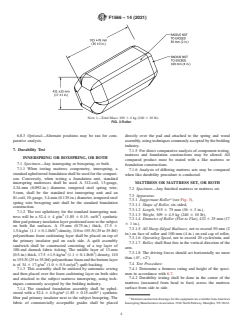
7.3.1 Juggernaut Roller (see Fig. 3),
spring wire boxspring unit shall be the standard foundation
7.3.1.1 Shape of Roller, six-sided,
construction.
7.3.1.2 Length, 915 6 75 mm (36 6 3 in.),
7.1.2 The test upholstery for the standard innerspring mat-
7.3.1.3 Weight, 109 6 4.5 kg (240 6 10 lb),
2 2
tress will be a 52.4 6 4 g/m (1.85 6 0.15- oz/ft ) synthetic
7.3.1.4 Diameter of Roller (Flat to Flat), 432 6 25 mm (17
fiberpadprimaryinsulationlayerpositionednexttothesubject
6 1 in.),
on both flat surfaces. A 19-mm (0.75-in.) thick, 17.5 6
7.3.1.5 All Sharp-Edged Radiuses, not to exceed 50 mm (2
1.5-kg/m (1.1 60.1-lb/ft )density,110to155-N(25to35-lbf)
in.) on face of roller and 100 mm (4 in.) on end cap of roller,
polyurethane foam cushioning layer shall be placed on top of
7.3.1.6 Operating Speed, not to exceed 20 cycles/min, and
the primary insulator pad on each side. A quilt assembly
7.3.1.7 Roller, shall float free in the vertical direction of the
sandwich shall be constructed consisting of a top layer of
arm.
100-end damask fabric ticking. The middle layer of 13-mm
7.3.1.8 The driving forces should act horizontally no more
3 3
(0.5-in.) thick, 17.5 61.5-kg/m (1.1 6 0.1-lb/ft ) density, 110
than (-0°, +2°).
to155-N(25to35-lbf)polyurethanefoamandthebottomlayer
2 2
7.4 Test Procedure:
is of 34 6 17-g/m (1.0 6 0.5-oz/yd ) quilt backing.
7.4.1 Determine a firmness rating and height of the speci-
7.1.3 This assembly shall be unitized by automatic sewing
men in accordance with 6.7.
and then placed over the foam cushioning layer on both sides
7.4.2 Durability testing shall be done in the center of the
and attache
...