

ASTM E2368-10(2017)
(Practice)Standard Practice for Strain Controlled Thermomechanical Fatigue Testing
General Information
- Abstract
SIGNIFICANCE AND USE
4.1 In the utilization of structural materials in elevated temperature environments, components that are susceptible to fatigue damage may experience some form of simultaneously varying thermal and mechanical forces throughout a given cycle. These conditions are often of critical concern because they combine temperature dependent and cycle dependent (fatigue) damage mechanisms with varying severity relating to the phase relationship between cyclic temperature and cyclic mechanical strain. Such effects can be found to influence the evolution of microstructure, micromechanisms of degradation, and a variety of other phenomenological processes that ultimately affect cyclic life. The strain-controlled thermomechanical fatigue test is often used to investigate the effects of simultaneously varying thermal and mechanical loadings under idealized conditions, where cyclic theoretically uniform temperature and strain fields are externally imposed and controlled throughout the gage section of the specimen.
SCOPE
1.1 This practice covers the determination of thermomechanical fatigue (TMF) properties of materials under uniaxially loaded strain-controlled conditions. A “thermomechanical” fatigue cycle is here defined as a condition where uniform temperature and strain fields over the specimen gage section are simultaneously varied and independently controlled. This practice is intended to address TMF testing performed in support of such activities as materials research and development, mechanical design, process and quality control, product performance, and failure analysis. While this practice is specific to strain-controlled testing, many sections will provide useful information for force-controlled or stress-controlled TMF testing.
1.2 This practice allows for any maximum and minimum values of temperature and mechanical strain, and temperature-mechanical strain phasing, with the restriction being that such parameters remain cyclically constant throughout the duration of the test. No restrictions are placed on environmental factors such as pressure, humidity, environmental medium, and others, provided that they are controlled throughout the test, do not cause loss of or change in specimen dimensions in time, and are detailed in the data report.
1.3 The use of this practice is limited to specimens and does not cover testing of full-scale components, structures, or consumer products.
1.4 The values stated in SI units are to be regarded as standard. No other units of measurement are included in this standard.
1.5 This international standard was developed in accordance with internationally recognized principles on standardization established in the Decision on Principles for the Development of International Standards, Guides and Recommendations issued by the World Trade Organization Technical Barriers to Trade (TBT) Committee.
- Status
- Published
- Publication Date
- 31-Oct-2017
- Technical Committee
- E08 - Fatigue and Fracture
- Drafting Committee
- E08.05 - Cyclic Deformation and Fatigue Crack Formation
Overview
ASTM E2368-10(2017), titled Standard Practice for Strain Controlled Thermomechanical Fatigue Testing, is an internationally recognized standard developed by ASTM Committee E08 on Fatigue and Fracture. This standard outlines best practices for evaluating the thermomechanical fatigue (TMF) properties of materials subjected to uniaxially loaded, strain-controlled conditions, especially in elevated temperature environments. The document provides procedures for controlled, repeatable testing of structural material specimens exposed to simultaneously varying thermal and mechanical strain fields, supporting activities such as materials research, mechanical design, product development, and failure analysis.
Key Topics
- Strain Controlled Thermomechanical Fatigue Testing: Defines a testing protocol where uniform temperature and strain fields are imposed and independently controlled, simulating service conditions experienced by materials in high-temperature operating environments.
- Specimen Requirements: Specifies design and fabrication recommendations for test specimens, including preferences for tubular designs to minimize thermal gradients and ensure uniformity during testing.
- Test Apparatus and Setup:
- Requirements for testing machines with tension-compression capability and accurate strain and temperature control.
- Use of extensometers, thermocouples, and data acquisition systems calibrated according to referenced ASTM standards.
- Testing Environment and Parameters:
- Control of environmental factors such as temperature, humidity, and medium, provided they are documented and maintained constant.
- Impose cyclically constant maximum and minimum values for strain and temperature.
- Recommendations for measuring and minimizing temperature gradients within specimens.
- Thermal Strain Compensation: Procedures for compensating thermal expansion effects to isolate true mechanical strain, ensuring data accuracy.
- Test Monitoring and Failure Criteria: Guidelines for tracking test progress, defining specimen failure by total separation, force drop, or surface crack observation.
Applications
The practices specified in ASTM E2368-10(2017) find broad application in industries where materials are exposed to fatigue in the presence of thermal cycling, such as:
- Aerospace and Power Generation: Evaluation of high-temperature alloys used in engines, turbines, and exhaust systems, where cyclic thermal and mechanical loads are common.
- Automotive Engineering: Testing of materials and components in high-stress, high-temperature zones such as exhaust manifolds, turbochargers, and cylinder heads.
- Materials Research and Development: Supporting the development and qualification of new alloys and heat-resistant materials by providing standardized TMF property data.
- Design and Quality Control: Assisting engineers in ensuring materials and products meet fatigue life requirements under simulated service conditions for safety and reliability.
- Failure Analysis: Diagnosing premature material failure in service by replicating real-world fatigue scenarios under controlled laboratory conditions.
Related Standards
ASTM E2368-10(2017) references and complements a number of other ASTM standards to ensure comprehensive and reliable testing, including:
- ASTM E3 – Guide for Preparation of Metallographic Specimens
- ASTM E4 – Practices for Force Verification of Testing Machines
- ASTM E83 – Practice for Verification and Classification of Extensometer Systems
- ASTM E111 – Test Method for Young’s Modulus, Tangent Modulus, and Chord Modulus
- ASTM E112 – Test Methods for Determining Average Grain Size
- ASTM E220 – Test Method for Calibration of Thermocouples by Comparison Techniques
- ASTM E337 – Test Method for Measuring Humidity with a Psychrometer
- ASTM E467 – Practice for Verification of Constant Amplitude Dynamic Forces
- ASTM E606 – Test Method for Strain-Controlled Fatigue Testing
- ASTM E1012 – Practice for Verification of Testing Frame and Specimen Alignment
- ASTM E1823 – Terminology Relating to Fatigue and Fracture Testing
Compliance with ASTM E2368-10(2017) encourages international harmonization in TMF testing practices, improving data comparability and supporting global trade and product development in sectors where high-temperature fatigue performance is critical. Proper implementation ensures rigorous, SI-unit based material testing aligned with recognized best practices.
Relations
- Effective Date
- 15-Feb-2024
- Effective Date
- 01-Feb-2024
- Effective Date
- 01-Feb-2020
- Effective Date
- 01-Jun-2014
- Effective Date
- 01-Nov-2013
- Effective Date
- 15-Dec-2012
- Effective Date
- 15-Nov-2012
- Effective Date
- 15-Nov-2012
- Effective Date
- 01-Sep-2012
- Effective Date
- 01-Aug-2012
- Effective Date
- 01-Jun-2012
- Effective Date
- 01-Jun-2012
- Effective Date
- 15-May-2012
- Effective Date
- 15-Mar-2012
- Effective Date
- 01-Nov-2011
Get Certified
Connect with accredited certification bodies for this standard

IMP NDT d.o.o.
Non-destructive testing services. Radiography, ultrasonic, magnetic particle, penetrant, visual inspection.
Inštitut za kovinske materiale in tehnologije
Institute of Metals and Technology. Materials testing, metallurgical analysis, NDT.
Q Techna d.o.o.
NDT and quality assurance specialist. 30+ years experience. NDT personnel certification per ISO 9712, nuclear and thermal power plant inspections, QA/
Sponsored listings
Frequently Asked Questions
ASTM E2368-10(2017) is a standard published by ASTM International. Its full title is "Standard Practice for Strain Controlled Thermomechanical Fatigue Testing". This standard covers: SIGNIFICANCE AND USE 4.1 In the utilization of structural materials in elevated temperature environments, components that are susceptible to fatigue damage may experience some form of simultaneously varying thermal and mechanical forces throughout a given cycle. These conditions are often of critical concern because they combine temperature dependent and cycle dependent (fatigue) damage mechanisms with varying severity relating to the phase relationship between cyclic temperature and cyclic mechanical strain. Such effects can be found to influence the evolution of microstructure, micromechanisms of degradation, and a variety of other phenomenological processes that ultimately affect cyclic life. The strain-controlled thermomechanical fatigue test is often used to investigate the effects of simultaneously varying thermal and mechanical loadings under idealized conditions, where cyclic theoretically uniform temperature and strain fields are externally imposed and controlled throughout the gage section of the specimen. SCOPE 1.1 This practice covers the determination of thermomechanical fatigue (TMF) properties of materials under uniaxially loaded strain-controlled conditions. A “thermomechanical” fatigue cycle is here defined as a condition where uniform temperature and strain fields over the specimen gage section are simultaneously varied and independently controlled. This practice is intended to address TMF testing performed in support of such activities as materials research and development, mechanical design, process and quality control, product performance, and failure analysis. While this practice is specific to strain-controlled testing, many sections will provide useful information for force-controlled or stress-controlled TMF testing. 1.2 This practice allows for any maximum and minimum values of temperature and mechanical strain, and temperature-mechanical strain phasing, with the restriction being that such parameters remain cyclically constant throughout the duration of the test. No restrictions are placed on environmental factors such as pressure, humidity, environmental medium, and others, provided that they are controlled throughout the test, do not cause loss of or change in specimen dimensions in time, and are detailed in the data report. 1.3 The use of this practice is limited to specimens and does not cover testing of full-scale components, structures, or consumer products. 1.4 The values stated in SI units are to be regarded as standard. No other units of measurement are included in this standard. 1.5 This international standard was developed in accordance with internationally recognized principles on standardization established in the Decision on Principles for the Development of International Standards, Guides and Recommendations issued by the World Trade Organization Technical Barriers to Trade (TBT) Committee.
SIGNIFICANCE AND USE 4.1 In the utilization of structural materials in elevated temperature environments, components that are susceptible to fatigue damage may experience some form of simultaneously varying thermal and mechanical forces throughout a given cycle. These conditions are often of critical concern because they combine temperature dependent and cycle dependent (fatigue) damage mechanisms with varying severity relating to the phase relationship between cyclic temperature and cyclic mechanical strain. Such effects can be found to influence the evolution of microstructure, micromechanisms of degradation, and a variety of other phenomenological processes that ultimately affect cyclic life. The strain-controlled thermomechanical fatigue test is often used to investigate the effects of simultaneously varying thermal and mechanical loadings under idealized conditions, where cyclic theoretically uniform temperature and strain fields are externally imposed and controlled throughout the gage section of the specimen. SCOPE 1.1 This practice covers the determination of thermomechanical fatigue (TMF) properties of materials under uniaxially loaded strain-controlled conditions. A “thermomechanical” fatigue cycle is here defined as a condition where uniform temperature and strain fields over the specimen gage section are simultaneously varied and independently controlled. This practice is intended to address TMF testing performed in support of such activities as materials research and development, mechanical design, process and quality control, product performance, and failure analysis. While this practice is specific to strain-controlled testing, many sections will provide useful information for force-controlled or stress-controlled TMF testing. 1.2 This practice allows for any maximum and minimum values of temperature and mechanical strain, and temperature-mechanical strain phasing, with the restriction being that such parameters remain cyclically constant throughout the duration of the test. No restrictions are placed on environmental factors such as pressure, humidity, environmental medium, and others, provided that they are controlled throughout the test, do not cause loss of or change in specimen dimensions in time, and are detailed in the data report. 1.3 The use of this practice is limited to specimens and does not cover testing of full-scale components, structures, or consumer products. 1.4 The values stated in SI units are to be regarded as standard. No other units of measurement are included in this standard. 1.5 This international standard was developed in accordance with internationally recognized principles on standardization established in the Decision on Principles for the Development of International Standards, Guides and Recommendations issued by the World Trade Organization Technical Barriers to Trade (TBT) Committee.
ASTM E2368-10(2017) is classified under the following ICS (International Classification for Standards) categories: 19.060 - Mechanical testing. The ICS classification helps identify the subject area and facilitates finding related standards.
ASTM E2368-10(2017) has the following relationships with other standards: It is inter standard links to ASTM E1823-24a, ASTM E1823-24, ASTM E1823-20, ASTM E4-14, ASTM E220-13, ASTM E1823-12e, ASTM E1823-12d, ASTM E112-12, ASTM E1823-12c, ASTM E1823-12b, ASTM E1012-12e1, ASTM E1012-12, ASTM E1823-12a, ASTM E1823-12, ASTM E467-08e1. Understanding these relationships helps ensure you are using the most current and applicable version of the standard.
ASTM E2368-10(2017) is available in PDF format for immediate download after purchase. The document can be added to your cart and obtained through the secure checkout process. Digital delivery ensures instant access to the complete standard document.
Standards Content (Sample)
This international standard was developed in accordance with internationally recognized principles on standardization established in the Decision on Principles for the
Development of International Standards, Guides and Recommendations issued by the World Trade Organization Technical Barriers to Trade (TBT) Committee.
Designation: E2368 − 10 (Reapproved 2017)
Standard Practice for
Strain Controlled Thermomechanical Fatigue Testing
This standard is issued under the fixed designation E2368; the number immediately following the designation indicates the year of
original adoption or, in the case of revision, the year of last revision. A number in parentheses indicates the year of last reapproval. A
superscript epsilon (´) indicates an editorial change since the last revision or reapproval.
1. Scope 2. Referenced Documents
1.1 This practice covers the determination of thermome- 2.1 ASTM Standards:
E3 Guide for Preparation of Metallographic Specimens
chanicalfatigue(TMF)propertiesofmaterialsunderuniaxially
E4 Practices for Force Verification of Testing Machines
loaded strain-controlled conditions. A “thermomechanical”
E83 Practice for Verification and Classification of Exten-
fatigue cycle is here defined as a condition where uniform
someter Systems
temperature and strain fields over the specimen gage section
E111 Test Method for Young’s Modulus, Tangent Modulus,
are simultaneously varied and independently controlled. This
and Chord Modulus
practice is intended to address TMF testing performed in
E112 Test Methods for Determining Average Grain Size
support of such activities as materials research and
E220 Test Method for Calibration of Thermocouples By
development, mechanical design, process and quality control,
Comparison Techniques
product performance, and failure analysis. While this practice
E337 Test Method for Measuring Humidity with a Psy-
is specific to strain-controlled testing, many sections will
chrometer (the Measurement of Wet- and Dry-Bulb Tem-
provide useful information for force-controlled or stress-
peratures)
controlled TMF testing.
E467 Practice for Verification of Constant Amplitude Dy-
1.2 This practice allows for any maximum and minimum
namic Forces in an Axial Fatigue Testing System
values of temperature and mechanical strain, and temperature-
E606 Test Method for Strain-Controlled Fatigue Testing
mechanical strain phasing, with the restriction being that such
E1012 Practice for Verification of Testing Frame and Speci-
parameters remain cyclically constant throughout the duration
men Alignment Under Tensile and Compressive Axial
of the test. No restrictions are placed on environmental factors
Force Application
such as pressure, humidity, environmental medium, and others,
E1823 TerminologyRelatingtoFatigueandFractureTesting
provided that they are controlled throughout the test, do not
cause loss of or change in specimen dimensions in time, and
3. Terminology
are detailed in the data report.
3.1 The definitions in this practice are in accordance with
1.3 The use of this practice is limited to specimens and does
definitions given in Terminology E1823 unless otherwise
not cover testing of full-scale components, structures, or
stated.
consumer products.
3.2 Definitions:
1.4 The values stated in SI units are to be regarded as
3.2.1 Additional definitions are as follows:
standard. No other units of measurement are included in this
3.2.2 stress, σ—stressisdefinedhereintobetheengineering
standard.
stress, which is the ratio of force, P, to specimen original cross
sectional area, A:
1.5 This international standard was developed in accor-
dance with internationally recognized principles on standard-
σ 5 P/A (1)
ization established in the Decision on Principles for the
The area, A, is that measured in an unloaded condition at
Development of International Standards, Guides and Recom-
room temperature. See 7.2 for temperature state implications.
mendations issued by the World Trade Organization Technical
Barriers to Trade (TBT) Committee. 3.2.3 coeffıcient of thermal expansion, α—the fractional
change in free expansion strain for a unit change in
temperature, as measured on the test specimen.
This practice is under the jurisdiction ofASTM Committee E08 on Fatigue and
Fracture and is the direct responsibility of Subcommittee E08.05 on Cyclic
Deformation and Fatigue Crack Formation. For referenced ASTM standards, visit the ASTM website, www.astm.org, or
Current edition approved Nov. 1, 2017. Published December 2017. Originally contact ASTM Customer Service at service@astm.org. For Annual Book of ASTM
ε1
approved in 2004. Last previous edition approved in 2010 as E2368–10 . DOI: Standards volume information, refer to the standard’s Document Summary page on
10.1520/E2368-10R17. the ASTM website.
Copyright © ASTM International, 100 Barr Harbor Drive, PO Box C700, West Conshohocken, PA 19428-2959. United States
E2368 − 10 (2017)
3.2.4 total strain, ε—the strain component measured on the idealized conditions, where cyclic theoretically uniform tem-
t
test specimen, and is the sum of the thermal strain and the perature and strain fields are externally imposed and controlled
mechanical strain. throughout the gage section of the specimen.
3.2.5 thermal strain, ε —the strain component resulting
th
5. Test Apparatus
from a change in temperature under free expansion conditions
(as measured on the test specimen).
5.1 Testing Machine—All tests shall be performed in a test
system with tension-compression loading capability and veri-
ε 5 α·∆T (2)
th
fied in accordance with Practices E4 and E467.The test system
NOTE 1—For some materials, α may be nonlinear over the temperature
range of interest.
(test frame and associated fixtures) shall be in compliance with
the bending strain criteria specified in Practices E606, E1012,
3.2.6 mechanical strain, ε —the strain component resulting
m
and E467. The test system shall be able to independently
whenthefreeexpansionthermalstrain(asmeasuredonthetest
control both temperature and total strain. In addition it shall be
specimen) is subtracted from the total strain.
capable of adding the measured thermal strain to the desired
ε 5 ε 2 ε (3)
m t th
mechanical strain to obtain the total strain needed for the
3.2.7 elastic strain, ε —the strain component resulting
el
independent control.
when the stress is divided by the temperature-dependent
5.2 Gripping Fixtures—Any fixture, such as those specified
Young’s Modulus (in accordance with Test Method E111).
in Practice E606, is acceptable provided it meets the alignment
ε 5 σ/E T (4)
~ !
el
criteria specified in Practice E606, and the specimen fails
3.2.8 inelastic strain, ε —the strain component resulting
withintheuniformgagesection.Specimenswiththreadedends
in
whentheelasticstrainissubtractedfromthemechanicalstrain.
typically tend to require more effort than those with smooth
shank ends to meet the alignment criteria; for this reason,
ε 5 ε 2 ε (5)
in m el
smooth shank specimens are preferred over specimens with
3.2.9 strain ratio, Rε—the ratio of minimum mechanical
threaded ends. Fixtures used for gripping specimens shall be
strain to the maximum mechanical strain in a strain cycle.
made from a material that can withstand prolonged usage,
Rε 5 ε /ε (6)
min max particularly at high temperatures. The design of the fixtures
largely depends upon the design of the specimen. Typically, a
3.2.10 mechanical strain/temperature true phase angle,
φ—for the purpose of assessing phasing accuracy, this is combination of hydraulically-actuated collet grips and smooth
shank specimens provide good alignment and high lateral
defined as the waveform shift (expressed in degrees) between
the maximum temperature response as measured on the speci- stiffness.
men and the maximum mechanical strain response. For refer-
5.3 Force Transducer—The force transducer shall be placed
ence purpose, the angle φ is considered positive if the
in series with the load train and shall comply with the
temperature response maximum leads the mechanical strain
specifications in Practices E4 and E467.
response maximum by 180° or less, otherwise the phase angle
5.4 Extensometers—Axial deformation in the gage section
is considered to be negative.
ofthespecimenshouldbemeasuredwithanextensometer.The
3.2.11 in-phase TMF,(φ=0°)—acyclewherethemaximum
extensometers (including optical extensometers, using an ap-
value of temperature and the maximum value of mechanical
propriate calibration procedure) should qualify as Class B-2 or
strain occur at the same time (see Fig. 1a).
better in accordance with Practice E83.
3.2.12 out-of-phase (anti-phase) TMF, (φ = 180°)—a cycle
5.5 Transducer Calibration—All transducers shall be cali-
where the maximum value of temperature leads the maximum
brated in accordance with the recommendations of the respec-
value of mechanical strain by a time value equal to ⁄2 the cycle
tive manufacturers. Calibration of each transducer shall be
period (see Fig. 1b).
traceable to the National Institute of Standards andTechnology
(NIST).
4. Significance and Use
5.6 Heating Device—Specimen heating can be accom-
4.1 In the utilization of structural materials in elevated
plished by various techniques including induction, direct
temperature environments, components that are susceptible to
resistance, radiant, or forced air heating. In all such cases,
fatigue damage may experience some form of simultaneously
active specimen cooling (for example, forced air) can be used
varying thermal and mechanical forces throughout a given
to achieve desired cooling rates provided that the temperature
cycle. These conditions are often of critical concern because
related specifications in 7.4 are satisfied.
they combine temperature dependent and cycle dependent
NOTE 2—If induction is used, it is advisable to select a generator with
(fatigue) damage mechanisms with varying severity relating to
a frequency sufficiently low to minimize “skin effects” (for example,
the phase relationship between cyclic temperature and cyclic
preferential heating on the surface and near surface material with respect
to the bulk, that is dependent on RF generator frequency) on the specimen
mechanical strain. Such effects can be found to influence the
during heating.
evolution of microstructure, micromechanisms of degradation,
and a variety of other phenomenological processes that ulti- 5.7 Temperature Measurement System—The specimen tem-
mately affect cyclic life. The strain-controlled thermomechani- peratureshallbemeasuredusingthermocouplesincontactwith
cal fatigue test is often used to investigate the effects of the specimen surface in conjunction with an appropriate
simultaneouslyvaryingthermalandmechanicalloadingsunder temperature indicating device or non-contacting sensors that
E2368 − 10 (2017)
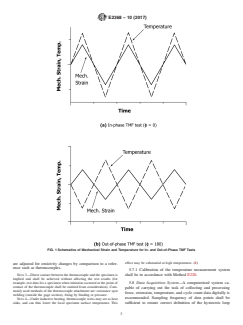
FIG. 1 Schematics of Mechanical Strain and Temperature for In- and Out-of-Phase TMF Tests
effect may be substantial at high temperatures. (1)
are adjusted for emisivity changes by comparison to a refer-
ence such as thermocouples.
5.7.1 Calibration of the temperature measurement system
NOTE 3—Direct contact between the thermocouple and the specimen is shall be in accordance with Method E220.
implied and shall be achieved without affecting the test results (for
5.8 Data Acquisition System—A computerized system ca-
example, test data for a specimen when initiation occurred at the point of
contact of the thermocouple shall be omitted from consideration). Com-
pable of carrying out the task of collecting and processing
monly used methods of the thermocouple attachment are: resistance spot
force, extension, temperature, and cycle count data digitally is
welding (outside the gage section), fixing by binding or pressure.
recommended. Sampling frequency of data points shall be
NOTE 4—Under inductive heating, thermocouple wires may act as heat
sinks, and can thus lower the local specimen surface temperature. This sufficient to ensure correct definition of the hysteresis loop
E2368 − 10 (2017)
especially in the regions of reversals. Different data collection 7. Test Procedure
strategies will affect the number of data points per cycle
7.1 LaboratoryEnvironment—Alltestsshouldbeperformed
needed, however, typically 200 points per cycle are required.
under a well-controlled laboratory environment. If testing is
performed in air, uniform ambient temperature conditions
5.9 Alternatively, an analog system capable of measuring
should be maintained throughout the duration of the test.
the same data may be used and would include:
Relative humidity may be measured in accordance with E337
5.9.1 An X-Y-Y recorder used to record force, extension,
unless it has already been determined to have little or no effect
and temperature hysteresis loops,
on thermomechanical fatigue life. If an effect is present,
5.9.2 A strip-chart recorder for several time-dependent pa-
relative humidity should be controlled. In either situation it
rameters: force, extension and temperature,
should be carefully monitored and reported.
5.9.3 A peak detector per signal, and
NOTE 7—It is strongly recommended that the relatively humidity is
controlled within the laboratory environment because of its potential to
5.9.4 A cycle counter.
affect strain gage based extensometry devices.
NOTE 5—The recorders may be replaced with storage devices capable
7.2 Measurement of Test Specimen Dimensions—The diam-
of reproducing the recorded signals either in photographic or analog form.
eter(s) of the gage section (or width and thickness for the case
These devices are necessary when the rate of recorded signals is greater
of a rectangular cross section) should be measured in at least
than the maximum slew-rate of the recorder. They allow permanent
three different locations to an accuracy of 0.0125 mm (0.0005
records to be reproduced subsequently at a lower rate.
in.) or better. Use the minimum of the values to compute the
cross-sectional area.
6. Specimens
NOTE 8—Because of the complexity of defining a gage length on the
6.1 Specimen Design Considerations—All specimen de- specimen due to the thermal expansion/contraction, it is recommended
that the gauge length be fixed to the room temperature dimension. The
signs shall be restricted to those featuring uniform axial gage
error introduced by this definition is reasonably insignificant for engineer-
sections, as these specimen designs offer a reasonable con-
ing purposes.
tinuum volume for testing. Tubular specimens are preferred to
7.3 Specimen Loading—The specimen should be loaded
solid specimen designs because they will tend to facilitate
into the test machine without subjecting it to any damaging
thermal cycling due to lower material mass and will reduce the
forces. (Forces shall not exceed the elastic limit during
potential for unwanted radial temperature gradients during
installation.) Care shall be taken not to damage the external
thermal cycling (see 7.4.5).
(and internal in the case of a tube) gage section surface while
6.2 Specimen Geometry—Specific geometries of tubular
mounting contact-type extensometers.
specimens will vary depending upon materials and testing
7.4 Temperature:
needs. One of the more critical dimensions is wall thickness,
7.4.1 The temperature command cycle (maximums, mini-
which should be large enough to avoid instabilities during
mums and rates) is to remain constant throughout the duration
cyclic loading and thin enough to maintain a uniform tempera-
of the test, unless the aim of the program is to examine the
ture across the specimen wall. For polycrystalline materials, at
effect of this parameter on the behavior of the material.
least 10 to 20 grains should be present through the thickness of
7.4.2 Through out the duration of the test, the tempera-
the wall to preserve isotropy. In order to determine the grain
ture(s) indicated by the control sensor; for example, thermo-
size of the material metallographic samples should be prepared
couple(s) shall not vary by more than 6 2 K from the
in accordance with Methods E3 and the average grain size
corresponding values of the initial temperature cycle.
should be measured according to Test Method E112. Repre-
NOTE 9—Currently, there is no standardized method for the dynamic
sentative examples of tubular specimens, which have been
calibration of temperature measurement devices. Therefore, for practical
successfully used in TMF testing, are included in Fig. 2.
purposes, all temperature related requirements specified under non-static
Further general guidance regarding specific geometric details
conditions assume that the temperature measuring system is calibrated
under static conditions. Further, it is assumed that the temperature
can be gained from the uniform gage section specimen designs
measurement system being used is sufficiently responsive so as to
presented in E606. Solid specimen designs such as those
accurately indicate the specimen temperature under the dynamic condi-
presented in Practice E606 are also permitted. However, care
tions selected for the thermomechanical cycle.
shallbetakentoensurethatradialtemperaturegradientsduring
7.4.3 The maximum allowable axial temperature gradient
thermal cycling are not excessive; see 7.4.4 and associated
over the gage section at any given instant in time within the
note.
cycle shall be the greater of:
NOTE 6—For tubular specimens, wall thicknesses (WT) and outer
61% 3T K (7)
max,
diameters(OD)thatfallinthefollowingrangeareoftenfoundacceptable:
5
or
6.3 Specimen Fabrication—Theprocedureusedformachin-
63K
ingsolidandtubularspecimensshallmeetallthespecifications
documented inAppendix X3 of Practice E606. In addition, the where T is the maximum cyclic temperature given in K
max
bore of the tubular specimen should be honed to inhibit fatigue and measured under dynamic conditions.The maximum allow-
crack nucleation from machining anomalies on the inner able transverse temperature gradient over the gage section at
surface of the specimen. any given instant time within the cycle shall be the greater of:
E2368 − 10 (2017)
NOTE 1—All dimensions in mm.
NOTE2—ThesearerepresentativedrawingsofspecimensthathavebeenusedinTMFstudies,andNOTfinisheddrawingsformachinesshoppurposes.
FIG. 2 Samples of Thin-Walled Tubular Specimens for TMF Testing
should be measured by attaching thermocouples to inside and outside
61% 3T K (8)
max,
surfaces at the same axial location. When using solid specimens, a
verification sample should be drilled out, removing as little material as
or
possible so as to enable a thermocouple to be mounted internally. The
57·K
gradients should be restricted to those specified for the axial gage section.
Where T is the maximum cyclic temperature given in K
max The interested reader is referred to (2) for additional background on the
and measured under dynamic conditions.
problems and practical bounds for axial and radial/transverse gradients.
NOTE 10—It is advisable to also examine and restrict the dynamic
7.4.4 The axial temperature gradient should be measured
temperaturegradientsexistingthroughthethicknessofthesample(thatis,
and adjusted under dynamic, thermal cycling conditions with
radial gradients) within the axial gage section. Such gradients are of
particular concern when rapid temperature rates are used. This gradient the specimen at zero force prior to the commencement of
E2368 − 10 (2017)
thermomechanical loading. The thermal cycle to be used (typically, one for the heating portion of the cycle and one for
duringexaminationandrefinementofthegagesectiongradient the cooling) where temperature is the independent variable.
should be identical to that used for the thermomechanical The function(s) can then be used to calculate the compensation
cycle. strain for any measured temperature during the thermome-
chanical fatigue test.
7.4.5 One measure of the accuracy and uniformity of the
cyclic temperature control can be associated with the amount
NOTE 11—It is generally not sufficiently accurate to take the free
of hysteresis in the resulting ε response when the specimen is
th expansion thermal strain range, divide it into equal time- or temperature-
maintained at zero force. Ideally, no hysteresis should exist.
based increments, and use this constant increment for subsequent com-
pensation calculations. This approach does not sufficiently account for a
The ε hysteresisexistingatanygiventemperaturepointinthe
th
nonlinear thermal expansion (α) and further does not account for potential
cycle under zero force conditions shall be no greater than 5 %
temperature lags experienced during reversals. The method described in
of the thermal ε induced.
range
7.6.3.2 will minimize damage to the specim
...