

ASTM F2216-17a
(Specification)Standard Specification for Selectorized Strength Equipment
General Information
- Abstract
ABSTRACT
This specification establishes guidelines for the design and manufacture of selectorized strength equipment. It is the intent of this specification to specify products for use by individuals age 12 and above. Selectorized strength training equipment shall be stable in the unloaded, intrinsically, and extrinsically loaded conditions. Tests for compliance to the general requirements will be conducted in accordance with the specified requirements.
SCOPE
1.1 This specification establishes parameters for the design and manufacture of selectorized strength training equipment as defined in 3.1.
1.2 It is intended that these fitness products be used in an indoor setting or environment.
1.3 It is the intent of this standard to specify fitness products for use only by individuals age 13 and older.
1.4 This standard is to be used in conjunction with Specification F2276, Test Methods F2571, and Test Method F2277.
1.5 This standard takes precedence over Specification F2276 and Test Methods F2571 in areas that are specific or unique to selectorized strength training equipment.
1.6 This specification2 establishes additional requirements for the design of commercial fitness equipment for use by people with functional limitations or impairments.
1.7 The values stated in SI units are to be regarded as the standard. The values in parentheses are for information only.
1.8 This standard does not purport to address all of the safety concerns, if any, associated with its use. It is the responsibility of the user of this standard to establish appropriate safety, health, and environmental practices and determine the applicability of regulatory limitations prior to use.
1.9 This international standard was developed in accordance with internationally recognized principles on standardization established in the Decision on Principles for the Development of International Standards, Guides and Recommendations issued by the World Trade Organization Technical Barriers to Trade (TBT) Committee.
- Status
- Published
- Publication Date
- 30-Nov-2017
- Technical Committee
- F08 - Sports Equipment, Playing Surfaces, and Facilities
- Drafting Committee
- F08.30 - Fitness Products
Overview
ASTM F2216-17a: Standard Specification for Selectorized Strength Equipment establishes comprehensive requirements for the design, construction, labeling, and instructions associated with selectorized strength training machines. These machines, used primarily in indoor gym and fitness environments, enable users to easily select varying resistance levels to perform strength exercises. ASTM F2216-17a is intended to enhance safety, inclusivity, and reliability for users aged 13 and above, including those with functional limitations or impairments. The standard supports manufacturers, commercial facilities, and home users by promoting best practices, reducing injury risks, and ensuring that equipment is accessible and robust.
Key Topics
- Design and Construction: Specifies requirements to ensure stability and proper function when selectorized strength equipment is unloaded or loaded, including the endurance of load transmission components (ropes, belts, chains), positive retention of weight selector pins, and provision of start position assist mechanisms when necessary.
- Entrapment Prevention: Addresses the design to prevent catch, shear, or pull-in points within reach or sight of the user, minimizing finger and hand injury risks.
- Weight Stack Enclosures: Details when and how weight stacks should be enclosed, depending on their placement relative to the user, to prevent unauthorized or accidental access.
- Accessibility and Universal Design: Introduces additional requirements so that commercial fitness equipment can be used by people with disabilities, including adjustable starting positions, accessible handgrip locations, and stable foot support provisions.
- Labeling and Instructions: Mandates that clear instructions, operational warnings, and safety labels are provided and comply with relevant safety signage standards.
- Testing and Documentation: Requires that all equipment is tested for compliance using specified methods and accompanied by detailed user manuals covering assembly, installation, safe operation, and maintenance.
Applications
Selectorized strength equipment manufactured and assessed according to ASTM F2216-17a is widely used in:
- Commercial Gyms and Fitness Centers: Ensures robust, safe, and inclusive equipment for diverse user bases, including individuals with disabilities.
- Rehabilitation Facilities: The standard's universal design provisions make equipment suitable for post-injury therapy and accessible to users with functional limitations.
- Schools and Community Centers: Provides clear guidance for safe usage by adolescents aged 13 and over, supporting youth fitness programs.
- Home Fitness Equipment: Distinguishes between commercial and consumer-grade machines, specifying appropriate marking and warnings to prevent misuse in a home environment.
Practical Value
- Enhanced Safety: Minimizes hazards associated with entrapment, unstable loads, and improper configuration.
- User Guidance: Mandates comprehensive user and maintenance manuals, installation, and use instructions to promote correct and safe operation.
- Inclusive Design: Promotes fitness opportunities for users of all abilities with specific accessibility criteria.
- Reliability and Longevity: Specifies endurance testing and material requirements to ensure equipment performs safely over time.
Related Standards
ASTM F2216-17a is closely linked to several additional standards to provide robust, holistic guidance:
- ASTM F2276: Specification for Fitness Equipment
- ASTM F2571: Test Methods for Fitness Equipment
- ASTM F2277: Test Methods for Selectorized Strength Equipment
- ASTM F1749: Specification for Fitness Equipment and Fitness Facility Safety Signage and Labels
- ASTM F3021: Specification for Universal Design of Fitness Equipment for Inclusive Use by Persons with Functional Limitations and Impairments
These standards collectively ensure that fitness equipment is safe, accessible, and clearly labeled, supporting manufacturers, facility operators, and end-users in meeting global expectations for quality and safety in the fitness industry.
Keywords: ASTM F2216-17a, selectorized strength equipment, fitness equipment standard, gym equipment safety, universal design, accessible fitness, equipment labeling, injury prevention, commercial strength machines, fitness standards.
Relations
- Effective Date
- 01-Dec-2017
- Effective Date
- 15-Nov-2023
- Effective Date
- 01-May-2020
- Effective Date
- 15-May-2017
- Effective Date
- 01-Apr-2017
- Effective Date
- 01-Oct-2016
- Effective Date
- 01-Apr-2015
- Effective Date
- 01-Apr-2015
- Effective Date
- 01-Sep-2014
- Effective Date
- 01-Jun-2013
- Effective Date
- 01-Mar-2012
- Effective Date
- 01-Feb-2010
- Effective Date
- 01-Feb-2010
- Effective Date
- 15-Nov-2009
- Effective Date
- 01-Jun-2009
Get Certified
Connect with accredited certification bodies for this standard

BSMI (Bureau of Standards, Metrology and Inspection)
Taiwan's standards and inspection authority.
Sponsored listings
Frequently Asked Questions
ASTM F2216-17a is a technical specification published by ASTM International. Its full title is "Standard Specification for Selectorized Strength Equipment". This standard covers: ABSTRACT This specification establishes guidelines for the design and manufacture of selectorized strength equipment. It is the intent of this specification to specify products for use by individuals age 12 and above. Selectorized strength training equipment shall be stable in the unloaded, intrinsically, and extrinsically loaded conditions. Tests for compliance to the general requirements will be conducted in accordance with the specified requirements. SCOPE 1.1 This specification establishes parameters for the design and manufacture of selectorized strength training equipment as defined in 3.1. 1.2 It is intended that these fitness products be used in an indoor setting or environment. 1.3 It is the intent of this standard to specify fitness products for use only by individuals age 13 and older. 1.4 This standard is to be used in conjunction with Specification F2276, Test Methods F2571, and Test Method F2277. 1.5 This standard takes precedence over Specification F2276 and Test Methods F2571 in areas that are specific or unique to selectorized strength training equipment. 1.6 This specification2 establishes additional requirements for the design of commercial fitness equipment for use by people with functional limitations or impairments. 1.7 The values stated in SI units are to be regarded as the standard. The values in parentheses are for information only. 1.8 This standard does not purport to address all of the safety concerns, if any, associated with its use. It is the responsibility of the user of this standard to establish appropriate safety, health, and environmental practices and determine the applicability of regulatory limitations prior to use. 1.9 This international standard was developed in accordance with internationally recognized principles on standardization established in the Decision on Principles for the Development of International Standards, Guides and Recommendations issued by the World Trade Organization Technical Barriers to Trade (TBT) Committee.
ABSTRACT This specification establishes guidelines for the design and manufacture of selectorized strength equipment. It is the intent of this specification to specify products for use by individuals age 12 and above. Selectorized strength training equipment shall be stable in the unloaded, intrinsically, and extrinsically loaded conditions. Tests for compliance to the general requirements will be conducted in accordance with the specified requirements. SCOPE 1.1 This specification establishes parameters for the design and manufacture of selectorized strength training equipment as defined in 3.1. 1.2 It is intended that these fitness products be used in an indoor setting or environment. 1.3 It is the intent of this standard to specify fitness products for use only by individuals age 13 and older. 1.4 This standard is to be used in conjunction with Specification F2276, Test Methods F2571, and Test Method F2277. 1.5 This standard takes precedence over Specification F2276 and Test Methods F2571 in areas that are specific or unique to selectorized strength training equipment. 1.6 This specification2 establishes additional requirements for the design of commercial fitness equipment for use by people with functional limitations or impairments. 1.7 The values stated in SI units are to be regarded as the standard. The values in parentheses are for information only. 1.8 This standard does not purport to address all of the safety concerns, if any, associated with its use. It is the responsibility of the user of this standard to establish appropriate safety, health, and environmental practices and determine the applicability of regulatory limitations prior to use. 1.9 This international standard was developed in accordance with internationally recognized principles on standardization established in the Decision on Principles for the Development of International Standards, Guides and Recommendations issued by the World Trade Organization Technical Barriers to Trade (TBT) Committee.
ASTM F2216-17a is classified under the following ICS (International Classification for Standards) categories: 17.020 - Metrology and measurement in general. The ICS classification helps identify the subject area and facilitates finding related standards.
ASTM F2216-17a has the following relationships with other standards: It is inter standard links to ASTM F2216-17, ASTM F3021-23, ASTM F1749-15(2020), ASTM F2277-17, ASTM F3021-17, ASTM F3021-16, ASTM F1749-15, ASTM F3021-15, ASTM F3021-14, ASTM F3021-13, ASTM F2277-12, ASTM F2276-10, ASTM F2277-03(2010), ASTM F2571-09, ASTM F1749-09. Understanding these relationships helps ensure you are using the most current and applicable version of the standard.
ASTM F2216-17a is available in PDF format for immediate download after purchase. The document can be added to your cart and obtained through the secure checkout process. Digital delivery ensures instant access to the complete standard document.
Standards Content (Sample)
This international standard was developed in accordance with internationally recognized principles on standardization established in the Decision on Principles for the
Development of International Standards, Guides and Recommendations issued by the World Trade Organization Technical Barriers to Trade (TBT) Committee.
Designation:F2216 −17a An American National Standard
Standard Specification for
Selectorized Strength Equipment
This standard is issued under the fixed designation F2216; the number immediately following the designation indicates the year of
original adoption or, in the case of revision, the year of last revision. A number in parentheses indicates the year of last reapproval. A
superscript epsilon (´) indicates an editorial change since the last revision or reapproval.
INTRODUCTION
The goal of this specification is to promote proper design and manufacturing practices for
selectorized strength training equipment.Through these specifications, this specification aims to assist
designers and manufactures in reducing the possibility of injury when these products are used in
accordance with the operational instructions.
The equipment user must recognize, however, that a standard alone will not necessarily prevent
injuries. Like other physical activities, exercise involving selectorized strength training equipment
involvestheriskofinjury,particularlyiftheequipmentisusedimproperlyornotproperlymaintained.
Inaddition,userswithphysicallimitationsshouldseekmedicaladviceandinstructionfromthefitness
facility prior to using this equipment. Certain physical conditions or limitations may preclude some
persons from using this equipment as intended by the manufacturer, and using this equipment may
increase the risk of injury.
1. Scope 1.8 This standard does not purport to address all of the
safety concerns, if any, associated with its use. It is the
1.1 This specification establishes parameters for the design
responsibility of the user of this standard to establish appro-
and manufacture of selectorized strength training equipment as
priate safety, health, and environmental practices and deter-
defined in 3.1.
mine the applicability of regulatory limitations prior to use.
1.2 It is intended that these fitness products be used in an
1.9 This international standard was developed in accor-
indoor setting or environment.
dance with internationally recognized principles on standard-
ization established in the Decision on Principles for the
1.3 It is the intent of this standard to specify fitness products
for use only by individuals age 13 and older. Development of International Standards, Guides and Recom-
mendations issued by the World Trade Organization Technical
1.4 This standard is to be used in conjunction with Speci-
Barriers to Trade (TBT) Committee.
fication F2276, Test Methods F2571, and Test Method F2277.
1.5 This standard takes precedence over Specification
2. Referenced Documents
F2276 and Test Methods F2571 in areas that are specific or
2.1 ASTM Standards:
unique to selectorized strength training equipment.
F1749 Specification for Fitness Equipment and Fitness Fa-
1.6 This specification establishes additional requirements
cility Safety Signage and Labels
for the design of commercial fitness equipment for use by
F2276 Specification for Fitness Equipment
people with functional limitations or impairments.
F2277 TestMethodsforEvaluatingDesignandPerformance
Characteristics of Selectorized Strength Equipment
1.7 The values stated in SI units are to be regarded as the
standard. The values in parentheses are for information only. F2571 TestMethodsforEvaluatingDesignandPerformance
Characteristics of Fitness Equipment
F3021 Specification for Universal Design of Fitness Equip-
ment for Inclusive Use by Persons with Functional Limi-
This specification is under the jurisdiction ofASTM Committee F08 on Sports
tations and Impairments
Equipment, Playing Surfaces, and Facilities and is the direct responsibility of
Subcommittee F08.30 on Fitness Products.
Current edition approved Dec. 1, 2017. Published January 2018. Originally
approved in 2003. Last previous edition approved in 2017 as F2216 – 17. DOI:
10.1520/F2216-17A. For referenced ASTM standards, visit the ASTM website, www.astm.org, or
This work was funded, in part, by the Rehabilitation Engineering Research contact ASTM Customer Service at service@astm.org. For Annual Book of ASTM
Center on RecTech through the National Institute on Disability, Independent Living, Standards volume information, refer to the standard’s Document Summary page on
and Rehabilitation Research grant #90RE5009-01-00. the ASTM website.
Copyright © ASTM International, 100 Barr Harbor Drive, PO Box C700, West Conshohocken, PA 19428-2959. United States
F2216−17a
3. Terminology tions) attain the loaded starting position for the machine, then
the machine shall be provided with an assist means.
3.1 Definitions:
4.1.4 Ropes, Belts, Chains, or Other Load Transmission
3.1.1 assist means, n—mechanism that the user engages on
Components—Ropes, belts, chains, and other means, including
the machine to assist them in getting into and out of the loaded
all attachment devices (links, shackles, end fittings, and termi-
starting position.
nation means) shall not fail with a load equal to six times the
3.1.2 bilateral, adj—relating to use of both sides of the
maximum static tension developed by the machine during
body, that is, both hands, arms, or legs.
operation and shall pass the endurance guidelines set forth in
3.1.3 cam, n—rotational component controlling the resis-
4.4.1. All end terminations shall not be subjected to cyclic
tance to the user.
bending under normal machine operation as defined by the
manufacturer.
3.1.4 consumer selectorized strength equipment,
4.1.5 Pulleys—Pulleys for rope/belt drive machines shall
n—selectorized strength equipment intended for home use or
rotate freely under all extrinsic loads.
for use in a home environment.
4.1.5.1 Wire Rope Pulleys—The groove radius, r,ofthe
3.1.4.1 Discussion—Since significant differences can arise
pulley for wire rope driven machines shall meet the wire rope
between consumer and institutional selectorized strength
manufacturer’s guidelines and allow for passing of the endur-
equipment, the products must be clearly identified as not for
ance guidelines set forth in 4.4.1. The dimensions shall lie
commercial use.
within the range given:
3.1.5 field of view, n—field of view of the user defined by an
C C
arc of 150°. Seventy-five degrees on each side of the user’s
d d
15%to 115% (1)
midline (sagittal plane). 2 2
3.1.6 foot support, n—machine component(s) contacting the
with C /2 + 10 % being the optimum. C is defined as the
d d
feet during operation, entry, and exit from the machine.
nominal wire rope diameter including coating. The tread
diameter, d, of the pulley shall be a minimum of 18 times
3.1.7 institutional selectorized strength equipment,
greater than the bare wire rope diameter (without coating). See
n—strength equipment intended for use by numerous persons
Fig. 1.
in a commercial or institutional facility, as opposed to home
environment. 4.1.5.2 Belt Pulleys—The diameter of the pulley shall be of
sufficient size to yield a belt life meeting the parameters
3.1.8 median plane, n—plane of reference that divides the
specified in 4.4.1. Belt pulleys shall be designed to prevent
midline of the body of the user into equal right and left halves.
disengagement through the use of groove, flanges, or other
3.1.9 rope, n—for the purpose of this specification, a cord
means.
comprised of intertwisted synthetic or natural fibers or steel
4.1.6 Rope/Belt Guards—Disengagement of ropes/belts
wiresusedforthetransmittalofloadfromtheresistancemeans
shall be prevented by the provision of adequate retention
to the user means.
guards or enclosures.
3.1.10 selector pin, n—the component used to select resis-
4.2 Entrapment Points:
tance on weight based selectorized strength equipment.
4.2.1 General Comments—Unlike other machinery, selec-
3.1.11 selectorized strength equipment, n—strength equip-
torized strength equipment is fully controlled by the user of the
ment where the resistance means is an integral part of the
equipment. It is therefore assumed that the user shall take
machine and may be varied easily by the user.
responsibility for his/her actions while using the machine and
3.1.12 strength equipment, n—fitness equipment designed
can prevent the inadvertent contact with machine components
to strengthen one or more groups of muscles anaerobically.
within the user’s field of view by the user or a third party by
stopping the exercise or movement of the machine. For this
3.1.13 unilateral, adj—relating to use of one side of the
reason, the discussion of entrapment points is broken down
body, that is, one hand, arm, or leg.
into “within” and “outside” the field of view of the user.
3.1.14 user means, n—movablecomponentorassemblythat
Wherever possible, the design of movable components shall
the user contacts to perform the exercise.
avoid catch, shear, or pull-in points.
4.2.1.1 Ingeneral,thefingersarethebodycomponentsmost
4. Design and Construction Requirements
likely to be injured. The primary exception to this is weight
4.1 Construction:
stacks, or other frame components, where feet or hands, or
4.1.1 Weights—Weights shall move only when displaced
both, could also be injured. Weight stacks shall be spaced less
intentionally. Weights shall move freely along their guide
than 9.5 mm (0.375 in.) or greater than 25 mm (0.98 in.) from
means and return to the resting point.The travel of the weights
any fixed frame member. This spacing shall remain constant
shall be controlled by the user such that no uncontrolled
through the travel range of the weight stack. Weight stack to
pendulum swing shall occur.
frame spacing greater than 60 mm (2.36 in.) is exempt from
4.1.2 Weight Selector Pin—Weight selector pins shall be
this requirement. Weight stacks shall be spaced at least 60 mm
fitted with a positive retention means. (2.36 in.) from the base frame of the machine. Strength
4.1.3 Starting Position Assist—If the user cannot (after equipment that includes weight stack enclosures designed in
adjusting the machine according to the manufacturer’s instruc- accordance with 4.3 as a permanent feature of the machine are
F2216−17a
FIG. 1Wire Rope Pulley Profile
exempt from this requirement, provided that the enclosure machine, then the spacing shall be greater than 25 mm (0.98
extends past the rest position of the bottom weight plate. in.)orlessthan9.5mm(0.375in.).Guardingshallbeprovided
4.2.1.2 The user means or other moving components, or if the design does not allow the above dimensions to be met.
both, shall not pass within 60 mm (2.36 in.) of any other fixed 4.2.3 Within the Field of View and Within Reach of the
or moving component, including the moving weight stack and User—If distances do not conform to those specified in 4.2.2,
frame, during normal operation of the machine, as defined in the components shall be guarded or enclosed.
the instructions provided by the manufacturer. Mechanical 4.2.4 Within the Field of View and Outside the Reach of the
stopsaregenerallyprovidedatoneorbothextremesoftheuser User—Moving components within the user’s field of view but
means range of travel. Since the user means will contact the accessible only to a third party shall not be located within 25
stops at these locations, they are excluded from the clearance mm (0.98 in.) of any other moving or fixed component.
requirements. However, if the stop is physically part of the Alternatively, such points can be less than 9.5 mm (0.375 in.)
moving user means, then it shall pass no closer than 60 mm from any other moving or fixed component if the spacing
(2.36 in.) to any fixed frame members throughout its range of between the components remains constant throughout the
travel. range of movement of the machine.
4.2.1.3 If the machine framework or the user’s body 4.2.5 Pull-In Points—Finger pull-in occurs when the spac-
placement, while using the machine in accordance with the ing between the fixed and rotating component is less than 25
manufacturer’s instructions, prevents the uncontrolled access mm (0.98 in.) or when the angle between the fixed guard and
of a third party into the area of concern, then guarding is not the belt or rope is less than 50°, or both (see Fig. 2). For ropes
required. For this exemption, the user’s body must prevent and pulleys or ropes and cams, pull-in will occur during the
access throughout the entire exercise range of motion. portion of the exercise stroke that the rope wraps onto the
4.2.2 Outside the Field of View—To a height of 1800 mm rotating element or passes into the guard. This can occur on
(70.8 in.), the distance between movable components or both sides of a pulley or guard as shown in Fig. 2 and Fig. 3.
between a movable and fixed component shall be at least 60 Fig. 4 illustrates a circular pulley or cam guard. To achieve a
mm(2.36in.)whenbodypartsotherthanthefingersareatrisk. pull-in angle greater than 50°, the guard radius G shall be
r
This dimension may be reduced to no less than 25 mm (0.98 calculated using the equation shown in Fig. 4.
in.) when only the fingers are at risk. If the spacing between 4.2.5.1 Outside the Field of View—Pull-in points up to a
moving components or between fixed and moving components heightof1800mm(70.8in.)shallbeguardedorspacedgreater
remains constant throughout the range of motion of the than 25 mm (0.98 in.) apart so that the user’s or third party’s
F2216−17a
FIG. 2Guarding of Pull-In Points—Unguarded
fingers, when extended, cannot be caught between the compo- theusercancontrolthemotionofthemachineandthusprevent
nents (see Fig. 2). Rope, belt, or rope driven machines where
any inadvertent contact with a third party. A site specific label
the pressure between the rope/belt and the cam or pulley is less
shall be present in the immediate location of the pull-in point,
than 90 N/cm (131 psi) are excluded from this requirement.
alerting the user or a third party to the potential for injury and
4.2.5.2 Within the Field of View—Pull-inpointswithinreach
to stay clear of the area. Rope or belt driven machines where
of the user when in the exercise position shall be guarded so
the pressure between the rope/belt and the cam or pulley is less
that the user’s fingers cannot be caught between the compo-
than 90 N/cm (131 psi) are excluded from the requirements of
nents. Pull-in points within the field of view of the user, during
4.2.5.1 and 4.2.5.2.
the entire range of motion of the exercise being performed, but
4.3 Weight Stack Enclosures:
accessible only to a third party, need not be guarded because
F2216−17a
FIG. 3Guarding of Pull-In Points—Pulley Guarding
4.3.1 General—Unlike other fitness equipment, selectorized work on these sides to prevent the inadvertent access by third
strength equipment is fully controlled by the user. Stopping the parties. On the side adjacent to the user enclosures shall be
exercise or the machine’s movement permits the user to designed in accordance with 4.3.2 – 4.3.4. Fig. 5 depicts the
prevent inadvertent contact with weight stacks within the field placement possibilities of the weight stacks on selectorized
of view of the user. Weight stack enclosures may assist in strength equipment with respect to the user and a plane of
preventing uncontrolled access by third parties outside this reference through the top surface of the seat back pad.
field of view. Weight stack enclosures shall be made available 4.3.2 Weight Stack in Front of User—Whentheweightstack
as an additional option by the manufacturer to the purchaser of is in front of the user (see Fig. 6), and it is always within the
institutional selectorized strength equipment. Weight stack user’s field of view throughout the entire exercise movement,
enclosures shall be designed in accordance with the parameters the weights need not be enclosed. The user shall face the
outlined in 4.3.2 – 4.3.4. For consumer selectorized strength weights at all times during the exercise and this shall be
equipment, the manufacturer shall provide either weight stack specified in the instructions supplied by the manufacturer.
enclosures designed to the parameters detailed in 4.3.2 – 4.3.4 4.3.3 Weight Stack Behind the User—Whentheweightstack
orprovidealockoutmechanismtosecuretheweightstackand is positioned behind the user (see Fig. 7) the weights shall be
prevent inadvertent use by children. Instructions and warnings completely enclosed up to a height of 60 mm (2.36 in.) beyond
shall state that this mechanism must be secured after use of the thefurthestpossibletraveloftheweightstackasdeterminedby
machine. use of the machine in accordance with instructions supplied by
4.3.1.1 Discussion—The dimensions specified in 4.3.2 – the manufacturer. The enclosure shall extend past the rest
4.3.4 shall allow for free travel of the weights and insertion of position of the bottom weight plate. The only opening shall be
the selector pin. Compliance with these specifications, a slot no greater than 75 mm (2.95 in.) wide for the insertion
however, may not necessarily prevent children from being and operation of the weight selector pin. The horizontal
injured by moving weights. In addition, an enclosure may spacing between the open edges of the enclosure and the
block the user’s field of view of third parties including weights shall be less than 9.5 mm (0.375 in.) or greater than 25
children. As specified in 8, manufacturers shall affix warnings mm (0.98 in.).
to the machine alerting to keep children away. Multiple weight 4.3.4 Weight Stack to the Side of the User—When the
stack machines do not require guarding on the three sides weight stack is positioned to the side of the user (see Fig. 8),
furthest from the user, provided that there is sufficient frame- theamountofenclosureshallbedependentontheplacementof
F2216−17a
NOTE 1—d and C have been defined in 4.1.5.1 and 4.1.5.2.
d
FIG. 4Guarding of Pull-In Points—Guarded
the weight stack relative to the user’s field of view and the pad over 80 % of the possible range of movement (this includes all
referenceplane.Weightstacksthatarelocatedtothesideofthe belts or ropes and mechanical components in the load path).
user and extend beyond any portion of the pad reference plane 4.4.1.2 When the equipment consists of two or more sepa-
either at rest, or during the execution of the exercise (see Fig. rate functional units, each shall withstand the endurance load
8-Part A), shall be enclosed in accordance with 4.3.3. When test.When more than one function is to be tested, any common
encased only on three sides (Fig. 8-Part B), the enclosure shall components (ropes, selector pins, pulleys, and so forth) may be
meet the height guidelines of 4.3.3, and at a minimum, be flush replaced prior to commencing the next test. Multistation
with the front of the weights with the spacing being less than strength equipment may have several exercise stations sharing
9.5 mm (0.375 in.) or greater than 25 mm (0.98 in.) as shown a common frame. In this case then the frame shall withstand
in Fig. 9. Encasement of the weights is not required when the 500 000cyclesforinstitutionalmachinesand28 000cyclesfor
weight stack is within the field of view of the user (Fig. 8-Part consumer products. The frame may be replaced during the test
C) and it does not become obscured by the user or the machine period if the number of stations to be tested causes the frame
during the performance of the exercise. to experience cycles in excess of the numbers stated above.
Tests for endurance shall apply loads to the machine in the
4.4 Loading:
same manner that the machine receives loading when it is
4.4.1 Endurance Loading:
operated in accordance with the manufacturer’s operation
4.4.1.1 Institutional selectorized strength training equip-
instructions. After the test, the equipment shall be capable of
ment shall withstand 250 000 cycles at the maximum specified
normal function.
load over 80 % of the possible range of movement (this
includes all belts or ropes and mechanical components in the 4.5 Compliance—Tests for compliance to the general re-
load path). Consumer selectorized strength training equipment quirements detailed in Section 4 will be conducted in accor-
shall withstand 14 000 cycles at the maximum specified load dance with the procedures detailed in Test Method F2277.
F2216−17a
FIG. 5Possible Weight Stack Placement
FIG. 6Weights to Front of User
with disabilities in addition to those without disability.
5. Additional Universal Design Requirements to
NOTE2—IfaconflictexistswiththerequirementslistedinSpecification
Specification F3021
F3021, then the specific requirements listed in Section 5 take precedence
NOTE 1—This set of accessibility criteria is to be used in conjunction
over the requirements listed in Specification F3021.
with the specifications listed above and Specification F3021. This set of
criteria pertains only to equipment designed to be accessible to people 5.1 Access and Setup:
F2216−17a
FIG. 7Weight to Rear of User
FIG. 8Weight to Side of User
5.1.1 Adjustable or alternative start position(s), for 5.2 Seats, Sitting Surfaces, and Back Supports—Seats shall
example, multipl
...
This document is not an ASTM standard and is intended only to provide the user of an ASTM standard an indication of what changes have been made to the previous version. Because
it may not be technically possible to adequately depict all changes accurately, ASTM recommends that users consult prior editions as appropriate. In all cases only the current version
of the standard as published by ASTM is to be considered the official document.
Designation: F2216 − 17 F2216 − 17a An American National Standard
Standard Specification for
Selectorized Strength Equipment
This standard is issued under the fixed designation F2216; the number immediately following the designation indicates the year of
original adoption or, in the case of revision, the year of last revision. A number in parentheses indicates the year of last reapproval. A
superscript epsilon (´) indicates an editorial change since the last revision or reapproval.
INTRODUCTION
The goal of this specification is to promote proper design and manufacturing practices for
selectorized strength training equipment. Through these specifications, this specification aims to assist
designers and manufactures in reducing the possibility of injury when these products are used in
accordance with the operational instructions.
The equipment user must recognize, however, that a standard alone will not necessarily prevent
injuries. Like other physical activities, exercise involving selectorized strength training equipment
involves the risk of injury, particularly if the equipment is used improperly or not properly maintained.
In addition, users with physical limitations should seek medical advice and instruction from the fitness
facility prior to using this equipment. Certain physical conditions or limitations may preclude some
persons from using this equipment as intended by the manufacturer, and using this equipment may
increase the risk of injury.
1. Scope
1.1 This specification establishes parameters for the design and manufacture of selectorized strength training equipment as
defined in 3.1.
1.2 It is intended that these fitness products be used in an indoor setting or environment.
1.3 It is the intent of this standard to specify fitness products for use only by individuals age 13 and older.
1.4 This standard is to be used in conjunction with Specification F2276, Test Methods F2571, and Test Method F2277.
1.5 This standard takes precedence over Specification F2276 and Test Methods F2571 in areas that are specific or unique to
selectorized strength training equipment.
1.6 This specification establishes additional requirements for the design of commercial fitness equipment for use by people
with functional limitations or impairments.
1.7 The values stated in SI units are to be regarded as the standard. The values in parentheses are for information only.
1.8 This standard does not purport to address all of the safety concerns, if any, associated with its use. It is the responsibility
of the user of this standard to establish appropriate safety safety, health, and healthenvironmental practices and determine the
applicability of regulatory limitations prior to use.
1.9 This international standard was developed in accordance with internationally recognized principles on standardization
established in the Decision on Principles for the Development of International Standards, Guides and Recommendations issued
by the World Trade Organization Technical Barriers to Trade (TBT) Committee.
2. Referenced Documents
2.1 ASTM Standards:
F1749 Specification for Fitness Equipment and Fitness Facility Safety Signage and Labels
This specification is under the jurisdiction of ASTM Committee F08 on Sports Equipment, Playing Surfaces, and Facilities and is the direct responsibility of
Subcommittee F08.30 on Fitness Products.
Current edition approved April 1, 2017Dec. 1, 2017. Published September 2017January 2018. Originally approved in 2003. Last previous edition approved in 20122017
as F2216 – 12.F2216 – 17. DOI: 10.1520/F2216-17.10.1520/F2216-17A.
This work was funded, in part, by the Rehabilitation Engineering Research Center on RecTech through the National Institute on Disability, Independent Living, and
Rehabilitation Research grant #90RE5009-01-00.
For referenced ASTM standards, visit the ASTM website, www.astm.org, or contact ASTM Customer Service at service@astm.org. For Annual Book of ASTM Standards
volume information, refer to the standard’s Document Summary page on the ASTM website.
Copyright © ASTM International, 100 Barr Harbor Drive, PO Box C700, West Conshohocken, PA 19428-2959. United States
F2216 − 17a
F2276 Specification for Fitness Equipment
F2277 Test Methods for Evaluating Design and Performance Characteristics of Selectorized Strength Equipment
F2571 Test Methods for Evaluating Design and Performance Characteristics of Fitness Equipment
F3021 Specification for Universal Design of Fitness Equipment for Inclusive Use by Persons with Functional Limitations and
Impairments
3. Terminology
3.1 Definitions:
3.1.1 assist means, n—mechanism that the user engages on the machine to assist them in getting into and out of the loaded
starting position.
3.1.2 bilateral exercise, bilateral, n—adj—relating to exercise or stabilization during exercise using use of both sides of the
body, that is, both hands, arms, or legs.
3.1.3 cam, n—rotational component controlling the resistance to the user.
3.1.4 consumer selectorized strength equipment, n—selectorized strength equipment intended for home use or for use in a home
environment.
3.1.4.1 Discussion—
Since significant differences can arise between consumer and institutional selectorized strength equipment, the products must be
clearly identified as not for commercial use.
3.1.5 field of view, n—field of view of the user defined by an arc of 150°. Seventy-five degrees on each side of the user’s midline
(sagittal plane).
3.1.6 foot support, n—machine component(s) contacting the feet during operation, entry, and exit from the machine.
3.1.7 institutional selectorized strength equipment, n—strength equipment intended for use by numerous persons in a
commercial or institutional facility, as opposed to home environment.
3.1.8 median plane, n—plane of reference that divides the midline of the body of the user into equal right and left halves.
3.1.9 rope, n—for the purpose of this specification, a cord comprised of intertwisted synthetic or natural fibers or steel wires
used for the transmittal of load from the resistance means to the user means.
3.1.10 selector pin, n—the component used to select resistance on weight based selectorized strength equipment.
3.1.11 selectorized strength equipment, n—strength equipment where the resistance means is an integral part of the machine and
may be varied easily by the user.
3.1.12 strength equipment, n—fitness equipment designed to strengthen one or more groups of muscles anaerobically.
3.1.13 unilateral exercise, unilateral, n—adj—relating to exercise or stabilization during exercise using use of one side of the
body, that is, one hand, arm, or leg.
3.1.14 user means, n—movable component or assembly that the user contacts to perform the exercise.
4. Design and Construction Requirements
4.1 Construction:
4.1.1 Weights—Weights shall move only when displaced intentionally. Weights shall move freely along their guide means and
return to the resting point. The travel of the weights shall be controlled by the user such that no uncontrolled pendulum swing shall
occur.
4.1.2 Weight Selector Pin—Weight selector pins shall be fitted with a positive retention means.
4.1.3 Starting Position Assist—If the user cannot (after adjusting the machine according to the manufacturer’s instructions)
attain the loaded starting position for the machine, then the machine shall be provided with an assist means.
4.1.4 Ropes, Belts, Chains, or Other Load Transmission Components—Ropes, belts, chains, and other means, including all
attachment devices (links, shackles, end fittings, and termination means) shall not fail with a load equal to six times the maximum
static tension developed by the machine during operation and shall pass the endurance guidelines set forth in 4.4.1. All end
terminations shall not be subjected to cyclic bending under normal machine operation as defined by the manufacturer.
4.1.5 Pulleys—Pulleys for rope/belt drive machines shall rotate freely under all extrinsic loads.
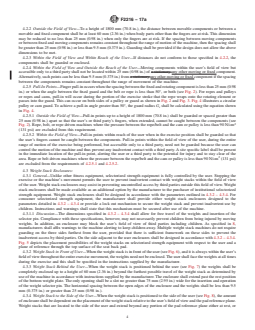
4.1.5.1 Wire Rope Pulleys—The groove radius, r, of the pulley for wire rope driven machines shall meet the wire rope
manufacturer’s guidelines and allow for passing of the endurance guidelines set forth in 4.4.1. The dimensions shall lie within the
range given:
C C
d d
15% to 115 % (1)
2 2
F2216 − 17a
with C /2 + 10 % being the optimum. C is defined as the nominal wire rope diameter including coating. The tread diameter,
d d
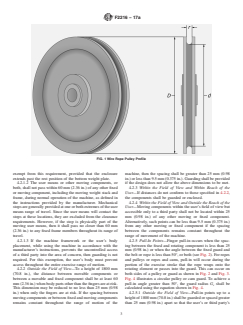
d, of the pulley shall be a minimum of 18 times greater than the bare wire rope diameter (without coating). See Fig. 1.
4.1.5.2 Belt Pulleys—The diameter of the pulley shall be of sufficient size to yield a belt life meeting the parameters specified
in 4.4.1. Belt pulleys shall be designed to prevent disengagement through the use of groove, flanges, or other means.
4.1.6 Rope/Belt Guards—Disengagement of ropes/belts shall be prevented by the provision of adequate retention guards or
enclosures.
4.2 Entrapment Points:
4.2.1 General Comments—Unlike other machinery, selectorized strength equipment is fully controlled by the user of the
equipment. It is therefore assumed that the user shall take responsibility for his/her actions while using the machine and can prevent
the inadvertent contact with machine components within the user’s field of view by the user or a third party by stopping the exercise
or movement of the machine. For this reason, the discussion of entrapment points is broken down into “within” and “outside” the
field of view of the user. Wherever possible, the design of movable components shall avoid catch, shear, or pull-in points.
4.2.1.1 In general, the fingers are the body components most likely to be injured. The primary exception to this is weight stacks,
or other frame components, where feet or hands, or both, could also be injured. Weight stacks shall be spaced less than 9.5 mm
(0.375 in.) or greater than 25 mm (0.98 in.) from any fixed frame member. This spacing shall remain constant through the travel
range of the weight stack. Weight stack to frame spacing greater than 60 mm (2.36 in.) is exempt from this requirement. Weight
stacks shall be spaced at least 60 mm (2.36 in.) from the base frame of the machine. Strength equipment that includes weight stack
enclosures designed in accordance with 4.3 as a permanent feature of the machine are exempt from this requirement, provided that
the enclosure extends past the rest position of the bottom weight plate.
4.2.1.2 The user means or other moving components, or both, shall not pass within 60 mm (2.36 in.) of any other fixed or
moving component, including the moving weight stack, or other frame components, during the stack and frame, during normal
operation of the machine, as defined in the instructions provided by the manufacturer. Mechanical stops are generally provided at
one or both extremes of the user means range of travel. Since the user means will contact the stops at these locations, they are
excluded from the clearance requirements. However, if the stop is physically part of the moving user means, then it shall pass no
closer than 2560 mm (0.98(2.36 in.) to any fixed frame members throughout its range of travel.
4.2.1.3 If the machine framework or the user’s body placement, while using the machine in accordance with the manufacturer’s
instructions, prevents the uncontrolled access of a third party into the area of concern, then guarding is not required. For this
exemption, the user’s body must prevent access throughout the entire exercise range of motion.
FIG. 1 Wire Rope Pulley Profile
F2216 − 17a
4.2.2 Outside the Field of View—To a height of 1800 mm (70.8 in.), the distance between movable components or between a
movable and fixed component shall be at least 60 mm (2.36 in.) when body parts other than the fingers are at risk. This dimension
may be reduced to no less than 25 mm (0.98 in.) when only the fingers are at risk. If the spacing between moving components
or between fixed and moving components remains constant throughout the range of motion of the machine, then the spacing shall
be greater than 25 mm (0.98 in.) or less than 9.5 mm (0.375 in.). Guarding shall be provided if the design does not allow the above
dimensions to be met.
4.2.3 Within the Field of View and Within Reach of the User—If distances do not conform to those specified in 4.2.2, the
components shall be guarded or enclosed.
4.2.4 Within the Field of View and Outside the Reach of the User—Moving components within the user’s field of view but
accessible only to a third party shall not be located within 25 mm (0.98 in.) of a stationary any other moving or fixed component.
Alternatively, such points can be less than 9.5 mm (0.375 in.) from a stationary any other moving or fixed component if the spacing
between the components remains constant throughout the range of movement of the machine.
4.2.5 Pull-In Points—Finger pull-in occurs when the spacing between the fixed and rotating component is less than 25 mm (0.98
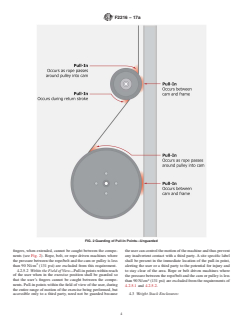
in.) or when the angle between the fixed guard and the belt or rope is less than 50°, or both (see Fig. 2). For ropes and pulleys
or ropes and cams, pull-in will occur during the portion of the exercise stroke that the rope wraps onto the rotating element or
passes into the guard. This can occur on both sides of a pulley or guard as shown in Fig. 2 and Fig. 3. Fig. 4 illustrates a circular
pulley or cam guard. To achieve a pull-in angle greater than 50°, the guard radius G shall be calculated using the equation shown
r
in Fig. 4.
4.2.5.1 Outside the Field of View—Pull-in points up to a height of 1800 mm (70.8 in.) shall be guarded or spaced greater than
25 mm (0.98 in.) apart so that the user’s or third party’s fingers, when extended, cannot be caught between the components (see
Fig. 2). Rope, belt, or rope driven machines where the pressure between the rope/belt and the cam or pulley is less than 90 N/cm
(131 psi) are excluded from this requirement.
4.2.5.2 Within the Field of View—Pull-in points within reach of the user when in the exercise position shall be guarded so that
the user’s fingers cannot be caught between the components. Pull-in points within the field of view of the user, during the entire
range of motion of the exercise being performed, but accessible only to a third party, need not be guarded because the user can
control the motion of the machine and thus prevent any inadvertent contact with a third party. A site specific label shall be present
in the immediate location of the pull-in point, alerting the user or a third party to the potential for injury and to stay clear of the
area. Rope or belt driven machines where the pressure between the rope/belt and the cam or pulley is less than 90 N/cm (131 psi)
are excluded from the requirements of 4.2.5.1 and 4.2.5.2.
4.3 Weight Stack Enclosures:
4.3.1 General—Unlike other fitness equipment, selectorized strength equipment is fully controlled by the user. Stopping the
exercise or the machine’s movement permits the user to prevent inadvertent contact with weight stacks within the field of view
of the user. Weight stack enclosures may assist in preventing uncontrolled access by third parties outside this field of view. Weight
stack enclosures shall be made available as an additional option by the manufacturer to the purchaser of institutional selectorized
strength equipment. Weight stack enclosures shall be designed in accordance with the parameters outlined in 4.3.2 – 4.3.4. For
consumer selectorized strength equipment, the manufacturer shall provide either weight stack enclosures designed to the
parameters detailed in 4.3.2 – 4.3.4 or provide a lock out mechanism to secure the weight stack and prevent inadvertent use by
children. Instructions and warnings shall state that this mechanism must be secured after use of the machine.
4.3.1.1 Discussion—The dimensions specified in 4.3.2 – 4.3.4 shall allow for free travel of the weights and insertion of the
selector pin. Compliance with these specifications, however, may not necessarily prevent children from being injured by moving
weights. In addition, an enclosure may block the user’s field of view of third parties including children. As specified in 8,
manufacturers shall affix warnings to the machine alerting to keep children away. Multiple weight stack machines do not require
guarding on the three sides furthest from the user, provided that there is sufficient framework on these sides to prevent the
inadvertent access by third parties. On the side adjacent to the user enclosures shall be designed in accordance with 4.3.2 – 4.3.4.
Fig. 5 depicts the placement possibilities of the weight stacks on selectorized strength equipment with respect to the user and a
plane of reference through the top surface of the seat back pad.
4.3.2 Weight Stack in Front of User—When the weight stack is in front of the user (see Fig. 6), and it is always within the user’s
field of view throughout the entire exercise movement, the weights need not be enclosed. The user shall face the weights at all times
during the exercise and this shall be specified in the instructions supplied by the manufacturer.
4.3.3 Weight Stack Behind the User—When the weight stack is positioned behind the user (see Fig. 7) the weights shall be
completely enclosed up to a height of 60 mm (2.36 in.) beyond the furthest possible travel of the weight stack as determined by
use of the machine in accordance with instructions supplied by the manufacturer. The enclosure shall extend past the rest position
of the bottom weight plate. The only opening shall be a slot no greater than 75 mm (2.95 in.) wide for the insertion and operation
of the weight selector pin. The horizontal spacing between the open edges of the enclosure and the weights shall be less than 9.5
mm (0.375 in.) or greater than 25 mm (0.98 in.).
4.3.4 Weight Stack to the Side of the User—When the weight stack is positioned to the side of the user (see Fig. 8), the amount
of enclosure shall be dependent on the placement of the weight stack relative to the user’s field of view and the pad reference plane.
Weight stacks that are located to the side of the user and extend beyond any portion of the pad reference plane either at rest, or
F2216 − 17a
FIG. 2 Guarding of Pull-In Points—Unguarded
during the execution of the exercise (see Fig. 8-Part A), shall be enclosed in accordance with 4.3.3. When encased only on three
sides (Fig. 8-Part B), the enclosure shall meet the height guidelines of 4.3.3, and at a minimum, be flush with the front of the
weights with the spacing being less than 9.5 mm (0.375 in.) or greater than 25 mm (0.98 in.) as shown in Fig. 9. Encasement of
the weights is not required when the weight stack is within the field of view of the user (Fig. 8-Part C) and it does not become
obscured by the user or the machine during the performance of the exercise.
4.4 Loading:
4.4.1 Endurance Loading:
4.4.1.1 Institutional selectorized strength training equipment shall withstand 250 000 cycles at the maximum specified load over
80 % of the possible range of movement (this includes all belts or ropes and mechanical components in the load path). Consumer
selectorized strength training equipment shall withstand 14 000 cycles at the maximum specified load over 80 % of the possible
range of movement (this includes all belts or ropes and mechanical components in the load path).
F2216 − 17a
FIG. 3 Guarding of Pull-In Points—Pulley Guarding
4.4.1.2 When the equipment consists of two or more separate functional units, each shall withstand the endurance load test.
When more than one function is to be tested, any common components (ropes, selector pins, pulleys, and so forth) may be replaced
prior to commencing the next test. Multistation strength equipment may have several exercise stations sharing a common frame.
In this case then the frame shall withstand 500 000 cycles for institutional machines and 28 000 cycles for consumer products. The
frame may be replaced during the test period if the number of stations to be tested causes the frame to experience cycles in excess
of the numbers stated above. Tests for endurance shall apply loads to the machine in the same manner that the machine receives
loading when it is operated in accordance with the manufacturer’s operation instructions. After the test, the equipment shall be
capable of normal function.
4.5 Compliance—Tests for compliance to the general requirements detailed in Section 4 will be conducted in accordance with
the procedures detailed in Test Method F2277.
5. Additional Universal Design Requirements to Specification F3021
NOTE 1—This set of accessibility criteria is to be used in conjunction with the specifications listed above and Specification F3021. This set of criteria
pertains only to equipment designed to be accessible to people with disabilities in addition to those without disability.
NOTE 2—If a conflict exists with the requirements listed in Specification F3021, then the specific requirements listed in Section 5 take precedence over
the requirements listed in Specification F3021.
5.1 Access and Setup:
5.1.1 Adjustable or alternative start position(s), for example, multiple grip options on hand grips or pads, shall be provided.
Positions shall be capable of being pre-set before commencing the exercise or self-adjusting. Equipment shall be adjustable across
a range of body sizes and shape.
NOTE 3—Equipment should allow the joint(s) being used to work within a non-stressed range of mot
...