

ASTM D5906-21
(Guide)Standard Guide for Measuring Horizontal Positioning During Measurements of Surface Water Depths
General Information
- Abstract
SIGNIFICANCE AND USE
5.1 This guide is intended to provide instructions for the selection of horizontal positioning equipment under a wide range of conditions encountered in measurement of water depth in surface water bodies. These conditions, that include physical conditions at the measuring site, the quality of data required, the availability of appropriate measuring equipment, and the distances over which the measurements are to be made (including cost considerations), that govern the selection process. A step-by-step procedure for obtaining horizontal position is not discussed. This guide is to be used in conjunction with standard guide on measurement of surface water depth (such as standard Practice D5173.)
SCOPE
1.1 This guide covers the selection of procedures commonly used to establish a measurement of horizontal position during investigations of surface water bodies that are as follows:
Sections
Procedure A—Manual Measurement
7 to 12
Procedure B—Optical Measurement
13 to 17
Procedure C—Electronic Measurement
18 to 27
1.1.1 The narrative specifies horizontal positioning terminology and describes manual, optical, and electronic measuring equipment and techniques.
1.2 The references cited contain information that may help in the design of a high quality measurement program.
1.3 The information provided on horizontal positioning is descriptive in nature and not intended to endorse any particular item of manufactured equipment or procedure.
1.4 This guide pertains to determining horizontal position of a depth measurement in quiescent or low velocity flow.
1.5 The values stated in inch-pound units are to be regarded as standard. The values given in parentheses are mathematical conversions to SI units that are provided for information only and are not considered standard.
1.6 This standard does not purport to address all of the safety concerns, if any, associated with its use. It is the responsibility of the user of this standard to establish appropriate safety, health, and environmental practices and determine the applicability of regulatory limitations prior to use.
1.7 This international standard was developed in accordance with internationally recognized principles on standardization established in the Decision on Principles for the Development of International Standards, Guides and Recommendations issued by the World Trade Organization Technical Barriers to Trade (TBT) Committee.
- Status
- Published
- Publication Date
- 31-Oct-2021
- Technical Committee
- D19 - Water
- Drafting Committee
- D19.07 - Sediments, Geomorphology, and Open-Channel Flow
Buy Documents
ASTM D5906-21 - Standard Guide for Measuring Horizontal Positioning During Measurements of Surface Water Depths
REDLINE ASTM D5906-21 - Standard Guide for Measuring Horizontal Positioning During Measurements of Surface Water Depths
Overview
ASTM D5906-21: Standard Guide for Measuring Horizontal Positioning During Measurements of Surface Water Depths provides comprehensive guidance on selecting appropriate horizontal positioning procedures and equipment when measuring water depths in surface water bodies. Published by ASTM International and under the jurisdiction of Committee D19 on Water, this standard is particularly valuable for hydrologists, environmental engineers, and professionals involved in water resource management who require reliable methods for determining the position of depth measurements in rivers, lakes, and reservoirs.
The guide addresses various field and project conditions-such as physical site constraints, data quality, equipment availability, required accuracy, distances involved, and budget considerations-that influence the selection and application of measurement techniques. While it does not prescribe a step-by-step process, ASTM D5906-21 details manual, optical, and electronic methods to support consistent, high-quality data collection in quiescent or low-velocity water flows.
Key Topics
ASTM D5906-21 is structured around three main measurement procedures:
Manual Measurement:
- Uses taglines, cables, measuring wheels, and shore marks for simple and cost-effective horizontal positioning.
- Suitable for sites where high-tech equipment may not be available or justifiable.
Optical Measurement:
- Employs transits, theodolites, stadia boards, and sextants.
- Offers improved precision over manual methods, making it ideal for more demanding survey requirements.
Electronic Measurement:
- Covers electronic positioning systems (EPS), including electronic distance measurements (EDM), GPS-based methods, and microwave/infrared systems.
- Enables long-distance, highly accurate data collection, digital integration, and automation.
The standard also discusses:
- Terminology and definitions specific to horizontal positioning.
- Criteria for selecting positioning class (precise, medium, or reconnaissance).
- General descriptions of positioning technologies and their field applications.
- Safety, health, and environmental guidelines for survey operations.
Applications
Practical applications of ASTM D5906-21 include:
- Hydrological Studies: Establishing precise horizontal position when measuring stream or river depths, crucial for flow calculations and sediment transport studies.
- Environmental Impact Assessments: Accurate mapping of waterbody profiles for monitoring changes or impacts due to construction, restoration, or remediation projects.
- Water Resource Management: Collecting reliable data for lake bathymetry, reservoir management, and flood risk analysis.
- Field Surveys: Supporting data consistency in multi-method and multi-crew operations, especially in varied or challenging environments.
- Project Planning: Assessing the suitability and accuracy of manual, optical, or electronic methods based on project-specific factors such as distance, required precision, and budget.
Related Standards
For comprehensive measurement programs, ASTM D5906-21 is often used in conjunction with other ASTM standards, including:
- ASTM D5173: Guide for On-Line Monitoring of Total Organic Carbon in Water by Oxidation and Detection of Resulting Carbon Dioxide.
- ASTM D5073: Practice for Depth Measurement of Surface Water.
- ASTM D1129: Terminology Relating to Water.
- ASTM D3858: Test Method for Open-Channel Flow Measurement of Water by Velocity-Area Method.
- ASTM D4410: Terminology for Fluvial Sediment.
Summary
ASTM D5906-21 serves as an essential reference for selecting the most suitable and accurate horizontal positioning technique when conducting surface water depth measurements. By aligning measurement methods with field conditions, data requirements, and operational constraints, this guide helps ensure data integrity, aids regulatory compliance, and supports informed decision-making in water resource projects. Adhering to this standard fosters best practices in modern hydrological and environmental surveying.
Relations
- Effective Date
- 01-May-2020
- Effective Date
- 01-Jan-2016
- Effective Date
- 01-Mar-2010
- Effective Date
- 01-Feb-2010
- Effective Date
- 01-Oct-2008
- Effective Date
- 15-Jun-2007
- Effective Date
- 15-Jun-2007
- Effective Date
- 01-Sep-2006
- Effective Date
- 01-Sep-2006
- Effective Date
- 15-Feb-2006
- Effective Date
- 01-Jun-2005
- Effective Date
- 01-Mar-2004
- Effective Date
- 01-Mar-2004
- Effective Date
- 10-Aug-2003
- Effective Date
- 10-Aug-2003
Buy Documents
ASTM D5906-21 - Standard Guide for Measuring Horizontal Positioning During Measurements of Surface Water Depths
REDLINE ASTM D5906-21 - Standard Guide for Measuring Horizontal Positioning During Measurements of Surface Water Depths
Get Certified
Connect with accredited certification bodies for this standard

BSMI (Bureau of Standards, Metrology and Inspection)
Taiwan's standards and inspection authority.
CIS Institut d.o.o.
Personal Protective Equipment (PPE) certification body. Notified Body NB-2890 for EU Regulation 2016/425 PPE.

Kiwa BDA Testing
Building and construction product certification.
Sponsored listings
Frequently Asked Questions
ASTM D5906-21 is a guide published by ASTM International. Its full title is "Standard Guide for Measuring Horizontal Positioning During Measurements of Surface Water Depths". This standard covers: SIGNIFICANCE AND USE 5.1 This guide is intended to provide instructions for the selection of horizontal positioning equipment under a wide range of conditions encountered in measurement of water depth in surface water bodies. These conditions, that include physical conditions at the measuring site, the quality of data required, the availability of appropriate measuring equipment, and the distances over which the measurements are to be made (including cost considerations), that govern the selection process. A step-by-step procedure for obtaining horizontal position is not discussed. This guide is to be used in conjunction with standard guide on measurement of surface water depth (such as standard Practice D5173.) SCOPE 1.1 This guide covers the selection of procedures commonly used to establish a measurement of horizontal position during investigations of surface water bodies that are as follows: Sections Procedure A—Manual Measurement 7 to 12 Procedure B—Optical Measurement 13 to 17 Procedure C—Electronic Measurement 18 to 27 1.1.1 The narrative specifies horizontal positioning terminology and describes manual, optical, and electronic measuring equipment and techniques. 1.2 The references cited contain information that may help in the design of a high quality measurement program. 1.3 The information provided on horizontal positioning is descriptive in nature and not intended to endorse any particular item of manufactured equipment or procedure. 1.4 This guide pertains to determining horizontal position of a depth measurement in quiescent or low velocity flow. 1.5 The values stated in inch-pound units are to be regarded as standard. The values given in parentheses are mathematical conversions to SI units that are provided for information only and are not considered standard. 1.6 This standard does not purport to address all of the safety concerns, if any, associated with its use. It is the responsibility of the user of this standard to establish appropriate safety, health, and environmental practices and determine the applicability of regulatory limitations prior to use. 1.7 This international standard was developed in accordance with internationally recognized principles on standardization established in the Decision on Principles for the Development of International Standards, Guides and Recommendations issued by the World Trade Organization Technical Barriers to Trade (TBT) Committee.
SIGNIFICANCE AND USE 5.1 This guide is intended to provide instructions for the selection of horizontal positioning equipment under a wide range of conditions encountered in measurement of water depth in surface water bodies. These conditions, that include physical conditions at the measuring site, the quality of data required, the availability of appropriate measuring equipment, and the distances over which the measurements are to be made (including cost considerations), that govern the selection process. A step-by-step procedure for obtaining horizontal position is not discussed. This guide is to be used in conjunction with standard guide on measurement of surface water depth (such as standard Practice D5173.) SCOPE 1.1 This guide covers the selection of procedures commonly used to establish a measurement of horizontal position during investigations of surface water bodies that are as follows: Sections Procedure A—Manual Measurement 7 to 12 Procedure B—Optical Measurement 13 to 17 Procedure C—Electronic Measurement 18 to 27 1.1.1 The narrative specifies horizontal positioning terminology and describes manual, optical, and electronic measuring equipment and techniques. 1.2 The references cited contain information that may help in the design of a high quality measurement program. 1.3 The information provided on horizontal positioning is descriptive in nature and not intended to endorse any particular item of manufactured equipment or procedure. 1.4 This guide pertains to determining horizontal position of a depth measurement in quiescent or low velocity flow. 1.5 The values stated in inch-pound units are to be regarded as standard. The values given in parentheses are mathematical conversions to SI units that are provided for information only and are not considered standard. 1.6 This standard does not purport to address all of the safety concerns, if any, associated with its use. It is the responsibility of the user of this standard to establish appropriate safety, health, and environmental practices and determine the applicability of regulatory limitations prior to use. 1.7 This international standard was developed in accordance with internationally recognized principles on standardization established in the Decision on Principles for the Development of International Standards, Guides and Recommendations issued by the World Trade Organization Technical Barriers to Trade (TBT) Committee.
ASTM D5906-21 is classified under the following ICS (International Classification for Standards) categories: 13.060.10 - Water of natural resources; 17.020 - Metrology and measurement in general. The ICS classification helps identify the subject area and facilitates finding related standards.
ASTM D5906-21 has the following relationships with other standards: It is inter standard links to ASTM D1129-13(2020)e2, ASTM D4410-16, ASTM D1129-10, ASTM D4410-10, ASTM D3858-95(2008), ASTM D5073-02(2007), ASTM D5173-97(2007), ASTM D1129-06ae1, ASTM D1129-06a, ASTM D1129-06, ASTM D4581-86(2005), ASTM D1129-04, ASTM D1129-04e1, ASTM D1129-03a, ASTM D4410-03. Understanding these relationships helps ensure you are using the most current and applicable version of the standard.
ASTM D5906-21 is available in PDF format for immediate download after purchase. The document can be added to your cart and obtained through the secure checkout process. Digital delivery ensures instant access to the complete standard document.
Standards Content (Sample)
This international standard was developed in accordance with internationally recognized principles on standardization established in the Decision on Principles for the
Development of International Standards, Guides and Recommendations issued by the World Trade Organization Technical Barriers to Trade (TBT) Committee.
Designation: D5906 − 21
Standard Guide for
Measuring Horizontal Positioning During Measurements of
Surface Water Depths
This standard is issued under the fixed designation D5906; the number immediately following the designation indicates the year of
original adoption or, in the case of revision, the year of last revision. A number in parentheses indicates the year of last reapproval. A
superscript epsilon (´) indicates an editorial change since the last revision or reapproval.
1. Scope 2. Referenced Documents
2.1 ASTM Standards:
1.1 Thisguidecoverstheselectionofprocedurescommonly
D1129 Terminology Relating to Water
used to establish a measurement of horizontal position during
D3858 Test Method for Open-Channel Flow Measurement
investigations of surface water bodies that are as follows:
of Water by Velocity-Area Method
Sections
D4410 Terminology for Fluvial Sediment
Procedure A—Manual Measurement 7 to 12
Procedure B—Optical Measurement 13 to 17
D4581 Guide for Measurement of Morphologic Character-
Procedure C—Electronic Measurement 18 to 27
istics of Surface Water Bodies (Withdrawn 2013)
1.1.1 The narrative specifies horizontal positioning termi-
D5073 Practice for Depth Measurement of Surface Water
nologyanddescribesmanual,optical,andelectronicmeasuring
D5173 Guide for On-Line Monitoring of Total Organic
equipment and techniques.
Carbon in Water by Oxidation and Detection of Resulting
Carbon Dioxide
1.2 The references cited contain information that may help
in the design of a high quality measurement program.
3. Terminology
1.3 The information provided on horizontal positioning is
3.1 Definitions:
descriptive in nature and not intended to endorse any particular
3.1.1 For definitions of terms used in this guide, refer to
item of manufactured equipment or procedure.
Terminology D1129.
1.4 Thisguidepertainstodetermininghorizontalpositionof 3.2 Definitions of Terms Specific to This Standard:
a depth measurement in quiescent or low velocity flow. 3.2.1 accuracy—refers to how close a measurement is to the
true or actual value. (See Terminology D1129.)
1.5 The values stated in inch-pound units are to be regarded
3.2.2 baseline, n—the primary reference line for use in
as standard. The values given in parentheses are mathematical
measuring azimuth angles and positioning distances.
conversions to SI units that are provided for information only
and are not considered standard.
3.2.3 continuous wave system, n—an electronic positioning
system in which the signal transmitted between the transmitter
1.6 This standard does not purport to address all of the
and responder stations travels as a wave having constant
safety concerns, if any, associated with its use. It is the
frequency and amplitude.
responsibility of the user of this standard to establish appro-
3.2.4 electronic distance measurement (EDM), n—the mea-
priate safety, health, and environmental practices and deter-
surement of distance using pulsing or phase comparison
mine the applicability of regulatory limitations prior to use.
systems.
1.7 This international standard was developed in accor-
dance with internationally recognized principles on standard-
3.2.5 electronic positioning system (EPS), n—a system that
ization established in the Decision on Principles for the receives two or more EDM to obtain a position.
Development of International Standards, Guides and Recom-
3.2.6 global positioning system (GPS), n—aglobalposition-
mendations issued by the World Trade Organization Technical
ing system (GPS) is a satellite-based EDM system used in
Barriers to Trade (TBT) Committee.
determining Cartesian coordinates (x, y, z) of a position by
means of radio signals from NAVSTAR satellites.
1 2
This guide is under the jurisdiction ofASTM Committee D19 on Water and is For referenced ASTM standards, visit the ASTM website, www.astm.org, or
the direct responsibility of Subcommittee D19.07 on Sediments, Geomorphology, contact ASTM Customer Service at service@astm.org. For Annual Book of ASTM
and Open-Channel Flow. Standards volume information, refer to the standard’s Document Summary page on
Current edition approved Nov. 1, 2021. Published June 2022. Originally the ASTM website.
approved in 1996. Last previous edition approved in 2013 as D5906 – 02 (2013). The last approved version of this historical standard is referenced on
DOI: 10.1520/D5906-22. www.astm.org.
Copyright © ASTM International, 100 Barr Harbor Drive, PO Box C700, West Conshohocken, PA 19428-2959. United States
D5906 − 21
3.2.7 horizontal control, n—a series of connected lines range of conditions encountered in measurement of water
whose azimuths and lengths have been determined by depth in surface water bodies. These conditions, that include
triangulation, trilateration, and traversing. physical conditions at the measuring site, the quality of data
required, the availability of appropriate measuring equipment,
3.2.8 line of position (LOP), n—the locus of points estab-
and the distances over which the measurements are to be made
lished along a rangeline.
(including cost considerations), that govern the selection pro-
3.2.9 precision, n—the agreement among or reproduciblity
cess.Astep-by-stepprocedureforobtaininghorizontalposition
of multiple measurements. (See Terminology D1129.)
is not discussed. This guide is to be used in conjunction with
3.2.10 pulsed wave system, n—an electronic positioning
standardguideonmeasurementofsurfacewaterdepth(suchas
system in which the signal from the transmitting station to the
standard Practice D5173.)
reflecting station travels in an electromagnetic wave pulse.
6. Horizontal Positioning Criteria
3.2.11 range, n—the distance to a point measured by
physical, optical, or electronic means. 6.1 The level of accuracy required in horizontal positioning
can be defined in three general classes:
3.2.12 range line, n—an imaginary, straight line extending
6.1.1 Class One pertains to precise positioning demanding a
across a body of water between fixed shore markings.
high degree of repeatability.
3.2.13 range line markers, n—sitepolesorotheridentifiable
6.1.2 Class Two is for medium accuracy requirements
objects used for positioning alignment on a range line.
typical of project condition studies or offshore/river hydraulic
3.2.14 shore markings, n—any object, natural or artificial,
investigations, or both.
that can be used as a reference for maintaining boat alignment
6.1.3 Class Three is for general reconnaissance investiga-
or establishing the boats position as it moves along it course.
tions requiring only approximate measurements of positions.
Examples include range line markers, sight poles, trees, power
6.1.4 Table1providesanestimateofthesuitabilitybyClass
poles, land surface features, structures, and etc.
for the different horizontal positioning discussed within this
3.2.15 site poles, n—metal or wood poles used as a sighting guide (2).
rod.
PROCEDURE A—MANUAL MEASUREMENT
3.2.16 stadia, n—telescopic instrument equipment with
horizontal hairs and used for measuring the vertical intercept
7. Scope
on a graduated vertical rod held vertically and at some distance
7.1 This procedure explains the measurement of horizontal
to and in front of the instrument.
position using manual techniques and equipment. These in-
3.2.17 total station, n—an electronic surveying instrument
clude use of tagline positioning techniques and application of
which digitally measures and displays horizontal distances and
shore marks.
vertical angles to a distant object.
7.2 Description of techniques and equipment are general in
nature and may need to be modified for use in specific field
4. Summary of Guide
conditions.
4.1 This guide includes three general procedures for deter-
mining the location or horizontal position in surveying of 8. Significance and Use
surfacewaterbodies.Thefirstdeterminespositionbyamanual
8.1 Prior to the development of optical and electronic
procedure. The equipment to perform this procedure may be
positioningequipment,manualequipmentandtechniqueswere
most readily available and most practical under certain condi-
the only means of measuring horizontal position. These tech-
tions.
niques and equipment are still widely used where precise
4.2 The second determines position by a optical procedure.
controlled measurements may be required (for example, taut
cable method), or where limitations in equipment availability,
4.3 The third determines position by a electronic procedure.
site conditions and cost considerations prohibit use of more
4.4 Horizontal control stations shall be in accordance with
modern equipment.
Third Order, Class I, Federal Geodetic Control Committee
Classification (FGCC) Standards, with traverses for such
TABLE 1 Allowable Horizontal Positioning System Error (7)
controls beginning and ending at existing first- or second-order
Estimated Positional Accuracy
stations (1).
Suitable for Survey Class
±1 ft (±1 m)
System
RMS (RMS)
5. Significance and Use
Visual range 10 to 66 (3 to 20) No No Yes
5.1 This guide is intended to provide instructions for the
intersection
Sextant angle 7to30 (2to10) No Yes Yes
selection of horizontal positioning equipment under a wide
resection
Transit/theodolite 3to16 (1to5) Yes Yes Yes
angle intersection
Available from National Oceanic and Atmospheric Administration (NOAA),
Range-azimuth 1.6to10 (0.5to3) Yes Yes Yes
14th St. and Constitution Ave., NW, Room 6217, Washington, DC 20230, http://
intersection
www.noaa.gov.
Tagline high 3to13 (1to4) Yes Yes Yes
The boldface numbers given in parentheses refer to a list of references at the frequency EPS
end of this standard.
D5906 − 21
9. Tagline Positioning Techniques normal procedure is to place a transit or theodolite on line for
this purpose. The transmit person, equipped with a two-way
9.1 Tagline positioning techniques makes use of a measur-
radio, relays alignment directions to the boat operator (also
ing line having markings at fixed intervals along its length to
equippedwithatwo-wayradio),asthelineistransportedtothe
indicate distance. These can be either a taut cable in which the
opposite bank. A power or hand winch or hand cranked reel,
line is anchored firmly at opposite banks and stretched taut, or
skid mounted on locally fabricated support assemblies, can be
a boat mounted cable in which one end of the line is firmly
attached to a tree or other firm support on shore and used to
anchoredatthebankandtheotherisattachedtoaboatwiththe
take slack out of the line and to minimize sag associated errors
linefedoutastheboatproceedsalongitscourse.Bothmethods
in distance. For safety, the reel should come equipped with a
are frequently used low cost positioning techniques. The taut
spring-loadedpinlockbrakeassembly.Buoysmaybeplacedat
cable is most commonly used for obtaining streamflow mea-
optimum locations along the line to help reduce sag as well as
surements and sediment sampling data at non-bridge locations
provide an indicator of boat alinement.
on rivers and streams, but is equally applicable for controlled
9.1.1.3 Taglines for the taut cable method are commonly
boat positioning when obtaining river or lake bed profiles for
stainless steel or galvanized 7 by 7 cable, although a fiber line
otherpurposes.Inthisregardithasprovenespeciallyusefulfor
is increasingly being used. The stainless steel lines generally
positioning on small lakes or reservoirs, usually where dis-
come pre-beaded at 2 ft intervals for the first 50 ft, at 5 ft for
tances involved are less than 1000 ft (305 m), and where sheer
the next 100 ft (30 m), and at 10-ft intervals for to the end of
walls exist at both ends of the range, or where the presence of
the line. Sizes vary in diameter with the length of the cable
densevegetationalongtheshorelineprecludesuseofopticalor
used. For a length less than 400 ft (122 m), a ⁄32 in. (0.79 mm)
electronic positioning methods. The boat mounted tagline, in
diameterlineisrecommended;forlengthsupto800ft(244m),
contrast, is much easier to set up and use since only one end of
a ⁄16 in. (1.59 mm) diameter is recommended; for greater
the line is anchored at the shore, but this method can be
lengths, the diameter should be at least ⁄8 in. (3.18 mm). The
considerably less accurate due to the increased possibility of
fiber line is normally ⁄16 in. (4.76 mm) diameter, is normally
misalignment errors.
yellow with black markings and generally comes available in
9.1.1 Taut Cable Method (Manual Procedure):
any length up to 1000 ft (305 m). It is usually pre-marked with
9.1.1.1 For the taut cable method (see Fig. 1), firmly anchor
one mark every 10 ft (3 m) and two marks every 100 ft (30 m).
theendsofthecableonbothbanks(see9.1.1.2forinstallation)
To prevent damage when attaching the tagline to a tree,
and the line then pulled as taut as possible without pulling the
connect the free end of the tagline (the end not connected to a
anchors out of the bank. This method of positioning is
reel),toa30ftlengthof ⁄32-in.(2.37mm)diametercable.One
recognized as accurate for use on streams where the flow
end of this cable should have a harness snap and the other
velocity does not exceed more than a few feet per second so
should have a pelican hook. The free end of the tagline should
that the drag induced by the flow, on any boat or other
be equipped with a sleeve and thimble, of size matching the
attachment, does not substantially deflect the line. The taut
tagline diameter (4).
cable method is time consuming when compared to other more
modern optical and electronic positioning equipment and 9.1.1.4 Attachments for holding the boat in position at a
techniques; take this into consideration when deciding on fixed location along the tag line will vary depending on the
which equipment and techniques best apply (3). specific needs of the data collection effort. Normally the
9.1.1.2 Installation of the taut cable should be done either in attachment is some form of clamp arrangement. If velocity
one of two ways: either securely anchor the cable to one bank measurements or sediment sampling is being done along with
and the line fed from a boat mounted reel as the boat proceeds the water depth measurements, the standard procedure is to
across the body of water; or securely anchor the reel to one equip the boat with a crosspiece (I-beam), normally a little
bank near the water’s edge with the loose end towed across. longer than the width of the boat, and set perpendicular to the
Shore markings can be used for visual alignment, but the boat’s centerline. The crosspiece is either clamped or bolted in
FIG. 1 Taut Cable Method
D5906 − 21
place and has guide sheaves at each end and a clamp
arrangement somewhere along the length of the crosspiece.
With the tagline fed through the sheaves, the boat can be held
in place or moved along the tagline from station to station.The
mid-point clamp permits the boat to be fixed to a one location
and not move laterally along the line as measurements are
being taken. For safety, fasten a small rope to the clamp to
permit quick release in the event of an emergency (4).
9.1.1.5 Position a standby person near the quick-release end
of the cable, to release the cable, if there is a possibility of a
boat, barge, or other large obstruction colliding with the cable.
In addition, a chase boat should also be present in traffic
FIG. 3 Calibrated Wheel (Cover Removed)
locations,towarnboatersofthecable’spresence.Forlocations
where flow velocities are high and boats and obstructions are
present upstream, it is recommended that all work boats be
proceeds along its path. Boat mounted taglines can be used
kept downstream of the cable.
over substantial distances but are not suitable for Class 1
9.1.1.6 Positions along the line are determined either
survey use unless the length of the cable is less than 1500 ft
through the use of a calibrated measuring wheel, or by keeping
(457 m) when stationary measurements are made or less than
trackofmarkingsattachedtotheline.Weight,sag,andstrength
1000 ft (305 m) if the boat is moving. Table 2 provides an
ofthelinelimititsrangetolessthan1000ft(305m).Markings
estimate of positional accuracies for different cable lengths (2).
must be clearly visible and easy to understand. The markings
The cable should be constructed of 0.059 in. (0.15 cm)
are normally crimped brass beads set at 20 ft (6 m) intervals,
diameter, steel piano wire or steel cable, and have markings
but this can vary significantly depending on the field applica-
attached that permit distance to be read by the length of line
tionandspecificmeasurementrequirements.Attachfluorescent
released from the reel. The standard guide is to use a reel with
flagging in 4 to 5 ft (1.2 to 1.5 m) lengths at 50 ft (15.2 m)
a calibrated measuring wheel and mechanical counter that
intervals along the length of the cable to assist in ease of
activates as the wheel rotates. Locate the reel in the rear of the
distance measurements. Fluorescent flagging provides the best
boat for safety and position as near as possible to the desired
visibility for all types of lighting and is recommended for use
point of measurement (that is, sounding device). If the reel and
in visually marking the cable for safety purposes.
the point of measurement do not coincide, record the distances
9.1.1.7 Begin measurements by positioning the boat near
between the two and add to the tagline measurements. Boat
the bank at a fixed mark on the cable. This initial or starting
draftshouldbelessthan1ft(0.3m)foraccuratemeasurements
mark should be determined by chain measurements from a
in shallow water areas.
surveyed control point near the water’s edge. The boat pro-
9.1.2.2 Establish positions along the boat’s path by setting
ceeds from this initial mark along the cable to the opposite
the boat on line and as near to the shore as practical. Then set
shore with a person on board calling out “fix” marks as each
the counter to zero and pull the loose end of the wire out and
marking on the line is reached (5).
fasten it to a pin or other anchoring device driven on-line near
9.1.1.8 Maintain alignment of a taut cable within at least 1
the shore. Record distance from the pin to the water’s edge on
to 2 ft (0.3 to 0.6 m) of accuracy.
a chart or notebook kept in the boat. With this done, the boat
9.1.2 Boat Mounted Tagline (Manual Procedure):
begins to proceed along its designated path. Attach styrofoam
9.1.2.1 This method (see Fig. 2, Fig. 3, and Fig. 4), also
floats to the line and dropped overboard at 100 to 300 ft (30 to
referred to as tethered piano-wire method, is similar in prin-
91 m) intervals that reduces sag by holding the wire near the
ciple to the taut cable with the distinction that only one end of
surface. Release the line from its starting point as the boat
the line is anchored at the bank. The opposite end is attached
reaches the opposite shore and retrieve it using the motor
to a reel mounted on the boat and the line is fed out as the boat
driven winch aboard the boat (6).
9.1.2.3 Specialcareshouldbemadetocertifythatthelateral
alignmentoftheboatisheldastheboatproceedsalongitspath
and that the line is held taut. The tagline method maintains
alignment through use of visual shore marks. But accuracy can
be improved appreciably with a transit or theolodite person
relaying alignment directions by a two-way radio.
9.1.2.4 If tagline markings are used in lieu of a measuring
wheel, they should be easy to see and understand to avoid
errors in determining the readings.
9.2 Calibrated Wheel (Manual Procedure):
9.2.1 A 2-ft (0.6 m) diameter calibrated measuring wheel
(seeFig.5)canbeusedwiththetautcableasareplacementfor
line markings. A counter attached to the wheel registers the
FIG. 2 Calibrated Wheel—Front Cover revolutions of the wheel as the boat moves along its prescribed
D5906 − 21
FIG. 4 Calibrated Wheel Method
TABLE 2 Allowable Tagline Positioning Procedures/Systems
10.2 The cable for the boat mounted tagline should be made
Criteria (7) 3
of galvanized, commercially available aircraft cable with ⁄32
in. (2.38 mm) outside diameter (O.D.) and seven by seven
NOTE 1—Tagline distance range limits shown for Class 1 and Class 2
surveys are contingent on the tagline being pulled clear of the water and
construction. Some cables may also come with a nylon coating
held taut during measurement. Distances for Class 1 surveys shall be
to reduce fraying typical of uncoated steel cables. The coating,
adjusted downward depending on the capabilities of the boat and
however, increases the outside diameter to ⁄8 in. (3.18 mm)
equipment used.
and reduces the length of cable that can be wound on a reel by
Estimated Positional Accuracy
about 50 %. Plastic water-ski tow cable of ⁄4 in. (6.35 mm)
±1 ft ±1 m Suitable for Survey Class
System diameter, 1 lb/100 ft weight (0.45 kg/30.5 m), is available from
RMS RMS
sporting goods stores and may also be used occasionally with
Tagline (Boat Stationary)
good success but is not recommended for use during windy
<1500 ft from baseline 1 to 3 (0.3 to 1) Yes Yes Yes
>1500 to <3000 ft 3 to 16 (1 to 5) No Yes Yes conditions because of the tendency to be deflected. The plastic
>3000 ft from baseline 16 to 164 (5 to 50 + ) No No Yes
cable has the advantage of being easily repaired in the field by
Tagline (Boat Moving)
telescoping one end into the other.
<1000 ft from baseline 3 to 9 (1 to 3) Yes Yes Yes
>1000 to <2000 ft 8 to 20 (3 to 6) No Yes Yes
>2000 from baseline 20 to 164 + (6 to 50 + ) No No Yes
11. Current Meters (Manual Procedure)
Tagline Calibration Frequency (in months) 1 6 12
Accuracy of Independent Calibration (feet) 0.1 1 5
11.1 A standard “Price current meter” suspended from a
Accuracy of Independent Calibration (meters) 0.03 0.01 1.52
boat,inwhichthepropellerbladerotatesbecauseofmovement
of the boat, can be used to measure the distance the boat has
traveled by keeping track of the accumulative revolutions of
path. Anchor the piano wire on both banks and hold taut with
the meter times a calibration constant for the mounted meter.
enough sag to permit the piano wire to encircle the wheel, but
When coupled with the sonic-sound “fix” switch, the current
provide enough friction to prevent slippage. Repair breaks that
meter can be used in a semi-automatic operation for recording
might occur in the line through the use of a compressed-sleeve
and documenting positions along the range line.
type wire splicer.
9.2.2 The procedure for the calibrated wheel method is the
12. Shore Marks (Manual Procedure)
same as that described for the taut cable, except that the
12.1 Shore marks may be used with taglines, alone in pairs,
calibrated wheel is used in lieu of markings permanently
or with optical and electronic procedures. Their function is to
attached to the line. The positioning begins with the boat
help maintain boat alignment as the boat moves along its
stationed at a fixed measured point on the line (established by
prescribed course. The boat operator can visually align the
distance measurement from a control station on shore), the
boat’s movement on target with the two or more shore marks,
counter on the wheel set to zero, and the boat’s position
or an instrument man on shore can convey instructions by
relative to this starting position measured as the boat moves
two-way radio as the boat proceeds between shore marks on
along its path.
the opposite bank. A transit works well for stadia positioning
10. Cable Reels (Manual Procedure) since the transit can be used both for alignment and stadia
measurements. Shore marks, placed in a perpendicular align-
10.1 Cable reels must be constructed of sturdy material and
ment to the boats path, can serve as an indicator of position
be equipped with a manual, electrical, or gasoline powered
and, as such, provide a good, rough measurement of position
winch, including a clutching and braking assembly. The brake
for reconnaissance surveys.
is used both for controlling rotation of the reel as the cable is
let out and to serve as a safety feature. For hand operated reels, 12.2 Accuracy in use of shore marks depends on ease of
the crank should be hinged to allow the crank to be disengaged visibility and how sharp the delineation is between the two or
from the shaft while the wire is let out and engaged for reeling moreobjectsbeingusedforlineofsight.Placetheshoremarks
in. Various devices are employed to drive a counter to register far enough apart to enable alignment to be clearly distinguish-
the amount of cable released from the reel (5). able.
D5906 − 21
FIG. 5 Tag Line
PROCEDURE B—OPTICAL MEASUREMENT AND
ALIGNMENT
13. Scope
13.1 Thisprocedureexplainstheuseofopticalequipmentin
horizontal positioning.
13.2 Equipment includes transits, theodolites, and alidades,
along with sextants, or range poles. The techniques applied
include stadia positioning, transit intersection, transit-stadia
positioning, and sextant positioning.
14. Stadia Measurements (Optical Procedure)
14.1 The stadia method (see Fig. 6) uses transit or alidade
standard guides similar to that applied in standard land
surveying applications. For boat positioning, however, the
stadia board is much larger in size and often has coded
markings in lieu of numbers. Fig. 7 illustrates a section of a
typical board used by some field offices of the U.S. Army
CorpsofEngineers.Theboardmustbesecurelymountedinthe
sounding boat and positioned as near to the required point of
measurement as possible. Distances are normally read at 100 ft
(30.5 m) intervals, unless field needs warrant otherwise. The
transitoperatorisstationedonshoreatasurveyedcontrolpoint
and conveys alignment and distance instructions to the boat
operator through use of two-way radios. Each distance mea-
surement is usually preceded by a “stand-by” message (includ-
inganindicationofthedistance),followedinafewsecondsby
thesignal“fix”astheactualdistanceisread.Thespacingoffix
marks can be made either by the transit or sounder operator. If
made by the transit operator, the spacing is more uniform and
the chance for erroneous readings is reduced. If made by the
FIG. 7 Stadia Board
sounding operator, the operator of the water depth measure-
ment instrument, the spacing can be determined by the change
FIG. 6 Stadia Method
D5906 − 21
in boat speed and the need for distance reading is indicated
when abrupt changes in depth are detected.
14.2 The limit for distance measurements using stadia
depends on the length of the stadia board and the telescopic
power of the transit. This limit should not normally exceed
1000 to 1500 ft (305 to 457 m). Longer distances are possible
by stationing an instrument person at each end of the range and
overlapping and averaging several stadia readings.
14.3 Astadiaboardshouldbeatleast15ft(4.6m)inlength,
hinged into two 7 ⁄2 ft (2.3 m) sections for easy transport, have
a triangular cross section with 6 in. (1.5 mm) side widths, and
be constructed of aluminum. The markings on the stadia board
should be in an alternating pattern of white markings with red
points and black markings with yellow points. This enables it
to be distinguishable against a variety of backgrounds and
more visible at greater distances. In addition the board should
be equipped with special marking to signify 250, 500 and 750
ft distances.
FIG. 8 Transit Intersection
14.4 The standard procedure in obtaining stadia measure-
ments is to set the transit on the rangeline alignment, on land,
and near the water’s edge. The transit should be plumbed over
1.0 min at the scale of the maps being used. Angles should be
a surveyed control point and be at normal eye level but as near
maintained between 30 and 150°. Table 3 provides an estimate
to the water level as possible to avoid the need for excessively
of positional error due to azimuth misalignments (7).
long stadia rods. Care must be taken to assure that the stadia
rod is firmly mounted in the boat. Stadia readings are best
16. Triangulation/Intersection Positioning (Optical
obtained when waves are not present because of the difficulty
Procedure)
in obtaining readings in a timely and accurate manner under
16.1 The intersecting lines of sight (see Fig. 9) from two or
conditions where the boat is subject to motions of pitch, roll,
more shore based transit or theodolite stations provide an
yaw, and heave.Atape, chain, stadia reading, or other suitable
accurate measurement of boat position, suitable for all three
formofmeasurementwillhavetobemadebetweenthevertical
classes of horizontal positioning. Each observation point can
centerline of the transit’s position and the stadia rod before the
be determined graphically, by plotting the angular data, or
boat can begin to proceed along its course. If possible the boat
mathematically, by using the known distance between any two
should proceed at a constant speed. A “fix” signal should be
shore stations and the inclosed angles formed by the intersect-
given when the boat has to slow down on reaching the shore
ing lines. Read angles to the nearest 0.01° and make at least
with a final reading when the boat reaches the opposite bank.
two backsight checks when the instruments are initially set up.
Make frequent rechecks if the instruments are to be used for
15. Transit Intersection (Optical Procedure)
several sets of measurements.
15.1 This is a two-transit method (see Fig. 8): one transit is
16.2 Accuracy of the triangulation/intersection method is
placed on line with the boat’s prescribed path and used for
strongly dependent on the precision of the instruments, the
alignmentinstructionsandthesecondislocatedatsomeknown
experience of the operators, the effectiveness of the coordi-
relative position upstream or downstream to permit the deter-
nated positional “fixes” (made by two way radio), and the
minationofanangularpositionontheboatasitproceedsonits
accuracy of the control point survey. As in intersection
course. The boat’s positions along the path is determined by
methods, the angle formed by the intersecting lines should be
measuring the straight or baseline distance between the two
between 30 to 150° (3). Measure azimuths to within 30 s of arc
transit stations, A and C, observing the interior angle formed
(1).
between this baseline and the boat at Station x, then solving
i
trigonometrically for the leg of the triangle represented by the
distance between the boat and the transit at Station A. Make
position readings at 100-ft (30-m) intervals or as essential to TABLE 3 Positional Error Due to Azimuth Misalignment (7)
permit an accurate profile of the lake bed surface. The angles
Distance Error per Alignment Procedure
Distance,
may be predetermined to intersect fixed positions along the
Sextant (±20 min), Transit (±2 min),
ft (m)
ft (m) ft (m)
course. Examples would be 100-ft (30 m) or 200-ft (61 m)
100 (30) 0.6 (0.2) 0.1 (0.0)
spacings.“ Fix” marks are transmitted to the boat by two-way
500 (152) 3 (0.9) 0.3 (0.1)
radios as the boat reaches each mark.
1000 (305) 6 (1.8) 0.6 (0.2)
2000 (610) 12 (3.7) 1.2 (0.4)
15.2 The angle of intersection at the boat should be such
5000 (1524) 29 (8.8) 2.9 (0.9)
thatadirectionalerrorof1mininarcfromatransitstationwill
10 000 (3048) 58 (17.7) 6 (1.8)
not cause the position of the boat to be in error by more than
D5906 − 21
concept to transit-intersection, except that the observation
stationisontheboatinlieuoftheshore,andbaselinedistances
between shore markings are not normally required. Positions
along the boat’s path are determined by manually plotting
sextant angles between two or more shore marks. Read
observations to the nearest 0.1 min of arc.The major drawback
to sextant resectioning stems from the fact that it is labor
intensive; requiring a boat operator, possibly two sextant
observers, a depth recorder operator (if water depths are being
measured), and a data logger/plotter (
7).
17.2.2 Error sources in sextant resectioning include insta-
bility of the observation platform (boat motion), imprecision in
the sextant angles, lack of synchronization in observations
being made simultaneously, plotting errors, observer fatigue,
and target delineation. The potential for error increases notice-
ably with decreases in boat size because of difficulty in
maintaining a stable observation platform with smaller size
boats. Precision in the angle measurement depends on the
FIG. 9 Triangulation/Intersection
resolution of the instruments, the skills of the observers, how
quickly the angles are changing, and the distinction of the
shore based targets. The weight of the hand held sextants and
17. Sextant Measurements (Optical Procedure)
the difficult
...
This document is not an ASTM standard and is intended only to provide the user of an ASTM standard an indication of what changes have been made to the previous version. Because
it may not be technically possible to adequately depict all changes accurately, ASTM recommends that users consult prior editions as appropriate. In all cases only the current version
of the standard as published by ASTM is to be considered the official document.
Designation: D5906 − 02 (Reapproved 2013) D5906 − 21
Standard Guide for
Measuring Horizontal Positioning During Measurements of
Surface Water Depths
This standard is issued under the fixed designation D5906; the number immediately following the designation indicates the year of
original adoption or, in the case of revision, the year of last revision. A number in parentheses indicates the year of last reapproval. A
superscript epsilon (´) indicates an editorial change since the last revision or reapproval.
1. Scope
1.1 This guide covers the selection of procedures commonly used to establish a measurement of horizontal position during
investigations of surface water bodies that are as follows:
Sections
Procedure A—Manual Measurement 7 to 12
Procedure B—Optical Measurement 13 to 17
Procedure C—Electronic Measurement 18 to 27
1.1.1 The narrative specifies horizontal positioning terminology and describes manual, optical, and electronic measuring
equipment and techniques.
1.2 The references cited contain information that may help in the design of a high quality measurement program.
1.3 The information provided on horizontal positioning is descriptive in nature and not intended to endorse any particular item
of manufactured equipment or procedure.
1.4 This guide pertains to determining horizontal position of a depth measurement in quiescent or low velocity flow.
1.5 The values stated in inch-pound units are to be regarded as the standard. The SI unitsvalues given in parentheses are for
information only.mathematical conversions to SI units that are provided for information only and are not considered standard.
1.6 This standard does not purport to address all of the safety concerns, if any, associated with its use. It is the responsibility
of the user of this standard to establish appropriate safety, health, and environmental practices and determine the applicability of
regulatory limitations prior to use.
1.7 This international standard was developed in accordance with internationally recognized principles on standardization
established in the Decision on Principles for the Development of International Standards, Guides and Recommendations issued
by the World Trade Organization Technical Barriers to Trade (TBT) Committee.
This guide is under the jurisdiction of ASTM Committee D19 on Water and is the direct responsibility of Subcommittee D19.07 on Sediments, Geomorphology, and
Open-Channel Flow.
Current edition approved Jan. 1, 2013Nov. 1, 2021. Published January 2013June 2022. Originally approved in 1996. Last previous edition approved in 20072013 as
D5906 – 02 (2007).(2013). DOI: 10.1520/D5906-02R13.10.1520/D5906-22.
Copyright © ASTM International, 100 Barr Harbor Drive, PO Box C700, West Conshohocken, PA 19428-2959. United States
D5906 − 21
2. Referenced Documents
2.1 ASTM Standards:
D1129 Terminology Relating to Water
D3858 Test Method for Open-Channel Flow Measurement of Water by Velocity-Area Method
D4410 Terminology for Fluvial Sediment
D4581 Guide for Measurement of Morphologic Characteristics of Surface Water Bodies (Withdrawn 2013)
D5073 Practice for Depth Measurement of Surface Water
D5173 Guide for On-Line Monitoring of Total Organic Carbon in Water by Oxidation and Detection of Resulting Carbon
Dioxide
3. Terminology
3.1 Definitions—Definitions:
3.1.1 For definitions of terms used in this guide, refer to Terminology D1129.
3.2 Definitions of Terms Specific to This Standard:
3.2.1 accuracy—refers to how close a measurement is to the true or actual value. (See Terminology D1129.)
3.2.2 baseline—baseline, n—the primary reference line for use in measuring azimuth angles and positioning distances.
3.2.3 continuous wave system—system, n—an electronic positioning system in which the signal transmitted between the
transmitter and responder stations travels as a wave having constant frequency and amplitude.
3.2.4 electronic distance measurement (EDM)—(EDM), n—the measurement of distance using pulsing or phase comparison
systems.
3.2.5 electronic positioning system (EPS)—(EPS), n—a system that receives two or more EDM to obtain a position.
3.2.6 global positioning system (GPS)—(GPS), n—a global positioning system (GPS) is a satellite-based EDM system used in
determining Cartesian coordinates (x, y, z) of a position by means of radio signals from NAVSTAR satellites.
3.2.7 horizontal control—control, n—a series of connected lines whose azimuths and lengths have been determined by
triangulation, trilateration, and traversing.
3.2.8 line of position (LOP)—(LOP), n—the locus of points established along a rangeline.
3.2.9 precision—precision, n—refers to how close a set of measurements can be repeated. the agreement among or reproduciblity
of multiple measurements. (See Terminology D1129.)
3.2.10 pulsed wave system—system, n—an electronic positioning system in which the signal from the transmitting station to the
reflecting station travels in an electromagnetic wave pulse.
3.2.11 range—range, n—the distance to a point measured by physical, optical, or electronic means.
3.2.12 range line—line, n—an imaginary, straight line extending across a body of water between fixed shore markings.
3.2.13 range line markers—markers, n—site poles or other identifiable objects used for positioning alignment on a range line.
3.2.14 shore markings—markings, n—any object, natural or artificial, that can be used as a reference for maintaining boat
For referenced ASTM standards, visit the ASTM website, www.astm.org, or contact ASTM Customer Service at service@astm.org. For Annual Book of ASTM Standards
volume information, refer to the standard’s Document Summary page on the ASTM website.
The last approved version of this historical standard is referenced on www.astm.org.
D5906 − 21
alignment or establishing the boats position as it moves along it course. Examples include range line markers, sight poles, trees,
power poles, land surface features, structures, and etc.
3.2.15 site poles—poles, n—metal or wood poles used as a sighting rod.
3.2.16 stadia—stadia, n—telescopic instrument equipment with horizontal hairs and used for measuring the vertical intercept on
a graduated vertical rod held vertically and at some distance to and in front of the instrument.
3.2.17 total station—station, n—an electronic surveying instrument which digitally measures and displays horizontal distances and
vertical angles to a distant object.
4. Summary of Guide
4.1 This guide includes three general procedures for determining the location or horizontal position in surveying of surface water
bodies. The first determines position by a manual procedure. The equipment to perform this procedure may be most readily
available and most practical under certain conditions.
4.2 The second determines position by a optical procedure.
4.3 The third determines position by a electronic procedure.
4.4 Horizontal control stations shall be in accordance with Third Order, Class I, Federal Geodetic Control Committee
Classification (FGCC) Standards, with traverses for such controls beginning and ending at existing first- or second-order stations
(1).
5. Significance and Use
5.1 This guide is intended to provide instructions for the selection of horizontal positioning equipment under a wide range of
conditions encountered in measurement of water depth in surface water bodies. These conditions, that include physical conditions
at the measuring site, the quality of data required, the availability of appropriate measuring equipment, and the distances over
which the measurements are to be made (including cost considerations), that govern the selection process. A step-by-step procedure
for obtaining horizontal position is not discussed. This guide is to be used in conjunction with standard guide on measurement of
surface water depth (such as standard Practice D5173.)
6. Horizontal Positioning Criteria
6.1 The level of accuracy required in horizontal positioning can be defined in three general classes:
6.1.1 Class One pertains to precise positioning demanding a high degree of repeatability.
6.1.2 Class Two is for medium accuracy requirements typical of project condition studies or offshore/river hydraulic
investigations, or both.
6.1.3 Class Three is for general reconnaissance investigations requiring only approximate measurements of positions.
6.1.4 Table 1 provides an estimate of the suitability by Class for the different horizontal positioning discussed within this guide
(2).
Available from National Oceanic and Atmospheric Administration (NOAA), 14th St. and Constitution Ave., NW, Room 6217, Washington, DC 20230,
http://www.noaa.gov.
The boldface numbers given in parentheses refer to a list of references at the end of this standard.
D5906 − 21
TABLE 1 Allowable Horizontal Positioning System Error (7)
Estimated Positional Accuracy
Suitable for Survey Class
±1 ft (±1 m)
System
RMS (RMS)
1 2 3
Visual range 10 to 66 (3 to 20) No No Yes
intersection
Sextant angle 7 to 30 (2 to 10) No Yes Yes
resection
Transit/theodolite 3 to 16 (1 to 5) Yes Yes Yes
angle intersection
Range-azimuth 1.6 to 10 (0.5 to 3) Yes Yes Yes
intersection
Tagline high 3 to 13 (1 to 4) Yes Yes Yes
frequency EPS
PROCEDURE A—MANUAL MEASUREMENT
7. Scope
7.1 This procedure explains the measurement of horizontal position using manual techniques and equipment. These include use
of tagline positioning techniques and application of shore marks.
7.2 Description of techniques and equipment are general in nature and may need to be modified for use in specific field conditions.
8. Significance and Use
8.1 Prior to the development of optical and electronic positioning equipment, manual equipment and techniques were the only
means of measuring horizontal position. These techniques and equipment are still widely used where precise controlled
measurements may be required (for example, taut cable method), or where limitations in equipment availability, site conditions and
cost considerations prohibit use of more modern equipment.
9. Tagline Positioning Techniques
9.1 Tagline positioning techniques makes use of a measuring line having markings at fixed intervals along its length to indicate
distance. These can be either a taut cable in which the line is anchored firmly at opposite banks and stretched taut, or a boat
mounted cable in which one end of the line is firmly anchored at the bank and the other is attached to a boat with the line fed out
as the boat proceeds along its course. Both methods are frequently used low cost positioning techniques. The taut cable is most
commonly used for obtaining streamflow measurements and sediment sampling data at non-bridge locations on rivers and streams,
but is equally applicable for controlled boat positioning when obtaining river or lake bed profiles for other purposes. In this regard
it has proven especially useful for positioning on small lakes or reservoirs, usually where distances involved are less than 1000
ft (305 m), and where sheer walls exist at both ends of the range, or where the presence of dense vegetation along the shoreline
precludes use of optical or electronic positioning methods. The boat mounted tagline, in contrast, is much easier to set up and use
since only one end of the line is anchored at the shore, but this method can be considerably less accurate due to the increased
possibility of misalignment errors.
9.1.1 Taut Cable Method (Manual Procedure):
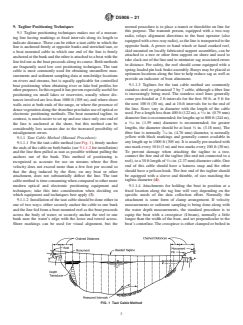
9.1.1.1 For the taut cable method (see Fig. 1), firmly anchor the ends of the cable on both banks (see 9.1.1.2 for installation) and
the line then pulled as taut as possible without pulling the anchors out of the bank. This method of positioning is recognized as
accurate for use on streams where the flow velocity does not exceed more than a few feet per second so that the drag induced by
the flow, on any boat or other attachment, does not substantially deflect the line. The taut cable method is time consuming when
compared to other more modern optical and electronic positioning equipment and techniques; take this into consideration when
deciding on which equipment and techniques best apply (3).
9.1.1.2 Installation of the taut cable should be done either in one of two ways: either securely anchor the cable to one bank and
the line fed from a boat mounted reel as the boat proceeds across the body of water; or securely anchor the reel to one bank near
the water’s edge with the loose end towed across. Shore markings can be used for visual alignment, but the normal procedure is
to place a transit or theodolite on line for this purpose. The transmit person, equipped with a two-way radio, relays alignment
D5906 − 21
FIG. 1 Taut Cable Method
directions to the boat operator (also equipped with a two-way radio), as the line is transported to the opposite bank. A power or
hand winch or hand cranked reel, skid mounted on locally fabricated support assemblies, can be attached to a tree or other firm
support on shore and used to take slack out of the line and to minimize sag associated errors in distance. For safety, the reel should
come equipped with a spring-loaded pin lock brake assembly. Buoys may be placed at optimum locations along the line to help
reduce sag as well as provide an indicator of boat alinement.
9.1.1.3 Taglines for the taut cable method are commonly stainless steel or galvanized 7 by 7 cable, although a fiber line is
increasingly being used. The stainless steel lines generally come pre-beaded at 2 ft intervals for the first 50 ft, at 5 ft for the next
100 ft (30 m), and at 10-ft intervals for to the end of the line. Sizes vary in diameter with the length of the cable used. For a length
1 1
less than 400 ft (122 m), a ⁄32 in. (0.79 mm) diameter line is recommended; for lengths up to 800 ft (244 m), a ⁄16 in. (1.59 mm)
1 3
diameter is recommended; for greater lengths, the diameter should be at least ⁄8 in. (3.18 mm). The fiber line is normally ⁄16 in.
(4.76 mm) diameter, is normally yellow with black markings and generally comes available in any length up to 1000 ft (305 m).
It is usually pre-marked with one mark every 10 ft (3 m) and two marks every 100 ft (30 m). To prevent damage when attaching
the tagline to a tree, connect the free end of the tagline (the end not connected to a reel), to a 30 ft length of ⁄32-in. (2.37 mm)
diameter cable. One end of this cable should have a harness snap and the other should have a pelican hook. The free end of the
tagline should be equipped with a sleeve and thimble, of size matching the tagline diameter (4).
9.1.1.4 Attachments for holding the boat in position at a fixed location along the tag line will vary depending on the specific needs
of the data collection effort. Normally the attachment is some form of clamp arrangement. If velocity measurements or sediment
sampling is being done along with the water depth measurements, the standard procedure is to equip the boat with a crosspiece
(I-beam), normally a little longer than the width of the boat, and set perpendicular to the boat’s centerline. The crosspiece is either
clamped or bolted in place and has guide sheaves at each end and a clamp arrangement somewhere along the length of the
crosspiece. With the tagline fed through the sheaves, the boat can be held in place or moved along the tagline from station to
station. The mid-point clamp permits the boat to be fixed to a one location and not move laterally along the line as measurements
are being taken. For safety, fasten a small rope to the clamp to permit quick release in the event of an emergency (4).
9.1.1.5 Position a standby person near the quick-release end of the cable, to release the cable, if there is a possibility of a boat,
barge, or other large obstruction colliding with the cable. In addition, a chase boat should also be present in traffic locations, to
warn boaters of the cable’s presence. For locations where flow velocities are high and boats and obstructions are present upstream,
it is recommended that all work boats be kept downstream of the cable.
9.1.1.6 Positions along the line are determined either through the use of a calibrated measuring wheel, or by keeping track of
markings attached to the line. Weight, sag, and strength of the line limit its range to less than 1000 ft (305 m). Markings must be
clearly visible and easy to understand. The markings are normally crimped brass beads set at 20 ft (6 m) intervals, but this can
vary significantly depending on the field application and specific measurement requirements. Attach fluorescent flagging in 4 to
5 ft (1.2 to 1.5 m) lengths at 50 ft (15.2 m) intervals along the length of the cable to assist in ease of distance measurements.
Fluorescent flagging provides the best visibility for all types of lighting and is recommended for use in visually marking the cable
for safety purposes.
9.1.1.7 Begin measurements by positioning the boat near the bank at a fixed mark on the cable. This initial or starting mark should
be determined by chain measurements from a surveyed control point near the water’s edge. The boat proceeds from this initial
mark along the cable to the opposite shore with a person on board calling out “fix” marks as each marking on the line is reached
(5).
D5906 − 21
9.1.1.8 Maintain alignment of a taut cable within at least 1 to 2 ft (0.3 to 0.6 m) of accuracy.
9.1.2 Boat Mounted Tagline (Manual Procedure):
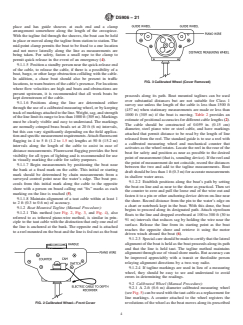
9.1.2.1 This method (see Fig. 2, Fig. 3, and Fig. 4), also referred to as tethered piano-wire method, is similar in principle to the
taut cable with the distinction that only one end of the line is anchored at the bank. The opposite end is attached to a reel mounted
on the boat and the line is fed out as the boat proceeds along its path. Boat mounted taglines can be used over substantial distances
but are not suitable for Class 1 survey use unless the length of the cable is less than 1500 ft (457 m) when stationary measurements
are made or less than 1000 ft (305 m) if the boat is moving. Table 2 provides an estimate of positional accuracies for different cable
lengths (2). The cable should be constructed of 0.059 in. (0.15 cm) diameter, steel piano wire or steel cable, and have markings
attached that permit distance to be read by the length of line released from the reel. The standard guide is to use a reel with a
calibrated measuring wheel and mechanical counter that activates as the wheel rotates. Locate the reel in the rear of the boat for
safety and position as near as possible to the desired point of measurement (that is, sounding device). If the reel and the point of
measurement do not coincide, record the distances between the two and add to the tagline measurements. Boat draft should be less
than 1 ft (0.3 m) for accurate measurements in shallow water areas.
9.1.2.2 Establish positions along the boat’s path by setting the boat on line and as near to the shore as practical. Then set the
counter to zero and pull the loose end of the wire out and fasten it to a pin or other anchoring device driven on-line near the shore.
Record distance from the pin to the water’s edge on a chart or notebook kept in the boat. With this done, the boat begins to proceed
along its designated path. Attach styrofoam floats to the line and dropped overboard at 100 to 300 ft (30 to 91 m) intervals that
reduces sag by holding the wire near the surface. Release the line from its starting point as the boat reaches the opposite shore and
retrieve it using the motor driven winch aboard the boat (6).
9.1.2.3 Special care should be made to certify that the lateral alignment of the boat is held as the boat proceeds along its path and
that the line is held taut. The tagline method maintains alignment through use of visual shore marks. But accuracy can be improved
appreciably with a transit or theolodite person relaying alignment directions by a two-way radio.
9.1.2.4 If tagline markings are used in lieu of a measuring wheel, they should be easy to see and understand to avoid errors in
determining the readings.
9.2 Calibrated Wheel (Manual Procedure):
9.2.1 A 2-ft (0.6 m) diameter calibrated measuring wheel (see Fig. 5) can be used with the taut cable as a replacement for line
markings. A counter attached to the wheel registers the revolutions of the wheel as the boat moves along its prescribed path. Anchor
the piano wire on both banks and hold taut with enough sag to permit the piano wire to encircle the wheel, but provide enough
friction to prevent slippage. Repair breaks that might occur in the line through the use of a compressed-sleeve type wire splicer.
9.2.2 The procedure for the calibrated wheel method is the same as that described for the taut cable, except that the calibrated
wheel is used in lieu of markings permanently attached to the line. The positioning begins with the boat stationed at a fixed
measured point on the line (established by distance measurement from a control station on shore), the counter on the wheel set
to zero, and the boat’s position relative to this starting position measured as the boat moves along its path.
FIG. 2 Calibrated Wheel—Front Cover
D5906 − 21
FIG. 3 Calibrated Wheel (Cover Removed)
10. Cable Reels (Manual Procedure)
10.1 Cable reels must be constructed of sturdy material and be equipped with a manual, electrical, or gasoline powered winch,
including a clutching and braking assembly. The brake is used both for controlling rotation of the reel as the cable is let out and
to serve as a safety feature. For hand operated reels, the crank should be hinged to allow the crank to be disengaged from the shaft
while the wire is let out and engaged for reeling in. Various devices are employed to drive a counter to register the amount of cable
released from the reel (5).
10.2 The cable for the boat mounted tagline should be made of galvanized, commercially available aircraft cable with ⁄32 in. (2.38
mm) outside diameter (O.D.) and seven by seven construction. Some cables may also come with a nylon coating to reduce fraying
typical of uncoated steel cables. The coating, however, increases the outside diameter to ⁄8 in. (3.18 mm) and reduces the length
of cable that can be wound on a reel by about 50 %. Plastic water-ski tow cable of ⁄4 in. (6.35 mm) diameter, 1 lb/100 ft weight
(0.45 kg/30.5 m), is available from sporting goods stores and may also be used occasionally with good success but is not
recommended for use during windy conditions because of the tendency to be deflected. The plastic cable has the advantage of being
easily repaired in the field by telescoping one end into the other.
11. Current Meters (Manual Procedure)
11.1 A standard “Price current meter” suspended from a boat, in which the propeller blade rotates because of movement of the
boat, can be used to measure the distance the boat has traveled by keeping track of the accumulative revolutions of the meter times
a calibration constant for the mounted meter. When coupled with the sonic-sound “fix” switch, the current meter can be used in
a semi-automatic operation for recording and documenting positions along the range line.
12. Shore Marks (Manual Procedure)
12.1 Shore marks may be used with taglines, alone in pairs, or with optical and electronic procedures. Their function is to help
maintain boat alignment as the boat moves along its prescribed course. The boat operator can visually align the boat’s movement
on target with the two or more shore marks, or an instrument man on shore can convey instructions by two-way radio as the boat
proceeds between shore marks on the opposite bank. A transit works well for stadia positioning since the transit can be used both
for alignment and stadia measurements. Shore marks, placed in a perpendicular alignment to the boats path, can serve as an
indicator of position and, as such, provide a good, rough measurement of position for reconnaissance surveys.
12.2 Accuracy in use of shore marks depends on ease of visibility and how sharp the delineation is between the two or more
objects being used for line of sight. Place the shore marks far enough apart to enable alignment to be clearly distinguishable.
PROCEDURE B—OPTICAL MEASUREMENT AND ALIGNMENT
13. Scope
13.1 This procedure explains the use of optical equipment in horizontal positioning.
13.2 Equipment includes transits, theodolites, and alidades, along with sextants, or range poles. The techniques applied include
stadia positioning, transit intersection, transit-stadia positioning, and sextant positioning.
D5906 − 21
FIG. 4 Calibrated Wheel Method
TABLE 2 Allowable Tagline Positioning Procedures/Systems
Criteria (7)
NOTE 1—Tagline distance range limits shown for Class 1 and Class 2
surveys are contingent on the tagline being pulled clear of the water and
held taut during measurement. Distances for Class 1 surveys shall be
adjusted downward depending on the capabilities of the boat and
equipment used.
Estimated Positional Accuracy
±1 ft ±1 m Suitable for Survey Class
System
RMS RMS
1 2 3
Tagline (Boat Stationary)
<1500 ft from baseline 1 to 3 (0.3 to 1) Yes Yes Yes
>1500 to <3000 ft 3 to 16 (1 to 5) No Yes Yes
>3000 ft from baseline 16 to 164 (5 to 50 + ) No No Yes
Tagline (Boat Moving)
<1000 ft from baseline 3 to 9 (1 to 3) Yes Yes Yes
>1000 to <2000 ft 8 to 20 (3 to 6) No Yes Yes
>2000 from baseline 20 to 164 + (6 to 50 + ) No No Yes
Tagline Calibration Frequency (in months) 1 6 12
Accuracy of Independent Calibration (feet) 0.1 1 5
Accuracy of Independent Calibration (meters) 0.03 0.01 1.52
14. Stadia Measurements (Optical Procedure)
14.1 The stadia method (see Fig. 6) uses transit or alidade standard guides similar to that applied in standard land surveying
applications. For boat positioning, however, the stadia board is much larger in size and often has coded markings in lieu of
numbers. Fig. 7 illustrates a section of a typical board used by some field offices of the U.S. Army Corps of Engineers. The board
must be securely mounted in the sounding boat and positioned as near to the required point of measurement as possible. Distances
are normally read at 100 ft (30.5 m) intervals, unless field needs warrant otherwise. The transit operator is stationed on shore at
a surveyed control point and conveys alignment and distance instructions to the boat operator through use of two-way radios. Each
distance measurement is usually preceded by a “stand-by” message (including an indication of the distance), followed in a few
seconds by the signal “fix” as the actual distance is read. The spacing of fix marks can be made either by the transit or sounder
operator. If made by the transit operator, the spacing is more uniform and the chance for erroneous readings is reduced. If made
by the sounding operator, the operator of the water depth measurement instrument, the spacing can be determined by the change
in boat speed and the need for distance reading is indicated when abrupt changes in depth are detected.
14.2 The limit for distance measurements using stadia depends on the length of the stadia board and the telescopic power of the
transit. This limit should not normally exceed 1000 to 1500 ft (305 to 457 m). Longer distances are possible by stationing an
instrument person at each end of the range and overlapping and averaging several stadia readings.
14.3 A stadia board should be at least 15 ft (4.6 m) in length, hinged into two 7 ⁄2 ft (2.3 m) sections for easy transport, have a
triangular cross section with 6 in. (1.5 mm) side widths, and be constructed of aluminum. The markings on the stadia board should
be in an alternating pattern of white markings with red points and black markings with yellow points. This enables it to be
distinguishable against a variety of backgrounds and more visible at greater distances. In addition the board should be equipped
with special marking to signify 250, 500 and 750 ft distances.
14.4 The standard procedure in obtaining stadia measurements is to set the transit on the rangeline alignment, on land, and near
the water’s edge. The transit should be plumbed over a surveyed control point and be at normal eye level but as near to the water
D5906 − 21
FIG. 5 Tag Line
FIG. 6 Stadia Method
D5906 − 21
FIG. 7 Stadia Board
level as possible to avoid the need for excessively long stadia rods. Care must be taken to assure that the stadia rod is firmly
mounted in the boat. Stadia readings are best obtained when waves are not present because of the difficulty in obtaining readings
in a timely and accurate manner under conditions where the boat is subject to motions of pitch, roll, yaw, and heave. A tape, chain,
stadia reading, or other suitable form of measurement will have to be made between the vertical centerline of the transit’s position
and the stadia rod before the boat can begin to proceed along its course. If possible the boat should proceed at a constant speed.
A “fix” signal should be given when the boat has to slow down on reaching the shore with a final reading when the boat reaches
the opposite bank.
15. Transit Intersection (Optical Procedure)
15.1 This is a two-transit method (see Fig. 8): one transit is placed on line with the boat’s prescribed path and used for alignment
instructions and the second is located at some known relative position upstream or downstream to permit the determination of an
angular position on the boat as it proceeds on its course. The boat’s positions along the path is determined by measuring the straight
or baseline distance between the two transit stations, A and C, observing the interior angle formed between this baseline and the
boat at Station x , then solving trigonometrically for the leg of the triangle represented by the distance between the boat and the
i
transit at Station A. Make position readings at 100-ft (30-m) intervals or as essential to permit an accurate profile of the lake bed
surface. The angles may be predetermined to intersect fixed positions along the course. Examples would be 100-ft (30 m) or 200-ft
(61 m) spacings.“ Fix” marks are transmitted to the boat by two-way radios as the boat reaches each mark.
15.2 The angle of intersection at the boat should be such that a directional error of 1 min in arc from a transit station will not cause
the position of the boat to be in error by more than 1.0 min at the scale of the maps being used. Angles should be maintained
between 30 and 150°. Table 3 provides an estimate of positional error due to azimuth misalignments (7).
D5906 − 21
FIG. 8 Transit Intersection
TABLE 3 Positional Error Due to Azimuth Misalignment (7)
Distance Error per Alignment Procedure
Distance,
Sextant (±20 min), Transit (±2 min),
ft (m)
ft (m) ft (m)
100 (30) 0.6 (0.2) 0.1 (0.0)
500 (152) 3 (0.9) 0.3 (0.1)
1000 (305) 6 (1.8) 0.6 (0.2)
2000 (610) 12 (3.7) 1.2 (0.4)
5000 (1524) 29 (8.8) 2.9 (0.9)
10 000 (3048) 58 (17.7) 6 (1.8)
16. Triangulation/Intersection Positioning (Optical Procedure)
16.1 The intersecting lines of sight (see Fig. 9) from two or more shore based transit or theodolite stations provide an accurate
measurement of boat position, suitable for all three classes of horizontal positioning. Each observation point can be determined
graphically, by plotting the angular data, or mathematically, by using the known distance between any two shore stations and the
inclosed angles formed by the intersecting lines. Read angles to the nearest 0.01° and make at least two backsight checks when
the instruments are initially set up. Make frequent rechecks if the instruments are to be used for several sets of measurements.
FIG. 9 Triangulation/Intersection
D5906 − 21
16.2 Accuracy of the triangulation/intersection method is strongly dependent on the precision of the instruments, the experience
of the operators, the effectiveness of the coordinated positional “fixes” (made by two way radio), and the accuracy of the control
point survey. As in intersection methods, the angle formed by the intersecting lines should be between 30 to 150° (3). Measure
azimuths to within 30 s of arc (1).
17. Sextant Measurements (Optical Procedure)
17.1 A sextant is a hand-held instrument used to measure vertical or horizontal angles up to a maximum spread of 140° (1).
Although once widely used for boat positioning, a sextant is no longer recommended for positioning of small boats, except under
very quiescent stream or lake conditions. This is due to the difficulty in keeping the boat stable long enough to measure the required
angles. The sextant angles are observed by holding the sextant in a horizontal plane with the left hand, viewing a specified object
through the telescope, and adjusting the mirror reflection of the right hand object until the two objects appear to coincide. At this
point, the angle between the two objects is read at the vernier position of a graduated arc attached to the sextant. Sextant positioning
should not be made where the angle between the two objects is less than 15° or for short distances of less than 1000 ft (305 m)
(6).
17.2 Sextant Resectioning (Optical Procedure):
17.2.1 Sextant resectioning (see Fig. 10) is similar in concept to transit-intersection, except that the observation station is on the
boat in lieu of the shore, and baseline distances between shore markings are not normally required. Positions along the boat’s path
are determined by manually plotting sextant angles between two or more shore marks. Read observations to the nearest 0.1 min
of arc. The major drawback to sextant resectioning stems from the fact that it is labor intensive; requiring a boat operator, possibly
two sextant observers, a depth recorder operator (if water depths are being measured), and a data logger/plotter (7).
17.2.2 Error sources in sextant resectioning include instability of the observation platform (boat motion), imprecision in the
sextant angles, lack of synchronization in observations being made simultaneously, plotting errors, observer fatigue, and target
delineation. The potential for error increases noticeably with decreases in boat size because of difficulty in maintaining a stable
observation platform with smaller size boats. Precision in the angle measurement depends on the resolution of the instruments, the
skills of the observers, how quickly the angles are changing, and the distinction of the shore based targets. The weight of the hand
held sextants and the difficulty in holding a stable platform (boat) long enough to obtain an observation adds an additional factor
that must be taken into consideration. Such errors make it essential that sextants be calibrated periodically between observations.
An estimate of positional error due to sextant azimuth misalignments is given in Table 3 (7).
17.2.3 Angles of observation should ideally be between 20 and 110° of arc. If more than one sextant observation is being made
simultaneously, position the observers on the boat as close together as possible to minimize parallax into the adjacent angles of
observation. Also, the offset between the position point and the position where the water depth measurement is being made must
be taken into account (1).
FIG. 10 Sextant Resectioning
D5906 − 21
PROCEDURE C—ELECTRONIC POSITIONING
18. Scope
18.1 This procedure explains the measurement of horizontal position using electronic positioning systems (EPS). It is electronic
distance measurement (EDM) equipment using microwave, visible light, laser light, and infrared light bandwidths.
18.2 Description of techniques and equipment are general in nature. Techniques and equipment may need to be modified for use
in specific field conditions.
19. Significance and Use
19.1 Electronic positioning systems offer a broader variety of positioning techniques than available with mechanical and optical
methods. This includes automation of angle and distance measurements, position measurement over much longer distances, and
potential for on-site microcomputer data storage and processing. In addition to using positioning procedures that are adaptions of
those used in optical positioning, the electronic positioning systems permit range-range boat tracking and fully integrated
positioning systems.
20. Signal Frequency Selection
20.1 All EPS equipment discussed within this guide is limited to that operating in the super high frequency range (3 to 30 GHz),
in contrast to lower frequency systems commonly used for ocean navigation. A classification of various electronic positioning
systems is given in Table 4. The higher frequency range provides the needed level of accuracy required for measuring boat
positions over distances up to 3 to 5 miles (5 to 8 KM). Most of the techniques applied are adaptations of those used with optically
based systems. The techniques vary from shore based range-azimuth systems (in which the stadia rod is replaced with a reflector
station) to the more sophisticated boat-based electronic transponder based systems in which distance is measured electronically
from the boat to two or more transponders stationed on shore. The position of the boat is calculated on the basis of a trigonometric
solution using the measurements between the EDM equipment and the shore based transponders (8). The output from electronic
positioning system can be in digital or analog form, but nearly always in a form compatible with automated processing systems.
Some EDM’s are also equipped with a microprocessor capable of preprocessing the raw data. This includes removing skew in the
data stemming from the boats travel during the measurement, as well as smoothing of the data to eliminate poor signals due to
1).
low signal-to-noise ratio, and errors associated with instrument instability (
21. Measurement Principals
21.1 EDM instruments operate by transmitting electromagnetic wave energy (the carrier signal) to a receiver station or responder
where it is retransmitted as a return signal back to the transmitting station. The delay time or phase shift in the signals (depending
on the type of equipment used) provides a measure of distance between the two stations. Special care must be made to avoid the
influence of intervening objects between the transmitter and receiving stations, such as trees, hills, buildings and other structures,
due to high absorption of the wave energy. EDM’s operate either as pulsed wave systems or as carrier phase systems.
TABLE 4 Electronic Positioning Systems (7)
Bandwidth Symbol Frequency System
Very low frequency VLF 10 to 30 KHz Omega
Low frequency LF 30 to 300 KHz Loran-C
Medium frequency MF 300 to 3000 KHz Raydist, Decca
High frequency HF 30 to 30 MHz
Very high frequency VHF 30 to 300 MHz
Ultra high frequency UHF 300 to 3000 MHz Del Norte
L-Band NAVSTAR GPS
Super high frequency SHF 3 to 30 GHz (Microwave EPS)
C-Band Motorola
S-Band Cubic
X-Band Del Norte
A
Visible light . . (EDM)
A
Laser light . . (EDM)
A
Infrared light . . (EDM), Polarfix
A
EDM—Electronic distance measuring instrument.
D5906 − 21
21.2 In pulse systems (see Fig. 11) the transmitting station sends out a coded electromagnetic pulse traveling at the velocity of
sound to a repeater station where the signal is then amplified and retransmitted to the transmitting station. Distance between the
two stations should be computed by the time comparison techniques and is equal to the velocity of sound, approximately 1050 ft/s
(350 m/s), times one half the sum of the round trip travel time plus equipment delays. The master device is set up at one end of
the distance to be measured. This device creates a beam of electromagnetic radiation, either incandescent light, laser, infrared, or
microwave, that serves as a carrier for the waves used for measurement. The beam is directed toward a reflector (in the case of
light beams) or a repeater (in the case of microwave) at the other end of the distance where it is reflected to the master station.
Signals from the master station are coded such that each specific transponder responds only to the specific transmission intended
for it. This coding occurs in the number or spacing of single pulses in a series, or by the interval in the pulses (1).
21.3 Carrier phase systems (see Fig. 12) operate by transmitting a series of waves of constant amplitude and frequency in the form
of infra-red or laser light. The receiving stations retransmit the signal back to the originating stations but with a slight phase shift.
Distances between the two stations is determined by the phase comparison technique in which the distance is determined as a
function of the difference between the outgoing and incoming signals, and the wave length of the signal (1).
21.4 EDM equipment of this nature is complex and requires not only an experienced operator but adherence to equipment
limitations regarding accuracy, repeatability, and resolution. On-board equipment should be placed directly over or as near as
possible to the measurement point. The shore-based transponders should be set so that the two range lines will intersect the boat
with an angle as close to 90° as possible; moreover, the transponders must be accurately tied into an appropriate grid system (5).
If a transit or theodolite is mounted on the tripod with the EDM, the two need to be in alignment. Sighting objects used in the
alignment must be at least 1000 ft (305 m) from the instruments when the adjustments are made. The length of time to make the
distance measurement needs to be kept to a minimum and as close to the other types of data being collected as possible. Care needs
to be taken to compensate the distance readings for temperature and density effects, although this isn’t normally a major error
source (9).
21.5 Shore repeater stations are referred to as transponders, trisponders or responders, depending on the equipment manufacturer.
Some EDM’s also use a passive radar reflector—a specially shaped reflector designed to send back a high percentage of the
incident energy (9).
21.6 The advent of the microprocessor has made it possible for electronic instruments (referred to as total-stations) to measure
both angles and distance, with the added capability in some instruments to calculate coordinates from azimuth and distance. Some
also offer the capability of internally storing data in built-in memory units, externally in data recorders, or microcomputers. This
includes the capability to key-in atmospheric temperature and pressure for automatic calculation of atmospheric correction factor
and automatic correction of distance readings. Others can also correct distance and angle readings for errors stemming from unlevel
instruments. Transmitting signals may be microwave, those that employ phase-comparison techniques, or laser which use the pulse
mode of operation (9).
21.7 Total-station survey systems come in a wide range of instruments, but three general types are available: manual,
semi-automatic, and automatic. Differences depend on the whether the vertical angle (or zenith angle) is read manually or
automatically and how the data is recorded. For manual total-stations, distance and angle measurements are read using a
conventional theodolite. Slope reduction is accomplished by keying the vertical angle into an onboard or hand held calculator. In
the semi-automatic total station, distances are read optically and the vertical angle is measured by a sensor. Slope reduction is
accomplished automatically within the unit. The automatic total station electronically reads both the horizontal and vertical angle,
FIG. 11 Pulsing Distance Measurement
D5906 − 21
FIG. 12 Phase Comparison Measurement
makes the necessary computations automatically, and stores the results in either internal or external computer (10). The choice of
which instrument to use depends on the accuracy requirements of the project, the availability of equipment, cost, and the extent
of automation affordable.
21.8
...