

ASTM C301-18(2022)
(Test Method)Standard Test Methods for Vitrified Clay Pipe
General Information
- Abstract
SIGNIFICANCE AND USE
4.1 Meaning and Suitability—The tests called for herein, from their results, indicate the suitability and acceptability of vitrified clay pipe for specifications acceptance, design purposes, regulatory statutes, manufacturing control, and research.
SCOPE
1.1 These test methods cover the equipment for, and the techniques of, testing vitrified clay pipe prior to installation. Tests using whole pipe determines the resistance to crushing and hydrostatic forces. Tests using pipe fragments measure the amount of water absorption of the pipe body and the quantity of acid-soluble material that may be extracted from it.
Note 1: The following standards also apply to clay pipe and can be referenced for further information: Practice C12 and Test Method C828; Specifications C425 and C700.
1.2 The values stated in inch-pound units are to be regarded as standard. The values given in parentheses are mathematical conversions to SI units that are provided for information only and are not considered standard.
1.3 This standard does not purport to address all of the safety concerns, if any, associated with its use. It is the responsibility of the user of this standard to establish appropriate safety, health, and environmental practices and determine the applicability of regulatory limitations prior to use.
1.4 This international standard was developed in accordance with internationally recognized principles on standardization established in the Decision on Principles for the Development of International Standards, Guides and Recommendations issued by the World Trade Organization Technical Barriers to Trade (TBT) Committee.
- Status
- Published
- Publication Date
- 31-Aug-2022
- Technical Committee
- C04 - Vitrified Clay Pipe
- Drafting Committee
- C04.20 - Methods of Test and Specifications

Overview
ASTM C301-18(2022), issued by ASTM International, defines standard test methods for vitrified clay pipe. These methods help assess the suitability and acceptability of vitrified clay pipes before installation, ensuring that they meet the necessary requirements for specifications acceptance, design, regulatory compliance, manufacturing control, and research purposes. The standard outlines procedures for evaluating structural performance and material characteristics, supporting quality assurance for infrastructure involving vitrified clay piping.
Key Topics
- Crushing and Hydrostatic Resistance: Tests using whole pipes determine the resistance of vitrified clay pipe to crushing loads and internal hydrostatic forces. These measurements help establish the structural integrity and durability of the pipe under various field conditions.
- Water Absorption: By testing pipe fragments, the amount of water absorbed by the clay pipe body is assessed. This feature is critical for long-term durability and resistance to environmental influences.
- Acid-Soluble Content: The standard describes procedures for measuring the quantity of acid-soluble material that can be extracted from pipe fragments. This property provides insight into the chemical resistance of the vitrified clay material.
- Bearing Strength: The specification includes three-edge and segmented bearing tests, requiring specialized apparatus to simulate loading conditions and ensure the pipe's ability to withstand stress in real-life applications.
- Hydrostatic Pressure Testing: Pipes are subjected to internal pressure testing to confirm leak-tightness, which is essential for both sanitary and stormwater applications.
- Visual Inspection: Requirements for visual inspection are provided to detect any manufacturing defects and ensure compliance with relevant specifications.
- Reporting and Accuracy: The document stipulates precise recording and calculation methods to ensure test reproducibility and standardization.
Applications
The methods established in ASTM C301-18(2022) are used extensively in:
- Quality Assurance in Manufacturing: Pipe manufacturers use these test methods during production for process control and to ensure compliance with industry requirements.
- Pre-Installation Assessment: Contractors and engineers rely on these standardized tests to verify the fitness of vitrified clay pipes prior to installation in municipal, commercial, and industrial infrastructure projects.
- Design and Specification Compliance: Civil engineers and designers reference the test results to confirm that selected pipes meet project and regulatory requirements for strength, absorption, and chemical resistance.
- Regulatory Acceptance: Government agencies and regulatory bodies use these methods to certify vitrified clay pipes for use in public works and utility installations.
- Research and Product Development: Researchers and product developers employ these tests to evaluate new formulations or improvements in vitrified clay pipe technology.
Related Standards
For a comprehensive approach to testing and installing vitrified clay pipe, the following ASTM standards are commonly referenced alongside ASTM C301-18(2022):
- ASTM C12: Practice for Installing Vitrified Clay Pipe Lines
- ASTM C425: Specification for Compression Joints for Vitrified Clay Pipe and Fittings
- ASTM C700: Specification for Vitrified Clay Pipe, Extra Strength, Standard Strength, and Perforated
- ASTM C828: Test Method for Low-Pressure Air Test of Vitrified Clay Pipe Lines
- ASTM C896: Terminology Relating to Clay Products
- ASTM E6: Terminology Relating to Methods of Mechanical Testing
ASTM C301-18(2022) plays a crucial role in the quality control process for vitrified clay pipes, supporting durability, performance, and safety in modern infrastructure systems. Using standardized test methods ensures consistency, reliability, and efficiency in the adoption of vitrified clay pipe products for a wide range of applications.
Relations
- Effective Date
- 01-Apr-2024
- Effective Date
- 01-Dec-2017
- Effective Date
- 01-Jun-2017
- Effective Date
- 01-Nov-2016
- Effective Date
- 15-May-2016
- Effective Date
- 01-Dec-2015
- Effective Date
- 01-Sep-2014
- Effective Date
- 01-Sep-2014
- Effective Date
- 01-Dec-2013
- Effective Date
- 01-Dec-2013
- Effective Date
- 01-Mar-2013
- Effective Date
- 01-Jan-2013
- Effective Date
- 01-Nov-2011
- Effective Date
- 01-Jan-2011
- Effective Date
- 01-Oct-2009
Get Certified
Connect with accredited certification bodies for this standard

Institut za varilstvo d.o.o. (Welding Institute)
Slovenia's leading welding institute since 1952. ISO 3834, EN 1090, pressure equipment certification, NDT personnel, welder qualification. Only IIW Au
Sponsored listings
Frequently Asked Questions
ASTM C301-18(2022) is a standard published by ASTM International. Its full title is "Standard Test Methods for Vitrified Clay Pipe". This standard covers: SIGNIFICANCE AND USE 4.1 Meaning and Suitability—The tests called for herein, from their results, indicate the suitability and acceptability of vitrified clay pipe for specifications acceptance, design purposes, regulatory statutes, manufacturing control, and research. SCOPE 1.1 These test methods cover the equipment for, and the techniques of, testing vitrified clay pipe prior to installation. Tests using whole pipe determines the resistance to crushing and hydrostatic forces. Tests using pipe fragments measure the amount of water absorption of the pipe body and the quantity of acid-soluble material that may be extracted from it. Note 1: The following standards also apply to clay pipe and can be referenced for further information: Practice C12 and Test Method C828; Specifications C425 and C700. 1.2 The values stated in inch-pound units are to be regarded as standard. The values given in parentheses are mathematical conversions to SI units that are provided for information only and are not considered standard. 1.3 This standard does not purport to address all of the safety concerns, if any, associated with its use. It is the responsibility of the user of this standard to establish appropriate safety, health, and environmental practices and determine the applicability of regulatory limitations prior to use. 1.4 This international standard was developed in accordance with internationally recognized principles on standardization established in the Decision on Principles for the Development of International Standards, Guides and Recommendations issued by the World Trade Organization Technical Barriers to Trade (TBT) Committee.
SIGNIFICANCE AND USE 4.1 Meaning and Suitability—The tests called for herein, from their results, indicate the suitability and acceptability of vitrified clay pipe for specifications acceptance, design purposes, regulatory statutes, manufacturing control, and research. SCOPE 1.1 These test methods cover the equipment for, and the techniques of, testing vitrified clay pipe prior to installation. Tests using whole pipe determines the resistance to crushing and hydrostatic forces. Tests using pipe fragments measure the amount of water absorption of the pipe body and the quantity of acid-soluble material that may be extracted from it. Note 1: The following standards also apply to clay pipe and can be referenced for further information: Practice C12 and Test Method C828; Specifications C425 and C700. 1.2 The values stated in inch-pound units are to be regarded as standard. The values given in parentheses are mathematical conversions to SI units that are provided for information only and are not considered standard. 1.3 This standard does not purport to address all of the safety concerns, if any, associated with its use. It is the responsibility of the user of this standard to establish appropriate safety, health, and environmental practices and determine the applicability of regulatory limitations prior to use. 1.4 This international standard was developed in accordance with internationally recognized principles on standardization established in the Decision on Principles for the Development of International Standards, Guides and Recommendations issued by the World Trade Organization Technical Barriers to Trade (TBT) Committee.
ASTM C301-18(2022) is classified under the following ICS (International Classification for Standards) categories: 23.040.50 - Pipes and fittings of other materials. The ICS classification helps identify the subject area and facilitates finding related standards.
ASTM C301-18(2022) has the following relationships with other standards: It is inter standard links to ASTM C896-24, ASTM C896-17a, ASTM C896-17, ASTM C12-16a, ASTM C12-16, ASTM C896-15, ASTM C12-14, ASTM C896-14, ASTM C896-13, ASTM C12-13a, ASTM C12-13, ASTM C700-13, ASTM C896-11, ASTM C700-11, ASTM C896-04(2009). Understanding these relationships helps ensure you are using the most current and applicable version of the standard.
ASTM C301-18(2022) is available in PDF format for immediate download after purchase. The document can be added to your cart and obtained through the secure checkout process. Digital delivery ensures instant access to the complete standard document.
Standards Content (Sample)
This international standard was developed in accordance with internationally recognized principles on standardization established in the Decision on Principles for the
Development of International Standards, Guides and Recommendations issued by the World Trade Organization Technical Barriers to Trade (TBT) Committee.
Designation: C301 −18 (Reapproved 2022)
Standard Test Methods for
Vitrified Clay Pipe
This standard is issued under the fixed designation C301; the number immediately following the designation indicates the year of
original adoption or, in the case of revision, the year of last revision. A number in parentheses indicates the year of last reapproval. A
superscript epsilon (´) indicates an editorial change since the last revision or reapproval.
This standard has been approved for use by agencies of the U.S. Department of Defense.
1. Scope C828 Test Method for Low-Pressure Air Test of Vitrified
Clay Pipe Lines
1.1 These test methods cover the equipment for, and the
C896 Terminology Relating to Clay Products
techniques of, testing vitrified clay pipe prior to installation.
E6 Terminology Relating to Methods of Mechanical Testing
Tests using whole pipe determines the resistance to crushing
and hydrostatic forces. Tests using pipe fragments measure the
3. Terminology
amount of water absorption of the pipe body and the quantity
of acid-soluble material that may be extracted from it.
3.1 Definitions:
NOTE 1—The following standards also apply to clay pipe and can be
3.1.1 For definitions of terms used in these test methods,
referenced for further information: Practice C12 and Test Method C828;
refer to Terminology E6 and Terminology C896.
Specifications C425 and C700.
1.2 The values stated in inch-pound units are to be regarded
4. Significance and Use
as standard. The values given in parentheses are mathematical
4.1 Meaning and Suitability—The tests called for herein,
conversions to SI units that are provided for information only
from their results, indicate the suitability and acceptability of
and are not considered standard.
vitrified clay pipe for specifications acceptance, design
1.3 This standard does not purport to address all of the
purposes, regulatory statutes, manufacturing control, and re-
safety concerns, if any, associated with its use. It is the
search.
responsibility of the user of this standard to establish appro-
priate safety, health, and environmental practices and deter-
5. Bearing Strength
mine the applicability of regulatory limitations prior to use.
1.4 This international standard was developed in accor-
5.1 Test Specimens:
dance with internationally recognized principles on standard-
5.1.1 The test specimens shall be sound, full-size pipe and
ization established in the Decision on Principles for the
shall be selected by the purchaser, or his representative, at
Development of International Standards, Guides and Recom-
points he designates when placing the order.
mendations issued by the World Trade Organization Technical
5.1.2 The number of specimens to be tested shall not exceed
Barriers to Trade (TBT) Committee.
0.5 % of the number of pipe of each size furnished, except that
no less than two specimens shall be tested.
2. Referenced Documents
5.2 Measurement and Inspection of Specimens:
2.1 ASTM Standards:
5.2.1 The specimens shall be free of all visible moisture and
C12 Practice for Installing Vitrified Clay Pipe Lines
frost. These specimens shall be inspected and measured for
C425 Specification for Compression Joints forVitrified Clay
conformance with the applicable specifications. The results of
Pipe and Fittings
these observations shall be recorded.
C700 Specification for Vitrified Clay Pipe, Extra Strength,
5.2.2 Specimens that are observed to have defects in excess
Standard Strength, and Perforated
of the limits permitted in the applicable specifications shall be
discarded and replaced with additional specimens from the lot
These test methods are under the jurisdiction of ASTM Committee C04 on
to be tested.
Vitrified Clay Pipe and is the direct responsibility of Subcommittee C04.20 on
Methods of Test and Specifications.
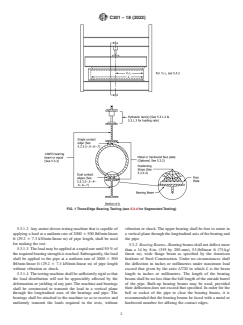
5.3 Loading Apparatus (see Fig. 1):
Current edition approved Sept. 1, 2022. Published September 2022. Originally
5.3.1 Testing Machine:
approved in 1952. Last previous edition approved in 2018 as C301 – 18. DOI:
10.1520/C0301-18R22.
5.3.1.1 The loading apparatus shall consist of a testing
For referenced ASTM standards, visit the ASTM website, www.astm.org, or
machine capable of applying loads, with upper and lower
contact ASTM Customer Service at service@astm.org. For Annual Book of ASTM
bearings capable of transmitting these loads to the pipe. The
Standards volume information, refer to the standard’s Document Summary page on
the ASTM website. bearings shall be bearing beams and contact edges.
Copyright © ASTM International, 100 Barr Harbor Drive, PO Box C700, West Conshohocken, PA 19428-2959. United States
C301 − 18 (2022)
FIG. 1 Three-Edge Bearing Testing (see 5.3.4 for Segmented Testing)
5.3.1.2 Any motor driven testing machine that is capable of vibration or shock. The upper bearing shall be free to rotate in
applying a load at a uniform rate of 2000 6 500 lbf/min·linear averticalplanethroughthelongitudinalaxisofthebearingand
ft (29.2 6 7.3 kN/min·linear m) of pipe length, shall be used
the pipe.
for making the test.
5.3.2 Bearing Beams—Bearingbeamsshallnotdeflectmore
5.3.1.3 The load may be applied at a rapid rate until 50 % of than a 14 by 8-in. (355 by 205-mm), 53-lb/linear ft (73-kg/
the required bearing strength is reached. Subsequently, the load
linear m), wide flange beam as specified by the American
shall be applied to the pipe at a uniform rate of 2000 6 500 Institute of Steel Construction. Under no circumstances shall
lbf/min·linear ft (29.2 6 7.3 kN/min·linear m) of pipe length
the deflection in inches or millimetres under maximum load
without vibration or shock.
exceed that given by the ratio L/720 in which L is the beam
length in inches or millimetres. The length of the bearing
5.3.1.4 Thetestingmachineshallbesufficientlyrigidsothat
beams shall be no less than the full length of the outside barrel
the load distribution will not be appreciably affected by the
deformation or yielding of any part. The machine and bearings of the pipe. Built-up bearing beams may be used, provided
their deflection does not exceed that specified. In order for the
shall be constructed to transmit the load in a vertical plane
through the longitudinal axes of the bearings and pipe. The bell or socket of the pipe to clear the bearing beams, it is
bearings shall be attached to the machine so as to receive and recommended that the bearing beams be faced with a metal or
uniformly transmit the loads required in the tests, without hardwood member for affixing the contact edges.
C301 − 18 (2022)
5.3.3 Three-Edge Bearings: 5.4.4 The loading shall be stopped after the required
5.3.3.1 Three-edge bearings shall consist of an upper strength has been met.
member, comprised of a bearing beam on which one contact
5.4.5 For further evaluation or quality assurance, the load-
edge is located so that it lies in the vertical plane passing
ing may be continued to the point of pipe failure.
through the longitudinal axis of the pipe; and a lower member
5.4.6 Record the maximum load sustained by the specimen.
comprised of a bearing beam on which two contact edges are
5.5 Calculation and Report:
symmetrically located parallel to that vertical plane.
5.5.1 Calculate the bearing strength by dividing the applied
5.3.3.2 The contact edges shall consist of rubber strips.
load by the inside length of the barrel. The length shall be the
Contact edges shall uniformly contact the outside barrel of the
average of two measurements taken at points 180° (3.1 rad)
pipe.
apart. Report the individual results of the tests of pipe of each
5.3.3.3 The two contact edges on the lower member shall be
size or lot.
spaced apart approximately 1 in./ft (83 mm/m) of pipe
diameter, but in no case less than 1 in. (25 mm).
6. Absorption
5.3.3.4 Positioning strips may be used to align the upper
contact edge and to align and space the lower contact edges. In
6.1 Test Specimens:
the case of rubber contact edges, positioning strips shall not
6.1.1 Absorption specimens shall be sound pieces of the full
exceed one half of the thickness of the contact edge and may
thickness of the barrel of the pipe, with all edges broken. Each
remain in place.
specimen shall be as nearly square as possible, with the area on
5.3.3.5 If rubber strips are used as contact edges, they shall
onebarrelsurfacenotlessthantwelvetimesthewallthickness,
be cut or formed from material having a Shore A,
expressed as square units. They shall be free of observable
instantaneous, durometer hardness between 45 and 60. The
cracks or shattered edges and shall not contain laminations and
strips shall be of rectangular cross se
...