

ASTM D6399-18
(Guide)Standard Guide for Selecting Instruments and Methods for Measuring Air Quality in Aircraft Cabins
General Information
- Abstract
SIGNIFICANCE AND USE
5.1 This guide may be used to identify instruments and methods for measuring air quality in aircraft cabins. Such measurements may be undertaken to:
5.1.1 Conduct monitoring surveys to characterize the aircraft cabin environment and to assess environmental conditions. Results of such measurements could then be compared with relevant standards or guidelines for assessment of health and comfort of passengers and flight attendants.
5.1.2 Investigate passenger and flight attendant complaints; or
5.1.3 Measure and compare the performance of new materials and systems for the aircraft cabin environment.
SCOPE
1.1 This guide covers information and guidance for the selection of instrumentation and test methods for measuring air quality in aircraft passenger cabins as well as in areas limited to flightcrew access.
1.2 This guide assumes that a list of pollutants to be measured, or analytes of interest, which are present, or may be present, in aircraft cabins is available.
1.3 This guide provides information and guidance to identify levels of concern pertaining to public and occupational exposures to relevant air pollutants. This guide does not address levels of concern, if any, related to degradation of materials or aircraft components because of the presence of air pollutants.
1.4 Based on levels of concern for public and occupational exposures for each pollutant of interest, this guide provides recommendations for developing three aspects of data quality objectives (a) detection limit; (b) precision; and (c) bias.
1.5 This guide summarizes information on technologies for measurement of different groups or classes of air pollutants to provide a basis for selection of instruments and methods. The guide also identifies information resources on types of available measurement systems.
1.6 This guide provides general recommendations for selection of instruments and methods. These recommendations are based on concepts associated with data quality objectives discussed in this guide and the information on available instruments and methods summarized in this guide.
1.7 This guide is specific to chemical contaminants and does not address bioaerosols, which may be present in the cabin environment.
1.8 This guide does not provide details on use or operation of instruments or methods for the measurement of cabin air quality.
1.9 This guide does not provide information on the design of a monitoring strategy, including issues such as frequency of measurement or placement of samplers.
1.10 Users of this guide should be familiar with, or have access to, individuals who have a background in (a) use of instruments and methods for measurement of air pollutants and (b) principles of toxicology and health-effects of environmental exposure to air pollutants.
1.11 The values stated in SI units are to be regarded as standard. No other units of measurement are included in this standard.
1.12 This standard does not purport to address all of the safety concerns, if any, associated with its use. It is the responsibility of the user of this standard to establish appropriate safety, health, and environmental practices and determine the applicability of regulatory limitations prior to use.
1.13 This international standard was developed in accordance with internationally recognized principles on standardization established in the Decision on Principles for the Development of International Standards, Guides and Recommendations issued by the World Trade Organization Technical Barriers to Trade (TBT) Committee.
- Status
- Published
- Publication Date
- 28-Feb-2018
- Technical Committee
- D22 - Air Quality
- Drafting Committee
- D22.05 - Indoor Air
Buy Documents
ASTM D6399-18 - Standard Guide for Selecting Instruments and Methods for Measuring Air Quality in Aircraft Cabins
REDLINE ASTM D6399-18 - Standard Guide for Selecting Instruments and Methods for Measuring Air Quality in Aircraft Cabins
Overview
ASTM D6399-18: Standard Guide for Selecting Instruments and Methods for Measuring Air Quality in Aircraft Cabins provides a comprehensive framework for evaluating and selecting appropriate instrumentation and analytical methods to assess air quality within passenger cabins and flightcrew areas. By outlining recommended practices, this ASTM standard supports airlines, regulatory agencies, consultants, and manufacturers in effectively monitoring cabin air, addressing passenger and crew health and comfort concerns, benchmarking new cabin materials or systems, and ensuring compliance with applicable guidelines and regulations.
Key Topics
Scope of Coverage: Focused on chemical contaminants, this guide assists users in the selection of suitable instruments and test methods for multiple air pollutants in aircraft cabin environments. The standard does not cover bioaerosols or detailed instrumental operating procedures.
Defining Data Quality Objectives: Users are directed to determine key quality measures such as detection limits, precision, and bias for each target pollutant. These requirements are set according to regulatory or health-based "levels of concern" derived from established guidelines, such as FAA Airworthiness Standards, OSHA Permissible Exposure Limits (PELs), ACGIH Threshold Limit Values (TLVs), and others.
Selection of Instruments and Methods: The guide summarizes operational characteristics for a range of measurement technologies, including their suitability for onboard use, power and calibration needs, mobility, and compatibility with aircraft systems. Recommendations focus on practicality, measurement accuracy, and minimal interference with plane operations.
Establishing Levels of Concern: The standard compiles typical exposure limits and health-based thresholds for common air pollutants in cabins, emphasizing a prioritization scheme for applying the most stringent or relevant standards depending on exposure scenarios and the population (passengers vs. flight crew).
Applications
Adopting ASTM D6399-18 delivers several practical benefits across aviation industry stakeholders:
Air Quality Monitoring: Airlines and regulators can use this guide to plan and execute cabin air surveys, compare results with health and comfort standards, and identify sources of chemical contaminants such as carbon monoxide, carbon dioxide, ozone, volatile organic compounds (VOCs), and particulates.
Complaint Investigation: Facilities and safety departments can diagnose and address passenger or crew complaints related to air quality issues, selecting validated methods and instruments best suited for the chemical species or concentrations in question.
Material and System Evaluation: When introducing new cabin materials or environmental systems, manufacturers and operators can apply the guide’s method selection process to ensure reliable air quality assessment and regulatory compliance.
Regulatory Compliance and Benchmarking: The guide ensures consistent and technically sound measurement approaches in line with international, federal, and occupational standards, supporting compliance with FAA, OSHA, and environmental regulations.
Resource Planning and Procurement: Facility managers can use the guide’s operational requirements section to select monitoring equipment that balances performance, portability, battery operation, and compliance with aircraft certification standards.
Related Standards
Implementing ASTM D6399-18 often involves coordination with other standards and guidelines, including:
- ASTM D1356: Terminology Relating to Sampling and Analysis of Atmospheres
- ASTM D5197: Test Method for Determination of Formaldehyde and Other Carbonyl Compounds in Air
- ASTM D4490: Practice for Measuring Toxic Gases Using Detector Tubes
- RTCA/DO-160: Environmental Conditions and Test Procedures for Airborne Equipment
- 14 CFR 25 (FAA Airworthiness Standards): Air quality criteria for aircraft cabins
- 29 CFR 1910.1450 (OSHA): Exposure to hazardous chemicals in laboratories
- 40 CFR 50 (EPA): National Ambient Air Quality Standards
- ASTM D6245: Guide for Using Indoor Carbon Dioxide Concentrations to Evaluate Indoor Air Quality
- ASTM D7034: Guide for Deriving Acceptable Levels of Airborne Chemical Contaminants in Aircraft Cabins
By following the structured approach of ASTM D6399-18, organizations involved in aircraft cabin air quality assessment can achieve reliable, accurate, and regulatory-aligned results, ensuring safety and comfort for all onboard.
Relations
- Effective Date
- 01-Mar-2018
- Effective Date
- 01-Sep-2020
- Effective Date
- 15-Mar-2020
- Effective Date
- 01-Mar-2017
- Effective Date
- 01-Oct-2016
- Effective Date
- 01-Nov-2015
- Effective Date
- 15-Oct-2015
- Effective Date
- 01-Jul-2015
- Effective Date
- 01-Dec-2014
- Effective Date
- 01-May-2014
- Effective Date
- 15-Jan-2014
- Effective Date
- 01-Apr-2012
- Effective Date
- 01-Oct-2011
- Effective Date
- 01-Mar-2011
- Effective Date
- 01-Apr-2010
Buy Documents
ASTM D6399-18 - Standard Guide for Selecting Instruments and Methods for Measuring Air Quality in Aircraft Cabins
REDLINE ASTM D6399-18 - Standard Guide for Selecting Instruments and Methods for Measuring Air Quality in Aircraft Cabins
Get Certified
Connect with accredited certification bodies for this standard

BSI Group
BSI (British Standards Institution) is the business standards company that helps organizations make excellence a habit.

Bureau Veritas
Bureau Veritas is a world leader in laboratory testing, inspection and certification services.

DNV
DNV is an independent assurance and risk management provider.
Sponsored listings
Frequently Asked Questions
ASTM D6399-18 is a guide published by ASTM International. Its full title is "Standard Guide for Selecting Instruments and Methods for Measuring Air Quality in Aircraft Cabins". This standard covers: SIGNIFICANCE AND USE 5.1 This guide may be used to identify instruments and methods for measuring air quality in aircraft cabins. Such measurements may be undertaken to: 5.1.1 Conduct monitoring surveys to characterize the aircraft cabin environment and to assess environmental conditions. Results of such measurements could then be compared with relevant standards or guidelines for assessment of health and comfort of passengers and flight attendants. 5.1.2 Investigate passenger and flight attendant complaints; or 5.1.3 Measure and compare the performance of new materials and systems for the aircraft cabin environment. SCOPE 1.1 This guide covers information and guidance for the selection of instrumentation and test methods for measuring air quality in aircraft passenger cabins as well as in areas limited to flightcrew access. 1.2 This guide assumes that a list of pollutants to be measured, or analytes of interest, which are present, or may be present, in aircraft cabins is available. 1.3 This guide provides information and guidance to identify levels of concern pertaining to public and occupational exposures to relevant air pollutants. This guide does not address levels of concern, if any, related to degradation of materials or aircraft components because of the presence of air pollutants. 1.4 Based on levels of concern for public and occupational exposures for each pollutant of interest, this guide provides recommendations for developing three aspects of data quality objectives (a) detection limit; (b) precision; and (c) bias. 1.5 This guide summarizes information on technologies for measurement of different groups or classes of air pollutants to provide a basis for selection of instruments and methods. The guide also identifies information resources on types of available measurement systems. 1.6 This guide provides general recommendations for selection of instruments and methods. These recommendations are based on concepts associated with data quality objectives discussed in this guide and the information on available instruments and methods summarized in this guide. 1.7 This guide is specific to chemical contaminants and does not address bioaerosols, which may be present in the cabin environment. 1.8 This guide does not provide details on use or operation of instruments or methods for the measurement of cabin air quality. 1.9 This guide does not provide information on the design of a monitoring strategy, including issues such as frequency of measurement or placement of samplers. 1.10 Users of this guide should be familiar with, or have access to, individuals who have a background in (a) use of instruments and methods for measurement of air pollutants and (b) principles of toxicology and health-effects of environmental exposure to air pollutants. 1.11 The values stated in SI units are to be regarded as standard. No other units of measurement are included in this standard. 1.12 This standard does not purport to address all of the safety concerns, if any, associated with its use. It is the responsibility of the user of this standard to establish appropriate safety, health, and environmental practices and determine the applicability of regulatory limitations prior to use. 1.13 This international standard was developed in accordance with internationally recognized principles on standardization established in the Decision on Principles for the Development of International Standards, Guides and Recommendations issued by the World Trade Organization Technical Barriers to Trade (TBT) Committee.
SIGNIFICANCE AND USE 5.1 This guide may be used to identify instruments and methods for measuring air quality in aircraft cabins. Such measurements may be undertaken to: 5.1.1 Conduct monitoring surveys to characterize the aircraft cabin environment and to assess environmental conditions. Results of such measurements could then be compared with relevant standards or guidelines for assessment of health and comfort of passengers and flight attendants. 5.1.2 Investigate passenger and flight attendant complaints; or 5.1.3 Measure and compare the performance of new materials and systems for the aircraft cabin environment. SCOPE 1.1 This guide covers information and guidance for the selection of instrumentation and test methods for measuring air quality in aircraft passenger cabins as well as in areas limited to flightcrew access. 1.2 This guide assumes that a list of pollutants to be measured, or analytes of interest, which are present, or may be present, in aircraft cabins is available. 1.3 This guide provides information and guidance to identify levels of concern pertaining to public and occupational exposures to relevant air pollutants. This guide does not address levels of concern, if any, related to degradation of materials or aircraft components because of the presence of air pollutants. 1.4 Based on levels of concern for public and occupational exposures for each pollutant of interest, this guide provides recommendations for developing three aspects of data quality objectives (a) detection limit; (b) precision; and (c) bias. 1.5 This guide summarizes information on technologies for measurement of different groups or classes of air pollutants to provide a basis for selection of instruments and methods. The guide also identifies information resources on types of available measurement systems. 1.6 This guide provides general recommendations for selection of instruments and methods. These recommendations are based on concepts associated with data quality objectives discussed in this guide and the information on available instruments and methods summarized in this guide. 1.7 This guide is specific to chemical contaminants and does not address bioaerosols, which may be present in the cabin environment. 1.8 This guide does not provide details on use or operation of instruments or methods for the measurement of cabin air quality. 1.9 This guide does not provide information on the design of a monitoring strategy, including issues such as frequency of measurement or placement of samplers. 1.10 Users of this guide should be familiar with, or have access to, individuals who have a background in (a) use of instruments and methods for measurement of air pollutants and (b) principles of toxicology and health-effects of environmental exposure to air pollutants. 1.11 The values stated in SI units are to be regarded as standard. No other units of measurement are included in this standard. 1.12 This standard does not purport to address all of the safety concerns, if any, associated with its use. It is the responsibility of the user of this standard to establish appropriate safety, health, and environmental practices and determine the applicability of regulatory limitations prior to use. 1.13 This international standard was developed in accordance with internationally recognized principles on standardization established in the Decision on Principles for the Development of International Standards, Guides and Recommendations issued by the World Trade Organization Technical Barriers to Trade (TBT) Committee.
ASTM D6399-18 is classified under the following ICS (International Classification for Standards) categories: 13.040.99 - Other standards related to air quality; 49.020 - Aircraft and space vehicles in general. The ICS classification helps identify the subject area and facilitates finding related standards.
ASTM D6399-18 has the following relationships with other standards: It is inter standard links to ASTM D6399-10, ASTM D1356-20a, ASTM D1356-20, ASTM D3631-99(2017), ASTM D5149-02(2016), ASTM D6196-15, ASTM D1356-15a, ASTM D1356-15, ASTM D1356-14b, ASTM D1356-14a, ASTM D1356-14, ASTM D6245-12, ASTM D3631-99(2011), ASTM D7034-11, ASTM D1914-95(2010). Understanding these relationships helps ensure you are using the most current and applicable version of the standard.
ASTM D6399-18 is available in PDF format for immediate download after purchase. The document can be added to your cart and obtained through the secure checkout process. Digital delivery ensures instant access to the complete standard document.
Standards Content (Sample)
This international standard was developed in accordance with internationally recognized principles on standardization established in the Decision on Principles for the
Development of International Standards, Guides and Recommendations issued by the World Trade Organization Technical Barriers to Trade (TBT) Committee.
Designation: D6399 − 18
Standard Guide for
Selecting Instruments and Methods for Measuring Air
Quality in Aircraft Cabins
This standard is issued under the fixed designation D6399; the number immediately following the designation indicates the year of
original adoption or, in the case of revision, the year of last revision. A number in parentheses indicates the year of last reapproval. A
superscript epsilon (´) indicates an editorial change since the last revision or reapproval.
1. Scope 1.9 This guide does not provide information on the design
of a monitoring strategy, including issues such as frequency of
1.1 This guide covers information and guidance for the
measurement or placement of samplers.
selectionofinstrumentationandtestmethodsformeasuringair
quality in aircraft passenger cabins as well as in areas limited
1.10 Users of this guide should be familiar with, or have
to flightcrew access.
access to, individuals who have a background in (a) use of
1.2 This guide assumes that a list of pollutants to be instrumentsandmethodsformeasurementofairpollutantsand
measured, or analytes of interest, which are present, or may be (b)principlesoftoxicologyandhealth-effectsofenvironmental
present, in aircraft cabins is available.
exposure to air pollutants.
1.3 This guide provides information and guidance to iden-
1.11 The values stated in SI units are to be regarded as
tify levels of concern pertaining to public and occupational
standard. No other units of measurement are included in this
exposures to relevant air pollutants. This guide does not
standard.
address levels of concern, if any, related to degradation of
1.12 This standard does not purport to address all of the
materials or aircraft components because of the presence of air
safety concerns, if any, associated with its use. It is the
pollutants.
responsibility of the user of this standard to establish appro-
1.4 Based on levels of concern for public and occupational
priate safety, health, and environmental practices and deter-
exposures for each pollutant of interest, this guide provides
mine the applicability of regulatory limitations prior to use.
recommendations for developing three aspects of data quality
1.13 This international standard was developed in accor-
objectives (a) detection limit; (b) precision; and (c) bias.
dance with internationally recognized principles on standard-
1.5 This guide summarizes information on technologies for
ization established in the Decision on Principles for the
measurement of different groups or classes of air pollutants to
Development of International Standards, Guides and Recom-
provide a basis for selection of instruments and methods. The
mendations issued by the World Trade Organization Technical
guide also identifies information resources on types of avail-
Barriers to Trade (TBT) Committee.
able measurement systems.
1.6 This guide provides general recommendations for selec-
2. Referenced Documents
tion of instruments and methods. These recommendations are
2.1 ASTM Standards:
based on concepts associated with data quality objectives
D1356 Terminology Relating to Sampling and Analysis of
discussed in this guide and the information on available
Atmospheres
instruments and methods summarized in this guide.
D1914 PracticeforConversionUnitsandFactorsRelatingto
1.7 Thisguideisspecifictochemicalcontaminantsanddoes
Sampling and Analysis of Atmospheres
not address bioaerosols, which may be present in the cabin
D3162 Test Method for Carbon Monoxide in the Atmo-
environment.
sphere (Continuous Measurement by Nondispersive Infra-
1.8 This guide does not provide details on use or operation
red Spectrometry)
of instruments or methods for the measurement of cabin air
D3631 Test Methods for Measuring Surface Atmospheric
quality.
Pressure
This guide is under the jurisdiction of ASTM Committee D22 on Air Quality
and is the direct responsibility of Subcommittee D22.05 on Indoor Air. For referenced ASTM standards, visit the ASTM website, www.astm.org, or
Current edition approved March 1, 2018. Published April 2018. Originally contact ASTM Customer Service at service@astm.org. For Annual Book of ASTM
approved in 1999. Last previous edition approved in 2010 as D6399 – 10. DOI: Standards volume information, refer to the standard’s Document Summary page on
10.1520/D6399-18. the ASTM website.
Copyright © ASTM International, 100 Barr Harbor Drive, PO Box C700, West Conshohocken, PA 19428-2959. United States
D6399 − 18
D4023 Terminology Relating to Humidity Measurements Health Administration (OSHA), that must not be exceeded
(Withdrawn 2002) during any part of the workday.
D4490 Practice for Measuring the Concentration of Toxic
3.2.4 concentration range, n—asemiquantitativetermrefer-
Gases or Vapors Using Detector Tubes
ring to the extreme uppermost portion of the distribution of
D4861 Practice for Sampling and Selection of Analytical
anticipated measurements.
Techniques for Pesticides and Polychlorinated Biphenyls
3.2.4.1 Discussion—This term (and the dose or risk ana-
in Air
logues)traditionallyreferstotheportionofthedistributionthat
D5149 Test Method for Ozone in theAtmosphere: Continu-
th
conceptually falls above about the 98 percentile of the
ous Measurement by Ethylene Chemiluminescence
distribution, but is not higher than the highest individual
D5156 Test Methods for Continuous Measurement of Ozone
measurement.
in Ambient, Workplace, and Indoor Atmospheres (Ultra-
3.2.5 data quality objectives (DQOs), n—qualitative and
violet Absorption)
quantitative statements of the overall level of uncertainty that
D5197 Test Method for Determination of Formaldehyde and
a decision-maker is willing to accept in results or decisions
OtherCarbonylCompoundsinAir(ActiveSamplerMeth-
derived from environmental data.
odology)
D5466 Test Method for Determination of Volatile Organic
3.2.5.1 Discussion—Minimum DQOs include method de-
Compounds in Atmospheres (Canister Sampling Method-
tection limit, precision, and bias.
ology)
3.2.6 level of concern, n—an exposure level or concentra-
D6196 Practice for Choosing Sorbents, Sampling Param-
tion that is not to be exceeded by regulation or, for unregulated
eters and Thermal Desorption Analytical Conditions for
pollutants, an exposure level or concentration that is believed
Monitoring Volatile Organic Chemicals in Air
to be associated with odor, sensory irritation, and other adverse
D6245 Guide for Using Indoor Carbon Dioxide Concentra-
health or toxic effects.
tions to Evaluate Indoor Air Quality and Ventilation
3.2.7 lowest-observed-adverse-effect level (LOAEL), n—the
D7034 Guide for Deriving Acceptable Levels of Airborne
lowest dose of a chemical in a study or group of studies that
Chemical Contaminants in Aircraft Cabins Based on
produce statistically or biologically significant increases in
Health and Comfort Considerations
frequency or severity of adverse effects between the exposed
2.2 Other Standards:
population and its appropriate control.
14 CFR 25 Airworthiness Standards
3.2.7.1 Discussion—See A Review of the Reference Dose
29 CFR 1910.1450 Occupational Exposure to Hazardous
and Reference Concentration Processes (1).
Chemicals in Laboratories
3.2.8 no-observed-adverse-effect level (NOAEL), n—the
40 CFR 50 National Ambient Air Quality Standards
dose of chemical at which there are no statistically or biologi-
40 CFR 53 AmbientAir Monitoring Reference and Equiva-
cally significant increases in frequency or severity of adverse
lent Methods
effectsseenbetweentheexposedpopulationanditsappropriate
40 CFR 60 Standards of Performance for New Stationary
control.
Sources—Appendix A: Test Methods
RTCA/DO-160 Environmental Conditions and Test Proce-
3.2.8.1 Discussion—Effects may be produced at this dose,
dures for Airborne Equipment
but they are not considered to be adverse. See A Review of the
Reference Dose and Reference Concentration Processes (1).
3. Terminology
3.2.9 safety factor, n—a dimensionless number, greater than
3.1 Definitions—For definitions of terms used in this guide,
unity, to account for incomplete understanding of errors
refer to Terminology D1356.
encountered in extrapolating exposure or health effects derived
3.2 Definitions of Terms Specific to This Standard:
for one set of conditions or basis to another.
3.2.1 analyte, n—designated chemical species to be mea-
3.2.10 spacecraft maximum allowable concentrations
sured by a monitor or to be identified and quantitated by an
(SMACs), n—developed by the National Aeronautics and
analyzer.
Space Administration and the Committee on Toxicology from
3.2.2 bioaerosol, n—airborne material of biological origin,
the National Research Council, based on exposure duration of
including viable microorganisms, pollens, spores, bacteria,
1 h to 180 days.
viruses, allergens, and biological debris.
4. Summary of Guide
3.2.3 ceiling limit, n—a maximum allowable air
4.1 This guide provides procedures and recommendations
concentration, established by the Occupational Safety and
for the selection of test methods and equipment suited to
measuring air quality in aircraft cabins.
The last approved version of this historical standard is referenced on
4.2 Major steps in the selection process include identifying
www.astm.org.
oneormorelevelsofconcernforeachanalytetobemonitored,
Available from U.S. Government Printing Office, Superintendent of
Documents, 732 N. Capitol St., NW, Washington, DC 20401-0001, http://
www.access.gpo.gov.
5 6
Available from Radio Technical Commission for Aeronautics (RTCA), 1150 The bold face numbers in parentheses refer to the list of references at the end
18th NW, Suite 910, Washington, DC 20036, https://www.rtca.org. of this standard.
D6399 − 18
selecting the most appropriate level of concern for each 6.2.4 The Occupational Safety and Health Act of 1970 (29
analyte, defining minimum data quality objectives that are CFR 1910), which establishes PELs and ceiling concentrations
compatible with the level of concern, defining desirable oper- to protect workers against the health effects of exposure to
ating characteristics that are compatible with the aircraft cabin approximately 200 hazardous substances;
environment, and selecting instruments and test methods that 6.2.5 ACGIH Threshold Limit Values for Chemical Sub-
meet these objectives. stances and Physical Agents and Biological Exposure Values,
which gives TLVs and STELs to define acceptable limits for
5. Significance and Use
workplace exposure.
6.2.6 AIHA Odor Thresholds for Chemicals with Estab-
5.1 This guide may be used to identify instruments and
lished Occupational Health Standards is a peer-reviewed
methods for measuring air quality in aircraft cabins. Such
document that contains odor thresholds for a wide variety of
measurements may be undertaken to:
chemicals.
5.1.1 Conduct monitoring surveys to characterize the air-
6.2.7 For analytes not covered by items 6.2.1 – 6.2.6,
craft cabin environment and to assess environmental condi-
specialized databases may be consulted to develop levels of
tions. Results of such measurements could then be compared
concern. Such resources include the Agency for Toxic Sub-
with relevant standards or guidelines for assessment of health
stances and Disease Registry (ATSDR), the Health Effects
and comfort of passengers and flight attendants.
Assessment Summary Tables (HEAST), the Integrated Risk
5.1.2 Investigate passenger and flight attendant complaints;
Information System (IRIS), and the Registry of Toxic Effects
or
of Chemical Substances (RTECS) (2). Interpretation of these
5.1.3 Measure and compare the performance of new mate-
information resources requires input from a qualified toxicolo-
rials and systems for the aircraft cabin environment.
gist.
6. Identify Levels of Concern
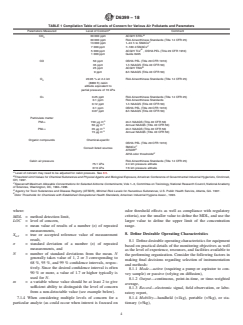
6.2.8 Table 1 gives an example of compilation of levels of
concern for selected contaminants.
6.1 Identification of the level of concern for each analyte of
interest is essential for defining data quality objectives. The 6.3 Refer to Guide D7034 for procedures to develop expo-
level of concern for each analyte is identified from review of
sure scenarios and to define and calculate appropriate levels of
applicable regulations, standards, and guidelines. concernforthepopulationunderconsiderationandthetypesof
health impacts being assessed, for example, cancer effects,
6.2 Use the following sources to compile levels of concerns
chronic non-cancer effects, acute effects, and odor concerns.
for each analyte identified for monitoring.Additional sources
may apply outside of the US:
7. Define Minimum Data Quality Objectives
6.2.1 FAA Airworthiness Standards (14 CFR 21), which
7.1 For each analyte, specify minimum data quality objec-
specify acceptable exposure levels for ozone, carbon dioxide,
tives in terms of concentration range, method detection limit,
carbon monoxide, and cabin pressure that explicitly apply to
precision, and bias.
the aircraft cabin environment;
7.1.1 Specify an upper limit of the concentration range that
6.2.2 Spacecraft Maximum Allowable Concentrations
is at least twice the level of concern.
(SMACs), which have been defined for chemicals under
7.1.2 Specify the precision and bias necessary to achieve
exposure conditions ranging from1hto180 days for the space
acceptable statistical confidence when comparing a measured
program;
value with the level of concern. The 99 % confidence level is
6.2.3 The Clean Air Act (40 CFR Part 50), which specifies
commonly used as a basis for comparison. For example, given
acceptable limits for general population exposure to criteria
a level of concern of 100 ppm and considering a measurement
pollutants (ozone, carbon monoxide, oxides of nitrogen, sulfur
system having 10 % precision, the 99 % confidence interval
dioxide, particulate matter, and lead), and also regulates
(that is, 3 standard deviations) extends from 70 ppm to 130
population exposure to emissions of nearly 200 hazardous air
ppm. Thus, a measured value of 69 ppm would be interpreted
pollutants;
with 99 % confidence as being below the level of concern. On
the other hand, a value of 71 ppm would be interpreted with 99
% confidence as being indistinguishable from the level of
Preparing a list of analytes of interest, if not available, requires considerable
effort such as review of results of past studies on cabin air quality, assessment of
concern.
sources of air contaminants, and consultation with toxicologists and health effects
7.1.3 Specify the method detection limit (MDL) such that
specialists (for example, physicians and epidemiologists) to assess potential causes
the MDL is well below the level of concern, considering the
of suspected or actual health effects or symptoms. As stated in the scope, the
development of a list of analytes is not within the scope of this guide. bias:
D6399 − 18
TABLE 1 Compilation Table of Levels of Concern for Various Air Pollutants and Parameters
A
Parameters Measured Level of Concern Comment
B
CO 30 000 ppm ACGIH STEL
30 000 ppm FAA Airworthiness Standards (Title 14 CFR 25)
C
13 000 ppm 1–24 h to SMACs
C
7 000 ppm 7–180 d SMACs
B
5 000 ppm ACGIH TLV , OSHA PEL (Title 29 CFR 1910)
1 000 ppm Guide 6245
CO 50 ppm OSHA PEL (Title 29 CFR 1910)
35 ppm 1-h NAAQS (Title 40 CFR 50)
B
25 ppm ACGIH TWA
9 ppm 8-h NAAQS (Title 40 CFR 50)
O 20.95 % at 2.4 km FAA Airworthiness Standards (Title 14 CFR 25)
(8000 ft) cabin
altitude equivalent to
partial pressure of 16 kPa
O 0.25 ppm FAA Airworthiness Standards (Title 14 CFR 25)
0.1 ppm FAA Airworthiness Standards
0.12 ppm 1-h NAAQS (Title 40 CFR 50)
0.1 ppm OSHA PEL (Title 29 CFR 1910)
0.07 ppm 8-h NAAQS (Title 40 CFR 50)
Particulate matter
-3
PM 150 µg m 24-h NAAQS (Title 40 CFR 50)
-3
50 µg m Annual NAAQS (Title 40 CFR 50)
-3
PM 35 µg m 24-h NAAQS (Title 40 CFR 50)
2.5
-3
15 µg m Annual NAAQS (Title 40 CFR 50)
Organic compounds Chemical-specific
OSHA PEL (Title 29 CFR 1910)
C
SMACs
Consult listed sources
D
ATSDR
E
AIHA odor thresholds
Cabin air pressure FAA Airworthiness Standards (Title 14 CFR 25)
75.1 kPa 2.4 km pressure altitude
37.6 kPa 7.6 km pressure altitude
A
Level of concern may need to be adjusted for cabin pressure. See 8.5.
B
Threshold Limit Values for Chemical Substances and PhysicalAgents and Biological Exposure, American Conference of Governmental Industrial Hygienists, Cincinnati,
OH, 1997.
C
Spacecraft MaximumAllowable Concentrations for SelectedAirborne Contaminants, Vols 1–3, Committee on Toxicology, National Research Council, National Academy
of Sciences, Washington, DC, 1994–1996.
D
Agency for Toxic Substances and Disease Registry (ATSDR), Minimal Risk Levels for Hazardous Substances, U.S. Public Health Service, Atlanta, GA. 1997.
E
Odor Thresholds for Chemicals with Established Occupational Health Standards, American Industrial Hygiene Assoc., 1993.
where: odor threshold effects as well as compliance with regulatory
criteria), use the smaller value to define the MDL, and use the
MDL = method detection limit,
larger value to define the upper limit of the concentration
LOC = level of concern,
= mean value of results of a number (n) of repeated range.
measurements,
8. Define Desirable Operating Characteristics
X = true or accepted reference value of measurement
ref
result,
8.1 Define desirable operating characteristics for equipment
σ = standard deviation of a number (n) of repeated
based on practical details of the monitoring objectives as well
measurements, and
as the level of experience, resources, and facilities available to
N = number of standard deviations from the mean. N
the performing organization. Consider the following factors in
generally takes value of 1, 2 or 3 corresponding to
making final decisions regarding selection of instrumentation
68 %, 95 %, and 99 % confidence intervals, respec-
and methods:
tively. Since the desired confidence interval is often
8.1.1 Mode—active (requiring a pump or aspirator to con-
90 % or more, a value of 1.7 or higher typically is
vey sample) or passive (relying on diffusion),
used for N.
8.1.2 Output—continuous, point-in-time, or time-weighted
m = a variable whose value should be at least 2 to give
average,
sufficient ability to distinguish the level of concern
8.1.3 Record—electronic signal, field observation, or labo-
from a non-detectable value (see example below).
ratory report,
7.1.4 When considering multiple levels of concern for a 8.1.4 Mobility—handheld (<1kg), portable (<5kg), or sta-
particular analyte (as could occur when interest is focused on tionary (>5kg),
D6399 − 18
8.1.5 Power—battery, standard alternating current, or 9.2 For commonly monitored pollutants, select from the
mechanical, technologies listed in Tables 2-10 which give examples of
8.1.6 Calibration—standard atmospheres, co-located
technologiesforeachpollutantorpollutantgroup.Thesetables
references, laboratory procedures or factory procedures, or include a wide range of technologies to give readers a feel for
both, and
what is available. Several of these technologies are appropriate
8.1.7 Ancillary Data—temperature, relative humidity, and foruseinmeasuringcabinairquality.Thosethatareclearlynot
air pressure may be required to adjust data to a common basis
appropriate are so indicated in these tables. A set of recom-
(for example, sea-level equivalent).
mendations are offered in a later section.
8.2 All electronic equipment operated in the aircraft cabin
9.3 For analytes not covered by Tables 2-10, consultASTM
must be certified for electromagnetic compatibility with avi-
standard test methods as well as compilations published by
onic systems (see, for example, RTCA/DO-160).
organizations such as USEPA (3, 4), NIOSH (5), and other
publications (6, 7, 8, 9, 10) to identify instruments and test
8.3 Instrumentation selected for aircraft cabin monitoring
methods.
must be sufficiently stable to allow for acceptable operation for
8 or more h. Calibrations and zero/span checks may be
9.4 If available equipment does not meet one or more data
conducted in a ground facility before and after a flight.
quality objectives, then select technologies of lesser capabili-
Calibrations generally are not performed aboard the aircraft
ties provided that changes to the affected data quality objec-
because the use of pressurized gases and the handling of toxic
tives do not increase statistical uncertainty to unacceptable
materials is prohibited in the aircraft cabin.
levels.
8.4 All electronic equipment taken aboard the aircraft must
9.4.1 It should be recognized that relationships defined in
be sufficiently stable to be turned off during ascent and descent
7.1.2 and 7.1.3 using the level of concern to determine
without loss of calibration.
instrument performance represents an ideal that practical
8.5 At a minimum, cabin pressure should be monitored to
instrumentation sometimes cannot meet.
permit correcting data for reduced air density at altitude.
9.4.2 Less-than-idealperformancecanbeaccommodatedby
Special equipment and procedures may be required to verify
accepting reduced statistical confidence or by reappraising
correction factors for some technologies. It should be noted
measurement objectives. Given a level of concern at 100 ppm,
that simple pressure-altitude corrections are not sufficient since
for example, the 99 % confidence interval for an instrument or
monitoring technologies such as non-dispersive infra red
method characterized by 620 % precision and bias would
(NDIR) have a systematic error caused by pressure differences
extend from 40 ppm to 160 ppm while the 90 % confidence
which need to be addressed.
intervalwouldextendfrom66ppmto134ppm.Suchamethod
or instrument would be acceptable for objectives focused on
9. Select Instruments and Test Methods
determining whether or not environmental concentrations ex-
9.1 For each analyte, identify available instruments and test ceed the level of concern, but results may be unacceptable if
methods using data quality objectives and operating objectives seek definitive statements regarding low concentra-
characteristics, as described below. tions.
TABLE 2 Operating Characteristics of Instrumentation and Methods for Monitoring Aldehydes and Ketones
Technology Guidance Comments
Sorbent Tube – sample gases are collected Test Method D5197 Field apparatus is compact. Requires external pump. Requires sophisticated labora-
A,B
using a cartridge with DNPH-coated EPA Methods tory. O at high concentrations interferes negatively. Approximate costs: <$15 per
sorbent that is returned to the laboratory Range: 0.01–5 ppm tube plus pump (;$500) and laboratory analysis ($100 to $1000).
for analysis of individual compounds by Bias: ±10 %
HPLC. Precision: ±10 %
MDL: 0.0005 ppm
B
Liquid Impingement – sample is absorbed in EPA Methods Field apparatus is compact, but requires liquid-filled impinger. Requires external pump.
DNPH solution and returned to the labora- Range: 0.01–5 ppm Requires sophisticated laboratory. O at high concentrations interferes negatively.
tory for analysis of individual compounds Bias: ±10 % Approximate costs: ;$50 for impinger plus pump (;$500) and laboratory analysis
by HPLC. Precision: ±10 % (;$100). Impractical for use in aircraft passenger cabins.
MDL: 0.0005 ppm
Colorimetric Tube – sample gases are Practice D4490 Requires external air pump (may be hand-powered). Disposable system (single use)
drawn through a chemically treated sor- Range: 0.2–100 ppm that relies on factory calibration. Resolution is generally lower than other technolo-
bent bed that changes color in the pres- Bias: ±25 % gies. Separate type of tube required for each aldehyde and ketone of interest. Ap-
ence of a specific aldehyde or ketone; Precision: - - proximate costs: $10 per tube plus pump (;$300). Inappropriate for quantitative
length of color stain is correlated with con- MDL: - - measurements of cabin air quality.
centration.
A
Compendium of Methods for the Determination of Air Pollutants in Indoor Air, Report No. EPA/600/4-90/010, U.S. Environmental Protection Agency, Office of Research
and Development, Research Triangle Park, NC, 1990, https://nepis.epa.gov/Exe/ZyPURL.cgi?Dockey=P1004G22.txt.
B
Compendium of Methods for the Determination of Toxic Organic Compounds in Ambient Air, 2nd ed., Report No. EPA/625/R-96/010b, U.S. Environmental Protection
Agency, Cincinnati, OH, 1999.
D6399 − 18
TABLE 3 Operating Characteristics of Instrumentation and Methods for Monitoring Carbon Dioxide
Technology Guidance Comments
Non-Dispersive Infrared (NDIR) Spectrometry OSHA ID-172 Very specific for CO ; portable units are available. Some units require an
A
– absorption of infrared radiation by CO in Woebkenberg external pump. Approximate costs: $500 (handheld) $5 000 to $10 000
a sample cell is compared to that of a Range: 20–500 000 ppm (portable or stationary).
reference (CO -free) absorption path. Bias: ±50 ppm
Precision: ±50 ppm
MDL: 200 ppm
Colorimetric Tube – sample gases are drawn Practice D4490 Requires external air pump (may be hand-powered). Disposable system (single
through a chemically treated sorbent bed Range: 100–200 000 ppm use) that relies on factory calibration. Resolution is generally lower than other
that changes color in the presence of CO ; Bias: ±25 % technologies. Approximate costs: $10 per tube plus pump (;$300). Inappro-
length of color stain is correlated with Precision: - - priate for quantitative measurements of cabin air quality.
concentration.
MDL: - -
A
Woebkenberg, M.L., and McCammon, C.S., “Direct-Reading Gas and Vapor Instruments.” Air Sampling Instruments, Cohen, B.S., and Hering, S.V., eds., American
Conference of Governmental Industrial Hygienists, Inc., Cincinnati, OH, 1995, pp. 439–510.
TABLE 4 Operating Characteristics of Instrumentation and Methods for Monitoring Carbon Monoxide
Technology Guidance Comments
A
Electrochemical – sample air is passed through Nagda et al
...
This document is not an ASTM standard and is intended only to provide the user of an ASTM standard an indication of what changes have been made to the previous version. Because
it may not be technically possible to adequately depict all changes accurately, ASTM recommends that users consult prior editions as appropriate. In all cases only the current version
of the standard as published by ASTM is to be considered the official document.
Designation: D6399 − 10 D6399 − 18
Standard Guide for
Selecting Instruments and Methods for Measuring Air
Quality in Aircraft Cabins
This standard is issued under the fixed designation D6399; the number immediately following the designation indicates the year of
original adoption or, in the case of revision, the year of last revision. A number in parentheses indicates the year of last reapproval. A
superscript epsilon (´) indicates an editorial change since the last revision or reapproval.
1. Scope
1.1 This guide covers information and guidance for the selection of instrumentation and test methods for measuring air quality
in aircraft passenger cabins as well as in areas limited to flightcrew access.
1.2 This guide assumes that a list of pollutants to be measured, or analytes of interest, which are present, or may be present,
in aircraft cabins is available.
1.3 This guide provides information and guidance to identify levels of concern pertaining to public and occupational exposures
to relevant air pollutants. This guide does not address levels of concern, if any, related to degradation of materials or aircraft
components because of the presence of air pollutants.
1.4 Based on levels of concern for public and occupational exposures for each pollutant of interest, this guide provides
recommendations for developing three aspects of data quality objectives (a) detection limit; (b) precision; and (c) bias.
1.5 This guide summarizes information on technologies for measurement of different groups or classes of air pollutants to
provide a basis for selection of instruments and methods. The guide also identifies information resources on types of available
measurement systems.
1.6 This guide provides general recommendations for selection of instruments and methods. These recommendations are based
on concepts associated with data quality objectives discussed in this guide and the information on available instruments and
methods summarized in this guide.
1.7 This guide is specific to chemical contaminants and does not address bioaerosols, which may be present in the cabin
environment.
1.8 This guide does not provide details on use or operation of instruments or methods for the measurement of cabin air quality.
1.9 This guide does not provide information on the design of a monitoring strategy, including issues such as frequency of
measurement or placement of samplers.
1.10 Users of this guide should be familiar with, or have access to, individuals who have a background in (a) use of instruments
and methods for measurement of air pollutants and (b) principles of toxicology and health-effects of environmental exposure to
air pollutants.
1.11 The values stated in SI units are to be regarded as standard. No other units of measurement are included in this standard.
1.12 This standard does not purport to address all of the safety concerns, if any, associated with its use. It is the responsibility
of the user of this standard to establish appropriate safety safety, health, and healthenvironmental practices and determine the
applicability of regulatory limitations prior to use.
1.13 This international standard was developed in accordance with internationally recognized principles on standardization
established in the Decision on Principles for the Development of International Standards, Guides and Recommendations issued
by the World Trade Organization Technical Barriers to Trade (TBT) Committee.
2. Referenced Documents
2.1 ASTM Standards:
D1356 Terminology Relating to Sampling and Analysis of Atmospheres
This guide is under the jurisdiction of ASTM Committee D22 on Air Quality and is the direct responsibility of Subcommittee D22.05 on Indoor Air.
Current edition approved April 1, 2010March 1, 2018. Published May 2010April 2018. Originally approved in 1999. Last previous edition approved in 20042010 as
D6399 – 04.D6399 – 10. DOI: 10.1520/D6399-10.10.1520/D6399-18.
For referenced ASTM standards, visit the ASTM website, www.astm.org, or contact ASTM Customer Service at service@astm.org. For Annual Book of ASTM Standards
volume information, refer to the standard’s Document Summary page on the ASTM website.
Copyright © ASTM International, 100 Barr Harbor Drive, PO Box C700, West Conshohocken, PA 19428-2959. United States
D6399 − 18
D1914 Practice for Conversion Units and Factors Relating to Sampling and Analysis of Atmospheres
D3162 Test Method for Carbon Monoxide in the Atmosphere (Continuous Measurement by Nondispersive Infrared Spectrom-
etry)
D3631 Test Methods for Measuring Surface Atmospheric Pressure
D4023 Terminology Relating to Humidity Measurements (Withdrawn 2002)
D4490 Practice for Measuring the Concentration of Toxic Gases or Vapors Using Detector Tubes
D4861 Practice for Sampling and Selection of Analytical Techniques for Pesticides and Polychlorinated Biphenyls in Air
D5149 Test Method for Ozone in the Atmosphere: Continuous Measurement by Ethylene Chemiluminescence
D5156 Test Methods for Continuous Measurement of Ozone in Ambient, Workplace, and Indoor Atmospheres (Ultraviolet
Absorption)
D5197 Test Method for Determination of Formaldehyde and Other Carbonyl Compounds in Air (Active Sampler Methodology)
D5466 Test Method for Determination of Volatile Organic Compounds in Atmospheres (Canister Sampling Methodology)
D6196 Practice for Choosing Sorbents, Sampling Parameters and Thermal Desorption Analytical Conditions for Monitoring
Volatile Organic Chemicals in Air
D6245 Guide for Using Indoor Carbon Dioxide Concentrations to Evaluate Indoor Air Quality and Ventilation
D7034 Guide for Deriving Acceptable Levels of Airborne Chemical Contaminants in Aircraft Cabins Based on Health and
Comfort Considerations
2.2 Other Standards:
14 CFR 25 Airworthiness Standards
29 CFR 1910.1450 Occupational Exposure to Hazardous Chemicals in Laboratories
40 CFR 50 National Ambient Air Quality Standards
40 CFR 53 Ambient Air Monitoring Reference and Equivalent Methods
40 CFR 60 Standards of Performance for New Stationary Sources—Appendix A: Test Methods
RTCA/DO-160 Environmental Conditions and Test Procedures for Airborne Equipment
3. Terminology
3.1 Definitions—For definitions of terms used in this guide, refer to Terminology D1356.
3.2 Definitions of Terms Specific to This Standard:
3.2.1 analyte, n—designated chemical species to be measured by a monitor or to be identified and quantitated by an analyzer.
3.2.2 bioaerosol, n—airborne material of biological origin, including viable microorganisms, pollens, spores, bacteria, viruses,
allergens, and biological debris.
3.2.3 ceiling limit, n—a maximum allowable air concentration, established by the Occupational Safety and Health Adminis-
tration (OSHA), that must not be exceeded during any part of the workday.
3.2.4 concentration range, n—a semiquantitative term referring to the extreme uppermost portion of the distribution of
anticipated measurements. This term (and the dose or risk analogues) traditionally refers to the portion of the distribution that
th
conceptually falls above about the 98 percentile of the distribution, but is not higher than the highest individual measurement.
3.2.4.1 Discussion—
This term (and the dose or risk analogues) traditionally refers to the portion of the distribution that conceptually falls above about
th
the 98 percentile of the distribution, but is not higher than the highest individual measurement.
3.2.5 data quality objectives (DQOs), n—qualitative and quantitative statements of the overall level of uncertainty that a
decision-maker is willing to accept in results or decisions derived from environmental data. Minimum DQOs include method
detection limit, precision, and bias.
3.2.5.1 Discussion—
Minimum DQOs include method detection limit, precision, and bias.
3.2.6 level of concern, n—an exposure level or concentration that is not to be exceeded by regulation or, for unregulated
pollutants, an exposure level or concentration that is believed to be associated with odor, sensory irritation, and other adverse health
or toxic effects.
The last approved version of this historical standard is referenced on www.astm.org.
Available from U.S. Government Printing Office, Superintendent of Documents, 732 N. Capitol St., NW, Washington, DC 20401-0001, http://www.access.gpo.gov.
Available from Radio Technical Commission for Aeronautics (RTCA), 1150 18th NW, Suite 910, Washington, DC 20036, https://www.rtca.org.
D6399 − 18
3.2.7 lowest-observed-adverse-effect level (LOAEL), n—the lowest exposure at which there is a significant increase in an
observable effect.dose of a chemical in a study or group of studies that produce statistically or biologically significant increases
in frequency or severity of adverse effects between the exposed population and its appropriate control.
3.2.7.1 Discussion—
See A Review of the Reference Dose and Reference Concentration Processes (1).
3.2.8 no-observed-adverse-effect level (NOAEL), n—the highest exposure among all the available experimental studies at which
no adverse health or toxic effect is observed.dose of chemical at which there are no statistically or biologically significant increases
in frequency or severity of adverse effects seen between the exposed population and its appropriate control.
3.2.8.1 Discussion—
Effects may be produced at this dose, but they are not considered to be adverse. See A Review of the Reference Dose and Reference
Concentration Processes (1).
3.2.9 overall uncertainty (OU), n—quantity used to characterize, as a whole, the statistical uncertainty of a measurement result
compared to a true or accepted value. The overall uncertainty is expressed as a percentage that combines bias and precision. For
a given statistical confidence level (Nσ), the overall percent uncertainty may be calculated using the following formula:
¯
X 2 X 1Nσ
? ?
REF
OU 5S D3100 (1)
X
REF
where:
X¯ = mean value of results of a number (n) of repeated measurements,
X = true or accepted reference value of measurement result,
ref
σ = standard deviation of a number (n) of repeated measurements, and
N = number of standard deviations from the mean. N generally takes value of 1, 2 or 3 corresponding to 68 %, 95 %, and 99 %
confidence intervals, respectively. Since the desired confidence interval is often 90 % or more, a value of 1.7 or higher
typically is used for N.
For example, given a precision and bias of 610 %, and a desired confidence interval of 95 %, the overall uncertainty using Eq
1 will be 30 %.
3.2.10 permissible exposure limit (PEL), n—the OSHA-mandated time-weighted-average (TWA) concentration of a chemical
in air that must not be exceeded during any 8-h workshift or 40-h work week.
3.2.9 safety factor, n—a dimensionless number, greater than unity, to account for incomplete understanding of errors
encountered in extrapolating exposure or health effects derived for one set of conditions or basis to another.
3.2.10 spacecraft maximum allowable concentrations (SMACs), n—developed by the National Aeronautics and Space
Administration and the Committee on Toxicology from the National Research Council, based on exposure duration of 1 h to 180
days.
3.2.13 short-term-exposure limit (STEL), n—American Conference of Governmental Industrial Hygienists (ACGIH)-
recommended 15-min TWA air concentration for a chemical which should not be exceeded at any time during a workday, even
if the 8-h TWA concentration is within the threshold limit value (TLV).
3.2.14 threshold limit value (TLV), n—ACGIH-recommended TWA air concentration of a chemical for a normal 8-h workday
and a 40-h workweek, to which nearly all workers may be repeatedly exposed without adverse effects.
4. Summary of Guide
4.1 This guide provides procedures and recommendations for the selection of test methods and equipment suited to measuring
air quality in aircraft cabins.
4.2 Major steps in the selection process include identifying one or more levels of concern for each analyte to be monitored,
selecting the most appropriate level of concern for each analyte, defining minimum data quality objectives that are compatible with
the level of concern, defining desirable operating characteristics that are compatible with the aircraft cabin environment, and
selecting instruments and test methods that meet these objectives.
5. Significance and Use
5.1 This guide may be used to identify instruments and methods for measuring air quality in aircraft cabins. Such measurements
may be undertaken to:
The bold face numbers in parentheses refer to the list of references at the end of this standard.
D6399 − 18
5.1.1 Conduct monitoring surveys to characterize the aircraft cabin environment and to assess environmental conditions. Results
of such measurements could then be compared with relevant standards or guidelines for assessment of health and comfort of
passengers and flight attendants.
5.1.2 Investigate passenger and flight attendant complaints; or
5.1.3 Measure and compare the performance of new materials and systems for the aircraft cabin environment.
6. Identify and Select Levels of Concern
6.1 Identification and selection of the level of concern for each analyte of interest is the most important basis essential for
defining data quality objectives. The level of concern for each analyte is definedidentified from review of applicable regulations,
standards, and guidelines using procedures described below in guidelines.6.2 and 6.3.
6.2 Use the following sources to compile levels of concerns for each analyte identified for monitoring: monitoring. Additional
sources may apply outside of the US:
6.2.1 FAA Airworthiness Standards (14 CFR 21), which specify acceptable exposure levels for ozone, carbon dioxide, carbon
monoxide, and cabin pressure that explicitly apply to the aircraft cabin environment;
6.2.2 Spacecraft Maximum Allowable Concentrations (SMACs), which have been defined for chemicals under exposure
conditions ranging from 1 h to 180 days for the space program;
6.2.3 The Clean Air Act (40 CFR Part 50), which specifies acceptable limits for general population exposure to criteria
pollutants (ozone, carbon monoxide, oxides of nitrogen, sulfur dioxide, particulate matter, and lead), and also regulates population
exposure to emissions of nearly 200 hazardous air pollutants;
6.2.4 The Occupational Safety and Health Act of 1970 (29 CFR 1910), which establishes PELs and ceiling concentrations to
protect workers against the health effects of exposure to approximately 200 hazardous substances;
6.2.5 ACGIH Threshold Limit Values for Chemical Substances and Physical Agents and Biological Exposure Values, which
gives TLVs and STELs to define acceptable limits for workplace exposure.
6.2.6 AIHA Odor Thresholds for Chemicals with Established Occupational Health Standards is a peer-reviewed document that
contains odor thresholds for a wide variety of chemicals.
6.2.7 For analytes not covered by items 6.2.1 – 6.2.6, specialized databases may be consulted to develop levels of concern. Such
resources include the Agency for Toxic Substances and Disease Registry (ATSDR), the Health Effects Assessment Summary Tables
(HEAST), the Integrated Risk Information System (IRIS), and the Registry of Toxic Effects of Chemical Substances (RTECS)
(12)). Interpretation of these information resources requires input from a qualified toxicologist.
6.2.8 Table 1 gives an example of compilation of levels of concern for selected contaminants.
6.3 Use the following approachRefer to Guide D7034 to prioritize and select for procedures to develop exposure scenarios and
to define and calculate appropriate levels of concern for each analytethe population identified from the above sources of data:under
consideration and the types of health impacts being assessed, for example, cancer effects, chronic non-cancer effects, acute effects,
and odor concerns.
6.3.1 Since regulations applicable to the aircraft cabin environment are developed based on the knowledge and data specific to
that environment, give the highest priority to levels of concern that are part of such regulations (for example, FAA Airworthiness
Standards). Similarly, available consensus-developed guidelines for cabin air quality should be also given high priority because
these are developed considering the effects of air pollutants on passengers and flight attendants in the aircraft cabin environment.
6.3.2 Guidelines developed for the spacecraft environment such as the SMACs developed for long-term exposures, such as the
180-day exposure period, should be considered at the next level of priority. The 180-day SMACs are based on health-effect
considerations over such extended periods of time and are applicable to astronauts. These are considered as the next best alternative
to cabin air quality standards or guidelines for passengers and flight attendants because the relative susceptibility of passengers
(that is, general public) as compared to astronauts (that is, healthy worker population) is balanced against the duration of exposure
(that is, 180-day continuous exposure for astronauts versus intermittent exposure over much shorter periods of time for passengers
or even flight attendants).
6.3.3 The next level of priority is for environmental standards such as ambient air quality standards that are developed
considering health effects of exposures to air contaminants by the public.
6.3.4 The next level of priority is for standards or guidelines for occupational exposures. It should be pointed out that, while
the aircraft cabin environment includes exposure of the general public (passengers) and occupational exposure (flight attendants)
in the same airspace, the limits of exposure for the public should be used, as those are more stringent. The reason for stringency
is that the public includes segments of more susceptible populations such as children, as compared to healthy workers that are
included in considerations for occupational exposures.
6.3.5 If a workplace standard is the only basis for defining a level of concern associated with passenger exposure, then a safety
factor should be considered to account for uncertainties. Sources of uncertainty include (a) extrapolating toxicological data from
Preparing a list of analytes of interest, if not available, requires considerable effort such as review of results of past studies on cabin air quality, assessment of sources
of air contaminants, and consultation with toxicologists and health effects specialists (for example, physicians and epidemiologists) to assess potential causes of suspected
or actual health effects or symptoms. As stated in the scope, the development of a list of analytes is not within the scope of this guide.
D6399 − 18
TABLE 1 Compilation Table of Levels of Concern for Various Air Pollutants and Parameters
A
Parameters Measured Level of Concern Comment
A
CO 30 000 ppmv ACGIH STEL
B
CO 30 000 ppm ACGIH STEL
30 000 ppmv FAA Airworthiness Standards (Title 14 CFR 25)
30 000 ppm FAA Airworthiness Standards (Title 14 CFR 25)
B
13 000 ppmv 1-24 h to SMACs
C
13 000 ppm 1–24 h to SMACs
B
7 000 ppmv 7-180 d SMACs
C
7 000 ppm 7–180 d SMACs
A
5 000 ppmv ACGIH TLV , OSHA PEL (Title 29 CFR 1910)
B
5 000 ppm ACGIH TLV , OSHA PEL (Title 29 CFR 1910)
1 000 ppmv Guide 6245
1 000 ppm Guide 6245
CO 50 ppmv OSHA PEL (Title 29 CFR 1910)
CO 50 ppm OSHA PEL (Title 29 CFR 1910)
35 ppmv 1-h NAAQS (Title 40 CFR 50)
35 ppm 1-h NAAQS (Title 40 CFR 50)
A
25 ppmv ACGIH TWA
B
25 ppm ACGIH TWA
9 ppmv 8-h NAAQS (Title 40 CFR 50)
9 ppm 8-h NAAQS (Title 40 CFR 50)
O 20.95 % at 2.4 km FAA Airworthiness Standards (Title 14 CFR 25)
km (8000 ft) cabin
(8000 ft) cabin
altitude equivalent to
partial pressure of 16 kPa
O 0.25 ppmv FAA Airworthiness Standards (Title 14 CFR 25)
O 0.25 ppm FAA Airworthiness Standards (Title 14 CFR 25)
0.1 ppmv FAA Airworthiness Standards
0.1 ppm FAA Airworthiness Standards
0.12 ppmv 1-h NAAQS (Title 40 CFR 50)
0.12 ppm 1-h NAAQS (Title 40 CFR 50)
0.1 ppmv OSHA PEL (Title 29 CFR 1910)
0.1 ppm OSHA PEL (Title 29 CFR 1910)
0.08 ppmv 8-h NAAQS (Title 40 CFR 50)
0.07 ppm 8-h NAAQS (Title 40 CFR 50)
Particulate matter
-3
PM 150 μg m 24-h NAAQS (Title 40 CFR 50)
-3
50 μg m Annual NAAQS (Title 40 CFR 50)
-3
PM 65 μg m 24-h NAAQS (Title 40 CFR 50)
2.5
-3
PM 35 μg m 24-h NAAQS (Title 40 CFR 50)
2.5
-3
15 μg m Annual NAAQS (Title 40 CFR 50)
Organic compounds Chemical-specific
OSHA PEL (Title 29 CFR 1910)
OSHA PEL (Title 29 CFR 1910)
;1-100 ppmv
B
to < 0.01 ppmv SMACs
Consult listed sources
C
SMACs
C
to < 0.01 ppmv ATSDR
D
ATSDR
D
to < 0.01 ppmv AIHA odor thresholds
E
AIHA odor thresholds
Cabin air pressure FAA Airworthiness Standards (Title 14 CFR 25)
75.1 kPa 2.4 km pressure altitude
37.6 kPa 7.6 km pressure altitude
A
Level of concern may need to be adjusted for cabin pressure. See 8.5.
B
Threshold Limit Values for Chemical Substances and Physical Agents and Biological Exposure, American Conference of Governmental Industrial Hygienists, Cincinnati,
OH, 1997.
C
Spacecraft Maximum Allowable Concentrations for Selected Airborne Contaminants.Contaminants, Vols.Vols 1–3, Committee on Toxicology, National Research Council,
National Academy of Sciences, Washington, DC, 1994-96.1994–1996.
D
Agency for Toxic Substances and Disease Registry (ATSDR), Minimal Risk Levels for Hazardous Substances, U.S. Public Health Service, Atlanta, GA. 1997.
E
Odor Thresholds for Chemicals with Established Occupational Health Standards, American Industrial Hygiene Assoc., 1993.
controlled animal testing to estimated health effects in humans, (b) extrapolating lowest-observed-adverse-effect levels (LOAEL)
to a no-observed-adverse-effect level (NOAEL), and (c) variations in individual responses. Regulatory agencies usually require
safety factor values of 10, 100, or 1000 in different situations. If the NOAEL has been derived from high-quality data in humans,
then a factor less than 10 may be appropriate provided test conditions are similar to conditions under investigation. If the NOAEL
D6399 − 18
is derived from less similar or less reliable studies, then a factor such as 100 or 1000 may be required (2). The selection and use
of a safety factor should be done by a qualified toxicologist or health-effects specialist and the scientific rationale for the selected
safety factor(s) must be documented.
6.4 Table 2 illustrates levels of concern selected based on the above approach.
7. Define Minimum Data Quality Objectives
7.1 For each analyte, specify minimum data quality objectives in terms of concentration range, method detection limit,
precision, and bias.
7.1.1 Specify an upper limit of the concentration range that is at least twice the level of concern.
7.1.2 Specify the precision and bias necessary to achieve acceptable statistical confidence when comparing a measured value
with the level of concern. The 99 % confidence level is commonly used as a basis for comparison. For example, given a level of
concern of 100 ppmvppm and considering a measurement system having 10 % precision, the 99 % confidence interval (that is,
3 standard deviations) extends from 70 ppmvppm to 130 ppmv.ppm. Thus, a measured value of 69 ppmvppm would be interpreted
with 99 % confidence as being below the level of concern. On the other hand, a value of 71 ppmvppm would be interpreted with
99 % confidence as being indistinguishable from the level of concern.
7.1.3 Specify the method detection limit (MDL) such that the MDL is well below the level of concern, considering the overall
uncertainty: bias:
LOC 3 12 OU/100
~ ~ !!
MDL # (2)
m
where:
MDL = method detection limit,
LOC = level of concern,
OU = overall uncertainty (Eq 1), and
= mean value of results of a number (n) of repeated measurements,
X = true or accepted reference value of measurement result,
ref
σ = standard deviation of a number (n) of repeated measurements, and
N = number of standard deviations from the mean. N generally takes value of 1, 2 or 3 corresponding to 68 %, 95 %, and
99 % confidence intervals, respectively. Since the desired confidence interval is often 90 % or more, a value of 1.7 or
higher typically is used for N.
m = a variable whose value should be at least 2 to give sufficient ability to distinguish the level of concern from a
non-detectable value (see example below).
Given a level of concern at 100 ppmv and an overall uncertainty of 30 %, for example, the level of concern minus the overall
uncertainty would be at 70 ppmv. Using a value of 2 for m in Eq 2 will specify a MDL of 35 ppmv, which is about one-third of
the level of concern. Using a more conservative value of 5 for m will result in a more stringent MDL of 14 ppmv.
7.1.4 When considering multiple levels of concern for a particular analyte (as could occur when interest is focused on odor
threshold effects as well as compliance with regulatory criteria), use the smaller value to define the MDL, and use the larger value
to define the upper limit of the concentration range.
8. Define Desirable Operating Characteristics
8.1 Define desirable operating characteristics for equipment based on practical details of the monitoring objectives as well as
the level of experience, resources, and facilities available to the performing organization. Consider the following factors in making
final decisions regarding selection of instrumentation and methods:
8.1.1 Mode–activeMode—active (requiring a pump or aspirator to convey sample) or passive (relying on diffusion),
8.1.2 Output–continuous,Output—continuous, point-in-time, or time-weighted average,
8.1.3 Record–electronicRecord—electronic signal, field observation, or laboratory report,
8.1.4 Mobility–handheldMobility (< 1kg), portable (< 5kg), —handheld (<1kg), portable (<5kg), or stationary (>5kg),
8.1.5 Power–battery,Power—battery, standard alternating current, or mechanical,
8.1.6 Calibration–standardCalibration—standard atmospheres, co-located references, laboratory procedures or factory
procedures, or both, and
8.1.7 Ancillary Data–temperature,Data—temperature, relative humidity, and air pressure may be required to adjust data to a
common basis (for example, sea-level equivalent).
8.2 All electronic equipment operated in the aircraft cabin must be certified for electromagnetic compatibility with avionic
systems (see, for example, RTCA/DO-160).
8.3 Instrumentation selected for aircraft cabin monitoring must be sufficiently stable to allow for acceptable operation for 8 or
more h. Calibrations and zero/span checks may be conducted in a ground facility before and after a flight. Calibrations generally
are not performed aboard the aircraft because the use of pressurized gases and the handling of toxic materials is prohibited in the
aircraft cabin.
D6399 − 18
8.4 All electronic equipment taken aboard the aircraft must be sufficiently stable to be turned off during ascent and descent
without loss of calibration.
8.5 At a minimum, cabin pressure should be monitored to permit correcting data for reduced air density at altitude. Special
equipment and procedures may be required to verify correction factors for some technologies. It should be noted that simple
pressure-altitude corrections are not sufficient since monitoring technologies such as non-dispersive infra red (NDIR) have a
systematic error caused by pressure differences which need to be addressed.
9. Select Instruments and Test Methods
9.1 For each analyte, identify available instruments and test methods using data quality objectives and operating characteristics,
as described below.
9.2 For commonly monitored pollutants, select from the technologies listed in Tables 3-2-1110 which give examples of
technologies for each pollutant or pollutant group. These tables include a wide range of technologies to give readers a feel for what
is available. Several of these technologies are appropriate for use in measuring cabin air quality. Those that are clearly not
appropriate are so indicated in these tables. A set of recommendations are offered in a later section.
TABLE 3 Operating Characteristics of Instrumentation and Methods for Monitoring Aldehydes and Ketones
Technology Guidance Comments
Sorbent Tube – sample gases Test Method D5197 Field apparatus is compact. Requires external pump. Requires
are collected using a cartridge EPA Methods
with DNPH-coated sorbent Range: 0.01-5
that is returned to the Bias: ± 10 %
laboratory for analysis of Precision: ± 10
individual compounds by MDL: 0.0005
HPLC.
B
Liquid Impingement - sample EPA Methods Field apparatus is compact, but requires
is absorbed in DNPH solution Range: 0.01-5
and returned to the laboratory Bias: ± 10 %
for analysis of individual Precision: ± 10
compounds by HPLC. MDL: 0.0005
pump (;$500) and laboratory analysis
(; $100). Impractical for use in aircraft passenger cabins.
Colorimetric Tube - - sample Practice D4490 Requires external air pump (may be hand-
gases are drawn through a Range: 0.2-100 ppmv powered). Disposable system (single use) that
chemically treated sorbent Bias: ± 25 % relies on factory calibration. Resolution is
bed that changes color in the Precision: - - generally lower than other technologies.
presence of a specific MDL: - -
aldehyde or ketone; length of aldehyde and ketone of interest. Approximate
color stain is correlated with costs: $10 per tube plus pump (;$300).
concentration. Inappropriate for quantitative measurements
of cabin air quality.
TABLE 2 Operating Characteristics of Instrumentation and Methods for Monitoring Aldehydes and Ketones
Technology Guidance Comments
Sorbent Tube – sample gases are collected Test Method D5197 Field apparatus is compact. Requires external pump. Requires sophisticated labora-
A,B
using a cartridge with DNPH-coated EPA Methods tory. O at high concentrations interferes negatively. Approximate costs: <$15 per
sorbent that is returned to the laboratory Range: 0.01–5 ppm tube plus pump (;$500) and laboratory analysis ($100 to $1000).
for analysis of individual compounds by
Bias: ±10 %
HPLC. Precision: ±10 %
MDL: 0.0005 ppm
B
Liquid Impingement – sample is absorbed in EPA Methods Field apparatus is compact, but requires liquid-filled impinger. Requires external pump.
DNPH solution and returned to the labora- Range: 0.01–5 ppm Requires sophisticated laboratory. O at high concentrations interferes negatively.
tory for analysis of individual compounds Bias: ±10 % Approximate costs: ;$50 for impinger plus pump (;$500) and laboratory analysis
by HPLC. (;$100). Impractical for use in aircraft passenger cabins.
Precision: ±10 %
MDL: 0.0005 ppm
Colorimetric Tube – sample gases are Practice D4490 Requires external air pump (may be hand-powered). Disposable system (single use)
drawn through a chemically treated sor- Range: 0.2–100 ppm that relies on factory calibration. Resolution is generally lower than other technolo-
bent bed that changes color in the pres- Bias: ±25 % gies. Separate type of tube required for each aldehyde and ketone of interest. Ap-
ence of a specific aldehyde or ketone; Precision: - - proximate costs: $10 per tube plus pump (;$300). Inappropriate for quantitative
length of color stain is correlated with con- MDL: - - measurements of cabin air quality.
centration.
A
Compendium of Methods for the Determination of Air Pollutants in Indoor Air, Report No. EPA/600/4-90/010.EPA/600/4-90/010, U.S. Environmental Protection Agency,
Office of Research and Development, Research Triangle Park, NC, 1990.1990, https://nepis.epa.gov/Exe/ZyPURL.cgi?Dockey=P1004G22.txt.
B
Compendium of Methods for the Determination of Toxic Organic Compounds in Ambient Air, U. S. 2nd ed., Report No. EPA/625/R-96/010b, U.S. Environmental Protection
Agency, Research Triangle Park, NC, 1988.Cincinnati, OH, 1999.
D6399 − 18
TABLE 4 Operating Characteristics of Instrumentation and Methods for Monitoring Carbon Dioxide
Technology Guidance Comments
Non-dispersive infrared OSHA ID-172 Very specific for CO ; portable units are
(NDIR) spectrometry – Woebkenberg
absorption of infrared Range: 20-20,000
radiation by CO in a sample Bias: ± 50 ppm
cell is compared to that of a Precision: ± 50
reference (CO -free) MDL: 200 ppmv
absorption cell
Colorimetric Tube – sample Practice D4490 Requires external air pump (may be hand-
gases are drawn through a Range: 100-200,000 ppmv powered). Disposable system (single use)
chemically treated sorbent Bias: ± 25 % that relies on factory calibration. Resolution
bed that changes color in the Precision: - - is generally lower than other technologies.
presence of CO ; length of MDL: - - Approximate costs: $10 per tube plus
color stain is correlated with pump (;$300). Inappropriate for
concentration quantitative measurements of cabin air
quality.
TABLE 3 Operating Characteristics of Instrumentation and Methods for Monitoring Carbon Dioxide
Technology Guidance Comments
Non-Dispersive Infrared (NDIR) Spectrometry OSHA ID-172 Very specific for CO ; portable units are available. Some units require an
A
– absorption of infrared radiation by CO in Woebkenberg external pump. Approximate costs: $500 (handheld) $5 000 to $10 000
a sample cell is compared to that of a Range: 20–500 000 ppm (portable or stationary).
reference (CO -free) absorption path. Bias: ±50 ppm
Precision: ±50 ppm
MDL: 200 ppm
Colorimetric Tube – sample gases are drawn Practice D4490 Requires external air pump (may be hand-powered). Disposable system (single
through a chemically treated sorbent bed Range: 100–200 000 ppm use) that relies on factory calibration. Resolution is generally lower than other
that changes color in the presence of CO ; Bias: ±25 % technologies. Approximate costs: $10 per tube plus pump (;$300). Inappro-
length of color stain is correlated with Precision: - - priate for quantitative measurements of cabin air quality.
concentration.
MDL: - -
A
Woebkenberg, M.L., and McCammon, C.S., “Direct-Reading Gas and Vapor Instruments.” Air Sampling Instruments, B.S. CohenCohen, B.S., and S.V. Hering, S.V., eds.,
American Conference of Governmental Industrial Hygienists, Inc., Cincinnati, OH, 1995, pp. 439-510.439–510.
9.3 For analytes not covered by Tables 3-2-1110, consult ASTM standard test methods as well as compilations published by
organizations such as USEPA (3, 4), NIOSH (5), and other publications (6, 7, 8, 9, 10) to identify instruments and test methods.
9.4 If available equipment does not meet one or more data quality objectives, then select technologies of lesser capabilities
provided that changes to the affected data quality objectives do not increase statistical uncertainty to unacceptable levels.
9.4.1 It should be recognized that relationships defined in 7.1.2 and 7.1.3 using the level of concern to determine instrument
performance represents an ideal that practical instrumentation sometimes cannot meet.
9.4.2 Less-than-ideal performance can be accommodated by accepting reduced statistical confidence or by reappraising
measurement objectives. Given a level of concern at 100 ppmv,ppm, for example, the 99 % confidence interval for an instrument
or method characterized by 620 % precision and bias would extend from 40 ppmvppm to 160 ppmvppm while the 90 %
confidence interval would extend from 66 ppmvppm to 134 ppmv.ppm. Such a method or instrument would be acceptable for
objectives focused on determining whether or not environmental concentrations exceed the level of concern, but results may be
unacceptable if objectives seek definitive statements regarding low concentrations.
9.4.3 Collecting replicate samples and averaging results can reduce statistical uncertainty associated with time-weighted-
average samples.
9.5 For each monitoring technology identified as meeting data quality objectives, evaluate operating characteristics compared
to desirable characteristics listed under Section 8.
9.5.1 Portable and handheld monitoring systems featuring battery-power are generally preferred over larger and heavier
stationary systems that require alternating current.
9.5.2 Monitoring systems featuring continuous output are generally preferred for monitoring objectives that involve examining
the impacts of short-term and episodic sources.
9.5.3 Monitoring systems designed to collect samples for subsequent analysis in the laboratory are generally preferred for
monitoring objectives that involve examining time-weighted average concentrations.
9.5.4 Not withstanding the considerations given in 9.5.1 – 9.5.3 related to operating characteristics, the first and foremost
consideration should be toward meeting the primary requirements of detection limit, precision and accuracy. Thus, a heavier or
nonportable equipment that meets these requirements would be preferred to a portable, battery powered instrument that does not
satisfy the primary requirements.
9.6 Evaluate appropriateness of the measurement instruments and methods for suitability of their use in commercial aircraft
cabins. For example, instruments requiring continuous gas supply are not appropriate as pressurized gas cylinders are not permitted
D6399 − 18
TABLE 54 Operating Characteristics of Instrumentation and Methods for Monitoring Carbon Monoxide
Technology Guidance Comments
A
Electrochemical – sample air Nagda et al.1989 Can be very specific for CO; portable units
Electrochemical – sample air is passed Nagda et al.
through a cell wherein oxidation of
CO produces a signal that is
B
is passed through a cell Woebkenberg are available.
proportional to concentration.
B
Woebkenberg
wherein oxidation of CO Range: 1-100 ppmv inlet scrubber of uncertain efficiency for
Range: 0–500 000 ppm
produces a signal that is Bias: ± 5 % some chemicals. Approximate costs: $500
Bias: ±5 %
proportional to concentration. Precision: ± 5 % (handheld) $5 000 to $10 000
Precision: ±5 %
MDL: < 1 ppmv (portable or stationary)
MDL: <1 ppm
Non-dispersive infrared Test Method D3162 Very specific for CO, EPA reference-grade
Non-Dispersive Infrared (NDIR) Spec- Test Method
trometry – absorption of infrared ra-
diation by CO in a sample cell is com-
pared to that of a reference (CO-free)
(NDIR) spectrometry – EPA 40CFR53 measurement.
absorption path.
B
absorption of infrared Woebkenberg $10 000 (portable or stationary).
radiation by CO in a sample Range: <1-100 ppmv
EPA 40CFR53
B
Woebkenberg
Range: <1–100 ppm
cell is compared to that of a Bias: ± 10 %
Bias: ±10 %
reference (CO-free) Precision: ± 10 %
Precision: ±10 %
absorption cell. MDL: 0.5 ppmv
MDL: 0.5 ppm
Colorimetric tube – sample Practice D4490 Requires external air pump (may be hand-
Colorimetric Tube – sample gases are Practice D4490
drawn through a chemically treated
sorbent bed that changes color in the
gases are drawn through a Range: 5-100 000 ppmv powered). Disposable
presence of CO; length of color stain
is correlated with concentration.
chemically treated sorbent Bias: ± 25 % that relies on factory calibration. Resolution
bed that changes color in the Precision: - - is generally lower than other technologies.
presence of CO; length of MDL: - - Approximate costs: $10 per tube plus
color stain is correlated with pump (;$300). Inappropriate for
concentration. quantitative measurements of cabin air
quality.
Range: 5–100 000 ppm
Bias: ±25 %
Precision: - -
MDL: - -
A
Nagda, N.L., Fortmann, R.C., Koontz, M.D., Baker, S.R., and Ginevan M.E.M.E., Airliner Cabin Environment: Contaminant Measurements, Health Risks, and Mitigation
Options.Options, Report No. DOT-P-15-89-5.DOT-P-15-89-5, U.S. Department of Transportation, Washington, DC, 1989.
B
Woebkenberg, M.L., and McCammon, C.S., “Direct-Reading Gas and Vapor Instruments.” Air Sampling Instruments, B.S. Cohen and S.V. Hering, eds., American
Conference of Governmental Industrial Hygienists, Inc., Cincinnati, OH, 1995, pp. 439-510.439–510.
on aircraft. For conducting measurements on passenger flights, the equipment should be safe for operating in the cabin
environment, non-intrusive, and self sufficient in terms of power requirements. For ground testing or testing on non-revenue test
flights, stationary or bench-top instruments may be appropriate, as 110–v power supply can be available.
9.7 Document Final Decisions—At a minimum, the measurement systems selection report should address the following topics:
9.7.1 Monitoring Objectives—Describe the purpose of the measurements and describe the analytes selected for measurement.
9.7.2 Levels of Concern—Summarize the basis for selecting levels of concern for each analyte.
9.7.3 Data Quality Objectives—For each analyte, summarize the basis for specifying concentration range, detection limit,
precision, and bias.
9.7.4 Selections—Summarize the basis for selecting each test method and equipment item.
10. General Recommendations for Selecting Instruments
10.1 Specify the upper limit of the concentration range to reach values at least twice the level of concern.
10.2 Specify the precision and bias to achieve an acceptable statistical uncertainty interval when comparing a measured value
with the level of concern.
D6399 − 18
TABLE 6 Operating Characteristics of Instrumentation and Methods for Monitoring Oxygen Partial Pressure
Technology Guidance Comments
Paramagnetism – magnetic Range: 0-100 % O No standard methods exist. Technology is
resistance of the air path Bias: ± 0.02 %
within a closed magnetic Precision: ± 0.03
circuit varies in proportion to MDL: - -
the O concentration are involved. Calibration can only be verified
against ambient air under field conditions.
Approximate costs: $5 000 to $10 000 (portable or stationary).
A
Electrochemical – sample air Woebkenberg No standard methods exist. Externally applied
is passed through a cell Range: 0-25
wherein reduction procedures a Bias: ± 2 % FS
signal that is proportional to Precision: - -
O concentration. MDL: - -
(handheld) $5 000 to $10 000 (portable or stationary).
Colorimetric Tube – sample Practice D4490 No standard methods exist. Requires external
gases are drawn through a Range: 5-23
chemically treated sorbent Bias: ± 25 %
bed that changes color in the Precision: - -
presence of O ; length of MDL: - -
color stain is correlated with (;$300). Inappropriate for quantitative
concentration. measurements of cabin air quality.
TABLE 5 Operating Characteristics of Instrumentation and Methods for Monitoring Oxygen Partial Pressure
Technology Guidance Comments
Paramagnetism – magnetic resistance of the air Range: 0–100 % O No standard methods exist. Technology is very specific for oxygen;
path within a closed magnetic circuit varies in requires correction for air pressure; suited for “long-life” applications
Bias: ±0.02 % O
proportion to the O concentration. Precision: ±0.03 % O because no chemical reactions are involved. Calibration can only be
verified against ambient air under field conditions. Approximate costs:
MDL: - -
$5 000 to $10 000 (portable or stationary).
Galvanic Mass Flow Oxygen Sensor Range: 0.5–95 % O Cost for portable $100–$250.
Bias: ±0.1 % O
Precision: - -
MDL: - -
A
Electrochemical – sample air is passed through a Woebkenberg No standard methods exist. Externally applied voltage and inert
cell wherein reduction procedures a signal that Range: 0–25 % O electrodes permits nondegradeable operation. Calibration can only be
is proportional to O concentration. Bias: ±2 % FS verified against ambient air under field conditions. Approximate costs:
$500 (handheld) $5 000 to $10 000 (portable or stationary).
Precision: - -
MDL: - -
Colorimetric Tube – sample chemically treated Practice D4490 No standard methods exist. Requires external air pump. Disposable
sorbent bed that changes color in the presence Range: 5–23 % system (single use) that relies on factory calibration. Resolution is
of O ; length of color stain is correlated with Bias: ±25 % generally lower than other technologies. Approximate costs: $10 per
concentration. Precision: - - tube plus pump (;$300). Inappropriate for quantitative measure-
MDL: - - ments of cabin air quality.
A
Woebkenberg, M.L. and McCammon, C.S., “Direct-Reading Gas and Vapor Instruments, Air Sampling Instruments, B.S. CohenCohen, B.S., and S.V. Hering, S
...