

ASTM D5149-02(2016)
(Test Method)Standard Test Method for Ozone in the Atmosphere: Continuous Measurement by Ethylene Chemiluminescence
General Information
- Abstract
SIGNIFICANCE AND USE
4.1 Air quality standards for ozone have been promulgated by government authorities to protect the health and welfare of the public. Though ozone itself is a toxic material, it is often complex organic compounds that cause the symptoms of smog such as tearing and burning eyes. However, ozone is the predominant oxidant and is much more easily monitored than organic species. Since ozone concentrations are also correlated with other photochemical oxidant levels, it is the substance that is specified in air quality standards and regulations.
SCOPE
1.1 This test method describes the sampling and continuous analysis of the ozone content of the atmosphere at concentrations of 20 to 2000 μg of ozone/m3 (10 ppb (v) to 1 ppm (v)).
1.2 This test method is limited in application by its sensitivity to interferences as described below. This test method is not suitable for personal sampling because of instrument size and sensitivity to vibration and ambient temperature.
1.3 This standard does not purport to address all of the safety concerns, if any, associated with its use. It is the responsibility of the user of this standard to establish appropriate safety and health practices and determine the applicability of regulatory limitations prior to use. Some specific precautionary statements are presented in Section 8.
- Status
- Published
- Publication Date
- 30-Sep-2016
- Technical Committee
- D22 - Air Quality
- Drafting Committee
- D22.03 - Ambient Atmospheres and Source Emissions
Overview
ASTM D5149-02(2016), titled Standard Test Method for Ozone in the Atmosphere: Continuous Measurement by Ethylene Chemiluminescence, provides a standardized procedure for sampling and continuously analyzing atmospheric ozone concentrations. Developed by ASTM International, this method is essential for assessing ozone levels in support of ambient air quality standards and environmental monitoring. By utilizing ethylene chemiluminescence, the method enables precise measurements of ozone, a key photochemical oxidant associated with urban smog and air pollution.
Ozone is included in regulatory standards due to its role as a predominant oxidant, its correlation with other photochemical oxidant levels, and its easier monitoring compared to complex organic species. This test method is crucial for organizations, researchers, and government agencies in effectively monitoring ozone concentrations to protect public health and meet regulatory requirements.
Key Topics
- Measurement Principle: The method is based on the detection of light emitted during the reaction between ethylene and ozone. This chemiluminescent reaction generates excited formaldehyde molecules, which emit light as they return to their ground state. The intensity of the emitted light is proportional to the ozone concentration in the sampled air.
- Sampling Range: The standard is applicable to ambient ozone concentrations from 20 to 2000 μg/m³ (10 ppb (v) to 1 ppm (v)), covering a wide range of environmental conditions.
- Instrument Requirements: Equipment must be constructed from materials inert to ozone, such as PTFE or borosilicate glass, with sampling lines and filters designed to minimize interferences.
- Interferences: Key interferences include aerosols (which can cause negative interference by scattering light) and atmospheric humidity (which can lead to positive interference). The standard addresses the use and regular maintenance of filters to minimize such impacts.
- Calibration: Calibration should be done using certified standards, typically referencing absolute ultraviolet photometry, to ensure accuracy and compliance with regulatory requirements.
- Safety Practices: The method requires handling high-voltage instruments and flammable gases (such as ethylene), along with the proper venting of excess ozone and calibration gases to prevent workplace hazards.
Applications
- Ambient Air Quality Monitoring: Widely used by environmental agencies and monitoring networks to assess compliance with ozone air quality standards.
- Regulatory Compliance: Supports government agencies in implementing and enforcing air quality regulations related to ozone exposure.
- Research and Data Collection: Facilitates atmospheric and environmental research by providing reliable continuous ozone measurements.
- Industrial and Urban Planning: Used to monitor and manage air quality in urban and industrial areas where ozone pollution is a concern.
This ASTM standard is intended for fixed-site continuous monitoring and is not suitable for personal or portable sampling due to instrument size and sensitivity to operational conditions. Data generated using this method support crucial decisions regarding public health, environmental policy, and smog control strategies.
Related Standards
- ASTM D1356: Terminology Relating to Sampling and Analysis of Atmospheres
- ASTM D1357: Practice for Planning the Sampling of the Ambient Atmosphere
- ASTM D1914: Practice for Conversion Units and Factors Relating to Sampling and Analysis of Atmospheres
- ASTM D3249: Practice for General Ambient Air Analyzer Procedures
- ASTM D5011 & D5110: Practices for Calibration of Ozone Monitors
- EPA-600/4 Series: U.S. EPA documents for calibration and performance testing of ozone analyzers
- 40 CFR Part 53.20: U.S. Code of Federal Regulations - Criteria for air quality monitoring methods
Adhering to ASTM D5149-02(2016) ensures that ozone monitoring is conducted with a high degree of accuracy, reliability, and regulatory compliance, supporting ongoing efforts to maintain and improve air quality globally.
Relations
- Effective Date
- 01-Oct-2016
- Effective Date
- 01-Sep-2020
- Effective Date
- 15-Mar-2020
- Effective Date
- 01-Oct-2019
- Effective Date
- 01-Aug-2019
- Effective Date
- 01-Oct-2017
- Effective Date
- 15-Oct-2015
- Effective Date
- 01-Jul-2015
- Effective Date
- 01-Dec-2014
- Effective Date
- 01-May-2014
- Effective Date
- 15-Jan-2014
- Effective Date
- 01-Oct-2011
- Effective Date
- 01-Oct-2011
- Effective Date
- 01-Oct-2010
- Effective Date
- 01-Apr-2010
Get Certified
Connect with accredited certification bodies for this standard

CIS Institut d.o.o.
Personal Protective Equipment (PPE) certification body. Notified Body NB-2890 for EU Regulation 2016/425 PPE.

Kiwa BDA Testing
Building and construction product certification.
Kmetijski inštitut Slovenije
Agricultural Institute of Slovenia. Soil testing, plant health, agricultural product analysis.
Sponsored listings
Frequently Asked Questions
ASTM D5149-02(2016) is a standard published by ASTM International. Its full title is "Standard Test Method for Ozone in the Atmosphere: Continuous Measurement by Ethylene Chemiluminescence". This standard covers: SIGNIFICANCE AND USE 4.1 Air quality standards for ozone have been promulgated by government authorities to protect the health and welfare of the public. Though ozone itself is a toxic material, it is often complex organic compounds that cause the symptoms of smog such as tearing and burning eyes. However, ozone is the predominant oxidant and is much more easily monitored than organic species. Since ozone concentrations are also correlated with other photochemical oxidant levels, it is the substance that is specified in air quality standards and regulations. SCOPE 1.1 This test method describes the sampling and continuous analysis of the ozone content of the atmosphere at concentrations of 20 to 2000 μg of ozone/m3 (10 ppb (v) to 1 ppm (v)). 1.2 This test method is limited in application by its sensitivity to interferences as described below. This test method is not suitable for personal sampling because of instrument size and sensitivity to vibration and ambient temperature. 1.3 This standard does not purport to address all of the safety concerns, if any, associated with its use. It is the responsibility of the user of this standard to establish appropriate safety and health practices and determine the applicability of regulatory limitations prior to use. Some specific precautionary statements are presented in Section 8.
SIGNIFICANCE AND USE 4.1 Air quality standards for ozone have been promulgated by government authorities to protect the health and welfare of the public. Though ozone itself is a toxic material, it is often complex organic compounds that cause the symptoms of smog such as tearing and burning eyes. However, ozone is the predominant oxidant and is much more easily monitored than organic species. Since ozone concentrations are also correlated with other photochemical oxidant levels, it is the substance that is specified in air quality standards and regulations. SCOPE 1.1 This test method describes the sampling and continuous analysis of the ozone content of the atmosphere at concentrations of 20 to 2000 μg of ozone/m3 (10 ppb (v) to 1 ppm (v)). 1.2 This test method is limited in application by its sensitivity to interferences as described below. This test method is not suitable for personal sampling because of instrument size and sensitivity to vibration and ambient temperature. 1.3 This standard does not purport to address all of the safety concerns, if any, associated with its use. It is the responsibility of the user of this standard to establish appropriate safety and health practices and determine the applicability of regulatory limitations prior to use. Some specific precautionary statements are presented in Section 8.
ASTM D5149-02(2016) is classified under the following ICS (International Classification for Standards) categories: 13.040.20 - Ambient atmospheres. The ICS classification helps identify the subject area and facilitates finding related standards.
ASTM D5149-02(2016) has the following relationships with other standards: It is inter standard links to ASTM D5149-02(2008), ASTM D1356-20a, ASTM D1356-20, ASTM D3249-95(2019), ASTM D1357-95(2019), ASTM D5011-17, ASTM D1356-15a, ASTM D1356-15, ASTM D1356-14b, ASTM D1356-14a, ASTM D1356-14, ASTM D3249-95(2011), ASTM D1357-95(2011), ASTM D5110-98(2010), ASTM D1914-95(2010). Understanding these relationships helps ensure you are using the most current and applicable version of the standard.
ASTM D5149-02(2016) is available in PDF format for immediate download after purchase. The document can be added to your cart and obtained through the secure checkout process. Digital delivery ensures instant access to the complete standard document.
Standards Content (Sample)
This international standard was developed in accordance with internationally recognized principles on standardization established in the Decision on Principles for the
Development of International Standards, Guides and Recommendations issued by the World Trade Organization Technical Barriers to Trade (TBT) Committee.
Designation: D5149 − 02 (Reapproved 2016)
Standard Test Method for
Ozone in the Atmosphere: Continuous Measurement by
Ethylene Chemiluminescence
This standard is issued under the fixed designation D5149; the number immediately following the designation indicates the year of
original adoption or, in the case of revision, the year of last revision. A number in parentheses indicates the year of last reapproval. A
superscript epsilon (´) indicates an editorial change since the last revision or reapproval.
1. Scope IEEE/ASTM SI-10 Practice for Use of the International
System of Units (SI) (the Modernized Metric System)
1.1 This test method describes the sampling and continuous
analysis of the ozone content of the atmosphere at concentra- 2.2 U.S. Environmental Protection Agency Standards:
tions of 20 to 2000 µg of ozone/m (10 ppb (v) to 1 ppm (v)). EPA-600/4-79-056 Transfer Standards for Calibration ofAir
Monitoring Analyzers for Ozone (NTIS: PB80146871)
1.2 This test method is limited in application by its sensi-
EPA-600/4-79-057 Technical Assistance Document for the
tivity to interferences as described below. This test method is
Calibration of Ozone Monitors (NTIS: PB80149552)
not suitable for personal sampling because of instrument size
EPA-600/4-80-050 Evaluation of Ozone Calibration Tech-
and sensitivity to vibration and ambient temperature.
niques (NTIS: PB81118911)
1.3 This standard does not purport to address all of the
EPA-600/4-83-003 Performance Test Results and Compara-
safety concerns, if any, associated with its use. It is the
tive Data for Designated Reference and Equivalent Meth-
responsibility of the user of this standard to establish appro-
ods for Ozone (NTIS: PB83166686)
priate safety and health practices and determine the applica-
2.3 Code of Federal Regulations:
bility of regulatory limitations prior to use. Some specific
40-CFR-Part 53.20
precautionary statements are presented in Section 8.
3. Terminology
2. Referenced Documents
3.1 Definitions—For definitions of terms used in this test
2.1 ASTM Standards:
method, refer to Terminology D1356 and Practice D1914.An
D1356 Terminology Relating to Sampling and Analysis of
explanation of units, symbols and conversion factors may be
Atmospheres
found in Practice IEEE/ASTM SI-10.
D1357 Practice for Planning the Sampling of the Ambient
3.2 Definitions of Terms Specific to This Standard:
Atmosphere
3.2.1 absolute ultra-violet photometer—a photometer
D1914 PracticeforConversionUnitsandFactorsRelatingto
whose design, construction and maintenance is such that it can
Sampling and Analysis of Atmospheres
measure the absorbance caused by ozone mixtures without
D3249 Practice for General Ambient Air Analyzer Proce-
reference to external absorption standards. Given a value for
dures
the absorption coefficient of ozone at 253.7 nm and a reading
D3670 Guide for Determination of Precision and Bias of
from the absolute ultraviolet photometer, ozone concentrations
Methods of Committee D22
can be calculated with accuracy. Measurements by an absolute
D5011 Practices for Calibration of Ozone Monitors Using
ultraviolet photometer should be made on prepared ozone
Transfer Standards
mixtures free from interferences.
D5110 Practice for Calibration of Ozone Monitors and
Certification of OzoneTransfer Standards Using Ultravio-
3.2.2 primary standard—a standard directly defined and
let Photometry
established by some authority, against which all secondary
standards are compared.
3.2.3 secondary standard—a standard used as a means of
This test method is under the jurisdiction of ASTM Committee D22 on Air
comparison, but checked against a primary standard.
Quality and is the direct responsibility of Subcommittee D22.03 on Ambient
Atmospheres and Source Emissions.
3.2.4 standard—an accepted reference sample or device
Current edition approved Oct. 1, 2016. Published October 2016. Originally
used for establishing measurement of a physical quantity.
approved in 1990. Last previous edition approved in 2008 as D5149 – 02 (2008).
DOI: 10.1520/D5149-02R16.
For referenced ASTM standards, visit the ASTM website, www.astm.org, or
contact ASTM Customer Service at service@astm.org. For Annual Book of ASTM
Standards volume information, refer to the standard’s Document Summary page on Available from National Technical Information Service (NTIS), 5285 Port
the ASTM website. Royal Rd., Springfield, VA 22161, http://www.ntis.gov.
Copyright © ASTM International, 100 Barr Harbor Drive, PO Box C700, West Conshohocken, PA 19428-2959. United States
D5149 − 02 (2016)
3.2.5 transfer standard—a type of secondary standard. It is
a transportable device or apparatus which, together with
operational procedures, is capable of reproducing a sample
concentration or producing acceptable assays of sample con-
centrations.
4. Significance and Use
4.1 Air quality standards for ozone have been promulgated
by government authorities to protect the health and welfare of
the public. Though ozone itself is a toxic material, it is often
complex organic compounds that cause the symptoms of smog
such as tearing and burning eyes. However, ozone is the
predominant oxidant and is much more easily monitored than
organic species. Since ozone concentrations are also correlated
withotherphotochemicaloxidantlevels,itisthesubstancethat
is specified in air quality standards and regulations.
FIG. 1 Schematic Diagram of a Chemiluminescence Ozone Ana-
lyzer
5. Interferences
5.1 Anyaerosolthatscatterslightorthatmaydepositonthe
photomultiplier window constitutes a negative interference to 7. Apparatus
this test method. Particulate matter can be removed with a
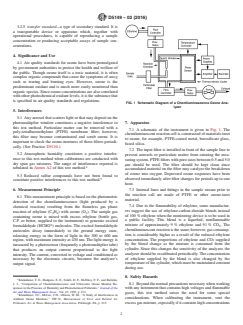
7.1 A schematic of the instrument is given in Fig. 1. The
poly-tetrafluoroethylene (PTFE) membrane filter; however,
chemiluminescentreactioncellisconstructedofmaterialsinert
this filter may become contaminated and scrub ozone. It is
to ozone, for example, PTFE-coated metal, borosilicate glass,
important to check the ozone-inertness of these filters periodi-
fused silica.
cally. (See Practice D5110.)
7.2 The input filter is installed in front of the sample line to
5.2 Atmospheric humidity constitutes a positive interfer-
prevent aerosols or particulate matter from entering the mea-
ence to this test method when calibrations are conducted with
suringsystem.PTFEfilterswithporesizesbetween0.5and5.0
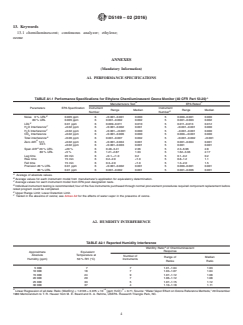
dry span gas mixtures. The range of interference reported is
µm should be used. The filter should be kept clean since
tabulated in Annex A2 of this test method.
accumulated material on the filter may catalyze the breakdown
of ozone into oxygen. Depressed ozone responses have been
5.3 Reduced sulfur compounds have not been found to
5 observed immediately after filter changes for periods up to one
constitute positive interferences to this test method.
hour.
6. Measurement Principle 7.3 Internal lines and fittings in the sample stream prior to
the reaction call are made of PTFE or other ozone-inert
6.1 This measurement principle is based on the photometric
material.
detection of the chemiluminescence (light produced by a
7.4 Due to the flammability of ethylene, some manufactur-
chemical reaction) resulting from the flameless gas phase
ers suggest the use of ethylene-carbon dioxide blends instead
reaction of ethylene (C H ) with ozone (O ). The sample gas
2 4 3
of 100 % ethylene when the monitoring device is to be used in
containing ozone is mixed with excess ethylene (bottle gas,
a public facility. This blend is a liquefied, nonflammable
C.P. or better, supplied to the instrument) to generate excited
mixture of approximately 9 % ethylene and 91 % CO . The
formaldehyde (HCHO*) molecules. The excited formaldehyde 2
chemiluminescentreactionisthesame;however,gasconsump-
molecules decay immediately to the ground energy state,
tion is considerably higher as a result of the reduced ethylene
releasing energy in the form of light in the 300 to 600 nm
concentration. The proportions of ethylene and CO supplied
region, with maximum intensity at 430 nm. The light energy is 2
by the blend change as the mixture is consumed from the
measured by a photosensor (frequently a photomultiplier tube)
cylinder. Since this changes the sensitivity of the analyzer, the
that produces an output current proportional to the light
analyzer should be recalibrated periodically.The concentration
intensity. The current, converted to voltage and conditioned as
of ethylene supplied by the blend is also changed by the
necessary by the electronic circuits, becomes the analyzer’s
temperatureofthecylinder,whichmustbemaintainedconstant
output signal.
during use.
8. Safety Hazards
Kleindienst, T. E., Hudgens, E. E., Smith, D. F., McElroy, F. F., and Bufalini,
8.1 Beyondthenormalprecautionsnecessarywhenworking
J. J., “Comparison of Chemiluminescence and Ultraviolet Ozone Monitor Re-
sponses in the Presence of Humidity and Photochemical Pollutants,” Journal of the
with any instrument that contains high voltages and flammable
Air and Waste Management Assoc., Vol. 43, 1993, p 213.
gases, this test method raises the need for some special
Kleindienst, T.C., McIver, C.D., Ollison, W. M., “A Study of Interferences in
considerations. When calibrating the instrument, vent the
Ambient Ozone Monitors,” VIP-74, Measurement of Toxic and Related Air
Pollutants, Air & Waste Management Association, Pittsburgh, PA, p. 215. excessgasmixture,especiallyifitcontainshighconcentrations
D5149 − 02 (2016)
of ozone, through a charcoal filter. This will avoid contamina- 11. Proce
...