

ASTM A275/A275M-23
(Practice)Standard Practice for Magnetic Particle Examination of Steel Forgings
General Information
- Abstract
ABSTRACT
This test method covers the procedures for the standard practice of performing magnetic particle examination on steel forgings. The inspection medium shall consist of finely divided ferromagnetic particles, whose size, shape and magnetic properties, both individually and collectively, shall be taken into account. Forgings may be magnetized in the longitudinal or circular direction by employing the surge or continuous current flow methods. Magnetization may be applied by passing current through the piece or by inducing a magnetic field by means of a central conductor, such as a prod or yoke, or by coils. While the material is properly magnetized, the magnetic particles may be applied by either the dry method, wet method, or fluorescent method. The parts shall also be sufficiently demagnetized after inspection so that residual or leakage fields will not interfere with future operations to which the steel forgings shall be used for. Indications to be evaluated are grouped into three broad classes, namely: surface defects, which include laminar defects, forging laps and folds, flakes (thermal ruptures caused by entrapped hydrogen), heat-treating cracks, shrinkage cracks, grinding cracks, and etching or plating cracks; subsurface defects, which include stringers of nonmetallic inclusions, large nonmetallics, cracks in underbeads of welds, and forging bursts; and nonrelevant or false indications, which include magnetic writing, changes in section, edge of weld, and flow lines.
SIGNIFICANCE AND USE
4.1 For ferromagnetic materials, magnetic particle examination is widely specified for the detection of surface and near surface discontinuities such as cracks, laps, seams, and linearly oriented nonmetallic inclusions. Such examinations are included as mandatory requirements in some forging standards such as Specification A508/A508M.
4.2 Use of direct current or rectified alternating (full or half wave) current as the power source for magnetic particle examination allows detection of subsurface discontinuities.
SCOPE
1.1 This practice2 covers a procedure for magnetic particle examination of steel forgings. The procedure will produce consistent results upon which acceptance standards can be based. This practice does not contain acceptance standards or recommended quality levels.
1.2 Only direct current or rectified alternating (full or half wave) current shall be used as the electric power source for any of the magnetizing methods. Alternating current is not permitted because its capability to detect subsurface discontinuities is very limited and therefore unsuitable.
1.2.1 Portable battery powered electromagnetic yokes are outside the scope of this practice.
Note 1: Guide E709 may be utilized for magnetic particle examination in the field for machinery components originally manufactured from steel forgings.
1.3 The minimum requirements for magnetic particle examination shall conform to practice standards of Practice E1444/E1444M. If the requirements of this practice are in conflict with the requirements of Practice E1444/E1444M, the requirements of this practice shall prevail.
1.4 This practice and the applicable material specifications are expressed in both inch-pound units and SI units. However, unless the order specifies the applicable “M” specification designation [SI units], the material shall be furnished to inch-pound units.
1.5 The values stated in either SI units or inch-pound units are to be regarded separately as standard. The values stated in each system are not necessarily exact equivalents; therefore, to ensure conformance with the standard, each system shall be used independently of the other, and values from the two systems shall not be combined.
1.6 This standard does not purport to address all of the safety concerns, if any, associated with its use. It is the responsibility of the user of this standard to establish appropriate safety, health, and environmental practices ...
- Status
- Published
- Publication Date
- 31-Oct-2023
- Technical Committee
- A01 - Steel, Stainless Steel and Related Alloys
- Drafting Committee
- A01.06 - Steel Forgings and Billets
Overview
ASTM A275/A275M-23: Standard Practice for Magnetic Particle Examination of Steel Forgings establishes procedures for the nondestructive magnetic particle examination of steel forgings to detect surface and near-surface discontinuities. This standard practice is widely adopted in industries where steel forging integrity is critical, such as automotive, aerospace, power generation, and pressure vessel manufacturing. By following this standard, organizations ensure the quality and safety of forged steel components, minimizing the risk of undetected flaws that could lead to failures in service.
Key Topics
Magnetic Particle Examination Procedures: The standard outlines how to perform magnetic particle inspections using finely divided ferromagnetic particles. This includes both the selection and application of the particles in dry, wet, or fluorescent form while the steel forging is suitably magnetized.
Magnetization Methods: Forgings can be magnetized in either the longitudinal or circular direction using direct current (DC) or rectified alternating current (full or half wave). Methods include applying current through the forging, using central conductors or coils, and employing direct-contact electrodes or electromagnetic yokes. Portable, battery-powered electromagnetic yokes are excluded from this scope.
Defect Detection: Magnetic particle testing is effective for identifying surface defects such as cracks, laps, seams, and nonmetallic inclusions, as well as subsurface discontinuities. The standard categorizes indications as surface defects, subsurface defects, or nonrelevant (false) indications.
Demagnetization: After inspection, parts must be sufficiently demagnetized to prevent interference with subsequent operations, such as welding or machining, and to ensure the reliability of further nondestructive tests.
Interpretation of Results: The standard provides guidance on evaluating magnetic particle indications, distinguishing between relevant flaws and nonrelevant signals that do not affect material integrity.
Reporting: Accurate documentation of the size, location, and type of detected indications, including permanent records using photographic techniques or tape reproductions, is emphasized for traceability.
Applications
ASTM A275/A275M-23 is a critical standard for manufacturing and quality control environments where steel forgings are used. Its practical applications include:
Pressure Vessels and Power Generation: Routine magnetic particle inspection is required for forgings used in high-pressure environments, as specified in related standards like ASTM A508/A508M.
Aerospace and Automotive Components: High-reliability industries depend on magnetic particle examination to ensure the integrity of load-bearing and safety-critical steel forgings.
Fabrication and Welding: The detection of surface and near-surface defects prior to further fabrication processes ensures that only sound materials are used, reducing the risk of subsequent failures.
Maintenance and Inspection: In field applications, magnetic particle examination helps assess the condition of steel machinery parts, enhancing preventive maintenance and reliability.
Related Standards
Various other standards complement or reference ASTM A275/A275M-23 in the practice of nondestructive testing of steel forgings:
- ASTM E709: Guide for Magnetic Particle Testing
- ASTM E1444/E1444M: Practice for Magnetic Particle Testing in Aerospace
- ASTM A508/A508M: Specification for Pressure Vessel Forgings
- ASTM A788/A788M: General Requirements for Steel Forgings
- ASTM E165/E165M: Practice for Liquid Penetrant Testing
- ASTM E1316: Terminology for Nondestructive Examinations
Organizations adopting ASTM A275/A275M-23 should ensure staff qualification according to standards like ASNT Recommended Practice No. SNT-TC-1A.
Keywords: magnetic particle examination, nondestructive testing, steel forgings, ASTM standards, surface flaw detection, quality control, industrial inspection, pressure vessels, magnetic particle testing procedures, demagnetization, forging defects
Relations
- Replaces
ASTM A275/A275M-18(2023) - Standard Practice for Magnetic Particle Examination of Steel Forgings - Effective Date
- 01-Nov-2023
- Effective Date
- 01-Feb-2024
- Effective Date
- 01-Nov-2023
- Effective Date
- 01-Sep-2023
- Effective Date
- 01-Nov-2023
- Referred By
ASTM A266/A266M-21 - Standard Specification for Carbon Steel Forgings for Pressure Vessel Components - Effective Date
- 01-Nov-2023
- Effective Date
- 01-Nov-2023
- Effective Date
- 01-Nov-2023
- Effective Date
- 01-Nov-2023
- Effective Date
- 01-Nov-2023
- Effective Date
- 01-Nov-2023
- Effective Date
- 01-Nov-2023
- Effective Date
- 01-Nov-2023
- Effective Date
- 01-Nov-2023
- Effective Date
- 01-Nov-2023
Get Certified
Connect with accredited certification bodies for this standard

Element Materials Technology
Materials testing and product certification.

Inštitut za kovinske materiale in tehnologije
Institute of Metals and Technology. Materials testing, metallurgical analysis, NDT.
Sponsored listings
Frequently Asked Questions
ASTM A275/A275M-23 is a standard published by ASTM International. Its full title is "Standard Practice for Magnetic Particle Examination of Steel Forgings". This standard covers: ABSTRACT This test method covers the procedures for the standard practice of performing magnetic particle examination on steel forgings. The inspection medium shall consist of finely divided ferromagnetic particles, whose size, shape and magnetic properties, both individually and collectively, shall be taken into account. Forgings may be magnetized in the longitudinal or circular direction by employing the surge or continuous current flow methods. Magnetization may be applied by passing current through the piece or by inducing a magnetic field by means of a central conductor, such as a prod or yoke, or by coils. While the material is properly magnetized, the magnetic particles may be applied by either the dry method, wet method, or fluorescent method. The parts shall also be sufficiently demagnetized after inspection so that residual or leakage fields will not interfere with future operations to which the steel forgings shall be used for. Indications to be evaluated are grouped into three broad classes, namely: surface defects, which include laminar defects, forging laps and folds, flakes (thermal ruptures caused by entrapped hydrogen), heat-treating cracks, shrinkage cracks, grinding cracks, and etching or plating cracks; subsurface defects, which include stringers of nonmetallic inclusions, large nonmetallics, cracks in underbeads of welds, and forging bursts; and nonrelevant or false indications, which include magnetic writing, changes in section, edge of weld, and flow lines. SIGNIFICANCE AND USE 4.1 For ferromagnetic materials, magnetic particle examination is widely specified for the detection of surface and near surface discontinuities such as cracks, laps, seams, and linearly oriented nonmetallic inclusions. Such examinations are included as mandatory requirements in some forging standards such as Specification A508/A508M. 4.2 Use of direct current or rectified alternating (full or half wave) current as the power source for magnetic particle examination allows detection of subsurface discontinuities. SCOPE 1.1 This practice2 covers a procedure for magnetic particle examination of steel forgings. The procedure will produce consistent results upon which acceptance standards can be based. This practice does not contain acceptance standards or recommended quality levels. 1.2 Only direct current or rectified alternating (full or half wave) current shall be used as the electric power source for any of the magnetizing methods. Alternating current is not permitted because its capability to detect subsurface discontinuities is very limited and therefore unsuitable. 1.2.1 Portable battery powered electromagnetic yokes are outside the scope of this practice. Note 1: Guide E709 may be utilized for magnetic particle examination in the field for machinery components originally manufactured from steel forgings. 1.3 The minimum requirements for magnetic particle examination shall conform to practice standards of Practice E1444/E1444M. If the requirements of this practice are in conflict with the requirements of Practice E1444/E1444M, the requirements of this practice shall prevail. 1.4 This practice and the applicable material specifications are expressed in both inch-pound units and SI units. However, unless the order specifies the applicable “M” specification designation [SI units], the material shall be furnished to inch-pound units. 1.5 The values stated in either SI units or inch-pound units are to be regarded separately as standard. The values stated in each system are not necessarily exact equivalents; therefore, to ensure conformance with the standard, each system shall be used independently of the other, and values from the two systems shall not be combined. 1.6 This standard does not purport to address all of the safety concerns, if any, associated with its use. It is the responsibility of the user of this standard to establish appropriate safety, health, and environmental practices ...
ABSTRACT This test method covers the procedures for the standard practice of performing magnetic particle examination on steel forgings. The inspection medium shall consist of finely divided ferromagnetic particles, whose size, shape and magnetic properties, both individually and collectively, shall be taken into account. Forgings may be magnetized in the longitudinal or circular direction by employing the surge or continuous current flow methods. Magnetization may be applied by passing current through the piece or by inducing a magnetic field by means of a central conductor, such as a prod or yoke, or by coils. While the material is properly magnetized, the magnetic particles may be applied by either the dry method, wet method, or fluorescent method. The parts shall also be sufficiently demagnetized after inspection so that residual or leakage fields will not interfere with future operations to which the steel forgings shall be used for. Indications to be evaluated are grouped into three broad classes, namely: surface defects, which include laminar defects, forging laps and folds, flakes (thermal ruptures caused by entrapped hydrogen), heat-treating cracks, shrinkage cracks, grinding cracks, and etching or plating cracks; subsurface defects, which include stringers of nonmetallic inclusions, large nonmetallics, cracks in underbeads of welds, and forging bursts; and nonrelevant or false indications, which include magnetic writing, changes in section, edge of weld, and flow lines. SIGNIFICANCE AND USE 4.1 For ferromagnetic materials, magnetic particle examination is widely specified for the detection of surface and near surface discontinuities such as cracks, laps, seams, and linearly oriented nonmetallic inclusions. Such examinations are included as mandatory requirements in some forging standards such as Specification A508/A508M. 4.2 Use of direct current or rectified alternating (full or half wave) current as the power source for magnetic particle examination allows detection of subsurface discontinuities. SCOPE 1.1 This practice2 covers a procedure for magnetic particle examination of steel forgings. The procedure will produce consistent results upon which acceptance standards can be based. This practice does not contain acceptance standards or recommended quality levels. 1.2 Only direct current or rectified alternating (full or half wave) current shall be used as the electric power source for any of the magnetizing methods. Alternating current is not permitted because its capability to detect subsurface discontinuities is very limited and therefore unsuitable. 1.2.1 Portable battery powered electromagnetic yokes are outside the scope of this practice. Note 1: Guide E709 may be utilized for magnetic particle examination in the field for machinery components originally manufactured from steel forgings. 1.3 The minimum requirements for magnetic particle examination shall conform to practice standards of Practice E1444/E1444M. If the requirements of this practice are in conflict with the requirements of Practice E1444/E1444M, the requirements of this practice shall prevail. 1.4 This practice and the applicable material specifications are expressed in both inch-pound units and SI units. However, unless the order specifies the applicable “M” specification designation [SI units], the material shall be furnished to inch-pound units. 1.5 The values stated in either SI units or inch-pound units are to be regarded separately as standard. The values stated in each system are not necessarily exact equivalents; therefore, to ensure conformance with the standard, each system shall be used independently of the other, and values from the two systems shall not be combined. 1.6 This standard does not purport to address all of the safety concerns, if any, associated with its use. It is the responsibility of the user of this standard to establish appropriate safety, health, and environmental practices ...
ASTM A275/A275M-23 is classified under the following ICS (International Classification for Standards) categories: 77.040.20 - Non-destructive testing of metals; 77.140.85 - Iron and steel forgings. The ICS classification helps identify the subject area and facilitates finding related standards.
ASTM A275/A275M-23 has the following relationships with other standards: It is inter standard links to ASTM A275/A275M-18(2023), ASTM E1316-24, ASTM A508/A508M-23a, ASTM E1316-23b, ASTM A504/A504M-18(2023), ASTM A266/A266M-21, ASTM A723/A723M-18a(2023), ASTM A291/A291M-19, ASTM A456/A456M-08(2023), ASTM A1021/A1021M-20, ASTM A470/A470M-05(2020), ASTM A711/A711M-17(2022), ASTM A837/A837M-17(2022), ASTM A989/A989M-23, ASTM A961/A961M-23. Understanding these relationships helps ensure you are using the most current and applicable version of the standard.
ASTM A275/A275M-23 is available in PDF format for immediate download after purchase. The document can be added to your cart and obtained through the secure checkout process. Digital delivery ensures instant access to the complete standard document.
Standards Content (Sample)
This international standard was developed in accordance with internationally recognized principles on standardization established in the Decision on Principles for the
Development of International Standards, Guides and Recommendations issued by the World Trade Organization Technical Barriers to Trade (TBT) Committee.
Designation: A275/A275M − 23
Standard Practice for
Magnetic Particle Examination of Steel Forgings
This standard is issued under the fixed designation A275/A275M; the number immediately following the designation indicates the year
of original adoption or, in the case of revision, the year of last revision. A number in parentheses indicates the year of last reapproval.
A superscript epsilon (´) indicates an editorial change since the last revision or reapproval.
This standard has been approved for use by agencies of the U.S. Department of Defense.
1. Scope* 1.6 This standard does not purport to address all of the
safety concerns, if any, associated with its use. It is the
1.1 This practice covers a procedure for magnetic particle
responsibility of the user of this standard to establish appro-
examination of steel forgings. The procedure will produce
priate safety, health, and environmental practices and deter-
consistent results upon which acceptance standards can be
mine the applicability of regulatory limitations prior to use.
based. This practice does not contain acceptance standards or
1.7 This international standard was developed in accor-
recommended quality levels.
dance with internationally recognized principles on standard-
1.2 Only direct current or rectified alternating (full or half
ization established in the Decision on Principles for the
wave) current shall be used as the electric power source for any
Development of International Standards, Guides and Recom-
of the magnetizing methods. Alternating current is not permit-
mendations issued by the World Trade Organization Technical
ted because its capability to detect subsurface discontinuities is
Barriers to Trade (TBT) Committee.
very limited and therefore unsuitable.
2. Referenced Documents
1.2.1 Portable battery powered electromagnetic yokes are
outside the scope of this practice.
2.1 ASTM Standards:
A508/A508M Specification for Quenched and Tempered
NOTE 1—Guide E709 may be utilized for magnetic particle examination
Vacuum-Treated Carbon and Alloy Steel Forgings for
in the field for machinery components originally manufactured from steel
forgings.
Pressure Vessels
A788/A788M Specification for Steel Forgings, General Re-
1.3 The minimum requirements for magnetic particle ex-
quirements
amination shall conform to practice standards of Practice
E165/E165M Practice for Liquid Penetrant Testing for Gen-
E1444/E1444M. If the requirements of this practice are in
eral Industry
conflict with the requirements of Practice E1444/E1444M, the
E709 Guide for Magnetic Particle Testing
requirements of this practice shall prevail.
E1316 Terminology for Nondestructive Examinations
1.4 This practice and the applicable material specifications
E1351 Practice for Production and Evaluation of Field
are expressed in both inch-pound units and SI units. However,
Metallographic Replicas
unless the order specifies the applicable “M” specification
E1444/E1444M Practice for Magnetic Particle Testing for
designation [SI units], the material shall be furnished to
Aerospace
inch-pound units. 4
2.2 Other Document:
1.5 The values stated in either SI units or inch-pound units Recommended Practice No. SNT-TC-1A, Supplement
B-Magnetic Particle Method
are to be regarded separately as standard. The values stated in
each system are not necessarily exact equivalents; therefore, to
3. Terminology
ensure conformance with the standard, each system shall be
used independently of the other, and values from the two
3.1 Definitions of Terms—For definitions of terms used in
systems shall not be combined.
this standard that are not included in 3.2, refer to Terminology
E1316.
3.2 Definitions:
This practice is under the jurisdiction of ASTM Committee A01 on Steel,
Stainless Steel and Related Alloys and is the direct responsibility of Subcommittee
A01.06 on Steel Forgings and Billets. For referenced ASTM standards, visit the ASTM website, www.astm.org, or
Current edition approved Nov. 1, 2023. Published November 2023. Originally contact ASTM Customer Service at service@astm.org. For Annual Book of ASTM
approved in 1944. Last previous edition approved in 2023 as A275/A275M – 18 Standards volume information, refer to the standard’s Document Summary page on
(2023). DOI: 10.1520/A0275_A0275M-23. the ASTM website.
2 4
For ASME Boiler and Pressure Vessel Code applications see related Method Available from American Society for Nondestructive Testing (ASNT), P.O. Box
SA-275/SA-275M in Section II of that Code. 28518, 1711 Arlingate Ln., Columbus, OH 43228-0518, http://www.asnt.org.
*A Summary of Changes section appears at the end of this standard
Copyright © ASTM International, 100 Barr Harbor Drive, PO Box C700, West Conshohocken, PA 19428-2959. United States
A275/A275M − 23
3.2.1 indication, n—the visual magnetic particle buildup with a written procedure conforming to Recommended Prac-
resulting from leakage fields in the magnetic field. tice No. SNT-TC-1A or another national standard that is
acceptable to both the purchaser and the supplier.
3.2.2 linear indication, n—an indication in which the length
is at least three times the width. The minimum length of
7. Stage of Inspection
indications to be considered linear shall be ⁄16 in. [1.6 mm].
7.1 Unless otherwise specified by the purchaser, acceptance
3.2.3 magnetic flux, n—the product of the magnetic induc-
inspection shall be performed on a forging in the final
tion and the area of a surface (or cross section) when the
machined surface condition and final thermally treated condi-
magnetic induction is uniformly distributed and normal to the
tion (including stress relief) or within 0.030 in. [0.8 mm] of the
plane of the surface. The concept that the magnetic field is
final machined surface.
flowing along the lines of force suggests that these lines are
therefore “flux” lines, and they are called magnetic flux.
8. Magnetizing Apparatus
3.2.4 magnetic particle method of examination, n—a
8.1 Rectified alternating (full or half wave) or direct-current
method for detecting discontinuities on or near the surface in
electric power sources may be used. When current is passed
suitably magnetized materials, which employs finely divided
through the part itself, the equipment shall consist of contact-
magnetic particles that tend to congregate in regions of leakage
ing or clamping elements with sufficient surface area and
fields.
clamping pressure to allow the required current to flow without
3.2.5 nonrelevant indications, n—indications produced by
damaging (burning) the part being examined.
leakage fields; however, the conditions causing them are
8.2 Portable electromagnetic (ac-dc) yokes may be used in
present by design or accident, or other features of the part
the dc mode as a magnetizing apparatus, provided the sensi-
having no relation to the damaging flaws being sought. The
tivity to detect crack-like defects is demonstrated to be at least
term signifies that such an indication has no relation to the
equivalent to that of the direct-magnetization method.
discontinuities that might constitute defects.
8.2.1 Portable battery powered electromagnetic yokes are
4. Significance and Use not included in the scope of this practice.
4.1 For ferromagnetic materials, magnetic particle examina-
9. Magnetic Particles
tion is widely specified for the detection of surface and near
9.1 The inspection medium shall consist of finely divided
surface discontinuities such as cracks, laps, seams, and linearly
ferromagnetic particles, which may be suspended in a suitable
oriented nonmetallic inclusions. Such examinations are in-
cluded as mandatory requirements in some forging standards liquid medium, or used in dry powder form.
such as Specification A508/A508M.
9.2 The size and shape of the particles, and their magnetic
properties, both individually and collectively, are important
4.2 Use of direct current or rectified alternating (full or half
(see Section 12).
wave) current as the power source for magnetic particle
examination allows detection of subsurface discontinuities.
10. Surface Preparation
5. Basis of Application
10.1 The sensitivity of the magnetic particle examination
will depend to a considerable extent upon the condition of the
5.1 When in accordance with the requirements of the
inquiry, contract, order, or specifications, forgings are fur- surface being tested. Defects may be satisfactorily revealed on
shot-blasted or otherwise cleaned forged surfaces, or on
nished subject to magnetic particle examination. The manufac-
turer and the purchaser shall be in agreement concerning the surfaces having small amounts of heat-treating scale without
any special surface preparation; however, loose scale must be
following:
5.1.1 The locations on the forgings that are to be subjected removed. To reveal fine defects, the surfaces to be inspected
should be smooth machined to at least a 250 μin. [6.35 μm]
to magnetic particle examination.
5.1.2 The type, size, number, location, and orientation of finish where the definition for surface finish is in accordance
indications that are to be considered injurious. with Specification A788/A788M.
5.1.3 The method of application of magnetic particles,
10.2 The surfaces shall be free of grease, oils, or other
demagnetization requirements and magnetic field strengths.
substances to which the particles may adhere.
5.2 In cases where large undercuts in the forgings are to be
10.3 Rough surfaces hamper the mobility of magnetic
taken by the purchaser, the manufacturer shall be given the
powders due to mechanical trapping, which in turn produces
privilege (when the design permits) of machining slots or
false indications. Such areas should be surface ground. If
grooves in the rough-machined forging to explore the internal
grinding is impractical, a paper tape overlay (as described in
conditions prior to shipping.
15.1.1.2) may eliminate the problem.
5.3 Acceptance standards.
11. Methods of Magnetization
6. Personnel Requirements
11.1 The forging may be magnetized either by passing
6.1 Personnel performing the magnetic particle examination current through the piece or by inducing a magnetic field by
to this practice shall be qualified and certified in accordance means of a central conductor or by coils.
A275/A275M − 23
11.1.1 Continuous Method—In the continuous method, the
inspection medium is applied to the surface under inspection
while the current is still flowing. The current source generates
high amperage current in pulses of up to 1 s duration. The
duration of this flow shall allow at least three pulses of current
or in the case where machines supply continuous current flow
1 1
a minimum shot of ⁄5 s to ⁄2 s duration should be applied.
11.1.2 Surge Method—In the surge method a high-
magnetizing force is applied and then reduced to a lower
continuous value, which is maintained during application of
the inspection medium.
11.2 At least two separate examinations shall be carried out
on each area. The second examination shall be with the lines of
FIG. 2 Longitudinal Magnetization, with Yoke
magnetic flux approximately perpendicular to those used for
the first examination in that area. A different means of
magnetizing may be used for the second examination. Magne-
tizing in more than one direction cannot be accomplished
simultaneously.
NOTE 2—An exception to the above rule is overall sequential multi-
vector magnetization whereby several magnetizing circuits are provided
for sequentially magnetizing a part in multiple directions depending upon
the locations of the current connectors. By this technique, flaws of any
orientation can be detected with a single application of magnetic particles.
11.3 The two general types of magnetization with regard to
FIG. 3 Circular Magnetization, Current Directly Through Forging
direction are longitudinal and circular, as follows:
11.3.1 Longitudinal—When a forging is magnetized
longitudinally, the magnetic flux lines are usually parallel to
the axis of the piece. A longitudinally magnetized piece always
has definite poles readily detectable by compass or magnetom-
eter. Longitudinal magnetization is usually accomplished by
placing the forging within a solenoid, often formed by wrap-
ping cable around the piece (Fig. 1). For special applications,
magnetic yokes can be used (Fig. 2) when requirements of 8.2
are met.
11.3.2 Circular—Circular magnetization is obtained by
FIG. 4 Circular Magnetization, Current Through a Conductor
passing a current directly through the piece (Fig. 3), or induced
through a conductor (Fig. 4), or conductors threaded (Fig. 5)
through an opening in the piece. Localized circular magneti-
zation may be obtained by passing current through the local
areas by use of prod-type contacts (Fig. 6).
11.4 The magnetic field is confined almost entirely to the
piece and there may be no external manifestation of the
FIG. 5 Circular Magnetization, Current Through Conductors
Threaded Through Forging
magnetized condition. Indications will appear strongest in the
direction perpendicular to the direction of the magnetic field.
FIG. 1 Longitudinal Magnetization
A275/A275M − 23
L/D ratio, adequate field strengths shall be demonstrated by the
use of a field indicator (see 11.5.6). The graph in Fig. 7 may be
used to determine the ampere-turns required for each L/D
relationship.
(2) Large Forgings—For large forgings the magnetizing
force shall be in the range from 1200 ampere-turns to 4500
ampere-turns. A field indicator (see 11.5.6) shall be used to
demonstrate the presence of an adequate field strength over the
area to be inspected.
FIG. 6 Circular Magnetization with “Prod” Type Contact
Electrodes 11.5.1.2 Circular Magnetization (Fig. 5)—For circular mag-
netization with through coils, use the current with amperage as
specified in 11.5.2 divided by the number of turns in the coil.
11.5.2 Direct Magnetization—When current is passed di-
rectly through the part to be examined, the current shall be
between 100 A per inch and 900 A per inch [4 A per millimetre
and 35 A per millimetre] of diameter or cross section (per inch
or millimetre of greatest width in a plane at right angles to
current flow). For hollow parts this would be wall thickness
when cables are clamped to the wall. Suggested current for
diameters or sections up to 5 in. [125 mm] are 600 A per inch
to 900 A per inch [25 A per millimetre to 35 A per millimetre];
for diameters or sections between 5 in. and 10 in. [125 mm to
250 mm], 400 A per inch to 600 A per inch [15 A per
millimetre to 25 A per millimetre]; and 100 A per inch to 400 A
per inch [4 A per millimetre to 15 A per millimetre] for outside
diameters or sections over 10 in. [250 mm]. If it is not practical
to obtain these current levels for diameters over 10 in.
[250 mm], the presence of an adequate field strength shall be
FIG. 7 Longitudinal Magnetization demonstrated using a field indicator. In all other instances the
adequacy of the magnetizing force shall be demonstrated by
means of a field indicator (see 11.5.6). When large parts have
11.5 Field Strength—The minimum field strength that will
been examined by clamping contacts to the wall thickness the
reveal and permit classification of all objectionable defects
adequacy of the field in the circumferential direction shall also
shall be used. The maximum field strengths practical are the
be determined by the field indicator.
ones just below the point at which excessive adherence of the
11.5.3 Prod Magnetization—When prods are used to circu-
particles begins to occur over the surface being inspected.
larly magnetize a local area, the field strength is directly
11.5.1 Coil Magnetization—When coil magnetization is
proportional to the amperage used but also varies with the prod
used, the magnetic field strength is directly proportional to the
spacing and thickness of section being inspected.
current (ampere-turns if a coil or solenoid is used) and
11.5.3.1 A magnetizing force of 75 A per linear inch to
inversely proportional to the thickness of the section being
inspected. 100 A per linear inch [3 A per millimetre to 4 A per millimetre]
of prod spacing shall be used for material under ⁄4 in. [20 mm]
11.5.1.1 Longitudinal Magnetization—For encircling coils
(Fig. 1), the turns of the coil shall be kept closely together. The thick, and 100 A per linear inch to 125 A per linear inch [4 A
per millimetre to 5 A per millimetre] of prod spacing shall be
field strength decreases as distance from the coil increases and
long parts must be magnetized in sections. If the area to be used for material ⁄4 in. [20 mm] and over in thickness.
inspected extends beyond 6 in. [150 mm] on either side of the 11.5.3.2 Prod spacing shall be a maximum of 8 in.
coils, the adequacy of the field shall be demonstra
...
This document is not an ASTM standard and is intended only to provide the user of an ASTM standard an indication of what changes have been made to the previous version. Because
it may not be technically possible to adequately depict all changes accurately, ASTM recommends that users consult prior editions as appropriate. In all cases only the current version
of the standard as published by ASTM is to be considered the official document.
Designation: A275/A275M − 18 (Reapproved 2023) A275/A275M − 23
Standard Practice for
Magnetic Particle Examination of Steel Forgings
This standard is issued under the fixed designation A275/A275M; the number immediately following the designation indicates the year
of original adoption or, in the case of revision, the year of last revision. A number in parentheses indicates the year of last reapproval.
A superscript epsilon (´) indicates an editorial change since the last revision or reapproval.
This standard has been approved for use by agencies of the U.S. Department of Defense.
1. Scope Scope*
1.1 This practice covers a procedure for magnetic particle examination of steel forgings. The procedure will produce consistent
results upon which acceptance standards can be based. This practice does not contain acceptance standards or recommended
quality levels.
1.2 Only direct current or rectified alternating (full or half wave) current shall be used as the electric power source for any of the
magnetizing methods. Alternating current is not permitted because its capability to detect subsurface discontinuities is very limited
and therefore unsuitable.
1.2.1 Portable battery powered electromagnetic yokes are outside the scope of this practice.
NOTE 1—Guide E709 may be utilized for magnetic particle examination in the field for machinery components originally manufactured from steel
forgings.
1.3 The minimum requirements for magnetic particle examination shall conform to practice standards of Practice E1444/E1444M.
If the requirements of this practice are in conflict with the requirements of Practice E1444/E1444M, the requirements of this
practice shall prevail.
1.4 This practice and the applicable material specifications are expressed in both inch-pound units and SI units. However, unless
the order specifies the applicable “M” specification designation [SI units], the material shall be furnished to inch-pound units.
1.5 The values stated in either SI units or inch-pound units are to be regarded separately as standard. The values stated in each
system are not necessarily exact equivalents; therefore, to ensure conformance with the standard, each system shall be used
independently of the other, and values from the two systems shall not be combined.
1.6 This standard does not purport to address all of the safety concerns, if any, associated with its use. It is the responsibility
of the user of this standard to establish appropriate safety, health, and environmental practices and determine the applicability of
regulatory limitations prior to use.
1.7 This international standard was developed in accordance with internationally recognized principles on standardization
established in the Decision on Principles for the Development of International Standards, Guides and Recommendations issued
by the World Trade Organization Technical Barriers to Trade (TBT) Committee.
This practice is under the jurisdiction of ASTM Committee A01 on Steel, Stainless Steel and Related Alloys and is the direct responsibility of Subcommittee A01.06
on Steel Forgings and Billets.
Current edition approved March 1, 2023Nov. 1, 2023. Published March 2023November 2023. Originally approved in 1944. Last previous edition approved in 20182023
as A275/A275M – 18.A275/A275M – 18 (2023). DOI: 10.1520/A0275_A0275M-18R23.10.1520/A0275_A0275M-23.
For ASME Boiler and Pressure Vessel Code applications see related Method SA-275/SA-275M in Section II of that Code.
*A Summary of Changes section appears at the end of this standard
Copyright © ASTM International, 100 Barr Harbor Drive, PO Box C700, West Conshohocken, PA 19428-2959. United States
A275/A275M − 23
2. Referenced Documents
2.1 ASTM Standards:
A508/A508M Specification for Quenched and Tempered Vacuum-Treated Carbon and Alloy Steel Forgings for Pressure Vessels
A788/A788M Specification for Steel Forgings, General Requirements
E165/E165M Practice for Liquid Penetrant Testing for General Industry
E709 Guide for Magnetic Particle Testing
E1316 Terminology for Nondestructive Examinations
E1351 Practice for Production and Evaluation of Field Metallographic Replicas
E1444/E1444M Practice for Magnetic Particle Testing for Aerospace
2.2 Other Document:
Recommended Practice No. SNT-TC-1A, Supplement B-Magnetic Particle Method
3. Terminology
3.1 Definitions of Terms—For definitions of terms used in this standard that are not included in 3.2, refer to Terminology E1316.
3.2 Definitions:
3.2.1 indication—indication, n—the visual magnetic particle buildup resulting from leakage fields in the magnetic field.
3.2.2 linear indication—indication, n—an indication in which the length is at least three times the width. The minimum length of
indications to be considered linear shall be ⁄16 in. [1.6 mm].
3.2.3 magnetic flux—flux, n—the product of the magnetic induction and the area of a surface (or cross section) when the magnetic
induction is uniformly distributed and normal to the plane of the surface. The concept that the magnetic field is flowing along the
lines of force suggests that these lines are therefore “flux” lines, and they are called magnetic flux.
3.2.4 magnetic particle method of examination—examination, n—a method for detecting discontinuities on or near the surface in
suitably magnetized materials, which employs finely divided magnetic particles that tend to congregate in regions of leakage fields.
3.2.5 nonrelevant indications—indications, n—indications produced by leakage fields. However,fields; however, the conditions
causing them are present by design or accident, or other features of the part having no relation to the damaging flaws being sought.
The term signifies that such an indication has no relation to the discontinuities that might constitute defects.
4. Significance and Use
4.1 For ferromagnetic materials, magnetic particle examination is widely specified for the detection of surface and near surface
discontinuities such as cracks, laps, seams, and linearly oriented nonmetallic inclusions. Such examinations are included as
mandatory requirements in some forging standards such as Specification A508/A508M.
4.2 Use of direct current or rectified alternating (full or half wave) current as the power source for magnetic particle examination
allows detection of subsurface discontinuities.
5. Basis of Application
5.1 When in accordance with the requirements of the inquiry, contract, order, or specifications, forgings are furnished subject to
magnetic particle examination, theexamination. The manufacturer and the purchaser shall be in agreement concerning the
following:
5.1.1 The locations on the forgings that are to be subjected to magnetic particle examination.
5.1.2 The type, size, number, location, and orientation of indications that are to be considered injurious.
For referenced ASTM standards, visit the ASTM website, www.astm.org, or contact ASTM Customer Service at service@astm.org. For Annual Book of ASTM Standards
volume information, refer to the standard’s Document Summary page on the ASTM website.
Available from American Society for Nondestructive Testing (ASNT), P.O. Box 28518, 1711 Arlingate Ln., Columbus, OH 43228-0518, http://www.asnt.org.
A275/A275M − 23
5.1.3 The method of application of magnetic particles, demagnetization requirements and magnetic field strengths.
5.2 In cases where large undercuts in the forgings are to be taken by the purchaser, the manufacturer shall be given the privilege
(when the design permits) of machining slots or grooves in the rough-machined forging to explore the internal conditions prior to
shipping.
5.3 Acceptance standards.
6. Personnel Requirements
6.1 Personnel performing the magnetic particle examination to this practice shall be qualified and certified in accordance with a
written procedure conforming to Recommended Practice No. SNT-TC-1A or another national standard that is acceptable to both
the purchaser and the supplier.
7. Stage of Inspection
7.1 Unless otherwise specified by the purchaser, acceptance inspection shall be performed on a forging in the final machined
surface condition and final thermally treated condition (including stress relief) or within 0.030 in. [0.8 mm] of the final machined
surface.
8. Magnetizing Apparatus
8.1 Rectified alternating (full or half wave) or direct-current electric power sources may be used. When current is passed through
the part itself, the equipment shall consist of contacting or clamping elements with sufficient surface area and clamping pressure
to allow the required current to flow without damaging (burning) the part being examined.
8.2 Portable electromagnetic (ac-dc) yokes may be used in the dc mode as a magnetizing apparatus, provided the sensitivity to
detect crack-like defects is demonstrated to be at least equivalent to that of the direct-magnetization method.
8.2.1 Portable battery powered electromagnetic yokes are not included in the scope of this practice.
9. Magnetic Particles
9.1 The inspection medium shall consist of finely divided ferromagnetic particles, which may be suspended in a suitable liquid
medium, or used in dry powder form.
9.2 The size and shape of the particles, and their magnetic properties, both individually and collectively, are important (see Section
12).
10. Surface Preparation
10.1 The sensitivity of the magnetic particle examination will depend to a considerable extent upon the condition of the surface
being tested. Defects may be satisfactorily revealed on shot-blasted or otherwise cleaned forged surfaces, or on surfaces having
small amounts of heat-treating scale without any special surface preparation; however, loose scale must be removed. To reveal fine
defects, the surfaces to be inspected should be smooth machined to at least a 250 μin. [6.35 μm] finish where the definition for
surface finish is as per in accordance with Specification A788/A788M.
10.2 The surfaces shall be free of grease, oils, or other substances to which the particles may adhere.
10.3 Rough surfaces hamper the mobility of magnetic powders due to mechanical trapping, which in turn produces false
indications. Such areas should be surface ground. If grinding is impractical, a paper tape overlay (as described in 15.1.1.2) may
eliminate the problem.
A275/A275M − 23
11. Methods of Magnetization
11.1 The forging may be magnetized either by passing current through the piece or by inducing a magnetic field by means of a
central conductor or by coils.
11.1.1 Continuous Method—In the continuous method, the inspection medium is applied to the surface under inspection while the
current is still flowing. The current source generates high amperage current in pulses of up to 1 s duration. The duration of this
flow shall allow at least three pulses of current or in the case where machines supply continuous current flow a minimum shot of
1 1
⁄5 s to ⁄2 s duration should be applied.
11.1.2 Surge Method—In the surge method a high-magnetizing force is applied and then reduced to a lower continuous value,
which is maintained during application of the inspection medium.
11.2 At least two separate examinations shall be carried out on each area. The second examination shall be with the lines of
magnetic flux approximately perpendicular to those used for the first examination in that area. A different means of magnetizing
may be used for the second examination. Magnetizing in more than one direction cannot be accomplished simultaneously.
NOTE 2—An exception to the above rule is overall sequential multivector magnetization whereby several magnetizing circuits are provided for
sequentially magnetizing a part in multiple directions depending upon the locations of the current connectors. By this technique, flaws of any orientation
can be detected with a single application of magnetic particles.
11.3 The two general types of magnetization with regard to direction are longitudinal and circular, as follows:
11.3.1 Longitudinal—When a forging is magnetized longitudinally, the magnetic flux lines are usually parallel to the axis of the
piece. A longitudinally magnetized piece always has definite poles readily detectable by compass or magnetometer. Longitudinal
magnetization is usually accomplished by placing the forging within a solenoid, often formed by wrapping cable around the piece
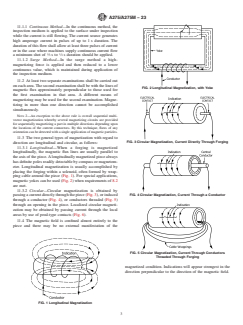
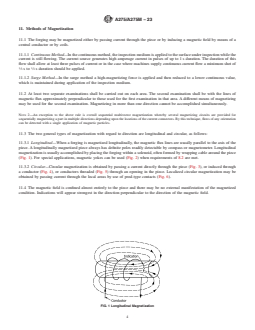
(Fig. 1). For special applications, magnetic yokes can be used (Fig. 2) when requirements of 8.2 are met.
11.3.2 Circular—Circular magnetization is obtained by passing a current directly through the piece (Fig. 3), or induced through
a conductor (Fig. 4), or conductors threaded (Fig. 5) through an opening in the piece. Localized circular magnetization may be
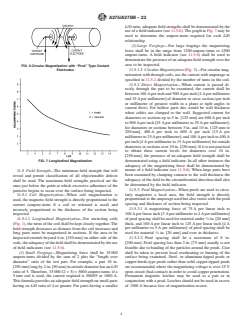
obtained by passing current through the local areas by use of prod-type contacts (Fig. 6).
11.4 The magnetic field is confined almost entirely to the piece and there may be no external manifestation of the magnetized
condition. Indications will appear strongest in the direction perpendicular to the direction of the magnetic field.
FIG. 1 Longitudinal Magnetization
A275/A275M − 23
FIG. 2 Longitudinal Magnetization, with Yoke
FIG. 3 Circular Magnetization, Current Directly Through Forging
FIG. 4 Circular Magnetization, Current Through a Conductor
FIG. 5 Circular Magnetization, Current Through Conductors Threaded Through Forging
11.5 Field Strength—The minimum field strength that will reveal and permit classification of all objectionable defects shall be
used. The maximum field strengths practical are the ones just below the point at which excessive adherence of the particles begins
to occur over the surface being inspected.
11.5.1 Coil Magnetization—When coil magnetization is used, the magnetic field strength is directly proportional to the current
(ampere-turns if a coil or solenoid is used) and inversely proportional to the thickness of the section being inspected.
A275/A275M − 23
FIG. 6 Circular Magnetization with “Prod” Type Contact
Electrodes
FIG. 7 Longitudinal Magnetization
11.5.1.1 Longitudinal Magnetization—For encircling coils (Fig. 1), the turns of the coil shall be kept closely together. The field
strength decreases as distance from the coil increases and long parts must be magnetized in sections. If the area to be inspected
extends beyond 6 in. [150 mm] on either side of the coils, the adequacy of the field shall be demonstrated by the use of field
indicators (see 11.5.6).
(1) Small Forgings—Magnetizing force shall be 35 000 ampere-turns divided by the sum of 2 plus the “length over diameter”
ratio of the test part. For example, a part 10 in. [250 mm] long by 2 in. [50 mm] in outside diameter has an L/D ratio of 5. Therefore,
35 000 ⁄(2 + 5) = 5000 ampere-turns; if a 5 turn coil is used, the current required is 5000/5 or 1000 A. This formula provides an
adequate field strength on small parts having an L/D ratio of 4 or greater. For parts having a smaller L/D ratio, adequate field
strengths shall be demonstrated by the use of a field indicator (see 11.5.6). The graph in Fig. 7 may be used to determine the
ampere-turns required for each L/D relationship.
(2) Large Forgings—For large forgings the magnetizing force shall be in the range from 1200 ampere-turns to 4500
ampere-turns. A field indicator (see 11.5.6) shall be used to demonstrate the presence of an adequate field strength over the area
to be inspected.
11.5.1.2 Circular Magnetization (Fig. 5)—For circular magnetization with through coils, use the current with amperage as
specified in 11.5.2 divided by the number of turns in the coil.
11.5.2 Direct Magnetization—When current is passed directly through the part to be examined, the current shall be between 100 A
per inch and 900 A per inch [4 A per millimetre and 35 A per millimetre] of diameter or cross section (per inch or millimetre of
greatest width in a plane at right angles to current flow). For hollow parts this would be wall thickness when cables are clamped
to the wall. Suggested current for diameters or sections up to 5 in. [125 mm] are 600 A per inch to 900 A per inch [25 A per
millimetre to 35 A per millimetre]; for diameters or sections between 5 in. and 10 in. [125 mm to 250 mm], 400 A per inch to 600
A per inch [15 A per millimetre to 25 A per millimetre]; and 100 A per inch to 400 A per inch [4 A per millimetre to 15 A per
millimetre] for outside diameters or sections over 10 in. [250 mm]. If it is not practical to obtain these current levels for diameters
over 10 in. [250 mm], the presence of an adequate field strength shall be demonstrated using a field indicator. In all other instances
A275/A275M − 23
the adequacy of the magnetizing force shall be demonstrated by means of a field indicator (see 11.5.6). When large parts have been
examined by clamping contacts to the wall thi
...