

ASTM F3388-23
(Classification)Standard Classification for Space Launch and Reentry Vehicles
General Information
- Abstract
SIGNIFICANCE AND USE
3.1 This classification involves two focuses:
3.1.1 Focus 1, the classification of a vehicle given a range of total capability, and
3.1.2 Focus 2, a classification of a mission being performed by a vehicle.
3.2 The two-focus classification system was necessary since a vehicle could have certain capabilities in general, which could be limited/tailored based on the particular mission.
SCOPE
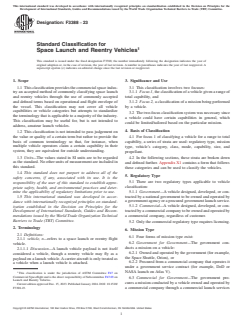
1.1 This classification provides the commercial space industry an accepted method of commonly classifying space launch and reentry vehicles through the use of commonly accepted and defined terms based on operational and flight envelope of the vessel. This classification may not cover all vehicle capabilities or vehicle categories but attempts to standardize the terminology that is applicable to a majority of the industry. This classification may be useful for, but is not intended to address, amateur launch vehicles.
1.2 This classification is not intended to pass judgement on the value or quality of a certain term but rather to provide the basis of common terminology so that, for instance, when multiple vehicle operators claim a certain capability in their system, they are equivalent for outside understanding.
1.3 Units—The values stated in SI units are to be regarded as the standard. No other units of measurement are included in this standard.
1.4 This standard does not purport to address all of the safety concerns, if any, associated with its use. It is the responsibility of the user of this standard to establish appropriate safety, health, and environmental practices and determine the applicability of regulatory limitations prior to use.
1.5 This international standard was developed in accordance with internationally recognized principles on standardization established in the Decision on Principles for the Development of International Standards, Guides and Recommendations issued by the World Trade Organization Technical Barriers to Trade (TBT) Committee.
- Status
- Published
- Publication Date
- 14-Dec-2023
- Technical Committee
- F47 - Commercial Spaceflight
- Drafting Committee
- F47.03 - Launch and Reentry Vehicles
Overview
ASTM F3388-23: Standard Classification for Space Launch and Reentry Vehicles is a key international standard developed by ASTM International. Its primary goal is to provide the commercial space industry with a unified system for classifying space launch and reentry vehicles. This standard uses clearly defined, accepted terminology based on each vehicle's operational capabilities and flight envelope, facilitating transparent communication and comparison among industry players and stakeholders.
This classification is focused on two essential aspects: the overall capabilities of the vehicle and the specific mission being performed. By standardizing vehicle categories and mission types, ASTM F3388-23 enables regulatory authorities, manufacturers, operators, and customers to have a common language, helping support regulatory compliance, system evaluation, and contract precision.
Key Topics
Dual-Focus Classification System:
- Vehicle capability: Considers the overall range of what a space launch or reentry vehicle can achieve.
- Mission profile: Classifies how the vehicle is used for a particular mission, recognizing that not all capabilities are used each time.
Common Terminology: The standard sets out universally accepted definitions for vehicle types, classes, and mission categories, addressing any disparities when different operators claim identical capabilities.
Classification Strata:
- Regulatory Type (Government, Commercial)
- Mission Type (Government for Government, Commercial for Government, Commercial for Commercial, Government for Commercial)
- Vehicle Category (e.g., rocket, spaceplane, capsule, lifting body, balloon)
- Vehicle Class (launch/landing orientation, launch domain, recovery method)
- Vehicle Mode (piloted, unguided/ballistic, autonomously guided, hybrid)
- Vehicle Capability (anti-collision, staging, termination system, reusable stages, etc.)
- Vehicle Size (launch/landing weight, thrust profile, explosive equivalent)
- Vehicle Propellant (propulsion type, fuels, capacities)
- Payload Types (crewed, cargo, hazardous materials)
- Mission Capabilities (orbital/suborbital, airspace impacts, launch/reentry windows)
Use of SI Units: All measurement values within the standard are stated in SI units to ensure consistency and international applicability.
Applications
ASTM F3388-23 is critical across the commercial spaceflight sector and associated regulatory environments. Its practical value includes:
- Industry Communication: Provides a common language for manufacturers, launch service providers, satellite operators, and spacecraft customers to describe and compare vehicle types and mission profiles.
- Regulatory Compliance: Simplifies interactions with regulatory bodies by standardizing terms and attributes required for licensing, mission approvals, and reporting.
- Procurement and Contracts: Supports clear contract definitions by using standardized vehicle and mission descriptors.
- Operational Planning & Safety: Enhances mission planning, risk assessment, and safety documentation by clearly outlining a vehicle’s attributes and mission functionalities.
- Stakeholder Transparency: Offers a basis for fair comparison and understanding between competing service providers and international partners.
Related Standards
- ASTM F47 Committee Standards: Other standards under Committee F47 on Commercial Spaceflight provide additional frameworks surrounding space vehicle operations, human spaceflight, and safety protocols.
- ISO Space Systems Standards: The International Organization for Standardization also produces standards relevant to space launch vehicles and mission assurance.
- National Regulatory Guidelines: May be used alongside requirements from national agencies such as the FAA (Federal Aviation Administration) or international equivalents.
- World Trade Organization TBT: In line with principles for international standards, supporting global trade in space services and equipment through harmonized classification.
Keywords: space launch, reentry vehicle, vehicle classification, commercial spaceflight, ASTM F3388, regulatory compliance, mission type, vehicle categories, standardization.
Frequently Asked Questions
ASTM F3388-23 is a standard published by ASTM International. Its full title is "Standard Classification for Space Launch and Reentry Vehicles". This standard covers: SIGNIFICANCE AND USE 3.1 This classification involves two focuses: 3.1.1 Focus 1, the classification of a vehicle given a range of total capability, and 3.1.2 Focus 2, a classification of a mission being performed by a vehicle. 3.2 The two-focus classification system was necessary since a vehicle could have certain capabilities in general, which could be limited/tailored based on the particular mission. SCOPE 1.1 This classification provides the commercial space industry an accepted method of commonly classifying space launch and reentry vehicles through the use of commonly accepted and defined terms based on operational and flight envelope of the vessel. This classification may not cover all vehicle capabilities or vehicle categories but attempts to standardize the terminology that is applicable to a majority of the industry. This classification may be useful for, but is not intended to address, amateur launch vehicles. 1.2 This classification is not intended to pass judgement on the value or quality of a certain term but rather to provide the basis of common terminology so that, for instance, when multiple vehicle operators claim a certain capability in their system, they are equivalent for outside understanding. 1.3 Units—The values stated in SI units are to be regarded as the standard. No other units of measurement are included in this standard. 1.4 This standard does not purport to address all of the safety concerns, if any, associated with its use. It is the responsibility of the user of this standard to establish appropriate safety, health, and environmental practices and determine the applicability of regulatory limitations prior to use. 1.5 This international standard was developed in accordance with internationally recognized principles on standardization established in the Decision on Principles for the Development of International Standards, Guides and Recommendations issued by the World Trade Organization Technical Barriers to Trade (TBT) Committee.
SIGNIFICANCE AND USE 3.1 This classification involves two focuses: 3.1.1 Focus 1, the classification of a vehicle given a range of total capability, and 3.1.2 Focus 2, a classification of a mission being performed by a vehicle. 3.2 The two-focus classification system was necessary since a vehicle could have certain capabilities in general, which could be limited/tailored based on the particular mission. SCOPE 1.1 This classification provides the commercial space industry an accepted method of commonly classifying space launch and reentry vehicles through the use of commonly accepted and defined terms based on operational and flight envelope of the vessel. This classification may not cover all vehicle capabilities or vehicle categories but attempts to standardize the terminology that is applicable to a majority of the industry. This classification may be useful for, but is not intended to address, amateur launch vehicles. 1.2 This classification is not intended to pass judgement on the value or quality of a certain term but rather to provide the basis of common terminology so that, for instance, when multiple vehicle operators claim a certain capability in their system, they are equivalent for outside understanding. 1.3 Units—The values stated in SI units are to be regarded as the standard. No other units of measurement are included in this standard. 1.4 This standard does not purport to address all of the safety concerns, if any, associated with its use. It is the responsibility of the user of this standard to establish appropriate safety, health, and environmental practices and determine the applicability of regulatory limitations prior to use. 1.5 This international standard was developed in accordance with internationally recognized principles on standardization established in the Decision on Principles for the Development of International Standards, Guides and Recommendations issued by the World Trade Organization Technical Barriers to Trade (TBT) Committee.
ASTM F3388-23 is available in PDF format for immediate download after purchase. The document can be added to your cart and obtained through the secure checkout process. Digital delivery ensures instant access to the complete standard document.
Standards Content (Sample)
This international standard was developed in accordance with internationally recognized principles on standardization established in the Decision on Principles for the
Development of International Standards, Guides and Recommendations issued by the World Trade Organization Technical Barriers to Trade (TBT) Committee.
Designation: F3388 − 23
Standard Classification for
Space Launch and Reentry Vehicles
This standard is issued under the fixed designation F3388; the number immediately following the designation indicates the year of
original adoption or, in the case of revision, the year of last revision. A number in parentheses indicates the year of last reapproval. A
superscript epsilon (´) indicates an editorial change since the last revision or reapproval.
1. Scope 3. Significance and Use
1.1 This classification provides the commercial space indus- 3.1 This classification involves two focuses:
try an accepted method of commonly classifying space launch 3.1.1 Focus 1, the classification of a vehicle given a range of
and reentry vehicles through the use of commonly accepted total capability, and
and defined terms based on operational and flight envelope of 3.1.2 Focus 2, a classification of a mission being performed
the vessel. This classification may not cover all vehicle by a vehicle.
capabilities or vehicle categories but attempts to standardize
3.2 The two-focus classification system was necessary since
the terminology that is applicable to a majority of the industry.
a vehicle could have certain capabilities in general, which
This classification may be useful for, but is not intended to
could be limited/tailored based on the particular mission.
address, amateur launch vehicles.
4. Basis of Classification
1.2 This classification is not intended to pass judgement on
the value or quality of a certain term but rather to provide the
4.1 For focus 1 of classifying a vehicle for a range to total
basis of common terminology so that, for instance, when
capability, a series of strata are used: regulatory type, mission
multiple vehicle operators claim a certain capability in their
type, vehicle’s category, class, mode, capability, size, and
system, they are equivalent for outside understanding.
propellant.
1.3 Units—The values stated in SI units are to be regarded
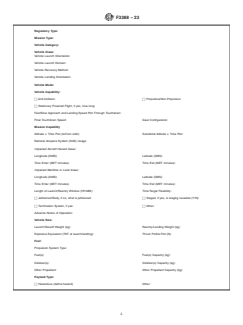
4.2 In the following sections, these strata are broken down
as the standard. No other units of measurement are included in
and defined further. Appendix X1 contains a form that follows
this standard.
these categories and can be used to classify the vehicles.
1.4 This standard does not purport to address all of the
5. Regulatory Type
safety concerns, if any, associated with its use. It is the
5.1 There are two regulatory types applicable to vehicle
responsibility of the user of this standard to establish appro-
classification:
priate safety, health, and environmental practices and deter-
5.1.1 Government—A vehicle designed, developed, or con-
mine the applicability of regulatory limitations prior to use.
tracted by a national government to be owned and operated by
1.5 This international standard was developed in accor-
a government agency or a procured government launch service.
dance with internationally recognized principles on standard-
5.1.2 Commercial—A vehicle designed, developed, or con-
ization established in the Decision on Principles for the
tracted by a commercial company to be owned and operated by
Development of International Standards, Guides and Recom-
a commercial company, regardless of customer.
mendations issued by the World Trade Organization Technical
Barriers to Trade (TBT) Committee.
5.2 Only the commercial regulatory type requires licensing.
2. Terminology
6. Mission Type
2.1 Definitions:
6.1 Four forms of mission type exist:
2.1.1 vehicle, n—refers to a space launch or reentry flight
6.2 Government for Government—The government con-
vehicle.
ducts a mission on a vehicle:
2.1.1.1 Discussion—A launch vehicle payload is not itself
6.2.1 Owned and operated by the government (for example,
considered a vehicle, though a reentry vehicle may fly as a
the Space Shuttle, Orion), or
payload on a launch vehicle. A carrier aircraft is only treated as
6.2.2 Procured from a commercial company that operates it
a vehicle when a launch vehicle is attached.
under a government service contract (for example, DoD or
1 NASA launch on Atlas V).
This classification is under the jurisdiction of ASTM Committee F47 on
Commercial Spaceflight and is the direct responsibility of Subcommittee F47.03 on
6.3 Commercial for Government—The government pro-
Launch and Reentry Vehicles.
cures a mission conducted by a vehicle owned and operated by
Current edition approved Dec. 15, 2023. Published January 2024. DOI: 10.1520/
F3388-23. a commercial company through a commercial launch services
Copyright © ASTM International, 100 Barr Harbor Drive, PO Box C700, West Conshohocken, PA 19428-2959. United States
F3388 − 23
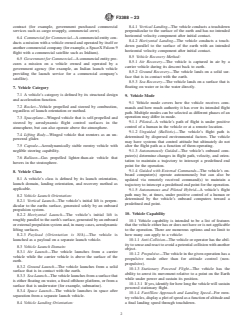
contract (for example, government purchased commercial 8.4.1 Vertical Landing—The vehicle conducts a touchdown
services such as cargo resupply, commercial crew). perpendicular to the surface of the earth and has no intended
horizontal velocity component after initial contact.
6.4 Commercial for Commercial—A commercial entity con-
8.4.2 Horizontal Landing—The vehicle conducts a touch-
ducts a mission with a vehicle owned and operated by itself or
down parallel to the surface of the earth with an intended
another commercial company (for example, a SpaceX Falcon 9
horizontal velocity component after initial contact.
flight with a commercial satellite such as Iridium).
8.5 Vehicle Recovery Method:
6.5 Government for Commercial—A commercial entity pro-
8.5.1 Air Recovery—The vehicle is captured in air by a
cures a mission on a vehicle owned and operated by a
carrier vehicle during its descent back to earth.
government agency (for example, an Indian launch vehicle
8.5.2 Ground Recovery—The vehicle lands on a solid sur-
providing the launch service for a commercial company’s
face that is in contact with the earth.
satellite).
8.5.3 Sea Recovery—The vehicle lands on a surface that is
floating on water or in the water directly.
7. Vehicle Category
7.1 A vehicle’s category is defined by its structural design
9. Vehicle Mode
and acceleration function.
9.1 Vehicle mode covers how the vehicle receives com-
7.2 Rocket—Vehicle propelled and steered by combustion,
mands and how much authority it has over its intended flight
regardless of launch orientation or method.
path. Multiple modes can be selected as different phases of an
operation may differ in mode.
7.3 Spaceplane—Winged vehicle that is self-propelled and
9.1.1 Piloted—A vehicle’s path of flight is under positive
steered by aerodynamic flight control surfaces in the
control of a human in the vehicle or at a remote location.
atmosphere, but can also operate above the atmosphere.
9.1.2 Unguided (Ballistic)—The vehicle’s flight path is
7.4 Lifting Body—Winged vehicle that reenters as an un-
determined by dispersed environmental factors. The vehicle
powered glider.
may have systems that control attitude but ultimately do not
7.5 Capsule—Aerodynamically stable reentry vehicle with alter the flight path as a function of them operating.
neglible steering capability.
9.1.3 Autonomously Guided—The vehicle’s onboard com-
puter(s) determine changes in flight path, velocity, and orien-
7.6 Balloon—Gas propelled lighter-than-air vehicle that
tation to maintain a trajectory to intercept a predefined end
hovers in the stratosphere.
point for the operation.
9.1.4 Guided with External Commands—The vehicle’s on-
8. Vehicle Class
board computer(s) operate autonomously but can also be
8.1 A vehicle’s class is defined by its launch orientation,
updated via remotely received command(s) to maintain a
launch domain, landing orientation, and recovery method as
trajectory to intercept a predefined end point for the operation.
applicable.
9.1.5 Autonomous and Piloted Hybrid—A vehicle’s flight
path may be, at times, under positive control of a human or
8.2 Vehicle Launch Orientation:
determined by the vehicle’s onboard computers toward a
8.2.1 Vertical Launch—The vehicle’s initial lift is perpen-
predefined end point.
dicular to the earths surface, generated solely by an onboard
propuls
...