

ASTM E1793-19
(Practice)Standard Practice for Preparation of Aluminum Alloy for Bonding in Foam and Beam Type Transportable Shelters
General Information
- Abstract
SIGNIFICANCE AND USE
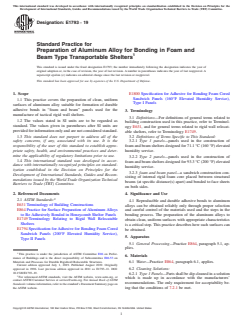
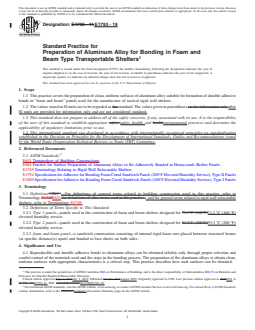
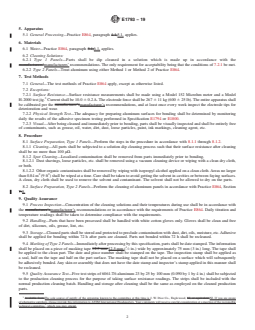
4.1 Reproducible and durable adhesive bonds to aluminum alloys can be obtained reliably only through proper selection and careful control of the materials used and the steps in the bonding process. The preparation of the aluminum alloys to obtain clean, uniform surfaces with appropriate characteristics is a critical step. This practice describes how such surfaces can be obtained.
SCOPE
1.1 This practice covers the preparation of clean, uniform surfaces of aluminum alloy suitable for formation of durable adhesive bonds in “foam and beam” panels used for the manufacture of tactical rigid wall shelters.
1.2 The values stated in SI units are to be regarded as standard. The values given in parentheses after SI units are provided for information only and are not considered standard.
1.3 This standard does not purport to address all of the safety concerns, if any, associated with its use. It is the responsibility of the user of this standard to establish appropriate safety, health, and environmental practices and determine the applicability of regulatory limitations prior to use.
1.4 This international standard was developed in accordance with internationally recognized principles on standardization established in the Decision on Principles for the Development of International Standards, Guides and Recommendations issued by the World Trade Organization Technical Barriers to Trade (TBT) Committee.
- Status
- Published
- Publication Date
- 30-Jun-2019
- Technical Committee
- E06 - Performance of Buildings
Buy Documents


ASTM E1793-19 - Standard Practice for Preparation of Aluminum Alloy for Bonding in Foam and Beam Type Transportable Shelters


REDLINE ASTM E1793-19 - Standard Practice for Preparation of Aluminum Alloy for Bonding in Foam and Beam Type Transportable Shelters
Overview
ASTM E1793-19: Standard Practice for Preparation of Aluminum Alloy for Bonding in Foam and Beam Type Transportable Shelters establishes procedures for preparing clean, uniform surfaces on aluminum alloys to ensure reliable and durable adhesive bonds. This standard is especially relevant for the production of "foam and beam" panels integral to tactical rigid wall shelters, commonly used in military, emergency, and transportable housing applications. Proper surface preparation of the aluminum alloy is a critical step in achieving consistent bond strength, enhancing panel performance, and ensuring the longevity of shelter structures.
Key Topics
- Surface Cleaning: Emphasizes the necessity for aluminum alloy surfaces to be cleaned with solutions specified by manufacturers to achieve a uniform and contaminant-free finish.
- Adhesive Bonding Readiness: Only properly prepared surfaces, free from grease, oil, dust, or other contaminants, are suitable for strong and durable adhesive bonds.
- Panel Types: Covers both Type 1 panels (for 160°F elevated humidity service) and Type 2 panels (for 200°F elevated humidity service), ensuring adaptable application for differing environmental conditions.
- Quality Assurance: Outlines strict protocols for inspection, handling, storage, and marking to guarantee that only compliant panels are used.
- Test Methods: Utilizes surface resistance measurements, physical strength tests, and visual inspections to verify the effectiveness of surface preparation and bonding.
Applications
ASTM E1793-19 is primarily applied in the manufacture of foam and beam panels for tactical rigid wall shelters, which require robust performance in field environments and transport scenarios. Key application areas include:
- Military Shelters: Ensuring structural integrity and durability for deployable living or operations units.
- Disaster Relief Housing: Supporting rapid assembly of temporary shelters where reliable bonding of panels is critical for occupant safety.
- Transportable and Modular Structures: Applied in products requiring lightweight, strong, and weather-resistant panel construction for mobile applications.
- Industrial and Commercial Construction: Utilized when sandwich panel technology combines foam insulation with aluminum facings bonded to beams, contributing to energy efficiency and structural performance.
Consistent surface preparation following ASTM E1793-19 supports productivity and reduces the risk of bond failures, panel delamination, and structural compromise.
Related Standards
The effective implementation of ASTM E1793-19 is supported by several referenced and related standards, including:
- ASTM E631: Terminology of Building Constructions - for common language and definitions.
- ASTM E864: Practice for Surface Preparation of Aluminum Alloys to Be Adhesively Bonded in Honeycomb Shelter Panels - details cleaning methods referenced in E1793-19.
- ASTM E1749: Terminology Relating to Rigid Wall Relocatable Shelters - for consistent terminology.
- ASTM E1794: Specification for Adhesive for Bonding Foam Cored Sandwich Panels (200°F Elevated Humidity Service), Type II Panels.
- ASTM E1800: Specification for Adhesive for Bonding Foam Cored Sandwich Panels (160°F Elevated Humidity Service), Type I Panels.
These interrelated standards collectively guide manufacturers in material preparation, adhesive selection, quality control, and terminology necessary for the successful assembly of foam and beam type transportable shelters.
Relevant Keywords: ASTM E1793-19, aluminum alloy preparation, adhesive bonding, foam and beam panels, tactical shelters, surface cleaning, quality assurance, durable adhesive bonds, transportable shelters, panel manufacturing.
Relations
- Effective Date
- 01-Jul-2019
- Effective Date
- 01-Oct-2018
- Effective Date
- 01-Mar-2015
- Effective Date
- 01-Nov-2014
- Effective Date
- 01-Nov-2010
- Effective Date
- 01-Nov-2008
- Effective Date
- 01-Nov-2008
- Effective Date
- 01-Nov-2008
- Effective Date
- 01-Jun-2006
- Effective Date
- 01-Oct-2005
- Effective Date
- 01-Oct-2003
- Effective Date
- 10-Apr-2003
- Effective Date
- 10-Apr-2003
- Effective Date
- 10-Oct-2000
- Effective Date
- 10-Oct-2000
Buy Documents
ASTM E1793-19 - Standard Practice for Preparation of Aluminum Alloy for Bonding in Foam and Beam Type Transportable Shelters
REDLINE ASTM E1793-19 - Standard Practice for Preparation of Aluminum Alloy for Bonding in Foam and Beam Type Transportable Shelters
Get Certified
Connect with accredited certification bodies for this standard

DVS-ZERT GmbH
German welding certification society.

Element Materials Technology
Materials testing and product certification.
Inštitut za kovinske materiale in tehnologije
Institute of Metals and Technology. Materials testing, metallurgical analysis, NDT.
Sponsored listings
Frequently Asked Questions
ASTM E1793-19 is a standard published by ASTM International. Its full title is "Standard Practice for Preparation of Aluminum Alloy for Bonding in Foam and Beam Type Transportable Shelters". This standard covers: SIGNIFICANCE AND USE 4.1 Reproducible and durable adhesive bonds to aluminum alloys can be obtained reliably only through proper selection and careful control of the materials used and the steps in the bonding process. The preparation of the aluminum alloys to obtain clean, uniform surfaces with appropriate characteristics is a critical step. This practice describes how such surfaces can be obtained. SCOPE 1.1 This practice covers the preparation of clean, uniform surfaces of aluminum alloy suitable for formation of durable adhesive bonds in “foam and beam” panels used for the manufacture of tactical rigid wall shelters. 1.2 The values stated in SI units are to be regarded as standard. The values given in parentheses after SI units are provided for information only and are not considered standard. 1.3 This standard does not purport to address all of the safety concerns, if any, associated with its use. It is the responsibility of the user of this standard to establish appropriate safety, health, and environmental practices and determine the applicability of regulatory limitations prior to use. 1.4 This international standard was developed in accordance with internationally recognized principles on standardization established in the Decision on Principles for the Development of International Standards, Guides and Recommendations issued by the World Trade Organization Technical Barriers to Trade (TBT) Committee.
SIGNIFICANCE AND USE 4.1 Reproducible and durable adhesive bonds to aluminum alloys can be obtained reliably only through proper selection and careful control of the materials used and the steps in the bonding process. The preparation of the aluminum alloys to obtain clean, uniform surfaces with appropriate characteristics is a critical step. This practice describes how such surfaces can be obtained. SCOPE 1.1 This practice covers the preparation of clean, uniform surfaces of aluminum alloy suitable for formation of durable adhesive bonds in “foam and beam” panels used for the manufacture of tactical rigid wall shelters. 1.2 The values stated in SI units are to be regarded as standard. The values given in parentheses after SI units are provided for information only and are not considered standard. 1.3 This standard does not purport to address all of the safety concerns, if any, associated with its use. It is the responsibility of the user of this standard to establish appropriate safety, health, and environmental practices and determine the applicability of regulatory limitations prior to use. 1.4 This international standard was developed in accordance with internationally recognized principles on standardization established in the Decision on Principles for the Development of International Standards, Guides and Recommendations issued by the World Trade Organization Technical Barriers to Trade (TBT) Committee.
ASTM E1793-19 is classified under the following ICS (International Classification for Standards) categories: 25.220.10 - Surface preparation; 77.120.10 - Aluminium and aluminium alloys. The ICS classification helps identify the subject area and facilitates finding related standards.
ASTM E1793-19 has the following relationships with other standards: It is inter standard links to ASTM E1793-11, ASTM E1749-18, ASTM E631-15, ASTM E631-14, ASTM E1749-10, ASTM E864-08, ASTM E1794-08, ASTM E1800-08, ASTM E631-06, ASTM E1749-05, ASTM E864-03, ASTM E1794-03, ASTM E1800-03, ASTM E1794-00, ASTM E1800-00. Understanding these relationships helps ensure you are using the most current and applicable version of the standard.
ASTM E1793-19 is available in PDF format for immediate download after purchase. The document can be added to your cart and obtained through the secure checkout process. Digital delivery ensures instant access to the complete standard document.
Standards Content (Sample)
This international standard was developed in accordance with internationally recognized principles on standardization established in the Decision on Principles for the
Development of International Standards, Guides and Recommendations issued by the World Trade Organization Technical Barriers to Trade (TBT) Committee.
Designation: E1793 − 19
Standard Practice for
Preparation of Aluminum Alloy for Bonding in Foam and
Beam Type Transportable Shelters
This standard is issued under the fixed designation E1793; the number immediately following the designation indicates the year of
original adoption or, in the case of revision, the year of last revision. A number in parentheses indicates the year of last reapproval. A
superscript epsilon (´) indicates an editorial change since the last revision or reapproval.
This standard has been approved for use by agencies of the U.S. Department of Defense.
1. Scope E1800 Specification for Adhesive for Bonding Foam Cored
Sandwich Panels (160°F Elevated Humidity Service),
1.1 This practice covers the preparation of clean, uniform
Type I Panels
surfaces of aluminum alloy suitable for formation of durable
adhesive bonds in “foam and beam” panels used for the
3. Terminology
manufacture of tactical rigid wall shelters.
3.1 Definitions—For definitions of general terms related to
1.2 The values stated in SI units are to be regarded as
building construction used in this practice, refer to Terminol-
standard. The values given in parentheses after SI units are
ogy E631, and for general terms related to rigid wall relocat-
provided for information only and are not considered standard.
able shelters, refer to Terminology E1749.
1.3 This standard does not purport to address all of the 3.2 Definitions of Terms Specific to This Standard:
safety concerns, if any, associated with its use. It is the 3.2.1 Type 1 panels—panels used in the construction of
responsibility of the user of this standard to establish appro- foam and beam shelters designed for 71.1 °C (160 °F) elevated
priate safety, health, and environmental practices and deter- humidity service.
mine the applicability of regulatory limitations prior to use.
3.2.2 Type 2 panels—panels used in the construction of
1.4 This international standard was developed in accor-
foam and beam shelters designed for 93.3 °C (200 °F) elevated
dance with internationally recognized principles on standard-
humidity service.
ization established in the Decision on Principles for the
3.2.3 foam and beam panel—a sandwich construction con-
Development of International Standards, Guides and Recom-
sisting of internal rigid foam core placed between structural
mendations issued by the World Trade Organization Technical
beams (at specific distance(s) apart) and bonded to face sheets
Barriers to Trade (TBT) Committee.
on both sides.
2. Referenced Documents
4. Significance and Use
2.1 ASTM Standards:
4.1 Reproducible and durable adhesive bonds to aluminum
E631 Terminology of Building Constructions
alloys can be obtained reliably only through proper selection
E864 Practice for Surface Preparation of Aluminum Alloys
and careful control of the materials used and the steps in the
to Be Adhesively Bonded in Honeycomb Shelter Panels
bonding process. The preparation of the aluminum alloys to
E1749 Terminology Relating to Rigid Wall Relocatable
obtain clean, uniform surfaces with appropriate characteristics
Shelters
is a critical step. This practice describes how such surfaces can
E1794 Specification for Adhesive for Bonding Foam Cored
be obtained.
Sandwich Panels (200°F Elevated Humidity Service),
5. Apparatus
Type II Panels
5.1 General Processing—Practice E864, paragraph 5.1, ap-
plies.
This practice is under the jurisdiction of ASTM Committee E06 on Perfor-
6. Materials
mance of Buildings and is the direct responsibility of Subcommittee E06.53 on
Materials and Processes for Durable Rigidwall Relocatable Structures.
6.1 Water—Practice E864, paragraph 6.1, applies.
Current edition approved July 1, 2019. Published August 2019. Originally
6.2 Cleaning Solutions:
approved in 1996. Last previous edition approved in 2011 as E1793–11. DOI:
10.1520/E1793–19.
6.2.1 Type 1 Panels—Parts shall be dip cleaned in a solution
For referenced ASTM standards, visit the ASTM website, www.astm.org, or
which is made up in accordance with the manufacturers’
contact ASTM Customer Service at service@astm.org. For Annual Book of ASTM
recommendations. The only requirement for acceptability be-
Standards volume information, refer to the standard’s Document Summary page on
the ASTM website. ing that the conditions of 7.2.1 be met.
Copyright © ASTM International, 100 Barr Harbor Drive, PO Box C700, West Conshohocken, PA 19428-2959. United States
E1793 − 19
6.2.2 Type 2 Panels—TreataluminumusingeitherMethod1 between faying surfaces. A clean, dry cloth shall be used to
or Method 2 of Practice E864. remove the solvent and contaminant. The solvent shall not be
allowed to dry on the parts.
7. Test Methods
8.2 Surface Preparation, Type 2 Panels—Perform the clean-
7.1 General—The test methods of Practice E864 apply,
ing of aluminum panels in accordance with Practice E864,
except as otherwise listed.
Section 8.
7.2 Exceptions:
9. Quality Assurance
7.2.1 Surface Resistance—Surface resistance meas
...
This document is not an ASTM standard and is intended only to provide the user of an ASTM standard an indication of what changes have been made to the previous version. Because
it may not be technically possible to adequately depict all changes accurately, ASTM recommends that users consult prior editions as appropriate. In all cases only the current version
of the standard as published by ASTM is to be considered the official document.
Designation: E1793 − 11 E1793 − 19
Standard Practice for
Preparation of Aluminum Alloy for Bonding in Foam and
Beam Type Transportable Shelters
This standard is issued under the fixed designation E1793; the number immediately following the designation indicates the year of
original adoption or, in the case of revision, the year of last revision. A number in parentheses indicates the year of last reapproval. A
superscript epsilon (´) indicates an editorial change since the last revision or reapproval.
This standard has been approved for use by agencies of the U.S. Department of Defense.
1. Scope
1.1 This practice covers the preparation of clean, uniform surfaces of aluminum alloy suitable for formation of durable adhesive
bonds in “foam and beam” panels used for the manufacture of tactical rigid wall shelters.
1.2 The values stated in SI units are to be regarded as the standard. The values given in parentheses are for information only.after
SI units are provided for information only and are not considered standard.
1.3 This standard does not purport to address all of the safety concerns, if any, associated with its use. It is the responsibility
of the user of this standard to establish appropriate safety safety, health, and healthenvironmental practices and determine the
applicability of regulatory limitations prior to use.
1.4 This international standard was developed in accordance with internationally recognized principles on standardization
established in the Decision on Principles for the Development of International Standards, Guides and Recommendations issued
by the World Trade Organization Technical Barriers to Trade (TBT) Committee.
2. Referenced Documents
2.1 ASTM Standards:
E631 Terminology of Building Constructions
E864 Practice for Surface Preparation of Aluminum Alloys to Be Adhesively Bonded in Honeycomb Shelter Panels
E1749 Terminology Relating to Rigid Wall Relocatable Shelters
E1794 Specification for Adhesive for Bonding Foam Cored Sandwich Panels (200°F Elevated Humidity Service), Type II Panels
E1800 Specification for Adhesive for Bonding Foam Cored Sandwich Panels (160°F Elevated Humidity Service), Type I Panels
3. Terminology
3.1 Definitions—See —For definitions of general terms related to building construction used in this practice, refer to
Terminology E1749E631 for definitions of other terms used in this practice. , and for general terms related to rigid wall relocatable
shelters, refer to Terminology E1749.
3.2 Definitions of Terms Specific to This Standard:
3.2.1 Type 1 panels—panels used in the construction of foam and beam shelters designed for 71.1°C (160°F)71.1 °C (160 °F)
elevated humidity service.
3.2.2 Type 2 panels—panels used in the construction of foam and beam shelters designed for 93.3°C (200°F)93.3 °C (200 °F)
elevated humidity service.
3.2.3 foam and beam panel—a sandwich construction consisting of internal rigid foam core placed between structural beams
(at specific distance(s) apart) and bonded to face sheets on both sides.
4. Significance and Use
4.1 Reproducible and durable adhesive bonds to aluminum alloys can be obtained reliably only through proper selection and
careful control of the materials used and the steps in the bonding process. The preparation of the aluminum alloys to obtain clean,
uniform surfaces with appropriate characteristics is a critical step. This practice describes how such surfaces can be obtained.
This practice is under the jurisdiction of ASTM Committee E06 on Performance of Buildings and is the direct responsibility of Subcommittee E06.53 on Materials and
Processes for Durable Rigidwall Relocatable Structures.
Current edition approved Sept. 1, 2011July 1, 2019. Published October 2011August 2019. Originally approved in 1996. Last previous edition approved in 20052011 as
E1793 – 05.E1793–11. DOI: 10.1520/E1793-11.10.1520/E1793–19.
For referenced ASTM standards, visit the ASTM website, www.astm.org, or contact ASTM Customer Service at service@astm.org. For Annual Book of ASTM Standards
volume information, refer to the standard’sstandard’s Document Summary page on the ASTM website.
Copyright © ASTM International, 100 Barr Harbor Drive, PO Box C700, West Conshohocken, PA 19428-2959. United States
E1793 − 19
5. Apparatus
5.1 General Processing—Practice E864, paragraph 4.1,5.1, applies.
6. Materials
6.1 Water—Practice E864, paragraph 5.1,6.1, applies.
6.2 Cleaning Solutions:
6.2.1 Type 1 Panels—Parts shall be dip cleaned in a solution which is made up in accordance with the
manufacturers’manufacturers’ recommendations. The only requirement for acceptability being that the conditions of 7.2.1 be met.
6.2.2 Type 2 Panels—Treat aluminum using either Method 1 or Method 2 of Practice E864.
7. Test Methods
7.1 General—The test methods of Practice E864 apply, except as otherwise listed.
7.2 Exceptions:
7.2.1 Surface Resistance—Surface resistance measurements shall be made using a Model 152 Microhm meter and a Model
H-2000 test jig. Current shall be 10.0 6 0.2 A. The electrode force shall be 267 6 11 kg (600 6 25 lb). The entire apparatus shall
be calibra
...