

ASTM D4006-22
(Test Method)Standard Test Method for Water in Crude Oil by Distillation
General Information
- Abstract
SIGNIFICANCE AND USE
5.1 A knowledge of the water content of crude oil is important in the refining, purchase, sale, or transfer of crude oils.
5.2 This test method may not be suitable for crude oils that contain alcohols that are soluble in water. In cases where the impact on the results may be significant, the user is advised to consider using another test method, such as Test Method D4928 (API MPMS Chapter 10.9).
SCOPE
1.1 This test method covers the determination of water in crude oil by distillation.
1.2 The values stated in SI units are to be regarded as standard. No other units of measurement are included in this standard.
1.3 This standard does not purport to address all of the safety concerns, if any, associated with its use. It is the responsibility of the user of this standard to establish appropriate safety, health, and environmental practices and determine the applicability of regulatory limitations prior to use. For specific warning statements, see 7.1 and A1.1.
1.4 This international standard was developed in accordance with internationally recognized principles on standardization established in the Decision on Principles for the Development of International Standards, Guides and Recommendations issued by the World Trade Organization Technical Barriers to Trade (TBT) Committee.
- Status
- Published
- Publication Date
- 30-Sep-2022
- Technical Committee
- D02 - Petroleum Products, Liquid Fuels, and Lubricants
- Drafting Committee
- D02.02 - Hydrocarbon Measurement for Custody Transfer (Joint ASTM-API)
Overview
ASTM D4006-22: Standard Test Method for Water in Crude Oil by Distillation is an internationally recognized standard developed by ASTM for the precise measurement of water content in crude oil samples using distillation. The knowledge of water content is crucial for the refining, purchase, sale, and custody transfer of crude oil, as water can affect volume, quality, and downstream processing costs. This method is referenced in major petroleum operations for its established accuracy and reliability.
This standardized procedure details the required apparatus, sampling, calibration, and calculation steps for determining the water present in crude oil, targeting crude oils that do not contain significant quantities of water-soluble alcohols. Where such alcohols are present, alternative ASTM methods, such as D4928, should be considered.
Key Topics
- Significance of Water Determination:
- Ensures accurate quantity and quality assessment during crude oil transactions.
- Helps refineries minimize processing challenges and equipment corrosion.
- Scope and Limitations:
- Specifically designed for crude oils without soluble alcohols; not suitable in cases where water-soluble organic compounds would bias results.
- Adheres strictly to SI units for consistency and global applicability.
- Precision and Reliability:
- Established repeatability and reproducibility, typically within 0.08% and 0.11% for water content above 0.1%.
- Lower bias and better precision compared to centrifuge methods in most cases.
- Sampling and Safety:
- Emphasizes representative sampling as per referenced practices (ASTM D4057 and D4177).
- Users must implement appropriate safety measures, especially when working with hazardous solvents such as xylene.
Applications
- Refining and Production:
- Used by refineries and oil producers to assess incoming crude batches for water content, preventing processing inefficiencies.
- Custody Transfer and Trading:
- Essential for fair financial settlements, ensuring buyers and sellers have a common metric.
- Supports accurate inventory management and regulatory reporting in the oil and gas industry.
- Quality Control and Compliance:
- Used in laboratories to monitor and ensure product specifications are met before transportation or further refining.
- Regulatory and Contractual Requirements:
- Frequently specified by contracts or regulations as the required test method during disputes or verifications.
Related Standards
- ASTM D95 – Test Method for Water in Petroleum Products and Bituminous Materials by Distillation; similar in procedure, can be referenced for bitumen and other petroleum products.
- ASTM D473 – Test Method for Sediment in Crude Oils and Fuel Oils by the Extraction Method.
- ASTM D1796 – Test Method for Water and Sediment in Fuel Oils by the Centrifuge Method.
- ASTM D4928 – Water in Crude Oils by Coulometric Karl Fischer Titration; recommended for crude oils containing alcohol.
- ASTM D4057 / D4177 – Practices for Manual and Automatic Sampling of Petroleum and Petroleum Products.
- API MPMS Chapters – Supplementary guidelines for the manual and automatic sampling, as well as water determination procedures.
Keywords: ASTM D4006-22, water in crude oil, crude oil distillation, petroleum analysis, oil refinery standards, custody transfer, water determination method, oil and gas testing standards.
Relations
- Refers
ASTM E123-02(2024) - Standard Specification for Apparatus for Determination of Water by Distillation - Effective Date
- 01-Feb-2024
- Refers
ASTM D4175-23a - Standard Terminology Relating to Petroleum Products, Liquid Fuels, and Lubricants - Effective Date
- 15-Dec-2023
- Effective Date
- 01-Dec-2023
- Refers
ASTM D4175-23e1 - Standard Terminology Relating to Petroleum Products, Liquid Fuels, and Lubricants - Effective Date
- 01-Jul-2023
- Effective Date
- 01-Dec-2019
- Refers
ASTM E123-02(2018) - Standard Specification for Apparatus for Determination of Water by Distillation - Effective Date
- 01-Jan-2018
- Effective Date
- 01-Oct-2014
- Refers
ASTM E123-02(2012) - Standard Specification for Apparatus for Determination of Water by Distillation - Effective Date
- 01-Nov-2012
- Effective Date
- 01-Nov-2012
- Refers
ASTM E123-02(2007) - Standard Specification for Apparatus for Determination of Water by Distillation - Effective Date
- 01-Nov-2007
- Effective Date
- 01-May-2006
- Effective Date
- 01-Nov-2003
- Effective Date
- 10-Nov-2002
- Refers
ASTM E123-02 - Standard Specification for Apparatus for Determination of Water by Distillation - Effective Date
- 10-May-2002
- Effective Date
- 10-Dec-1999
Get Certified
Connect with accredited certification bodies for this standard

Element Materials Technology
Materials testing and product certification.

ABS Group Brazil
ABS Group certification services in Brazil.

ABS Quality Evaluations Inc.
American Bureau of Shipping quality certification.
Sponsored listings
Frequently Asked Questions
ASTM D4006-22 is a standard published by ASTM International. Its full title is "Standard Test Method for Water in Crude Oil by Distillation". This standard covers: SIGNIFICANCE AND USE 5.1 A knowledge of the water content of crude oil is important in the refining, purchase, sale, or transfer of crude oils. 5.2 This test method may not be suitable for crude oils that contain alcohols that are soluble in water. In cases where the impact on the results may be significant, the user is advised to consider using another test method, such as Test Method D4928 (API MPMS Chapter 10.9). SCOPE 1.1 This test method covers the determination of water in crude oil by distillation. 1.2 The values stated in SI units are to be regarded as standard. No other units of measurement are included in this standard. 1.3 This standard does not purport to address all of the safety concerns, if any, associated with its use. It is the responsibility of the user of this standard to establish appropriate safety, health, and environmental practices and determine the applicability of regulatory limitations prior to use. For specific warning statements, see 7.1 and A1.1. 1.4 This international standard was developed in accordance with internationally recognized principles on standardization established in the Decision on Principles for the Development of International Standards, Guides and Recommendations issued by the World Trade Organization Technical Barriers to Trade (TBT) Committee.
SIGNIFICANCE AND USE 5.1 A knowledge of the water content of crude oil is important in the refining, purchase, sale, or transfer of crude oils. 5.2 This test method may not be suitable for crude oils that contain alcohols that are soluble in water. In cases where the impact on the results may be significant, the user is advised to consider using another test method, such as Test Method D4928 (API MPMS Chapter 10.9). SCOPE 1.1 This test method covers the determination of water in crude oil by distillation. 1.2 The values stated in SI units are to be regarded as standard. No other units of measurement are included in this standard. 1.3 This standard does not purport to address all of the safety concerns, if any, associated with its use. It is the responsibility of the user of this standard to establish appropriate safety, health, and environmental practices and determine the applicability of regulatory limitations prior to use. For specific warning statements, see 7.1 and A1.1. 1.4 This international standard was developed in accordance with internationally recognized principles on standardization established in the Decision on Principles for the Development of International Standards, Guides and Recommendations issued by the World Trade Organization Technical Barriers to Trade (TBT) Committee.
ASTM D4006-22 is classified under the following ICS (International Classification for Standards) categories: 75.040 - Crude petroleum. The ICS classification helps identify the subject area and facilitates finding related standards.
ASTM D4006-22 has the following relationships with other standards: It is inter standard links to ASTM E123-02(2024), ASTM D4175-23a, ASTM D665-23, ASTM D4175-23e1, ASTM D665-19, ASTM E123-02(2018), ASTM D665-14, ASTM E123-02(2012), ASTM D665-12, ASTM E123-02(2007), ASTM D665-06, ASTM D665-03, ASTM D665-02, ASTM E123-02, ASTM D665-99. Understanding these relationships helps ensure you are using the most current and applicable version of the standard.
ASTM D4006-22 is available in PDF format for immediate download after purchase. The document can be added to your cart and obtained through the secure checkout process. Digital delivery ensures instant access to the complete standard document.
Standards Content (Sample)
This international standard was developed in accordance with internationally recognized principles on standardization established in the Decision on Principles for the
Development of International Standards, Guides and Recommendations issued by the World Trade Organization Technical Barriers to Trade (TBT) Committee.
Designation: D4006 − 22
Manual of Petroleum Measurement Standards (MPMS), Chapter 10.2
Standard Test Method for
Water in Crude Oil by Distillation
This standard is issued under the fixed designation D4006; the number immediately following the designation indicates the year of
original adoption or, in the case of revision, the year of last revision.Anumber in parentheses indicates the year of last reapproval.A
superscript epsilon (´) indicates an editorial change since the last revision or reapproval.
This standard has been approved for use by agencies of the U.S. Department of Defense.
1. Scope* Inhibited Mineral Oil in the Presence of Water
D1796Test Method for Water and Sediment in Fuel Oils by
1.1 This test method covers the determination of water in
the Centrifuge Method (Laboratory Procedure) (API
crude oil by distillation.
MPMS Chapter 10.6)
1.2 The values stated in SI units are to be regarded as
D4057Practice for Manual Sampling of Petroleum and
standard. No other units of measurement are included in this
Petroleum Products (API MPMS Chapter 8.1)
standard.
D4175Terminology Relating to Petroleum Products, Liquid
1.3 This standard does not purport to address all of the Fuels, and Lubricants
safety concerns, if any, associated with its use. It is the
D4177Practice for Automatic Sampling of Petroleum and
responsibility of the user of this standard to establish appro- Petroleum Products (API MPMS Chapter 8.2)
priate safety, health, and environmental practices and deter-
D4928Test Method forWater in Crude Oils by Coulometric
mine the applicability of regulatory limitations prior to use. Karl Fischer Titration (API MPMS Chapter 10.9)
For specific warning statements, see 7.1 and A1.1.
E123SpecificationforApparatusforDeterminationofWater
1.4 This international standard was developed in accor- by Distillation
dance with internationally recognized principles on standard-
2.2 API Standards:
ization established in the Decision on Principles for the MPMS Chapter 1Terms and Definitions Database
Development of International Standards, Guides and Recom-
MPMS Chapter 8.1Manual Sampling of Petroleum and
mendations issued by the World Trade Organization Technical Petroleum Products (ASTM Practice D4057)
Barriers to Trade (TBT) Committee.
MPMS Chapter 8.2Automatic Sampling of Petroleum and
Petroleum Products (ASTM Practice D4177)
2. Referenced Documents
MPMS Chapter 10.1Test Method for Sediment in Crude
Oils and Fuel Oils by the Extraction Method (ASTMTest
2.1 ASTM Standards:
Method D473)
D95Test Method for Water in Petroleum Products and
MPMS Chapter 10.4Determination of Water and/or Sedi-
BituminousMaterialsbyDistillation(API MPMSChapter
ment in Crude Oil by the Centrifuge Method (Field
10.5)
Procedure)
D473TestMethodforSedimentinCrudeOilsandFuelOils
MPMS Chapter 10.5Test Method for Water in Petroleum
by the Extraction Method (API MPMS Chapter 10.1)
Products and Bituminous Materials by Distillation
D665Test Method for Rust-Preventing Characteristics of
(ASTM Test Method D95)
MPMSChapter10.6TestMethodforWaterandSedimentin
This test method is under the jurisdiction of ASTM Committee D02 on
Fuel Oils by the Centrifuge Method (Laboratory Proce-
Petroleum Products, Liquid Fuels, and Lubricants and the API Committee on
dure) (ASTM Test Method D1796)
Petroleum Measurement and is the direct responsibility of Subcommittee D02.02
MPMSChapter10.9TestMethodforWaterinCrudeOilsby
/COMQ the joint ASTM-API Committee on Hydrocarbon Measurement for
Custody Transfer (Joint ASTM-API). This test method has been approved by the Coulometric Karl Fischer Titration (ASTM Test Method
sponsoring committees and accepted by the Cooperating Societies in accordance
D4928)
with established procedures.
Current edition approved Oct. 1, 2022. Published December 2022. Originally
3. Terminology
ɛ1
approved in 1981. Last previous edition approved in 2016 as D4006–16 . DOI:
10.1520/D4006-22.
3.1 Definitions:
For referenced ASTM standards, visit the ASTM website, www.astm.org, or
3.1.1 For definitions of terms used in this test method, refer
contact ASTM Customer Service at service@astm.org. For Annual Book of ASTM
to Terminology D4175 and the API MPMS Chapter 1 Terms
Standards volume information, refer to the standard’s Document Summary page on
the ASTM website. and Definitions Database.
*A Summary of Changes section appears at the end of this standard
© Jointly copyrighted by ASTM International, 100 Barr Harbor Drive, PO Box C700, West Conshohocken, PA 19428-2959, USA and the American Petroleum Institute (API), 1220 L Street NW, Washington DC 20005, USA
D4006 − 22
trap with 0.05mL graduations. The trap will be fitted with a
400mm Liebig condenser. A drying tube filled with desiccant
(to prevent entrance of atmospheric moisture) is placed on top
of the condenser.
6.1.2 Heater—Any suitable gas or electric heater that can
uniformly distribute heat to the entire lower half of the flask
may be used.An electric heating mantle is preferred for safety
reasons.
6.1.3 The apparatus used in this test will be accepted when
satisfactory results are obtained by the calibration technique
described in Section 9.
7. Solvent
7.1 Xylene—reagent grade (Warning—Extremely flam-
mable.Vapor harmful. See AnnexA1.)Asolvent blank will be
established by placing 400mL of solvent in the distillation
apparatus and testing as outlined in Section 10. The blank will
be determined to the nearest 0.025mL and used to correct the
volume of water in the trap as in Section 11.
7.2 Thexyleneusedinthisprocedureisgenerallyamixture
of ortho, meta, and para isomers and may contain some ethyl
benzene. The typical characteristics for this reagent are:
Color (APHA) not more than 10
Boiling range 137 °C to 144 °C
Residue after evaporation 0.002 %
Sulfur compounds (as S) 0.003 %
Substances darkened by H SO Color pass test
2 4
Water (H O) 0.02 %
FIG. 1 Distillation Apparatus
Heavy metals (as Pb) 0.1 ppm
Copper (Cu) 0.1 ppm
Iron (Fe) 0.1 ppm
Nickel (Ni) 0.1 ppm
4. Summary of Test Method
Silver (Ag) 0.1 ppm
4.1 The sample is heated under reflux conditions with a
8. Sampling, Test Samples, and Test Units
waterimmisciblesolventwhichco-distillswiththewaterinthe
sample. Condensed solvent and water are continuously sepa-
8.1 Sampling is defined as all steps required to obtain an
ratedinatrap—thewatersettlesinthegraduatedsectionofthe
aliquotofthecontentsofanypipe,tank,orothersystemandto
trap, and the solvent returns to the distillation flask.
place the sample into the laboratory test container.
8.1.1 Laboratory Sample—Only representative samples ob-
5. Significance and Use
tainedasspecifiedinPracticeD4057(API MPMSChapter8.1)
5.1 A knowledge of the water content of crude oil is
andPracticeD4177(API MPMSChapter8.2)shallbeusedfor
important in the refining, purchase, sale, or transfer of crude
this test method.
oils.
8.1.2 Preparation of Test Samples—The following sample
handling procedure shall apply in addition to those covered in
5.2 This test method may not be suitable for crude oils that
8.1.1.
contain alcohols that are soluble in water. In cases where the
8.1.2.1 Thesamplesizeshallbeselectedasindicatedbelow
impact on the results may be significant, the user is advised to
based on the expected water content of the sample:
consider using another test method, such as Test Method
D4928 (API MPMS Chapter 10.9). Expected Water Content, Approximate Sample Size,
weight or volume % gormL
50.1–100.0 5
6. Apparatus
25.1–50.0 10
10.1–25.0 20
6.1 The preferred apparatus, shown in Fig. 1, consists of a
5.1–10.0 50
glass distillation flask, a condenser, a graduated glass trap, and
1.1–5.0 100
a heater. Other types of distillation apparatus are specified in 0.5–1.0 200
less than 0.5 200
Specification E123.Any of these apparatus will be acceptable
for this test method provided it can be demonstrated that they 8.1.2.2 If there is any doubt about the uniformity of the
operate within the precision established with the preferred mixedsample,determinationsshouldbemadeonatleastthree
apparatus. test portions and the average result reported as the water
6.1.1 Distillation Flask—A 1000mL round-bottom, glass, content.
distillation flask fitted with a 24/40 female taper joint shall be 8.1.2.3 To determine water on a volume basis, measure
used. This flask receives a 5mL calibrated, graduated water mobile liquids in a 5mL, 10mL, 20mL, 50mL, 100mL, or
D4006 − 22
200mLcalibrated, graduated cylinder (NBS ClassA) depend- 10.1.2 To determine water on a mass basis, proceed as
ing on the sample size indicated in 8.1.2.1. Take care to pour indicatedin8.1.2.4.Inadditiontothexyleneaddedtorinsethe
the sample slowly into the graduated cylinder to avoid entrap- oil sample transfer device, add sufficient xylene to the flask to
ment of air and to adjust the level as closely as possible to the make the total xylene volume 400mL.
appropriate graduation. Carefully pour the contents of the
10.2 A magnetic stirrer is the most effective device to
cylinder into the distillation flask and rinse the cylinder five
reduce bumping. Glass beads or other boiling aids, although
times with portions of xylene equivalent to one-fifth of the
less effective, have been found to be useful.
capacity of the graduated cylinder and add the rinsings to the
10.3 Assemble the apparatus as shown in Fig. 1, making
flask.Drainthecylinderthoroughlytoensurecompletesample
sure all connections are vapor and liquid-tight. It is recom-
transfer.
mended that glass joints not be greased. Insert a drying tube
8.1.2.4 To determine water on a mass basis, weigh a test
containinganindicatingdesiccantintotheendofthecondenser
portion of sample in accordance with 8.1.2.1, pouring the
to prevent condensation of atmospheric moisture inside the
sample directly into the distillation flask. If a transfer vessel
condenser. Circulate water, between 20°C and 25°C, through
(beaker or cylinder) must be used, rinse it with at least five
the condenser jacket.
portions of xylene and add the rinsings to the flask.
10.4 Apply heat to the flask. The type of crude oil being
9. Calibration
evaluated can significantly alter the boiling characteristics of
the crude-solvent mixture. Heat should be applied slowly
9.1 Calibrate both the trap and the entire assembly prior to
during the initial stages of the distillation (approximately ⁄2h
initial use and after any equipment changes as indicated in
to 1h) to prevent bumping and possible loss of water from the
9.1.1–9.1.3.Additionally,calibrateboththetrapandtheentire
system. (Condensate shall not proceed higher than three
assembly periodically, at a frequency not to exceed yearly.
quartersofthedistanceupthecondenserinnertube(Point Ain
9.1.1 Verify the accuracy of the graduation marks on the
Fig. 1).) To facilitate condenser wash-down, the condensate
trap by adding 0.05mLincrements of distilled water, at 20°C,
should be held as close as possible to the condenser outlet.
from a 5mLmicroburet or a precision micro-pipet readable to
After the initial heating, adjust the rate of boiling so that the
the nearest 0.01mL. If there is a deviation of more than
condensate proceeds no more than three quarters of the
0.050mL between the water added and water observed, reject
distance up the condenser inner tube. Distillate should dis-
the trap or recalibrate.
charge into the trap at the rate of approximately 2drops to
9.1.2 Also calibrate the entire apparatus. Put 400mLof dry
5drops per second. Continue distillation until no water is
(0.02% water maximum) xylene in the apparatus and test in
visible in any part of the apparatus, except in the trap, and the
accordance with Section 10. When complete, discard the
volumeofwaterinthetrapremainsconstantforatleast5min.
contents of the trap and add 1.00mL 6 0.01mL of distilled
If there is a persistent accumulation of water droplets in the
water from the buret or micro-pipet, at 20°C, directly to the
condenser inner tube, flush with xylene. (A jet spray washing
distillationflaskandtestinaccordancewithSection10.Repeat
tube, see Fig. 2, or equivalent device is recommended.) The
9.1.2 and add 4.50mL 6 0.01mL directly to the flask. The
addition of an oil-soluble emulsion breaker at a concentration
assembly of the apparatus is satisfactory only if trap readings
of 1000ppm to the xylene wash helps dislodge the clinging
are within the tolerances specified here:
water drops.After flushing, redistill for at least 5min (the heat
Limits Capacity Volume of Water Permissible for
must be shut off at least 15min prior to wash-down to prevent
of Trap at 20 °C, Added at 20 °C, Recovered Water
mL mL at 20 °C, mL
bumping). After wash-down, apply heat slowly to prevent
5.00 1.00 1.00 ± 0.025
bumping. Repeat this procedure until no water is visible in the
5.00 4.50 4.50 ± 0.025
condenserandthevolumeofwaterinthetrapremainsconstant
9.1.3 A reading outside the limits suggests malfunctioning
foratleast5min.Ifthisproceduredoesnotdislodgethewater,
due to vapor leaks, too rapid boiling, inaccuracies in gradua-
use the TFE-fluorocarbon scraper, pick shown in Fig. 2,or
tions of the trap, or ingress of extraneous moisture. These
equivalent device to cause the water to run into the trap.
malfunctions must be eliminated before repeating 9.1.2.
10.5 When the carryover of water is complete, allow the
trapandcontentstocoolto20°C.Dislodgeanydropsofwater
10. Procedure
adhering to the sides of the trap with the TFE-fluorocarbon
10.1 The precision of this test method can be affected by
scraper or pick and transfer them to the water layer. Read the
water droplets adhering to surfaces in the apparatus and
volume of the water in the trap. The trap is graduated in
therefore not settling into the water trap to be measured. To
0.05mLincrements, but the volume is estimated to the nearest
minimize the problem, all apparatus must be chemically
0.025mL.
cleanedatleastdailytoremovesurfacefilmsanddebriswhich
hinder free drainage of water in the test apparatus. More
11. Calculation
frequent cleaning is recommended if the nature of the samples
11.1 Calculate the water in the sample as follows:
being run causes persistent contamination.
A 2 B
~ !
10.1.1 To determine water on a volume basis, proceed as
Volume% 5 3100 (1)
C
indicatedin8.1.2.3.Inadditiontothexyleneaddedtorinsethe
oil sample transfer device, add sufficient xylene to the flask to ~A 2 B!
Volume% 5 3100 (2)
make the total xylene volume 400mL. M/D
~ !
D4006 − 22
FIG. 2 Pick, Scraper, and Jet Spray Tube for Distillation Apparatus
A 2 B 13. Precision and Bias
~ !
Mass% 5 3100 (3)
M
13.1 The precision of this test method, as obtained by
statistical examination of interlaboratory test results in the
where:
range from 0.01% to 1.0%, is described in 13.1.1 and 13.1.2.
A = mL of water in trap,
13.1.1 Repeatability—The difference between successive
B = mL of solvent blank,
test results, obtained by the same operator with the same
C = mL of test sample,
apparatus under constant operating conditions on identical test
M = g of test sample, and
D = density of sample, g/mL. material, would, in the long run, in the normal and correct
operation of the test method, exceed the following value in
Volatile water-soluble material, if present, may be
measured as water. only one case in twenty:
From 0.0 % to 0.1 % water, see Fig. 3.
Greater than 0.1 % water, repeatability is constant at 0.08.
12. Report
12.1 Report the result as the water content to the nearest
0.025%, reporting water content of less than 0.025% as 0%, 13.1.2 Reproducibility—The difference between the two
and reference this Test Method D4006 (API MPMS Chapter single and independent test results obtained by different
10.2) as the procedure used. operators working in different laboratories on identical test
D4006 − 22
FIG. 3 Basic Sediment and Water Precision
material, would, in the long run, in the normal and correct 14. Keywords
operation of the test method, exceed the following value in
14.1 crude oil; distillation; water
only one case in twenty:
From 0.0 % to 0.1 % water, see Fig. 3
Greater than 0.1 % water, reproducibility is constant at 0.11.
ANNEX
(Mandatory Information)
A1. WARNING STATEMENT
A1.1 Xylene A1.1.3 Use with adequate ventilation.
A1.1.1 Keep away from heat, sparks, and open flame. A1.1.4 Avoid breathing of vapor or spray mist.
A1.1.2 Keep container closed. A1.1.5 Avoid prolonged or repeated contact with skin.
APPENDIX
(Nonmandatory Information)
X1. PRECISION AND BIAS OF TEST METHODS FOR DETERMINING WATER IN CRUDE OILS
X1.1 Summary versus 0.2 for reproducibility. These figures are applicable
from0.1%to1%watercontent;themaximumlevelstudiedin
X1.1.1 Thisround-robintestingprogramhasshownthatthe
this program.
distillationtestmethodaspracticedissomewhatmoreaccurate
than the centrifuge test method.The average correction for the X1.1.3 The precision of the centrifuge test method is worse
than the distillation: repeatability is about 0.12 and the repro-
distillation test method is about 0.06, whereas the centrifuge
correction is about 0.10. However, this correction is not ducibility is 0.28.
constant nor does it correlate well with the measured concen-
tration. X1.2 Introduction
X1.1.2 Thereisaslightimprovementintheprecisionofthe X1.2.1 In view of the economic importance of measuring
distillationtestmethodoverthepresentTestMethodD95(API the water content of crude oils precisely and accurately, a
MPMSChapter10.5):0.08versus0.1forrepeatabilityand0.11 working group of API/ASTM Joint Committee on Static
D4006 − 22
TABLE X1.2 Base Case—Water Content of Crudes TABLE X1.3 Water Content of Crude Oil Samples
Crude Oil % H O Crude Source %H O
2 2
San Ardo 0.90 Found Added Expect
Arabian Light 0.15
San Ardo 0.90 0 0.90
Alaskan 0.25
dried 0.0
Arabian Heavy 0.10
dried + 0.4 0.40
Minas 0.50
Arabian Light 0.15 0 0.15
Fosterton 0.30
0.10 0.25
Nigerian <0.05
0.90 1.05
Alaskan 0.25 0 0.25
0.20 0.45
0.80 1.05
Arabian Heavy 0.10 0 0.10
dried 0.0
Petroleum Measurement (COSM) undertook the evaluation of
dried + 0.1 0.10
twotestmethodsfordeterminingwaterincrudes.Adistillation
Minas 0.50 0 0.50
0.10 0.60
testmethod(TestMethodD95(APIMPMSChapter10.5)),and
0.50 1.00
a centrifuge test method (Test Method D1796 (API MPMS
Fosterton 0.30 0 0.30
Chapter 10.6)) were evaluated in this program. Both test
0.20 0.50
0.80 1.10
methods were modified slightly in an attempt to improve the
Nigerian 0.05 0 <0.05
precision and accuracy.
0.40 0.45
0.80 0.85
X1.3 Experimental
X1.3.1 Samples—The following seven crude oils were ob-
tained for this program:
Crude Source
X1.3.2.5 Samples were coded to mask the presence of
San Ardo Texaco
Arabian Light Mobil duplicates and a table of random numbers dictated the running
Alaskan Williams Pipe Line
order of tests.
Arabian Heavy Exxon
X1.3.2.6 The participating laboratories were:
Minas Texaco
Fosterton Koch Industries
Chevron Research Co.
Nigerian Gulf
Exxon
...
This document is not an ASTM standard and is intended only to provide the user of an ASTM standard an indication of what changes have been made to the previous version. Because
it may not be technically possible to adequately depict all changes accurately, ASTM recommends that users consult prior editions as appropriate. In all cases only the current version
of the standard as published by ASTM is to be considered the official document.
´1
Designation: D4006 − 16 D4006 − 22
Manual of Petroleum Measurement Standards (MPMS), Chapter 10.2
Standard Test Method for
Water in Crude Oil by Distillation
This standard is issued under the fixed designation D4006; the number immediately following the designation indicates the year of
original adoption or, in the case of revision, the year of last revision. A number in parentheses indicates the year of last reapproval. A
superscript epsilon (´) indicates an editorial change since the last revision or reapproval.
This standard has been approved for use by agencies of the U.S. Department of Defense.
ε NOTE—Subsections 5.1 and X1.3.3.2 were revised editorially in November 2016.
1. Scope*
1.1 This test method covers the determination of water in crude oil by distillation.
1.2 The values stated in SI units are to be regarded as standard. No other units of measurement are included in this standard.
1.3 This standard does not purport to address all of the safety concerns, if any, associated with its use. It is the responsibility
of the user of this standard to establish appropriate safety safety, health, and healthenvironmental practices and determine the
applicability of regulatory limitations prior to use. For specific warning statements, see 6.17.1 and A1.1.
1.4 This international standard was developed in accordance with internationally recognized principles on standardization
established in the Decision on Principles for the Development of International Standards, Guides and Recommendations issued
by the World Trade Organization Technical Barriers to Trade (TBT) Committee.
2. Referenced Documents
2.1 ASTM Standards:
D95 Test Method for Water in Petroleum Products and Bituminous Materials by Distillation (API MPMS Chapter 10.5)
D473 Test Method for Sediment in Crude Oils and Fuel Oils by the Extraction Method (API MPMS Chapter 10.1)
D665 Test Method for Rust-Preventing Characteristics of Inhibited Mineral Oil in the Presence of Water
D1796 Test Method for Water and Sediment in Fuel Oils by the Centrifuge Method (Laboratory Procedure) (API MPMS Chapter
10.6)
D4057 Practice for Manual Sampling of Petroleum and Petroleum Products (API MPMS Chapter 8.1)
D4175 Terminology Relating to Petroleum Products, Liquid Fuels, and Lubricants
D4177 Practice for Automatic Sampling of Petroleum and Petroleum Products (API MPMS Chapter 8.2)
D4928 Test Method for Water in Crude Oils by Coulometric Karl Fischer Titration (API MPMS Chapter 10.9)
E123 Specification for Apparatus for Determination of Water by Distillation
2.2 API Standards:
MPMS Chapter 1 Terms and Definitions Database
MPMS Chapter 8.1 Manual Sampling of Petroleum and Petroleum Products (ASTM Practice D4057)
This test method is under the jurisdiction of ASTM Committee D02 on Petroleum Products, Liquid Fuels, and Lubricants and the API Committee on Petroleum
Measurement and is the direct responsibility of Subcommittee D02.02 /COMQ the joint ASTM-API Committee on Hydrocarbon Measurement for Custody Transfer (Joint
ASTM-API). This test method has been approved by the sponsoring committees and accepted by the Cooperating Societies in accordance with established procedures.
Current edition approved June 1, 2016Oct. 1, 2022. Published July 2016December 2022. Originally approved in 1981. Last previous edition approved in 20122016 as
ɛ1
D4006 – 11 (2012)D4006 – 16 . DOI: 10.1520/D4006-16E01.10.1520/D4006-22.
For referenced ASTM standards, visit the ASTM website, www.astm.org, or contact ASTM Customer Service at service@astm.org. For Annual Book of ASTM Standards
volume information, refer to the standard’s Document Summary page on the ASTM website.
*A Summary of Changes section appears at the end of this standard
© Jointly copyrighted by ASTM International, 100 Barr Harbor Drive, PO Box C700, West Conshohocken, PA 19428-2959, USA and the American Petroleum Institute (API), 1220 L Street NW, Washington DC 20005, USA
D4006 − 22
MPMS Chapter 8.2 Automatic Sampling of Petroleum and Petroleum Products (ASTM Practice D4177)
MPMS Chapter 10.1 Test Method for Sediment in Crude Oils and Fuel Oils by the Extraction Method (ASTM Test Method
D473)
MPMS Chapter 10.4 Determination of Water and/or Sediment in Crude Oil by the Centrifuge Method (Field Procedure)
MPMS Chapter 10.5 Test Method for Water in Petroleum Products and Bituminous Materials by Distillation (ASTM Test
Method D95)
MPMS Chapter 10.6 Test Method for Water and Sediment in Fuel Oils by the Centrifuge Method (Laboratory Procedure)
(ASTM Test Method D1796)
MPMS Chapter 10.9 Test Method for Water in Crude Oils by Coulometric Karl Fischer Titration (ASTM Test Method D4928)
3. Terminology
3.1 Definitions:
3.1.1 For definitions of terms used in this test method, refer to Terminology D4175 and the API MPMS Chapter 1 Terms and
Definitions Database.
4. Summary of Test Method
4.1 The sample is heated under reflux conditions with a water immiscible solvent which co-distills with the water in the sample.
Condensed solvent and water are continuously separated in a trap—the water settles in the graduated section of the trap, and the
solvent returns to the distillation flask.
5. Significance and Use
5.1 A knowledge of the water content of crude oil is important in the refining, purchase, sale, or transfer of crude oils.
5.2 This test method may not be suitable for crude oils that contain alcohols that are soluble in water. In cases where the impact
on the results may be significant, the user is advised to consider using another test method, such as Test Method D4928 (API MPMS
Chapter 10.9).
6. Apparatus
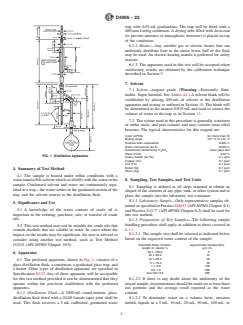
6.1 The preferred apparatus, shown in Fig. 1, consists of a glass distillation flask, a condenser, a graduated glass trap, and a heater.
Other types of distillation apparatus are specified in Specification E123. Any of these apparatus will be acceptable for this test
method provided it can be demonstrated that they operate within the precision established with the preferred apparatus.
6.1.1 Distillation Flask—A 1000 mL round-bottom, glass, distillation flask fitted with a 24/40 female taper joint shall be used. This
flask receives a 5 mL calibrated, graduated water trap with 0.05 mL graduations. The trap will be fitted with a 400 mm Liebig
condenser. A drying tube filled with desiccant (to prevent entrance of atmospheric moisture) is placed on top of the condenser.
6.1.2 Heater—Any suitable gas or electric heater that can uniformly distribute heat to the entire lower half of the flask may be
used. An electric heating mantle is preferred for safety reasons.
6.1.3 The apparatus used in this test will be accepted when satisfactory results are obtained by the calibration technique described
in Section 89.
7. Solvent
7.1 Xylene—reagent grade (Warning—Extremely flammable. Vapor harmful. See Annex A1.) A solvent blank will be established
by placing 400 mL of solvent in the distillation apparatus and testing as outlined in Section 910. The blank will be determined to
the nearest 0.025 mL and used to correct the volume of water in the trap as in Section 1011.
7.2 The xylene used in this procedure is generally a mixture of ortho, meta, and para isomers and may contain some ethyl benzene.
The typical characteristics for this reagent are:
Color (APHA) not more than 10
Boiling range 137 °C to 144 °C
Residue after evaporation 0.002 %
D4006 − 22
FIG. 1 Distillation Apparatus
Sulfur compounds (as S) 0.003 %
Substances darkened by H SO Color pass test
2 4
Water (H O) 0.02 %
Heavy metals (as Pb) 0.1 ppm
Copper (Cu) 0.1 ppm
Iron (Fe) 0.1 ppm
Nickel (Ni) 0.1 ppm
Silver (Ag) 0.1 ppm
8. Sampling, Test Samples, and Test Units
8.1 Sampling is defined as all steps required to obtain an aliquot of the contents of any pipe, tank, or other system and to place
the sample into the laboratory test container.
8.1.1 Laboratory Sample—Only representative samples obtained as specified in Practice D4057 (API MPMS Chapter 8.1) and
Practice D4177 (API MPMS Chapter 8.2) shall be used for this test method.
8.1.2 Preparation of Test Samples—The following sample handling procedure shall apply in addition to those covered in
7.1.18.1.1.
8.1.2.1 The sample size shall be selected as indicated below based on the expected water content of the sample:
D4006 − 22
Expected Water Content, Approximate Sample Size,
weight or volume % g or mL
50.1–100.0 5
25.1– 50.0 10
25.1–50.0 10
10.1– 25.0 20
10.1–25.0 20
5.1– 10.0 50
5.1–10.0 50
1.1– 5.0 100
1.1–5.0 100
0.5– 1.0 200
0.5–1.0 200
less than 0.5 200
8.1.2.2 If there is any doubt about the uniformity of the mixed sample, determinations should be made on at least three test
portions and the average result reported as the water content.
8.1.2.3 To determine water on a volume basis, measure mobile liquids in a 5 mL, 10 mL, 20 mL, 50 mL, 100 mL, or 200 mL
calibrated, graduated cylinder (NBS Class A) depending on the sample size indicated in 7.1.2.18.1.2.1. Take care to pour the
sample slowly into the graduated cylinder to avoid entrapment of air and to adjust the level as closely as possible to the appropriate
graduation. Carefully pour the contents of the cylinder into the distillation flask and rinse the cylinder five times with portions of
xylene equivalent to one-fifth of the capacity of the graduated cylinder and add the rinsings to the flask. Drain the cylinder
thoroughly to ensure complete sample transfer.
8.1.2.4 To determine water on a mass basis, weigh a test portion of sample in accordance with 7.1.2.18.1.2.1, pouring the sample
directly into the distillation flask. If a transfer vessel (beaker or cylinder) must be used, rinse it with at least five portions of xylene
and add the rinsings to the flask.
9. Calibration
9.1 Calibrate both the trap and the entire assembly prior to initial use and after any equipment changes as indicated in 8.1.19.1.1
– 8.1.39.1.3. Additionally, calibrate both the trap and the entire assembly periodically, at a frequency not to exceed yearly.
9.1.1 Verify the accuracy of the graduation marks on the trap by adding 0.05 mL increments of distilled water, at 20 °C, from a
5 mL microburet or a precision micro-pipet readable to the nearest 0.01 mL. If there is a deviation of more than 0.050 mL between
the water added and water observed, reject the trap or recalibrate.
9.1.2 Also calibrate the entire apparatus. Put 400 mL of dry (0.02 % water maximum) xylene in the apparatus and test in
accordance with Section 910. When complete, discard the contents of the trap and add 1.00 mL 6 0.01 mL of distilled water from
the buret or micro-pipet, at 20 °C, directly to the distillation flask and test in accordance with Section 910. Repeat 8.1.29.1.2 and
add 4.50 mL 6 0.01 mL directly to the flask. The assembly of the apparatus is satisfactory only if trap readings are within the
tolerances specified here:
Limits Capacity Volume of Water Permissible for
of Trap at 20 °C, Added at 20 °C, Recovered Water
mL mL at 20 °C, mL
5.00 1.00 1.00 ± 0.025
5.00 4.50 4.50 ± 0.025
9.1.3 A reading outside the limits suggests malfunctioning due to vapor leaks, too rapid boiling, inaccuracies in graduations of the
trap, or ingress of extraneous moisture. These malfunctions must be eliminated before repeating 8.1.29.1.2.
10. Procedure
10.1 The precision of this test method can be affected by water droplets adhering to surfaces in the apparatus and therefore not
settling into the water trap to be measured. To minimize the problem, all apparatus must be chemically cleaned at least daily to
remove surface films and debris which hinder free drainage of water in the test apparatus. More frequent cleaning is recommended
if the nature of the samples being run causes persistent contamination.
10.1.1 To determine water on a volume basis, proceed as indicated in 7.1.2.38.1.2.3. In addition to the xylene added to rinse the
oil sample transfer device, add sufficient xylene to the flask to make the total xylene volume 400 mL.
D4006 − 22
10.1.2 To determine water on a mass basis, proceed as indicated in 7.1.2.48.1.2.4. In addition to the xylene added to rinse the oil
sample transfer device, add sufficient xylene to the flask to make the total xylene volume 400 mL.
10.2 A magnetic stirrer is the most effective device to reduce bumping. Glass beads or other boiling aids, although less effective,
have been found to be useful.
10.3 Assemble the apparatus as shown in Fig. 1, making sure all connections are vapor and liquid-tight. It is recommended that
glass joints not be greased. Insert a drying tube containing an indicating desiccant into the end of the condenser to prevent
condensation of atmospheric moisture inside the condenser. Circulate water, between 20 °C and 25 °C, through the condenser
jacket.
10.4 Apply heat to the flask. The type of crude oil being evaluated can significantly alter the boiling characteristics of the
crude-solvent mixture. Heat should be applied slowly during the initial stages of the distillation (approximately ⁄2 h to 1 h) to
prevent bumping and possible loss of water from the system. (Condensate shall not proceed higher than three quarters of the
distance up the condenser inner tube (Point A in Fig. 1).) To facilitate condenser wash-down, the condensate should be held as close
as possible to the condenser outlet. After the initial heating, adjust the rate of boiling so that the condensate proceeds no more than
three quarters of the distance up the condenser inner tube. Distillate should discharge into the trap at the rate of approximately
2 drops to 5 drops per second. Continue distillation until no water is visible in any part of the apparatus, except in the trap, and
the volume of water in the trap remains constant for at least 5 min. If there is a persistent accumulation of water droplets in the
condenser inner tube, flush with xylene. (A jet spray washing tube, see Fig. 2, or equivalent device is recommended.) The addition
of an oil-soluble emulsion breaker at a concentration of 1000 ppm to the xylene wash helps dislodge the clinging water drops. After
flushing, redistill for at least 5 min (the heat must be shut off at least 15 min prior to wash-down to prevent bumping). After
wash-down, apply heat slowly to prevent bumping. Repeat this procedure until no water is visible in the condenser and the volume
of water in the trap remains constant for at least 5 min. If this procedure does not dislodge the water, use the TFE-fluorocarbon
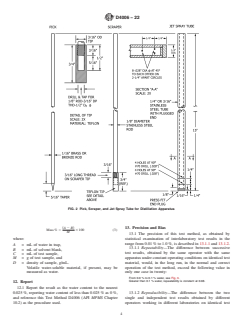
scraper, pick shown in Fig. 2, or equivalent device to cause the water to run into the trap.
10.5 When the carryover of water is complete, allow the trap and contents to cool to 20 °C. Dislodge any drops of water adhering
to the sides of the trap with the TFE-fluorocarbon scraper or pick and transfer them to the water layer. Read the volume of the water
in the trap. The trap is graduated in 0.05 mL increments, but the volume is estimated to the nearest 0.025 mL.
11. Calculation
11.1 Calculate the water in the sample as follows:
A 2 B
~ !
Volume %5 3100 (1)
C
~A 2 B!
Volume %5 3100 (2)
M/D
~ !
A 2 B
~ !
Mass %5 3100 (3)
M
where:
A = mL of water in trap,
B = mL of solvent blank,
C = mL of test sample,
M = g of test sample, and
D = density of sample, g/mL.
Volatile water-soluble material, if present, may be measured as water.
12. Report
12.1 Report the result as the water content to the nearest 0.025 %, reporting water content of less than 0.025 % as 0 %, and
reference this Test Method D4006 (API MPMS Chapter 10.2) as the procedure used.
D4006 − 22
FIG. 2 Pick, Scraper, and Jet Spray Tube for Distillation Apparatus
13. Precision and Bias
13.1 The precision of this test method, as obtained by statistical examination of interlaboratory test results in the range from
0.01 % to 1.0 %, is described in 12.1.113.1.1 and 12.1.213.1.2.
13.1.1 Repeatability—The difference between successive test results, obtained by the same operator with the same apparatus under
constant operating conditions on identical test material, would, in the long run, in the normal and correct operation of the test
method, exceed the following value in only one case in twenty:
From 0.0 % to 0.1 % water, see Fig. 3.
Greater than 0.1 % water, repeatability is constant at 0.08.
13.1.2 Reproducibility—The difference between the two single and independent test results obtained by different operators
working in different laboratories on identical test material, would, in the long run, in the normal and correct operation of the test
method, exceed the following value in only one case in twenty:
D4006 − 22
FIG. 3 Basic Sediment and Water Precision
From 0.0 % to 0.1 % water, see Fig. 3
Greater than 0.1 % water, reproducibility is constant at 0.11.
14. Keywords
14.1 crude oil; distillation; water
ANNEX
(Mandatory Information)
A1. WARNING STATEMENT
A1.1 Xylene
A1.1.1 Keep away from heat, sparks, and open flame.
A1.1.2 Keep container closed.
A1.1.3 Use with adequate ventilation.
A1.1.4 Avoid breathing of vapor or spray mist.
A1.1.5 Avoid prolonged or repeated contact with skin.
D4006 − 22
APPENDIX
(Nonmandatory Information)
X1. PRECISION AND BIAS OF TEST METHODS FOR DETERMINING WATER IN CRUDE OILS
X1.1 Summary
X1.1.1 This round-robin testing program has shown that the distillation test method as practiced is somewhat more accurate than
the centrifuge test method. The average correction for the distillation test method is about 0.06, whereas the centrifuge correction
is about 0.10. However, this correction is not constant nor does it correlate well with the measured concentration.
X1.1.2 There is a slight improvement in the precision of the distillation test method over the present Test Method D95 (API MPMS
Chapter 10.5): 0.08 versus 0.1 for repeatability and 0.11 versus 0.2 for reproducibility. These figures are applicable from 0.1 % to
1 % water content; the maximum level studied in this program.
X1.1.3 The precision of the centrifuge test method is worse than the distillation: repeatability is about 0.12 and the reproducibility
is 0.28.
X1.2 Introduction
X1.2.1 In view of the economic importance of measuring the water content of crude oils precisely and accurately, a working group
of API/ASTM Joint Committee on Static Petroleum Measurement (COSM) undertook the evaluation of two test methods for
determining water in crudes. A distillation test method (Test Method D95 (API MPMS Chapter 10.5)), and a centrifuge test method
(Test Method D1796 (API MPMS Chapter 10.6)) were evaluated in this program. Both test methods were modified slightly in an
attempt to improve the precision and accuracy.
X1.3 Experimental
X1.3.1 Samples—The following seven crude oils were obtained for this program:
Crude Source
San Ardo Texaco
Arabian Light Mobil
Alaskan Williams Pipe Line
Arabian Heavy Exxon
Minas Texaco
Fosterton Koch Industries
Nigerian Gulf
By removing all water or adding known amounts of water to the above crudes, 21 samples were prepared for testing. Each crude
oil was represented at three levels of water concentration. The entire concentration range studied was from zero to 1.1 % water.
These expected values were used to determine the accuracy of the test procedures.
X1.3.2 Sample Preparation:
D4006 − 22
TABLE X1.2 Base Case—Water Content of Crudes
Crude Oil % H O
San Ardo 0.90
Arabian Light 0.15
Alaskan 0.25
Arabian Heavy 0.10
Minas 0.50
Fosterton 0.30
Nigerian <0.05
X1.3.2.1 The crude oils we
...