

ASTM D6430-18
(Guide)Standard Guide for Using the Gravity Method for Subsurface Site Characterization
General Information
- Abstract
SIGNIFICANCE AND USE
5.1 Concepts—This guide summarizes the equipment, field procedures, and interpretation methods used for the determination of subsurface conditions due to density variations using the gravity method. Gravity measurements can be used to map major geologic features over hundreds of square miles and to detect shallow smaller features in soil or rock. In some areas, the gravity method can detect subsurface cavities.
5.1.1 Another benefit of the gravity method is that measurements can be made in many culturally developed areas, where other geophysical methods may not work. For example, gravity measurements can be made inside buildings; in urban areas; and in areas of cultural, electrical, and electromagnetic noise.
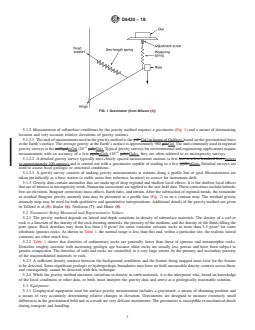
5.1.2 Measurement of subsurface conditions by the gravity method requires a gravimeter (Fig. 1) and a means of determining location and very accurate relative elevations of gravity stations.
5.1.2.1 The unit of measurement used in the gravity method is the Gal (in honor of Galileo), based on the gravitational force at the Earth's surface. The average gravity at the Earth's surface is approximately 980 Gal. The unit commonly used in regional gravity surveys is the mGal (10−3 Gal). Typical gravity surveys for environmental and engineering applications require measurements with an accuracy of a few μGals (10−6 Gals), they are often referred to as microgravity surveys.
5.1.2.2 A detailed gravity survey typically uses closely spaced measurement stations (a few meters to approximately 100 meters) and is carried out with a gravimeter capable of reading to a few μGals. Detailed surveys are used to assess local geologic or structural conditions.
5.1.2.3 A gravity survey consists of making gravity measurements at stations along a profile line or grid. Measurements are taken periodically at a base station (a stable noise-free reference location) to correct for instrument drift.
5.1.3 Gravity data contain anomalies that are made up of deep regional and shall...
SCOPE
1.1 Purpose and Application:
1.1.1 This guide summarizes the equipment, field procedures, and interpretation methods for the assessment of subsurface conditions using the gravity method. However, this standard does not address the use of marine, airborne, or satellite gravity measurements.
1.1.2 The gravity method described in this guide is applicable to site characterization of a wide range of subsurface conditions.
1.1.3 Gravity measurements indicate variations in the earth's gravitational field caused by lateral differences in the density of the subsurface soil or rock or the presence of natural voids or man-made structures. By measuring spatial changes in the gravitational field, variations in subsurface conditions can be determined.
1.1.4 Detailed gravity surveys (commonly called microgravity surveys) are used for near-surface geologic site characterizations and geotechnical, environmental, and archaeological studies. Geologic and geotechnical applications include location of buried channels, bedrock structural features, voids, and caves, and low-density zones in foundations. Environmental applications include site characterization, groundwater studies, landfill characterization, and location of underground storage tanks (1)2.
1.2 Limitations:
1.2.1 This guide provides an overview of the gravity method. It does not address the details of the gravity theory, field procedures, or interpretation of the data. Numerous references are included for that purpose and are considered an essential part of this guide. It is recommended that the user of the gravity method be familiar with the references cited and with the Guides D420, D5753, D6235, and D6429, and Practices D5088, and D5608.
1.2.2 This guide is limited to gravity measurements made on land. The gravity method can be adapted for a number of special uses: on land, in a borehole, on water, and from aircraft and space. A discussion of these other...
- Status
- Published
- Publication Date
- 31-Jan-2018
- Technical Committee
- D18 - Soil and Rock
- Drafting Committee
- D18.01 - Surface and Subsurface Investigation
Buy Documents
ASTM D6430-18 - Standard Guide for Using the Gravity Method for Subsurface Site Characterization
REDLINE ASTM D6430-18 - Standard Guide for Using the Gravity Method for Subsurface Site Characterization
Overview
ASTM D6430-18: Standard Guide for Using the Gravity Method for Subsurface Site Characterization provides guidance for professionals seeking to utilize gravity measurements in subsurface investigations. Developed by ASTM International, this guide outlines equipment, field procedures, and interpretation methods to determine subsurface conditions resulting from density variations in soil or rock. The gravity method is a valuable geophysical technique for mapping major geological features and detecting small-scale subsurface anomalies, such as cavities or voids, in both urban and natural environments.
Gravity surveys can be effectively used in areas with high levels of cultural, electrical, or electromagnetic noise, where other geophysical methods may be limited. This makes the guide especially relevant for site characterization in developed, urban, or industrial areas.
Key Topics
- Principles of the Gravity Method: Measures spatial variations in the Earth's gravitational field due to density differences in underground materials.
- Equipment Requirements: Use of sensitive gravimeters capable of detecting minute changes in gravity; importance of accurate position and elevation measurements.
- Survey Planning and Implementation:
- Design of grid or profile lines for gravity stations.
- Establishment of base stations for drift corrections.
- Determining the appropriate measurement spacing based on objectives.
- Data Collection and Quality Control:
- Routine base station checks.
- Processes for calibration and standardization of measurement equipment.
- Importance of repeated and overlapped measurements for data verification.
- Data Processing and Interpretation:
- Application of corrections: drift, earth tides, latitude, elevation (free-air and Bouguer), and terrain effects.
- Presentation of residual anomaly data via profiles or maps.
- Integration with borehole logs, geological maps, and other geophysical data for comprehensive interpretation.
- Limitations and Interferences:
- Necessity of sufficient density contrast for feature detection.
- Sensitivity to ambient (earthquakes, microseisms, tides), geologic, and cultural (vehicle vibrations, buildings) noise.
- Decreasing resolution with depth and the inherent ambiguity of geophysical methods.
Applications
The gravity method, as described in ASTM D6430-18, is broadly applicable to:
- Geological and Geotechnical Surveys: Detection of buried channels, bedrock structures, voids, caves, and evaluation of foundation zones.
- Environmental Investigations: Site characterization, groundwater monitoring, landfill mapping, and locating underground storage tanks.
- Archaeology: Identification of subsurface features and archaeological site mapping.
- Urban and Industrial Site Assessments: Effective in areas with complex infrastructure and high background noise.
By providing non-intrusive insight into subsurface conditions, gravity surveys support informed decision-making for construction, remediation, and resource exploration projects.
Related Standards
Professionals using ASTM D6430-18 should also consider the following related ASTM standards to enhance the effectiveness and accuracy of gravity-based site investigations:
- ASTM D420 - Guide to Site Characterization for Engineering Design and Construction Purposes
- ASTM D653 - Terminology Relating to Soil, Rock, and Contained Fluids
- ASTM D5088 - Practice for Decontamination of Field Equipment Used at Waste Sites
- ASTM D5608 - Practices for Decontamination of Sampling Equipment at Low-Level Radioactive Waste Sites
- ASTM D5753 - Guide for Planning and Conducting Geotechnical Borehole Geophysical Logging
- ASTM D6235 - Practice for Expedited Site Characterization of Vadose Zone and Groundwater Contamination at Hazardous Waste Contaminated Sites
- ASTM D6429 - Guide for Selecting Surface Geophysical Methods
Conclusion
ASTM D6430-18 provides comprehensive guidelines on using the gravity method for efficient and accurate subsurface site characterization. Its clear procedures for equipment use, survey planning, quality control, and data interpretation make it a foundational standard for geotechnical, environmental, and archaeological applications. Utilizing the gravity method in line with ASTM D6430-18 ensures reliable subsurface data, especially where other techniques may face limitations, thereby supporting sound engineering and environmental decisions.
Relations
- Replaces
ASTM D6430-99(2010) - Standard Guide for Using the Gravity Method for Subsurface Investigation - Effective Date
- 01-Feb-2018
- Effective Date
- 01-May-2020
- Effective Date
- 15-Dec-2018
- Refers
ASTM D5753-18 - Standard Guide for Planning and Conducting Geotechnical Borehole Geophysical Logging - Effective Date
- 01-Feb-2018
- Effective Date
- 01-Feb-2016
- Effective Date
- 01-Aug-2015
- Effective Date
- 15-Jan-2015
- Effective Date
- 01-Aug-2014
- Effective Date
- 01-Sep-2011
- Refers
ASTM D6429-99(2011)e1 - Standard Guide for Selecting Surface Geophysical Methods (Withdrawn 2020) - Effective Date
- 01-Jul-2011
- Effective Date
- 01-May-2010
- Effective Date
- 01-May-2010
- Effective Date
- 01-May-2010
- Effective Date
- 01-Jan-2009
- Effective Date
- 01-Dec-2008
Buy Documents
ASTM D6430-18 - Standard Guide for Using the Gravity Method for Subsurface Site Characterization
REDLINE ASTM D6430-18 - Standard Guide for Using the Gravity Method for Subsurface Site Characterization
Frequently Asked Questions
ASTM D6430-18 is a guide published by ASTM International. Its full title is "Standard Guide for Using the Gravity Method for Subsurface Site Characterization". This standard covers: SIGNIFICANCE AND USE 5.1 Concepts—This guide summarizes the equipment, field procedures, and interpretation methods used for the determination of subsurface conditions due to density variations using the gravity method. Gravity measurements can be used to map major geologic features over hundreds of square miles and to detect shallow smaller features in soil or rock. In some areas, the gravity method can detect subsurface cavities. 5.1.1 Another benefit of the gravity method is that measurements can be made in many culturally developed areas, where other geophysical methods may not work. For example, gravity measurements can be made inside buildings; in urban areas; and in areas of cultural, electrical, and electromagnetic noise. 5.1.2 Measurement of subsurface conditions by the gravity method requires a gravimeter (Fig. 1) and a means of determining location and very accurate relative elevations of gravity stations. 5.1.2.1 The unit of measurement used in the gravity method is the Gal (in honor of Galileo), based on the gravitational force at the Earth's surface. The average gravity at the Earth's surface is approximately 980 Gal. The unit commonly used in regional gravity surveys is the mGal (10−3 Gal). Typical gravity surveys for environmental and engineering applications require measurements with an accuracy of a few μGals (10−6 Gals), they are often referred to as microgravity surveys. 5.1.2.2 A detailed gravity survey typically uses closely spaced measurement stations (a few meters to approximately 100 meters) and is carried out with a gravimeter capable of reading to a few μGals. Detailed surveys are used to assess local geologic or structural conditions. 5.1.2.3 A gravity survey consists of making gravity measurements at stations along a profile line or grid. Measurements are taken periodically at a base station (a stable noise-free reference location) to correct for instrument drift. 5.1.3 Gravity data contain anomalies that are made up of deep regional and shall... SCOPE 1.1 Purpose and Application: 1.1.1 This guide summarizes the equipment, field procedures, and interpretation methods for the assessment of subsurface conditions using the gravity method. However, this standard does not address the use of marine, airborne, or satellite gravity measurements. 1.1.2 The gravity method described in this guide is applicable to site characterization of a wide range of subsurface conditions. 1.1.3 Gravity measurements indicate variations in the earth's gravitational field caused by lateral differences in the density of the subsurface soil or rock or the presence of natural voids or man-made structures. By measuring spatial changes in the gravitational field, variations in subsurface conditions can be determined. 1.1.4 Detailed gravity surveys (commonly called microgravity surveys) are used for near-surface geologic site characterizations and geotechnical, environmental, and archaeological studies. Geologic and geotechnical applications include location of buried channels, bedrock structural features, voids, and caves, and low-density zones in foundations. Environmental applications include site characterization, groundwater studies, landfill characterization, and location of underground storage tanks (1)2. 1.2 Limitations: 1.2.1 This guide provides an overview of the gravity method. It does not address the details of the gravity theory, field procedures, or interpretation of the data. Numerous references are included for that purpose and are considered an essential part of this guide. It is recommended that the user of the gravity method be familiar with the references cited and with the Guides D420, D5753, D6235, and D6429, and Practices D5088, and D5608. 1.2.2 This guide is limited to gravity measurements made on land. The gravity method can be adapted for a number of special uses: on land, in a borehole, on water, and from aircraft and space. A discussion of these other...
SIGNIFICANCE AND USE 5.1 Concepts—This guide summarizes the equipment, field procedures, and interpretation methods used for the determination of subsurface conditions due to density variations using the gravity method. Gravity measurements can be used to map major geologic features over hundreds of square miles and to detect shallow smaller features in soil or rock. In some areas, the gravity method can detect subsurface cavities. 5.1.1 Another benefit of the gravity method is that measurements can be made in many culturally developed areas, where other geophysical methods may not work. For example, gravity measurements can be made inside buildings; in urban areas; and in areas of cultural, electrical, and electromagnetic noise. 5.1.2 Measurement of subsurface conditions by the gravity method requires a gravimeter (Fig. 1) and a means of determining location and very accurate relative elevations of gravity stations. 5.1.2.1 The unit of measurement used in the gravity method is the Gal (in honor of Galileo), based on the gravitational force at the Earth's surface. The average gravity at the Earth's surface is approximately 980 Gal. The unit commonly used in regional gravity surveys is the mGal (10−3 Gal). Typical gravity surveys for environmental and engineering applications require measurements with an accuracy of a few μGals (10−6 Gals), they are often referred to as microgravity surveys. 5.1.2.2 A detailed gravity survey typically uses closely spaced measurement stations (a few meters to approximately 100 meters) and is carried out with a gravimeter capable of reading to a few μGals. Detailed surveys are used to assess local geologic or structural conditions. 5.1.2.3 A gravity survey consists of making gravity measurements at stations along a profile line or grid. Measurements are taken periodically at a base station (a stable noise-free reference location) to correct for instrument drift. 5.1.3 Gravity data contain anomalies that are made up of deep regional and shall... SCOPE 1.1 Purpose and Application: 1.1.1 This guide summarizes the equipment, field procedures, and interpretation methods for the assessment of subsurface conditions using the gravity method. However, this standard does not address the use of marine, airborne, or satellite gravity measurements. 1.1.2 The gravity method described in this guide is applicable to site characterization of a wide range of subsurface conditions. 1.1.3 Gravity measurements indicate variations in the earth's gravitational field caused by lateral differences in the density of the subsurface soil or rock or the presence of natural voids or man-made structures. By measuring spatial changes in the gravitational field, variations in subsurface conditions can be determined. 1.1.4 Detailed gravity surveys (commonly called microgravity surveys) are used for near-surface geologic site characterizations and geotechnical, environmental, and archaeological studies. Geologic and geotechnical applications include location of buried channels, bedrock structural features, voids, and caves, and low-density zones in foundations. Environmental applications include site characterization, groundwater studies, landfill characterization, and location of underground storage tanks (1)2. 1.2 Limitations: 1.2.1 This guide provides an overview of the gravity method. It does not address the details of the gravity theory, field procedures, or interpretation of the data. Numerous references are included for that purpose and are considered an essential part of this guide. It is recommended that the user of the gravity method be familiar with the references cited and with the Guides D420, D5753, D6235, and D6429, and Practices D5088, and D5608. 1.2.2 This guide is limited to gravity measurements made on land. The gravity method can be adapted for a number of special uses: on land, in a borehole, on water, and from aircraft and space. A discussion of these other...
ASTM D6430-18 is classified under the following ICS (International Classification for Standards) categories: 07.060 - Geology. Meteorology. Hydrology. The ICS classification helps identify the subject area and facilitates finding related standards.
ASTM D6430-18 has the following relationships with other standards: It is inter standard links to ASTM D6430-99(2010), ASTM D5088-20, ASTM D6235-18, ASTM D5753-18, ASTM D5608-16, ASTM D5088-15a, ASTM D5088-15, ASTM D653-14, ASTM D653-11, ASTM D6429-99(2011)e1, ASTM D5608-10, ASTM D6235-04(2010), ASTM D5753-05(2010), ASTM D653-09, ASTM D653-08a. Understanding these relationships helps ensure you are using the most current and applicable version of the standard.
ASTM D6430-18 is available in PDF format for immediate download after purchase. The document can be added to your cart and obtained through the secure checkout process. Digital delivery ensures instant access to the complete standard document.
Standards Content (Sample)
This international standard was developed in accordance with internationally recognized principles on standardization established in the Decision on Principles for the
Development of International Standards, Guides and Recommendations issued by the World Trade Organization Technical Barriers to Trade (TBT) Committee.
Designation: D6430 − 18
Standard Guide for
Using the Gravity Method for Subsurface Site
Characterization
This standard is issued under the fixed designation D6430; the number immediately following the designation indicates the year of
original adoption or, in the case of revision, the year of last revision.Anumber in parentheses indicates the year of last reapproval.A
superscript epsilon (´) indicates an editorial change since the last revision or reapproval.
1. Scope* 1.2.2 This guide is limited to gravity measurements made
on land. The gravity method can be adapted for a number of
1.1 Purpose and Application:
specialuses:onland,inaborehole,onwater,andfromaircraft
1.1.1 This guide summarizes the equipment, field
and space. A discussion of these other gravity methods,
procedures, and interpretation methods for the assessment of
including vertical gravity gradient measurements, is not in-
subsurface conditions using the gravity method. However, this
cluded in this guide.
standard does not address the use of marine, airborne, or
1.2.3 The approaches suggested in this guide for the gravity
satellite gravity measurements.
method are the most commonly used, widely accepted, and
1.1.2 The gravity method described in this guide is appli-
proven. However, other approaches or modifications to the
cable to site characterization of a wide range of subsurface
gravity method that are technically sound may be substituted.
conditions.
1.2.4 This guide offers an organized collection of informa-
1.1.3 Gravity measurements indicate variations in the
tion or a series of options and does not recommend a specific
earth’s gravitational field caused by lateral differences in the
course of action. This document cannot replace education,
densityofthesubsurfacesoilorrockorthepresenceofnatural
experience, and should be used in conjunction with profes-
voidsorman-madestructures.Bymeasuringspatialchangesin
sional judgment. Not all aspects of this guide may be appli-
the gravitational field, variations in subsurface conditions can
cable in all circumstances. This ASTM document is not
be determined.
intended to represent or replace the standard of care by which
1.1.4 Detailed gravity surveys (commonly called micro-
the adequacy of a given professional service must be judged,
gravity surveys) are used for near-surface geologic site char-
nor should this document be applied without consideration of
acterizations and geotechnical, environmental, and archaeo-
a project’s many unique aspects. The word “Standard” in the
logicalstudies.Geologicandgeotechnicalapplicationsinclude
title of this document means only that the document has been
location of buried channels, bedrock structural features, voids,
approved through the ASTM consensus process.
and caves, and low-density zones in foundations. Environmen-
tal applications include site characterization, groundwater
1.3 Units—The values stated in SI units are regarded as
studies, landfill characterization, and location of underground
standard. No other units of measurement are included in this
storage tanks (1) .
standard. Reporting of test results in units other than SI shall
1.2 Limitations:
not be regarded as nonconformance with this test method.
1.2.1 This guide provides an overview of the gravity
1.4 Precautions:
method. It does not address the details of the gravity theory,
1.4.1 It is the responsibility of the user of this guide to
field procedures, or interpretation of the data. Numerous
follow any precautions in the equipment manufacturer’s rec-
references are included for that purpose and are considered an
ommendations and to establish appropriate health and safety
essential part of this guide. It is recommended that the user of
practices.
the gravity method be familiar with the references cited and
1.4.2 If this guide is used at sites with hazardous materials,
with the Guides D420, D5753, D6235, and D6429, and
operations, or equipment, it is the responsibility of the user of
Practices D5088, and D5608.
this guide to establish appropriate safety and health practices
and to determine the applicability of any regulations prior to
ThisguideisunderthejurisdictionofASTMCommitteeD18onSoilandRock
use.
and is the direct responsibility of Subcommittee D18.01 on Surface and Subsurface
1.5 This standard does not purport to address all of the
Characterization.
Current edition approved Feb. 1, 2018. Published March 2018. Originally
safety concerns, if any, associated with its use. It is the
approved in 1999. Last previous edition approved in 2010 as D6430–99(2010).
responsibility of the user of this standard to establish appro-
DOI: 10.1520/D6430-18.
priate safety, health, and environmental practices and deter-
Theboldfacenumbersinparenthesesrefertothelistofreferencesattheendof
this standard. mine the applicability of regulatory limitations prior to use.
*A Summary of Changes section appears at the end of this standard
Copyright © ASTM International, 100 Barr Harbor Drive, PO Box C700, West Conshohocken, PA 19428-2959. United States
D6430 − 18
1.6 This international standard was developed in accor-
dance with internationally recognized principles on standard-
ization established in the Decision on Principles for the
Development of International Standards, Guides and Recom-
mendations issued by the World Trade Organization Technical
Barriers to Trade (TBT) Committee.
2. Referenced Documents
2.1 ASTM Standards:
D420GuidetoSiteCharacterizationforEngineeringDesign
and Construction Purposes
D653Terminology Relating to Soil, Rock, and Contained
Fluids
D5088Practice for Decontamination of Field Equipment
Used at Waste Sites
D5608Practices for Decontamination of Sampling and Non
Sample Contacting Equipment Used at Low Level Radio-
FIG. 1 Gravimeter (from Milsom (4))
active Waste Sites
D5753Guide for Planning and Conducting Geotechnical
Borehole Geophysical Logging
modeling can often be used to characterize the densities of
D6235Practice for Expedited Site Characterization of Va-
natural or man-made subsurface materials.
dose Zone and Groundwater Contamination at Hazardous
4.2 Complementary Data—Geologic and water table data
Waste Contaminated Sites
obtained from borehole logs, geologic maps, and data from
D6429Guide for Selecting Surface Geophysical Methods
outcrops or other complementary surface geophysical methods
(D6429)andboreholegeophysicalmethods(GuideD5753)are
3. Terminology
usually necessary to properly interpret subsurface conditions
3.1 Definitions—
from gravity data.
3.1.1 Forcommondefinitionsoftermsusedinthisstandard,
5. Significance and Use
see Terminology D653.
5.1 Concepts—This guide summarizes the equipment, field
3.2 Additionaltechnicaltermsusedinthisguidearedefined
procedures, and interpretation methods used for the determi-
in Sheriff (2) and Bates and Jackson (3).
nation of subsurface conditions due to density variations using
the gravity method. Gravity measurements can be used to map
4. Summary of Guide
major geologic features over hundreds of square miles and to
4.1 Summary of the Method—The gravity method makes
detect shallow smaller features in soil or rock. In some areas,
measurements of gravity variations at stations along a profile
the gravity method can detect subsurface cavities.
line or grid relative to an arbitrary selected local base station
5.1.1 Anotherbenefitofthegravitymethodisthatmeasure-
gravityvalue.Thegravitymeasurementsarethencorrectedfor
ments can be made in many culturally developed areas, where
other effects that cause variations in gravity. Lateral variations
othergeophysicalmethodsmaynotwork.Forexample,gravity
or anomalies in the resulting residual gravity data can then be
measurements can be made inside buildings; in urban areas;
attributed to lateral variations in the densities of subsurface
and in areas of cultural, electrical, and electromagnetic noise.
materials, for example, buried channels, structures, or caves.
5.1.2 Measurement of subsurface conditions by the gravity
The data are interpreted by creating geologically consistent
method requires a gravimeter (Fig. 1) and a means of deter-
density models that produce similar gravity values to those
mininglocationandveryaccuraterelativeelevationsofgravity
observed in the field data.
stations.
4.1.1 Measurements of variations in the subsurface density
5.1.2.1 Theunitofmeasurementusedinthegravitymethod
of soil and rock are made from the land surface using a
istheGal(inhonorofGalileo),basedonthegravitationalforce
gravimeter(Fig.1).Thelateralvariationsindensityareusedto
at the Earth’s surface. The average gravity at the Earth’s
interpret subsurface conditions along a profile line or grid of
surface is approximately 980 Gal. The unit commonly used in
gravity measurements.
−3
regional gravity surveys is the mGal (10 Gal). Typical
4.1.2 Gravity measurements can be interpreted to yield the
gravitysurveysforenvironmentalandengineeringapplications
depth to rock, the location of a buried valley or fault, or the
−6
require measurements with an accuracy of a few µGals (10
presence of a cave or cavity. The results obtained from
Gals), they are often referred to as microgravity surveys.
5.1.2.2 A detailed gravity survey typically uses closely
spaced measurement stations (a few meters to approximately
For referenced ASTM standards, visit the ASTM website, www.astm.org, or
100 meters) and is carried out with a gravimeter capable of
contact ASTM Customer Service at service@astm.org. For Annual Book of ASTM
reading to a few µGals. Detailed surveys are used to assess
Standards volume information, refer to the standard’s Document Summary page on
the ASTM website. local geologic or structural conditions.
D6430 − 18
−3
TABLE 1 Approximate Density Ranges (Mg/m ) of Some
5.1.2.3 A gravity survey consists of making gravity mea-
Common Rock Types and Ores (Keary and Books (9))
surementsatstationsalongaprofilelineorgrid.Measurements
Alluvium (wet) 1.96–2.00
are taken periodically at a base station (a stable noise-free
Clay 1.63–2.60
reference location) to correct for instrument drift.
Shale 2.06–2.66
5.1.3 Gravity data contain anomalies that are made up of
Sandstone
Cretaceous 2.05–2.35
deep regional and shallow local effects. It is the shallow local
Triassic 2.25–2.30
effects that are of interest in microgravity work. Numerous
Carboniferous 2.35–2.55
corrections are applied to the raw field data. These corrections Limestone 2.60–2.80
Chalk 1.94–2.23
include latitude, free air elevation, Bouguer correction (mass
Dolomite 2.28–2.90
effect), Earth tides, and terrain. After the subtraction of
Halite 2.10–2.40
regional trends, the remainder or residual Bouguer gravity Granite 2.52–2.75
Granodiorite 2.67–2.79
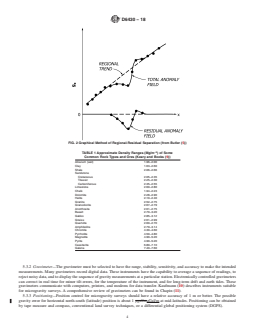
anomaly data may be presented as a profile line (Fig. 2)oron
Anorthosite 2.61–2.75
acontourmap.Theresidualgravityanomalymapmaybeused
Basalt 2.70–3.20
for both qualitative and quantitative interpretations.Additional Gabbo 2.85–3.12
Gneiss 2.61–2.99
details of the gravity method are given in Telford et al (5);
Quartzite 2.60–2.70
Butler (6); Nettleton (7); and Hinze (8).
Amphibolite 2.79–3.14
Chromite 4.30–4.60
5.2 Parameter Being Measured and Representative Values:
Pyrrhotite 4.50–4.80
5.2.1 The gravity method depends on lateral and depth
Magnetite 4.90–5.20
Pyrite 4.90–5.20
variations in density of subsurface materials. The density of a
Cassiterite 6.80–7.10
soil or rock is a function of the density of the rock-forming
Galena 7.40–7.60
minerals, the porosity of the medium, and the density of the
fluidsfillingtheporespace.Rockdensitiesvaryfromlessthan
1.0 g/cm for some vesicular volcanic rocks to more than 3.5
g/cm for some ultrabasic igneous rocks.As shown in Table 1, controlled,toaverylargeextent,bytheprimaryandsecondary
the normal range is less than this and, within a particular site, porosity of the unconsolidated materials or rock.
the realistic lateral contrasts are often much less. 5.2.3 A sufficient density contrast between the background
5.2.2 Table 1 shows that densities of sedimentary rocks are conditions and the feature being mapped must exist for the
generally lower than those of igneous and metamorphic rocks. feature to be detected. Some significant geologic or hydrogeo-
Densities roughly increase with increasing geologic age be- logic boundaries may have no field-measurable density con-
causeolderrocksareusuallylessporousandhavebeensubject trast across them, and consequently cannot be detected with
to greater compaction. The densities of soils and rocks are this technique.
FIG. 2 Graphical Method of Regional-Residual Separation (from Butler (5))
D6430 − 18
5.2.4 While the gravity method measures variations in 5.4.2 Limitations Specific to the Gravity Method:
density in earth materials, it is the interpreter who, based on
5.4.2.1 Asufficientdensitycontrastbetweenthebackground
knowledge of the local conditions or other data, or both, must
conditions and the feature being mapped must exist for the
interpret the gravity data and arrive at a geologically reason-
feature to be detected. Some significant geologic or hydrogeo-
able solution.
logic boundaries may have no field-measurable density con-
5.3 Equipment:
trast across them, and consequently cannot be detected with
5.3.1 Geophysical equipment used for surface gravity mea-
this technique.An interpretation of gravity data alone does not
surement includes a gravimeter, a means of obtaining position
yield a unique correlation between possible geologic models
andameansofveryaccuratelydeterminingrelativechangesin
and a single set of field data. This ambiguity can only be
elevation. Gravimeters are designed to measure extremely
resolved through the use of sufficient supporting geologic data
small differences in the gravitational field and as a result are
and by an experienced interpreter.
very delicate instruments. The gravimeter is susceptible to
5.4.2.2 Interferences Caused by Ambient, Geologic, and
mechanical shock during transport and handling.
Cultural Conditions:
5.3.2 Gravimeter—The gravimeter must be selected to have
(1)The gravity method is sensitive to noise (vibrations)
the range, stability, sensitivity, and accuracy to make the
from a variety of natural ambient and cultural sources. Spatial
intended measurements. Many gravimeters record digital data.
variations in density caused by geologic factors may also
Theseinstrumentshavethecapabilitytoaverageasequenceof
produce unwanted noise.
readings, to reject noisy data, and to display the sequence of
(2) Ambient Sources of Noise—Ambient sources of noise
gravity measurements at a particular station. Electronically
include earthquakes, microseisms, tides, winds, rain, and
controlled gravimeters can correct in real time for minor tilt
extreme temperatures.
errors,forthetemperatureoftheinstrument,andforlong-term
(a) Earthquakes—Local earthquakes seldom are a prob-
drift and earth tides. These gravimeters communicate with
computers, printers, and modems for data transfer. Kaufmann lem during gravity observations. They occur and are gone
(10)describesinstrumentssuitableformicrogravitysurveys.A before they are any inconvenience. Distant earthquakes
comprehensive review of gravimeters can be found in Chapin
however, can lead to gravity changes of 100 µGals or more
(11).
with periods of tens of minutes or more. These effects can
5.3.3 Positioning—Position control for microgravity sur-
delay gravity observations for several hours or even days.
veys should have a relative accuracy of1mor better. The
(b) Microseisms—Microseismsaredefinedasfeebleearth
possible gravity error for horizontal north-south (latitude)
tremors due to natural causes such as wind, water, or waves
position is about 1 µGal/m at mid-latitudes. Positioning can be
(Sheriff (1)).They are believed to be related to wave action on
obtained by tape measure and compass, conventional land
shorelinesandtothepassageofrapidlymovingpressurefronts
survey techniques, or a differential global positioning system
whose effects are seen as sinusoidal variations in the gravity
(DGPS).
data.Their amplitude can readily exceed several tens of µGals.
5.3.4 Elevations—Accurate relative elevation measure-
(c) Earth Tides—Solar and lunar tides affect the force of
ments are critical for a microgravity survey.Anominal gravity
gravity at the Earth’s surface by as much as 300 µGals with a
error of 1 µGal can result from an elevation change of 3 mm.
rate of change as large as 1 µGal/min. These solid earth tides
Therefore, elevation control for a microgravity survey requires
arepredictableandcanbecorrectedforasapartofgravitydata
a relative elevation accuracy of about 3 mm. Elevations are
correction procedures.
generally determined relative to an arbitrary reference on site
(d) Wind and Rain—Wind and heavy rain can cause
but can also be tied to an elevation benchmark. Elevations are
movement of the gravimeter. The gravimeter should be
obtained by careful optical leveling or by automatic digital
shielded from the wind and rain.
levels.
(e) Extreme Temperatures—Extremetemperaturechanges
5.4 Limitations and Interferences:
over short periods of time can cause instrument drift. In order
5.4.1 General Limitations Inherent to Geophysical Meth-
tominimizethiseffect,thegravimetershouldbeinsulatedfrom
ods:
extreme heating or cooling. Slow gradual changes in tempera-
5.4.1.1 Afundamentallimitationofallgeophysicalmethods
ture are normally accommodated by repeat base station mea-
isthatagivensetofdatacannotbeassociatedwithauniqueset
surements and drift corrections made as a normal part of the
of subsurface conditions. In most situations, surface geophysi-
gravity survey.
cal measurements alone cannot resolve all ambiguities, and
(f) Geologic Sources of Noise—Geologicsourcesofnoise
someadditionalinformation,suchasboreholedata,isrequired.
may include unknown variations in the natural spatial distri-
Becauseofthisinherentlimitationinthegeophysicalmethods,
bution of soil and rock and their densities.
a gravity survey alone can never be considered a complete
(g) Topography—Hills, mountains, and valleys affect
assessment of subsurface conditions. Properly integrated with
gravity measurements. Depending on the objectives of the
other geologic information, gravity surveying is a highly
survey, topographic corrections may be needed (Hinze (8)).
effective, accurate, and cost-effective method of obtaining
(h) Cultural Sources of Noise—Cultural sources of noise
subsurface information.
include vibration from vehicles, heavy equipment, trains, and
5.4.1.2 In addition, all surface geophysical methods are
inherently limited by decreasing resolution with depth. even persons walking near the gravimeter.
D6430 − 18
5.4.3 Summary—During the course of designing and carry- 6.2.3.2 Assuming that no previous gravity surveys have
ing out a gravity survey, the sources of ambient, geologic, and been made in the area, knowledge of the geology from
cultural noise must be considered and time of occurrence and published references containing the geologic character or
locationnoted.Theexactformoftheinterferenceisnotalways densities of earth materials and from published reports of
predictablebecauseitdependsuponthetypeandmagnitudeof gravity studies performed under similar conditions is required.
noise and distance from the source of noise. From this information, the feasibility of using the gravity
method at the site can be assessed.
5.5 Alternate Methods—In some cases, the factors previ-
6.2.3.3 Forward modeling using analytical equations or
ously discussed may prevent the effective use of the gravity
numerical modeling methods can be used to calculate gravity
method, and other geophysical (Guide D6429) or non-
data for a given set of subsurface conditions. Given the depth
geophysicalmethodsmayberequiredtoinvestigatesubsurface
and the shape of the subsurface feature and the difference in
conditions.
density, such models can be used to assess the feasibility of
conducting a gravity survey and to determine the geometry of
6. Procedure
the field-survey. However, all too often, sufficient information
6.1 This section includes a discussion of personnel
about the depth, shape, and density contrast will not be
qualification, considerations for planning and implementing available to accurately model a site before fieldwork is carried
the gravity survey, and interpretation of gravity data.
out.
6.1.1 Qualification of Personnel—The success of a gravity
6.3 Survey Design:
survey, as with most geophysical techniques, is dependent
6.3.1 Theremustbeacleartechnicalobjectivetothegravity
upon many factors. One of the most important factors is the
survey. The target’s size, depth, orientation, number and
competencyoftheperson(s)responsibleforplanning,carrying
distribution,anddensityshouldbeestimated.Aforwardmodel
out the survey, and interpreting the data. An understanding of
of the gravity anomaly caused by a specific geologic condition
the theory, field procedures, and methods for interpretation of
canbeusedtodetermineitsshapeandsize.Thiswilldetermine
gravity data along with an understanding of the site geology is
the required measurement station spacing. The length of a
necessary to successfully complete a gravity survey. Personnel
profile line or area of survey should be larger than the area of
not having specialized training or experience should be cau-
interest so that measurements are taken in background condi-
tious about using this technique and solicit assistance from
tions to establish a regional gravity gradient. For example, in
qualified practitioners.
mapping a buried channel, the gravity survey line should cross
over the channel so that its boundaries can be determined.
6.2 Planning the Survey—Successful use of the surface
6.3.2 The distance between station measurements should be
gravity method depends to a great extent on careful and
closeenoughtodefinetheexpectedanomaly.Ananomalymust
detailed planning as discussed in this section.
be defined by a minimum of 3 points and preferably by more
6.2.1 Objectives of the Gravity Survey—Planning and de-
points.
sign of a gravity survey is done with due consideration to the
6.3.3 Preliminary location of survey lines is usually done
objectives of the survey and the characteristics of the site.
withtheaidoftopographicmapsandaerialphotosifanon-site
These factors will determine the survey design, the equipment
visit is not possible. Consideration should be given to:
used,thelevelofeffort,theinterpretationmethodselected,and
6.3.3.1 The need for data at a given location,
budget necessary to achieve the desired results. Important
6.3.3.2 Theaccessibilityoftheareawithadequatespacefor
considerations include site geology, desired depth of the site
the gravity line or grid,
characterization, topography, and access. The presence of
6.3.3.3 Theproximityofwellsortestholesforcontroldata,
noise-generating activities and operation
...
This document is not an ASTM standard and is intended only to provide the user of an ASTM standard an indication of what changes have been made to the previous version. Because
it may not be technically possible to adequately depict all changes accurately, ASTM recommends that users consult prior editions as appropriate. In all cases only the current version
of the standard as published by ASTM is to be considered the official document.
Designation: D6430 − 99 (Reapproved 2010) D6430 − 18
Standard Guide for
Using the Gravity Method for Subsurface InvestigationSite
Characterization
This standard is issued under the fixed designation D6430; the number immediately following the designation indicates the year of
original adoption or, in the case of revision, the year of last revision. A number in parentheses indicates the year of last reapproval. A
superscript epsilon (´) indicates an editorial change since the last revision or reapproval.
1. Scope Scope*
1.1 Purpose and Application:
1.1.1 This guide summarizes the equipment, field procedures, and interpretation methods for the assessment of subsurface
conditions using the gravity method. However, this standard does not address the use of marine, airborne, or satellite gravity
measurements.
1.1.2 The gravity method described in this guide is applicable to investigation site characterization of a wide range of subsurface
conditions.
1.1.3 Gravity measurements indicate variations in the earth’s gravitational field caused by lateral differences in the density of
the subsurface soil or rock or the presence of natural voids or man-made structures. By measuring spatial changes in the
gravitational field, variations in subsurface conditions can be determined.
1.1.4 Detailed gravity surveys (commonly called microgravity surveys) are used for near-surface geologic investigations site
characterizations and geotechnical, environmental, and archaeological studies. Geologic and geotechnical applications include
location of buried channels, bedrock structural features, voids, and caves, and low-density zones in foundations. Environmental
applications include site characterization, groundwater studies, landfill characterization, and location of underground storage tanks
(1) .
1.2 Limitations:
1.2.1 This guide provides an overview of the gravity method. It does not address the details of the gravity theory, field
procedures, or interpretation of the data. Numerous references are included for that purpose and are considered an essential part
of this guide. It is recommended that the user of the gravity method be familiar with the references cited and with the Guides D420,
D5753, D6235, and D6429, and Practices D5088, and D5608.
1.2.2 This guide is limited to gravity measurements made on land. The gravity method can be adapted for a number of special
uses: on land, in a borehole, on water, and from aircraft and space. A discussion of these other gravity methods, including vertical
gravity gradient measurements, is not included in this guide.
1.2.3 The approaches suggested in this guide for the gravity method are the most commonly used, widely accepted, and proven.
However, other approaches or modifications to the gravity method that are technically sound may be substituted.
1.2.4 This guide offers an organized collection of information or a series of options and does not recommend a specific course
of action. This document cannot replace education, experience, and should be used in conjunction with professional judgment. Not
all aspects of this guide may be applicable in all circumstances. This ASTM document is not intended to represent or replace the
standard of care by which the adequacy of a given professional service must be judged, nor should this document be applied
without consideration of a project’s many unique aspects. The word “Standard” in the title of this document means only that the
document has been approved through the ASTM consensus process.
1.3 Units—The values stated in SI units are regarded as standard. No other units of measurement are included in this standard.
Reporting of test results in units other than SI shall not be regarded as nonconformance with this test method.
1.4 Precautions:
1.4.1 It is the responsibility of the user of this guide to follow any precautions in the equipment manufacturer’s
recommendations and to establish appropriate health and safety practices.
This guide is under the jurisdiction of ASTM Committee D18 on Soil and Rock and is the direct responsibility of Subcommittee D18.01 on Surface and Subsurface
Characterization.
Current edition approved May 1, 2010Feb. 1, 2018. Published September 2010March 2018. Originally approved in 1999. Last previous edition approved in 20052010 as
D6430–99(2005).D6430–99(2010). DOI: 10.1520/D6430-99R10.10.1520/D6430-18.
The boldface numbers in parentheses refer to the list of references at the end of this standard.
*A Summary of Changes section appears at the end of this standard
Copyright © ASTM International, 100 Barr Harbor Drive, PO Box C700, West Conshohocken, PA 19428-2959. United States
D6430 − 18
1.4.2 If this guide is used at sites with hazardous materials, operations, or equipment, it is the responsibility of the user of this
guide to establish appropriate safety and health practices and to determine the applicability of any regulations prior to use.
1.3.3 This guide does not purport to address all of the safety concerns that may be associated with the use of the gravity method.
It is the responsibility of the user of this guide to establish appropriate safety and health practices and to determine the
applicability of regulations prior to use.
1.5 This standard does not purport to address all of the safety concerns, if any, associated with its use. It is the responsibility
of the user of this standard to establish appropriate safety, health, and environmental practices and determine the applicability of
regulatory limitations prior to use.
1.6 This international standard was developed in accordance with internationally recognized principles on standardization
established in the Decision on Principles for the Development of International Standards, Guides and Recommendations issued
by the World Trade Organization Technical Barriers to Trade (TBT) Committee.
2. Referenced Documents
2.1 ASTM Standards:
D420 Guide to Site Characterization for Engineering Design and Construction Purposes (Withdrawn 2011)
D653 Terminology Relating to Soil, Rock, and Contained Fluids
D5088 Practice for Decontamination of Field Equipment Used at Waste Sites
D5608 Practices for Decontamination of Sampling and Non Sample Contacting Equipment Used at Low Level Radioactive
Waste Sites
D5753 Guide for Planning and Conducting Geotechnical Borehole Geophysical Logging
D6235 Practice for Expedited Site Characterization of Vadose Zone and Groundwater Contamination at Hazardous Waste
Contaminated Sites
D6429 Guide for Selecting Surface Geophysical Methods
3. Terminology
3.1 Definitions—Definitions shall be in accordance with the terms and symbols in Terminology D653.
3.1.1 For common definitions of terms used in this standard, see Terminology D653.
3.2 Additional technical terms used in this guide are defined in Sheriff (2) and Bates and Jackson (3).
4. Summary of Guide
4.1 Summary of the Method—The gravity method makes measurements of gravity variations at stations along a profile line or
grid relative to an arbitrary selected local base station gravity value. The gravity measurements are then corrected for other effects
that cause variations in gravity. Lateral variations or anomalies in the resulting residual gravity data can then be attributed to lateral
variations in the densities of subsurface materials, for example, buried channels, structures, or caves. The data are interpreted by
creating geologically consistent density models that produce similar gravity values to those observed in the field data.
4.1.1 Measurements of variations in the subsurface density of soil and rock are made from the land surface using a gravimeter
(Fig. 1). The lateral variations in density are used to interpret subsurface conditions along a profile line or grid of gravity
measurements.
4.1.2 Gravity measurements can be interpreted to yield the depth to rock, the location of a buried valley or fault, or the presence
of a cave or cavity. The results obtained from modeling can often be used to characterize the densities of natural or man-made
subsurface materials.
4.2 Complementary Data—Geologic and water table data obtained from borehole logs, geologic maps, and data from outcrops
or other complementary surface geophysical methods (D6429) and borehole geophysical methods (Guide D5753) are usually
necessary to properly interpret subsurface conditions from gravity data.
5. Significance and Use
5.1 Concepts—This guide summarizes the equipment, field procedures, and interpretation methods used for the determination
of subsurface conditions due to density variations using the gravity method. Gravity measurements can be used to map major
geologic features over hundreds of square miles and to detect shallow smaller features in soil or rock. In some areas, the gravity
method can detect subsurface cavities.
5.1.1 Another benefit of the gravity method is that measurements can be made in many culturally developed areas, where other
geophysical methods may not work. For example, gravity measurements can be made inside buildings; in urban areas; and in areas
of cultural, electrical, and electromagnetic noise.
For referenced ASTM standards, visit the ASTM website, www.astm.org, or contact ASTM Customer Service at service@astm.org. For Annual Book of ASTM Standards
volume information, refer to the standard’s Document Summary page on the ASTM website.
D6430 − 18
FIG. 1 Gravimeter (from Milsom (4))
5.1.2 Measurement of subsurface conditions by the gravity method requires a gravimeter (Fig. 1) and a means of determining
location and very accurate relative elevations of gravity stations.
5.1.2.1 The unit of measurement used in the gravity method is the gal, Gal (in honor of Galileo), based on the gravitational force
at the Earth’s surface. The average gravity at the Earth’s surface is approximately 980 gal.Gal. The unit commonly used in regional
−3
gravity surveys is the milligalmGal (10 gal).Gal). Typical gravity surveys for environmental and engineering applications require
−6
measurements with an accuracy of a few μgalsμGals (10 gals),Gals), they are often referred to as microgravity surveys.
5.1.2.2 A detailed gravity survey typically uses closely spaced measurement stations (a few feet to a few hundred feet) meters
to approximately 100 meters) and is carried out with a gravimeter capable of reading to a few μgals.μGals. Detailed surveys are
used to assess local geologic or structural conditions.
5.1.2.3 A gravity survey consists of making gravity measurements at stations along a profile line or grid. Measurements are
taken periodically at a base station (a stable noise-free reference location) to correct for instrument drift.
5.1.3 Gravity data contain anomalies that are made up of deep regional and shallow local effects. It is the shallow local effects
that are of interest in microgravity work. Numerous corrections are applied to the raw field data. These corrections include latitude,
free air elevation, Bouguer correction (mass effect), Earth tides, and terrain. After the subtraction of regional trends, the remainder
or residual Bouguer gravity anomaly data may be presented as a profile line (Fig. 2) or on a contour map. The residual gravity
anomaly map may be used for both qualitative and quantitative interpretations. Additional details of the gravity method are given
in Telford et al (5); Butler (6); Nettleton (7); and Hinze (8).
5.2 Parameter Being Measured and Representative Values:
5.2.1 The gravity method depends on lateral and depth variations in density of subsurface materials. The density of a soil or
rock is a function of the density of the rock-forming minerals, the porosity of the medium, and the density of the fluids filling the
3 3
pore space. Rock densities vary from less than 1.0 g/cm for some vesicular volcanic rocks to more than 3.5 g/cm for some
ultrabasic igneous rocks. As shown in Table 1, the normal range is less than this and, within a particular site, the realistic lateral
contrasts are often much less.
5.2.2 Table 1 shows that densities of sedimentary rocks are generally lower than those of igneous and metamorphic rocks.
Densities roughly increase with increasing geologic age because older rocks are usually less porous and have been subject to
greater compaction. The densities of soils and rocks are controlled, to a very large extent, by the primary and secondary porosity
of the unconsolidated materials or rock.
5.2.3 A sufficient density contrast between the background conditions and the feature being mapped must exist for the feature
to be detected. Some significant geologic or hydrogeologic boundaries may have no field-measurable density contrast across them,
and consequently cannot be detected with this technique.
5.2.4 While the gravity method measures variations in density in earth materials, it is the interpreter who, based on knowledge
of the local conditions or other data, or both, must interpret the gravity data and arrive at a geologically reasonable solution.
5.3 Equipment:
5.3.1 Geophysical equipment used for surface gravity measurement includes a gravimeter, a means of obtaining position and
a means of very accurately determining relative changes in elevation. Gravimeters are designed to measure extremely small
differences in the gravitational field and as a result are very delicate instruments. The gravimeter is susceptible to mechanical shock
during transport and handling.
D6430 − 18
FIG. 2 Graphical Method of Regional-Residual Separation (from Butler (5))
−3
TABLE 1 Approximate Density Ranges (Mg/m ) of Some
Common Rock Types and Ores (Keary and Books (9))
Alluvium (wet) 1.96–2.00
Clay 1.63–2.60
Shale 2.06–2.66
Sandstone
Cretaceous 2.05–2.35
Triassic 2.25–2.30
Carboniferous 2.35–2.55
Limestone 2.60–2.80
Chalk 1.94–2.23
Dolomite 2.28–2.90
Halite 2.10–2.40
Granite 2.52–2.75
Granodiorite 2.67–2.79
Anorthosite 2.61–2.75
Basalt 2.70–3.20
Gabbo 2.85–3.12
Gneiss 2.61–2.99
Quartzite 2.60–2.70
Amphibolite 2.79–3.14
Chromite 4.30–4.60
Pyrrhotite 4.50–4.80
Magnetite 4.90–5.20
Pyrite 4.90–5.20
Cassiterite 6.80–7.10
Galena 7.40–7.60
5.3.2 Gravimeter—The gravimeter must be selected to have the range, stability, sensitivity, and accuracy to make the intended
measurements. Many gravimeters record digital data. These instruments have the capability to average a sequence of readings, to
reject noisy data, and to display the sequence of gravity measurements at a particular station. Electronically controlled gravimeters
can correct in real time for minor tilt errors, for the temperature of the instrument, and for long-term drift and earth tides. These
gravimeters communicate with computers, printers, and modems for data transfer. Kaufmann (10) describes instruments suitable
for microgravity surveys. A comprehensive review of gravimeters can be found in Chapin (11).
5.3.3 Positioning—Position control for microgravity surveys should have a relative accuracy of 1 m or better. The possible
gravity error for horizontal north-south (latitude) position is about 1 μgal/mμGal/m at mid-latitudes. Positioning can be obtained
by tape measure and compass, conventional land survey techniques, or a differential global positioning system (DGPS).
D6430 − 18
5.3.4 Elevations—Accurate relative elevation measurements are critical for a microgravity survey. A nominal gravity error of
1 μgalμGal can result from an elevation change of 3 mm. Therefore, elevation control for a microgravity survey requires a relative
elevation accuracy of about 3 mm. Elevations are generally determined relative to an arbitrary reference on site but can also be
tied to an elevation benchmark. Elevations are obtained by careful optical leveling or by automatic digital levels.
5.4 Limitations and Interferences : Interferences:
5.4.1 General Limitations Inherent to Geophysical Methods:
5.4.1.1 A fundamental limitation of all geophysical methods is that a given set of data cannot be associated with a unique set
of subsurface conditions. In most situations, surface geophysical measurements alone cannot resolve all ambiguities, and some
additional information, such as borehole data, is required. Because of this inherent limitation in the geophysical methods, a gravity
survey alone can never be considered a complete assessment of subsurface conditions. Properly integrated with other geologic
information, gravity surveying is a highly effective, accurate, and cost-effective method of obtaining subsurface information.
5.4.1.2 In addition, all surface geophysical methods are inherently limited by decreasing resolution with depth.
5.4.2 Limitations Specific to the Gravity Method:
5.4.2.1 A sufficient density contrast between the background conditions and the feature being mapped must exist for the feature
to be detected. Some significant geologic or hydrogeologic boundaries may have no field-measurable density contrast across them,
and consequently cannot be detected with this technique. An interpretation of gravity data alone does not yield a unique correlation
between possible geologic models and a single set of field data. This ambiguity can only be resolved through the use of sufficient
supporting geologic data and by an experienced interpreter.
5.4.2.2 Interferences Caused by Ambient, Geologic, and Cultural Conditions:
(1) The gravity method is sensitive to noise (vibrations) from a variety of natural ambient and cultural sources. Spatial
variations in density caused by geologic factors may also produce unwanted noise.
(2) Ambient Sources of Noise—Ambient sources of noise include earthquakes, microseisms, tides, winds, rain, and extreme
temperatures.
(a) Earthquakes—Local earthquakes seldom are a problem during gravity observations. They occur and are gone before they
are any inconvenience. Distant earthquakes however, can lead to gravity changes of 100 μgalsμGals or more with periods of tens
of minutes or more. These effects can delay gravity observations for several hours or even days.
(b) Microseisms—Microseisms are defined as feeble earth tremors due to natural causes such as wind, water, or waves (Sheriff
(1)). They are believed to be related to wave action on shorelines and to the passage of rapidly moving pressure fronts whose effects
are seen as sinusoidal variations in the gravity data. Their amplitude can readily exceed several tens of μgals.μGals.
(c) Earth Tides—Solar and lunar tides affect the force of gravity at the Earth’s surface by as much as 300 μgalsμGals with
a rate of change as large as 1 μgal/min.μGal/min. These solid earth tides are predictable and can be corrected for as a part of gravity
data correction procedures.
(d) Wind and Rain—Wind and heavy rain can cause movement of the gravimeter. The gravimeter should be shielded from
the wind and rain.
(e) Extreme Temperatures—Extreme temperature changes over short periods of time can cause instrument drift. In order to
minimize this effect, the gravimeter should be insulated from extreme heating or cooling. Slow gradual changes in temperature are
normally accommodated by repeat base station measurements and drift corrections made as a normal part of the gravity survey.
(f) Geologic Sources of Noise—Geologic sources of noise may include unknown variations in the natural spatial distribution
of soil and rock and their densities.
(g) Topography—Hills, mountains, and valleys affect gravity measurements. Depending on the objectives of the survey,
topographic corrections may be needed (Hinze (8)).
(h) Cultural Sources of Noise—Cultural sources of noise include vibration from vehicles, heavy equipment, trains, and even
persons walking near the gravimeter.
5.4.3 Summary—During the course of designing and carrying out a gravity survey, the sources of ambient, geologic, and cultural
noise must be considered and time of occurrence and location noted. The exact form of the interference is not always predictable
because it depends upon the type and magnitude of noise and distance from the source of noise.
5.5 Alternate Methods—In some cases, the factors previously discussed may prevent the effective use of the gravity method,
and other geophysical (Guide D6429) or non-geophysical methods may be required to investigate subsurface conditions.
6. Procedure
6.1 This section includes a discussion of personnel qualification, considerations for planning and implementing the gravity
survey, and interpretation of gravity data.
6.1.1 Qualification of Personnel —Personnel—The success of a gravity survey, as with most geophysical techniques, is
dependent upon many factors. One of the most important factors is the competency of the person(s) responsible for planning,
carrying out the survey, and interpreting the data. An understanding of the theory, field procedures, and methods for interpretation
of gravity data along with an understanding of the site geology is necessary to successfully complete a gravity survey. Personnel
not having specialized training or experience should be cautious about using this technique and solicit assistance from qualified
practitioners.
D6430 − 18
6.2 Planning the Survey—Successful use of the surface gravity method depends to a great extent on careful and detailed
planning as discussed in this section.
6.2.1 Objectives of the Gravity Survey—Planning and design of a gravity survey is done with due consideration to the objectives
of the survey and the characteristics of the site. These factors will determine the survey design, the equipment used, the level of
effort, the interpretation method selected, and budget necessary to achieve the desired results. Important considerations include site
geology, desired depth of investigation, the site characterization, topography, and access. The presence of noise-generating
activities and operational constraints (which may restrict survey activities) must also be considered. It is good practice to obtain
as much of the relevant information as possible about the site prior to designing a survey and mobilization to the field. For example,
data from any previous gravity work, other surface geophysical methods, boreholes, and geologic and geophysical logs in the study
area and topographic maps or aerial photos should be used to plan the survey.
6.2.2 A simple geologic/hydrologic model of the subsurface conditions at the site is developed early in the design phase and
should include the thickness and type of soil cover, depth and type of rock, depth to water table, stratigraphy and structure, and
targets to be mapped with the gravity method.
6.2.3 Assess Density Contrast:
6.2.3.1 One of the most critical elements in planning a gravity survey is the determination of whether there is an adequate
density contrast to produce a measurable gravity anomaly.
6.2.3.2 Assuming that no previous gravity surveys have been made in the area, knowledge of the geology from published
references containing the geologic character or densities of earth materials and from published reports of gravity studies performed
under similar conditions is required. From this information, the feasibility of using the gravity method at the site can be assessed.
6.2.3.3 Forward modeling using analytical equations or numerical modeling methods can be used to calculate gravity data for
a given set of subsurface conditions. Given the depth and the shape of the subsurface feature and the difference in density, such
models can be used to assess the feasibility of conducting a gravity survey and to determine the geometry of the field-survey.
However, all too often, sufficient information about the depth, shape, and density contrast will not be available to accurately model
a site before fieldwork is carried out.
6.3 Survey Design:
6.3.1 There must be a clear technical objective to the gravity survey. The target’s size, depth, orientation, number and
distribution, and density should be estimated. A forward model of the gravity anomaly cau
...