

ASTM D6258-17
(Test Method)Standard Test Method for Determination of Solvent Red 164 Dye Concentration in Diesel Fuels
General Information
- Abstract
SIGNIFICANCE AND USE
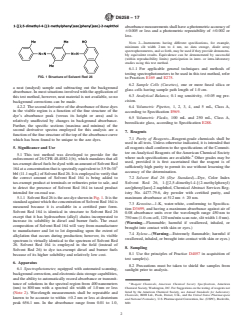
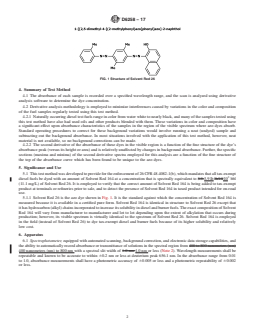
5.1 This test method was developed to provide for the enforcement of 26 CFR 48.4082-1(b), which mandates that all tax-exempt diesel fuels be dyed with an amount of Solvent Red 164 at a concentration that is spectrally equivalent to 3.9 lb/103 bbl (11.1 mg/L) of Solvent Red 26. It is employed to verify that the correct amount of Solvent Red 164 is being added to tax-exempt product at terminals or refineries prior to sale, and to detect the presence of Solvent Red 164 in taxed product intended for on-road use.
5.1.1 Solvent Red 26 is the azo dye shown in Fig. 1. It is the standard against which the concentration of Solvent Red 164 is measured because it is available in a certified pure form. Solvent Red 164 is identical in structure to Solvent Red 26 except that it has hydrocarbon (alkyl) chains incorporated to increase its solubility in diesel and burner fuels. The exact composition of Solvent Red 164 will vary from manufacturer to manufacturer and lot to lot depending upon the extent of alkylation that occurs during production; however, its visible spectrum is virtually identical to the spectrum of Solvent Red 26. Solvent Red 164 is employed in the field (instead of Solvent Red 26) to dye tax-exempt diesel and burner fuels because of its higher solubility and relatively low cost.
FIG. 1 Structure of Solvent Red 26
SCOPE
1.1 This test method covers the procedure for determining the concentration of dye Solvent Red 164 in commercially available diesel and burner fuels using visible spectroscopy.
Note 1: This test method is suitable for all No. 1 and No. 2 grades in Specifications D396 and D975 and for grades DMA and DMB in Specification D2069.
1.2 The concentration ranges specified for the calibration standards are established in response to the Internal Revenue Service dyeing requirements which state that tax-exempt diesel fuel satisfies the dyeing requirement only if it contains the dye Solvent Red 164 (and no other dye) at a concentration spectrally equivalent to 3.9 lb of the solid dye standard Solvent Red 26 per thousand bbl (11.1 mg/L) of diesel fuel.
1.3 The values stated in SI units are to be regarded as standard. No other units of measurement are included in this standard.
1.4 This standard does not purport to address all of the safety concerns, if any, associated with its use. It is the responsibility of the user of this standard to establish appropriate safety and health practices and determine the applicability of regulatory limitations prior to use.
1.5 This international standard was developed in accordance with internationally recognized principles on standardization established in the Decision on Principles for the Development of International Standards, Guides and Recommendations issued by the World Trade Organization Technical Barriers to Trade (TBT) Committee.
- Status
- Published
- Publication Date
- 30-Apr-2017
- Technical Committee
- D02 - Petroleum Products, Liquid Fuels, and Lubricants
- Drafting Committee
- D02.05 - Properties of Fuels, Petroleum Coke and Carbon Material
Buy Documents
ASTM D6258-17 - Standard Test Method for Determination of Solvent Red 164 Dye Concentration in Diesel Fuels
REDLINE ASTM D6258-17 - Standard Test Method for Determination of Solvent Red 164 Dye Concentration in Diesel Fuels
Overview
ASTM D6258-17 is the Standard Test Method for Determination of Solvent Red 164 Dye Concentration in Diesel Fuels, developed by ASTM International. This standard outlines a visible spectroscopy method for accurately determining the concentration of Solvent Red 164 dye in diesel and burner fuels. The procedure is crucial for compliance with U.S. federal regulations regarding tax-exempt diesel fuels, which require specific dye concentrations for enforcement and identification purposes. Ensuring proper dye concentration supports regulatory compliance and helps differentiate tax-exempt fuels from taxable ones.
Key Topics
- Purpose and Scope: The standard provides procedures for quantifying Solvent Red 164 in commercial diesel and burner fuels in line with regulatory requirements, specifically targeting tax-exempt fuels. It utilizes visible spectroscopy, ensuring accurate and repeatable results.
- Regulatory Enforcement: The method supports enforcement of 26 CFR 48.4082-1(b), which mandates dyed diesel fuel for tax exemption. Solvent Red 164 is added at a spectral equivalency of 11.1 mg/L of Solvent Red 26, the dye standard.
- Dye Characteristics:
- Solvent Red 164 is structurally similar to Solvent Red 26, with added hydrocarbon chains to improve solubility in fuels.
- The test method is relevant for all No. 1 and No. 2 diesel grades (ASTM D396, D975) and certain marine fuels.
- Analytical Approach: The absorbance of a fuel sample is measured over a specified wavelength range, with derivative analysis used to determine dye concentration, minimizing interference from the fuel matrix.
- Precision and Quality: The method emphasizes repeatability, reproducibility, and proper equipment calibration, ensuring reliability for laboratory and regulatory use.
Applications
- Regulatory Compliance: Petroleum refineries and fuel terminals use this method to verify that tax-exempt diesel fuels are properly dyed before distribution, complying with internal revenue and excise tax regulations.
- Fuel Distribution Oversight: The test helps detect improper or illegal use of dyed diesel (meant for tax-exempt purposes) in taxed, on-road applications.
- Fuel Quality Control: Laboratories employ this procedure for fuel quality assurance, ensuring that products meet both regulatory and specification requirements for dyed fuels.
- Environmental and Legal Enforcement: Government agencies, inspectors, and third-party labs use ASTM D6258-17 to enforce laws governing fuel taxation and usage, discouraging tax evasion and ensuring proper fuel labeling.
Related Standards
- ASTM D975: Standard Specification for Diesel Fuel Oils - referenced for applicability of test method to certain fuel grades.
- ASTM D396: Standard Specification for Fuel Oils - includes relevant grades for method suitability.
- ASTM D4057: Practice for Manual Sampling of Petroleum and Petroleum Products - referenced for fuel sampling procedures.
- ASTM E131, E169, E275, E288, E969, E691: Standards covering terminology, techniques in ultraviolet-visible spectroscopy, equipment specifications, and precision testing relevant to this method.
- 26 CFR 48.4082-1(b): U.S. Federal Regulation mandating diesel fuel dyeing for tax exemption.
Practical Value
Using ASTM D6258-17 delivers:
- Accurate and reproducible determination of Solvent Red 164 concentrations
- Support for tax and regulatory compliance efforts
- Efficient detection of improper dyeing or illegal diesel fuel use
- Alignment with internationally recognized standardization principles
- Reliability in fuel quality assurance and enforcement applications
With its clear procedures and regulatory alignment, this method is essential for any organization handling, distributing, or regulating dyed diesel fuels.
Relations
- Effective Date
- 01-May-2017
- Effective Date
- 15-Dec-2023
- Effective Date
- 15-Dec-2019
- Effective Date
- 01-Jul-2019
- Effective Date
- 01-May-2019
- Effective Date
- 01-Feb-2019
- Effective Date
- 01-Dec-2018
- Effective Date
- 01-Oct-2018
- Effective Date
- 01-Oct-2018
- Effective Date
- 01-May-2018
- Effective Date
- 01-May-2018
- Effective Date
- 15-Dec-2017
- Effective Date
- 01-Dec-2017
- Effective Date
- 01-Nov-2017
- Effective Date
- 01-Jul-2017
Buy Documents
ASTM D6258-17 - Standard Test Method for Determination of Solvent Red 164 Dye Concentration in Diesel Fuels
REDLINE ASTM D6258-17 - Standard Test Method for Determination of Solvent Red 164 Dye Concentration in Diesel Fuels
Get Certified
Connect with accredited certification bodies for this standard

Element Materials Technology
Materials testing and product certification.

ABS Group Brazil
ABS Group certification services in Brazil.

ABS Quality Evaluations Inc.
American Bureau of Shipping quality certification.
Sponsored listings
Frequently Asked Questions
ASTM D6258-17 is a standard published by ASTM International. Its full title is "Standard Test Method for Determination of Solvent Red 164 Dye Concentration in Diesel Fuels". This standard covers: SIGNIFICANCE AND USE 5.1 This test method was developed to provide for the enforcement of 26 CFR 48.4082-1(b), which mandates that all tax-exempt diesel fuels be dyed with an amount of Solvent Red 164 at a concentration that is spectrally equivalent to 3.9 lb/103 bbl (11.1 mg/L) of Solvent Red 26. It is employed to verify that the correct amount of Solvent Red 164 is being added to tax-exempt product at terminals or refineries prior to sale, and to detect the presence of Solvent Red 164 in taxed product intended for on-road use. 5.1.1 Solvent Red 26 is the azo dye shown in Fig. 1. It is the standard against which the concentration of Solvent Red 164 is measured because it is available in a certified pure form. Solvent Red 164 is identical in structure to Solvent Red 26 except that it has hydrocarbon (alkyl) chains incorporated to increase its solubility in diesel and burner fuels. The exact composition of Solvent Red 164 will vary from manufacturer to manufacturer and lot to lot depending upon the extent of alkylation that occurs during production; however, its visible spectrum is virtually identical to the spectrum of Solvent Red 26. Solvent Red 164 is employed in the field (instead of Solvent Red 26) to dye tax-exempt diesel and burner fuels because of its higher solubility and relatively low cost. FIG. 1 Structure of Solvent Red 26 SCOPE 1.1 This test method covers the procedure for determining the concentration of dye Solvent Red 164 in commercially available diesel and burner fuels using visible spectroscopy. Note 1: This test method is suitable for all No. 1 and No. 2 grades in Specifications D396 and D975 and for grades DMA and DMB in Specification D2069. 1.2 The concentration ranges specified for the calibration standards are established in response to the Internal Revenue Service dyeing requirements which state that tax-exempt diesel fuel satisfies the dyeing requirement only if it contains the dye Solvent Red 164 (and no other dye) at a concentration spectrally equivalent to 3.9 lb of the solid dye standard Solvent Red 26 per thousand bbl (11.1 mg/L) of diesel fuel. 1.3 The values stated in SI units are to be regarded as standard. No other units of measurement are included in this standard. 1.4 This standard does not purport to address all of the safety concerns, if any, associated with its use. It is the responsibility of the user of this standard to establish appropriate safety and health practices and determine the applicability of regulatory limitations prior to use. 1.5 This international standard was developed in accordance with internationally recognized principles on standardization established in the Decision on Principles for the Development of International Standards, Guides and Recommendations issued by the World Trade Organization Technical Barriers to Trade (TBT) Committee.
SIGNIFICANCE AND USE 5.1 This test method was developed to provide for the enforcement of 26 CFR 48.4082-1(b), which mandates that all tax-exempt diesel fuels be dyed with an amount of Solvent Red 164 at a concentration that is spectrally equivalent to 3.9 lb/103 bbl (11.1 mg/L) of Solvent Red 26. It is employed to verify that the correct amount of Solvent Red 164 is being added to tax-exempt product at terminals or refineries prior to sale, and to detect the presence of Solvent Red 164 in taxed product intended for on-road use. 5.1.1 Solvent Red 26 is the azo dye shown in Fig. 1. It is the standard against which the concentration of Solvent Red 164 is measured because it is available in a certified pure form. Solvent Red 164 is identical in structure to Solvent Red 26 except that it has hydrocarbon (alkyl) chains incorporated to increase its solubility in diesel and burner fuels. The exact composition of Solvent Red 164 will vary from manufacturer to manufacturer and lot to lot depending upon the extent of alkylation that occurs during production; however, its visible spectrum is virtually identical to the spectrum of Solvent Red 26. Solvent Red 164 is employed in the field (instead of Solvent Red 26) to dye tax-exempt diesel and burner fuels because of its higher solubility and relatively low cost. FIG. 1 Structure of Solvent Red 26 SCOPE 1.1 This test method covers the procedure for determining the concentration of dye Solvent Red 164 in commercially available diesel and burner fuels using visible spectroscopy. Note 1: This test method is suitable for all No. 1 and No. 2 grades in Specifications D396 and D975 and for grades DMA and DMB in Specification D2069. 1.2 The concentration ranges specified for the calibration standards are established in response to the Internal Revenue Service dyeing requirements which state that tax-exempt diesel fuel satisfies the dyeing requirement only if it contains the dye Solvent Red 164 (and no other dye) at a concentration spectrally equivalent to 3.9 lb of the solid dye standard Solvent Red 26 per thousand bbl (11.1 mg/L) of diesel fuel. 1.3 The values stated in SI units are to be regarded as standard. No other units of measurement are included in this standard. 1.4 This standard does not purport to address all of the safety concerns, if any, associated with its use. It is the responsibility of the user of this standard to establish appropriate safety and health practices and determine the applicability of regulatory limitations prior to use. 1.5 This international standard was developed in accordance with internationally recognized principles on standardization established in the Decision on Principles for the Development of International Standards, Guides and Recommendations issued by the World Trade Organization Technical Barriers to Trade (TBT) Committee.
ASTM D6258-17 is classified under the following ICS (International Classification for Standards) categories: 75.160.20 - Liquid fuels. The ICS classification helps identify the subject area and facilitates finding related standards.
ASTM D6258-17 has the following relationships with other standards: It is inter standard links to ASTM D6258-09(2014), ASTM D975-23a, ASTM D396-19a, ASTM E969-02(2019), ASTM D396-19, ASTM D975-19, ASTM D975-18a, ASTM D396-18a, ASTM D3699-18a, ASTM D3699-18, ASTM D396-18, ASTM D975-17a, ASTM D396-17a, ASTM E288-10(2017), ASTM D396-17. Understanding these relationships helps ensure you are using the most current and applicable version of the standard.
ASTM D6258-17 is available in PDF format for immediate download after purchase. The document can be added to your cart and obtained through the secure checkout process. Digital delivery ensures instant access to the complete standard document.
Standards Content (Sample)
This international standard was developed in accordance with internationally recognized principles on standardization established in the Decision on Principles for the
Development of International Standards, Guides and Recommendations issued by the World Trade Organization Technical Barriers to Trade (TBT) Committee.
Designation: D6258 − 17
Standard Test Method for
Determination of Solvent Red 164 Dye Concentration in
Diesel Fuels
This standard is issued under the fixed designation D6258; the number immediately following the designation indicates the year of
original adoption or, in the case of revision, the year of last revision. A number in parentheses indicates the year of last reapproval. A
superscript epsilon (´) indicates an editorial change since the last revision or reapproval.
1. Scope* D975 Specification for Diesel Fuel Oils
D2069 Specification for Marine Fuels (Withdrawn 2003)
1.1 This test method covers the procedure for determining
D3699 Specification for Kerosine
the concentration of dye Solvent Red 164 in commercially
D4057 Practice for Manual Sampling of Petroleum and
available diesel and burner fuels using visible spectroscopy.
Petroleum Products
NOTE 1—This test method is suitable for all No. 1 and No. 2 grades in
E131 Terminology Relating to Molecular Spectroscopy
Specifications D396 and D975 and for grades DMA and DMB in
E169 PracticesforGeneralTechniquesofUltraviolet-Visible
Specification D2069.
Quantitative Analysis
1.2 The concentration ranges specified for the calibration
E275 Practice for Describing and Measuring Performance of
standards are established in response to the Internal Revenue
Ultraviolet and Visible Spectrophotometers
Servicedyeingrequirementswhichstatethattax-exemptdiesel
E288 Specification for Laboratory Glass Volumetric Flasks
fuel satisfies the dyeing requirement only if it contains the dye
E691 Practice for Conducting an Interlaboratory Study to
Solvent Red 164 (and no other dye) at a concentration
Determine the Precision of a Test Method
spectrally equivalent to 3.9 lb of the solid dye standard Solvent
E969 Specification for Glass Volumetric (Transfer) Pipets
Red 26 per thousand bbl (11.1 mg/L) of diesel fuel.
2.2 Federal Regulation:
1.3 The values stated in SI units are to be regarded as 26 CFR 48.4082-1(b) Federal Excise Tax Regulation
standard. No other units of measurement are included in this
3. Terminology
standard.
3.1 Definitions:
1.4 This standard does not purport to address all of the
3.1.1 For definitions of terms used in this test method, refer
safety concerns, if any, associated with its use. It is the
to Terminology E131.
responsibility of the user of this standard to establish appro-
priate safety and health practices and determine the applica-
4. Summary of Test Method
bility of regulatory limitations prior to use.
1.5 This international standard was developed in accor- 4.1 The absorbance of each sample is recorded over a
specified wavelength range, and the scan is analyzed using
dance with internationally recognized principles on standard-
ization established in the Decision on Principles for the derivative analysis software to determine the dye concentra-
tion.
Development of International Standards, Guides and Recom-
mendations issued by the World Trade Organization Technical
4.2 Derivative analysis methodology is employed to mini-
Barriers to Trade (TBT) Committee.
mize interferences caused by variations in the color and
composition of the fuel samples regularly tested using this test
2. Referenced Documents
method.
2.1 ASTM Standards:
4.2.1 Naturally occurring diesel test fuels range in color
D396 Specification for Fuel Oils
from water white to nearly black, and many of the samples
tested using this test method have also had used oils and other
products blended with them. These variations in color and
This test method is under the jurisdiction of ASTM Committee D02 on
Petroleum Products, Liquid Fuels, and Lubricants and is the direct responsibility of composition have a significant effect upon absorbance charac-
SubcommitteeD02.05onPropertiesofFuels,PetroleumCokeandCarbonMaterial.
teristics of the samples in the region of the visible spectrum
Current edition approved May 1, 2017. Published May 2017. Originally
where azo dyes absorb. Standard operating procedures to
approved in 1998. Last previous edition approved in 2014 as D6258 – 09 (2014).
correct for these background variations would involve running
DOI: 10.1520/D6258-17.
For referenced ASTM standards, visit the ASTM website, www.astm.org, or
contact ASTM Customer Service at service@astm.org. For Annual Book of ASTM
Standards volume information, refer to the standard’s Document Summary page on The last approved version of this historical standard is referenced on
the ASTM website. www.astm.org.
*A Summary of Changes section appears at the end of this standard
Copyright © ASTM International, 100 Barr Harbor Drive, PO Box C700, West Conshohocken, PA 19428-2959. United States
D6258 − 17
absorbancemeasurementsshallhaveaphotometricaccuracyof
60.005 or less and a photometric repeatability of 60.002 or
less.
NOTE 2—Instruments having different specifications, for example,
minimum slit width 2 nm to 4 nm, no data storage, diode array
spectrophotometers, and so forth, may be used if they provide demonstra-
bly equivalent results. Equivalence can be demonstrated by successful
(within reproducibility limits) participation in inter- or intra-laboratory
studies using this test method.
6.1.1 For applicable general techniques and methods of
testing spectrophotometers to be used in this test method, refer
FIG. 1 Structure of Solvent Red 26
to Practices E169 and E275.
6.2 Sample Cells (Cuvettes), one or more fused silica or
a neat (undyed) sample and subtracting out the background
glass cells having sample path length of 1.0 cm.
absorbance. In most situations involved with the application of
6.3 Analytical Balance, 0.1 mg sensitivity, 60.05 mg pre-
this test method, however, neat material is not available, so no
cision.
background corrections can be made.
4.2.2 The second derivative of the absorbance of these dyes
6.4 Volumetric Pipettes, 1, 2, 3, 4, and 5 mL, Class A,
in the visible region is a function of the fine structure of the
according to Specification E969.
dye’s absorbance peak (versus its height or area) and is
6.5 Volumetric Flasks, 100 mL and 250 mL, Class A,
relatively unaffected by changes in background absorbance.
borosilicate glass, according to Specification E288.
Further, the specific sections (maxima and minima) of the
second derivative spectra employed for this analysis are a
7. Reagents
function of the fine structure of the top of the absorbance curve
7.1 Purity of Reagents—Reagent-grade chemicals shall be
which has been found to be unique to the azo dyes.
used in all tests. Unless otherwise indicated, it is intended that
5. Significance and Use all reagents shall conform to the specifications of the Commit-
tee on Analytical Reagents of the American Chemical Society
5.1 This test method was developed to provide for the
where such specifications are available. Other grades may be
enforcement of 26 CFR 48.4082-1(b), which mandates that all
used, provided it is first ascertained that the reagent is of
tax-exemptdieselfuelsbedyedwithanamountofSolventRed
3 sufficiently high purity to permit its use without lessening the
164ataconcentrationthatisspectrallyequivalentto3.9 lb⁄10
accuracy of the determination.
bbl(11.1mg/L)ofSolventRed26.Itisemployedtoverifythat
the correct amount of Solvent Red 164 is being added to 7.2 Solvent Red 26 (Dye Standard)—Dye, Color Index
Solvent Red 26, 1-[[2,5-dimethyl-4-[(2-methylphenyl)
tax-exempt product at terminals or refineries prior to sale, and
to detect the presence of Solvent Red 164 in taxed product azo]phenyl]azo]-2-naphthol, Chemical Abstract Services Reg-
istry No. 4477-79-6, dry powder with certified purity, and
intended for on-road use.
5.1.1 Solvent Red 26 is the azo dye shown in Fig. 1.Itisthe maximum absorbance at 512 nm 6 20 nm.
standard against which the concentration of Solvent Red 164 is
7.3 Kerosine—1-K, water-white, conforming to Specifica-
measured because it is available in a certified pure form.
tion D3699, and having a maximum absorbance against air of
Solvent Red 164 is identical in structure to Solvent Red 26
0.08 absorbance units over the wavelength range 450 nm to
except that it has hydrocarbon (alkyl) chains incorporated to
750 nm (1.0 cm cell, 120 nm/min scan rate, slit width 1.0 nm).
increase its solubility in diesel and burner fuels. The exact
(Warning—Flammable; harmful if swallowed, inhaled, or
composition of Solvent Red 164 will vary from manufacturer
brought into contact with skin or eyes.)
to manufacturer and lot to lot depending upon the extent of
7.4 Xylene—(Warning—Extremely flammable; harmful if
alkylation that occurs during production; however, its visible
swallowed, inhaled, or brought into contact with skin or eyes.)
spectrum is virtually identical to the spectrum of Solvent Red
26. Solvent Red 164 is employed in the field (instead of
8. Sampling
Solvent Red 26) to dye tax-exempt diesel and burner fuels
8.1 Use the principles of Practice D4057 in acquisition of
because of its higher solubility and relatively low cost.
test sample(s).
6. Apparatus
8.2 Precautions must be taken to shield the samples from
6.1 Spectrophotometer, equipped with automated scanning,
sunlight prior to analysis.
backgroundcorrection,andelectronicdatastoragecapabilities,
and the ability to automatically record absorbance or transmit-
tance of solutions in the spectral region from 400 nanometers
Reagent Chemicals, American Chemical Society Specifications, American
Chemical Society, Washington, DC. For Suggestions on the testing of reagents not
(nm) to 800 nm with a spectral slit width of 1.0 nm or less
listed by the American Chemical Society, see Annual Standards for Laboratory
(Note 2). Wavelength measurements shall be repeatable and
Chemicals, BDH Ltd., Poole, Dorset, U.K., and the United States Pharmacopeia
known to be accurate to within 60.2 nm or less at deuterium
and National Formulary, U.S. Pharmacopeial Convention, Inc. (USPC), Rockville,
peak 656.1 nm. In the absorbance range from 0.01 to 1.0, MD.
D6258 − 17
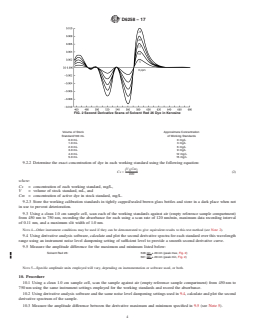
FIG. 2 Second Derivative Scans of Solvent Red 26 Dye in Kerosine
NOTE 3—Studies have shown that exposure to direct sunlight will show
V Cm
~ !~ !
Cs 5 (2)
a decrease in dye concentration over time.
9. Calibration and Standardization
where:
Cs = concentration of each working standard, mg/L,
9.1 Preparation of Stock Standard:
V = volume of stock standard, m
...
This document is not an ASTM standard and is intended only to provide the user of an ASTM standard an indication of what changes have been made to the previous version. Because
it may not be technically possible to adequately depict all changes accurately, ASTM recommends that users consult prior editions as appropriate. In all cases only the current version
of the standard as published by ASTM is to be considered the official document.
Designation: D6258 − 09 (Reapproved 2014) D6258 − 17
Standard Test Method for
Determination of Solvent Red 164 Dye Concentration in
Diesel Fuels
This standard is issued under the fixed designation D6258; the number immediately following the designation indicates the year of
original adoption or, in the case of revision, the year of last revision. A number in parentheses indicates the year of last reapproval. A
superscript epsilon (´) indicates an editorial change since the last revision or reapproval.
1. Scope Scope*
1.1 This test method covers the procedure for determining the concentration of dye Solvent Red 164 in commercially available
diesel and burner fuels using visible spectroscopy.
NOTE 1—This test method is suitable for all No. 1 and No. 2 grades in Specifications D396 and D975 and for grades DMA and DMB in Specification
D2069.
1.2 The concentration ranges specified for the calibration standards are established in response to the Internal Revenue Service
dyeing requirements which state that tax-exempt diesel fuel satisfies the dyeing requirement only if it contains the dye Solvent Red
164 (and no other dye) at a concentration spectrally equivalent to 3.9 lb of the solid dye standard Solvent Red 26 per thousand
bbl (11.1 mg/L) of diesel fuel.
1.3 The values stated in SI units are to be regarded as standard. No other units of measurement are included in this standard.
1.4 This standard does not purport to address all of the safety concerns, if any, associated with its use. It is the responsibility
of the user of this standard to establish appropriate safety and health practices and determine the applicability of regulatory
limitations prior to use.
1.5 This international standard was developed in accordance with internationally recognized principles on standardization
established in the Decision on Principles for the Development of International Standards, Guides and Recommendations issued
by the World Trade Organization Technical Barriers to Trade (TBT) Committee.
2. Referenced Documents
2.1 ASTM Standards:
D396 Specification for Fuel Oils
D975 Specification for Diesel Fuel Oils
D2069 Specification for Marine Fuels (Withdrawn 2003)
D3699 Specification for Kerosine
D4057 Practice for Manual Sampling of Petroleum and Petroleum Products
E131 Terminology Relating to Molecular Spectroscopy
E169 Practices for General Techniques of Ultraviolet-Visible Quantitative Analysis
E275 Practice for Describing and Measuring Performance of Ultraviolet and Visible Spectrophotometers
E288 Specification for Laboratory Glass Volumetric Flasks
E691 Practice for Conducting an Interlaboratory Study to Determine the Precision of a Test Method
E969 Specification for Glass Volumetric (Transfer) Pipets
2.2 Federal Regulation:
26 CFR 48.4082-1(b) Federal Excise Tax Regulation
3. Terminology
3.1 Definitions:
3.1.1 For definitions of terms used in this test method, refer to Terminology E131.
This test method is under the jurisdiction of ASTM Committee D02 on Petroleum Products, Liquid Fuels, and Lubricants and is the direct responsibility of Subcommittee
D02.05 on Properties of Fuels, Petroleum Coke and Carbon Material.
Current edition approved May 1, 2014May 1, 2017. Published July 2014May 2017. Originally approved in 1998. Last previous edition approved in 20092014 as
D6258 – 09.D6258 – 09 (2014). DOI: 10.1520/D6258-09R14.10.1520/D6258-17.
For referenced ASTM standards, visit the ASTM website, www.astm.org, or contact ASTM Customer Service at service@astm.org. For Annual Book of ASTM Standards
volume information, refer to the standard’s Document Summary page on the ASTM website.
The last approved version of this historical standard is referenced on www.astm.org.
*A Summary of Changes section appears at the end of this standard
Copyright © ASTM International, 100 Barr Harbor Drive, PO Box C700, West Conshohocken, PA 19428-2959. United States
D6258 − 17
FIG. 1 Structure of Solvent Red 26
4. Summary of Test Method
4.1 The absorbance of each sample is recorded over a specified wavelength range, and the scan is analyzed using derivative
analysis software to determine the dye concentration.
4.2 Derivative analysis methodology is employed to minimize interferences caused by variations in the color and composition
of the fuel samples regularly tested using this test method.
4.2.1 Naturally occurring diesel test fuels range in color from water white to nearly black, and many of the samples tested using
this test method have also had used oils and other products blended with them. These variations in color and composition have
a significant effect upon absorbance characteristics of the samples in the region of the visible spectrum where azo dyes absorb.
Standard operating procedures to correct for these background variations would involve running a neat (undyed) sample and
subtracting out the background absorbance. In most situations involved with the application of this test method, however, neat
material is not available, so no background corrections can be made.
4.2.2 The second derivative of the absorbance of these dyes in the visible region is a function of the fine structure of the dye’s
absorbance peak (versus its height or area) and is relatively unaffected by changes in background absorbance. Further, the specific
sections (maxima and minima) of the second derivative spectra employed for this analysis are a function of the fine structure of
the top of the absorbance curve which has been found to be unique to the azo dyes.
5. Significance and Use
5.1 This test method was developed to provide for the enforcement of 26 CFR 48.4082-1(b), which mandates that all tax-exempt
diesel fuels be dyed with an amount of Solvent Red 164 at a concentration that is spectrally equivalent to 3.9 3.9 lb lb/10⁄10 bbl
(11.1 mg/L) of Solvent Red 26. It is employed to verify that the correct amount of Solvent Red 164 is being added to tax-exempt
product at terminals or refineries prior to sale, and to detect the presence of Solvent Red 164 in taxed product intended for on-road
use.
5.1.1 Solvent Red 26 is the azo dye shown in Fig. 1. It is the standard against which the concentration of Solvent Red 164 is
measured because it is available in a certified pure form. Solvent Red 164 is identical in structure to Solvent Red 26 except that
it has hydrocarbon (alkyl) chains incorporated to increase its solubility in diesel and burner fuels. The exact composition of Solvent
Red 164 will vary from manufacturer to manufacturer and lot to lot depending upon the extent of alkylation that occurs during
production; however, its visible spectrum is virtually identical to the spectrum of Solvent Red 26. Solvent Red 164 is employed
in the field (instead of Solvent Red 26) to dye tax-exempt diesel and burner fuels because of its higher solubility and relatively
low cost.
6. Apparatus
6.1 Spectrophotometer, equipped with automated scanning, background correction, and electronic data storage capabilities, and
the ability to automatically record absorbance or transmittance of solutions in the spectral region from 400 to 800 nanometers (nm)
400 nanometers (nm) to 800 nm with a spectral slit width of 1.0 nm 1.0 nm or less (Note 2). Wavelength measurements shall be
repeatable and known to be accurate to within 60.2 nm or less at deuterium peak 656.1 nm. In the absorbance range from 0.01
to 1.0, absorbance measurements shall have a photometric accuracy of 60.005 or less and a photometric repeatability of 60.002
or less.
D6258 − 17
NOTE 2—Instruments having different specifications, for example, minimum slit width 22 nm to 4 nm, no data storage, diode array spectrophotometers,
and so forth, may be used if they provide demonstrably equivalent results. Equivalence can be demonstrated by successful (within reproducibility limits)
participation in inter- or intra-laboratory studies using this test method.
6.1.1 For applicable general techniques and methods of testing spectrophotometers to be used in this test method, refer to
Practices E169 and E275.
6.2 Sample Cells (Cuvettes), one or more fused silica or glass cells having sample path length of 1.0 cm.
6.3 Analytical Balance, 0.1 mg sensitivity, 60.05 mg precision.
6.4 Volumetric Pipettes, 1, 2, 3, 4, and 5 mL, Class A, according to Specification E969.
6.5 Volumetric Flasks, 100 mL and 250 mL, Class A, borosilicate glass, according to Specification E288.
7. Reagents
7.1 Purity of Reagents—Reagent grade Reagent-grade chemicals shall be used in all tests. Unless otherwise indicated, it is
intended that all reagents shall conform to the specifications of the Committee on Analytical Reagents of the American Chemical
Society where such specifications are available. Other grades may be used, provided it is first ascertained that the reagent is of
sufficiently high purity to permit its use without lessening the accuracy of the determination.
7.2 Solvent Red 26 (Dye Standard)—Dye, Color Index Solvent Red 26, 1-[[2,5-dimethyl-4-[(2-methylphenyl) azo]phenyl]azo]-
2-naphthol, Chemical Abstract Services Registry No. 4477-79-6, dry powder with certified purity, and maximum absorbance at
512512 nm 6 20 nm.
7.3 Kerosine—1-K, water-white, conforming to Specification D3699, and having a maximum absorbance against air of 0.08
absorbance units over the wavelength range 450450 nm to 750 nm (1.0 cm cell, 120 nm/min scan rate, slit width 1.0 nm).
(Warning—Flammable; harmful if swallowed, inhaled, or brought into contact with skin or eyes.)
7.4 Xylene—(Warning—Extremely flammable; harmful if swallowed, inhaled, or brought into contact with skin or eyes.)
8. Sampling
8.1 Use the principles of Practice D4057 in acquisition of test sample(s).
8.2 Precautions must be taken to shield the samples from sunlight prior to analysis.
NOTE 3—Studies have shown that exposure to direct sunlight will show a decrease in dye concentration over time.
9. Calibration and Standardization
9.1 Preparation of Stock Standard:
9.1.1 Solvent Red 26—Weigh approximately 0.0750 g of the dye standard to the nearest 0.1 mg on an analytical balance,
quantitatively transfer the dye to a 250 mL volumetric flask, and dilute to mark with xylene. Mix the prepared solution thoroughly.
9.1.2 Determine the exact concentration of dye in the stock standard using the following equation:
M P 1000
~ ! ~ ! ~ !
C 5 (1)
0.250
where:
C = concentration of active dye ingredient in the stock standard, mg/L,
M = mass of certified dye standard used in preparing the stock standard, g, and
P = purity of certified dye standard use
...