

ASTM F3640-23
(Test Method)Standard Test Method for Full Depth Field Sampling of In-situ Synthetic Turf Infill Materials
General Information
- Abstract
SIGNIFICANCE AND USE
5.1 Currently methods of infill sampling procedures differ from vendor to vendor and from technical agent to technical agent. Providing a uniform procedure for sampling, which allows for a consistent vertical sample, will allow for more consistent and accurate evaluation/measurement in the laboratory of samples taken in the field.
5.2 The Sampling Program and associated Sample Area Site Plan (Map) shall take into account the specific purpose or purposes of the testing and determine appropriate sample areas based on needs and field conditions. A partial list of possible purposes include:
5.2.1 General overall field evaluation of the infill material density, overall application rate, total quantities, and infill variation across the field area.
5.2.2 Infill component composition and variation/uniformity as it relates to infill material weights and ratios. This can identify inconsistencies in construction techniques and quality control.
5.2.3 Infill material evaluation for injury related surface assessment.
5.2.4 Infill material end of life and potential reuse assessment.
5.2.5 Field area contamination assessment.
5.3 Laboratory testing that may be performed on obtained samples include but are not limited to:
5.3.1 Test Method C136.
5.3.2 Test Method D5644.
5.3.3 Test Method F1632.
SCOPE
1.1 This test method provides a consistent sampling procedure for obtaining infill samples of synthetic turf infill materials in the field.
1.2 Operational considerations include:
1.2.1 This method requires that attic stock infill materials or infill materials from areas that are out-of-play be available for refilling holes left by the sampling procedure. Replacement of infill materials shall match the composition of the material removed.
1.2.2 Using this method to determine the in-situ weight and density will result in unreliable data due to the inclusion of moisture within the infill materials. Proper laboratory procedure including wet weight, dry weight before separation, and component weight after separation ensure no loss, and reliable data.
1.3 Evaluation and analysis of the samples in the field and or laboratory are not covered herein.
1.4 The values stated in SI units are to be regarded as the standard. The values given in parentheses are for information only.
1.5 This standard does not purport to address all of the safety concerns, if any, associated with its use. It is the responsibility of the user of this standard to establish appropriate safety, health, and environmental practices and determine the applicability of regulatory limitations prior to use.
1.6 This international standard was developed in accordance with internationally recognized principles on standardization established in the Decision on Principles for the Development of International Standards, Guides and Recommendations issued by the World Trade Organization Technical Barriers to Trade (TBT) Committee.
- Status
- Published
- Publication Date
- 14-Nov-2023
- Technical Committee
- F08 - Sports Equipment, Playing Surfaces, and Facilities
- Drafting Committee
- F08.65 - Artificial Turf Surfaces and Systems
Overview
ASTM F3640-23: Standard Test Method for Full Depth Field Sampling of In-situ Synthetic Turf Infill Materials provides a comprehensive, uniform field sampling method for synthetic turf infill materials. Synthetic turf infill plays a critical role in the safety, performance, and lifespan of artificial turf systems. Establishing a consistent approach to sampling ensures that evaluations conducted in the laboratory are based on representative and comparable field samples, thus supporting quality control, safety assessments, performance optimization, and regulatory compliance. This standard is integral for professionals engaged in synthetic turf installation, maintenance, research, and performance evaluation.
Key Topics
Uniform Sampling Method:
ASTM F3640-23 standardizes the procedure for obtaining full-depth infill samples directly from the field, reducing discrepancies between vendors and technical agents.Sampling Program and Site Plan:
The standard requires the development of a sampling program and a detailed sample area site plan (map) tailored to the objectives of the assessment and prevailing field conditions.Sampling Tools and Conditions:
- Use of specialized equipment such as sampling tubes, vacuums, infill depth gauges, and sample containers.
- Emphasis on representative sampling, ensuring samples reflect the range of conditions across the field.
- Guidance on sample handling to minimize loss and prevent contamination.
Operational Considerations:
- Procedures for refilling sampling holes using stock infill materials to maintain field integrity.
- Limitations on using in-situ field data for density and weight measurements due to moisture content-reliable results require laboratory procedures.
Reporting Requirements:
A detailed reporting protocol, including mapping, environmental conditions, infill depths, abnormalities, and refilling statements, is outlined to promote data integrity and transparency.
Applications
ASTM F3640-23 is essential for a variety of applications across the lifecycle of synthetic turf sports fields:
General Field Evaluation:
Assessing overall infill density, distribution, and total infill quantities across the playing surface.Composition and Uniformity Assessment:
Evaluating consistency in infill materials can help identify construction quality issues or assess performance variability.Safety and Surface Assessments:
Supporting injury-related investigations, surface performance studies, and compliance with safety standards such as shock absorbance and impact attenuation.End-of-Life and Reuse:
Sampling for the evaluation of infill materials for potential recycling or reuse at the conclusion of a turf system's service life.Contamination Analysis:
Determining the presence of foreign substances or degradation byproducts to maintain player safety and field performance.
Professionals such as field managers, turf care specialists, construction quality control personnel, and laboratory testing agencies will find ASTM F3640-23 invaluable for ensuring data-driven decisions, regulatory compliance, and optimal field performance.
Related Standards
ASTM F3640-23 references and aligns with several related ASTM standards to facilitate comprehensive evaluation and laboratory analysis:
- ASTM C136: Standard Test Method for Sieve Analysis of Fine and Coarse Aggregates
- ASTM D5644: Determination of Particle Size Distribution of Recycled Vulcanizate Particulate Rubber
- ASTM F1632: Particle Size Analysis and Sand Shape Grading of Golf Course Putting Green and Sports Field Rootzone Mixes
- ASTM F1936: Specification for Impact Attenuation of Turf Playing Systems as Measured in the Field
Collectively, these support the end-to-end process of synthetic turf performance assessment and quality management, making ASTM F3640-23 a cornerstone in artificial turf testing programs.
Keywords: synthetic turf sampling, infill materials, ASTM F3640-23, field test method, artificial turf quality control, sports field safety, infill particle size, synthetic turf infill density, ASTM turf testing
Frequently Asked Questions
ASTM F3640-23 is a standard published by ASTM International. Its full title is "Standard Test Method for Full Depth Field Sampling of In-situ Synthetic Turf Infill Materials". This standard covers: SIGNIFICANCE AND USE 5.1 Currently methods of infill sampling procedures differ from vendor to vendor and from technical agent to technical agent. Providing a uniform procedure for sampling, which allows for a consistent vertical sample, will allow for more consistent and accurate evaluation/measurement in the laboratory of samples taken in the field. 5.2 The Sampling Program and associated Sample Area Site Plan (Map) shall take into account the specific purpose or purposes of the testing and determine appropriate sample areas based on needs and field conditions. A partial list of possible purposes include: 5.2.1 General overall field evaluation of the infill material density, overall application rate, total quantities, and infill variation across the field area. 5.2.2 Infill component composition and variation/uniformity as it relates to infill material weights and ratios. This can identify inconsistencies in construction techniques and quality control. 5.2.3 Infill material evaluation for injury related surface assessment. 5.2.4 Infill material end of life and potential reuse assessment. 5.2.5 Field area contamination assessment. 5.3 Laboratory testing that may be performed on obtained samples include but are not limited to: 5.3.1 Test Method C136. 5.3.2 Test Method D5644. 5.3.3 Test Method F1632. SCOPE 1.1 This test method provides a consistent sampling procedure for obtaining infill samples of synthetic turf infill materials in the field. 1.2 Operational considerations include: 1.2.1 This method requires that attic stock infill materials or infill materials from areas that are out-of-play be available for refilling holes left by the sampling procedure. Replacement of infill materials shall match the composition of the material removed. 1.2.2 Using this method to determine the in-situ weight and density will result in unreliable data due to the inclusion of moisture within the infill materials. Proper laboratory procedure including wet weight, dry weight before separation, and component weight after separation ensure no loss, and reliable data. 1.3 Evaluation and analysis of the samples in the field and or laboratory are not covered herein. 1.4 The values stated in SI units are to be regarded as the standard. The values given in parentheses are for information only. 1.5 This standard does not purport to address all of the safety concerns, if any, associated with its use. It is the responsibility of the user of this standard to establish appropriate safety, health, and environmental practices and determine the applicability of regulatory limitations prior to use. 1.6 This international standard was developed in accordance with internationally recognized principles on standardization established in the Decision on Principles for the Development of International Standards, Guides and Recommendations issued by the World Trade Organization Technical Barriers to Trade (TBT) Committee.
SIGNIFICANCE AND USE 5.1 Currently methods of infill sampling procedures differ from vendor to vendor and from technical agent to technical agent. Providing a uniform procedure for sampling, which allows for a consistent vertical sample, will allow for more consistent and accurate evaluation/measurement in the laboratory of samples taken in the field. 5.2 The Sampling Program and associated Sample Area Site Plan (Map) shall take into account the specific purpose or purposes of the testing and determine appropriate sample areas based on needs and field conditions. A partial list of possible purposes include: 5.2.1 General overall field evaluation of the infill material density, overall application rate, total quantities, and infill variation across the field area. 5.2.2 Infill component composition and variation/uniformity as it relates to infill material weights and ratios. This can identify inconsistencies in construction techniques and quality control. 5.2.3 Infill material evaluation for injury related surface assessment. 5.2.4 Infill material end of life and potential reuse assessment. 5.2.5 Field area contamination assessment. 5.3 Laboratory testing that may be performed on obtained samples include but are not limited to: 5.3.1 Test Method C136. 5.3.2 Test Method D5644. 5.3.3 Test Method F1632. SCOPE 1.1 This test method provides a consistent sampling procedure for obtaining infill samples of synthetic turf infill materials in the field. 1.2 Operational considerations include: 1.2.1 This method requires that attic stock infill materials or infill materials from areas that are out-of-play be available for refilling holes left by the sampling procedure. Replacement of infill materials shall match the composition of the material removed. 1.2.2 Using this method to determine the in-situ weight and density will result in unreliable data due to the inclusion of moisture within the infill materials. Proper laboratory procedure including wet weight, dry weight before separation, and component weight after separation ensure no loss, and reliable data. 1.3 Evaluation and analysis of the samples in the field and or laboratory are not covered herein. 1.4 The values stated in SI units are to be regarded as the standard. The values given in parentheses are for information only. 1.5 This standard does not purport to address all of the safety concerns, if any, associated with its use. It is the responsibility of the user of this standard to establish appropriate safety, health, and environmental practices and determine the applicability of regulatory limitations prior to use. 1.6 This international standard was developed in accordance with internationally recognized principles on standardization established in the Decision on Principles for the Development of International Standards, Guides and Recommendations issued by the World Trade Organization Technical Barriers to Trade (TBT) Committee.
ASTM F3640-23 is available in PDF format for immediate download after purchase. The document can be added to your cart and obtained through the secure checkout process. Digital delivery ensures instant access to the complete standard document.
Standards Content (Sample)
This international standard was developed in accordance with internationally recognized principles on standardization established in the Decision on Principles for the
Development of International Standards, Guides and Recommendations issued by the World Trade Organization Technical Barriers to Trade (TBT) Committee.
Designation: F3640 − 23
Standard Test Method for
Full Depth Field Sampling of In-situ Synthetic Turf Infill
Materials
This standard is issued under the fixed designation F3640; the number immediately following the designation indicates the year of
original adoption or, in the case of revision, the year of last revision. A number in parentheses indicates the year of last reapproval. A
superscript epsilon (´) indicates an editorial change since the last revision or reapproval.
1. Scope 2. Referenced Documents
2.1 ASTM Standards:
1.1 This test method provides a consistent sampling proce-
C136 Test Method for Sieve Analysis of Fine and Coarse
dure for obtaining infill samples of synthetic turf infill mate-
Aggregates
rials in the field.
D5644 Test Method for Rubber Compounding Materials—
1.2 Operational considerations include:
Determination of Particle Size Distribution of Recycled
Vulcanizate Particulate Rubber
1.2.1 This method requires that attic stock infill materials or
F1632 Test Method for Particle Size Analysis and Sand
infill materials from areas that are out-of-play be available for
Shape Grading of Golf Course Putting Green and Sports
refilling holes left by the sampling procedure. Replacement of
Field Rootzone Mixes
infill materials shall match the composition of the material
F1936 Specification for Impact Attenuation of Turf Playing
removed.
Systems as Measured in the Field
1.2.2 Using this method to determine the in-situ weight and
density will result in unreliable data due to the inclusion of
3. Terminology
moisture within the infill materials. Proper laboratory proce-
3.1 Definitions:
dure including wet weight, dry weight before separation, and
3.1.1 attic stock infill, n—a reserve supply of the original
component weight after separation ensure no loss, and reliable
infill material suitable for filling holes resulting from sampling.
data.
3.1.2 cleaning brush, n—a suitable brush, similar to a small
1.3 Evaluation and analysis of the samples in the field and
paint brush that would be used for brushing of infill materials
or laboratory are not covered herein. that are adhered to the wall of the collection container into the
sample container.
1.4 The values stated in SI units are to be regarded as the
3.1.3 dimension ties, n—measurements from fixed field
standard. The values given in parentheses are for information
event marking points to the sample area. Dimension ties shall
only.
be provided where precise locations are considered critical.
1.5 This standard does not purport to address all of the
3.1.4 duplicate samples, n—multiple samples taken from a
safety concerns, if any, associated with its use. It is the
sample area in cases where an undisturbed sample or samples
responsibility of the user of this standard to establish appro-
are required.
priate safety, health, and environmental practices and deter-
3.1.5 infill depth gauge, n—the infill depth gauge shall be
mine the applicability of regulatory limitations prior to use.
suitable for measuring depths of the infill being sampled.
1.6 This international standard was developed in accor-
3.1.6 sample, n—the infill material contained within the
dance with internationally recognized principles on standard-
walls of the sampling tube down to the top of the turf backing
ization established in the Decision on Principles for the
system.
Development of International Standards, Guides and Recom-
3.1.7 sample area, n—a square meter area from which a
mendations issued by the World Trade Organization Technical
sample or samples are taken. Where multiple samples are taken
Barriers to Trade (TBT) Committee.
from a sample area they shall be no more than 0.5 m (1.64 ft)
apart.
This test method is under the jurisdiction of ASTM Committee F08 on Sports
Equipment, Playing Surfaces, and Facilities and is the direct responsibility of For referenced ASTM standards, visit the ASTM website, www.astm.org, or
Subcommittee F08.65 on Artificial Turf Surfaces and Systems. contact ASTM Customer Service at service@astm.org. For Annual Book of ASTM
Current edition approved Nov. 15, 2023. Published January 2024. DOI: 10.1520/ Standards volume information, refer to the standard’s Document Summary page on
F3640-23. the ASTM website.
Copyright © ASTM International, 100 Barr Harbor Drive, PO Box C700, West Conshohocken, PA 19428-2959. United States
F3640 − 23
3.1.8 sample area site plan (map), n—depicts the location of 5.2 The Sampling Program and associated Sample Area Site
the individual Sample Areas within a site that are included in Plan (Map) shall take into account the specific purpose or
the sampling program. It shall provide adequate detail for the purposes of the testing and determine appropriate sample areas
Map to be oriented with field conditions. This shall be included based on needs and field conditions. A partial list of possible
in the final report. purposes include:
5.2.1 General overall field evaluation of the infill material
3.1.9 sample containers, n—sealable bags or other suitable
density, overall application rate, total quantities, and infill
sealable, moisture proof containers of adequate size to contain
variation across the field area.
the full sample size.
5.2.2 Infill component composition and variation/
3.1.10 sample infill depth, n—the average of three infill
uniformity as it relates to infill material weights and ratios. This
depths measured within the sample tube.
can identify inconsistencies in construction techniques and
3.1.11 sample loosening device, n—shall be a rounded edge
quality control.
metal spoon, rounded edge screwdriver, a large metal spike, or
5.2.3 Infill material evaluation for injury related surface
other small digging device without sharp edges, sized to fit
assessment.
within the matrix of the fibers.
5.2.4 Infill material end of life and potential reuse assess-
ment.
3.1.12 sampling program, n—shall outline the issue(s) of
concern, purpose(s), and goals of the sampling effort. 5.2.5 Field area contamination assessment.
3.1.13 sampling site, n—the locus, location, site, or a field 5.3 Laboratory testing that may be performed on obtained
from which multiple samples are taken.
samples include but are not limited to:
5.3.1 Test Method C136.
3.1.14 sampling tube, n—a sample area containment vessel
5.3.2 Test Method D5644.
that shall consist of a round pipe shape tube with a handle used
5.3.3 Test Method F1632.
to allow a full-depth infill sample to be obtained in the field,
wall to wall of the sampling tube.
6. Interferences
3.1.15 sampling vacuum, n—a portable vacuum with a
6.1 Sampling during frozen conditions and extremely wet
collection receptacle capable of containing removed infill
conditions is not recommended.
materials.
6.2 Sampling of damaged or contaminated areas, or both,
4. Summary of Sampling Method
where damaged or contaminated conditions, or both, are not
the subject of the Sampling Program are likely to result in
4.1 Prior to undertaking a Sampling Program an evaluation
inaccurate data and shall be avoided.
of the Sampling Site should be made to identify potential
Sample Areas. A Sample Area Site Plan shall be prepared to
6.3 When sampling of damaged and or contaminated infill
depict Sample Areas which shall each have a Sample Area
material is part of the assessment, a mix of damaged or
Number.
contaminated and non-damaged or non-contaminated condi-
4.1.1 The number of samples and Sample Area locations
tions shall be evaluated for comparison purposes.
shall be specific to the underlying purpose of the Sampling
6.4 Poorly cleaned vacuum hoses, wands, and collection
Program.
receptacle are likely to result in inaccurate data.
4.1.2 The range of infill depths on a Sampling Site shall be
determined before sampling in order to assure that the Sample
7. Apparatus
Areas are representative of the intended sample conditions
7.1 Sampling Tube:
being evaluated. To assure this an infill depth evaluation shall
7.1.1 The sampling tube shall be a round pipe shape device
be performed in support of the sampling program.
used to allow a full-depth infill sample to be obtained in the
NOTE 1—As an example, having a measured infill depth range over the field with the sample being removed from inside edge to edge
full Sampling Site allows total infill material volume and mass to be
of the sampling tube wall. It shall be durable enough to not
calculated.
deform from use or transportation. It is suggested that the
4.2 Samples shall be taken using the sampling tube with
material be plastic or metal. (See Fig. 1.)
critical data such as sample area number and infill depth
7.1.1.1 The top and bottom open edges of the tube shall not
recorded on the final report.
be sharp. It is suggested that the bottom edge be crimped in the
manor of a metal stove pipe reducer to allow the edge to gently
4.3 Samples shall be placed in sealable bags or containers to
loosen the infill material as the tube is pressed down and
maintain moisture content of the sample.
twisted to the backing system. The thickness of the tube walls
shall be between 0.7 mm in thickness to 1.0 mm (22 gauge to
5. Significance and Use
20 gauge). Thicker tubes have a tendency to prevent the tube
5.1 Currently methods of infill sampling procedures differ
from entering the infill material without disrupting the sample
from vendor to vendor and from technical agent to technical
by causing displacement of infill material, or both. A handle
agent. Providing a uniform procedure for sampling, which
shall be attached to the top of the sampler to facilitate full
allows for a consistent vertical sample, will allow for more
insertion the tube to the top surface of the backing.
consistent and accurate evaluation/measurement in the labora-
tory of samples taken in the field. NOTE 2—An example of a sampling tube is a 180 mm in diameter to
F3640 − 23
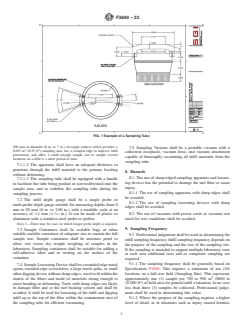
FIG. 1 Example of a Sampling Tube
200 mm in diameter (8 in. to 7 in.) stovepipe reducer which provides a
7.5 Sampling Vacuum shall be a portable vacuum with a
2 2
0.023 m (0.25 ft ) sampling area, has a crimped edge to improve infill
collection receptacle, vacuum hose, and vacuum attachment
penetration, and offers a small enough sample size to sample several
capable of thoroughly vacuuming all infill materials from the
locations on a field is a short period of time.
sampling tube.
7.1.1.2 The apparatus shall have an adequate thickness to
penetrate through the infill material to the primary backing
8. Hazards
without deforming.
8.1 The use of sharp-edged sampling apparatus and loosen-
7.1.1.3 The sampling tube shall be equipped with a handle
ing devices has the potential to damage the turf fiber or cause
to facilitate the tube being pushed or screwed/twisted into the
...