

ASTM F1972-19
(Guide)Standard Guide for Terminology Relating to Candles and Associated Accessory Items
General Information
- Abstract
SIGNIFICANCE AND USE
4.1 This guide is used to establish a set of definitions that allows manufacturers, consumers, retailers, and the scientific community to use a common language to define candles and associated accessory items.
SCOPE
1.1 This guide defines standard terms used to describe candles and associated accessory products.
1.2 The values stated in inch-pound units are to be regarded as standard. The values given in parentheses are for information only.
1.3 This international standard was developed in accordance with internationally recognized principles on standardization established in the Decision on Principles for the Development of International Standards, Guides and Recommendations issued by the World Trade Organization Technical Barriers to Trade (TBT) Committee.
- Status
- Published
- Publication Date
- 31-Mar-2019
- Technical Committee
- F15 - Consumer Products
- Drafting Committee
- F15.45 - Candle Products
Buy Documents

ASTM F1972-19 - Standard Guide for Terminology Relating to Candles and Associated Accessory Items
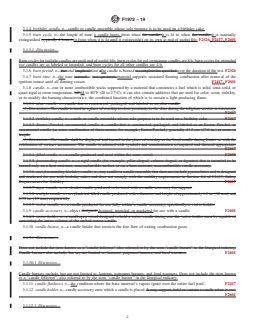
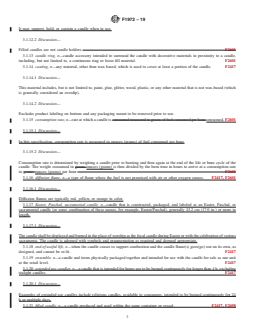
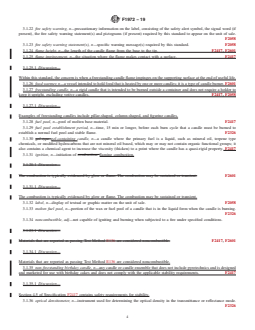
REDLINE ASTM F1972-19 - Standard Guide for Terminology Relating to Candles and Associated Accessory Items
Overview
ASTM F1972-19: Standard Guide for Terminology Relating to Candles and Associated Accessory Items establishes consistent definitions for terms used in the candle industry. Developed by ASTM International, this standard is vital for manufacturers, retailers, consumers, and researchers, providing a clear and unified language when discussing candles and related accessories. Using this terminology guide ensures that all parties operate with common understanding, helping to prevent miscommunication and promoting safety within the global candle market.
This guide is aligned with internationally recognized principles for standardization, supporting compliance with technical regulations and trade requirements.
Key Topics
Standardized Definitions:
The standard provides precise meanings for a wide range of terms related to candles, wicks, bases, accessories, safety, and operating conditions. Examples include:- Candle types (e.g., pillar, taper, tealight, votive, birthday, altar, sacramental)
- Candle accessories (e.g., holders, shades, toppers, votive holders, rings)
- Operational terminology (e.g., burn cycle, burn period, burn time, useful life, flammable and noncombustible material)
- Safety concepts (e.g., barrier technology, fire safety warning, consumption rate)
- Material terms (e.g., base material, wax, molten fuel pool, coating, paint)
Safety & Performance:
Definitions related to key safety components-such as barrier technology, fire safety labels, sustained flaming, and secondary ignition-are included to help support candle safety standards and fire prevention.Trade & Labeling Compliance:
The standard aligns terminology with requirements from international trade bodies, helping to ensure products meet both safety and labeling regulations.
Applications
ASTM F1972-19 serves as the foundational terminology reference for several practical applications:
Product Development:
Manufacturers utilize the standard to harmonize the naming and specifications of candles and accessories, ensuring consistency across product lines.Consumer Communication:
Retailers and marketers use the standard’s definitions for product labeling, packaging, and marketing communications, enabling consumers to make informed purchasing decisions.Safety Testing & Certification:
Testing laboratories and certification bodies rely on the standard terminology to ensure candles and related items meet the safety and performance requirements set by relevant ASTM safety standards.Regulatory Compliance:
Regulatory agencies and trade organizations reference this standard to enforce accurate labeling, safety warnings, and correct usage instructions across international borders.Research & Education:
Scientists and academics use standardized definitions for research, studies, and educational materials focused on candle technology, fire safety, and material science.
Related Standards
ASTM F1972-19 is closely linked to a number of other important standards within the candle and fire safety sectors:
- ASTM E136: Test Method for Assessing Combustibility of Materials Using a Vertical Tube Furnace at 750°C
- ASTM F2058: Specification for Candle Fire Safety Labeling
- ASTM F2326: Test Method for Collection and Analysis of Visible Emissions from Candles as They Burn
- ASTM F2417: Specification for Fire Safety for Candles
- ASTM F2601: Specification for Fire Safety for Candle Accessories
- NFPA 909: Code for the Protection of Cultural Resources
By following ASTM F1972-19 alongside these related standards, professionals in the candle industry can ensure products meet stringent quality, labeling, and safety requirements, supporting both market acceptance and regulatory compliance.
Keywords: ASTM F1972-19, candle terminology, candle safety, candle accessories, standard definitions, fire safety, candle labeling, ASTM standards, candle manufacturing, candle industry compliance
Relations
- Replaces
ASTM F1972-16 - Standard Guide for Terminology Relating to Candles and Associated Accessory Items - Effective Date
- 01-Apr-2019
- Effective Date
- 01-Mar-2024
- Effective Date
- 01-Feb-2024
- Effective Date
- 01-Feb-2019
- Effective Date
- 01-Apr-2018
- Effective Date
- 01-Nov-2016
- Effective Date
- 01-Jul-2016
- Effective Date
- 01-May-2016
- Effective Date
- 01-Feb-2016
- Effective Date
- 01-Jan-2016
- Effective Date
- 01-Jul-2013
- Effective Date
- 01-Aug-2012
- Effective Date
- 01-Mar-2012
- Effective Date
- 01-Oct-2011
- Effective Date
- 15-Jan-2011
Buy Documents
ASTM F1972-19 - Standard Guide for Terminology Relating to Candles and Associated Accessory Items
REDLINE ASTM F1972-19 - Standard Guide for Terminology Relating to Candles and Associated Accessory Items
Get Certified
Connect with accredited certification bodies for this standard

ECOCERT
Organic and sustainability certification.

Eurofins Food Testing Global
Global leader in food, environment, and pharmaceutical product testing.

Intertek Bangladesh
Intertek certification and testing services in Bangladesh.
Sponsored listings
Frequently Asked Questions
ASTM F1972-19 is a guide published by ASTM International. Its full title is "Standard Guide for Terminology Relating to Candles and Associated Accessory Items". This standard covers: SIGNIFICANCE AND USE 4.1 This guide is used to establish a set of definitions that allows manufacturers, consumers, retailers, and the scientific community to use a common language to define candles and associated accessory items. SCOPE 1.1 This guide defines standard terms used to describe candles and associated accessory products. 1.2 The values stated in inch-pound units are to be regarded as standard. The values given in parentheses are for information only. 1.3 This international standard was developed in accordance with internationally recognized principles on standardization established in the Decision on Principles for the Development of International Standards, Guides and Recommendations issued by the World Trade Organization Technical Barriers to Trade (TBT) Committee.
SIGNIFICANCE AND USE 4.1 This guide is used to establish a set of definitions that allows manufacturers, consumers, retailers, and the scientific community to use a common language to define candles and associated accessory items. SCOPE 1.1 This guide defines standard terms used to describe candles and associated accessory products. 1.2 The values stated in inch-pound units are to be regarded as standard. The values given in parentheses are for information only. 1.3 This international standard was developed in accordance with internationally recognized principles on standardization established in the Decision on Principles for the Development of International Standards, Guides and Recommendations issued by the World Trade Organization Technical Barriers to Trade (TBT) Committee.
ASTM F1972-19 is classified under the following ICS (International Classification for Standards) categories: 01.040.71 - Chemical technology (Vocabularies); 71.100.99 - Other products of the chemical industry. The ICS classification helps identify the subject area and facilitates finding related standards.
ASTM F1972-19 has the following relationships with other standards: It is inter standard links to ASTM F1972-16, ASTM E136-24a, ASTM E136-24, ASTM E136-19, ASTM F2601-18, ASTM E136-16a, ASTM F2601-16a, ASTM F2417-16, ASTM F2601-16, ASTM E136-16, ASTM F2601-13, ASTM E136-12, ASTM F2601-12, ASTM F2417-11, ASTM E136-11. Understanding these relationships helps ensure you are using the most current and applicable version of the standard.
ASTM F1972-19 is available in PDF format for immediate download after purchase. The document can be added to your cart and obtained through the secure checkout process. Digital delivery ensures instant access to the complete standard document.
Standards Content (Sample)
This international standard was developed in accordance with internationally recognized principles on standardization established in the Decision on Principles for the
Development of International Standards, Guides and Recommendations issued by the World Trade Organization Technical Barriers to Trade (TBT) Committee.
Designation: F1972 − 19
Standard Guide for
Terminology Relating to Candles and Associated Accessory
Items
This standard is issued under the fixed designation F1972; the number immediately following the designation indicates the year of
original adoption or, in the case of revision, the year of last revision. A number in parentheses indicates the year of last reapproval. A
superscript epsilon (´) indicates an editorial change since the last revision or reapproval.
1. Scope 3.1.1.1 Discussion—The candle is used in a place of wor-
ship in close proximity to the altar during the religious service
1.1 This guide defines standard terms used to describe
or ceremony.
candles and associated accessory products.
3.1.2 barrier technology, n—a functional design element of
1.2 The values stated in inch-pound units are to be regarded
a candle accessory that minimizes the risk of ignition of the
as standard. The values given in parentheses are for informa-
combustible components of the candle accessory as a result of
tion only.
foreseeable misuse or failure of the candle. F2417, F2601
1.3 This international standard was developed in accor-
3.1.2.1 Discussion—Precautions should be taken in barrier
dance with internationally recognized principles on standard-
technology designs to prevent ignition of combustible compo-
ization established in the Decision on Principles for the
nents. During intended use, the candle should not be capable of
Development of International Standards, Guides and Recom-
igniting combustible components from either heat transfer or
mendations issued by the World Trade Organization Technical
direct flame impingement.Accessories should also be designed
Barriers to Trade (TBT) Committee.
to prevent ignition of combustible components in reasonable
and foreseeable situations such as in drafts or the candle falling
2. Referenced Documents
over. Examples include a durable, noncombustible wall, or
space absent of combustible objects.
2.1 ASTM Standards:
E136 Test Method forAssessing Combustibility of Materials
3.1.3 base material, n—the intended fuel source for candle
Using a Vertical Tube Furnace at 750°C
flame. F2417
F2058 Specification for Candle Fire Safety Labeling
3.1.4 birthday candle, n—candle or candle ensemble whose
F2326 Test Method for Collection and Analysis of Visible
sole purpose is to be used on a birthday cake.
Emissions from Candles as They Burn
3.1.5 burn cycle, n—the length of time a candle burns from
F2417 Specification for Fire Safety for Candles
when it is lit to when it is manually extinguished or from when
F2601 Specification for Fire Safety for Candle Accessories
it is lit until it extinguishes on its own at end of useful life.
2.2 NFPA Standard:
F2326, F2417, F2601
NFPA 909 Code for the Protection of Cultural Resources
3.1.5.1 Discussion—Burn cycles for tealight candles are
until end of useful life; burn cycles for gel-containing candles
3. Terminology
are 8 h; burn cycles for extended use candles are as labeled or
3.1 Definitions of Terms Specific to This Standard: intended; and burn cycles for all other candles are 4 h.
3.1.1 altar candle, n—candle that is constructed, packaged,
3.1.6 burn period, n—total time the candle is burned over
and labeled as an altar candle.
the duration of the test. F2326
3.1.7 burn time, n—the time a material supports sustained
flaming combustion after removal of the ignition source until
This guide is under the jurisdiction of ASTM Committee F15 on Consumer
all flaming ceases. F2417, F2601
Products and is the direct responsibility of Subcommittee F15.45 on Candle
3.1.8 candle, n—one or more combustible wicks supported
Products.
Current edition approved April 1, 2019. Published April 2019. Originally
by a material that constitutes a fuel which is solid, semi-solid,
approved in 1999. Last previous edition approved in 2016 as F1972 – 16. DOI:
or quasi-rigid at room temperature, 68 to 80°F (20 to 27°C); it
10.1520/F1972-19.
can also contain additives that are used for color, scent,
For referenced ASTM standards, visit the ASTM website, www.astm.org, or
stability,ortomodifytheburningcharacteristics;thecombined
contact ASTM Customer Service at service@astm.org. For Annual Book of ASTM
Standards volume information, refer to the standard’s Document Summary page on
function of which is to sustain a light-producing flame.
the ASTM website.
3.1.9 candle accessory, n—object designed, intended, or
Available from National Fire Protection Association (NFPA), 1 Batterymarch
Park, Quincy, MA 02269-9101. marketed for use with a candle. F2601
Copyright © ASTM International, 100 Barr Harbor Drive, PO Box C700, West Conshohocken, PA 19428-2959. United States
F1972 − 19
3.1.10 candle burner, n—a candle holder that restricts the 3.1.20 extended use candles, n—acandlethatisintendedfor
free flow of exiting combustion gases. F2601 home use to be burned continuously for longer than 4 h,
excluding tealight candles. F2417
3.1.10.1 Discussion—Candle burners include, but are not
limited to, lanterns, potpourri burners, and food warmers. Does 3.1.20.1 Discussion—Examples of extended use candles
not include the item known as a “candle follower”, also include religious candles, available to consumers, intended to
referred to by the term “candle burner” in the liturgical be burned continuously for 24 h or multiple days.
industry.
3.1.21 filled candle, n—a candle produced and used within
3.1.11 candle flashover, n—the condition where the base the same container or vessel. F2417, F2058
material’s vapors ignite over the entire fuel pool. F2417
3.1.22 fire safety warning, n—precautionary information on
3.1.12 candle holder, n—candle accessory onto which a the label, consisting of the safety alert symbol, the signal word
(ifpresent),thefiresafetywarningstatement(s)andpictograms
candle is placed. F2601
(if present) required by this standard to appear on the unit of
3.1.12.1 Discussion—It may support, hold, or contain a
sale. F2058
candle when in use.
3.1.12.2 Discussion—Filled candles are not candle holders.
3.1.23 fire safety warning statement(s), n—specific warning
message(s) required by this standard. F2058
3.1.13 candle ring, n—candle accessory intended to sur-
round the candle with decorative materials in proximity to a
3.1.24 flame height, n—the length of the candle flame from
candle, including, but not limited to, a continuous ring or loose
the base to the tip. F2417, F2601
fill material. F2601
3.1.25 flame impingement, n—the situation where the flame
3.1.14 coating, n—any material, other than wax based,
makes contact with a surface. F2417
which is used to cover at least a portion of the candle. F2417
3.1.25.1 Discussion—Within this standard, the concern is
3.1.14.1 Discussion—This material includes, but is not lim-
when a freestanding candle flame impinges on the supporting
ited to, paint, glue, glitter, wood, plastic, or any other material
surface at the end of useful life.
that is not wax-based (which is generally considered an
3.1.26 food warmer, n—a vessel intended to hold food that
overdip).
is heated by one or more candles; it is a type of candle burner.
3.1.14.2 Discussion—Excludes product labeling on bottom
F2601
and any packaging meant to be removed prior to use.
3.1.27 freestanding candle, n—a rigid candle that is in-
3.1.15 consumption rate, n—rate at which a candle is
tended to be burned outside a container and does not require a
consumed. F2601
holder to keep it upright, excluding votive candles. F2417,
3.1.15.1 Discussion—In this specification, consumption rate
F2058
is measured in ounces (grams) of fuel consumed per hour.
3.1.27.1 Discussion—Examples of freestanding candles in-
3.1.15.2 Discussion—Consumption rate is determined by
clude pillar-shaped, column-shaped, and figurine candles.
weighing a candle prior to burning and then again at the end of
3.1.28 fuel pool, n—pool of molten base material. F2417
the life or burn cycle of the candle. The weight consumed in
3.1.29 fuel pool establishment period, n—time, 15 min or
ounces (grams) is then divided by the burn time in hours to
longer, before each burn cycle that a candle must be burned to
arrive at a consumption rate in ounces (grams) per hour.
establish a normal fuel pool and stable flame. F2326
3.1.16 diffusion flame, n—a type of flame where th
...
This document is not an ASTM standard and is intended only to provide the user of an ASTM standard an indication of what changes have been made to the previous version. Because
it may not be technically possible to adequately depict all changes accurately, ASTM recommends that users consult prior editions as appropriate. In all cases only the current version
of the standard as published by ASTM is to be considered the official document.
Designation: F1972 − 16 F1972 − 19
Standard Guide for
Terminology Relating to Candles and Associated Accessory
Items
This standard is issued under the fixed designation F1972; the number immediately following the designation indicates the year of
original adoption or, in the case of revision, the year of last revision. A number in parentheses indicates the year of last reapproval. A
superscript epsilon (´) indicates an editorial change since the last revision or reapproval.
1. Scope
1.1 This guide defines standard terms used to describe candles and associated accessory products.
1.2 The values stated in inch-pound units are to be regarded as standard. The values given in parentheses are for information
only.
1.3 This international standard was developed in accordance with internationally recognized principles on standardization
established in the Decision on Principles for the Development of International Standards, Guides and Recommendations issued
by the World Trade Organization Technical Barriers to Trade (TBT) Committee.
2. Referenced Documents
2.1 ASTM Standards:
E136 Test Method for Assessing Combustibility of Materials Using a Vertical Tube Furnace at 750°C
F2058 Specification for Candle Fire Safety Labeling
F2326 Test Method for Collection and Analysis of Visible Emissions from Candles as They Burn
F2417 Specification for Fire Safety for Candles
F2601 Specification for Fire Safety for Candle Accessories
2.2 NFPA Standard:
NFPA 909 Code for the Protection of Cultural Resources
3. Terminology
3.1 Definitions of Terms Specific to This Standard:
3.1.1 altar candle, n—candle that is constructed, packaged, and labeled as an altar candle.
3.1.1.1 Discussion—
The candle is used in a place of worship in close proximity to the altar during the religious service or ceremony.
3.1.2 barrier technology, n—a functional design element of a candle accessory that minimizes the risk of ignition of the
combustible components of the candle accessory as a result of foreseeable misuse or failure of the candle. F2417, F2601
3.1.2.1 Discussion—
Precautions should be taken in barrier technology designs to prevent ignition of combustible components. During intended use,
the candle should not be capable of igniting combustible components from either heat transfer or direct flame impingement.
Accessories should also be designed to prevent ignition of combustible components in reasonable and foreseeable situations such
as in drafts or the candle falling over. Examples include a durable, noncombustible wall, or space absent of combustible objects.
3.1.3 base material, n—the intended fuel source for candle flame. F2417
This guide is under the jurisdiction of ASTM Committee F15 on Consumer Products and is the direct responsibility of Subcommittee F15.45 on Candle Products.
Current edition approved May 1, 2016April 1, 2019. Published May 2016April 2019. Originally approved in 1999. Last previous edition approved in 20132016 as
F1972 – 13.F1972 – 16. DOI: 10.1520/F1972-16.10.1520/F1972-19.
For referenced ASTM standards, visit the ASTM website, www.astm.org, or contact ASTM Customer Service at service@astm.org. For Annual Book of ASTM Standards
volume information, refer to the standard’s Document Summary page on the ASTM website.
Available from National Fire Protection Association (NFPA), 1 Batterymarch Park, Quincy, MA 02269-9101.
Copyright © ASTM International, 100 Barr Harbor Drive, PO Box C700, West Conshohocken, PA 19428-2959. United States
F1972 − 19
3.1.4 birthday candle, n—candle or candle ensemble whose sole purpose is to be used on a birthday cake.
3.1.5 burn cycle, n—the length of time a candle burns from when the candle it is lit to when the candle it is manually
extinguished (typically 4 hours).or from when it is lit until it extinguishes on its own at end of useful life. F2326, F2417, F2601
3.1.5.1 Discussion—
Burn cycles for tealight candles are until end of useful life; burn cycles for gel-containing candles are 8 h; burn cycles for extended
use candles are as labeled or intended; and burn cycles for all other candles are 4 h.
3.1.6 burn period, n—the total length of time athe candle is burned to complete the specified over the duration of the test. F2326
3.1.7 burn time, n—the time interval a test specimen material supports sustained flaming combustion after removal of the
ignition source until all flaming ceases. F2417, F2601
3.1.8 candle, n—one or more combustible wicks supported by a material that constitutes a fuel which is solid, semi-solid, or
quasi-rigid at room temperature, 68°68 to 80°F (20 to 27°C); it can also contain additives that are used for color, scent, stability,
or to modify the burning characteristics; the combined function of which is to sustain a light-producing flame.
3.1.5.1 altar candle, n—candle that is constructed, packaged, and labeled as an altar candle.
(1) Discussion—The candle is used in a place of worship in close proximity to the altar during the religious service or ceremony.
F2417
3.1.5.2 birthday candle, n—candle or candle ensemble whose sole purpose is to be used on a birthday cake. F2417
3.1.5.3 Easter, Paschal, sacramental candle, n—candle that is constructed, packaged, and labeled as an Easter, Paschal, or
sacramental candle (or some combination of these names, for example, Easter/Paschal), generally 43.2 cm (17.0 in.) or more in
length.
(1) Discussion—The candle shall be displayed and burned in the place of worship as the focal candle during Easter or with the
celebration of various sacraments. The candle is adorned with symbols and ornamentation as required and deemed appropriate.
F2417
3.1.5.4 filled candle, n—a candle produced and used within the same vessel. F2058
3.1.5.5 freestanding candle, n—a rigid candle (for example, pillar-shaped, column-shaped, or figurine) that is intended to be
burned only on a heat–resistant, noncombustible surface or on a heat-resistant, noncombustible candle accessory.
3.1.5.6 non-freestanding birthday candle, n—any candle or candle ensemble that does not include pyrotechnics and is designed
and marketed for use with birthday cakes and does not comply with the stability requirements in Section 4.4 of F2417, Safety
Requirements for Stability. F2417
3.1.5.7 taper candle, n—a slender candle produced to be used with a candle accessory for support.
3.1.5.8 tealight candle, n—a cylindrical filled candle produced with a diameter and height of approximately 1.5 in. (38 mm) and
0.75 in. (19 mm) respectively
3.1.5.9 votive candle, n—a candle produced for use fully within a candle accessory, specifically, a votive holder.
3.1.9 candle accessory, n—object designed designed, intended, or marketed for use with a candle. F2601
3.1.6.1 votive holder, n—a small open vessel designed to hold a votive candle during use; the votive holder must be capable of
containing the entire volume of the melted votive candle.
3.1.10 candle burner, n—a candle holder that restricts the free flow of exiting combustion gases.
3.1.7.1 Discussion—
Does not include the item known as a “candle follower” also referred to by the term “candle burner” in the liturgical industry.
Candle burners also include, but are not limited to, lanterns, potpourri burners, and food warmers. F2601
3.1.10.1 Discussion—
Candle burners include, but are not limited to, lanterns, potpourri burners, and food warmers. Does not include the item known
as a “candle follower”, also referred to by the term “candle burner” in the liturgical industry.
3.1.11 candle flashover, n—the condition where the base material’s vapors ignite over the entire fuel pool. F2417
3.1.12 candle holder, n—candle accessory onto which a candle is placed. It may support, hold or contain a candle when in use.
F2601
3.1.12.1 Discussion—
F1972 − 19
It may support, hold, or contain a candle when in use.
3.1.12.2 Discussion—
Filled candles are not candle holders. F2601
3.1.13 candle ring, n—candle accessory intended to surround the candle with decorative materials in proximity to a candle,
including, but not limited to, a continuous ring or loose fill material. F2601
3.1.14 coating, n—any material, other than wax based, which is used to cover at least a portion of the candle. F2417
3.1.14.1 Discussion—
This material includes, but is not limited to, paint, glue, glitter, wood, plastic, or any other material that is not wax-based (which
is generally considered an overdip).
3.1.14.2 Discussion—
Excludes product labeling on bottom and any packaging meant to be removed prior to use.
3.1.15 consumption rate, n—rate at which a candle is consumed measured in grams of fuel consumed per hour.consumed. F2601
3.1.15.1 Discussion—
In this specification, consumption rate is measured in ounces (grams) of fuel consumed per hour.
3.1.15.2 Discussion—
Consumption rate is determined by weighing a candle prior to burning and then again at the end of the life or burn cycle of the
candle. The weight consumed in grams ounces (grams) is then divided by the burn time in hours to arrive at a consumption rate
in grams ounces (grams) per hour. F2601
3.1.16 diffusion flame, n—a type of flame where the fuel is not premixed with air or other oxygen source. F2417, F2601
3.1.16.1 Discussion—
Diffusion flames are typically red, yellow, or orange in color.
3.1.17 Easter, Paschal, sacramental candle, n—candle that is constructed, packaged, and labeled as an Easter, Paschal, or
sacramental candle (or some combination of these names, for example, Easter/Paschal), generally 43.2 cm (17.0 in.) or more in
length.
3.1.17.1 Discussion—
The candle shall be displayed and burned in the place of worship as the focal candle during Easter or with the celebration of various
sacraments. The candle is adorned with symbols and ornamentation as required and deemed appropriate.
3.1.18 end of useful life, n—when the candle ceases to support combustion and the candle flame(s) goes(go) out on its own, as
designed, and cannot be re-lit. F2417
3.1.19 ensemble, n—a candle and i
...