


ASTM G88-21
(Guide)Standard Guide for Designing Systems for Oxygen Service
Standard Guide for Designing Systems for Oxygen Service
SIGNIFICANCE AND USE
4.1 Purpose of Guide G88—The purpose of this guide is to furnish qualified technical personnel with pertinent information for use in designing oxygen systems or assessing the safety of oxygen systems. It emphasizes factors that cause ignition and enhance propagation throughout a system's service life so that the occurrence of these conditions may be avoided or minimized. It is not intended as a specification for the design of oxygen systems.
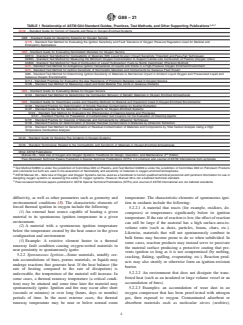
4.2 Role of Guide G88—ASTM Committee G04’s abstract standard is Guide G128, and it introduces the overall subject of oxygen compatibility and the body of related work and related resources including standards, research reports and a DVD3 G04 has developed and adopted for use in coping with oxygen hazards. The interrelationships among the standards are shown in Table 1. Guide G88 deals with oxygen system and hardware design principles, and it is supported by a regulator ignition test (see G175). Other standards cover: (1) the selection of materials (both metals and nonmetals) which are supported by a series of standards for testing materials of interest and for preparing materials for test; (2) the cleaning of oxygen hardware which is supported by a series of standards on cleaning procedures, cleanliness testing methods, and cleaning agent selection and evaluation; (3) the study of fire incidents in oxygen systems; and (4) related terminology. (A) Test Method D2863 is under the jurisdiction of Committee D20 on Plastics, and Test Method D4809 is under the jurisdiction of Committee D02 on Petroleum Products and Lubricants but both are used in the asessment of flammability and sensitivity of materials in oxygen-enriched atmospheres.(B) ASTM Manual 36 – Safe Use of Oxygen and Oxygen Systems can be used as a handbook to furnish qualified technical personnel with pertinent information for use in designing oxygen systems or assessing the safety of oxygen systems. However, Manual 36 is not a balloted technical standard.(C) Peer-review...
SCOPE
1.1 This guide applies to the design of systems for oxygen or oxygen-enriched service but is not a comprehensive document. Specifically, this guide addresses system factors that affect the avoidance of ignition and fire. It does not thoroughly address the selection of materials of construction for which Guides G63 and G94 are available, nor does it cover mechanical, economic or other design considerations for which well-known practices are available. This guide also does not address issues concerning the toxicity of nonmetals in breathing gas or medical gas systems.
Note 1: The American Society for Testing and Materials takes no position respecting the validity of any evaluation methods asserted in connection with any item mentioned in this guide. Users of this guide are expressly advised that determination of the validity of any such evaluation methods and data and the risk of use of such evaluation methods and data are entirely their own responsibility.
1.2 This standard does not purport to address all of the safety concerns, if any, associated with its use. It is the responsibility of the user of this standard to establish appropriate safety, health, and environmental practices and determine the applicability of regulatory limitations prior to use.
1.3 This standard guide is organized as follows:
Section Title
Section
Referenced Documents
2
ASTM Standards
2.1
ASTM Adjuncts
2.2
ASTM Manuals
2.3
NFPA Documents
2.4
CGA Documents
2.5
EIGA Documents
2.6
Terminology
3
Significance and Use
4
Purpose of G88
4.1
Role of G88
4.2
Use of G88
4.3
Factors Affecting the Design for an Oxygen or Oxygen-
Enriched System
5
General
5.1
Factors Recognized as Causing Fires
5.2
Temperature
5.2.1
Spontaneous Ignition
5.2.2
Pressure
5.2.3
Concentration
5.2.4
Contamination ...
General Information
- Status
- Published
- Publication Date
- 30-Sep-2021
- Drafting Committee
- G04.02 - Recommended Practices
Relations
- Effective Date
- 01-Apr-2011
- Effective Date
- 01-Apr-2011
- Refers
ASTM G74-08 - Standard Test Method for Ignition Sensitivity of Materials to Gaseous Fluid Impact - Effective Date
- 01-Sep-2008
- Refers
ASTM G128-02(2008) - Standard Guide for Control of Hazards and Risks in Oxygen Enriched Systems - Effective Date
- 01-Sep-2008
- Effective Date
- 15-Mar-2007
- Effective Date
- 01-Sep-2005
- Effective Date
- 01-Nov-2003
- Effective Date
- 10-Apr-2003
- Effective Date
- 10-Mar-2002
- Refers
ASTM G74-01 - Standard Test Method for Ignition Sensitivity of Materials to Gaseous Fluid Impact - Effective Date
- 10-Sep-2001
- Effective Date
- 10-Sep-2001
- Effective Date
- 10-Sep-2001
- Effective Date
- 10-Sep-2001
- Effective Date
- 10-Mar-1999
- Effective Date
- 10-Sep-1998
Overview
ASTM G88-21: Standard Guide for Designing Systems for Oxygen Service provides essential guidance for technical professionals responsible for the safety and reliability of oxygen systems. This ASTM standard focuses on identifying and minimizing ignition sources and fire propagation risks in oxygen and oxygen-enriched systems. It is a key reference for those designing new oxygen service systems or auditing existing installations, emphasizing the critical factors that impact fire safety throughout the operational life of the system.
ASTM G88-21 does not serve as a prescriptive specification; rather, it offers a systematic approach for understanding design hazards and applying best practices. This guide is widely adopted by industries where oxygen use poses significant fire risks, supporting overall safety program development and compliance with regulatory requirements.
Key Topics
ASTM G88-21 covers several crucial aspects to ensure safe design and operation of oxygen systems:
- Ignition and Fire Hazards: Identifies common ignition sources, including temperature, spontaneous ignition, pressure, oxygen concentration, contamination, particle impact, heat of compression, friction and galling, resonance, static electric discharge, and mechanical impact.
- System Design Principles: Highlights the importance of managing temperatures and pressures, maintaining clean systems, using proven and compatible hardware, minimizing available fuel sources, and designing to control fire propagation.
- Safety Audits: Outlines how to perform safety audits of existing oxygen systems, starting with schematic review and followed by physical inspection.
- Operational Practices: Stresses the need for comprehensive safety training for personnel involved in design, cleaning, assembly, operations, and maintenance of oxygen components and systems.
- Complementary Evaluations: Recommends using this guide alongside specialized guides for material selection (such as ASTM G63 and G94) and cleaning methodologies (ASTM G93).
Applications
ASTM G88-21 is applicable across a wide range of industries and facilities where oxygen service is integral. Key applications include:
- Industrial Gas Production: Ensures safety in air separation plants, oxygen pipelines, and storage systems.
- Chemical and Petrochemical Industries: Guides safe system design for oxygen-enriched processes and transportation.
- Medical and Breathing Gas Systems: Assesses and helps mitigate fire risks in systems delivering high-purity oxygen to healthcare environments.
- Aerospace and Defense: Supports the design of propulsion and life-support systems involving oxygen and oxygen-enriched atmospheres.
- Equipment Manufacturing: Advises manufacturers of valves, compressors, tanks, and piping for oxygen service on risk identification and design safety factors.
By following the design and safety recommendations in ASTM G88-21, organizations can significantly reduce the likelihood and severity of fire incidents in oxygen systems, ensuring higher reliability and compliance with international safety standards.
Related Standards
ASTM G88-21 ties into a broader body of standards and best practices for oxygen system safety and material compatibility. Notable related standards include:
- ASTM G63 - Guide for Evaluating Nonmetallic Materials for Oxygen Service
- ASTM G93 - Guide for Cleanliness Levels and Cleaning Methods for Materials and Equipment Used in Oxygen-Enriched Environments
- ASTM G94 - Guide for Evaluating Metals for Oxygen Service
- ASTM G128 - Guide for Control of Hazards and Risks in Oxygen-Enriched Systems
- ASTM G175 - Test Method for Evaluating the Ignition Sensitivity and Fault Tolerance of Oxygen Pressure Regulators
- NFPA 50 & 53 - Standards for Bulk Oxygen Systems and Oxygen-Enriched Atmospheres
- CGA E-4, G-4.1, and others – Compressed Gas Association guidelines for pressure regulators and cleaning
- EIGA IGC Series – European Industrial Gases Association documents on fire hazards, compressor design, and cleaning
These standards can be used together to create a comprehensive approach to oxygen safety, addressing everything from materials selection and cleaning to operational procedures and fire incident investigation. For additional practical details, users may reference ASTM Manual 36, which compiles guidelines for the safe use and operation of oxygen systems.
Keywords: ASTM G88-21, oxygen service, oxygen system design, oxygen safety, ignition sources, fire hazards, material compatibility, oxygen-enriched system, cleaning methods, standard guide, industrial gas, medical oxygen systems, oxygen piping, system audits, compliance, safety training.
Get Certified
Connect with accredited certification bodies for this standard

BSI Group
BSI (British Standards Institution) is the business standards company that helps organizations make excellence a habit.

TÜV Rheinland
TÜV Rheinland is a leading international provider of technical services.

TÜV SÜD
TÜV SÜD is a trusted partner of choice for safety, security and sustainability solutions.
Sponsored listings
Frequently Asked Questions
ASTM G88-21 is a guide published by ASTM International. Its full title is "Standard Guide for Designing Systems for Oxygen Service". This standard covers: SIGNIFICANCE AND USE 4.1 Purpose of Guide G88—The purpose of this guide is to furnish qualified technical personnel with pertinent information for use in designing oxygen systems or assessing the safety of oxygen systems. It emphasizes factors that cause ignition and enhance propagation throughout a system's service life so that the occurrence of these conditions may be avoided or minimized. It is not intended as a specification for the design of oxygen systems. 4.2 Role of Guide G88—ASTM Committee G04’s abstract standard is Guide G128, and it introduces the overall subject of oxygen compatibility and the body of related work and related resources including standards, research reports and a DVD3 G04 has developed and adopted for use in coping with oxygen hazards. The interrelationships among the standards are shown in Table 1. Guide G88 deals with oxygen system and hardware design principles, and it is supported by a regulator ignition test (see G175). Other standards cover: (1) the selection of materials (both metals and nonmetals) which are supported by a series of standards for testing materials of interest and for preparing materials for test; (2) the cleaning of oxygen hardware which is supported by a series of standards on cleaning procedures, cleanliness testing methods, and cleaning agent selection and evaluation; (3) the study of fire incidents in oxygen systems; and (4) related terminology. (A) Test Method D2863 is under the jurisdiction of Committee D20 on Plastics, and Test Method D4809 is under the jurisdiction of Committee D02 on Petroleum Products and Lubricants but both are used in the asessment of flammability and sensitivity of materials in oxygen-enriched atmospheres.(B) ASTM Manual 36 – Safe Use of Oxygen and Oxygen Systems can be used as a handbook to furnish qualified technical personnel with pertinent information for use in designing oxygen systems or assessing the safety of oxygen systems. However, Manual 36 is not a balloted technical standard.(C) Peer-review... SCOPE 1.1 This guide applies to the design of systems for oxygen or oxygen-enriched service but is not a comprehensive document. Specifically, this guide addresses system factors that affect the avoidance of ignition and fire. It does not thoroughly address the selection of materials of construction for which Guides G63 and G94 are available, nor does it cover mechanical, economic or other design considerations for which well-known practices are available. This guide also does not address issues concerning the toxicity of nonmetals in breathing gas or medical gas systems. Note 1: The American Society for Testing and Materials takes no position respecting the validity of any evaluation methods asserted in connection with any item mentioned in this guide. Users of this guide are expressly advised that determination of the validity of any such evaluation methods and data and the risk of use of such evaluation methods and data are entirely their own responsibility. 1.2 This standard does not purport to address all of the safety concerns, if any, associated with its use. It is the responsibility of the user of this standard to establish appropriate safety, health, and environmental practices and determine the applicability of regulatory limitations prior to use. 1.3 This standard guide is organized as follows: Section Title Section Referenced Documents 2 ASTM Standards 2.1 ASTM Adjuncts 2.2 ASTM Manuals 2.3 NFPA Documents 2.4 CGA Documents 2.5 EIGA Documents 2.6 Terminology 3 Significance and Use 4 Purpose of G88 4.1 Role of G88 4.2 Use of G88 4.3 Factors Affecting the Design for an Oxygen or Oxygen- Enriched System 5 General 5.1 Factors Recognized as Causing Fires 5.2 Temperature 5.2.1 Spontaneous Ignition 5.2.2 Pressure 5.2.3 Concentration 5.2.4 Contamination ...
SIGNIFICANCE AND USE 4.1 Purpose of Guide G88—The purpose of this guide is to furnish qualified technical personnel with pertinent information for use in designing oxygen systems or assessing the safety of oxygen systems. It emphasizes factors that cause ignition and enhance propagation throughout a system's service life so that the occurrence of these conditions may be avoided or minimized. It is not intended as a specification for the design of oxygen systems. 4.2 Role of Guide G88—ASTM Committee G04’s abstract standard is Guide G128, and it introduces the overall subject of oxygen compatibility and the body of related work and related resources including standards, research reports and a DVD3 G04 has developed and adopted for use in coping with oxygen hazards. The interrelationships among the standards are shown in Table 1. Guide G88 deals with oxygen system and hardware design principles, and it is supported by a regulator ignition test (see G175). Other standards cover: (1) the selection of materials (both metals and nonmetals) which are supported by a series of standards for testing materials of interest and for preparing materials for test; (2) the cleaning of oxygen hardware which is supported by a series of standards on cleaning procedures, cleanliness testing methods, and cleaning agent selection and evaluation; (3) the study of fire incidents in oxygen systems; and (4) related terminology. (A) Test Method D2863 is under the jurisdiction of Committee D20 on Plastics, and Test Method D4809 is under the jurisdiction of Committee D02 on Petroleum Products and Lubricants but both are used in the asessment of flammability and sensitivity of materials in oxygen-enriched atmospheres.(B) ASTM Manual 36 – Safe Use of Oxygen and Oxygen Systems can be used as a handbook to furnish qualified technical personnel with pertinent information for use in designing oxygen systems or assessing the safety of oxygen systems. However, Manual 36 is not a balloted technical standard.(C) Peer-review... SCOPE 1.1 This guide applies to the design of systems for oxygen or oxygen-enriched service but is not a comprehensive document. Specifically, this guide addresses system factors that affect the avoidance of ignition and fire. It does not thoroughly address the selection of materials of construction for which Guides G63 and G94 are available, nor does it cover mechanical, economic or other design considerations for which well-known practices are available. This guide also does not address issues concerning the toxicity of nonmetals in breathing gas or medical gas systems. Note 1: The American Society for Testing and Materials takes no position respecting the validity of any evaluation methods asserted in connection with any item mentioned in this guide. Users of this guide are expressly advised that determination of the validity of any such evaluation methods and data and the risk of use of such evaluation methods and data are entirely their own responsibility. 1.2 This standard does not purport to address all of the safety concerns, if any, associated with its use. It is the responsibility of the user of this standard to establish appropriate safety, health, and environmental practices and determine the applicability of regulatory limitations prior to use. 1.3 This standard guide is organized as follows: Section Title Section Referenced Documents 2 ASTM Standards 2.1 ASTM Adjuncts 2.2 ASTM Manuals 2.3 NFPA Documents 2.4 CGA Documents 2.5 EIGA Documents 2.6 Terminology 3 Significance and Use 4 Purpose of G88 4.1 Role of G88 4.2 Use of G88 4.3 Factors Affecting the Design for an Oxygen or Oxygen- Enriched System 5 General 5.1 Factors Recognized as Causing Fires 5.2 Temperature 5.2.1 Spontaneous Ignition 5.2.2 Pressure 5.2.3 Concentration 5.2.4 Contamination ...
ASTM G88-21 is classified under the following ICS (International Classification for Standards) categories: 11.040.10 - Anaesthetic, respiratory and reanimation equipment. The ICS classification helps identify the subject area and facilitates finding related standards.
ASTM G88-21 has the following relationships with other standards: It is inter standard links to ASTM G93-03(2011), ASTM G175-03(2011), ASTM G74-08, ASTM G128-02(2008), ASTM G63-99(2007), ASTM G94-05, ASTM G93-03e1, ASTM G175-03, ASTM G128-02e1, ASTM G74-01, ASTM G72-82(1996)e1, ASTM G74-82(1996)e1, ASTM G72-01, ASTM G63-99, ASTM G94-92(1998). Understanding these relationships helps ensure you are using the most current and applicable version of the standard.
ASTM G88-21 is available in PDF format for immediate download after purchase. The document can be added to your cart and obtained through the secure checkout process. Digital delivery ensures instant access to the complete standard document.
Standards Content (Sample)
This international standard was developed in accordance with internationally recognized principles on standardization established in the Decision on Principles for the
Development of International Standards, Guides and Recommendations issued by the World Trade Organization Technical Barriers to Trade (TBT) Committee.
Designation: G88 − 21
Standard Guide for
Designing Systems for Oxygen Service
ThisstandardisissuedunderthefixeddesignationG88;thenumberimmediatelyfollowingthedesignationindicatestheyearoforiginal
adoption or, in the case of revision, the year of last revision.Anumber in parentheses indicates the year of last reapproval.Asuperscript
epsilon (´) indicates an editorial change since the last revision or reapproval.
1. Scope
Section Title Section
Role of G88 4.2
1.1 This guide applies to the design of systems for oxygen
Use of G88 4.3
or oxygen-enriched service but is not a comprehensive docu- Factors Affecting the Design for an 5
Oxygen or Oxygen-
ment. Specifically, this guide addresses system factors that
Enriched System
affect the avoidance of ignition and fire. It does not thoroughly
General 5.1
address the selection of materials of construction for which Factors Recognized as Causing 5.2
Fires
Guides G63 and G94 are available, nor does it cover
Temperature 5.2.1
mechanical,economicorotherdesignconsiderationsforwhich
Spontaneous Ignition 5.2.2
Pressure 5.2.3
well-known practices are available. This guide also does not
Concentration 5.2.4
address issues concerning the toxicity of nonmetals in breath-
Contamination 5.2.5
ing gas or medical gas systems.
Particle Impact 5.2.6
NOTE 1—The American Society for Testing and Materials takes no Heat of Compression 5.2.7
Friction and Galling 5.2.8
position respecting the validity of any evaluation methods asserted in
Resonance 5.2.9
connection with any item mentioned in this guide. Users of this guide are
Static Electric Discharge 5.2.10
expresslyadvisedthatdeterminationofthevalidityofanysuchevaluation
Electrical Arc 5.2.11
methods and data and the risk of use of such evaluation methods and data
Flow Friction 5.2.12
are entirely their own responsibility.
Mechanical Impact 5.2.13
Kindling Chain 5.2.14
1.2 This standard does not purport to address all of the
Other Ignition Mechanisms 5.2.15
safety concerns, if any, associated with its use. It is the
Test Methods 6
responsibility of the user of this standard to establish appro-
System Design Method 7
Overview 7.1
priate safety, health, and environmental practices and deter-
Final Design 7.2
mine the applicability of regulatory limitations prior to use.
Avoid Unnecessarily Elevated Tem- 7.3
1.3 This standard guide is organized as follows:
peratures
Avoid Unnecessarily Elevated Pres- 7.4
Section Title Section
sures
Referenced Documents 2
Design for System Cleanness 7.5
ASTM Standards 2.1
Avoid Particle Impacts 7.6
ASTM Adjuncts 2.2
Minimize Heat of Compression 7.7
ASTM Manuals 2.3
Avoid Friction and Galling 7.8
NFPA Documents 2.4
Avoid Corrosion 7.9
CGA Documents 2.5
Avoid Resonance 7.10
EIGA Documents 2.6
Use Proven Hardware 7.11
Terminology 3
Design to Manage Fires 7.12
Significance and Use 4
Anticipate Indirect Oxygen Exposure 7.13
Purpose of G88 4.1
Minimize Available Fuel/Oxygen 7.14
Avoid Potentially Exothermic Mate- 7.15
rial Combinations
This guide is under the jurisdiction ofASTM Committee G04 on Compatibility
Anticipate Common Failure Mecha- 7.16
and Sensitivity of Materials in Oxygen Enriched Atmospheres and is the direct
nism Consequences
responsibility of Subcommittee G04.02 on Recommended Practices. Avoid High Surface-Area-to-Volume 7.17
Current edition approved Oct. 1, 2021. Published November 2021. Originally (S/V) Conditions
ε1
where Practical
approved in 1984. Last previous edition approved in 2013 as G88 – 13 . DOI:
10.1520/G0088-21.
Copyright © ASTM International, 100 Barr Harbor Drive, PO Box C700, West Conshohocken, PA 19428-2959. United States
G88−21
2.4 NFPA Standards
Section Title Section
Avoid Unnecessarily-Elevated 7.18
NFPA 50 Standard for Bulk Oxygen Systems at Consumer
Oxygen Concentrations
Sites
Anticipate Permutations from 7.19
Intended System Design NFPA 53 Recommended Practice on Materials, Equipment,
Avoid Designs and Failure 7.20
and Systems Used in Oxygen-Enriched Atmospheres
Scenarios that can Introduce
2.5 CGA Documents:
Potential Flow Friction Ignition
Hazards
CGA E-4 Standard for Gas Pressure Regulators
Use Only the Most Compatible of 7.21
CGA G-4.1 Cleaning Equipment for Oxygen Service
Practical Materials
CGA G-4.4 Oxygen Pipeline and Piping Systems
and Designs
Provide Thorough Safety Training 7.22
CGA G-4.6 Oxygen Compressor Installation and Operation
for All Personnel
Guide
Working with Oxygen or Oxygen-
CGA G-4.7 Installation Guide for Stationary Electric Motor
Enriched
Components or Systems, including
Driven Centrifugal Liquid Oxygen Pumps
Design,
CGA G-4.8 Safe Use of Aluminum Structured Packing for
Cleaning, Assembly, Operations,
Oxygen Distillation
and
Maintenance as Applicable to
CGAG-4.9 Safe Use of BrazedAluminum Heat Exchangers
Personnel
for Producing Pressurized Oxygen
Miscellaneous 7.23
Examples 8 CGA G-4.11 Reciprocating Oxygen Compressor Code of
Key Words 9
Practice
References
CGA G-4.13 Centrifugal Compressors for Oxygen Service
1.4 This international standard was developed in accor-
CGA P-8.4 Safe Operation of Reboilers/Condensers in Air
dance with internationally recognized principles on standard-
Separation Units
ization established in the Decision on Principles for the
CGA P-8 Safe Practices Guide for Air Separation Plants
Development of International Standards, Guides and Recom-
CGAP-25 Guide for Flat Bottomed LOX/LIN/LAR Storage
mendations issued by the World Trade Organization Technical
Tank Systems
Barriers to Trade (TBT) Committee.
CGAPS-15 Toxicity Considerations of Nonmetallic Materi-
als in Medical Oxygen Cylinder Valves
2. Referenced Documents
CGA SB-2 Definition of Oxygen Enrichment/Deficiency
2.1 ASTM Standards:
Safety Criteria
G63 Guide for Evaluating Nonmetallic Materials for Oxy- 6
2.6 EIGA Documents:
gen Service
EIGA/IGC 4 Fire Hazards of Oxygen and Oxygen Enriched
G72 Test Method for Autogenous Ignition Temperature of
Atmospheres
Liquids and Solids in a High-Pressure Oxygen-Enriched
EIGA/IGC10 ReciprocatingOxygenCompressorsForOxy-
Environment
gen Service
G74 Test Method for Ignition Sensitivity of Nonmetallic
EIGA/IGC 13 Oxygen Pipeline and Piping Systems
Materials and Components by Gaseous Fluid Impact
EIGA/IGC 27/12 Centrifugal Compressors For Oxygen Ser-
G93 GuideforCleanlinessLevelsandCleaningMethodsfor
vice
Materials and Equipment Used in Oxygen-Enriched En-
EIGA/IGC 33 Cleaning of Equipment for Oxygen Service
vironments
Guideline
G94 Guide for Evaluating Metals for Oxygen Service
EIGA/IGC 65 Safe Operation of Reboilers/Condensers in
G128 Guide for Control of Hazards and Risks in Oxygen
Air Separation Units
Enriched Systems
EIGA/IGC 73/08 Design Considerations to Mitigate the
G175 Test Method for Evaluating the Ignition Sensitivity
Potential Risks of Toxicity when using Non-metallic
and Fault Tolerance of Oxygen Pressure Regulators Used
Materials in High Pressure Oxygen Breathing Systems
for Medical and Emergency Applications
EIGA/IGC 115 Storage of Cryogenic Air Gases at Users
NOTE 2—The latest versions of these referenced documents should be Premises
consulted.
EIGA/IGC 127 Bulk Liquid Oxygen, Nitrogen and Argon
Storage Systems at Production Sites
2.2 ASTM Adjuncts:
EIGA/IGC 144 Safe Use of Aluminum-Structured Packing
ADJG0088DVD Oxygen Safety DVD
for Oxygen Distillation
2.3 ASTM Manual:
EIGA/IGC 145 Safe Use of Brazed Aluminum Heat Ex-
Manual 36 Safe Use of Oxygen and Oxygen Systems:
changers for Producing Pressurized Oxygen
Guidelines for Oxygen System Design, Materials
Selection, Operations, Storage, and Transportation
Available from National Fire Protection Association (NFPA), 1 Batterymarch
For referenced ASTM adjuncts and standards, visit the ASTM website, Park, Quincy, MA 02169-7471, http://www.nfpa.org.
www.astm.org, or contact ASTM Customer Service at service@astm.org. For Available from Compressed Gas Association (CGA), 8484 Westpark Drive,
Annual Book of ASTM Standards volume information, refer to the standard’s Suite 220, McLean, VA 22102, https://www.cganet.com.
Document Summary page on the ASTM website. Available from European Industrial Gases Association (EIGA), https://
Available from ASTM Headquarters, Order ADJG0088DVD. www.eiga.eu/.
G88−21
EIGA/IGC 147 Safe Practices Guide for Air Separation hardware which is supported by a series of standards on
Plants cleaning procedures, cleanliness testing methods, and cleaning
EIGA/IGC 148 Installation Guide for Stationary Electric- agent selection and evaluation; (3) the study of fire incidents in
Motor-Driven Centrifugal Liquid Oxygen Pumps oxygen systems; and (4) related terminology.
EIGA/IGC154 SafeLocationofOxygen,NitrogenandInert
4.3 Use of Guide G88—Guide G88 can be used as an initial
Gas Vents
design guideline for oxygen systems and components, but can
EIGA/IGC 159 Reciprocating Cryogenic Pump and Pump
also be used as a tool to perform safety audits of existing
Installation
oxygen systems and components. When used as an auditing
EIGA/IGC 179 Liquid Oxygen, Nitrogen, and Argon Cryo-
tool for existing systems, Guide G88 can be applied in two
genic Tanker Loading Systems
stages: first examining system schematics/drawings, then by
visually inspecting the system (that is, “walking the pipeline”).
3. Terminology
Guide G88 can be used in conjunction with the materials
3.1 Definitions of Terms Specific to This Standard:
selection/hazards analysis approach outlined in Guides G63
3.1.1 characteristic elements, n—those factors that must be
and G94 to provide a comprehensive review of the fire hazards
present for an ignition mechanism to be active in an oxygen-
in an oxygen or oxygen-enriched system (1).
enriched atmosphere.
5. Factors Affecting the Design for an Oxygen or
3.1.2 direct oxygen service, n—service in contact with
oxygen during normal operations. Examples: oxygen compres- Oxygen-Enriched System
sor piston rings, control valve seats.
5.1 General—An oxygen system designer should under-
3.1.3 galling, n—a condition whereby excessive friction
stand that oxygen, fuel, and heat (source of ignition) must be
between high spots results in localized welding with subse- present to start and propagate a fire. Since materials of
quent splitting and a further roughening of rubbing surfaces of
construction of the system are often flammable and oxygen is
one or both of two mating parts. always present, the design of a system for oxygen or oxygen-
enriched service requires identifying potential sources of
3.1.4 indirect oxygen service, n—service in which oxygen is
ignition and the factors that aggravate propagation. The goal is
not normally contacted but in which it might be as a result of
to eliminate these factors or compensate for their presence.
a reasonably foreseeable malfunction (single fault), operator
Preventing fires in oxygen and oxygen-enriched systems in-
error, or process disturbance. Examples: liquid oxygen tank
volves all of the following: minimizing system factors that
insulation, liquid oxygen pump motor bearings.
cause fires and environments that enhance fire propagation;
3.1.5 oxygen-enriched atmosphere, n—afluid(gasorliquid)
maximizing the use of system materials with properties that
mixture that contains more than 25 mol % oxygen.
resist ignition and burning, especially where ignition mecha-
3.1.6 qualified technical personnel—persons such as engi-
nisms are active; and using good practices during system
neers and chemists who, by virtue of education, training, or
design, assembly, operations and maintenance.
experience, know how to apply physical and chemical prin-
5.2 Factors Recognized as Causing Fires:
ciples involved in the reactions between oxygen and other
5.2.1 Temperature—As the temperature of a material
materials.
increases, the amount of energy that must be added to produce
ignition decreases (2). Operating a system at unnecessarily
4. Significance and Use
elevated temperatures, whether locally or generally elevated,
4.1 Purpose of Guide G88—The purpose of this guide is to
reducesthesafetymargin.Theignitiontemperatureofthemost
furnishqualifiedtechnicalpersonnelwithpertinentinformation
easily ignited material in a system is related to the temperature
for use in designing oxygen systems or assessing the safety of
measured byTest Method G72, but is also a function of system
oxygen systems. It emphasizes factors that cause ignition and
pressure, configuration and operation, and thermal history of
enhance propagation throughout a system’s service life so that
the material. Elevated temperature also facilitates sustained
the occurrence of these conditions may be avoided or mini-
burning of materials that might otherwise be self-
mized. It is not intended as a specification for the design of
extinguishing.
oxygen systems.
5.2.1.1 Thermal Ignition—Thermal ignition consists of
4.2 Role of Guide G88—ASTM Committee G04’s abstract
heatingamaterial(eitherbyexternalorself-heatingmeans,see
standardisGuideG128,anditintroducestheoverallsubjectof
also 5.2.2) in an oxidizing atmosphere to a temperature
oxygen compatibility and the body of related work and related
sufficient to cause ignition. In thermal ignition testing, the
resources including standards, research reports and a DVD
spontaneous ignition temperature is normally used to rate
G04 has developed and adopted for use in coping with oxygen
material compatibility with oxygen as well as evaluate a
hazards. The interrelationships among the standards are shown
material’s ease of ignition. The ignition temperature of a given
in Table 1. Guide G88 deals with oxygen system and hardware
material is generally dependent on its thermal properties,
designprinciples,anditissupportedbyaregulatorignitiontest
including thermal conductivity, heat of oxidation, and thermal
(see G175). Other standards cover: (1) the selection of mate-
rials (both metals and nonmetals) which are supported by a
series of standards for testing materials of interest and for
The boldface numbers in parentheses refer to the list of references at the end of
preparing materials for test; (2) the cleaning of oxygen this standard.
G88−21
A,B,C
TABLE 1 Relationship of ASTM G04 Standard Guides, Practices, Test Methods, and Other Supporting Publications
G128 - Standard Guide for Control of Hazards and Risks in Oxygen-Enriched Systems
G88 - Standard Guide for Designing Systems for Oxygen Service
G175 - Standard Test Method for Evaluating the Ignition Sensitivity and Fault Tolerance of Oxygen Pressure Regulators Used for Medical and
Emergency Applications
G63 - Standard Guide for Evaluating Nonmetallic Materials for Oxygen Service
D2512 - Standard Test Method for Compatibility of Materials With Liquid Oxygen (Impact Sensitivity Threshold and Pass-Fail Techniques)
D2863 - Standard Test Method for Measuring the Minimum Oxygen Concentration to Support Candle-Like Combustion of Plastics (Oxygen Index)
D4809 - Standard Test Method for Heat of Combustion of Liquid Hydrocarbon Fuels by Bomb Calorimeter (Precision Method)
G72 - Standard Test Method for Autogenous Ignition Temperature of Liquids and Solids in a High-Pressure Oxygen Enriched Environment
G74 - Standard Test Method for Ignition Sensitivity of Nonmetallic Materials and Components by Gaseous Fluid Impact
G86 - Standard Test Method for Determining Ignition Sensitivity of Materials to Mechanical Impact in Ambient Liquid Oxygen and Pressurized Liquid and
Gaseous Oxygen Environments
G114 - Standard Practices for Evaluating the Age Resistance of Polymeric Materials Used in Oxygen Service
G125 - Standard Test Method for Measuring Liquid and Solid Material Fire Limits in Gaseous Oxidants
G94 - Standard Guide for Evaluating Metals for Oxygen Service
G124 - Standard Test Method for Determining the Combustion Behavior of Metallic Materials in Oxygen Enriched Atmospheres
G93 - Standard Guide for Cleanliness Levels and Cleaning Methods for Material and Equipment Used in Oxygen-Enriched Environments
G120 - Standard Practice for Determination of Soluble Residual Contamination by Soxhlet Extraction
G127 - Standard Guide for the Selection of Cleaning Agents for Oxygen-Enriched Systems
G122 - Standard Test Method for Evaluating the Effectiveness of Cleaning Agents and Processes
G121 - Standard Practice for Preparation of Contaminated Test Coupons for the Evaluation of Cleaning Agents
G131 - Standard Practice for Cleaning of Materials and Components by Ultrasonic Techniques
G136 - Standard Practice for Determination of Soluble Residual Contaminants in Materials by Ultrasonic Extraction
G144 - Standard Test Method for Determination of Residual Contamination of Materials and Components by Total Carbon Analysis Using a High
Temperature Combustion Analyzer
G145 - Standard Guide for Studying Fire Incidents in Oxygen Systems
G126 - Standard Terminology Related to the Compatibility and Sensitivity of Materials in Oxygen-Enriched Atmospheres
Other ASTM Publications:
nd
Manual 36 – Safe Use of Oxygen and Oxygen Systems: Handbook for Design, Operation, and Maintenance: 2 Edition
Peer-Reviewed Technical Papers Published in Special Technical Publications (STPs) (14 volumes) and Journal of ASTM International from symposia
A
Test Method D2863 is under the jurisdiction of Committee D20 on Plastics, and Test Method D4809 is under the jurisdiction of Committee D02 on Petroleum Products
and Lubricants but both are used in the asessment of flammability and sensitivity of materials in oxygen-enriched atmospheres.
B
ASTM Manual 36 – Safe Use of Oxygen and Oxygen Systems can be used as a handbook to furnish qualified technical personnel with pertinent information for use in
designing oxygen systems or assessing the safety of oxygen systems. However, Manual 36 is not a balloted technical standard.
C
Peer-reviewed technical papers published in ASTM Special Technical Publications (STPs) and Journal of ASTM International are not balloted standards.
diffusivity, as well as other parameters such as geometry and temperature. The characteristic elements of spontaneous igni-
environmental conditions (3). The characteristic elements of tion in oxidants include the following:
forced thermal ignition in oxygen include the following:
5.2.2.1 A material that reacts (for example, oxidizes, de-
(1) An external heat source capable of heating a given
composes) at temperatures significantly below its ignition
material to its spontaneous ignition temperature in a given
temperature. If the rate of reaction is low, the effect of reaction
environment.
can still be large if the material has a high surface-area-to-
(2) A material with a spontaneous ignition temperature
volume ratio (such as dusts, particles, foams, chars, etc.).
below the temperature created by the heat source in the given
Likewise, materials that will not spontaneously combust in
configuration and environment.
bulk forms may become prone to do so when subdivided. In
(3) Example: A resistive element heater in a thermal
some cases, reaction products may instead serve to passivate
runaway fault condition causing oxygen-wetted materials in
the material surface producing a protective coating that pre-
near proximity to spontaneously ignite.
vents ignition so long as it is not compromised (by melting,
5.2.2 Spontaneous Ignition—Some materials, notably cer-
cracking, flaking, spalling, evaporating. etc.). Reaction prod-
tain accumulations of fines, porous materials, or liquids may
ucts may also stratify or otherwise form an ignition-resistant
undergo reactions that generate heat. If the heat balance (the
barrier.
rate of heating compared to the rate of dissipation) is
5.2.2.2 An environment that does not dissipate the trans-
unfavorable, the temperature of the material will increase. In
ferred heat (such as an insulated or large volume vessel or an
some cases, a thermal runaway temperature (a critical condi-
accumulation of fines).
tion) may be attained and some time later the material may
5.2.2.3 Examples: an accumulation of wear dust in an
spontaneously ignite. Ignition and fire may occur after short
(seconds or minutes) or over long (hours, days or months) oxygen compressor that has been proof-tested with nitrogen
gas, then exposed to oxygen. Contaminated adsorbent or
periods of time. In the most extreme cases, the thermal
runaway temperature may be near or below normal room absorbent materials such as molecular sieves (zeolites),
G88−21
alumina, and activated carbon may become highly reactive in 5.2.6 Particle Impact—Collisions of inert or ignitable solid
oxygen-enriched atmospheres. particles entrained in an oxidant stream are a potential ignition
5.2.3 Pressure—As the pressure of a system increases, the source. Such ignition may result from the particle being
ignition temperatures of the materials of construction typically flammable and igniting upon impact and, in turn, igniting other
decrease (2, 4),andtheratesoffirepropagationincrease (2, 5). system materials (8). Ignition may also result from heating of
Therefore, operating a system at unnecessarily elevated pres- the particle and subsequent contact with system plastics and
sures increases the probability and consequences of a fire. It elastomers, from flammable particles produced during the
should be noted that pure oxygen, even at lower–than- collision, or from the direct transfer of kinetic energy during
atmospheric pressure, may still pose a significant fire hazard the collision. Particle impact is considered by many to be the
since increased oxygen concentration has a greater effect than most commonly experienced mechanism that directly ignites
total pressure on the flammability of materials (6, 7). metals in oxygen systems. The characteristic elements of
5.2.4 Concentration—As oxygen concentration decreases particle impact ignition include the following:
from 100 % with the balance being inert gases, there is a 5.2.6.1 Presence of Particles—Absolute removal of par-
progressive decrease in the likelihood and intensity of a ticles is not possible, and systems can generate their own
reaction (2). Though the principles in this standard still apply, particlesduringoperation.Thequantityofparticlesinasystem
greater latitude may be exercised in the design of a system for will tend to increase with the age of the system. Hence, a
dilute oxygen service. system must be designed to tolerate the presence of at least
5.2.5 Contamination—Contamination can be present in a some particles. The hazard associated with particles increases
system because of inadequate initial cleaning, introduction with both the particles’ heat of combustion and their kinetic
duringassemblyorservicelife,orgenerationwithinthesystem energies.
by abrasion, flaking, etc. Contaminants may be liquids, solids, 5.2.6.2 High Fluid (Gas) Velocities—High fluid velocities
or gases. Such contamination may be highly flammable and increase the kinetic energies of particles entrained in flowing
readily ignitable (for example, hydrocarbon oils).Accordingly, oxygensystemssothattheyhaveahigherriskofignitingupon
it is likely to ignite and promote consequential system fires impact. High velocities can occur as a result of reducing
through a kindling chain reaction (see 5.2.14). Even normally pressureacrossasystemcomponentorduringasystemstart-up
inert contaminants such as rust may produce ignition through transient where pressure is being established through a com-
particle impact (see 5.2.6), friction (see 5.2.8), or through ponent or in a pipeline. Components with inherently high
augmentation of resonance heating effects (see 5.2.9). A internal fluid velocities include pressure regulators, control
properly designed system, if properly cleaned and maintained, valves, and flow-limiting orifices. Depending on system
can be assumed to be free of unacceptable levels of hydrocar- configuration, some components can generate high fluid ve-
bon contamination, but may still contain some particulate locities that can be sustained for extended distances down-
contamination. System design and operation must accommo- stream.Systemstart-upsorshut-downscancreatetransientgas
date this contamination, as discussed in the following para- velocities that are often orders of magnitude higher than those
graphs. experienced during steady-state operation.
FIG. 1 Maximum Oxygen Gas Velocity Produced by Pressure Differentials, Assuming Isentropic Flow
G88−21
NOTE 3—The pressure differential that can be tolerated to control high
5.2.7 Heat of Compression—Heat is generated from the
gas velocities is significantly smaller than for control of downstream heat
conversion of mechanical energy when a gas is compressed
ofcompression (9)(see5.2.7fordiscussionofheatofcompression).Even
from a lower to a higher pressure. High gas temperatures can
small pressure differentials across components can generate gas velocities
result if this compression occurs quickly enough to simulate
in excess of those recommended for various metals in oxygen service (10,
adiabatic (no heat transfer) conditions. Heat of compression
11). Eq 1 can be used to estimate the downstream gas pressure for a given
upstream pressure and maximum downstream gas velocity, assuming an
has also been referred to as compression heating, pneumatic
ideal gas and isentropic flow (9):
impact, rapid pressurization, adiabatic compression, and gas-
eous impact. This can occur when high-pressure oxygen is
P
T
P 5 (1)
2 K
D
released into a dead-ended tube or pipe, quickly compressing
V
D
FS D G
the residual oxygen initially in the tube or pipe. The elevated
2g KRT
c D
gas temperatures produced can ignite contaminants or materi-
where:
als in system components. The hazard of heat of compression
P = downstream pressure (absolute),
D increases with system pressure and with pressurization rate.
P = source pressure (absolute),
T
Heat of compression is considered by many to be the most
V = maximum gas velocity downstream,
D
commonly experienced mechanism that directly ignites non-
2 2 2
g = dimensional constant (1 kg/N s or 4636 lb in. /lb s
c f
metals in oxygen systems. In general, metal alloys are not
ft),
vulnerable to direct ignition by this mechanism. Fig. 2 shows
K = γ/(γ-1) where γ is the ratio of specific heats C /C (γ =
p v
an example of a compression heating sequence leading to
1.4 for O ),
ignition of a nonmetal valve seat. Sequence A shows high-
R = individual gas constant for O (260 N-m/kg °K or
pressure oxygen upstream of a fast-opening valve in the closed
3 2 8
0.333 ft lb /in. lb °R), and
f m
position.Downstreamofthevalveisoxygenatinitialpressure,
T = temperature downstream (absolute).
D
volume, and temperature (P,V,T, respectively. P and T are
i i i i i
NOTE 4—Fig. 1 shows the maximum gas velocity versus pressure
assumedtobeatambientconditionsinthisexample).Asecond
differential considering isentropic flow for gaseous oxygen, based on the
equation shown above. Even with only a 1.5 % differential pressure, gas valve with a nonmetallic seat is shown downstream in the
velocityexceedsthe45m/s(150ft/s)minimumvelocityrequiredtoignite
closed position, representing a “dead-end,” or closed volume.
particles in particle impact experiments (12).
Sequence B shows the opening of the fast-opening valve,
5.2.6.3 Impingement Sites—A particle entrained in a high-
rapidly pressurizing the downstream volume with high-
velocity fluid must impinge upon a surface, or impact point, to
pressure oxygen (final pressure shown as P ), compressing and
f
transfer its kinetic energy to heat and ignite. Impingement sites
heating the original gas volume. The final temperature gener-
can be internal to components (for example in the body of an
ated at the “dead-end” from such an event (shown as T ) can
f
in-line globe valve just downstream of its seat), or downstream
exceed the ignition temperature of the exposed nonmetal valve
ofhighfluidvelocitycomponents(forexampleinsideanelbow
seat and cause it to ignite. The presence of lubricant, debris, or
or Tee placed close to the outlet of a component with a high
other contaminants proximate to the valve seat may increase
fluid velocity). Generally, impacts normal (perpendicular) to
the hazard since they may be easier to ignite. Once ignited, the
the impact surface are considered most severe.
lubricant, debris, or other contaminants may begin a kindling
5.2.6.4 Flammable Materials—Generally, both the par-
chain (see 5.2.14). In order for ignition to occur, pressurization
ticle(s) and the target (impact point) materials must be flam-
of the downstream volume must be rapid enough to create
mable in the given environment for ignition and sustained
near-adiabatic heating, as discussed below. The characteristic
burning to occur. However, particle impact ignition studies
elements for heat of compression include the following:
have shown that some highly flammable metals, such as
5.2.7.1 Compression Pressure Ratio—In order to produce
aluminum alloys, may ignite even when impacted by inert
temperatures capable of igniting most materials in oxygen
particles (8). Additionally, common nonmetal particles have
environments, a significant compression pressure ratio (P /P)
f i
been shown to be ineffective igniters of metals by particle
is required, where the final pressure is significantly higher than
impact (13), and softer nonmetal targets, though more prone to
the starting pressure.
ignition by other means, are generally less susceptible to direct
NOTE 5—Eq 2 shows a formula for the theoretical maximum tempera-
ignition by particle impact because they tend to cushion the
ture (T ) that can be developed when pressurizing a gas rapidly from one
f
impact (14). This cushioning effect of nonmetals can act to
pressure and temperature to an elevated pressure without heat transfer:
increase the time-to-zero velocity of a particle, lower its peak
n21 /n
~ !
T P
f f
deceleration, and generally create a less destructive collision.
5 (2)
F G
T P
i i
However, harder nonmetal targets, such as those used in some
valve seat applications, have been shown to ignite in particle
where:
impact studies (14).
T = final temperature, abs,
f
T = initial temperature, abs,
i
P = final pressure, abs,
f
P = initial pressure, abs, and
Reference (9) provides Eq 1 with the given list of variables as defined here. i
However, the value for the Individual Gas Constant, R, was incorrectly stated as the
C
p
Universal Gas Constant, and its metric value was incorrectly listed as 26 N-m/kg K
n 5 5 1.40for oxygen (3)
instead of 260 N-m/kg K. C
v
G88−21
FIG. 2 Example of a Compression Heating Sequence Leading to Ignition of a Nonmetal Valve Seat
where: example,Teflon-linedflexhosescanbeignitedifpressurizedin
fractions of a second but not if pressurized in seconds (15).
C = specific heat at constant pressure, and
p
C = specific heat at constant volume. 5.2.7.3 Exposed Nonmetal Proximate to a Dead-end—For
v
NOTE 6—Table 2 gives the theoretical temperatures (T ) that could be ignition to occur by heat of compression, a nonmetal material
f
obtained by compressing oxygen adiabatically from an initial temperature
must be exposed to the heated compressed gas slug proximate
(T) of 20 °C and initial pressure (P) of one standard atmosphere to the
i i
to a dead-end location (for example, a nonmetal valve seat in
pressures shown. Figs. 3 and 4 show these final temperatures graphically
a closed valve). Nonmetals typically have lower thermal
asafunctionofPressureRatio(P /P)andFinalPressure(P ),respectively.
f i f
diffusivities and lower autogenous ignition temperatures than
Table 2 and Fig. 3 show that pressure ratios as low as 10 (for example
rapidly pressurizing a system from ambient to 1 MPa (145 psia)) can metals and thus are more vulnerable to this mechanism.
theoretically produce temperatures that exceed the autogenous ignition
5.2.8 Friction and Galling—The rubbing together of two
temperatures (AIT) of many nonmetals or contaminants in oxygen
surfaces can produce heat and can generate particles. An
systems (based upon the AIT of various materials per Test Method G72).
example is the rub of a centrifugal compressor rotor against its
Fig. 4 shows how increasing the downstream pressure prior to the
compression event lowers the final temperature. casing creating ignition from galling and friction at the
metal-to-metal interface. Heat produced by friction and galling
5.2.7.2 Rapid Pressurization—The rate of compression, or
(see 3.1.3) may elevate component materials above their
timeofpressurization,mustbefasttominimizeheatlosstothe
ignition temperatures. Particles can participate in ignition as
surroundings. Pressurization times on the order of fractions of
contaminants (see 5.2.5) or in particle impacts (see 5.2.6). The
asecondasopposedtosecondsorminutesaremostsevere.For
characteristic elements of ignition by galling and friction
include the following:
TABLE 2 Theoretical Maximum Temperature Obtained when
5.2.8.1 Two or More Rubbing Surfaces—Metal-to-metal
Compressing Oxygen Adiabatically from 20 °C and One Standard
contact is generally considered most severe as it produces a
Atmosphere to Various Pressures
high-temperature oxidizing environment, and it destroys pro-
Pressure
Final Pressure, P Final Temperature, T
f f
tective oxide surfaces or coatings, exposing fresh metal and
Ratio,
kPa PSIA °C °F
P/P
f i generating fine particles. By comparison, limited test data for
345 50 3.4 143 289
nonmetals suggests that nonmetals can deform or fragment
690 100 6.8 234 453
under frictional loading and not necessarily ignite (though
1000 145 9.9 291 556
generally none of these results are desirable in an oxygen
1379 200 13.6 344 653
2068 300 20.4 421 789
system).
2758 400 27.2 480 896
5.2.8.2 High Rubbing Speeds or High Loading, or Both—
3447 500 34.0 530 986
5170 750 51.0 628 1163 These conditions are generally considered most severe as they
6895 1000 68.0 706 1303
create a high rate of heat transfer as reflected by the Pv
10 000 1450 98.6 815 1499
Product, (the loading pressure normal to the surface multiplied
13 790 2000 136.1 920 1688
by the velocity of the rubbing surfaces) (16).
27 579 4000 272.1 1181 2158
34 474 5000 340.1 1277 2330
5.2.9 Resonance—Acoustic oscillations within resonant
100 000 14 500 986.4 1828 3322
cavities can create rapid heating. The temperature rises more
1 000 000 145 000 9863.9 3785 6845
rapidly and achieves higher values when particles are present
G88−21
FIG. 3 Final Compression Temperatures for Pressure Ratios
FIG. 4 Final Compression Temperatures for Final Pressures Given the Initial Presssures Shown
or when gas velocities are high. Resonance phenomena in ignition occurs and a flame jet is emitted from the chamber
oxygen systems are well documented (17) but limited design (18). The characteristic elements of ignition by resonance
criteria are available to avoid its unintentional occurance. An include the following:
example of resonance ignition has been demonstrated in 5.2.9.1 Resonance Cavity Geometry—The requirements in-
aerospace applications with solid or liquid rocket fuel engines. clude a throttling device such as a nozzle, orifice, regulator, or
Gaseous oxygen flows through a sonic nozzle and directly into valve directing a sonic gas jet into a cavity or closed-end tube.
a resonance cavity, heating the gas and solid or liquid fuel. Fig.5showsanexampleofasystemwithasonicnozzle/orifice
When the gas reaches the auto-ignition temperature of the fuel, directly upstream of aTee with a closed end.The gas flows out
G88−21
FIG. 5 Example of a System Configuration with Potential for Resonance Heating
the branch port of the Tee (making a 90° turn) but the closed 5.2.10.3 Two charged surfaces are not likely to discharge
end creates a cavity in which shock waves generated by the unless one material is conductive.
throttling device can resonate.
5.2.10.4 Accumulation of charge is more likely in a dry gas
5.2.9.2 Acoustic Resonance Phenomena—The distance be-
or a dry environment as opposed to a moist or humid
tween the throttling device and the closed end affects the
environment.
frequency of acoustic oscillations in the cavity, similar to a
5.2.11 Electrical Arc—Sufficient electrical current arcing
pipeorganwithaclosedend,duetotheinterferenceofincident
from a power source to a flammable material can cause
and reflecting sound waves. This distance also affects the
ignition. Examples include a defective pressure switch or an
temperature produced in the cavity. Higher harmonic frequen-
insulated electrical heater element undergoing short circuit
cies have been shown to produce higher temperatures. The
arcing through its sheath to a combustible material. The
resonant frequency has been shown to be a function of pipe
characteristic elements of electrical arc ignition include the
diameter and pressure ratio (17).
following:
5.2.9.3 Flammable Particulate or Contaminant Debris at
5.2.11.1 Ungrounded or short-circuited power source such
Closed End—Particulate or debris residing at the closed end of
as a motor brush (especially if dirty or high powered, or both),
the cavity (see Fig. 5) can self-ignite due to the high tempera-
electrical control equipment, instrumentation, lighting, etc.
tures produced by resonance heating, or they can vibrate and
5.2.11.2 Flammable materials capable of being ignited by
their collisions generate sufficient heat to self-ignite.
the electrical arc or spark.
5.2.10 Static Electric Discharge—Accumulated static
5.2.12 Flow Friction—It is theorized that oxygen and
charge on a nonconducting surface can discharge with enough
oxygen-enriched gas flowing across the surface of or imping-
energy to ignite the material receiving the discharge. Static
ing directly upon nonmetals can generate heat within the
electrical discharge may be generated by high fluid flow under
nonmetal, causing it to self-ignite. Though neither well
certain conditions, especially where particulate matter is pres-
understood, well documented in literature, nor well demon-
ent. Examples of static electric discharge include arcing in
strated in experimental efforts to date, several oxygen fires
poorly cleaned, inadequately grounded piping; two pieces of
havebeenattributedtothismechanismwhennootherapparent
clothing or fabric creating a static discharge when quickly
mechanisms were active aside from a leaking, or scrubbing
pulled apart; and large diameter ball valves with nonmetal
action of gas across a nonmetal surface (most commonly a
upstream and downstream seats, where the ball/stem can
polymer) (19).Anexampleisignitionofanonmetalliccylinder
become electrically isolated from the body and can develop a
valveseatfromaplug-stylecylindervalvethathasbeencycled
charge differential between the ball and body from the ball
extensively and is used in a throttling manner. Flow friction
rubbing against the large surface area nonmetallic seat. The
ignition is supported by unverifiable anecdotes. The back-
characteristic elements of static discharge include the follow-
ground for the flow friction hypothesis suggests the character-
ing:
istic elements:
5.2.10.1 Static charge buildup from flow or rubbing accu-
mulates on a nonconducting surface. 5.2.12.1 Higher-pressure Systems—Though there is cur-
5.2.10.2 Discharge typically occurs at a point source be- rently no clearly defined lower pressure threshold where flow
tween materials of differing electrical potentials. friction ignition becomes inactive, the current known fire
G88−21
history is in higher-pressure systems operating at approxi- occur, it does not lead to a breach of the system. One method
mately 3.5 MPa (500 psi) or higher. to accomplish this is to limit the mass of nonmetallic compo-
nents so that if the nonmetal does ignite, it does not release
5.2.12.2 Configurations including leaks past nonmetal com-
sufficient energy to ignite the adjacent metal.
ponent seats or pressure seals, or “weeping” or “scrubbing”
5.2.15 Other Ignition Mechanisms—There are numerous
flow configurations around nonmetals. These configurations
other potential ignition sources that may be considered in
can include external leaks past elastomeric pressure seals or
oxygen system design that are not elaborated upon here. These
internal flows on or close to plastic seats in components. Flow
includeenvironmentalfactorssuchaspersonnelsmoking;open
friction is not believed to be a credible ignition source for
flames; shock waves and fragments from vessel ruptures;
metals.
welding; mechanical vibration; intake of exhaust from an
5.2.12.3 Surfaces of nonmetals that are highly fibrous from
internal combustion engine; smoke from nearby fires or other
beingchafed,abraded,orplasticallydeformedmayrenderflow
environmental chemicals; and lightning.
friction more severe. The smaller, more easily ignited fibers of
the nonmetal may begin resonating, or vibrating/flexing, per-
6. Test Methods
haps at high frequencies due to flow, and this “friction” of the
material would generate heat.
6.1 The test methods used to support the design of oxygen
5.2.13 Mechanical Impact—Heat can be generated from the systems are listed in Table 1.
transfer of kinetic energy when an object having a relatively
large mass or momentum strikes a material. In an oxygen 7. System Design Method
environment, the heat and mechanical interaction between the
7.1 Overview—The designer of a system for oxygen service
objects can cause ignition of the impacted material. The
should observe good mechanical design principles and incor-
characteristic elements of mechanical impact ignition include
poratethefactorsbelowtoadegreeconsistentwiththeseverity
the following:
of the application. Mechanical failures are undesirable since
5.2.13.1 Single, Large Impact or Repeated Impacts—
these failures, for example rupture and friction, can produce
Example: If a high-pressure relief valve “chatters,” it can
heating,particulates,andotherfactorswhichcancauseignition
impart repeated impacts on a nonmetallic seat, in combination
as discussed in the following sections.
with other effects, and lead to ignition of the seat.
NOTE 7—Good mechanical design practice is a highly advanced and
specialized technology addressed in general by a wealth of textbooks,
5.2.13.2 Nonmetal at Point of Impact—Generally, test data
college curricula and professional societies, standards and codes. Among
show this mechanism is only active with nonmetals, though
the sources are the American Society of Mechanical Engineers Pressure
aluminum, magnesium, and titanium alloys in thin cross-
Vessel and Piping Division, theAmerican Petroleum Institute, theAmeri-
sections as well as some solders have been ignited experimen-
can National Standards Institute, and Deutsches Institut für Normung.
Prevailing standards and codes cover many mechanical considerations,
tally (20, 21). However, in these alloys, mechanical failure
including adequate strength to contain pressure, avoidance of fatigue,
(which introduces additional ignition mechanisms) will likely
corrosion allowances, etc.
precede, or at minimum coincide with, mechanical impact
7.2 Final Design—Oxygen system design involves a com-
ignitions in liquid oxygen (LOX) (22).
plex interplay of the various factors that promote ignition and
5.2.13.3 Special caution is required for mechanical impact
of the ability of the materials of construction to resist such
in LOX environments. Some cleaning solvents are known to
ignition and potential burning (10, 11, 25). There are many
become shock-sensitive in LOX. Porous hydrocarbons such as
subjective judgements, external influences, and compromises
asphalt, wood, and leather can become shock-sensitive in LOX
involved. While each case must ultimately be decided on its
andreactexplosivelywhenimpactedevenwithrelativelysmall
own merits, the generalizations below apply. In applying these
amounts of energy (23). Testing has showed that the presence
principles, the designer should consider the system’s normal
of contamination on hydrocarbon materials will increase the
and worst-case operating conditions and, in addition, indirect
hazard (24). If LOX comes into contact with any porous
oxygen exposure that may result from system upsets and
hydrocarbon materials, care should be take to avoid mechani-
failure modes.The system should be designed to fail safely.To
cal impacts of any kind
...
This document is not an ASTM standard and is intended only to provide the user of an ASTM standard an indication of what changes have been made to the previous version. Because
it may not be technically possible to adequately depict all changes accurately, ASTM recommends that users consult prior editions as appropriate. In all cases only the current version
of the standard as published by ASTM is to be considered the official document.
´1
Designation: G88 − 13 G88 − 21
Standard Guide for
Designing Systems for Oxygen Service
This standard is issued under the fixed designation G88; the number immediately following the designation indicates the year of original
adoption or, in the case of revision, the year of last revision. A number in parentheses indicates the year of last reapproval. A superscript
epsilon (´) indicates an editorial change since the last revision or reapproval.
ε NOTE—Editorial corrections were made to the adjunct information in March 2021.
1. Scope
1.1 This guide applies to the design of systems for oxygen or oxygen-enriched service but is not a comprehensive document.
Specifically, this guide addresses system factors that affect the avoidance of ignition and fire. It does not thoroughly address the
selection of materials of construction for which Guides G63 and G94 are available, nor does it cover mechanical, economic or other
design considerations for which well-known practices are available. This guide also does not address issues concerning the toxicity
of nonmetals in breathing gas or medical gas systems.
NOTE 1—The American Society for Testing and Materials takes no position respecting the validity of any evaluation methods asserted in connection with
any item mentioned in this guide. Users of this guide are expressly advised that determination of the validity of any such evaluation methods and data
and the risk of use of such evaluation methods and data are entirely their own responsibility.
1.2 This standard does not purport to address all of the safety concerns, if any, associated with its use. It is the responsibility
of the user of this standard to establish appropriate safety, health, and environmental practices and determine the applicability of
regulatory limitations prior to use.
1.3 This standard guide is organized as follows:
Section Title Section
Referenced Documents 2
ASTM Standards 2.1
ASTM Adjuncts 2.2
ASTM Manuals 2.3
NFPA Documents 2.4
CGA Documents 2.5
EIGA Documents 2.6
Terminology 3
Significance and Use 4
Purpose of G88 4.1
Role of G88 4.2
Use of G88 4.3
Factors Affecting the Design for an 5
Oxygen or Oxygen-
Enriched System
General 5.1
Factors Recognized as Causing 5.2
Fires
Temperature 5.2.1
Spontaneous Ignition 5.2.2
Pressure 5.2.3
This guide is under the jurisdiction of ASTM Committee G04 on Compatibility and Sensitivity of Materials in Oxygen Enriched Atmospheres and is the direct
responsibility of Subcommittee G04.02 on Recommended Practices.
Current edition approved Oct. 1, 2013Oct. 1, 2021. Published November 2013November 2021. Originally approved in 1984. Last previous edition approved in 20052013
ε1
as G88 – 05.13 . DOI: 10.1520/G0088-13E01.10.1520/G0088-21.
Copyright © ASTM International, 100 Barr Harbor Drive, PO Box C700, West Conshohocken, PA 19428-2959. United States
G88 − 21
Section Title Section
Concentration 5.2.4
Contamination 5.2.5
Particle Impact 5.2.6
Heat of Compression 5.2.7
Friction and Galling 5.2.8
Resonance 5.2.9
Static Electric Discharge 5.2.10
Electrical Arc 5.2.11
Flow Friction 5.2.12
Mechanical Impact 5.2.13
Kindling Chain 5.2.14
Other Ignition Mechanisms 5.2.15
Test Methods 6
System Design Method 7
Overview 7.1
Final Design 7.2
Avoid Unnecessarily Elevated 7.3
Temperatures
Avoid Unnecessarily Elevated 7.4
Pressures
Design for System Cleanness 7.5
Avoid Particle Impacts 7.6
Minimize Heat of Compression 7.7
Avoid Friction and Galling 7.8
Avoid Corrosion 7.9
Avoid Resonance 7.10
Use Proven Hardware 7.11
Design to Manage Fires 7.12
Anticipate Indirect Oxygen Exposure 7.13
Minimize Available Fuel/Oxygen 7.14
Avoid Potentially Exothermic 7.15
Material Combinations
Anticipate Common Failure 7.16
Mechanism Consequences
Avoid High Surface-Area-to-Volume 7.17
(S/V) Conditions
where Practical
Avoid Unnecessarily-Elevated 7.18
Oxygen Concentrations
Anticipate Permutations from 7.19
Intended System Design
Avoid Designs and Failure 7.20
Scenarios that can Introduce
Potential Flow Friction Ignition
Hazards
Use Only the Most Compatible of 7.21
Practical Materials
and Designs
Provide Thorough Safety Training 7.22
for All Personnel
Working with Oxygen or Oxygen-
Enriched
Components or Systems, including
Design,
Cleaning, Assembly, Operations,
and
Maintenance as Applicable to
Personnel
Miscellaneous 7.23
Examples 8
Key Words 9
References
1.4 This international standard was developed in accordance with internationally recognized principles on standardization
established in the Decision on Principles for the Development of International Standards, Guides and Recommendations issued
by the World Trade Organization Technical Barriers to Trade (TBT) Committee.
2. Referenced Documents
2.1 ASTM Standards:
G63 Guide for Evaluating Nonmetallic Materials for Oxygen Service
For referenced ASTM adjuncts and standards, visit the ASTM website, www.astm.org, or contact ASTM Customer Service at service@astm.org. For Annual Book of
ASTM Standards volume information, refer to the standard’s Document Summary page on the ASTM website.
G88 − 21
G72 Test Method for Autogenous Ignition Temperature of Liquids and Solids in a High-Pressure Oxygen-Enriched Environment
G74 Test Method for Ignition Sensitivity of Nonmetallic Materials and Components by Gaseous Fluid Impact
G93 Guide for Cleanliness Levels and Cleaning Methods for Materials and Equipment Used in Oxygen-Enriched Environments
G94 Guide for Evaluating Metals for Oxygen Service
G128 Guide for Control of Hazards and Risks in Oxygen Enriched Systems
G175 Test Method for Evaluating the Ignition Sensitivity and Fault Tolerance of Oxygen Pressure Regulators Used for Medical
and Emergency Applications
NOTE 2—The latest versions of these referenced documents should be consulted.
2.2 ASTM Adjuncts:
ADJG0088DVD Oxygen Safety DVD
2.3 ASTM Manual:
Manual 36 Safe Use of Oxygen and Oxygen Systems: Guidelines for Oxygen System Design, Materials Selection, Operations,
Storage, and Transportation
2.4 NFPA Standards
NFPA 50 Standard for Bulk Oxygen Systems at Consumer Sites
NFPA 53 Recommended Practice on Materials, Equipment, and Systems Used in Oxygen-Enriched Atmospheres
2.5 Compressed Gas Association CGA Documents:
CGA E-4 Standard for Gas Pressure Regulators
CGA G-4.1 Cleaning Equipment for Oxygen Service
CGA G-4.4 Oxygen Pipeline and Piping Systems
CGA G-4.6 Oxygen Compressor Installation and Operation Guide
CGA G-4.7 Installation Guide for Stationary Electric Motor Driven Centrifugal Liquid Oxygen Pumps
CGA G-4.8 Safe Use of Aluminum Structured Packing for Oxygen Distillation
CGA G-4.9 Safe Use of Brazed Aluminum Heat Exchangers for Producing Pressurized Oxygen
CGA G-4.11 Reciprocating Oxygen Compressor Code of Practice
CGA G-4.13 Centrifugal Compressors for Oxygen Service
CGA P-8.4 Safe Operation of Reboilers/Condensers in Air Separation Units
CGA P-8 Safe Practices Guide for Air Separation Plants
CGA P-25 Guide for Flat Bottomed LOX/LIN/LAR Storage Tank Systems
CGA PS-15 Toxicity Considerations of Nonmetallic Materials in Medical Oxygen Cylinder Valves
CGA SB-2 Definition of Oxygen Enrichment/Deficiency Safety Criteria
2.6 European Industrial Gases Association EIGA Documents:
EIGA/IGC 4 Fire Hazards of Oxygen and Oxygen Enriched Atmospheres
EIGA/IGC 10 Reciprocating Oxygen Compressors For Oxygen Service
EIGA/IGC 13 Oxygen Pipeline and Piping Systems
EIGA/IGC 27/12 Centrifugal Compressors For Oxygen Service
EIGA/IGC 33 Cleaning of Equipment for Oxygen Service Guideline
EIGA/IGC 65 Safe Operation of Reboilers/Condensers in Air Separation Units
EIGA/IGC 73/08 Design Considerations to Mitigate the Potential Risks of Toxicity when using Non-metallic Materials in High
Pressure Oxygen Breathing Systems
EIGA/IGC 115 Storage of Cryogenic Air Gases at Users Premises
EIGA/IGC 127 Bulk Liquid Oxygen, Nitrogen and Argon Storage Systems at Production Sites
EIGA/IGC 144 Safe Use of Aluminum-Structured Packing for Oxygen Distillation
EIGA/IGC 145 Safe Use of Brazed Aluminum Heat Exchangers for Producing Pressurized Oxygen
EIGA/IGC 147 Safe Practices Guide for Air Separation Plants
EIGA/IGC 148 Installation Guide for Stationary Electric-Motor-Driven Centrifugal Liquid Oxygen Pumps
EIGA/IGC 154 Safe Location of Oxygen, Nitrogen and Inert Gas Vents
EIGA/IGC 159 Reciprocating Cryogenic Pump and Pump Installation
EIGA/IGC 179 Liquid Oxygen, Nitrogen, and Argon Cryogenic Tanker Loading Systems
3. Terminology
3.1 Definitions of Terms Specific to This Standard:
Available from ASTM Headquarters, Order ADJG0088DVD.
Available from National Fire Protection Association (NFPA), 1 Batterymarch Park, Quincy, MA 02169-7471, http://www.nfpa.org.
Available from Compressed Gas Association (CGA), 8484 Westpark Drive, Suite 220, McLean, VA 22102, https://www.cganet.com.
Available from European Industrial Gases Association (EIGA), https://www.eiga.eu/.
G88 − 21
3.1.1 characteristic elements—elements, n—those factors that must be present for an ignition mechanism to be active in an
oxygen-enriched atmosphere.
3.1.2 direct oxygen service—service, n—service in contact with oxygen during normal operations. Examples: oxygen compressor
piston rings, control valve seats.
3.1.3 galling—galling, n—a condition whereby excessive friction between high spots results in localized welding with subsequent
splitting and a further roughening of rubbing surfaces of one or both of two mating parts.
3.1.4 indirect oxygen service—service, n—service in which oxygen is not normally contacted but in which it might be as a result
of a reasonably foreseeable malfunction (single fault), operator error, or process disturbance. Examples: liquid oxygen tank
insulation, liquid oxygen pump motor bearings.
3.1.5 oxygen-enriched atmosphere—atmosphere, n—a fluid (gas or liquid) mixture that contains more than 25 mol % oxygen.
3.1.6 qualified technical personnel—persons such as engineers and chemists who, by virtue of education, training, or experience,
know how to apply physical and chemical principles involved in the reactions between oxygen and other materials.
4. Significance and Use
4.1 Purpose of Guide G88—The purpose of this guide is to furnish qualified technical personnel with pertinent information for
use in designing oxygen systems or assessing the safety of oxygen systems. It emphasizes factors that cause ignition and enhance
propagation throughout a system’s service life so that the occurrence of these conditions may be avoided or minimized. It is not
intended as a specification for the design of oxygen systems.
4.2 Role of Guide G88—ASTM Committee G04’s abstract standard is Guide G128, and it introduces the overall subject of oxygen
compatibility and the body of related work and related resources including standards, research reports and a DVD G04 has
developed and adopted for use in coping with oxygen hazards. The interrelationships among the standards are shown in Table 1.
Guide G88 deals with oxygen system and hardware design principles, and it is supported by a regulator ignition test (see
G175).Other ). Other standards cover: (1) the selection of materials (both metals and nonmetals) which are supported by a series
of standards for testing materials of interest and for preparing materials for test; (2) the cleaning of oxygen hardware which is
supported by a series of standards on cleaning procedures, cleanliness testing methods, and cleaning agent selection and evaluation;
(3) the study of fire incidents in oxygen systems; and (4) related terminology.
4.3 Use of Guide G88—Guide G88 can be used as an initial design guideline for oxygen systems and components, but can also
be used as a tool to perform safety audits of existing oxygen systems and components. When used as an auditing tool for existing
systems, Guide G88 can be applied in two stages: first examining system schematics/drawings, then by visually inspecting the
system (that is, “walking the pipeline”). Guide G88 can be used in conjunction with the materials selection/hazards analysis
approach outlined in Guides G63 and G94 to provide a comprehensive review of the fire hazards in an oxygen or oxygen-enriched
system (1).
5. Factors Affecting the Design for an Oxygen or Oxygen-Enriched System
5.1 General—An oxygen system designer should understand that oxygen, fuel, and heat (source of ignition) must be present to
start and propagate a fire. Since materials of construction of the system are often flammable and oxygen is always present, the
design of a system for oxygen or oxygen-enriched service requires identifying potential sources of ignition and the factors that
aggravate propagation. The goal is to eliminate these factors or compensate for their presence. Preventing fires in oxygen and
oxygen-enriched systems involves all of the following: minimizing system factors that cause fires and environments that enhance
fire propagation; maximizing the use of system materials with properties that resist ignition and burning, especially where ignition
mechanisms are active; and using good practices during system design, assembly, operations and maintenance.
5.2 Factors Recognized as Causing Fires:
The boldface numbers in parentheses refer to the list of references at the end of this standard.
G88 − 21
TABLE 1 RoleRelationship of Guide G88 with Respect to Other ASTM G04 Standard Guides and Practices and their Guides, Practices,
Test Methods, and Other Supporting
A, B,C
Test Methods Publications ,
G128 Guide to Control of Hazards and Risks in Oxygen-Enriched
Systems
G128 - Standard Guide for Control of Hazards and Risks in Oxygen-Enriched
Systems
G88 Designing Systems for Oxygen Service
G88 - Standard Guide for Designing Systems for Oxygen Service
G175 Evaluating the Ignition Sensitivity and Fault Tolerance of
Oxygen Regulators
G175 - Standard Test Method for Evaluating the Ignition Sensitivity and Fault Tolerance of Oxygen Pressure Regulators Used for Medical and
Emergency Applications
G63 Evaluating Nonmetallic Materials
G63 - Standard Guide for Evaluating Nonmetallic Materials for Oxygen Service
D2512 Compatibility of Materials With Liquid Oxygen
(Mechanical Impact)
D2512 - Standard Test Method for Compatibility of Materials With Liquid Oxygen
(Impact Sensitivity Threshold and Pass-Fail Techniques)
D2863 Measuring the Minimum Oxygen Concentration to Support
Candle-Like Combustion (Oxygen Index)
D2863 - Standard Test Method for Measuring the Minimum Oxygen Concentration to Support
Candle-Like Combustion of Plastics (Oxygen Index)
D4809 Heat of Combustion of Liquid Hydrocarbon Fuels by
Bomb Calorimeter (Precision Method)
D4809 - Standard Test Method for Heat of Combustion of Liquid Hydrocarbon Fuels by
Bomb Calorimeter (Precision Method)
G72 Autogenous Ignition Temperature of Liquids and Solids in
High-Pressure Oxygen Enriched Atmospheres
G72 - Standard Test Method for Autogenous Ignition Temperature of Liquids and Solids in
a High-Pressure Oxygen Enriched Environment
G74 Ignition Sensitivity of Materials to Gaseous Fluid Impact
G74 - Standard Test Method for Ignition Sensitivity of Nonmetallic Materials and Components by Gaseous Fluid Impact
G86 Determining Ignition Sensitivity of Materials to Mechanical
Impact in Pressurized
Oxygen Environments
G86 - Standard Test Method for Determining Ignition Sensitivity of Materials to Mechanical
Impact in Ambient Liquid Oxygen and Pressurized Liquid and
Gaseous Oxygen Environments
G114 Aging Oxygen-Service Materials Prior to Flammability
Testing
G114 - Standard Practices for Evaluating the Age Resistance of Polymeric Materials Used in Oxygen
Service
G125 Measuring Liquid and Solid Material Fire Limits in Gaseous
Oxidants
G125 - Standard Test Method for Measuring Liquid and Solid Material Fire Limits in Gaseous
Oxidants
G94 Evaluating Metals
G94 - Standard Guide for Evaluating Metals for Oxygen Service
G124 Determining the Combustion Behavior of Metallic Materials
in Oxygen Enriched Atmospheres
G124 - Standard Test Method for Determining the Combustion Behavior of Metallic Materials
in Oxygen Enriched Atmospheres
G93 Cleaning Methods for Material and Equipment
G93 - Standard Guide for Cleanliness Levels and Cleaning Methods for Material and Equipment Used in Oxygen-Enriched Environments
G120 Determination of Soluble Residual Contamination in
Materials and Components by Soxhlet Extraction
G120 - Standard Practice for Determination of Soluble Residual Contamination
by Soxhlet Extraction
G136 Determination of Soluble Residual Contaminants in
Materials by Ultrasonic Extraction
G144 Determination of Residual Contamination of Materials and
Components by Total Carbon Analysis Using a High
Temperature Combustion Analyzer
G127 Guide to the Selection of Cleaning Agents for Oxygen
Systems
G127 - Standard Guide for the Selection of Cleaning Agents for Oxygen-Enriched
Systems
G122 Test Method for Evaluating the Effectiveness of
Cleaning Agents
G122 - Standard Test Method for Evaluating the Effectiveness of
Cleaning Agents and Processes
G88 − 21
G121 Preparation of Contaminated Test Coupons for the
Evaluation of Cleaning Agents
G121 - Standard Practice for Preparation of Contaminated Test Coupons for the
Evaluation of Cleaning Agents
G131 Cleaning of Materials and Components by Ultrasonic
Techniques
G131 - Standard Practice for Cleaning of Materials and Components by Ultrasonic
Techniques
G136 - Standard Practice for Determination of Soluble Residual Contaminants in Materials by Ultrasonic Extraction
G144 - Standard Test Method for Determination of Residual Contamination of Materials and Components by Total Carbon Analysis Using a High
Temperature Combustion Analyzer
G145 Studying Fire Incidents in Oxygen Systems
G145 - Standard Guide for Studying Fire Incidents in Oxygen Systems
G126 Terminology Related to the Compatibility and Sensitivity of
Materials in Oxygen-Enriched Atmospheres
G126 - Standard Terminology Related to the Compatibility and Sensitivity of
Materials in Oxygen-Enriched Atmospheres
Other ASTM Publications:
Manual 36 – Safe Use of Oxygen and Oxygen Systems: Guidelines for Oxygen System Design, Materials Selection, Operations, Storage, and Transportation
nd
Manual 36 – Safe Use of Oxygen and Oxygen Systems: Handbook for Design, Operation, and Maintenance: 2 Edition
Peer-Reviewed Technical Papers Published in Special Technical Publications (STPs) (14 volumes) and Journal of ASTM International from symposia
A
ASTM Test Method D2863 is under the jurisdiction of Committee D20 on Plastics, and Test Method D4809 is under the jurisdiction of Committee D02 on Petroleum
Products and Lubricants but both are used in the asessment of flammability and sensitivity of materials in oxygen-enriched atmospheres.
B
ASTM ASTM Manual 36 – Safe Use of Oxygen and Oxygen Systems can be used as a handbook to furnish qualified technical personnel with pertinent information for
use in designing oxygen systems or assessing the safety of oxygen systems. However, Manual 36 is not a balloted technical standard.
C
Peer-reviewed technical papers published in ASTM Special Technical Publications (STPs) and Journal of ASTM International are not balloted standards.
5.2.1 Temperature—As the temperature of a material increases, the amount of energy that must be added to produce ignition
decreases (2). Operating a system at unnecessarily elevated temperatures, whether locally or generally elevated, reduces the safety
margin. The ignition temperature of the most easily ignited material in a system is related to the temperature measured by Test
Method G72, but is also a function of system pressure, configuration and operation, and thermal history of the material. Elevated
temperature also facilitates sustained burning of materials that might otherwise be self-extinguishing.
5.2.1.1 Thermal Ignition—Thermal ignition consists of heating a material (either by external or self-heating means, see also
5.2.2section 5.2.2) ) in an oxidizing atmosphere to a temperature sufficient to cause ignition. In thermal ignition testing, the
spontaneous ignition temperature is normally used to rate material compatibility with oxygen as well as evaluate a material’s ease
of ignition. The ignition temperature of a given material is generally dependent on its thermal properties, including thermal
conductivity, heat of oxidation, and thermal diffusivity, as well as other parameters such as geometry and environmental conditions
(3). The characteristic elements of forced thermal ignition in oxygen include the following:
(1) An external heat source capable of heating a given material to its spontaneous ignition temperature in a given environment.
(2) A material with a spontaneous ignition temperature below the temperature created by the heat source in the given
configuration and environment.
(3) Example: A resistive element heater in a thermal runaway fault condition causing oxygen-wetted materials in near
proximity to spontaneously ignite.
5.2.2 Spontaneous Ignition—Some materials, notably certain accumulations of fines, porous materials, or liquids may undergo
reactions that generate heat. If the heat balance (the rate of heating compared to the rate of dissipation) is unfavorable, the
temperature of the material will increase. In some cases, a thermal runaway temperature (a critical condition) may be attained and
some time later the material may spontaneously ignite. Ignition and fire may occur after short (seconds or minutes) or over long
(hours, days or months) periods of time. In the most extreme cases, the thermal runaway temperature may be near or below normal
room temperature. The characteristic elements of spontaneous ignition in oxidants include the following:
5.2.2.1 A material that reacts (for example, oxidizes, decomposes) at temperatures significantly below its ignition temperature. If
the rate of reaction is low, the effect of reaction can still be large if the material has a high surface-area-to-volume ratio (such as
dusts, particles, foams, chars, etc.). Likewise, materials that will not spontaneously combust in bulk forms may become prone to
do so when subdivided. In some cases, reaction products may instead serve to passivate the material surface producing a protective
coating that prevents ignition so long as it is not compromised (by melting, cracking, flaking, spalling, evaporating. etc.). Reaction
products may also stratify or otherwise form an ignition-resistant barrier.
G88 − 21
5.2.2.2 An environment that does not dissipate the transferred heat (such as an insulated or large volume vessel or an accumulation
of fines).
5.2.2.3 Examples: an accumulation of wear dust in an oxygen compressor that has been proof-tested with nitrogen gas, then
exposed to oxygen. Contaminated adsorbent or absorbent materials such as molecular sieves (zeolites), alumina, and activated
carbon may become highly reactive in oxygen-enriched atmospheres.
5.2.3 Pressure—As the pressure of a system increases, the ignition temperatures of the materials of construction typically decrease
(2, 4), and the rates of fire propagation increase (2, 5). Therefore, operating a system at unnecessarily elevated pressures increases
the probability and consequences of a fire. It should be noted that pure oxygen, even at lower–than-atmospheric pressure, may still
pose a significant fire hazard since increased oxygen concentration has a greater effect than total pressure on the flammability of
materials (6, 7).
5.2.4 Concentration—As oxygen concentration decreases from 100 % with the balance being inert gases, there is a progressive
decrease in the likelihood and intensity of a reaction (2). Though the principles in this standard still apply, greater latitude may
be exercised in the design of a system for dilute oxygen service.
5.2.5 Contamination—Contamination can be present in a system because of inadequate initial cleaning, introduction during
assembly or service life, or generation within the system by abrasion, flaking, etc. Contaminants may be liquids, solids, or gases.
Such contamination may be highly flammable and readily ignitable (for example, hydrocarbon oils). Accordingly, it is likely to
ignite and promote consequential system fires through a kindling chain reaction (see 5.2.14). Even normally inert contaminants
such as rust may produce ignition through particle impact (see 5.2.6), friction (see 5.2.8), or through augmentation of resonance
heating effects (see 5.2.9). A properly designed system, if properly cleaned and maintained, can be assumed to be free of
unacceptable levels of hydrocarbon contamination, but may still contain some particulate contamination. System design and
operation must accommodate this contamination, as discussed in the following paragraphs.
5.2.6 Particle Impact—Collisions of inert or ignitable solid particles entrained in an oxidant stream are a potential ignition source.
Such ignition may result from the particle being flammable and igniting upon impact and, in turn, igniting other system materials
(8). Ignition may also result from heating of the particle and subsequent contact with system plastics and elastomers, from
flammable particles produced during the collision, or from the direct transfer of kinetic energy during the collision. Particle impact
is considered by many to be the most commonly experienced mechanism that directly ignites metals in oxygen systems. The
characteristic elements of particle impact ignition include the following:
5.2.6.1 Presence of Particles—Absolute removal of particles is not possible, and systems can generate their own particles during
operation. The quantity of particles in a system will tend to increase with the age of the system. Hence, a system must be designed
to tolerate the presence of at least some particles. The hazard associated with particles increases with both the particles’ heat of
combustion and their kinetic energies.
5.2.6.2 High Fluid (Gas) Velocities—High fluid velocities increase the kinetic energies of particles entrained in flowing oxygen
systems so that they have a higher risk of igniting upon impact. High velocities can occur as a result of reducing pressure across
a system component or during a system start-up transient where pressure is being established through a component or in a pipeline.
Components with inherently high internal fluid velocities include pressure regulators, control valves, and flow-limiting orifices.
Depending on system configuration, some components can generate high fluid velocities that can be sustained for extended
distances downstream. System start-ups or shut-downs can create transient gas velocities that are often orders of magnitude higher
than those experienced during steady-state operation.
NOTE 3—The pressure differential that can be tolerated to control high gas velocities is significantly smaller than for control of downstream heat of
compression (9) (see 5.2.7 for discussion of heat of compression). Even small pressure differentials across components can generate gas velocities in
excess of those recommended for various metals in oxygen service (10, 11).Eq 1 can be used to estimate the downstream gas pressure for a given upstream
pressure and maximum downstream gas velocity, assuming an ideal gas and isentropic flow (9):
P
T
P 5 (1)
D 2 K
V
D
FS D G
2g KRT
c D
where:
P = downstream pressure (absolute),
D
G88 − 21
FIG. 1 Maximum Oxygen Gas Velocity Produced by Pressure Differentials, Assuming Isentropic Flow
P = source pressure (absolute),
T
V = maximum gas velocity downstream,
D
2 2 2
g = dimensional constant (1 kg/N s or 4636 lb in. /lb s ft),
c f
K = γ/(γ-1) where γ is the ratio of specific heats C /C (γ = 1.4 for O ),
p v 2
3 2 8
R = individual gas constant for O (260 N-m/kg °K or 0.333 ft lb /in. lb °R), and
2 f m
T = temperature downstream (absolute).
D
NOTE 4—Fig. 1 shows the maximum gas velocity versus pressure differential considering isentropic flow for gaseous oxygen, based on the equation shown
above. Even with only a 1.5-percent1.5 % differential pressure, gas velocity exceeds the 45 m/s (150 ft/s) minimum velocity required to ignite particles
in particle impact experiments (12).
5.2.6.3 Impingement Sites—A particle entrained in a high-velocity fluid must impinge upon a surface, or impact point, to transfer
its kinetic energy to heat and ignite. Impingement sites can be internal to components (for example in the body of an in-line globe
valve just downstream of its seat), or downstream of high fluid velocity components (for example inside an elbow or Tee placed
close to the outlet of a component with a high fluid velocity). Generally, impacts normal (perpendicular) to the impact surface are
considered most severe.
5.2.6.4 Flammable Materials—Generally, both the particle(s) and the target (impact point) materials must be flammable in the
given environment for ignition and sustained burning to occur. However, particle impact ignition studies have shown that some
highly flammable metals, such as aluminum alloys, may ignite even when impacted by inert particles (8). Additionally, common
nonmetal particles have been shown to be ineffective igniters of metals by particle impact (13), and softer nonmetal targets, though
more prone to ignition by other means, are generally less susceptible to direct ignition by particle impact because they tend to
cushion the impact (14). This cushioning effect of nonmetals can act to increase the time-to-zero velocity of a particle, lower its
peak deceleration, and generally create a less destructive collision. However, harder nonmetal targets, such as those used in some
valve seat applications, have been shown to ignite in particle impact studies (14).
5.2.7 Heat of Compression—Heat is generated from the conversion of mechanical energy when a gas is compressed from a lower
to a higher pressure. High gas temperatures can result if this compression occurs quickly enough to simulate adiabatic (no heat
transfer) conditions. Heat of compression has also been referred to as compression heating, pneumatic impact, rapid pressurization,
adiabatic compression, and gaseous impact. This can occur when high-pressure oxygen is released into a dead-ended tube or pipe,
quickly compressing the residual oxygen initially in the tube or pipe. The elevated gas temperatures produced can ignite
contaminants or materials in system components. The hazard of heat of compression increases with system pressure and with
Reference (9) provides Eq 1 with the given list of variables as defined here. However, the value for the Individual Gas Constant, R, was incorrectly stated as the Universal
Gas Constant, and its metric value was incorrectly listed as 26 N-m/kg K instead of 260 N-m/kg K.
G88 − 21
pressurization rate. Heat of compression is considered by many to be the most commonly experienced mechanism that directly
ignites nonmetals in oxygen systems. In general, metal alloys are not vulnerable to direct ignition by this mechanism. Fig. 2 shows
an example of a compression heating sequence leading to ignition of a nonmetal valve seat. Sequence A shows high-pressure
oxygen upstream of a fast-opening valve in the closed position. Downstream of the valve is oxygen at initial pressure, volume,
and temperature (P , V , T , respectively).respectively. P and T are assumed to be at ambient conditions in this example). A second
i i i i i
valve with a nonmetallic seat is shown downstream in the closed position, representing a “dead-end,” or closed volume. Sequence
B shows the opening of the fast-opening valve, rapidly pressurizing the downstream volume with high-pressure oxygen (final
pressure shown as P ), compressing and heating the original gas volume. The final temperature generated at the “dead-end” from
f
such an event (shown as T ) can exceed the ignition temperature of the exposed nonmetal valve seat and cause it to ignite. The
f
presence of lubricant, debris, or other contaminants proximate to the valve seat may increase the hazard since they may be easier
to ignite. Once ignited, the lubricant, debris, or other contaminants may begin a kindling chain (see 5.2.14). In order for ignition
to occur, pressurization of the downstream volume must be rapid enough to create near-adiabatic heating, as discussed below. The
characteristic elements for heat of compression include the following:
5.2.7.1 Compression Pressure Ratio—In order to produce temperatures capable of igniting most materials in oxygen
environments, a significant compression pressure ratio (P /P ) is required, where the final pressure is significantly higher than the
f i
starting pressure.
NOTE 5—Eq 2 shows a formula for the theoretical maximum temperature (T ) that can be developed when pressurizing a gas rapidly from one pressure
f
and temperature to an elevated pressure without heat transfer:
n21 /n
~ !
T P
f f
5 (2)
F G
T P
i i
where:
T = final temperature, abs,
f
T = initial temperature, abs,
i
P = final pressure, abs,
f
P = initial pressure, abs, and
i
C
p
n 5 5 1.40 for oxygen (3)
C
v
where:
C = specific heat at constant pressure, and
p
FIG. 2 Example of a Compression Heating Sequence Leading to Ignition of a Nonmetal Valve Seat
G88 − 21
C = specific heat at constant volume.
v
NOTE 6—Table 2 gives the theoretical temperatures (T ) that could be obtained by compressing oxygen adiabatically from an initial temperature (T ) of
f i
20°C20 °C and initial pressure (P ) of one standard atmosphere to the pressures shown. Figs. 3 and 4 show these final temperatures graphically as a
i
function of Pressure Ratio (P /P ) and Final Pressure (P ), respectively. Table 2 and Fig. 3 show that pressure ratios as low as 10 (for example rapidly
f i f
pressurizing a system from ambient to 1 MPa (145 psia)) can theoretically produce temperatures that exceed the autogenous ignition temperatures (AIT)
of many nonmetals or contaminants in oxygen systems (based upon the AIT of various materials per Test Method G72). Fig. 4 shows how increasing
the downstream pressure prior to the compression event lowers the final temperature.
5.2.7.2 Rapid Pressurization—The rate of compression, or time of pressurization, must be fast to minimize heat loss to the
surroundings. Pressurization times on the order of fractions of a second as opposed to seconds or minutes are most severe. For
example, Teflon-lined flexhoses can be ignited if pressurized in fractions of a second but not if pressurized in seconds (15).
5.2.7.3 Exposed Nonmetal Proximate to a Dead-end—For ignition to occur by heat of compression, a nonmetal material must be
exposed to the heated compressed gas slug proximate to a dead-end location (for example, a nonmetal valve seat in a closed valve).
Nonmetals typically have lower thermal diffusivities and lower autogenous ignition temperatures than metals and thus are more
vulnerable to this mechanism.
5.2.8 Friction and Galling—The rubbing together of two surfaces can produce heat and can generate particles. An example is the
rub of a centrifugal compressor rotor against its casing creating ignition from galling and friction at the metal-to-metal interface.
Heat produced by friction and galling (see 3.1.3) may elevate component materials above their ignition temperatures. Particles can
participate in ignition as contaminants (see 5.2.5) or in particle impacts (see 5.2.6). The characteristic elements of ignition by
galling and friction include the following:
5.2.8.1 Two or More Rubbing Surfaces—Metal-to-metal contact is generally considered most severe as it produces a
high-temperature oxidizing environment, and it destroys protective oxide surfaces or coatings, exposing fresh metal and generating
fine particles. By comparison, limited test data for nonmetals suggests that nonmetals can deform or fragment under frictional
loading and not necessarily ignite (though generally none of these results are desirable in an oxygen system).
5.2.8.2 High Rubbing Speeds and/or High Loading—or High Loading, or Both—These conditions are generally considered most
severe as they create a high rate of heat transfer as reflected by the Pv Product, (the loading pressure normal to the surface
multiplied by the velocity of the rubbing surfaces) (16).
5.2.9 Resonance—Acoustic oscillations within resonant cavities can create rapid heating. The temperature rises more rapidly and
achieves higher values when particles are present or when gas velocities are high. Resonance phenomena in oxygen systems are
well documented (17) but limited design criteria are available to avoid its unintentional occurance. An example of resonance
ignition has been demonstrated in aerospace applications with solid or liquid rocket fuel engines. Gaseous oxygen flows through
a sonic nozzle and directly into a resonance cavity, heating the gas and solid or liquid fuel. When the gas reaches the auto-ignition
temperature of the fuel, ignition occurs and a flame jet is emitted from the chamber (18). The characteristic elements of ignition
by resonance include the following:
TABLE 2 Theoretical Maximum Temperature Obtained when
Compressing Oxygen Adiabatically from 20°C20 °C and One
Standard Atmosphere to Various Pressures
Pressure
Final Pressure, P Final Temperature, T
f f
Ratio,
kPa PSIA °C °F
P /P
f i
345 50 3.4 143 289
690 100 6.8 234 453
1000 145 9.9 291 556
1379 200 13.6 344 653
2068 300 20.4 421 789
2758 400 27.2 480 896
3447 500 34.0 530 986
5170 750 51.0 628 1163
6895 1000 68.0 706 1303
10 000 1450 98.6 815 1499
13 790 2000 136.1 920 1688
27 579 4000 272.1 1181 2158
34 474 5000 340.1 1277 2330
100 000 14 500 986.4 1828 3322
1 000 000 145 000 9863.9 3785 6845
G88 − 21
FIG. 3 Final Compression Temperatures for Pressure Ratios
FIG. 4 Final Compression Temperatures for Final Pressures Given the Initial Presssures Shown
5.2.9.1 Resonance Cavity Geometry—The requirements include a throttling device such as a nozzle, orifice, regulator, or valve
directing a sonic gas jet into a cavity or closed-end tube. Fig. 5 shows an example of a system with a sonic nozzle/orifice directly
upstream of a Tee with a closed end. The gas flows out the branch port of the Tee (making a 90° turn) but the closed end creates
a cavity in which shock waves generated by the throttling device can resonate.
5.2.9.2 Acoustic Resonance Phenomena—The distance between the throttling device and the closed end affects the frequency of
acoustic oscillations in the cavity, similar to a pipe organ with a closed end, due to the interference of incident and reflecting sound
G88 − 21
FIG. 5 Example of a System Configuration with Potential for Resonance Heating
waves. This distance also affects the temperature produced in the cavity. Higher harmonic frequencies have been shown to produce
higher temperatures. The resonant frequency has been shown to be a function of pipe diameter and pressure ratio (17).
5.2.9.3 Flammable Particulate or Contaminant Debris at Closed End—Particulate or debris residing at the closed end of the cavity
(see Fig. 5) can self-ignite due to the high temperatures produced by resonance heating, or they can vibrate and their collisions
generate sufficient heat to self-ignite.
5.2.10 Static Electric Discharge—Accumulated static charge on a nonconducting surface can discharge with enough energy to
ignite the material receiving the discharge. Static electrical discharge may be generated by high fluid flow under certain conditions,
especially where particulate matter is present. Examples of static electric discharge include arcing in poorly cleaned, inadequately
grounded piping; two pieces of clothing or fabric creating a static discharge when quickly pulled apart; and large diameter ball
valves with nonmetal upstream and downstream seats, where the ball/stem can become electrically isolated from the body and can
develop a charge differential between the ball and body from the ball rubbing against the large surface area nonmetallic seat. The
characteristic elements of static discharge include the following:
5.2.10.1 Static charge buildup from flow or rubbing accumulates on a nonconducting surface.
5.2.10.2 Discharge typically occurs at a point source between materials of differing electrical potentials.
5.2.10.3 Two charged surfaces are not likely to discharge unless one material is conductive.
5.2.10.4 Accumulation of charge is more likely in a dry gas or a dry environment as opposed to a moist or humid environment.
5.2.11 Electrical Arc—Sufficient electrical current arcing from a power source to a flammable material can cause ignition.
Examples include a defective pressure switch or an insulated electrical heater element undergoing short circuit arcing through its
sheath to a combustible material. The characteristic elements of electrical arc ignition include the following:
5.2.11.1 Ungrounded or short-circuited power source such as a motor brush (especially if dirty and/or high powered), or high
powered, or both), electrical control equipment, instrumentation, lighting, etc.
5.2.11.2 Flammable materials capable of being ignited by the electrical arc or spark.
5.2.12 Flow Friction—It is theorized that oxygen and oxygen-enriched gas flowing across the surface of or impinging directly
upon nonmetals can generate heat within the nonmetal, causing it to self-ignite. Though neither well understood, well documented
in literature, nor well demonstrated in experimental efforts to date, several oxygen fires have been attributed to this mechanism
when no other apparent mechanisms were active aside from a leaking, or scrubbing action of gas across a nonmetal surface (most
commonly a polymer) (19). An example is ignition of a nonmetallic cylinder valve seat from a plug-style cylinder valve that has
G88 − 21
been cycled extensively and is used in a throttling manner. Flow friction ignition is supported by unverifiable anecdotes. The
background for the flow friction hypothesis suggests the characteristic elements:
5.2.12.1 Higher-pressure Systems—Though there is currently no clearly defined lower pressure threshold where flow friction
ignition becomes inactive, the current known fire history is in higher-pressure systems operating at approximately 3.5 MPa (500
psi) or higher.
5.2.12.2 Configurations including leaks past nonmetal component seats or pressure seals, or “weeping” or “scrubbing” flow
configurations around nonmetals. These configurations can include external leaks past elastomeric pressure seals or internal flows
on or close to plastic seats in components. Flow friction is not believed to be a credible ignition source for metals.
5.2.12.3 Surfaces of nonmetals that are highly fibrous from being chafed, abraded, or plastically deformed may render flow friction
more severe. The smaller, more easily ignited fibers of the nonmetal may begin resonating, or vibrating/flexing, perhaps at high
frequencies due to flow, and this “friction” of the material would generate heat.
5.2.13 Mechanical Impact—Heat can be generated from the transfer of kinetic energy when an object having a relatively large
mass or momentum strikes a material. In an oxygen environment, the heat and mechanical interaction between the objects can
cause ignition of the impacted material. The characteristic elements of mechanical impact ignition include the following:
5.2.13.1 Single, Large Impact or Repeated Impacts—Example: If a high-pressure relief valve “chatters,” it can impart repeated
impacts on a nonmetallic seat, in combination with other effects, and lead to ignition of the seat.
5.2.13.2 Nonmetal at Point of Impact—Generally, test data show this mechanism is only active with nonmetals, though aluminum,
magnesium, and titanium alloys in thin cross-sections as well as some solders have been ignited experimentally (20, 21). However,
in these alloys, mechanical failure (which introduces additional ignition mechanisms) will likely precede, or at minimum coincide
with, mechanical impact ignitions in liquid oxygen (LOX) (22).
5.2.13.3 Special caution is required for mechanical
...
Questions, Comments and Discussion
Ask us and Technical Secretary will try to provide an answer. You can facilitate discussion about the standard in here.
Loading comments...