


ASTM D4057-06(2011)
(Practice)Standard Practice for Manual Sampling of Petroleum and Petroleum Products
Standard Practice for Manual Sampling of Petroleum and Petroleum Products
SIGNIFICANCE AND USE
Representative samples of petroleum and petroleum products are required for the determination of chemical and physical properties, which are used to establish standard volumes, prices, and compliance with commercial and regulatory specifications.
The following concepts must be considered when selecting a specific sampling procedure.
Objective of Manual Sampling:
The objective of manual sampling is to obtain a small portion (spot sample) of material from a selected area within a container that is representative of the material in the area or, in the case of running or all-level samples, a sample whose composition is representative of the total material in the container. A series of spot samples may be combined to create a representative sample.
Required Conditions for the Application of Manual Sampling:
Manual sampling may be applied under all conditions within the scope of this practice, provided that the proper sampling procedures are followed.
In many liquid manual sampling applications, the material to be sampled contains a heavy component (such as free water) which tends to separate from the main component. In these cases, manual sampling is appropriate under the following conditions.
(1) Sufficient time must have elapsed for the heavy component to adequately separate and settle.
(2) It must be possible to measure the level of the settled component in order to stay well above that level when drawing representative samples, unless all or part of the heavy component will be included in the portion of the tank contents to be identified.
(3) When one or more of these conditions cannot be met, sampling is recommended and is accomplished by means of an automatic sampling system (see Practice D4177 (API MPMS Chapter 8.2)).
SCOPE
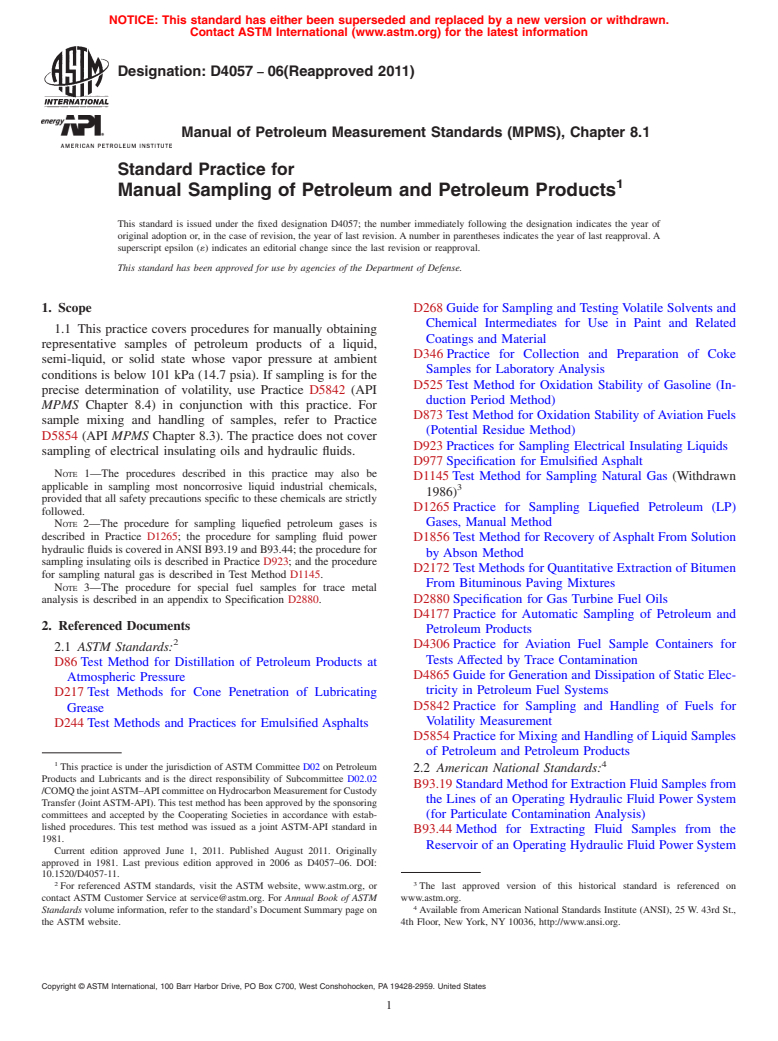
1.1 This practice covers procedures for manually obtaining representative samples of petroleum products of a liquid, semi-liquid, or solid state whose vapor pressure at ambient conditions is below 101 kPa (14.7 psia). If sampling is for the precise determination of volatility, use Practice D5842 (API MPMS Chapter 8.4) in conjunction with this practice. For sample mixing and handling of samples, refer to Practice D5854 (API MPMS Chapter 8.3). The practice does not cover sampling of electrical insulating oils and hydraulic fluids.
Note 1—The procedures described in this practice may also be applicable in sampling most noncorrosive liquid industrial chemicals, provided that all safety precautions specific to these chemicals are strictly followed.
Note 2—The procedure for sampling liquefied petroleum gases is described in Practice D1265; the procedure for sampling fluid power hydraulic fluids is covered in ANSI B93.19 and B93.44; the procedure for sampling insulating oils is described in Practice D923; and the procedure for sampling natural gas is described in Test Method .
Note 3—The procedure for special fuel samples for trace metal analysis is described in an appendix to Specification D2880.
General Information
Relations
Buy Standard
Standards Content (Sample)
NOTICE: This standard has either been superseded and replaced by a new version or withdrawn.
Contact ASTM International (www.astm.org) for the latest information
Designation: D4057 − 06(Reapproved 2011)
Manual of Petroleum Measurement Standards (MPMS), Chapter 8.1
Standard Practice for
1
Manual Sampling of Petroleum and Petroleum Products
This standard is issued under the fixed designation D4057; the number immediately following the designation indicates the year of
original adoption or, in the case of revision, the year of last revision. A number in parentheses indicates the year of last reapproval. A
superscript epsilon (´) indicates an editorial change since the last revision or reapproval.
This standard has been approved for use by agencies of the Department of Defense.
1. Scope D268 Guide for Sampling and Testing Volatile Solvents and
Chemical Intermediates for Use in Paint and Related
1.1 This practice covers procedures for manually obtaining
Coatings and Material
representative samples of petroleum products of a liquid,
D346 Practice for Collection and Preparation of Coke
semi-liquid, or solid state whose vapor pressure at ambient
Samples for Laboratory Analysis
conditions is below 101 kPa (14.7 psia). If sampling is for the
D525 Test Method for Oxidation Stability of Gasoline (In-
precise determination of volatility, use Practice D5842 (API
duction Period Method)
MPMS Chapter 8.4) in conjunction with this practice. For
D873 Test Method for Oxidation Stability of Aviation Fuels
sample mixing and handling of samples, refer to Practice
(Potential Residue Method)
D5854 (API MPMS Chapter 8.3). The practice does not cover
D923 Practices for Sampling Electrical Insulating Liquids
sampling of electrical insulating oils and hydraulic fluids.
D977 Specification for Emulsified Asphalt
NOTE 1—The procedures described in this practice may also be
D1145 Test Method for Sampling Natural Gas (Withdrawn
applicable in sampling most noncorrosive liquid industrial chemicals, 3
1986)
provided that all safety precautions specific to these chemicals are strictly
D1265 Practice for Sampling Liquefied Petroleum (LP)
followed.
Gases, Manual Method
NOTE 2—The procedure for sampling liquefied petroleum gases is
described in Practice D1265; the procedure for sampling fluid power
D1856 Test Method for Recovery of Asphalt From Solution
hydraulic fluids is covered inANSI B93.19 and B93.44; the procedure for
by Abson Method
sampling insulating oils is described in Practice D923; and the procedure
D2172 Test Methods for Quantitative Extraction of Bitumen
for sampling natural gas is described in Test Method D1145.
From Bituminous Paving Mixtures
NOTE 3—The procedure for special fuel samples for trace metal
analysis is described in an appendix to Specification D2880. D2880 Specification for Gas Turbine Fuel Oils
D4177 Practice for Automatic Sampling of Petroleum and
2. Referenced Documents
Petroleum Products
2
D4306 Practice for Aviation Fuel Sample Containers for
2.1 ASTM Standards:
Tests Affected by Trace Contamination
D86 Test Method for Distillation of Petroleum Products at
D4865 Guide for Generation and Dissipation of Static Elec-
Atmospheric Pressure
tricity in Petroleum Fuel Systems
D217 Test Methods for Cone Penetration of Lubricating
D5842 Practice for Sampling and Handling of Fuels for
Grease
Volatility Measurement
D244 Test Methods and Practices for Emulsified Asphalts
D5854 Practice for Mixing and Handling of Liquid Samples
of Petroleum and Petroleum Products
1 4
This practice is under the jurisdiction ofASTM Committee D02 on Petroleum
2.2 American National Standards:
Products and Lubricants and is the direct responsibility of Subcommittee D02.02
B93.19 Standard Method for Extraction Fluid Samples from
/COMQthejointASTM–APIcommitteeonHydrocarbonMeasurementforCustody
the Lines of an Operating Hydraulic Fluid Power System
Transfer (JointASTM-API). This test method has been approved by the sponsoring
committees and accepted by the Cooperating Societies in accordance with estab-
(for Particulate Contamination Analysis)
lished procedures. This test method was issued as a joint ASTM-API standard in
B93.44 Method for Extracting Fluid Samples from the
1981.
Reservoir of an Operating Hydraulic Fluid Power System
Current edition approved June 1, 2011. Published August 2011. Originally
approved in 1981. Last previous edition approved in 2006 as D4057–06. DOI:
10.1520/D4057-11.
2 3
For referenced ASTM standards, visit the ASTM website, www.astm.org, or The last approved version of this historical standard is referenced on
contact ASTM Customer Service at service@astm.org. For Annual Book of ASTM www.astm.org.
4
Standards volume information, refer to the standard’s Document Summary page on Available fromAmerican National Standards Institute (ANSI), 25 W. 43rd St.,
the ASTM website. 4th Floor, New York, NY 10036, http://www.ansi.org.
Copyright © ASTM International, 100 Barr Harbor Drive, PO Box C700, West Conshohocken, PA 19428-2959. United States
...
This document is not anASTM standard and is intended only to provide the user of anASTM standard an indication of what changes have been made to the previous version. Because
it may not be technically possible to adequately depict all changes accurately, ASTM recommends that users consult prior editions as appropriate. In all cases only the current version
of the standard as published by ASTM is to be considered the official document.
Designation:D4057–06 Designation: D4057 – 06 (Reapproved 2011)
Designation: Manual of Petroleum Measurement Standards (MPMS), Chapter 8.1
Standard Practice for
1
Manual Sampling of Petroleum and Petroleum Products
This standard is issued under the fixed designation D4057; the number immediately following the designation indicates the year of
original adoption or, in the case of revision, the year of last revision. A number in parentheses indicates the year of last reapproval. A
superscript epsilon (´) indicates an editorial change since the last revision or reapproval.
This standard has been approved for use by agencies of the Department of Defense.
1. Scope
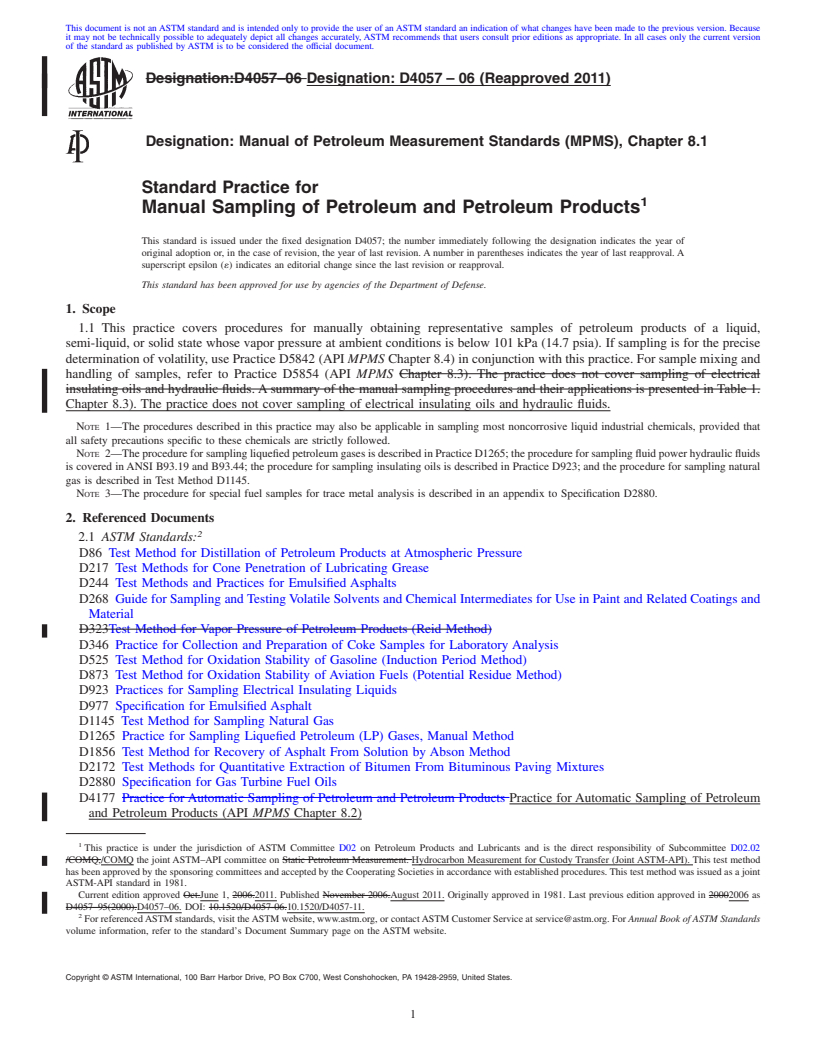
1.1 This practice covers procedures for manually obtaining representative samples of petroleum products of a liquid,
semi-liquid, or solid state whose vapor pressure at ambient conditions is below 101 kPa (14.7 psia). If sampling is for the precise
determination of volatility, use Practice D5842 (API MPMS Chapter 8.4) in conjunction with this practice. For sample mixing and
handling of samples, refer to Practice D5854 (API MPMS Chapter 8.3). The practice does not cover sampling of electrical
insulating oils and hydraulic fluids.Asummary of the manual sampling procedures and their applications is presented in Table 1.
Chapter 8.3). The practice does not cover sampling of electrical insulating oils and hydraulic fluids.
NOTE 1—The procedures described in this practice may also be applicable in sampling most noncorrosive liquid industrial chemicals, provided that
all safety precautions specific to these chemicals are strictly followed.
NOTE 2—TheprocedureforsamplingliquefiedpetroleumgasesisdescribedinPracticeD1265;theprocedureforsamplingfluidpowerhydraulicfluids
is covered inANSI B93.19 and B93.44; the procedure for sampling insulating oils is described in Practice D923; and the procedure for sampling natural
gas is described in Test Method D1145.
NOTE 3—The procedure for special fuel samples for trace metal analysis is described in an appendix to Specification D2880.
2. Referenced Documents
2
2.1 ASTM Standards:
D86 Test Method for Distillation of Petroleum Products at Atmospheric Pressure
D217 Test Methods for Cone Penetration of Lubricating Grease
D244 Test Methods and Practices for Emulsified Asphalts
D268 Guide for Sampling andTestingVolatile Solvents and Chemical Intermediates for Use in Paint and Related Coatings and
Material
D323Test Method for Vapor Pressure of Petroleum Products (Reid Method)
D346 Practice for Collection and Preparation of Coke Samples for Laboratory Analysis
D525 Test Method for Oxidation Stability of Gasoline (Induction Period Method)
D873 Test Method for Oxidation Stability of Aviation Fuels (Potential Residue Method)
D923 Practices for Sampling Electrical Insulating Liquids
D977 Specification for Emulsified Asphalt
D1145 Test Method for Sampling Natural Gas
D1265 Practice for Sampling Liquefied Petroleum (LP) Gases, Manual Method
D1856 Test Method for Recovery of Asphalt From Solution by Abson Method
D2172 Test Methods for Quantitative Extraction of Bitumen From Bituminous Paving Mixtures
D2880 Specification for Gas Turbine Fuel Oils
D4177 Practice for Automatic Sampling of Petroleum and Petroleum Products Practice for Automatic Sampling of Petroleum
and Petroleum Products (API MPMS Chapter 8.2)
1
This practice is under the jurisdiction of ASTM Committee D02 on Petroleum Products and Lubricants and is the direct responsibility of Subcommittee D02.02
/COMQ,/COMQ the joint ASTM–API committee on Static Petroleum Measurement. Hydrocarbon Measurement for Custody Transfer (Joint ASTM-API). This test method
has been approved by the sponsoring committees and accepted by the Cooperating Societies in accordance with established procedures.This test method was issued as a joint
ASTM-API standard in 1981.
Current edition approved Oct.June 1, 2006.2011. Published November 2006.August 2011. Originally approved in 1981. Last previous edition approved in 20002006 as
D4057–95(2000).D4057–06. DOI: 10.1520/D4057-06.10.1520/D4057-11.
2
For referencedASTM standards, visit theASTM website, www.astm.org, or contactASTM Customer Service at service@astm.org. For Annual Book of ASTM Standards
volume information, refer to the standard’s Document Summary page on the ASTM website.
Copyright © ASTM International, 100 Barr Harbor Drive, PO Box C700, West Conshohocken, PA 19428-2959, United States.
1
---------------------- Page: 1 ----------------------
D4057 – 06 (2011)
D4306 Practice for Aviation Fuel Sample Containers for Tests Aff
...
Questions, Comments and Discussion
Ask us and Technical Secretary will try to provide an answer. You can facilitate discussion about the standard in here.