


ASTM F3438-24
(Guide)Standard Guide for Detection and Quantification of Cleaning Markers (Analytes) for the Validation of Cleaning Methods for Reusable Medical Devices
Standard Guide for Detection and Quantification of Cleaning Markers (Analytes) for the Validation of Cleaning Methods for Reusable Medical Devices
SIGNIFICANCE AND USE
5.1 This standard guide may be used by medical device manufacturers as part of their design plan and implementation of the validation of the cleaning instructions of their reusable medical devices.
5.2 This guide helps medical device manufacturers to identify the appropriate method(s) for detecting and quantifying markers for the simulated-use test soil (see Guide F3208), thereby evaluating whether the medical device can be adequately cleaned.
5.3 This guide describes various test methods for the different analytes.
5.4 This guide specifies the validation criteria for analyte detection methods.
SCOPE
1.1 This standard guide provides methods and considerations for detecting and quantifying test soil(s) from reusable medical device(s) that result from simulated-use testing of medical devices during validation of the cleaning procedures as described in the instructions for use (IFU) provided by the medical device manufacturer.
1.2 The methods described are for detecting and measuring markers (analytes) that are components within the most common test soils and are relevant to the clinical use of the device. Appropriate test soils without protein, carbon, or carbohydrates (for example, bone) will require other methods.
1.3 This is a part of a series of ASTM standard guides for validating cleaning instructions. The scope of the first guide in the series is selecting appropriate test soils (Guide F3208). The second in the series (Guide F3293) describes methods for inoculating medical devices with test soil. The third in the series (Guide F3321) describes methods for extracting soils for measuring residual soil on medical devices after the performance of cleaning process. This is the fourth guide in the series and describes the methods of detecting and quantifying residual analytes on the device.
1.4 Units—The values stated in SI units are to be regarded as standard. No other units of measurement are included in this standard.
1.5 This standard does not purport to address all of the safety concerns, if any, associated with its use. It is the responsibility of the user of this standard to establish appropriate safety, health, and environmental practices and determine the applicability of regulatory limitations prior to use.
1.6 This international standard was developed in accordance with internationally recognized principles on standardization established in the Decision on Principles for the Development of International Standards, Guides and Recommendations issued by the World Trade Organization Technical Barriers to Trade (TBT) Committee.
General Information
- Status
- Published
- Publication Date
- 14-Mar-2024
- Technical Committee
- F04 - Medical and Surgical Materials and Devices
- Drafting Committee
- F04.15 - Material Test Methods
Relations
- Effective Date
- 15-Mar-2024
Overview
ASTM F3438-24 is a standard guide developed by ASTM International to provide methodologies and considerations for detecting and quantifying cleaning markers (analytes) on reusable medical devices. This guide is an essential component in the validation of cleaning instructions specified by medical device manufacturers, ensuring that devices can be adequately cleaned after exposure to clinical contaminants. By implementing the requirements in ASTM F3438-24, manufacturers can reliably validate their cleaning processes and ultimately improve the safety of reusable medical devices.
Key Topics
Detection and Quantification Methods: The guide outlines several analytical techniques used to detect and quantify residual test soils on medical devices, including:
- Protein assays (Bicinchoninic Acid (BCA), Bradford, Ortho-Phthalaldehyde (OPA))
- Hemoglobin detection (Tetramethylbenzidine (TMB), Drabkin’s assay, Copper(II)-Phthalocyanine Complex)
- Carbohydrate analysis (Phenol-Sulfuric Acid method)
- Total Organic Carbon (TOC) measurement
Validation Criteria: The standard emphasizes critical validation parameters for analyte detection methods:
- Linearity and Range: Assessment through calibration curves to ensure measurement accuracy across relevant concentrations.
- Accuracy: Agreement between measured and actual values.
- Precision: Reproducibility of results within and between laboratories, with a recommended relative standard deviation (RSD) ≤15%.
- Limits of Detection (LOD) and Quantification (LOQ): Establishing the minimum detectable and quantifiable amounts of an analyte.
Simulated-Use Testing: The guide highlights best practices for simulating clinical use, applying and extracting test soils, and evaluating cleaning effectiveness in accordance with associated guides in the ASTM series.
Safety and Compliance: Promotes adherence to laboratory safety, health, and environmental protocols, and considers regulatory requirements in medical device reprocessing.
Applications
Practical applications of ASTM F3438-24 include:
- Medical Device Manufacturing: Guiding engineers and quality assurance teams in the development of cleaning validation protocols for reusable medical devices, such as surgical instruments, endoscopes, and similar products.
- Regulatory Submission: Assisting manufacturers in demonstrating compliance with regulatory expectations for cleaning validation, supporting submissions to organizations like the FDA and meeting international standards.
- Healthcare Facilities: Providing validated cleaning instructions and supporting materials to ensure safe reprocessing of reusable devices within hospitals and clinics.
- Test Laboratories: Offering standard operating procedures and validation benchmarks for laboratories performing cleaning effectiveness testing on reusable medical devices.
Related Standards
ASTM F3438-24 is part of a comprehensive series devoted to cleaning validation:
- ASTM F3208: Guide for selecting relevant test soils for cleaning validation.
- ASTM F3293: Guide for the application of test soils onto medical devices.
- ASTM F3321: Guide for methods of extracting residual soils from medical devices for measurement after cleaning processes.
- Referenced Methods and Standards:
- ASTM D7573 - Total Carbon and Organic Carbon detection
- ISO 15883-5 - Washer-disinfectors performance and cleaning efficacy
- AAMI TIR12 and AAMI ST98 - Design, reprocessing, and validation guidance for reusable medical devices
Summary
Adopting ASTM F3438-24 ensures that medical device manufacturers and laboratories have a systematic, standardized approach for validating the efficacy of cleaning procedures. By utilizing recognized detection and quantification methods for common analytes, and adhering to strict validation criteria, stakeholders can confidently demonstrate the cleanliness and safety of reusable medical devices-ultimately protecting patient health and meeting regulatory demands for reprocessing validation.
Keywords: medical device cleaning, analyte detection, cleaning validation, reusable medical devices, ASTM F3438-24, protein quantification, hemoglobin detection, total organic carbon, healthcare reprocessing, cleaning efficacy.
Buy Documents
ASTM F3438-24 - Standard Guide for Detection and Quantification of Cleaning Markers (Analytes) for the Validation of Cleaning Methods for Reusable Medical Devices
REDLINE ASTM F3438-24 - Standard Guide for Detection and Quantification of Cleaning Markers (Analytes) for the Validation of Cleaning Methods for Reusable Medical Devices
Get Certified
Connect with accredited certification bodies for this standard

BSI Group
BSI (British Standards Institution) is the business standards company that helps organizations make excellence a habit.

TÜV Rheinland
TÜV Rheinland is a leading international provider of technical services.

TÜV SÜD
TÜV SÜD is a trusted partner of choice for safety, security and sustainability solutions.
Sponsored listings
Frequently Asked Questions
ASTM F3438-24 is a guide published by ASTM International. Its full title is "Standard Guide for Detection and Quantification of Cleaning Markers (Analytes) for the Validation of Cleaning Methods for Reusable Medical Devices". This standard covers: SIGNIFICANCE AND USE 5.1 This standard guide may be used by medical device manufacturers as part of their design plan and implementation of the validation of the cleaning instructions of their reusable medical devices. 5.2 This guide helps medical device manufacturers to identify the appropriate method(s) for detecting and quantifying markers for the simulated-use test soil (see Guide F3208), thereby evaluating whether the medical device can be adequately cleaned. 5.3 This guide describes various test methods for the different analytes. 5.4 This guide specifies the validation criteria for analyte detection methods. SCOPE 1.1 This standard guide provides methods and considerations for detecting and quantifying test soil(s) from reusable medical device(s) that result from simulated-use testing of medical devices during validation of the cleaning procedures as described in the instructions for use (IFU) provided by the medical device manufacturer. 1.2 The methods described are for detecting and measuring markers (analytes) that are components within the most common test soils and are relevant to the clinical use of the device. Appropriate test soils without protein, carbon, or carbohydrates (for example, bone) will require other methods. 1.3 This is a part of a series of ASTM standard guides for validating cleaning instructions. The scope of the first guide in the series is selecting appropriate test soils (Guide F3208). The second in the series (Guide F3293) describes methods for inoculating medical devices with test soil. The third in the series (Guide F3321) describes methods for extracting soils for measuring residual soil on medical devices after the performance of cleaning process. This is the fourth guide in the series and describes the methods of detecting and quantifying residual analytes on the device. 1.4 Units—The values stated in SI units are to be regarded as standard. No other units of measurement are included in this standard. 1.5 This standard does not purport to address all of the safety concerns, if any, associated with its use. It is the responsibility of the user of this standard to establish appropriate safety, health, and environmental practices and determine the applicability of regulatory limitations prior to use. 1.6 This international standard was developed in accordance with internationally recognized principles on standardization established in the Decision on Principles for the Development of International Standards, Guides and Recommendations issued by the World Trade Organization Technical Barriers to Trade (TBT) Committee.
SIGNIFICANCE AND USE 5.1 This standard guide may be used by medical device manufacturers as part of their design plan and implementation of the validation of the cleaning instructions of their reusable medical devices. 5.2 This guide helps medical device manufacturers to identify the appropriate method(s) for detecting and quantifying markers for the simulated-use test soil (see Guide F3208), thereby evaluating whether the medical device can be adequately cleaned. 5.3 This guide describes various test methods for the different analytes. 5.4 This guide specifies the validation criteria for analyte detection methods. SCOPE 1.1 This standard guide provides methods and considerations for detecting and quantifying test soil(s) from reusable medical device(s) that result from simulated-use testing of medical devices during validation of the cleaning procedures as described in the instructions for use (IFU) provided by the medical device manufacturer. 1.2 The methods described are for detecting and measuring markers (analytes) that are components within the most common test soils and are relevant to the clinical use of the device. Appropriate test soils without protein, carbon, or carbohydrates (for example, bone) will require other methods. 1.3 This is a part of a series of ASTM standard guides for validating cleaning instructions. The scope of the first guide in the series is selecting appropriate test soils (Guide F3208). The second in the series (Guide F3293) describes methods for inoculating medical devices with test soil. The third in the series (Guide F3321) describes methods for extracting soils for measuring residual soil on medical devices after the performance of cleaning process. This is the fourth guide in the series and describes the methods of detecting and quantifying residual analytes on the device. 1.4 Units—The values stated in SI units are to be regarded as standard. No other units of measurement are included in this standard. 1.5 This standard does not purport to address all of the safety concerns, if any, associated with its use. It is the responsibility of the user of this standard to establish appropriate safety, health, and environmental practices and determine the applicability of regulatory limitations prior to use. 1.6 This international standard was developed in accordance with internationally recognized principles on standardization established in the Decision on Principles for the Development of International Standards, Guides and Recommendations issued by the World Trade Organization Technical Barriers to Trade (TBT) Committee.
ASTM F3438-24 is classified under the following ICS (International Classification for Standards) categories: 11.040.01 - Medical equipment in general; 11.080.01 - Sterilization and disinfection in general. The ICS classification helps identify the subject area and facilitates finding related standards.
ASTM F3438-24 has the following relationships with other standards: It is inter standard links to ASTM F3438-21. Understanding these relationships helps ensure you are using the most current and applicable version of the standard.
ASTM F3438-24 is available in PDF format for immediate download after purchase. The document can be added to your cart and obtained through the secure checkout process. Digital delivery ensures instant access to the complete standard document.
Standards Content (Sample)
This international standard was developed in accordance with internationally recognized principles on standardization established in the Decision on Principles for the
Development of International Standards, Guides and Recommendations issued by the World Trade Organization Technical Barriers to Trade (TBT) Committee.
Designation: F3438 − 24
Standard Guide for
Detection and Quantification of Cleaning Markers (Analytes)
for the Validation of Cleaning Methods for Reusable Medical
Devices
This standard is issued under the fixed designation F3438; the number immediately following the designation indicates the year of
original adoption or, in the case of revision, the year of last revision. A number in parentheses indicates the year of last reapproval. A
superscript epsilon (´) indicates an editorial change since the last revision or reapproval.
1. Scope Development of International Standards, Guides and Recom-
mendations issued by the World Trade Organization Technical
1.1 This standard guide provides methods and consider-
Barriers to Trade (TBT) Committee.
ations for detecting and quantifying test soil(s) from reusable
medical device(s) that result from simulated-use testing of
2. Referenced Documents
medical devices during validation of the cleaning procedures as
2.1 ASTM Standards:
described in the instructions for use (IFU) provided by the
D7573 Test Method for Total Carbon and Organic Carbon in
medical device manufacturer.
Water by High Temperature Catalytic Combustion and
1.2 The methods described are for detecting and measuring
Infrared Detection
markers (analytes) that are components within the most com-
E1097 Guide for Determination of Various Elements by
mon test soils and are relevant to the clinical use of the device.
Direct Current Plasma Atomic Emission Spectrometry
Appropriate test soils without protein, carbon, or carbohydrates
E2520 Practice for Measuring and Scoring Performance of
(for example, bone) will require other methods.
Trace Explosive Chemical Detectors
F3127 Guide for Validating Cleaning Processes Used During
1.3 This is a part of a series of ASTM standard guides for
validating cleaning instructions. The scope of the first guide in the Manufacture of Medical Devices
F3208 Guide for Selecting Test Soils for Validation of
the series is selecting appropriate test soils (Guide F3208). The
second in the series (Guide F3293) describes methods for Cleaning Methods for Reusable Medical Devices
F3293 Guide for Application of Test Soils for the Validation
inoculating medical devices with test soil. The third in the
series (Guide F3321) describes methods for extracting soils for of Cleaning Methods for Reusable Medical Devices
measuring residual soil on medical devices after the perfor- F3321 Guide for Methods of Extraction of Test Soils for the
mance of cleaning process. This is the fourth guide in the series Validation of Cleaning Methods for Reusable Medical
and describes the methods of detecting and quantifying re- Devices
sidual analytes on the device. 2.2 AAMI Documents:
AAMI TIR12 Designing, testing, and labeling reusable
1.4 Units—The values stated in SI units are to be regarded
medical devices for reprocessing in health care facilities:
as standard. No other units of measurement are included in this
A guide for medical device manufacturers
standard.
AAMI ST98 Cleaning validation of health care products—
1.5 This standard does not purport to address all of the
Requirements for development and validation of a clean-
safety concerns, if any, associated with its use. It is the
ing process for medical devices
responsibility of the user of this standard to establish appro- 4
2.3 ISO Standard:
priate safety, health, and environmental practices and deter-
ISO 15883-5 Washer-disinfectors—Part 5: Performance re-
mine the applicability of regulatory limitations prior to use.
quirements and test method criteria for demonstrating
1.6 This international standard was developed in accor-
cleaning efficacy
dance with internationally recognized principles on standard-
ization established in the Decision on Principles for the
For referenced ASTM standards, visit the ASTM website, www.astm.org, or
contact ASTM Customer Service at service@astm.org. For Annual Book of ASTM
Standards volume information, refer to the standard’s Document Summary page on
This guide is under the jurisdiction of ASTM Committee F04 on Medical and the ASTM website.
Surgical Materials and Devices and is the direct responsibility of Subcommittee Available from Association for the Advancement of Medical Instrumentation
F04.15 on Material Test Methods. (AAMI), 4301 N. Fairfax Dr., Suite 301, Arlington, VA 22203-1633, http://
Current edition approved March 15, 2024. Published March 2024. Originally www.aami.org.
approved in 2021. Last previous edition approved in 2021 as F3438 – 21. DOI: Available from American National Standards Institute (ANSI), 25 W. 43rd St.,
10.1520/F3438-24. 4th Floor, New York, NY 10036, http://www.ansi.org.
Copyright © ASTM International, 100 Barr Harbor Drive, PO Box C700, West Conshohocken, PA 19428-2959. United States
F3438 − 24
2.4 FDA Guidance Document: range of expected analyte concentration and includes method
Reprocessing Medical Devices in Health Care Settings: acceptance criteria. The linearity, measured by the R value of
Validation Methods and Labeling, Guidance for Industry the line, should be greater than 0.9900. For the range, the
and Food and Drug Administration Staff analyte residual acceptance criteria should be in the portion of
the curve that demonstrates the best accuracy and precision
3. Terminology
with the upper and lower points of the curve being both
accurate and precise (1).
3.1 Definitions:
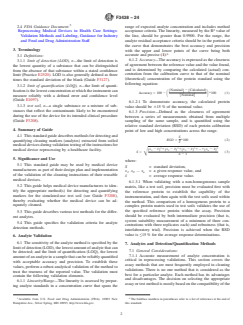
6.1.2 Accuracy—The accuracy is expressed as the closeness
3.1.1 limit of detection (LOD), n—the limit of detection is
of agreement between the reference value and the value found,
the lowest quantity of a substance that can be distinguished
and is determined by comparing the calculated (actual) con-
from the absence of that substance within a stated confidence
centration from the calibration curve to that of the nominal
limit (Practice E2520). LOD is also generally defined as three
(theoretical) concentration of the protein standard using the
times the standard deviation of the blank (Guide F3127).
following equation:
3.1.2 limit of quantification (LOQ), n—the limit of quanti-
Nominal 2 Calculated
@ # @ #
fication is the lowest concentration at which the instrument can
Accuracy 5 100 2 *100 (1)
S D
@Nominal#
measure reliably with a defined error and confidence level
(Guide E1097).
6.1.2.1 To demonstrate accuracy, the calculated protein
3.1.3 test soil, n—a single substance or a mixture of sub-
value should be 615 % of the nominal value.
stances that reflect the contaminants likely to be encountered
6.1.3 Precision—Defined as the closeness of agreement
during the use of the device for its intended clinical procedure
between a series of measurements obtained from multiple
(Guide F3208).
sampling of the same sample, and is quantified using the
relative standard deviation (RSD) of each protein calibration
4. Summary of Guide
point of low and high concentrations across the range.
4.1 This standard guide describes methods for detecting and
S
RSD 5 *100 (2)
quantifying cleaning markers (analytes) extracted from soiled
x¯
medical devices during validation testing of the instructions for
2 2 2 2
x 2 x¯ 1 x 2 x¯ 1 x 2 x¯ 1.1 x 2 x¯
~ ! ~ ! ~ ! ~ !
medical device reprocessing by a healthcare facility.
1 2 3 n
S 5 (3)
Œ
n 2 1
5. Significance and Use
where:
5.1 This standard guide may be used by medical device
S = standard deviation,
manufacturers as part of their design plan and implementation
x , x , . x = a given response value, and
1 2 n
of the validation of the cleaning instructions of their reusable
x¯ = average response value.
medical devices.
6.1.3.1 When validating with a non-homogeneous sample
5.2 This guide helps medical device manufacturers to iden-
matrix, like a test soil, precision must be evaluated first with
tify the appropriate method(s) for detecting and quantifying
the reference protein to establish the capability of the
markers for the simulated-use test soil (see Guide F3208),
instrumentation, and then again with the test soils used within
thereby evaluating whether the medical device can be ad-
the method. This comparison of a homogenous protein to a
equately cleaned.
complex protein matrix used in test soils validates the use of
the specified reference protein within the assay. Precision
5.3 This guide describes various test methods for the differ-
should be evaluated by both intermediate precision (that is,
ent analytes.
system suitability measurement of a minimum of three con-
5.4 This guide specifies the validation criteria for analyte
centrations with three replicates each) and robustness (that is,
detection methods.
interlaboratory trial). Precision is achieved when the RSD
value is ≤15 % for the average response determinations.
6. Analyte Validation
6.1 The sensitivity of the analyte method is specified by the
7. Analytes and Detection/Quantification Methods
limit of detection (LOD), the lowest amount of analyte that can
7.1 General Considerations:
be detected; and the limit of quantification (LOQ), the lowest
7.1.1 Accurate measurement of analyte concentration is
amount of an analyte in a sample that can be reliably quantified
critical in reprocessing validations. This section covers the
with acceptable accuracy and precision. To establish these
assay methods that are most frequently employed in cleaning
values, perform a robust analytical validation of the method to
validations. There is no one method that is considered as the
trust the trueness of the reported value. The validation must
best for a particular analyte. Each method has its advantages
contain the following validation elements.
and disadvantages. The decision on selecting the appropriate
6.1.1 Linearity/Range—The linearity is assessed by prepar-
assay or test method is mostly based on the compatibility of the
ing analyte standards in a concentration curve that spans the
5 6
Available from U.S. Food and Drug Administration (FDA), 10903 New The boldface numbers in parentheses refer to a list of references at the end of
Hampshire Ave., Silver Spring, MD 20993, http://www.fda.gov. this standard.
F3438 − 24
assay with the samples and the potential interfering substances 7.2.3.1 The OPA method is based on quantitative detection
included in samples that may affect certain methods. of primary amines in amino acids, peptides, and proteins. OPA
reacts with primary amines in the presence of mercaptoethanol
7.1.2 The limit of detection depends on the assay or reagent
to yield a blue-colored fluorescent product. The reaction can be
kit that is being used. It also depends on the standard curve
monitored by absorbance and by fluorescence. The inherent
used, the sensitivity and stability of the instrumentation, any
sensitivity and speed of OPA, along with its broad linear range,
minor modifications in reagents used, and background/
make it a useful protein and peptide assay reagent. The OPA
interference effects from the sample extract. Modifications can
assay functions well in the presence of lipids and detergents.
be made to improve the sensitivity of the method, but a
7.2.3.2 Liquid OPA Assay—There is a published indirect
validation using the criteria in Section 6 should be completed.
OPA assay that can be used to measure protein soil on device
7.1.3 The standard addition method, addition of 10 μg ⁄mL
surfaces without the use of extraction. This can help to
of protein standard added to unknown sample concentrations,
eliminate any protentional errors inherent in extraction of
can be used to shift low concentrations into more accurate and
challenging test soils and has a detection limit of 1.6 μg ⁄cm
precise portions of the calibration curve to increase sensitivity.
protein. See Ref (6) for more information.
A spiked blank should be included and subtracted from the
7.3 Hemoglobin Detection/Quantification:
unknown value to deliver the final unknown sample result (2).
7.3.1 Tetramethylbenzidine (TMB) Assay (7):
7.1.4 Diluents (that is, extraction fluids) must be validated
7.3.1.1 The TMB assay is a catalytic test that is based on the
for use in the method.
peroxidase-like activity of hemoglobin. With its peroxidase-
7.1.5 Extraction hold times and containers must be vali-
like activity, hemoglobin catalyzes the oxidation of TMB in the
dated to ensure results of unknown samples, especially if the
presence of hydrogen peroxide. TMB produces a colored end
unknown samples are not analyzed directly after collection.
product that can be read spectrophotometrically.
7.2 Protein Detection/Quantification: 7.3.1.2 Liquid TMB Assay—This method uses test strips to
7.2.1 Bicinchoninic Acid (BCA) Assay (3): detect hemoglobin in the sample collected. It has shown that it
is 500× more sensitive than MicroBCA in a 1 min assay, as
7.2.1.1 BCA assay is a biochemical assay for determining
well as unaffected by cleaning reagents at 10 ppm. See Ref (8)
the total concentration of protein in a solution. The assay is
for more information.
based on protein-copper chelation and secondary detection of
7.3.2 Drabkin’s Assay (9):
the reduced copper. The assay relies on two reactions. First, the
2+
7.3.2.1 Drabkin’s assay is used for the quantitative, colori-
peptide bonds in the protein sample reduce Cu ions, in a
metric determination of hemoglobin concentration in a solu-
temperature-dependent reaction, from the copper solution to
+ 2+
tion. This assay is based on the oxidation of hemoglobin
Cu . The amount of Cu reduced is proportional to the amount
(except sulfhemoglobin, which normally occurs in only minute
of protein present in the solution. Next, two molecules of BCA
+
concentrations in blood) to methemoglobin in the presence of
chelate with each Cu ion, forming a purple-colored product.
alkaline potassium ferricyanide. Methemoglobin then reacts
The total protein concentration is exhibited by a color change
with potassium cyanide to form cyanmethemoglobin. The
of the sample solution from green to purple in proportion to
color intensity measured spectrophotometrically is propor-
protein concentration. The amount of protein present in a
tional to the total hemoglobin concentration.
solution can be quantified by measuring the absorption spectra
7.3.3 Copper (II)-Phthalocyanine Complex Assay (10):
and comparing with protein solutions with known concentra-
7.3.3.1 This assay uses copper (II)-phthalocyanine complex
tions. The advantage of the BCA assay is that it is compatible
to determine the concentration of hemoglobin in the test
with a wide range of ionic and non-ionic detergents and
samples. It is a quantitative, highly sensitive, colorimetric
denaturing agents. A limitation of the method is the presence of
method that relies on the oxidative decomposition of copper
reducing agents and copper chelating agents, which can affect
(II)-phthalocyanine complex in the presence of hemoglobin
the accuracy of the results.
and a peroxomonosulfate. The samples are mixed with a liquid
7.2.2 Bradford Assay (4):
copper phthalocyanine reagent and read on a
7.2.2.1 The Bradford assay is used to measure the concen-
spectrophotometer, then quantified using a calibration curve.
tration of total protein in a sample. The assay is based on the
The color of test sample changes from blue to clear in the
binding of protein molecules to Coomassie dye under acidic
presence of hemoglobin.
conditions. When mixed with a protein solution, the acidic
7.3.4 Triton/NaOH Assay:
Coomassie dye changes color from brown to blue in proportion
7.3.4.1 This assay is based on the improved Triton/NaOH
with the amount of protein initially present in the sample. The
method in which hemoglobin is converted to a colorimetric
assay is done at room temperature and the resultant blue color
product measured at 400 nm. The intensity of color is directly
is measured spectrophotometrically. Protein determinations are
proportional to the hemoglobin concentration.
made by comparison to the color response of protein assay
7.4 Carbohydrate Detection/Quantification:
standards. Among the advantages of the Bradford assay is the
compatibility with reducing agents used to stabilize proteins in 7.4.1 Phenol-Sulfuric Acid Assay (11, 12):
solution. The main limitation of the Bradford assay is its 7.4.1.1 The phenol-sulfuric acid method is a colorimetric
incompatibility with most detergents routinely used to solubi- method to determine total carbohydrates in a sample. The
lize membrane proteins. method detects all classes of carbohydrates. The basic principle
7.2.3 Ortho-Phthalaldehyde (OPA) Method (5): of this method is that carbohydrates react with concentrated
F3438 − 24
sulfuric acid to produce furfural derivatives, which further reprocessing. The main stages of TOC analysis are sampling,
react with phenol to develop a detectable color. Light absorp- oxidation, detection, and quantification. A typical analysis for
TOC is the differential method, which first separately measures
tion is recorded on a spectrophotometer. The absorbance is
proportional to the carbohydrate concentration initially present the total carbon and the inorganic carbon in the sample. The
inorganic carbon is then subtracted from the total carbon to
in the sample.
yield TOC. This method is suitable for samples in which the
7.5 Total Organic Carbon Detection/Quantification—
inorganic carbon is less than or of similar amount as TOC.
(United States Pharmacopeia <643> Total Organic Carbon,
Another common method of TOC analysis is the direct method,
Test Method D7573):
which involves removing the inorganic carbon from the sample
7.5.1 Total organic carbon (TOC) is the amount of carbon
first and then measuring the leftover carbon.
found in a water-soluble organic compound. TOC is an
8. Keywords
accurate, nonspecific test for quantifying cleaning marker
residues and detergent residuals and is often used as an indirect 8.1 analyte; carbohydrates; hemoglobin; protein; total or-
indicator for water quality or cleanliness of devices after ganic carbon (TOC)
ANNEX
(Mandatory Information)
A1. SAMPLE STANDARD OPERATING PROCEDURES (SOP) FOR ANALYTE QUANTIFICATION
A1.1 QuantiPro BCA Protein Assay A1.1.5.2.4 1 mg/mL BSA protein standard (catalog no.
P0914).
A1.1.1 Purpose—To provide
...
This document is not an ASTM standard and is intended only to provide the user of an ASTM standard an indication of what changes have been made to the previous version. Because
it may not be technically possible to adequately depict all changes accurately, ASTM recommends that users consult prior editions as appropriate. In all cases only the current version
of the standard as published by ASTM is to be considered the official document.
Designation: F3438 − 21 F3438 − 24
Standard Guide for
Detection and Quantification of Cleaning Markers (Analytes)
for the Validation of Cleaning Methods for Reusable Medical
Devices
This standard is issued under the fixed designation F3438; the number immediately following the designation indicates the year of
original adoption or, in the case of revision, the year of last revision. A number in parentheses indicates the year of last reapproval. A
superscript epsilon (´) indicates an editorial change since the last revision or reapproval.
1. Scope
1.1 This standard guide provides methods and considerations for detecting and quantifying test soil(s) from reusable medical
device(s) that result from simulated-use testing of medical devices during validation of the cleaning procedures as described in the
instructions for use (IFU) provided by the medical device manufacturer.
1.2 The methods described are for detecting and measuring markers (analytes) that are components within the most common test
soils and are relevant to the clinical use of the device. Appropriate test soils without protein, carbon, or carbohydrates (for example,
bone) will require other methods.
1.3 This is a part of a series of ASTM standard guides for validating cleaning instructions. The scope of the first guide in the series
is selecting appropriate test soils (Guide F3208). The second in the series (Guide F3293) describes methods for inoculating medical
devices with test soil. The third in the series (Guide F3321) describes methods for extracting soils for measuring residual soil on
medical devices after the performance of cleaning process. This is the fourth guide in the series and describes the methods of
detecting and quantifying residual analytes on the device.
1.4 Units—The values stated in SI units are to be regarded as standard. No other units of measurement are included in this
standard.
1.5 This standard does not purport to address all of the safety concerns, if any, associated with its use. It is the responsibility
of the user of this standard to establish appropriate safety, health, and environmental practices and determine the applicability of
regulatory limitations prior to use.
1.6 This international standard was developed in accordance with internationally recognized principles on standardization
established in the Decision on Principles for the Development of International Standards, Guides and Recommendations issued
by the World Trade Organization Technical Barriers to Trade (TBT) Committee.
2. Referenced Documents
2.1 ASTM Standards:
This guide is under the jurisdiction of ASTM Committee F04 on Medical and Surgical Materials and Devices and is the direct responsibility of Subcommittee F04.15
on Material Test Methods.
Current edition approved March 1, 2021March 15, 2024. Published March 2021March 2024. Originally approved in 2021. Last previous edition approved in 2021 as
F3438 – 21. DOI: 10.1520/F3438-21.10.1520/F3438-24.
For referenced ASTM standards, visit the ASTM website, www.astm.org, or contact ASTM Customer Service at service@astm.org. For Annual Book of ASTM Standards
volume information, refer to the standard’s Document Summary page on the ASTM website.
Copyright © ASTM International, 100 Barr Harbor Drive, PO Box C700, West Conshohocken, PA 19428-2959. United States
F3438 − 24
D7573 Test Method for Total Carbon and Organic Carbon in Water by High Temperature Catalytic Combustion and Infrared
Detection
E1097 Guide for Determination of Various Elements by Direct Current Plasma Atomic Emission Spectrometry
E2520 Practice for Measuring and Scoring Performance of Trace Explosive Chemical Detectors
F3127 Guide for Validating Cleaning Processes Used During the Manufacture of Medical Devices
F3208 Guide for Selecting Test Soils for Validation of Cleaning Methods for Reusable Medical Devices
F3293 Guide for Application of Test Soils for the Validation of Cleaning Methods for Reusable Medical Devices
F3321 Guide for Methods of Extraction of Test Soils for the Validation of Cleaning Methods for Reusable Medical Devices
2.2 AAMI Documents:
AAMI TIR12 Designing, testing, and labeling reusable medical devices for reprocessing in health care facilities: A guide for
medical device manufacturers
AAMI TIR30ST98 A compendium of processes, materials, test methods, and acceptance criteria for cleaning reusable Cleaning
validation of health care products—Requirements for development and validation of a cleaning process for medical devices
2.3 ISO Standard:
ISO/TSISO 15883-5 Washer-disinfectors—Part 5: Test soils and methods Performance requirements and test method criteria for
demonstrating cleaning efficacy
2.4 FDA Guidance Document:
Reprocessing Medical Devices in Health Care Settings: Validation Methods and Labeling, Guidance for Industry and Food and
Drug Administration Staff
3. Terminology
3.1 Definitions:
3.1.1 limit of detection (LOD), n—the limit of detection is the lowest quantity of a substance that can be distinguished from the
absence of that substance within a stated confidence limit (Practice E2520). LOD is also generally defined as three times the
standard deviation of the blank (Guide F3127).
3.1.2 limit of quantification (LOQ), n—the limit of quantification is the lowest concentration at which the instrument can measure
reliably with a defined error and confidence level (Guide E1097). LOQ is also generally defined as ten times the standard deviation
of the blank (Guide F3127).
3.1.3 test soil, n—a single substance or a mixture of substances that reflect the contaminants likely to be encountered during the
use of the device for its intended clinical procedure (Guide F3208).
4. Summary of Guide
4.1 This standard guide describes methods for detecting and quantifying cleaning markers (analytes) extracted from soiled medical
devices during validation testing of the instructions for medical device reprocessing by a healthcare facility.
5. Significance and Use
5.1 This standard guide may be used by medical device manufacturers as part of their design plan and implementation of the
validation of the cleaning instructions of their reusable medical devices.
5.2 This guide helps medical device manufacturers to identify the appropriate method(s) for detecting and quantifying markers for
the simulated-use test soil (see Guide F3208), thereby evaluating whether the medical device can be adequately cleaned.
5.3 This guide describes various test methods for the different analytes.
5.4 This guide specifies the validation criteria for analyte detection methods.
6. Analyte Validation
6.1 The sensitivity of the analyte method is specified by the limit of detection (LOD), the lowest amount of analyte that can be
Available from Association for the Advancement of Medical Instrumentation (AAMI), 4301 N. Fairfax Dr., Suite 301, Arlington, VA 22203-1633, http://www.aami.org.
Available from American National Standards Institute (ANSI), 25 W. 43rd St., 4th Floor, New York, NY 10036, http://www.ansi.org.
Available from U.S. Food and Drug Administration (FDA), 10903 New Hampshire Ave., Silver Spring, MD 20993, http://www.fda.gov.
F3438 − 24
detected; and the limit of quantification (LOQ), the lowest amount of an analyte in a sample that can be reliably quantified with
acceptable accuracy and precision. To establish these values, perform a robust analytical validation of the method to trust the
trueness of the reported value. The validation must contain the following validation elements.
6.1.1 Linearity/Range—The linearity is assessed by preparing analyte standards in a concentration curve that spans the range of
expected analyte concentration and includes method acceptance criteria. The linearity, measured by the R value of the line, should
be greater than 0.9900. For the range, the analyte residual acceptance criteria should be in the portion of the curve that demonstrates
the best accuracy and precision with the upper and lower points of the curve being both accurate and precise (1).
6.1.2 Accuracy—The accuracy is expressed as the closeness of agreement between the reference value and the value found, and
is determined by comparing the calculated (actual) concentration from the calibration curve to that of the nominal (theoretical)
concentration of the protein standard using the following equation:
@Nominal# 2 @Calculated#
Accuracy 5 100 2 *100 (1)
S D
Nominal
@ #
6.1.2.1 To demonstrate accuracy, the calculated protein value should be 615 % of the nominal value.
6.1.3 Precision—Defined as the closeness of agreement between a series of measurements obtained from multiple sampling of the
same sample, and is quantified using the relative standard deviation (RSD) of each protein calibration point of low and high
concentrations across the range.
S
RSD 5 *100 (2)
x¯
2 2 2 2
~x 2 x¯ ! 1~x 2 x¯ ! 1~x 2 x¯ ! 1.1~x 2 x¯ !
1 2 3 n
S 5 (3)
Œ
n 2 1
where:
S = standard deviation,
x , x , . x = a given response value, and
1 2 n
x¯ = average response value.
6.1.3.1 When validating with a non-homogeneous sample matrix, like a test soil, precision must be evaluated first with the
reference protein to establish the capability of the instrumentation, and then again with the test soils used within the method. This
comparison of a homogenous protein to a complex protein matrix used in test soils validates the use of the specified reference
protein within the assay. Precision should be evaluated by both intermediate precision (that is, system suitability measurement of
a minimum of three concentrations with three replicates each) and robustness (that is, interlaboratory trial). Precision is achieved
when the RSD value is ≤15 % for the average response determinations.
7. Analytes and Detection/Quantification Methods
7.1 General Considerations:
7.1.1 Accurate measurement of analyte concentration is critical in reprocessing validations. This section covers the assay methods
that are most frequently employed in cleaning validations. There is no one method that is considered as the best for a particular
analyte. Each method has its advantages and disadvantages. The decision on selecting the appropriate assay or test method is
mostly based on the compatibility of the assay with the samples and the potential interfering substances included in samples that
may affect certain methods.
7.1.2 The limit of detection depends on the assay or reagent kit that is being used. It also depends on the standard curve used, the
sensitivity and stability of the instrumentation, any minor modifications in reagents used, and background/interference effects from
the sample extract. Modifications can be made to improve the sensitivity of the method, but a validation using the criteria in Section
6 should be completed.
7.1.3 The standard addition method, addition of 10 μg ⁄mL of protein standard added to unknown sample concentrations, can be
The boldface numbers in parentheses refer to a list of references at the end of this standard.
F3438 − 24
used to shift low concentrations into more accurate and precise portions of the calibration curve to increase sensitivity. A spiked
blank should be included and subtracted from the unknown value to deliver the final unknown sample result (2).
7.1.4 Diluents (that is, extraction fluids) must be validated for use in the method.
7.1.5 Extraction hold times and containers must be validated to ensure results of unknown samples, especially if the unknown
samples are not analyzed directly after collection.
7.2 Protein Detection/Quantification:
7.2.1 Bicinchoninic Acid (BCA) Assay (13):
7.2.1.1 BCA assay is a biochemical assay for determining the total concentration of protein in a solution. The assay is based on
protein-copper chelation and secondary detection of the reduced copper. The assay relies on two reactions. First, the peptide bonds
2+ + 2+
in the protein sample reduce Cu ions, in a temperature-dependent reaction, from the copper solution to Cu . The amount of Cu
+
reduced is proportional to the amount of protein present in the solution. Next, two molecules of BCA chelate with each Cu ion,
forming a purple-colored product. The total protein concentration is exhibited by a color change of the sample solution from green
to purple in proportion to protein concentration. The amount of protein present in a solution can be quantified by measuring the
absorption spectra and comparing with protein solutions with known concentrations. The advantage of the BCA assay is that it is
compatible with a wide range of ionic and non-ionic detergents and denaturing agents. A limitation of the method is the presence
of reducing agents and copper chelating agents, which can affect the accuracy of the results.
7.2.2 Bradford Assay (24):
7.2.2.1 The Bradford assay is used to measure the concentration of total protein in a sample. The assay is based on the binding
of protein molecules to Coomassie dye under acidic conditions. When mixed with a protein solution, the acidic Coomassie dye
changes color from brown to blue in proportion with the amount of protein initially present in the sample. The assay is done at
room temperature and the resultant blue color is measured spectrophotometrically. Protein determinations are made by comparison
to the color response of protein assay standards. Among the advantages of the Bradford assay is the compatibility with reducing
agents used to stabilize proteins in solution. The main limitation of the Bradford assay is its incompatibility with most detergents
routinely used to solubilize membrane proteins.
7.2.3 Ortho-Phthalaldehyde (OPA) Method (35):
7.2.3.1 The OPA method is based on quantitative detection of primary amines in amino acids, peptides, and proteins. OPA reacts
with primary amines in the presence of mercaptoethanol to yield a blue-colored fluorescent product. The reaction can be monitored
by absorbance and by fluorescence. The inherent sensitivity and speed of OPA, along with its broad linear range, make it a useful
protein and peptide assay reagent. The OPA assay functions well in the presence of lipids and detergents.
7.2.3.2 Liquid OPA Assay—There is a published indirect OPA assay that can be used to measure protein soil on device surfaces
without the use of extraction. This can help to eliminate any protentional errors inherent in extraction of challenging test soils and
has a detection limit of 1.6 μg ⁄cm protein. See Ref (6) for more information.
7.3 Hemoglobin Detection/Quantification:
7.3.1 Tetramethylbenzidine (TMB) Assay (47):
7.3.1.1 The TMB assay is a catalytic test that is based on the peroxidase-like activity of hemoglobin. With its peroxidase-like
activity, hemoglobin catalyzes the oxidation of TMB in the presence of hydrogen peroxide. TMB produces a colored end product
that can be read spectrophotometrically.
7.3.1.2 Liquid TMB Assay—This method uses test strips to detect hemoglobin in the sample collected. It has shown that it is 500×
more sensitive than MicroBCA in a 1 min assay, as well as unaffected by cleaning reagents at 10 ppm. See Ref (8) for more
information.
7.3.2 Drabkin’s Assay (59):
7.3.2.1 Drabkin’s assay is used for the quantitative, colorimetric determination of hemoglobin concentration in a solution. This
F3438 − 24
assay is based on the oxidation of hemoglobin (except sulfhemoglobin, which normally occurs in only minute concentrations in
blood) to methemoglobin in the presence of alkaline potassium ferricyanide. Methemoglobin then reacts with potassium cyanide
to form cyanmethemoglobin. The color intensity measured spectrophotometrically is proportional to the total hemoglobin
concentration.
7.3.3 Copper (II)-Phthalocyanine Complex Assay (610):
7.3.3.1 This assay uses copper (II)-phthalocyanine complex to determine the concentration of hemoglobin in the test samples. It
is a quantitative, highly sensitive, colorimetric method that relies on the oxidative decomposition of copper (II)-phthalocyanine
complex in the presence of hemoglobin and a peroxomonosulfate. The samples are mixed with a liquid copper phthalocyanine
reagent and read on a spectrophotometer, then quantified using a calibration curve. The color of test sample changes from blue to
clear in the presence of hemoglobin.
7.3.4 Triton/NaOH Assay:
7.3.4.1 This assay is based on the improved Triton/NaOH method in which hemoglobin is converted to a colorimetric product
measured at 400 nm. The intensity of color is directly proportional to the hemoglobin concentration.
7.4 Carbohydrate Detection/Quantification:
7.4.1 Phenol-Sulfuric Acid Assay (711, 812):
7.4.1.1 The phenol-sulfuric acid method is a widely used colorimetric method to determine total carbohydrates in a sample. The
method detects all classes of carbohydrates. The basic principle of this method is that carbohydrates react with concentrated
sulfuric acid to produce furfural derivatives, which further react with phenol to develop a detectable color. Light absorption is
recorded on a spectrophotometer. The absorbance is proportional to the carbohydrate concentration initially present in the sample.
7.5 Total Organic Carbon Detection/Quantification—(United States Pharmacopeia <643> Total Organic Carbon, Test Method
D7573):
7.5.1 Total organic carbon (TOC) is the amount of carbon found in a water-soluble organic compound. TOC is an accurate,
nonspecific test for quantifying cleaning marker residues and detergent residuals and is often used as an indirect indicator for water
quality or cleanliness of devices after reprocessing. The main stages of TOC analysis are sampling, oxidation, detection, and
quantification. A typical analysis for TOC is the differential method, which first separately measures the total carbon and the
inorganic carbon in the sample. The inorganic carbon is then subtracted from the total carbon to yield TOC. This method is suitable
for samples in which the inorganic carbon is less than or of similar amount as TOC. Another common method of TOC analysis
is the direct method, which involves removing the inorganic carbon from the sample first and then measuring the leftover carbon.
8. Keywords
8.1 analyte; carbohydrates; hemoglobin; protein; total organic carbon (TOC)
ANNEX
(Mandatory Information)
A1. SAMPLE STANDARD OPERATING PROCEDURES (SOP) FOR ANALYTE QUANTIFICATION
F3438 − 24
A1.1 QuantiPro BCA Protein Assay
A1.1.1 Purpose—To provide instructions on perfor
...
Questions, Comments and Discussion
Ask us and Technical Secretary will try to provide an answer. You can facilitate discussion about the standard in here.
Loading comments...