

ASTM E1258-23
(Test Method)Standard Test Method for Airflow Calibration of Fan Pressurization Devices
General Information
- Abstract
SIGNIFICANCE AND USE
5.1 The fan pressurization procedure provides a relatively fast evaluation of the airtightness of building envelopes. In order for the accuracy of the test results to be known, the airflow rate measurement technique of the fan pressurization system must be calibrated.
5.2 This test method is applicable to fan pressurization systems that are installed in an opening in the building envelope, as opposed to pressurization techniques involving the mechanical ventilation system of the building.
5.3 The technique of pressurization testing of buildings puts specific requirements on the calibration of fan pressurization systems. The calibration must cover the range of fan pressure differences (approximately 12.5 Pa to 75 Pa) that is induced during pressurization tests. The calibration must also cover a range in fan airflow rates corresponding to the range in building size and airtightness that the fan pressurization system will encounter in the field.
5.4 The fan pressurization system must be calibrated in both directions of airflow used to pressurize and depressurize a building if the system airflow direction is reversible. These two calibrations can be conducted using the various setups described in this test method; however some of the setups can be combined such that a single calibration facility can be used to calibrate the fan in both directions. Such a single setup may involve moving the fan pressurization system from one end of the chamber to the other, reversing the orientation of the system at the same end of the chamber, or it may not require moving the system at all.
5.5 The calibration technique is applicable to the two basic types of fan pressurization systems in use, r/min doors and signal doors.
5.6 For fan pressurization systems that operate in multiple ranges of airflow rate, the system must be calibrated in each range.
5.7 The calibration technique is intended to provide a complete calibration of a fan pressurization system. After calibra...
SCOPE
1.1 This test method covers the airflow measurement calibration techniques for fan pressurization systems used for measuring air leakage rates through building envelopes.
1.2 This test method is applicable to systems used for air leakage measurement as described in Test Methods E779, E1827, E3158, and ANSI/RESNET/ICC 380.
1.3 This test method involves the installation of the fan pressurization system in a calibration chamber. Use of the fan pressurization system in an actual building may introduce additional errors in the airflow measurement due to operator influence, interference of internal partitions and furnishings, weather effects, and other factors.
1.4 The proper use of this test method requires a knowledge of the principles of airflow and pressure measurement.
1.5 This standard includes two basic procedures, a preferred procedure, based on ASHRAE 51/AMCA 210, and an optional procedure based on a nonstandard airflow measurement technique, commonly used by manufacturers of fan pressurization devices, but which has not been compared with standard airflow measurement techniques.
1.6 The values stated in SI units are to be regarded as standard. No other units of measurement are included in this standard.
1.7 This standard does not purport to address all of the safety concerns, if any, associated with its use. It is the responsibility of the user of this standard to establish appropriate safety, health, and environmental practices and determine the applicability of regulatory limitations prior to use.
1.8 This international standard was developed in accordance with internationally recognized principles on standardization established in the Decision on Principles for the Development of International Standards, Guides and Recommendations issued by the World Trade Organization Technical Barriers to Trade (TBT) Committee.
- Status
- Published
- Publication Date
- 30-Jun-2023
- Technical Committee
- E06 - Performance of Buildings
- Drafting Committee
- E06.41 - Air Leakage and Ventilation Performance
Overview
ASTM E1258-23: Standard Test Method for Airflow Calibration of Fan Pressurization Devices provides procedures to calibrate fan pressurization systems, which are extensively used to assess air leakage rates in building envelopes. Accurately calibrated fan pressurization devices-such as blower doors-are essential for reliable airtightness testing, supporting both building performance verification and energy efficiency efforts.
The standard outlines methods for calibrating these systems using laboratory-based airflow measurement techniques. It specifies procedures that ensure the measurement of air leakage rates is both accurate and repeatable across various fan pressure differences and airflow ranges, reflecting real-world conditions across building types and sizes.
Key Topics
- Airflow Calibration Techniques: ASTM E1258-23 specifies the setup and procedures for calibration, focusing on in-chamber methods that use reference devices like nozzles, pitot tubes, or orifice plates to attain traceable measurement accuracy.
- Applicability: The test method applies to systems installed in openings of the building envelope and not to those using the mechanical ventilation system.
- Calibration Range Requirements: The fan pressurization system must be calibrated over a range of induced fan pressure differences (approximately 12.5 Pa to 75 Pa) and airflow rates suitable for expected field conditions.
- Bidirectional Calibration: For systems capable of both pressurization and depressurization, calibration must be performed in both airflow directions.
- Fan Types: The method covers both r/min doors (fan flow related to speed) and signal doors (flow related to a signal output other than speed).
- Multiple Airflow Ranges: Systems that operate across multiple ranges must undergo separate calibrations for each range.
- Reference Procedures: The preferred calibration procedure references ASHRAE 51/AMCA 210, with an optional method based on orifice measurement commonly used by device manufacturers.
Applications
- Building Envelope Airtightness Testing: Accurate calibration under ASTM E1258-23 is foundational for blower door tests, which are widely used to quantify air leakage in residential, commercial, and institutional buildings.
- Quality Assurance and Commissioning: Calibration in line with ASTM E1258 ensures that fan pressurization devices deliver reliable results for building performance assessments, supporting certification, code compliance, and energy efficiency programs.
- Research and Development: Device manufacturers and calibration laboratories use this standard to verify the performance of blower door systems and related measurement equipment.
- Field Testing Integrity: Proper calibration per ASTM E1258-23 helps minimize uncertainties in air leakage measurement, supporting best practices in building inspection, diagnostics, and energy auditing.
Related Standards
- ASTM E779: Standard Test Method for Determining Air Leakage Rate by Fan Pressurization.
- ASTM E1827: Test Methods for Determining Airtightness of Buildings Using an Orifice Blower Door.
- ASTM E3158: Test Method for Measuring the Air Leakage Rate of a Large or Multizone Building.
- ANSI/RESNET/ICC 380: Standard for Testing Airtightness of Building Enclosures.
- ASHRAE 51/AMCA 210: Laboratory Methods for Testing Fans for Rating.
- ASME MFC-3M: Standard Measurement of Fluid Flow in Pipes Using Orifice, Nozzle, and Venturi.
By following ASTM E1258-23 for airflow calibration, professionals in the building science and HVAC industries can ensure their fan pressurization devices meet recognized standards for accuracy, supporting high-quality air leakage measurement and building energy performance initiatives.
Relations
- Effective Date
- 01-Jan-2019
- Effective Date
- 01-Dec-2018
- Refers
ASTM E779-10(2018) - Standard Test Method for Determining Air Leakage Rate by Fan Pressurization - Effective Date
- 15-Jul-2018
- Effective Date
- 01-Mar-2015
- Effective Date
- 01-Nov-2014
- Effective Date
- 01-Sep-2011
- Effective Date
- 15-Jan-2010
- Effective Date
- 01-Aug-2007
- Effective Date
- 01-Jun-2006
- Effective Date
- 01-Oct-2003
- Effective Date
- 28-Jul-2000
- Effective Date
- 10-Jun-1999
- Effective Date
- 10-Sep-1996
- Effective Date
- 10-Sep-1996
Get Certified
Connect with accredited certification bodies for this standard

Institut za varilstvo d.o.o. (Welding Institute)
Slovenia's leading welding institute since 1952. ISO 3834, EN 1090, pressure equipment certification, NDT personnel, welder qualification. Only IIW Au
Sponsored listings
Frequently Asked Questions
ASTM E1258-23 is a standard published by ASTM International. Its full title is "Standard Test Method for Airflow Calibration of Fan Pressurization Devices". This standard covers: SIGNIFICANCE AND USE 5.1 The fan pressurization procedure provides a relatively fast evaluation of the airtightness of building envelopes. In order for the accuracy of the test results to be known, the airflow rate measurement technique of the fan pressurization system must be calibrated. 5.2 This test method is applicable to fan pressurization systems that are installed in an opening in the building envelope, as opposed to pressurization techniques involving the mechanical ventilation system of the building. 5.3 The technique of pressurization testing of buildings puts specific requirements on the calibration of fan pressurization systems. The calibration must cover the range of fan pressure differences (approximately 12.5 Pa to 75 Pa) that is induced during pressurization tests. The calibration must also cover a range in fan airflow rates corresponding to the range in building size and airtightness that the fan pressurization system will encounter in the field. 5.4 The fan pressurization system must be calibrated in both directions of airflow used to pressurize and depressurize a building if the system airflow direction is reversible. These two calibrations can be conducted using the various setups described in this test method; however some of the setups can be combined such that a single calibration facility can be used to calibrate the fan in both directions. Such a single setup may involve moving the fan pressurization system from one end of the chamber to the other, reversing the orientation of the system at the same end of the chamber, or it may not require moving the system at all. 5.5 The calibration technique is applicable to the two basic types of fan pressurization systems in use, r/min doors and signal doors. 5.6 For fan pressurization systems that operate in multiple ranges of airflow rate, the system must be calibrated in each range. 5.7 The calibration technique is intended to provide a complete calibration of a fan pressurization system. After calibra... SCOPE 1.1 This test method covers the airflow measurement calibration techniques for fan pressurization systems used for measuring air leakage rates through building envelopes. 1.2 This test method is applicable to systems used for air leakage measurement as described in Test Methods E779, E1827, E3158, and ANSI/RESNET/ICC 380. 1.3 This test method involves the installation of the fan pressurization system in a calibration chamber. Use of the fan pressurization system in an actual building may introduce additional errors in the airflow measurement due to operator influence, interference of internal partitions and furnishings, weather effects, and other factors. 1.4 The proper use of this test method requires a knowledge of the principles of airflow and pressure measurement. 1.5 This standard includes two basic procedures, a preferred procedure, based on ASHRAE 51/AMCA 210, and an optional procedure based on a nonstandard airflow measurement technique, commonly used by manufacturers of fan pressurization devices, but which has not been compared with standard airflow measurement techniques. 1.6 The values stated in SI units are to be regarded as standard. No other units of measurement are included in this standard. 1.7 This standard does not purport to address all of the safety concerns, if any, associated with its use. It is the responsibility of the user of this standard to establish appropriate safety, health, and environmental practices and determine the applicability of regulatory limitations prior to use. 1.8 This international standard was developed in accordance with internationally recognized principles on standardization established in the Decision on Principles for the Development of International Standards, Guides and Recommendations issued by the World Trade Organization Technical Barriers to Trade (TBT) Committee.
SIGNIFICANCE AND USE 5.1 The fan pressurization procedure provides a relatively fast evaluation of the airtightness of building envelopes. In order for the accuracy of the test results to be known, the airflow rate measurement technique of the fan pressurization system must be calibrated. 5.2 This test method is applicable to fan pressurization systems that are installed in an opening in the building envelope, as opposed to pressurization techniques involving the mechanical ventilation system of the building. 5.3 The technique of pressurization testing of buildings puts specific requirements on the calibration of fan pressurization systems. The calibration must cover the range of fan pressure differences (approximately 12.5 Pa to 75 Pa) that is induced during pressurization tests. The calibration must also cover a range in fan airflow rates corresponding to the range in building size and airtightness that the fan pressurization system will encounter in the field. 5.4 The fan pressurization system must be calibrated in both directions of airflow used to pressurize and depressurize a building if the system airflow direction is reversible. These two calibrations can be conducted using the various setups described in this test method; however some of the setups can be combined such that a single calibration facility can be used to calibrate the fan in both directions. Such a single setup may involve moving the fan pressurization system from one end of the chamber to the other, reversing the orientation of the system at the same end of the chamber, or it may not require moving the system at all. 5.5 The calibration technique is applicable to the two basic types of fan pressurization systems in use, r/min doors and signal doors. 5.6 For fan pressurization systems that operate in multiple ranges of airflow rate, the system must be calibrated in each range. 5.7 The calibration technique is intended to provide a complete calibration of a fan pressurization system. After calibra... SCOPE 1.1 This test method covers the airflow measurement calibration techniques for fan pressurization systems used for measuring air leakage rates through building envelopes. 1.2 This test method is applicable to systems used for air leakage measurement as described in Test Methods E779, E1827, E3158, and ANSI/RESNET/ICC 380. 1.3 This test method involves the installation of the fan pressurization system in a calibration chamber. Use of the fan pressurization system in an actual building may introduce additional errors in the airflow measurement due to operator influence, interference of internal partitions and furnishings, weather effects, and other factors. 1.4 The proper use of this test method requires a knowledge of the principles of airflow and pressure measurement. 1.5 This standard includes two basic procedures, a preferred procedure, based on ASHRAE 51/AMCA 210, and an optional procedure based on a nonstandard airflow measurement technique, commonly used by manufacturers of fan pressurization devices, but which has not been compared with standard airflow measurement techniques. 1.6 The values stated in SI units are to be regarded as standard. No other units of measurement are included in this standard. 1.7 This standard does not purport to address all of the safety concerns, if any, associated with its use. It is the responsibility of the user of this standard to establish appropriate safety, health, and environmental practices and determine the applicability of regulatory limitations prior to use. 1.8 This international standard was developed in accordance with internationally recognized principles on standardization established in the Decision on Principles for the Development of International Standards, Guides and Recommendations issued by the World Trade Organization Technical Barriers to Trade (TBT) Committee.
ASTM E1258-23 is classified under the following ICS (International Classification for Standards) categories: 23.120 - Ventilators. Fans. Air-conditioners. The ICS classification helps identify the subject area and facilitates finding related standards.
ASTM E1258-23 has the following relationships with other standards: It is inter standard links to ASTM E779-19, ASTM E3158-18, ASTM E779-10(2018), ASTM E631-15, ASTM E631-14, ASTM E1827-11, ASTM E779-10, ASTM E1827-96(2007), ASTM E631-06, ASTM E779-03, ASTM E631-93a(1998)e1, ASTM E779-99, ASTM E1827-96(2002), ASTM E1827-96. Understanding these relationships helps ensure you are using the most current and applicable version of the standard.
ASTM E1258-23 is available in PDF format for immediate download after purchase. The document can be added to your cart and obtained through the secure checkout process. Digital delivery ensures instant access to the complete standard document.
Standards Content (Sample)
This international standard was developed in accordance with internationally recognized principles on standardization established in the Decision on Principles for the
Development of International Standards, Guides and Recommendations issued by the World Trade Organization Technical Barriers to Trade (TBT) Committee.
Designation: E1258 − 23
Standard Test Method for
Airflow Calibration of Fan Pressurization Devices
This standard is issued under the fixed designation E1258; the number immediately following the designation indicates the year of
original adoption or, in the case of revision, the year of last revision. A number in parentheses indicates the year of last reapproval. A
superscript epsilon (´) indicates an editorial change since the last revision or reapproval.
1. Scope 2. Referenced Documents
1.1 This test method covers the airflow measurement cali- 2.1 ASTM Standards:
bration techniques for fan pressurization systems used for
E631 Terminology of Building Constructions
measuring air leakage rates through building envelopes.
E779 Test Method for Determining Air Leakage Rate by Fan
Pressurization
1.2 This test method is applicable to systems used for air
E1827 Test Methods for Determining Airtightness of Build-
leakage measurement as described in Test Methods E779,
ings Using an Orifice Blower Door
E1827, E3158, and ANSI/RESNET/ICC 380.
E3158 Test Method for Measuring the Air Leakage Rate of
1.3 This test method involves the installation of the fan
a Large or Multizone Building
pressurization system in a calibration chamber. Use of the fan
2.2 American Society of Heating, Refrigerating, and Air-
pressurization system in an actual building may introduce
Conditioning Engineers Standard:
additional errors in the airflow measurement due to operator
ASHRAE 51 ⁄AMCA 210 Laboratory Methods for Testing
influence, interference of internal partitions and furnishings,
Fans for Rating
weather effects, and other factors.
2.3 American Society of Mechanical Engineers Standard:
1.4 The proper use of this test method requires a knowledge
ASME MFC-3M Standard Measurement of Fluid Flow in
of the principles of airflow and pressure measurement.
Pipes Using Orifice, Nozzle, and Venturi
1.5 This standard includes two basic procedures, a preferred
2.4 Residential Energy Services Network (RESNET) Stan-
procedure, based on ASHRAE 51 ⁄AMCA 210, and an optional
dard:
procedure based on a nonstandard airflow measurement
ANSI/RESNET/ICC 380 Standard for Testing Airtightness
technique, commonly used by manufacturers of fan pressur-
of Building, Dwelling Unit and Sleeping Unit Enclosures;
ization devices, but which has not been compared with
Airtightness of Heating and Cooling Air Distribution
standard airflow measurement techniques.
Systems, and Airflow of Mechanical Ventilation Systems
1.6 The values stated in SI units are to be regarded as
standard. No other units of measurement are included in this
3. Terminology
standard.
3.1 Definitions—For definitions used in this test method,
1.7 This standard does not purport to address all of the
see Terminology E631.
safety concerns, if any, associated with its use. It is the
3.2 Definitions of Terms Specific to This Standard:
responsibility of the user of this standard to establish appro-
priate safety, health, and environmental practices and deter- 3.2.1 ambient conditions, n—conditions in the space from
mine the applicability of regulatory limitations prior to use. which air is drawn into the calibration chamber and into which
1.8 This international standard was developed in accor- the chamber air is expelled.
dance with internationally recognized principles on standard-
ization established in the Decision on Principles for the
Development of International Standards, Guides and Recom-
For referenced ASTM standards, visit the ASTM website, www.astm.org, or
mendations issued by the World Trade Organization Technical
contact ASTM Customer Service at service@astm.org. For Annual Book of ASTM
Standards volume information, refer to the standard’s Document Summary page on
Barriers to Trade (TBT) Committee.
the ASTM website.
Available from American Society of Heating, Refrigerating, and Air-
Conditioning Engineers, Inc. (ASHRAE), 1791 Tullie Circle, NE, Atlanta, GA
This test method is under the jurisdiction of ASTM Committee E06 on 30329, http://www.ashrae.org.
Performance of Buildings and is the direct responsibility of Subcommittee E06.41 Available from American Society of Mechanical Engineers (ASME), ASME
on Air Leakage and Ventilation Performance. International Headquarters, Two Park Ave., New York, NY 10016-5990, http://
Current edition approved July 1, 2023. Published August 2023. Originally www.asme.org.
approved in 1988. Last previous edition approved in 2018 as E1258 – 88 (2018). Available from Residential Energy Services Network, Inc, P.O. Box 4561
DOI: 10.1520/E1258-23. Oceanside, CA 92052-4561, https://www.resnet.us/
Copyright © ASTM International, 100 Barr Harbor Drive, PO Box C700, West Conshohocken, PA 19428-2959. United States
E1258 − 23
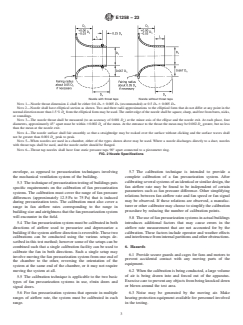
3.2.14 nozzle throat pressure difference, n—static pressure
difference across the nozzle in a duct measured with throat taps
expressed in pascals (see Fig. 2).
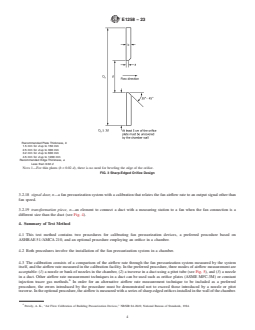
3.2.15 orifice, n—a sharp-edged circular constriction used in
airflow measurement (see Fig. 3).
3.2.16 orifice pressure difference, n—static pressure differ-
ence measured across an orifice when the orifice is installed in
a chamber expressed in pascals.
3.2.17 revolution-per-minute (r/min) door, n—a fan pressur-
ization system with a calibration that relates the fan airflow rate
to the fan speed.
3.2.18 signal door, n—a fan pressurization system with a
calibration that relates the fan airflow rate to an output signal
other than fan speed.
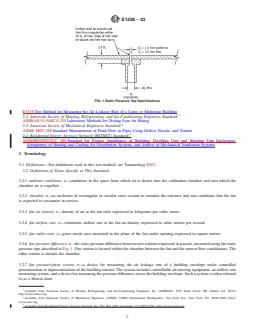
FIG. 1 Static Pressure Tap Specifications
3.2.19 transformation piece, n—an element to connect a
duct with a measuring station to a fan when the fan connection
is a different size than the duct (see Fig. 4).
3.2.2 chamber, n—an enclosure of rectangular or circular
cross section to simulate the entrance and exit conditions that
4. Summary of Test Method
the fan is expected to encounter in service.
4.1 This test method contains two procedures for calibrating
3.2.3 fan air density, n—density of air at the fan inlet
fan pressurization devices, a preferred procedure based on
expressed in kilograms per cubic metre.
ASHRAE 51 ⁄AMCA 210, and an optional procedure employ-
3.2.4 fan airflow rate, n—volumetric airflow rate at the fan ing an orifice in a chamber.
air density expressed in cubic metres per second.
4.2 Both procedures involve the installation of the fan
3.2.5 fan outlet area, n—gross inside area measured in the
pressurization system in a chamber.
plane of the fan outlet opening expressed in square metres.
4.3 The calibration consists of a comparison of the airflow
3.2.6 fan pressure difference, n—the static pressure differ-
rate through the fan pressurization system measured by the
ence between two stations expressed in pascals, measured
system itself, and the airflow rate measured in the calibration
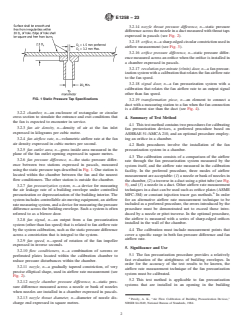
using the static pressure taps described in Fig. 1. One station is
facility. In the preferred procedure, three modes of airflow
located within the chamber between the fan and the nearest
measurement are acceptable: (1) a nozzle or bank of nozzles in
flow conditioners. The other station is outside the chamber.
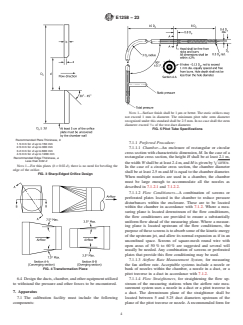
the chamber, (2) a traverse in a duct using a pitot tube (see Fig.
3.2.7 fan pressurization system, n—a device for measuring 5), and (3) a nozzle in a duct. Other airflow rate measurement
techniques in a duct can be used such as orifice plates (ASME
the air leakage rate of a building envelope under controlled
pressurization or depressurization of the building interior. The MFC-3M) or constant injection tracer gas methods. In order
for an alternative airflow rate measurement technique to be
system includes controllable air-moving equipment, an airflow
included as a preferred procedure, the errors introduced by the
rate measuring system, and a device for measuring the pressure
procedure must be demonstrated not to exceed those intro-
difference across the building envelope. Such a system is often
duced by a nozzle or pitot traverse. In the optional procedure,
referred to as a blower door.
the airflow is measured with a series of sharp-edged orifices
3.2.8 fan signal, n—an output from a fan pressurization
installed in the wall of the chamber.
system (other than fan speed) that is related to fan airflow rate
by the system calibration, such as the static pressure difference
4.4 The calibration must include measurement points that
across a constriction that is integral to the system. cover a specific range in both fan pressure difference and fan
airflow rate.
3.2.9 fan speed, n—speed of rotation of the fan impeller
expressed in inverse seconds.
5. Significance and Use
3.2.10 flow conditioners, n—a combination of screens or
5.1 The fan pressurization procedure provides a relatively
perforated plates located within the calibration chamber to
fast evaluation of the airtightness of building envelopes. In
reduce pressure disturbances within the chamber.
order for the accuracy of the test results to be known, the
3.2.11 nozzle, n—a gradually tapered constriction, of very
airflow rate measurement technique of the fan pressurization
precise elliptical shape, used in airflow rate measurement (see
system must be calibrated.
Fig. 2).
5.2 This test method is applicable to fan pressurization
3.2.12 nozzle chamber pressure difference, n—static pres-
systems that are installed in an opening in the building
sure difference measured across a nozzle or bank of nozzles
when nozzles are installed in a chamber expressed in pascals.
3.2.13 nozzle throat diameter, n—diameter of nozzle dis-
Persily, A. K., “Air Flow Calibration of Building Pressurization Devices,”
charge end expressed in square metres. NBSIR 84-2849, National Bureau of Standards, 1984.
E1258 − 23
Nozzle with throat taps Nozzle without throat taps
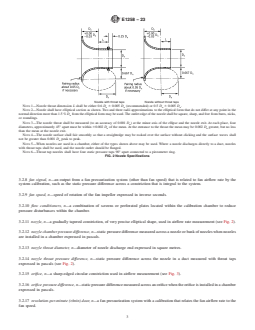
NOTE 1—Nozzle throat dimension L shall be either 0.6 D 6 0.005 D (recommended) or 0.5 D 6 0.005 D .
n n n n
NOTE 2—Nozzle shall have elliptical section as shown. Two and three radii approximations to the elliptical form that do not differ at any point in the
normal direction more than 1.5 % D from the elliptical form may be used. The outlet edge of the nozzle shall be square, sharp, and free from burrs, nicks,
n
or roundings.
NOTE 3—The nozzle throat shall be measured (to an accuracy of 0.001 D ) at the minor axis of the ellipse and the nozzle exit. At each place, four
n
diameters, approximately 45° apart must be within 60.002 D of the mean. At the entrance to the throat the mean may be 0.002 D greater, but no less
n n
than the mean at the nozzle exit.
NOTE 4—The nozzle surface shall fair smoothly so that a straightedge may be rocked over the surface without clicking and the surface waves shall
not be greater than 0.001 D peak to peak.
n
NOTE 5—When nozzles are used in a chamber, either of the types shown above may be used. Where a nozzle discharges directly to a duct, nozzles
with throat taps shall be used, and the nozzle outlet should be flanged.
NOTE 6—Throat tap nozzles shall have four static pressure taps 90° apart connected to a piezometer ring.
FIG. 2 Nozzle Specifications
envelope, as opposed to pressurization techniques involving 5.7 The calibration technique is intended to provide a
the mechanical ventilation system of the building. complete calibration of a fan pressurization system. After
calibrating several systems of an identical or similar design, the
5.3 The technique of pressurization testing of buildings puts
fan airflow rate may be found to be independent of certain
specific requirements on the calibration of fan pressurization
parameters such as fan pressure difference. Other simplifying
systems. The calibration must cover the range of fan pressure
relations between fan airflow rate and fan speed or fan signal
differences (approximately 12.5 Pa to 75 Pa) that is induced
may be observed. If these relations are observed, a manufac-
during pressurization tests. The calibration must also cover a
turer or other calibrator may choose to simplify the calibration
range in fan airflow rates corresponding to the range in
procedure by reducing the number of calibration points.
building size and airtightness that the fan pressurization system
will encounter in the field.
5.8 The use of fan pressurization systems in actual buildings
5.4 The fan pressurization system must be calibrated in both introduces additional factors that may cause errors in the
directions of airflow used to pressurize and depressurize a airflow rate measurement that are not accounted for by the
building if the system airflow direction is reversible. These two calibration. These factors include operator and weather effects
calibrations can be conducted using the various setups de- and interference from internal partitions and other obstructions.
scribed in this test method; however some of the setups can be
combined such that a single calibration facility can be used to 6. Hazards
calibrate the fan in both directions. Such a single setup may
6.1 Provide secure guards and cages for fans and motors to
involve moving the fan pressurization system from one end of
prevent accidental contact with any moving parts of the
the chamber to the other, reversing the orientation of the
equipment.
system at the same end of the chamber, or it may not require
moving the system at all.
6.2 When the calibration is being conducted, a large volume
of air is being drawn into and forced out of the apparatus.
5.5 The calibration technique is applicable to the two basic
Exercise care to prevent any objects from being knocked down
types of fan pressurization systems in use, r/min doors and
or blown around the test area.
signal doors.
5.6 For fan pressurization systems that operate in multiple 6.3 Noise may be generated by the moving air. Make
ranges of airflow rate, the system must be calibrated in each hearing protection equipment available for personnel involved
range. in the testing.
E1258 − 23
NOTE 1—Surface finish shall be 1 μm or better. The static orifices may
not exceed 1 mm in diameter. The minimum pitot tube stem diameter
recognized under this standard shall be 2.5 mm. In no case shall the stem
diameter exceed ⁄30 of the test duct diameter.
FIG. 5 Pitot Tube Specifications
Recommended Plate Thickness, b
7.1.1 Preferred Procedure:
1.5 mm for d up to 150 mm
2.5 mm for d up to 300 mm
7.1.1.1 Chamber—An enclosure of rectangular or circular
3.2 mm for d up to 600 mm
cross section with characteristic dimension, M. In the case of a
4.5 mm for d up to 1200 mm
rectangular cross section, the height H shall be at least 2.1 m,
Recommended Edge Thickness, a
Less than 0.02 d
the width W shall be at least 2.4 m, and M is given by =4HW/π.
NOTE 1—For thin plates (b < 0.02 d), there is no need for beveling the
In the case of a circular cross section, the chamber diameter
edge of the orifice.
shall be at least 2.5 m and M is equal to the chamber diameter.
FIG. 3 Sharp-Edged Orifice Design
When multiple nozzles are used in a chamber, the chamber
must be large enough to accommodate all the nozzles as
described in 7.1.2.1 and 7.1.2.2.
7.1.1.2 Flow Conditioners—A combination of screens or
perforated plates located in the chamber to reduce pressure
disturbances within the enclosure. These are to be located
within the chamber in accordance with 7.1.2. Where a mea-
suring plane is located downstream of the flow conditioners,
the flow conditioners are provided to ensure a substantially
uniform flow ahead of the measuring plane. Where a measur-
ing plane is located upstream of the flow conditioners, the
purpose of these screens is to absorb some of the kinetic energy
of the upstream jet, and allow its normal expansion as if in an
unconfined space. Screens of square-mesh round wire with
open areas of 50 % to 60 % are suggested and several will
usually be needed. Any combination of screens or perforated
plates that provide this flow conditioning may be used.
7.1.1.3 Airflow Rate Measurement System, for measuring
the fan airflow rate. Acceptable systems include a nozzle or
FIG. 4 Transformation Piece bank of nozzles within the chamber, a nozzle in a duct, or a
pitot traverse in a duct in accordance with 7.1.2.
6.4 Design the ducts, chamber, and other equipment utilized 7.1.1.4 Flow Straighteners, for straightening the flow up-
to withstand the pressure and other forces to be encountered. stream of the measuring stations when the airflow rate mea-
surement system uses a nozzle in a duct or a pitot traverse in
7. Apparatus
a duct. The downstream plane of the straightener shall be
7.1 The calibration facility must include the following located between 5 and 5.25 duct diameters upstream of the
components: plane of the pitot traverse or nozzle. A recommended form for
E1258 − 23
distance between centers of any two nozzles in simultaneous
use shall be three times the throat diameter of the larger nozzle,
with flow conditioners on either side (see Fig. 7 (b)).
7.1.2.3 Ducted Nozzle/Inflow—The airflow rate measure-
ment station is a ducted nozzle at the end of the chamber. One
set of flow conditioners is required in the chamber. The
variable exhaust system is located downstream of the measure-
ment station (see Fig. 7 (c)).
7.1.2.4 Ducted Nozzle/Outflow—The airflow rate measure-
ment station is a ducted nozzle in the inlet to the chamber. One
set of flow conditioners is required in the chamber, along with
flow straighteners upstream of the nozzle. The variable supply
system is located upstream of the measurement duct. A
NOTE 1—All Dimensions shall be within 60.005 D except y which
transformation piece may be required between the supply
shall not exceed 0.005 D.
system and the duct. The ratio of the nozzle throat diameter to
FIG. 6 Flow Straightener Specifications
the diameter of the inlet duct shall not exceed 0.5 (see Fig. 7
(d)).
the straightener is shown in Fig. 6. The dimension D is the
7.1.2.5 Pitot Traverse/Inflow—The airflow rate measure-
inside diameter of the duct. The dimension y, which is the
ment station is a pitot traverse in an outlet duct. One set of flow
thickness of the straightener elements, shall not exceed
conditioners is required in the chamber. A set of flow straight-
0.005 D.
eners is required between the chamber outlet and the measure-
7.1.1.5 Variable Supply/Exhaust System—A controllable fan
ment station. The variable exhaust system is located down-
or throttling device to enable variation in the fan pressure
stream of the measurement station (see Fig. 7 (e)).
difference at a particular airflow rate.
7.1.2.6 Pitot Traverse/Outflow—The airflow rate measure-
7.1.1.6 Pressure Difference Measuring Device, for measur-
ment station is a pitot traverse in an inlet duct. One set of flow
ing the fan pressure difference, and if applicable the nozzle
conditioners is required in the chamber. The variable supply
chamber or nozzle throat pressure difference, with a maximum
system is located upstream of the measurement station. A set of
error of 1 % of the maximum observed reading or 1.25 Pa,
flow straighteners is required between the variable supply
whichever is greater.
system and the measurement station. A transformation piece
7.1.1.7 Temperature Measuring Devices, to measure dry-
may be required between the supply system and the duct. The
...
This document is not an ASTM standard and is intended only to provide the user of an ASTM standard an indication of what changes have been made to the previous version. Because
it may not be technically possible to adequately depict all changes accurately, ASTM recommends that users consult prior editions as appropriate. In all cases only the current version
of the standard as published by ASTM is to be considered the official document.
Designation: E1258 − 88 (Reapproved 2018) E1258 − 23
Standard Test Method for
Airflow Calibration of Fan Pressurization Devices
This standard is issued under the fixed designation E1258; the number immediately following the designation indicates the year of
original adoption or, in the case of revision, the year of last revision. A number in parentheses indicates the year of last reapproval. A
superscript epsilon (´) indicates an editorial change since the last revision or reapproval.
1. Scope
1.1 This test method covers the airflow measurement calibration techniques for fan pressurization systems used for measuring air
leakage rates through building envelopes.
1.2 This test method is applicable to systems used for air leakage measurement as described in Test MethodMethods E779., E1827,
E3158, and ANSI/RESNET/ICC 380.
1.3 This test method involves the installation of the fan pressurization system in a calibration chamber. Use of the fan
pressurization system in an actual building may introduce additional errors in the airflow measurement due to operator influence,
interference of internal partitions and furnishings, weather effects, and other factors.
1.4 The proper use of this test method requires a knowledge of the principles of airflow and pressure measurement.
1.5 This standard includes two basic procedures, a preferred procedure, based on ASHRAE 51 ⁄AMCA 210, and an optional
procedure based on a nonstandard airflow measurement technique, commonly used by manufacturers of fan pressurization devices,
but which has not been compared with standard airflow measurement techniques.
1.6 The values stated in SI units are to be regarded as standard. No other units of measurement are included in this standard.
1.7 This standard does not purport to address all of the safety concerns, if any, associated with its use. It is the responsibility
of the user of this standard to establish appropriate safety, health, and environmental practices and determine the applicability of
regulatory limitations prior to use.
1.8 This international standard was developed in accordance with internationally recognized principles on standardization
established in the Decision on Principles for the Development of International Standards, Guides and Recommendations issued
by the World Trade Organization Technical Barriers to Trade (TBT) Committee.
2. Referenced Documents
2.1 ASTM Standards:
E631 Terminology of Building Constructions
E779 Test Method for Determining Air Leakage Rate by Fan Pressurization
E1827 Test Methods for Determining Airtightness of Buildings Using an Orifice Blower Door
This test method is under the jurisdiction of ASTM Committee E06 on Performance of Buildings and is the direct responsibility of Subcommittee E06.41 on Air Leakage
and Ventilation Performance.
Current edition approved July 1, 2018July 1, 2023. Published July 2018August 2023. Originally approved in 1988. Last previous edition approved in 20122018 as
E1258 – 88 (2012).(2018). DOI: 10.1520/E1258-88R18.10.1520/E1258-23.
For referenced ASTM standards, visit the ASTM website, www.astm.org, or contact ASTM Customer Service at service@astm.org. For Annual Book of ASTM Standards
volume information, refer to the standard’s Document Summary page on the ASTM website.
Copyright © ASTM International, 100 Barr Harbor Drive, PO Box C700, West Conshohocken, PA 19428-2959. United States
E1258 − 23
FIG. 1 Static Pressure Tap Specifications
E3158 Test Method for Measuring the Air Leakage Rate of a Large or Multizone Building
2.2 American Society of Heating, Refrigerating, and Air-Conditioning Engineers Standard:
ASHRAE 51 ⁄AMCA 210 Laboratory Methods for Testing Fans for Rating
2.3 American Society of Mechanical Engineers Standard:
ASME MFC-3M Standard Measurement of Fluid Flow in Pipes Using Orifice, Nozzle, and Venturi
2.4 Residential Energy Services Network (RESNET) Standard:
ANSI/RESNET/ICC 380 Standard for Testing Airtightness of Building, Dwelling Unit and Sleeping Unit Enclosures;
Airtightness of Heating and Cooling Air Distribution Systems, and Airflow of Mechanical Ventilation Systems
3. Terminology
3.1 Definitions—For definitions used in this test method, see Terminology E631.
3.2 Definitions of Terms Specific to This Standard:
3.2.1 ambient conditions, n—conditions in the space from which air is drawn into the calibration chamber and into which the
chamber air is expelled.
3.2.2 chamber, n—an enclosure of rectangular or circular cross section to simulate the entrance and exit conditions that the fan
is expected to encounter in service.
3.2.3 fan air density, n—density of air at the fan inlet expressed in kilograms per cubic metre.
3.2.4 fan airflow rate, n—volumetric airflow rate at the fan air density expressed in cubic metres per second.
3.2.5 fan outlet area, n—gross inside area measured in the plane of the fan outlet opening expressed in square metres.
3.2.6 fan pressure difference, n—the static pressure difference between two stations expressed in pascals, measured using the static
pressure taps described in Fig. 1. One station is located within the chamber between the fan and the nearest flow conditioners. The
other station is outside the chamber.
3.2.7 fan pressurization system, n—a device for measuring the air leakage rate of a building envelope under controlled
pressurization or depressurization of the building interior. The system includes controllable air-moving equipment, an airflow rate
measuring system, and a device for measuring the pressure difference across the building envelope. Such a system is often referred
to as a blower door.
Available from American Society of Heating, Refrigerating, and Air-Conditioning Engineers, Inc. (ASHRAE), 1791 Tullie Circle, NE, Atlanta, GA 30329,
http://www.ashrae.org.
Available from American Society of Mechanical Engineers (ASME), ASME International Headquarters, Two Park Ave., New York, NY 10016-5990, http://
www.asme.org.
Available from Residential Energy Services Network, Inc, P.O. Box 4561 Oceanside, CA 92052-4561, https://www.resnet.us/
E1258 − 23
Nozzle with throat taps Nozzle without throat taps
NOTE 1—Nozzle throat dimension L shall be either 0.6 D 6 0.005 D (recommended) or 0.5 D 6 0.005 D .
n n n n
NOTE 2—Nozzle shall have elliptical section as shown. Two and three radii approximations to the elliptical form that do not differ at any point in the
normal direction more than 1.5 % D from the elliptical form may be used. The outlet edge of the nozzle shall be square, sharp, and free from burrs, nicks,
n
or roundings.
NOTE 3—The nozzle throat shall be measured (to an accuracy of 0.001 D ) at the minor axis of the ellipse and the nozzle exit. At each place, four
n
diameters, approximately 45° apart must be within 60.002 D of the mean. At the entrance to the throat the mean may be 0.002 D greater, but no less
n n
than the mean at the nozzle exit.
NOTE 4—The nozzle surface shall fair smoothly so that a straightedge may be rocked over the surface without clicking and the surface waves shall
not be greater than 0.001 D peak to peak.
n
NOTE 5—When nozzles are used in a chamber, either of the types shown above may be used. Where a nozzle discharges directly to a duct, nozzles
with throat taps shall be used, and the nozzle outlet should be flanged.
NOTE 6—Throat tap nozzles shall have four static pressure taps 90° apart connected to a piezometer ring.
FIG. 2 Nozzle Specifications
3.2.8 fan signal, n—an output from a fan pressurization system (other than fan speed) that is related to fan airflow rate by the
system calibration, such as the static pressure difference across a constriction that is integral to the system.
3.2.9 fan speed, n—speed of rotation of the fan impeller expressed in inverse seconds.
3.2.10 flow conditioners, n—a combination of screens or perforated plates located within the calibration chamber to reduce
pressure disturbances within the chamber.
3.2.11 nozzle, n—a gradually tapered constriction, of very precise elliptical shape, used in airflow rate measurement (see Fig. 2).
3.2.12 nozzle chamber pressure difference, n—static pressure difference measured across a nozzle or bank of nozzles when nozzles
are installed in a chamber expressed in pascals.
3.2.13 nozzle throat diameter, n—diameter of nozzle discharge end expressed in square metres.
3.2.14 nozzle throat pressure difference, n—static pressure difference across the nozzle in a duct measured with throat taps
expressed in pascals (see Fig. 2).
3.2.15 orifice, n—a sharp-edged circular constriction used in airflow measurement (see Fig. 3).
3.2.16 orifice pressure difference, n—static pressure difference measured across an orifice when the orifice is installed in a chamber
expressed in pascals.
3.2.17 revolution-per-minute (r/min) door, n—a fan pressurization system with a calibration that relates the fan airflow rate to the
fan speed.
E1258 − 23
Recommended Plate Thickness, b
1.5 mm for d up to 150 mm
2.5 mm for d up to 300 mm
3.2 mm for d up to 600 mm
4.5 mm for d up to 1200 mm
Recommended Edge Thickness, a
Less than 0.02 d
NOTE 1—For thin plates (b < 0.02 d), there is no need for beveling the edge of the orifice.
FIG. 3 Sharp-Edged Orifice Design
3.2.18 signal door, n—a fan pressurization system with a calibration that relates the fan airflow rate to an output signal other than
fan speed.
3.2.19 transformation piece, n—an element to connect a duct with a measuring station to a fan when the fan connection is a
different size than the duct (see Fig. 4).
4. Summary of Test Method
4.1 This test method contains two procedures for calibrating fan pressurization devices, a preferred procedure based on
ASHRAE 51 ⁄AMCA 210, and an optional procedure employing an orifice in a chamber.
4.2 Both procedures involve the installation of the fan pressurization system in a chamber.
4.3 The calibration consists of a comparison of the airflow rate through the fan pressurization system measured by the system
itself, and the airflow rate measured in the calibration facility. In the preferred procedure, three modes of airflow measurement are
acceptable: (1) a nozzle or bank of nozzles in the chamber, (2) a traverse in a duct using a pitot tube (see Fig. 5), and (3) a nozzle
in a duct. Other airflow rate measurement techniques in a duct can be used such as orifice plates (ASME MFC-3M) or constant
injection tracer gas methods. In order for an alternative airflow rate measurement technique to be included as a preferred
procedure, the errors introduced by the procedure must be demonstrated not to exceed those introduced by a nozzle or pitot
traverse. In the optional procedure, the airflow is measured with a series of sharp-edged orifices installed in the wall of the chamber.
Persily, A. K., “Air Flow Calibration of Building Pressurization Devices,” NBSIR 84-2849, National Bureau of Standards, 1984.
E1258 − 23
FIG. 4 Transformation Piece
NOTE 1—Surface finish shall be 1 μm or better. The static orifices may not exceed 1 mm in diameter. The minimum pitot tube stem diameter recognized
under this standard shall be 2.5 mm. In no case shall the stem diameter exceed ⁄30 of the test duct diameter.
FIG. 5 Pitot Tube Specifications
4.4 The calibration must include measurement points that cover a specific range in both fan pressure difference and fan airflow
rate.
5. Significance and Use
5.1 The fan pressurization procedure provides a relatively fast evaluation of the airtightness of building envelopes. In order for
the accuracy of the test results to be known, the airflow rate measurement technique of the fan pressurization system must be
calibrated.
5.2 This test method is applicable to fan pressurization systems that are installed in an opening in the building envelope, as
opposed to pressurization techniques involving the mechanical ventilation system of the building.
5.3 The technique of pressurization testing of buildings puts specific requirements on the calibration of fan pressurization systems.
The calibration must cover the range of fan pressure differences (approximately 12.5 to 75 Pa) 12.5 Pa to 75 Pa) that is induced
E1258 − 23
during pressurization tests. The calibration must also cover a range in fan airflow rates corresponding to the range in building size
and airtightness that the fan pressurization system will encounter in the field.
5.4 The fan pressurization system must be calibrated in both directions of airflow used to pressurize and depressurize a building
if the system airflow direction is reversible. These two calibrations can be conducted using the various setups described in this test
method; however some of the setups can be combined such that a single calibration facility can be used to calibrate the fan in both
directions. Such a single setup may involve moving the fan pressurization system from one end of the chamber to the other,
reversing the orientation of the system at the same end of the chamber, or it may not require moving the system at all.
5.5 The calibration technique is applicable to the two basic types of fan pressurization systems in use, r/min doors and signal
doors.
5.6 For fan pressurization systems that operate in multiple ranges of airflow rate, the system must be calibrated in each range.
5.7 The calibration technique is intended to provide a complete calibration of a fan pressurization system. After calibrating several
systems of an identical or similar design, the fan airflow rate may be found to be independent of certain parameters such as fan
pressure difference. Other simplifying relations between fan airflow rate and fan speed or fan signal may be observed. If these
relations are observed, a manufacturer or other calibrator may choose to simplify the calibration procedure by reducing the number
of calibration points.
5.8 The use of fan pressurization systems in actual buildings introduces additional factors that may cause errors in the airflow rate
measurement that are not accounted for by the calibration. These factors include operator and weather effects and interference from
internal partitions and other obstructions.
6. Hazards
6.1 Provide secure guards and cages for fans and motors to prevent accidental contact with any moving parts of the equipment.
6.2 When the calibration is being conducted, a large volume of air is being drawn into and forced out of the apparatus. Exercise
care to prevent any objects from being knocked down or blown around the test area.
6.3 Noise may be generated by the moving air. Make hearing protection equipment available for personnel involved in the testing.
6.4 Design the ducts, chamber, and other equipment utilized to withstand the pressure and other forces to be encountered.
7. Apparatus
7.1 The calibration facility must include the following components:
7.1.1 Preferred Procedure:
7.1.1.1 Chamber—An enclosure of rectangular or circular cross section with characteristic dimension, M. In the case of a
rectangular cross section, the height H shall be at least 2.1 m, the width W shall be at least 2.4 m, and M is given by =4HW/π.
In the case of a circular cross section, the chamber diameter shall be at least 2.5 m and M is equal to the chamber diameter. When
multiple nozzles are used in a chamber, the chamber must be large enough to accommodate all the nozzles as described in 7.1.2.1
and 7.1.2.2.
7.1.1.2 Flow Conditioners—A combination of screens or perforated plates located in the chamber to reduce pressure disturbances
within the enclosure. These airare to be located within the chamber in accordance with 7.1.2. Where a measuring plane is located
downstream of the flow conditioners, the flow conditioners are provided to ensure a substantially uniform flow ahead of the
measuring plane. Where a measuring plane is located upstream of the flow conditioners, the purpose of these screens is to absorb
some of the kinetic energy of the upstream jet, and allow its normal expansion as if in an unconfined space. Screens of square-mesh
round wire with open areas of 5050 % to 60 % are suggested and several will usually be needed. Any combination of screens or
perforated plates that provide this flow conditioning may be used.
E1258 − 23
NOTE 1—All Dimensions shall be within 60.005 D except y which shall not exceed 0.005 D.
FIG. 6 Flow Straightener Specifications
7.1.1.3 Airflow Rate Measurement System, for measuring the fan airflow rate. Acceptable systems include a nozzle or bank of
nozzles within the chamber, a nozzle in a duct, or a pitot traverse in a duct in accordance with 7.1.2.
7.1.1.4 Flow Straighteners, for straightening the flow upstream of the measuring stations when the airflow rate measurement
system uses a nozzle in a duct or a pitot traverse in a duct. The downstream plane of the straightener shall be located between 5
and 5.25 duct diameters upstream of the plane of the pitot traverse or nozzle. A recommended form for the straightener is shown
in Fig. 6. The dimension D is the inside diameter of the duct. The dimension y, which is the thickness of the straightener elements,
shall not exceed 0.005 D.
7.1.1.5 Variable Supply/Exhaust System—A controllable fan or throttling device to enable variation in the fan pressure difference
at a particular airflow rate.
7.1.1.6 Pressure Difference Measuring Device, for measuring the fan pressure difference, and if applicable the nozzle chamber or
nozzle throat pressure difference, with a maximum error of 1 % of the maximum observed reading or 1.25 Pa, whichever is greater.
7.1.1.7 Temperature Measuring Devices, to measure drybulb temperatures within an accuracy of 61 °C.
7.1.1.8 Barometric Pressure Measuring Device, for measuring the barometric pressure within an accuracy of 6200 Pa.
7.1.2 Calibration Setups—The six basic calibration setups are described in 7.1.2.1 – 7.1.2.6 and shown in Fig. 7 (a) through Fig.
7 (f) (adapted from ASHRAE 51 ⁄AMCA 210). These setups are of two basic types: inflow and outflow. In the inflow setups, the
fan pressurization system forces air into the chamber. In the outflow setups, the system pulls air out of the chamber. In all cases
there must be a minimum distance of 2M between the fan pressurization system inlet and outlet and the nearest wall or other
vertical obstruction.
7.1.2.1 Chamber Nozzle/Inflow—The airflow rate measurement station consists of a nozzle or bank of nozzles within the chamber
with flow conditioners on either side. Multiple nozzles shall be located as symmetrically in the measurement plane as possible.
The centerline of each nozzle shall be at least 1.5 times the nozzle throat diameter from the chamber wall. The minimum distance
between centers of any two nozzles in simultaneous use shall be three times the throat diameter of the larger nozzle. The fan
pressurization system is in the inlet wall and a variable exhaust system is located in the outlet (see Fig. 7 (a)).
7.1.2.2 Chamber Nozzle/Outflow—The setup is basically the same as that in 7.1.3 with the locations of the fan pressurization
system and the variable exhaust (now supply) system reversed. Multiple nozzles shall be located as symmetrically as possible. The
centerline of each nozzle shall be at least 1.5 times the nozzle throat diameter from the chamber wall. The minimum distance
between centers of any
...