

ASTM D5073-21
(Practice)Standard Practice for Depth Measurement of Surface Water
General Information
- Abstract
SIGNIFICANCE AND USE
5.1 This is a general practice intended to give direction in the selection of depth measuring procedures and equipment for use under a wide range of conditions encountered in surface water bodies. Physical conditions at the measuring site, the quality of data required, and the availability of appropriate measuring equipment govern the selection process. A step-by-step procedure for actually obtaining a depth measurement is not discussed. This practice is to be used in conjunction with a practice on positioning techniques and another practice on bathymetric survey procedures to obtain horizontal location and bottom elevations of points on a water body.
SCOPE
1.1 This practice guides the user in selection of procedures commonly used to measure depth in water bodies that are as follows:
Sections
Procedure A—Manual Measurement
6 through 11
Procedure B—Electronic Sonic-Echo Sounding
12 through 13
Procedure C—Electronic Nonacoustic Measurement
14 through 15
The text specifies depth measuring terminology, describes measurement of depth by manual and electronic equipment, outlines specific uses of electronic sounders, and describes an electronic procedure for depth measurement other than using sonar.
1.2 The references cited and listed at the end of this practice contain information that may help in the design of a high quality measurement program.
1.3 The information provided on depth measurement is descriptive in nature and not intended to endorse any particular item of manufactured equipment or procedure.
1.4 This practice pertains to depth measurement in quiescent or low-velocity flow. For depth measurement related to stream gauging, see Test Method D3858. For depth measurements related to reservoir surveys, see Guide D4581.
1.5 The values stated in inch-pound units are to be regarded as standard. The values given in parentheses are mathematical conversions to SI units that are provided for information only and are not considered standard.
1.6 This standard does not purport to address all of the safety concerns, if any, associated with its use. It is the responsibility of the user of this standard to establish appropriate safety, health, and environmental practices and determine the applicability of regulatory limitations prior to use.
1.7 This international standard was developed in accordance with internationally recognized principles on standardization established in the Decision on Principles for the Development of International Standards, Guides and Recommendations issued by the World Trade Organization Technical Barriers to Trade (TBT) Committee.
- Status
- Published
- Publication Date
- 31-Oct-2021
- Technical Committee
- D19 - Water
- Drafting Committee
- D19.07 - Sediments, Geomorphology, and Open-Channel Flow
Overview
ASTM D5073-21 - Standard Practice for Depth Measurement of Surface Water provides comprehensive guidance for selecting and applying effective depth measurement procedures in various surface water bodies. Developed by ASTM International, this standard supports practitioners in choosing appropriate equipment and methodologies for depth determination, addressing both manual and electronic measurement techniques. The guidance covers a broad range of field conditions, recognizes the importance of data quality, and underscores the significance of using the standard in conjunction with established positioning and bathymetric survey practices to ensure accurate bottom elevation and horizontal location determination.
Key Topics
- Manual Measurement Procedures: Includes methods such as sounding rods, sounding lines, sounding reels, and bar sweeps. Manual techniques are particularly useful for shallow, quiescent water, areas inaccessible to electronic equipment, locating obstacles, verifying electronic measurements, and aiding in bottom sampling for water quality analysis.
- Electronic Sonic-Echo Sounding: Describes the use of echo sounders for water depth determination by measuring the time interval for sound pulses to travel to and reflect back from the water bottom. It offers guidance on transducer frequency selection, recording and interpreting soundings, quality assurance, and common sources of error including sound velocity variations, wave action, and bottom conditions.
- Electronic Nonacoustic Measurement: Briefly outlines non-sonic electronic methods, such as ground-penetrating radar, for specific applications where acoustic equipment may be ineffective.
- Terminology & Definitions: Provides standardized vocabulary around depth measurement, including definitions for terms like sounding lines, bar-checks, transducer draft, sonar, and more, to promote consistency in surface water measurement.
- Limitations and Data Use: The practice focuses on general procedures rather than prescriptive methods, emphasizing selection rather than endorsement of any specific technology or brand. The standard is geared toward still or low-velocity water; for dynamic channels or reservoir surveys, related standards are recommended.
- Safety and Regulatory Considerations: Notes the user’s responsibility to address local safety, health, and environmental practices and comply with regulatory boundaries.
Applications
ASTM D5073-21 is widely applicable for organizations and professionals involved in hydrology, environmental monitoring, water resource management, and civil engineering. Typical uses include:
- Hydrographic and Bathymetric Surveys: Supporting the creation of accurate maps and profiles of lakes, reservoirs, and ponds.
- Navigation Safety Assessments: Locating submerged hazards and verifying navigational clearances in waterways.
- Environmental Monitoring: Gathering base data for sediment studies, aquatic habitat assessments, water quality projects, and ecosystem management.
- Construction and Engineering Projects: Determining site suitability and informing the design of structures such as bridges, dams, docks, or pipelines in or crossing bodies of water.
- Regulatory Compliance and Research: Providing data for reporting, regulatory submissions, and academic studies relating to surface water characteristics.
Related Standards
Utilizing ASTM D5073-21 often requires reference to additional standards for full project integration and enhanced accuracy:
- ASTM D3858: Open-Channel Flow Measurement of Water by Velocity-Area Method - pertinent for stream gauging and dynamic water bodies.
- ASTM D4581: Guide for Measurement of Morphologic Characteristics of Surface Water Bodies (Withdrawn, but still cited for reference).
- ASTM D4410: Terminology for Fluvial Sediment - for projects involving sediment-related measurements.
- ASTM D1129: Terminology Relating to Water - for standardized water-related terms and definitions.
By adhering to ASTM D5073-21, professionals can ensure standardized, reliable, and high-quality depth measurements across a variety of surface water contexts, supporting accurate data collection and effective decision-making in water resources and environmental management.
Relations
- Effective Date
- 01-May-2020
- Effective Date
- 01-Jan-2016
- Effective Date
- 01-Mar-2010
- Effective Date
- 01-Feb-2010
- Effective Date
- 01-Oct-2008
- Effective Date
- 01-Sep-2006
- Effective Date
- 01-Sep-2006
- Effective Date
- 15-Feb-2006
- Effective Date
- 01-Jun-2005
- Effective Date
- 01-Mar-2004
- Effective Date
- 01-Mar-2004
- Effective Date
- 10-Aug-2003
- Effective Date
- 10-Aug-2003
- Effective Date
- 10-Jun-2003
- Effective Date
- 10-Mar-2003
Get Certified
Connect with accredited certification bodies for this standard

CIS Institut d.o.o.
Personal Protective Equipment (PPE) certification body. Notified Body NB-2890 for EU Regulation 2016/425 PPE.

Kiwa BDA Testing
Building and construction product certification.
Kmetijski inštitut Slovenije
Agricultural Institute of Slovenia. Soil testing, plant health, agricultural product analysis.
Sponsored listings
Frequently Asked Questions
ASTM D5073-21 is a standard published by ASTM International. Its full title is "Standard Practice for Depth Measurement of Surface Water". This standard covers: SIGNIFICANCE AND USE 5.1 This is a general practice intended to give direction in the selection of depth measuring procedures and equipment for use under a wide range of conditions encountered in surface water bodies. Physical conditions at the measuring site, the quality of data required, and the availability of appropriate measuring equipment govern the selection process. A step-by-step procedure for actually obtaining a depth measurement is not discussed. This practice is to be used in conjunction with a practice on positioning techniques and another practice on bathymetric survey procedures to obtain horizontal location and bottom elevations of points on a water body. SCOPE 1.1 This practice guides the user in selection of procedures commonly used to measure depth in water bodies that are as follows: Sections Procedure A—Manual Measurement 6 through 11 Procedure B—Electronic Sonic-Echo Sounding 12 through 13 Procedure C—Electronic Nonacoustic Measurement 14 through 15 The text specifies depth measuring terminology, describes measurement of depth by manual and electronic equipment, outlines specific uses of electronic sounders, and describes an electronic procedure for depth measurement other than using sonar. 1.2 The references cited and listed at the end of this practice contain information that may help in the design of a high quality measurement program. 1.3 The information provided on depth measurement is descriptive in nature and not intended to endorse any particular item of manufactured equipment or procedure. 1.4 This practice pertains to depth measurement in quiescent or low-velocity flow. For depth measurement related to stream gauging, see Test Method D3858. For depth measurements related to reservoir surveys, see Guide D4581. 1.5 The values stated in inch-pound units are to be regarded as standard. The values given in parentheses are mathematical conversions to SI units that are provided for information only and are not considered standard. 1.6 This standard does not purport to address all of the safety concerns, if any, associated with its use. It is the responsibility of the user of this standard to establish appropriate safety, health, and environmental practices and determine the applicability of regulatory limitations prior to use. 1.7 This international standard was developed in accordance with internationally recognized principles on standardization established in the Decision on Principles for the Development of International Standards, Guides and Recommendations issued by the World Trade Organization Technical Barriers to Trade (TBT) Committee.
SIGNIFICANCE AND USE 5.1 This is a general practice intended to give direction in the selection of depth measuring procedures and equipment for use under a wide range of conditions encountered in surface water bodies. Physical conditions at the measuring site, the quality of data required, and the availability of appropriate measuring equipment govern the selection process. A step-by-step procedure for actually obtaining a depth measurement is not discussed. This practice is to be used in conjunction with a practice on positioning techniques and another practice on bathymetric survey procedures to obtain horizontal location and bottom elevations of points on a water body. SCOPE 1.1 This practice guides the user in selection of procedures commonly used to measure depth in water bodies that are as follows: Sections Procedure A—Manual Measurement 6 through 11 Procedure B—Electronic Sonic-Echo Sounding 12 through 13 Procedure C—Electronic Nonacoustic Measurement 14 through 15 The text specifies depth measuring terminology, describes measurement of depth by manual and electronic equipment, outlines specific uses of electronic sounders, and describes an electronic procedure for depth measurement other than using sonar. 1.2 The references cited and listed at the end of this practice contain information that may help in the design of a high quality measurement program. 1.3 The information provided on depth measurement is descriptive in nature and not intended to endorse any particular item of manufactured equipment or procedure. 1.4 This practice pertains to depth measurement in quiescent or low-velocity flow. For depth measurement related to stream gauging, see Test Method D3858. For depth measurements related to reservoir surveys, see Guide D4581. 1.5 The values stated in inch-pound units are to be regarded as standard. The values given in parentheses are mathematical conversions to SI units that are provided for information only and are not considered standard. 1.6 This standard does not purport to address all of the safety concerns, if any, associated with its use. It is the responsibility of the user of this standard to establish appropriate safety, health, and environmental practices and determine the applicability of regulatory limitations prior to use. 1.7 This international standard was developed in accordance with internationally recognized principles on standardization established in the Decision on Principles for the Development of International Standards, Guides and Recommendations issued by the World Trade Organization Technical Barriers to Trade (TBT) Committee.
ASTM D5073-21 is classified under the following ICS (International Classification for Standards) categories: 13.060.10 - Water of natural resources. The ICS classification helps identify the subject area and facilitates finding related standards.
ASTM D5073-21 has the following relationships with other standards: It is inter standard links to ASTM D1129-13(2020)e2, ASTM D4410-16, ASTM D1129-10, ASTM D4410-10, ASTM D3858-95(2008), ASTM D1129-06ae1, ASTM D1129-06a, ASTM D1129-06, ASTM D4581-86(2005), ASTM D1129-04, ASTM D1129-04e1, ASTM D4410-03, ASTM D1129-03a, ASTM D3858-95(2003), ASTM D1129-03. Understanding these relationships helps ensure you are using the most current and applicable version of the standard.
ASTM D5073-21 is available in PDF format for immediate download after purchase. The document can be added to your cart and obtained through the secure checkout process. Digital delivery ensures instant access to the complete standard document.
Standards Content (Sample)
This international standard was developed in accordance with internationally recognized principles on standardization established in the Decision on Principles for the
Development of International Standards, Guides and Recommendations issued by the World Trade Organization Technical Barriers to Trade (TBT) Committee.
Designation: D5073 − 21
Standard Practice for
Depth Measurement of Surface Water
This standard is issued under the fixed designation D5073; the number immediately following the designation indicates the year of
original adoption or, in the case of revision, the year of last revision. A number in parentheses indicates the year of last reapproval. A
superscript epsilon (´) indicates an editorial change since the last revision or reapproval.
1. Scope mendations issued by the World Trade Organization Technical
Barriers to Trade (TBT) Committee.
1.1 This practice guides the user in selection of procedures
commonly used to measure depth in water bodies that are as
2. Referenced Documents
follows:
2.1 ASTM Standards:
Sections
D1129 Terminology Relating to Water
Procedure A—Manual Measurement 6 through 11
D3858 Test Method for Open-Channel Flow Measurement
Procedure B—Electronic Sonic-Echo Sounding 12 through 13
Procedure C—Electronic Nonacoustic Measurement 14 through 15
of Water by Velocity-Area Method
D4410 Terminology for Fluvial Sediment
The text specifies depth measuring terminology, describes
D4581 Guide for Measurement of Morphologic Character-
measurement of depth by manual and electronic equipment,
istics of Surface Water Bodies (Withdrawn 2013)
outlines specific uses of electronic sounders, and describes
an electronic procedure for depth measurement other than
3. Terminology
using sonar.
3.1 Definitions:
1.2 The references cited and listed at the end of this practice
3.1.1 For definitions of terms used in this standard, refer to
contain information that may help in the design of a high
Terminologies D1129 and D4410.
quality measurement program.
3.2 Definitions of Terms Specific to This Standard:
1.3 The information provided on depth measurement is
3.2.1 bar-check,n—amethodfordeterminingdepthbelowa
descriptive in nature and not intended to endorse any particular
survey vessel by means of a long, narrow metal bar or beam
item of manufactured equipment or procedure.
suspended on a marked line beneath a sounding transducer.
1.4 This practice pertains to depth measurement in quies-
3.2.2 bar sweep, n—a bar or pipes, suspended by wire or
cent or low-velocity flow. For depth measurement related to
cable beneath a floating vessel, used to search for submerged
stream gauging, see Test Method D3858. For depth measure-
snags or obstructions hazardous to navigation.
ments related to reservoir surveys, see Guide D4581.
3.2.3 beam width, n—theangleindegreesmadebythemain
1.5 The values stated in inch-pound units are to be regarded
lobe of acoustical energy emitted from the radiating face of a
as standard. The values given in parentheses are mathematical
transducer.
conversions to SI units that are provided for information only
3.2.4 bottom profile, n—a line trace of the bottom surface
and are not considered standard.
beneath a water body.
1.6 This standard does not purport to address all of the
3.2.5 sonar, n—a method for detecting and locating objects
safety concerns, if any, associated with its use. It is the
submerged in water by means of the sound waves they reflect
responsibility of the user of this standard to establish appro-
or produce.
priate safety, health, and environmental practices and deter-
3.2.6 sound, vt—to determine the depth of water (1).
mine the applicability of regulatory limitations prior to use.
3.2.7 sounding line, n—a rope or cable used for supporting
1.7 This international standard was developed in accor-
a weight while the weight is lowered below the water surface
dance with internationally recognized principles on standard-
to determine depth.
ization established in the Decision on Principles for the
Development of International Standards, Guides and Recom-
For referenced ASTM standards, visit the ASTM website, www.astm.org, or
contact ASTM Customer Service at service@astm.org. For Annual Book of ASTM
This practice is under the jurisdiction ofASTM Committee D19 on Water and Standards volume information, refer to the standard’s Document Summary page on
is the direct responsibility of Subcommittee D19.07 on Sediments, Geomorphology, the ASTM website.
and Open-Channel Flow. The last approved version of this historical standard is referenced on
Current edition approved Nov. 1, 2021. Published January 2022. Originally www.astm.org.
approved in 1990. Last previous edition approved in 2021 as D5073 – 02 (2021). The boldface numbers in parentheses refer to a list of references at the end of
DOI: 10.1520/D5073-21. this standard.
Copyright © ASTM International, 100 Barr Harbor Drive, PO Box C700, West Conshohocken, PA 19428-2959. United States
D5073 − 21
3.2.8 sounding weight, n—a heavy object usually of lead, 6.2 Description of techniques and equipment are general in
that may be bell-shaped, for use in still water and soft bottom nature.Techniques and equipment may need to be modified for
materials or torpedo shaped with stabilizing fins, for use in use in specific field conditions.
flowing water.
7. Significance and Use
3.2.9 stray, n—spurious marks on the graphic depth records
7.1 Prior to the development of acoustic sounding
caused by surfaces other than the bottom surface of a water
equipment, manual techniques provided the only means of
body below the sounding vessel.
depth measurement. Some circumstances may still require
3.2.10 subbottom profile, n—a trace of a subsurface horizon
sounding by manual techniques such as shallow areas where
due to a change in the acoustic properties of the medium
depth is not sufficient for acoustic sounding. Manual proce-
through which the sound energy has traveled.
dures continue to serve several useful purposes such as the
3.2.11 towfish, n—a streamlined container, containing
following:
acoustical equipment for sounding depth, and designed to be
7.1.1 To search for and confirm the minimum depths over
pulled behind or beneath a survey vessel.
shallow area of sunken obstacles.
3.2.12 transducer, n—a device for translating electrical 7.1.2 To confirm bottom soundings in areas with submerged
energy to acoustical energy and acoustical energy back to vegetation, or other soft bottom materials.
electrical energy. 7.1.3 To assist in obtaining bottom samples.
7.1.4 To calibrate electronic sounding equipment.
3.2.13 transducer draft, n—the distance from the water
7.1.5 To suspend other measuring instruments to known
surface to the radiating face of a transducer.
depths for making various physical or chemical water quality
3.2.14 vertical control, n—a horizontal plane of reference
measurements (2).
used to convert measured depth to bottom elevation.
8. Sounding Rod (Manual Procedure)
4. Summary of Practices
8.1 The sounding rod (or sounding pole) can be used to
4.1 These practices include the following three general
measure depth over extensive flat, shallow areas more easily
techniques for acquiring depth measurements in surface water:
and more accurately than by other means. Use of the sounding
4.1.1 The first general technique is to determine depth by
rod should be restricted to still water or where the velocity is
manual procedures. The equipment to perform these proce-
relatively low, and to depths less than 12 ft (3.7 m). Sounding
dures may be most readily available and most practical under
rods are usually not used in depths over 6 ft (1.8 m) except to
certain conditions.
provide supplemental soundings to aid in interpreting analog
4.1.2 Thesecondgeneraltechniqueistodeterminedepthby
depth records. A weighted, flat shoe (see Fig. 1) should be
electronic sonic-echo sounding procedures. These procedures
attached to the bottom of the rod to prevent it from penetration
are most commonly used because of their reliability and the
of the bottom sediments.The rod may be graduated in feet and
variety of instruments available that meet specific measuring
tenths of a foot; zero being at the bottom of the shoe (3).
requirements.
4.1.3 The third general technique is to determine depth by
8.2 Modern sounding rods may be made of light-weight
an electronic procedure other than acoustic sounding. A pro- metals for strength, neutral buoyancy, and sound transmitting
cedure using ground penetrating radar is currently being used
capability. An experienced operator can measure the water
for measuring water depth for specific applications. depth and can distinguish the relative firmness of the bottom
material by the feel of the rod and the tone produced by the
5. Significance and Use
metal pole as it contacts the bottom (4).
5.1 This is a general practice intended to give direction in
8.3 When sounding in still water the operator should lower
the selection of depth measuring procedures and equipment for
therodintothewateruntilthebottomplatemakescontactwith
use under a wide range of conditions encountered in surface
the bottom surface. After determining that a firm bottom
water bodies. Physical conditions at the measuring site, the
material has been encountered, the water surface level is
quality of data required, and the availability of appropriate
visually read on the rod. When sounding in flowing water, to
measuring equipment govern the selection process. A step-by-
achieve vertical sounding, a long wire or cable anchored
step procedure for actually obtaining a depth measurement is
upstream and attached to the lower end of the rod may be
not discussed. This practice is to be used in conjunction with a
necessary.
practice on positioning techniques and another practice on
bathymetric survey procedures to obtain horizontal location
9. Sounding Line (Manual Procedure)
and bottom elevations of points on a water body.
9.1 The sounding line (see Fig. 2) can be used to measure
depthsoflargemagnitudebutisseldomusedfordepthsgreater
PROCEDURE A—MANUAL MEASUREMENT
than 15 ft (4.57 m). The sounding line should be of a material
6. Scope
that does not shrink or stretch, or lengthen from wear or
6.1 Thisprocedureexplainsthemeasurementofwaterdepth corrosion of the material as will occur in chain links over
using manual techniques and equipment.These include the use several years of use. Though manila rope and cotton, or other
of sounding rods, sounding lines, sounding reels, or a bar materials that require prestretching before use, have been
sweep. employed for large depths, small-diameter high-strength steel
D5073 − 21
be used without introducing significant error. Depth indicators,
calibrated in either inch-pound or metric units, or both, are
available (5).
9.2 Markingsonthesoundinglineshouldbeeasytoseeand
understand to avoid making errors in determining the readings.
For sounding relatively shallow depths, marking at 0.5-ft
intervals with different colors to identify the 1, 2, and 10-ft
intervals is recommended. Care must be exercised so that the
first marker is the correct distance from the bottom of the
sounding weight when the weight is attached. When sounding,
depths are obtained from the difference in readings at an index
point on the bridge or boat rail, when the base of the sounding
weight is at the water surface, and when it is at the bottom. A
short steel tape or folding rule is usually employed to measure
the fractional distance from the line markers to the reference
point. Within the minimum 0.5-ft markings depths are esti-
mated and recorded to the nearest 0.1 ft. For sounding in deep
water, a sounding reel with depth indicator and an unmarked
high-strength steel cable is recommended (4).
9.2.1 When the metric system of units is used, the sounding
line for use in shallow depths is usually marked at 0.5-m
intervals with different colors to identify the 1 and 2-m
intervals. Depths are recorded to the nearest 0.01 m.
9.3 Weightsusedinsoundingareusuallyoflead,aluminum,
or brass. For application in still water, the weights are
FIG. 1 Graduated Sounding Rod with Shoe Attached
bell-shaped (see Fig. 3a) and made of cast aluminum or lead.
Theamountofweightshouldbefrom5to10lb(2.3to4.5kg).
9.3.1 For application in flowing water, the weight should be
of circular cross section and steamlined with fins (see Fig. 3b)
toturntheweightnosefirstintothecurrenttoofferaminimum
of resistance to the flow. The amount of weight should be
varied, depending on the water depth and flow velocity at a
cross section. A rule of thumb is that the weight in pounds
should be greater than the maximum product of velocity and
depth in the cross section. If debris or ice is flowing or the
stream is shallow or swift, use a heavier weight than the rule
designates. A variety of sizes of sounding weights from 15 to
300 lb (7 to 136 kg) should be available with appropriate
means of attaching to the sounding line (1). Sounding weights
should always be attached to the sounding line using a hanger
bar, clevis, snap hook, or thimble of brass or stainless steel to
protect the line from wear or damage.
9.4 The procedure for making soundings will vary depend-
ing on depth, current velocity, and means of locating where the
soundings are taken. Once at the location where a depth
measurement is needed, the basic procedure is to lower the
weight until the bottom of the weight is at the water surface.
When using a marked sounding line, the distance is read from
thesoundinglineatareferencepointonthebridgeorboatafter
which the weight is lowered to the bottom, and a new distance
FIG. 2 Sounding Line Used from Small Boat is read from the line and recorded.When using a sounding reel
the indicator is set to zero after which the weight is lowered to
the bottom and the depth is read and recorded. It is usually of
cable wound and released from a reel with a gear driven depth someimportance,especiallywhensoundinganunevenbottom,
indicator are readily available and greatly simplify the work to have the locations of the soundings accurately known
(1). The stretch of the high-strength cable is very small for its relative to the surroundings. When sounding from a boat using
intended use, and therefore, a considerable length of cable may weighted line, the boat should be stationary and should remain
D5073 − 21
FIG. 4 Hand-Operated Sounding Reel (1)
to allow the crank to be disengaged from the shaft while the
(a) Bell Shaped Sounding Weight (4)
wire is let out and engaged for reeling in. Various devices are
employed to drive a counter registering the amount of cable let
out from which the depth below water surface is determined.
These sounding reels may also be electrically driven, in that
case, they may have a depth capacity of more than 5000 ft
(1524 m) (1).
11. Bar Sweep (Manual Procedure)
11.1 The bar sweep is commonly used to search for and
locate any shoal or obstruction within or above navigation
depth that may present a hazard to navigation. It augments the
hydrographic survey in navigable waters by locating shallow
submerged areas that may go undetected by the usual hydro-
graphicprocedures.Thebarsweep(seeFig.5)consistsofabar
(steel pipe) suspended beneath the survey vessel by graduated
wire or cable from hand operated drums. The drums may be
mounted either off the stern or at the port and starboard
gunwale.Eachendofthebarshouldbepackedwithleadtoadd
weight and to reduce lift when underway. Pipe weight is the
(b) Torpedo Columbus-Type Sounding Weight
major factor in allowable vessel speed. Trial and error varia-
tions are usually necessary to determine the best combination.
FIG. 3 Typical Weights Used with Sounding Line
In a normal operation, the bar is lowered to navigation depth
and the vessel moves forward to sweep an area. Whenever a
at that position until the sounding has been completed and the
shoal is encountered, the operator raises the bar until it clears
location is determined.
the obstruction. The shoal depth and position is then recorded.
9.5 Soundingthroughtheicecoverofalakeorrivermaybe
The bar is then returned to navigation depth and the survey
taken after boring holes in the ice with an ice auger. In this
continues (2).
case, a marked sounding line with an appropriate sounding
PROCEDURE B—ELECTRONIC SONIC-ECHO
weight attached at the end, is lowered through the hole and the
SOUNDING
determined depth is recorded.
10. Sounding Reels (Manual Procedure) 12. Scope
10.1 Sounding reels (see Fig. 4) are used with high strength 12.1 This procedure is applicable to the measurement of
cable where heavy weights are required or where depths are water depth using electronic sonic-echo sounding techniques
great. These reels are usually very sturdily constructed having and equipment. Because of the large variety of instrumentation
abrakingsystemforcontrollingrotationofthereelasthecable currently available, this discussion is limited to types of
is let out. For hand operated reels, the hand cranks are hinged equipment in most common use.
D5073 − 21
interval is converted mechanically or electronically to depth
beneath the transmitter by the following equation:
depth 51/2 vt
where:
v = the velocity of sound in water, ft/s (m/s), and
t = the time for the pulse to travel from the transmitter to
the reflective surface and back to the transmitter, s.
Because velocity of sound varies with water density, that is
afunctionoftemperature,salinity,suspendedsolids,anddepth,
ameansofcorrectingtheresultingmeasurementsforvariations
in the velocity of sound must be employed to ensure an
acceptable measurement accuracy (2). The methods for adjust-
ment are presented in 13.6.
13.2.2 The sound waves transmitted by an echo sounder
may be varied in frequency, duration, and shape of the
acousticalbeam(seeFig.6).Thesoundwavemaybedispersed
in all directions, or contained and concentrated into a narrow
beam by a reflector. The suitability of an echo sounder to meet
a given requirement depends on how these variables are
combined (2).
FIG. 5 Bar Sweep for Locating Shoals
12.2 Discussions of the techniques used include methods of
measurement, criteria for selection of sounding frequency and
recording equipment, means for achieving quality assurance,
and factors to consider in interpreting depth records.
13. Sonic-Echo Sounding (Electronic Procedure)
13.1 Water depths are most commonly obtained by echo
sounders that record a continuous profile of the bottom surface
of the water body under the vessel. Echo sounders measure the
timerequiredforasoundwavetotravelfromitspointoforigin
to the bottom and the reflected wave to return. The sounder
then converts this time interval to distance or depth below the
face of the transducer. The transmission of sound is dependent
oncertainpropertiesofthewaterandthereflectingsurface.For
a sound wave to travel at a constant velocity from the surface
to bottom and be completely reflected off the bottom, the water
must have the same physical characteristics throughout its
entiredepthandthebottommustbeaperfectreflector.Because
such conditions do not exist in nature, echo sounders are
usually designed to permit adjustments for variations in the
velocity of sound in water and wave attenuation (2).
13.2 Measuring Principles:
13.2.1 Echo sounding equipment is designed to generate the
sound wave, receive and amplify the returning echo, measure
the intervening time interval, convert the time interval into
units of depth, and record the results graphically, digitally, or
both. The echo sounder only measures time (that is, the time it
takes for a sound wave to travel from the transmitter to the
FIG. 6 Shape of a General-Purpose Echo Sounders’
bottom or other reflecting surface and back again). The time Acoustical Beam (2)
D5073 − 21
13.3 Frequency Selection:
13.3.1 An echo sounding transducer is used to convert
electrical energy pulses to acoustical energy. The acoustical
energy pulses are then transmitted through a liquid medium
and the returning echoes are detected and reconverted back to
electrical energy. These energy pulses are then amplified and
used to compute and record depth. Transducers are usually
designed to operate on specific frequencies, depending on the
application and depth range (2).
13.3.2 Low-frequency transducers, those operating below
15 kHz, produce sound waves having low absorption rates and
high penetrating power. These characteristics make them
useful for deep soundings and penetration of the fine deposited
material on the bottom of a river or lake. These transducers
cannot be used to accurately measure very shallow depths, and
they are very susceptible to noise interference in the more
audiblefrequencyrange.Becauseoftheirlongwavelengthsthe
lower frequency pulses cannot be beamed directionally unless FIG. 7 Analog Bottom Profile Charted with Stylus
the transducers are very large (2). The use of low-frequency
transducers for subbottom penetration is discussed in 13.10.
depth measurement accuracy. Thermal print recorders begin
13.3.3 Medium-frequency transducers (15 to 50 kHz) may
with blank thermal paper. The scale grids and other chart
be used for water depths less than 1800 ft (549 m) and in
features are preprogrammed to be generated by these units,
situations when it is necessary to penetrate a layer of low
allowing for a variety of chart formats (see Fig. 8).
density sediment suspended above more compacted sediments.
13.5 Errors in Measurement:
In this range, the transducers may be small in size, the
13.5.1 Factors that lead to error in depth measurement are
maximum dimension being 8 in. (20.3 cm) or less. These
numerous and should be recognized when conducting a bathy-
transducers can generate a comparatively narrow beam that
metric survey or analyzing graphic depth recordings. For a
results in a more accurate definition of the bottom.
detailed description of these errors, see Ref (2). The most
13.3.4 High-frequency transducers (greater than 50 kHz)
significant factors are described in 13.5.2 – 13.5.9.
overcome most of the disadvantages of the low and medium-
13.5.2 Velocity of Sound Wave Propagation—The velocity
frequency transducers. With small transmitting units, the ultra-
of a sound wave traveling through water varies with tempera-
sonic acoustical energy can be directed and concentrated in a
ture and density. It is, therefore, necessary to check the
relatively narrow water column. By narrowing the beam angle,
effective velocity of sound in a given body of water to achieve
side echoes can be reduced, and a more detailed profile of an
the depth accuracy required. In a deep reservoir, temperatures
irregular bottom can be achieved. In addition, shallow depths
may vary as much as 45°F (25°C) between the surface and the
can be measured more accurately. Due to greater attenuation of
bottom.Inanestuary,salinitymayalsovaryinboththevertical
the sound wave, the high frequencies are ineffective in very
and horizontal direction, thus causing density to vary. Calibra-
deep water (2).
tion of the sounding instrument should be made by the survey
13.4 Recording Soundings:
crew, at appropriate times to adjust the depth readings for
13.4.1 Analog recorders usually employ one of two meth-
changes in water temperature and density (see 13.6).
ods for registering depth on a chart.
13.4.1.1 Inthefirstmethod,thedepthisrecordedbyastylus
mounted on a rotating arm that makes a mark on dry,
electrosensitive, calibrated paper. The stylus passes over the
chart paper at a constant speed marking the chart at the zero
(initial) point, at a point designating the draft of the transducer,
and at a point representing bottom depth.As continuing echoes
are received from the bottom, a bottom profile is recorded (see
Fig. 7). The horizontal scale of the plot is determined by the
chart speed set by the operator.
13.4.1.2 In the second method, the depth is recorded by a
fixed-head thermal recording device (6). The printing mecha-
nism consists of a nonmoving print head containing hundreds
of thermal dots heated precisely at the proper time to print the
chart.The only moving parts on thermal print recorders are the
motor and roller assembly that moves the paper across the
printhead. Unlike moving-stylus type recorders, the chart and
motor timing on the thermal print recorders have no effect on FIG. 8 Analog Bottom Profile Charted by Thermal Printer
D5073 − 21
13.5.3 Signal Transit Time—Water depth is determined by raisethewatersurfaceonthedownwindsideofthewaterbody
the time required for a signal to travel from the transducer, andintroduceerrorshouldaspecificwatersurfaceelevationbe
strikeareflectivesurface,andreturntothetransducer.Withthe assumed for vertical control (8). Real time kinematic global
high quality instruments currently available, errors in time positioning systems (RTK GPS) can provide 2 to 5 centimetre
measurement are insignificant (7). accuracies both horizontally and vertically for the receiver on
the moving survey vessel. The proper use of RTK GPS
13.5.4 Transducer Location—The draft or vertical location
technology can monitor and minimize the errors from tidal and
of the transducer with respect to water surface can be set into
other vertical effects (7).
most high precision echo sounders.The vertical location, when
set for static conditions, will change with the motion of the
13.6 Calibration:
boat. The effect of boat motion on draft, may be corrected
13.6.1 Depth measurements by an echo sounder require a
during calibration of the instrument.
number of corrections. The largest correction results from the
13.5.5 WaveAction—The vertical and rotational motion of a
variability of sound velocity in water. The velocity varies with
boat due to wave action can result in severe fluctuations in the
the temperature, salinity, and depth of water. In fresh water at
bottom trace. Some smoothing of the trace may be necessary
60°F, echo sounders are generally calibrated for a sound
during data processing to eliminate the fluctuations. The
velocity of 4800 ft/s (1463 m/s). The indicated depth given by
motion effects, described as survey vessel roll, pitch, yaw, and the echo sounder needs to be corrected for the difference
heave, were once difficult errors to correct in hydrographic
between the calibrated velocity and the actual velocity deter-
surveying. Measurements from accurate, compact, and rela- mined by the water temperature and salinity. This can be
tively inexpensive motion compensation instruments have
accomplished by several methods. One method is to measure
significantly reduced these errors (7). the temperature and salinity of the water at various depths, and
using predeveloped tables and graphs, correct the depth read-
13.5.6 Bottom Conditions—The condition of the reflective
ings on that basis. A more direct method is to construct
surface of a reservoir or river bottom may vary widely,
calibration curves from bar-check data for a particular instru-
resulting in a sounding chart that gives an erroneous impres-
ment and using these curves to make corrections. A third
sion of the actual bottom profile. Vegetation attached to or
suspended above the bottom, isolated boulders, or submerged method is available on many echo sounders where adjustment
control is offered to adjust velocity of sound to local condi-
man-made objects, may produce a nonrepresentative bottom
profile. Depending on the purpose of the survey, the cause of tions.
13.6.2 Abar-check (see Fig. 9) is the preferred method used
these bottom reflections may have to be determined by other
means before choosing to eliminate them from the trace. to verify the accuracy of an echo sounder and to determine
correctionsforinstrumentandvelocityerror.However,reliable
13.5.7 Nature of Bottom Sediments—Very low density
and accurate bar-checks can be made only under favorable
sediment, suspended as a nepheloid layer or zone above more
conditions. When the water surface is calm and there is little
compacted sediments, can result in an erroneous depth reading
differential current or wind effect near the vessel, bar-checks
whenatransducerwithafrequencyhigherthan50kHzisused.
can be obtained in depths as great as 200 ft (61 m). Under less
Awaterway bottom may be described in nautical terms as any
favorable conditions, accurate bar-check depths may be re-
water/solid interface level that blocks or impedes the passage
duced to 10 ft (3.05 m). In moderate depths where bar-checks
of ships,
...
This document is not an ASTM standard and is intended only to provide the user of an ASTM standard an indication of what changes have been made to the previous version. Because
it may not be technically possible to adequately depict all changes accurately, ASTM recommends that users consult prior editions as appropriate. In all cases only the current version
of the standard as published by ASTM is to be considered the official document.
Designation: D5073 − 02 (Reapproved 2021) D5073 − 21
Standard Practice for
Depth Measurement of Surface Water
This standard is issued under the fixed designation D5073; the number immediately following the designation indicates the year of
original adoption or, in the case of revision, the year of last revision. A number in parentheses indicates the year of last reapproval. A
superscript epsilon (´) indicates an editorial change since the last revision or reapproval.
1. Scope
1.1 This practice guides the user in selection of procedures commonly used to measure depth in water bodies that are as follows:
Sections
Procedure A—Manual Measurement 6 through 11
Procedure B—Electronic Sonic-Echo Sounding 12 through 13
Procedure C—Electronic Nonacoustic Measurement 14 through 15
The text specifies depth measuring terminology, describes measurement of depth by manual and electronic equipment, outlines
specific uses of electronic sounders, and describes an electronic procedure for depth measurement other than using sonar.
1.2 The references cited and listed at the end of this practice contain information that may help in the design of a high quality
measurement program.
1.3 The information provided on depth measurement is descriptive in nature and not intended to endorse any particular item of
manufactured equipment or procedure.
1.4 This practice pertains to depth measurement in quiescent or low-velocity flow. For depth measurement related to stream
gauging, see Test Method D3858. For depth measurements related to reservoir surveys, see Guide D4581.
1.5 The values stated in inch-pound units are to be regarded as standard. The values given in parentheses are mathematical
conversions to SI units that are provided for information only and are not considered standard.
1.6 This standard does not purport to address all of the safety concerns, if any, associated with its use. It is the responsibility
of the user of this standard to establish appropriate safety, health, and environmental practices and determine the applicability of
regulatory limitations prior to use.
1.7 This international standard was developed in accordance with internationally recognized principles on standardization
established in the Decision on Principles for the Development of International Standards, Guides and Recommendations issued
by the World Trade Organization Technical Barriers to Trade (TBT) Committee.
This practice is under the jurisdiction of ASTM Committee D19 on Water and is the direct responsibility of Subcommittee D19.07 on Sediments, Geomorphology, and
Open-Channel Flow.
Current edition approved July 1, 2021Nov. 1, 2021. Published July 2021January 2022. Originally approved in 1990. Last previous edition approved in 20132021 as
D5073 – 02 (2013).(2021). DOI: 10.1520/D5073-02R21.10.1520/D5073-21.
Copyright © ASTM International, 100 Barr Harbor Drive, PO Box C700, West Conshohocken, PA 19428-2959. United States
D5073 − 21
2. Referenced Documents
2.1 ASTM Standards:
D1129 Terminology Relating to Water
D3858 Test Method for Open-Channel Flow Measurement of Water by Velocity-Area Method
D4410 Terminology for Fluvial Sediment
D4581 Guide for Measurement of Morphologic Characteristics of Surface Water Bodies (Withdrawn 2013)
3. Terminology
3.1 Definitions:
3.1.1 For definitions of terms used in this standard, refer to Terminologies D1129 and D4410.
3.2 Definitions of Terms Specific to This Standard:
3.2.1 bar-check, n—a method for determining depth below a survey vessel by means of a long, narrow metal bar or beam
suspended on a marked line beneath a sounding transducer.
3.2.2 bar sweep, n—a bar or pipes, suspended by wire or cable beneath a floating vessel, used to search for submerged snags or
obstructions hazardous to navigation.
3.2.3 beam width, n—the angle in degrees made by the main lobe of acoustical energy emitted from the radiating face of a
transducer.
3.2.4 bottom profile, n—a line trace of the bottom surface beneath a water body.
3.2.5 sonar, n—a method for detecting and locating objects submerged in water by means of the sound waves they reflect or
produce.
3.2.6 sound, vt—to determine the depth of water (1).
3.2.7 sounding line, n—a rope or cable used for supporting a weight while the weight is lowered below the water surface to
determine depth.
3.2.8 sounding weight, n—a heavy object usually of lead, that may be bell-shaped, for use in still water and soft bottom materials
or torpedo shaped with stabilizing fins, for use in flowing water.
3.2.9 stray, n—spurious marks on the graphic depth records caused by surfaces other than the bottom surface of a water body
below the sounding vessel.
3.2.10 subbottom profile, n—a trace of a subsurface horizon due to a change in the acoustic properties of the medium through
which the sound energy has traveled.
3.2.11 towfish, n—a streamlined container, containing acoustical equipment for sounding depth, and designed to be pulled behind
or beneath a survey vessel.
3.2.12 transducer, n—a device for translating electrical energy to acoustical energy and acoustical energy back to electrical energy.
3.2.13 transducer draft, n—the distance from the water surface to the radiating face of a transducer.
For referenced ASTM standards, visit the ASTM website, www.astm.org, or contact ASTM Customer Service at service@astm.org. For Annual Book of ASTM Standards
volume information, refer to the standard’s Document Summary page on the ASTM website.
The last approved version of this historical standard is referenced on www.astm.org.
The boldface numbers in parentheses refer to a list of references at the end of this standard.
D5073 − 21
3.2.14 vertical control, n—a horizontal plane of reference used to convert measured depth to bottom elevation.
4. Summary of Practices
4.1 These practices include the following three general techniques for acquiring depth measurements in surface water:
4.1.1 The first general technique is to determine depth by manual procedures. The equipment to perform these procedures may
be most readily available and most practical under certain conditions.
4.1.2 The second general technique is to determine depth by electronic sonic-echo sounding procedures. These procedures are
most commonly used because of their reliability and the variety of instruments available that meet specific measuring requirements.
4.1.3 The third general technique is to determine depth by an electronic procedure other than acoustic sounding. A procedure using
ground penetrating radar is currently being used for measuring water depth for specific applications.
5. Significance and Use
5.1 This is a general practice intended to give direction in the selection of depth measuring procedures and equipment for use
under a wide range of conditions encountered in surface water bodies. Physical conditions at the measuring site, the quality of data
required, and the availability of appropriate measuring equipment govern the selection process. A step-by-step procedure for
actually obtaining a depth measurement is not discussed. This practice is to be used in conjunction with a practice on positioning
techniques and another practice on bathymetric survey procedures to obtain horizontal location and bottom elevations of points
on a water body.
PROCEDURE A—MANUAL MEASUREMENT
6. Scope
6.1 This procedure explains the measurement of water depth using manual techniques and equipment. These include the use of
sounding rods, sounding lines, sounding reels, or a bar sweep.
6.2 Description of techniques and equipment are general in nature. Techniques and equipment may need to be modified for use
in specific field conditions.
7. Significance and Use
7.1 Prior to the development of acoustic sounding equipment, manual techniques provided the only means of depth measurement.
Some circumstances may still require sounding by manual techniques such as shallow areas where depth is not sufficient for
acoustic sounding. Manual procedures continue to serve several useful purposes such as the following:
7.1.1 To search for and confirm the minimum depths over shallow area of sunken obstacles.
7.1.2 To confirm bottom soundings in areas with submerged vegetation, or other soft bottom materials.
7.1.3 To assist in obtaining bottom samples.
7.1.4 To calibrate electronic sounding equipment.
7.1.5 To suspend other measuring instruments to known depths for making various physical or chemical water quality
measurements (2).
8. Sounding Rod (Manual Procedure)
8.1 The sounding rod (or sounding pole) can be used to measure depth over extensive flat, shallow areas more easily and more
accurately than by other means. Use of the sounding rod should be restricted to still water or where the velocity is relatively low,
and to depths less than 12 ft (3.7 m). Sounding rods are usually not used in depths over 6 ft (1.8 m) except to provide supplemental
D5073 − 21
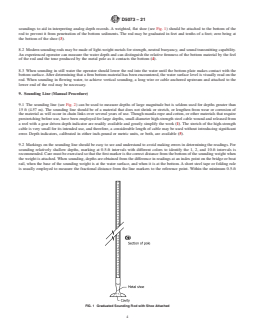
soundings to aid in interpreting analog depth records. A weighted, flat shoe (see Fig. 1) should be attached to the bottom of the
rod to prevent it from penetration of the bottom sediments. The rod may be graduated in feet and tenths of a foot; zero being at
the bottom of the shoe (3).
8.2 Modern sounding rods may be made of light-weight metals for strength, neutral buoyancy, and sound transmitting capability.
An experienced operator can measure the water depth and can distinguish the relative firmness of the bottom material by the feel
of the rod and the tone produced by the metal pole as it contacts the bottom (4).
8.3 When sounding in still water the operator should lower the rod into the water until the bottom plate makes contact with the
bottom surface. After determining that a firm bottom material has been encountered, the water surface level is visually read on the
rod. When sounding in flowing water, to achieve vertical sounding, a long wire or cable anchored upstream and attached to the
lower end of the rod may be necessary.
9. Sounding Line (Manual Procedure)
9.1 The sounding line (see Fig. 2) can be used to measure depths of large magnitude but is seldom used for depths greater than
15 ft (4.57 m). The sounding line should be of a material that does not shrink or stretch, or lengthen from wear or corrosion of
the material as will occur in chain links over several years of use. Though manila rope and cotton, or other materials that require
prestretching before use, have been employed for large depths, small-diameter high-strength steel cable wound and released from
a reel with a gear driven depth indicator are readily available and greatly simplify the work (1). The stretch of the high-strength
cable is very small for its intended use, and therefore, a considerable length of cable may be used without introducing significant
error. Depth indicators, calibrated in either inch-pound or metric units, or both, are available (5).
9.2 Markings on the sounding line should be easy to see and understand to avoid making errors in determining the readings. For
sounding relatively shallow depths, marking at 0.5-ft intervals with different colors to identify the 1, 2, and 10-ft intervals is
recommended. Care must be exercised so that the first marker is the correct distance from the bottom of the sounding weight when
the weight is attached. When sounding, depths are obtained from the difference in readings at an index point on the bridge or boat
rail, when the base of the sounding weight is at the water surface, and when it is at the bottom. A short steel tape or folding rule
is usually employed to measure the fractional distance from the line markers to the reference point. Within the minimum 0.5-ft
FIG. 1 Graduated Sounding Rod with Shoe Attached
D5073 − 21
FIG. 2 Sounding Line Used from Small Boat
markings depths are estimated and recorded to the nearest 0.1 ft. For sounding in deep water, a sounding reel with depth indicator
and an unmarked high-strength steel cable is recommended (4).
9.2.1 When the metric system of units is used, the sounding line for use in shallow depths is usually marked at 0.5-m intervals
with different colors to identify the 1 and 2-m intervals. Depths are recorded to the nearest 0.01 m.
9.3 Weights used in sounding are usually of lead, aluminum, or brass. For application in still water, the weights are bell-shaped
(see Fig. 3a) and made of cast aluminum or lead. The amount of weight should be from 5 to 10 lb (2.3 to 4.5 kg).
9.3.1 For application in flowing water, the weight should be of circular cross section and steamlined with fins (see Fig. 3b) to turn
the weight nose first into the current to offer a minimum of resistance to the flow. The amount of weight should be varied,
depending on the water depth and flow velocity at a cross section. A rule of thumb is that the weight in pounds should be greater
than the maximum product of velocity and depth in the cross section. If debris or ice is flowing or the stream is shallow or swift,
use a heavier weight than the rule designates. A variety of sizes of sounding weights from 15 to 300 lb (7 to 136 kg) should be
available with appropriate means of attaching to the sounding line (1). Sounding weights should always be attached to the sounding
line using a hanger bar, clevis, snap hook, or thimble of brass or stainless steel to protect the line from wear or damage.
9.4 The procedure for making soundings will vary depending on depth, current velocity, and means of locating where the
soundings are taken. Once at the location where a depth measurement is needed, the basic procedure is to lower the weight until
the bottom of the weight is at the water surface. When using a marked sounding line, the distance is read from the sounding line
at a reference point on the bridge or boat after which the weight is lowered to the bottom, and a new distance is read from the line
and recorded. When using a sounding reel the indicator is set to zero after which the weight is lowered to the bottom and the depth
is read and recorded. It is usually of some importance, especially when sounding an uneven bottom, to have the locations of the
soundings accurately known relative to the surroundings. When sounding from a boat using weighted line, the boat should be
stationary and should remain at that position until the sounding has been completed and the location is determined.
9.5 Sounding through the ice cover of a lake or river may be taken after boring holes in the ice with an ice auger. In this case,
a marked sounding line with an appropriate sounding weight attached at the end, is lowered through the hole and the determined
depth is recorded.
D5073 − 21
(a) Bell Shaped Sounding Weight (4)
(b) Torpedo Columbus-Type Sounding Weight
FIG. 3 Typical Weights Used with Sounding Line
10. Sounding Reels (Manual Procedure)
10.1 Sounding reels (see Fig. 4) are used with high strength cable where heavy weights are required or where depths are great.
These reels are usually very sturdily constructed having a braking system for controlling rotation of the reel as the cable is let out.
For hand operated reels, the hand cranks are hinged to allow the crank to be disengaged from the shaft while the wire is let out
and engaged for reeling in. Various devices are employed to drive a counter registering the amount of cable let out from which
the depth below water surface is determined. These sounding reels may also be electrically driven, in that case, they may have a
depth capacity of more than 5000 ft (1524 m) (1).
11. Bar Sweep (Manual Procedure)
11.1 The bar sweep is commonly used to search for and locate any shoal or obstruction within or above navigation depth that may
present a hazard to navigation. It augments the hydrographic survey in navigable waters by locating shallow submerged areas that
D5073 − 21
FIG. 4 Hand-operatedHand-Operated Sounding Reel (1)
may go undetected by the usual hydrographic procedures. The bar sweep (see Fig. 5) consists of a bar (steel pipe) suspended
beneath the survey vessel by graduated wire or cable from hand operated drums. The drums may be mounted either off the stern
or at the port and starboard gunwale. Each end of the bar should be packed with lead to add weight and to reduce lift when
underway. Pipe weight is the major factor in allowable vessel speed. Trial and error variations are usually necessary to determine
the best combination. In a normal operation, the bar is lowered to navigation depth and the vessel moves forward to sweep an area.
Whenever a shoal is encountered, the operator raises the bar until it clears the obstruction. The shoal depth and position is then
recorded. The bar is then returned to navigation depth and the survey continues (2).
FIG. 5 Bar Sweep for Locating Shoals
D5073 − 21
PROCEDURE B—ELECTRONIC SONIC-ECHO SOUNDING
12. Scope
12.1 This procedure is applicable to the measurement of water depth using electronic sonic-echo sounding techniques and
equipment. Because of the large variety of instrumentation currently available, this discussion is limited to types of equipment in
most common use.
12.2 Discussions of the techniques used include methods of measurement, criteria for selection of sounding frequency and
recording equipment, means for achieving quality assurance, and factors to consider in interpreting depth records.
13. Sonic-Echo Sounding (Electronic Procedure)
13.1 Water depths are most commonly obtained by echo sounders that record a continuous profile of the bottom surface of the
water body under the vessel. Echo sounders measure the time required for a sound wave to travel from its point of origin to the
bottom and the reflected wave to return. The sounder then converts this time interval to distance or depth below the face of the
transducer. The transmission of sound is dependent on certain properties of the water and the reflecting surface. For a sound wave
to travel at a constant velocity from the surface to bottom and be completely reflected off the bottom, the water must have the same
physical characteristics throughout its entire depth and the bottom must be a perfect reflector. Because such conditions do not exist
in nature, echo sounders are usually designed to permit adjustments for variations in the velocity of sound in water and wave
attenuation (2).
13.2 Measuring Principles:
13.2.1 Echo sounding equipment is designed to generate the sound wave, receive and amplify the returning echo, measure the
intervening time interval, convert the time interval into units of depth, and record the results graphically, digitally, or both. The
echo sounder only measures time (that is, the time it takes for a sound wave to travel from the transmitter to the bottom or other
reflecting surface and back again). The time interval is converted mechanically or electronically to depth beneath the transmitter
by the following equation:
depth 5 1/2 vt
where:
v = the velocity of sound in water, ft/s (m/s), and
t = the time for the pulse to travel from the transmitter to the reflective surface and back to the transmitter, s.
Because velocity of sound varies with water density, that is a function of temperature, salinity, suspended solids, and depth, a
means of correcting the resulting measurements for variations in the velocity of sound must be employed to ensure an acceptable
measurement accuracy (2). The methods for adjustment are presented in 13.6.
13.2.2 The sound waves transmitted by an echo sounder may be varied in frequency, duration, and shape of the acoustical beam
(see Fig. 6). The sound wave may be dispersed in all directions, or contained and concentrated into a narrow beam by a reflector.
The suitability of an echo sounder to meet a given requirement depends on how these variables are combined (2).
D5073 − 21
FIG. 6 Shape of a General-purposeGeneral-Purpose Echo Sounders’
Acoustical Beam (2)
13.3 Frequency Selection:
13.3.1 An echo sounding transducer is used to convert electrical energy pulses to acoustical energy. The acoustical energy pulses
are then transmitted through a liquid medium and the returning echoes are detected and reconverted back to electrical energy. These
energy pulses are then amplified and used to compute and record depth. Transducers are usually designed to operate on specific
frequencies, depending on the application and depth range (2).
13.3.2 Low-frequency transducers, those operating below 15 kHz, produce sound waves having low absorption rates and high
penetrating power. These characteristics make them useful for deep soundings and penetration of the fine deposited material on
the bottom of a river or lake. These transducers cannot be used to accurately measure very shallow depths, and they are very
susceptible to noise interference in the more audible frequency range. Because of their long wavelengths the lower frequency
pulses cannot be beamed directionally unless the transducers are very large (2). The use of low-frequency transducers for
subbottom penetration is discussed in 13.10.
13.3.3 Medium-frequency transducers (15 to 50 kHz) may be used for water depths less than 1800 ft (549 m) and in situations
when it is necessary to penetrate a layer of low density sediment suspended above more compacted sediments. In this range, the
transducers may be small in size, the maximum dimension being 8 in. (20.3 cm) or less. These transducers can generate a
comparatively narrow beam that results in a more accurate definition of the bottom.
13.3.4 High-frequency transducers (greater than 50 kHz) overcome most of the disadvantages of the low and medium-frequency
transducers. With small transmitting units, the ultrasonic acoustical energy can be directed and concentrated in a relatively narrow
D5073 − 21
water column. By narrowing the beam angle, side echoes can be reduced, and a more detailed profile of an irregular bottom can
be achieved. In addition, shallow depths can be measured more accurately. Due to greater attenuation of the sound wave, the high
frequencies are ineffective in very deep water (2).
13.4 Recording Soundings:
13.4.1 Analog recorders usually employ one of two methods for registering depth on a chart.
13.4.1.1 In the first method, the depth is recorded by a stylus mounted on a rotating arm that makes a mark on dry, electrosensitive,
calibrated paper. The stylus passes over the chart paper at a constant speed marking the chart at the zero (initial) point, at a point
designating the draft of the transducer, and at a point representing bottom depth. As continuing echoes are received from the
bottom, a bottom profile is recorded (see Fig. 7). The horizontal scale of the plot is determined by the chart speed set by the
operator.
13.4.1.2 In the second method, the depth is recorded by a fixed-head thermal recording device (6). The printing mechanism
consists of a nonmoving print head containing hundreds of thermal dots heated precisely at the proper time to print the chart. The
only moving parts on thermal print recorders are the motor and roller assembly that moves the paper across the printhead. Unlike
moving-stylus type recorders, the chart and motor timing on the thermal print recorders have no effect on depth measurement
accuracy. Thermal print recorders begin with blank thermal paper. The scale grids and other chart features are preprogrammed to
be generated by these units, allowing for a variety of chart formats (see Fig. 8).
13.5 Errors in Measurement:
13.5.1 Factors that lead to error in depth measurement are numerous and should be recognized when conducting a bathymetric
survey or analyzing graphic depth recordings. For a detailed description of these errors, see Ref (2). The most significant factors
are described in 13.5.2 – 13.5.9.
13.5.2 Velocity of Sound Wave Propagation—The velocity of a sound wave traveling through water varies with temperature and
density. It is, therefore, necessary to check the effective velocity of sound in a given body of water to achieve the depth accuracy
required. In a deep reservoir, temperatures may vary as much as 45°F (25°C) between the surface and the bottom. In an estuary,
salinity may also vary in both the vertical and horizontal direction, thus causing density to vary. Calibration of the sounding
instrument should be made by the survey crew, at appropriate times to adjust the depth readings for changes in water temperature
and density (see 13.6).
13.5.3 Signal Transit Time—Water depth is determined by the time required for a signal to travel from the transducer, strike a
reflective surface, and return to the transducer. With the high quality instruments currently available, errors in time measurement
are insignificant (7).
FIG. 7 Analog Bottom Profile Charted with Stylus
D5073 − 21
FIG. 8 Analog Bottom Profile Charted by Thermal Printer
13.5.4 Transducer Location—The draft or vertical location of the transducer with respect to water surface can be set into most high
precision echo sounders. The vertical location, when set for static conditions, will change with the motion of the boat. The effect
of boat motion on draft, may be corrected during calibration of the instrument.
13.5.5 Wave Action—The vertical and rotational motion of a boat due to wave action can result in severe fluctuations in the bottom
trace. Some smoothing of the trace may be necessary during data processing to eliminate the fluctuations. The motion effects,
described as survey vessel roll, pitch, yaw, and heave, were once difficult errors to correct in hydrographic surveying.
Measurements from accurate, compact, and relatively inexpensive motion compensation instruments have significantly reduced
these errors (7).
13.5.6 Bottom Conditions—The condition of the reflective surface of a reservoir or river bottom may vary widely, resulting in a
sounding chart that gives an erroneous impression of the actual bottom profile. Vegetation attached to or suspended above the
bottom, isolated boulders, or submerged man-made objects, may produce a nonrepresentative bottom profile. Depending on the
purpose of the survey, the cause of these bottom reflections may have to be determined by other means before choosing to eliminate
them from the trace.
13.5.7 Nature of Bottom Sediments—Very low density sediment, suspended as a nepheloid layer or zone above more compacted
sediments, can result in an erroneous depth reading when a transducer with a frequency higher than 50 kHz is used. A waterway
bottom may be described in nautical terms as any water/solid interface level that blocks or impedes the passage of ships, boats,
or barges. A low or medium-frequency transducer may be used to determine depth to the more consolidated sediment layer.
13.5.8 Tidal Effects—When surveying in tidal zones of rivers and estuaries, a continuous record must be kept of tidal fluctuations
within the area during the surveys in order to adjust the depth readings for the changing water surface. The measured depths are
generally referred to a reference level, such as mean sea level. By exercising good technique in determining tidal changes and
making tidal corrections, the errors in measuring bottom elevations can be significantly reduced.
13.5.9 Other Causes—Errors may occur due to special conditions during a survey that may be either unknown or overlooked by
the survey crew. Examples of these conditions are as follows: a reservoir water surface elevation may fluctuate appreciably due
to inflow or outflow, thus changing the conditions for vertical control during the survey; when downstream flow occurs in narrow
canyon areas or in river portions of a reservoir, a water surface slope may extend in the upstream direction and produce error when
a constant reservoir water surface elevation is assumed for vertical control; a constant wind blowing from one side of a water body
to another may raise the water surface on the downwind side of the water body and introduce error should a specific water surface
elevation be assumed for vertical control (8). Real time kinematic global positioning systems (RTK GPS) can provide 2 to 5
centimetre accuracies both horizontally and vertically for the receiver on the moving survey vessel. The proper use of RTK GPS
technology can monitor and minimize the errors from tidal and other vertical effects (7).
13.6 Calibration:
13.6.1 Depth measurements by an echo sounder require a number of corrections. The largest correction results from the variability
of sound velocity in water. The velocity varies with the temperature, salinity, and depth of water. In fresh
...