

ASTM D5413-21
(Test Method)Standard Test Methods for Measurement of Water Levels in Open-Water Bodies
General Information
- Abstract
SIGNIFICANCE AND USE
4.1 These test methods are used to determine the gauge height or elevation of a river or other body of water above a given datum.
4.2 Water level data can serve as an easily recorded parameter, and through use of a stage-discharge relation provide an indirect value of stream discharge, often at a gauging station.
4.3 These test methods can be used in conjunction with other determinations of biological, physical, or chemical properties of waters.
SCOPE
1.1 These test methods cover equipment and procedures used in obtaining water levels of rivers, lakes, and reservoirs or other water bodies. Three types of equipment are available as follows:
Test Method A—Nonrecording water-level measurement devices
Test Method B—Recording water-level measurement devices
Test Method C—Remote-interrogation water-level measurement devices
1.2 The procedures detailed in these test methods are widely used by those responsible for investigations of streams, lakes, reservoirs, and estuaries, for example, the U.S. Agricultural Research Service, the U.S. Army Corp of Engineers, and the U.S. Geological Survey.2 The referenced ISO standard also furnishes useful information.
1.3 It is the responsibility of the user of these test methods to determine the acceptability of a specific device or procedure to meet operational requirements. Compatibility between sensors, recorders, retrieval equipment, and operational systems is necessary, and data requirements and environmental operating conditions must be considered in equipment selection.
1.4 The values stated in inch-pound units are to be regarded as standard. The values given in parentheses are mathematical conversions to SI units that are provided for information only and are not considered standard.
1.5 This standard does not purport to address all of the safety concerns, if any, associated with its use. It is the responsibility of the user of this standard to establish appropriate safety, health, and environmental practices and determine the applicability of regulatory limitations prior to use.
1.6 This international standard was developed in accordance with internationally recognized principles on standardization established in the Decision on Principles for the Development of International Standards, Guides and Recommendations issued by the World Trade Organization Technical Barriers to Trade (TBT) Committee.
- Status
- Published
- Publication Date
- 31-Oct-2021
- Technical Committee
- D19 - Water
- Drafting Committee
- D19.07 - Sediments, Geomorphology, and Open-Channel Flow
Overview
ASTM D5413-21: Standard Test Methods for Measurement of Water Levels in Open-Water Bodies provides comprehensive guidelines for measuring the water level or gauge height in various open-water environments, such as rivers, lakes, and reservoirs. Published by ASTM International, this standard specifies equipment, procedures, and best practices for water-level measurement, ensuring accurate and consistent data for hydrologic studies and operational requirements. The standard is applicable for both direct field measurements and automated monitoring at gauging stations, supporting effective water resource management and environmental monitoring.
Key Topics
Types of Water-Level Measurement Devices:
- Nonrecording Devices: These include staff gauges, wire-weight gauges, float-tape gauges, electric-tape gauges, point and hook gauges. They are read manually and often used for periodic readings or calibration of automated systems.
- Recording Devices: Equipment such as float-tape recorders, gas purge systems (bubble gauges), and electronic sensors collect continuous records of water level or discharge, providing crucial data for trend analysis.
- Remote Interrogation Devices: Allows for remote data collection via telephone, satellite telemetry, radio, and meteor-burst transmission, offering real-time access to water-level information.
Procedural Guidance:
- Establishment of reference datums and calibration processes
- Compatibility between sensors, recorders, data retrieval equipment, and operational systems
- Consideration of environmental conditions impacting device selection and data accuracy
Data Integrity:
- Manual and automated documentation requirements
- Importance of regular calibration and field checks
- Identification and mitigation of potential sources of error including structural instability, observational variables, and electronic interference
Practical Limitations:
- Need for suitable safety, health, and environmental practices
- Responsibility of users to ensure correct application and compliance with regulatory standards
Applications
ASTM D5413-21 is widely used by water resource professionals, government agencies, and engineers involved in:
- Hydrological and Environmental Studies: Determining water level fluctuations in streams, lakes, and reservoirs for flood forecasting, drought assessment, and ecosystem evaluation.
- Stream Discharge Calculation: Utilizing stage-discharge relationships to indirectly estimate flow rates at gauging stations.
- Water Resource Management: Supporting decisions on water supply, flood control, and infrastructure planning.
- Regulatory Compliance: Ensuring measurements align with national and international requirements for water data collection.
- Integration with Other Measurements: Facilitating combined analyses with biological, physical, or chemical water quality indicators.
Related Standards
For comprehensive water level measurement practices, users should refer to the following related standards:
- ASTM D1129: Terminology Relating to Water
- ASTM D1941: Test Method for Open Channel Flow Measurement of Water with the Parshall Flume
- ASTM D2777: Practice for Determination of Precision and Bias of Applicable Test Methods of Committee D19 on Water
- ASTM D5242: Test Method for Open-Channel Flow Measurement of Water with Thin-Plate Weirs
- ISO 4373: Measurement of Liquid Flow in Open Channels - Water Level Measuring Devices
Practical Value
By adhering to ASTM D5413-21, organizations can ensure the accuracy, reliability, and comparability of water level measurements across different sites and timeframes. This standard supports improved decision-making in water management, enhances data quality for hydrologic research, and fosters consistent practices that align with international protocols. Proper implementation facilitates resource planning, environmental protection, and compliance with regulatory mandates, ultimately contributing to sustainable water management strategies.
Keywords: water level measurement, open-water bodies, gauge height, stream discharge, gauging station, staff gauge, recording devices, remote interrogation, ASTM D5413-21, hydrologic data, water resource management.
Relations
- Effective Date
- 01-May-2020
- Effective Date
- 15-Jun-2012
- Effective Date
- 01-Mar-2010
- Effective Date
- 15-Jan-2008
- Effective Date
- 15-Jun-2007
- Effective Date
- 15-Jun-2007
- Effective Date
- 01-Sep-2006
- Effective Date
- 01-Sep-2006
- Effective Date
- 15-Aug-2006
- Effective Date
- 15-Feb-2006
- Effective Date
- 01-Mar-2004
- Effective Date
- 01-Mar-2004
- Effective Date
- 10-Aug-2003
- Effective Date
- 10-Aug-2003
- Effective Date
- 10-Mar-2003
Get Certified
Connect with accredited certification bodies for this standard

CIS Institut d.o.o.
Personal Protective Equipment (PPE) certification body. Notified Body NB-2890 for EU Regulation 2016/425 PPE.

Kiwa BDA Testing
Building and construction product certification.
Kmetijski inštitut Slovenije
Agricultural Institute of Slovenia. Soil testing, plant health, agricultural product analysis.
Sponsored listings
Frequently Asked Questions
ASTM D5413-21 is a standard published by ASTM International. Its full title is "Standard Test Methods for Measurement of Water Levels in Open-Water Bodies". This standard covers: SIGNIFICANCE AND USE 4.1 These test methods are used to determine the gauge height or elevation of a river or other body of water above a given datum. 4.2 Water level data can serve as an easily recorded parameter, and through use of a stage-discharge relation provide an indirect value of stream discharge, often at a gauging station. 4.3 These test methods can be used in conjunction with other determinations of biological, physical, or chemical properties of waters. SCOPE 1.1 These test methods cover equipment and procedures used in obtaining water levels of rivers, lakes, and reservoirs or other water bodies. Three types of equipment are available as follows: Test Method A—Nonrecording water-level measurement devices Test Method B—Recording water-level measurement devices Test Method C—Remote-interrogation water-level measurement devices 1.2 The procedures detailed in these test methods are widely used by those responsible for investigations of streams, lakes, reservoirs, and estuaries, for example, the U.S. Agricultural Research Service, the U.S. Army Corp of Engineers, and the U.S. Geological Survey.2 The referenced ISO standard also furnishes useful information. 1.3 It is the responsibility of the user of these test methods to determine the acceptability of a specific device or procedure to meet operational requirements. Compatibility between sensors, recorders, retrieval equipment, and operational systems is necessary, and data requirements and environmental operating conditions must be considered in equipment selection. 1.4 The values stated in inch-pound units are to be regarded as standard. The values given in parentheses are mathematical conversions to SI units that are provided for information only and are not considered standard. 1.5 This standard does not purport to address all of the safety concerns, if any, associated with its use. It is the responsibility of the user of this standard to establish appropriate safety, health, and environmental practices and determine the applicability of regulatory limitations prior to use. 1.6 This international standard was developed in accordance with internationally recognized principles on standardization established in the Decision on Principles for the Development of International Standards, Guides and Recommendations issued by the World Trade Organization Technical Barriers to Trade (TBT) Committee.
SIGNIFICANCE AND USE 4.1 These test methods are used to determine the gauge height or elevation of a river or other body of water above a given datum. 4.2 Water level data can serve as an easily recorded parameter, and through use of a stage-discharge relation provide an indirect value of stream discharge, often at a gauging station. 4.3 These test methods can be used in conjunction with other determinations of biological, physical, or chemical properties of waters. SCOPE 1.1 These test methods cover equipment and procedures used in obtaining water levels of rivers, lakes, and reservoirs or other water bodies. Three types of equipment are available as follows: Test Method A—Nonrecording water-level measurement devices Test Method B—Recording water-level measurement devices Test Method C—Remote-interrogation water-level measurement devices 1.2 The procedures detailed in these test methods are widely used by those responsible for investigations of streams, lakes, reservoirs, and estuaries, for example, the U.S. Agricultural Research Service, the U.S. Army Corp of Engineers, and the U.S. Geological Survey.2 The referenced ISO standard also furnishes useful information. 1.3 It is the responsibility of the user of these test methods to determine the acceptability of a specific device or procedure to meet operational requirements. Compatibility between sensors, recorders, retrieval equipment, and operational systems is necessary, and data requirements and environmental operating conditions must be considered in equipment selection. 1.4 The values stated in inch-pound units are to be regarded as standard. The values given in parentheses are mathematical conversions to SI units that are provided for information only and are not considered standard. 1.5 This standard does not purport to address all of the safety concerns, if any, associated with its use. It is the responsibility of the user of this standard to establish appropriate safety, health, and environmental practices and determine the applicability of regulatory limitations prior to use. 1.6 This international standard was developed in accordance with internationally recognized principles on standardization established in the Decision on Principles for the Development of International Standards, Guides and Recommendations issued by the World Trade Organization Technical Barriers to Trade (TBT) Committee.
ASTM D5413-21 is classified under the following ICS (International Classification for Standards) categories: 13.060.10 - Water of natural resources. The ICS classification helps identify the subject area and facilitates finding related standards.
ASTM D5413-21 has the following relationships with other standards: It is inter standard links to ASTM D1129-13(2020)e2, ASTM D2777-12, ASTM D1129-10, ASTM D2777-08, ASTM D5242-92(2007), ASTM D1941-91(2007), ASTM D1129-06ae1, ASTM D1129-06a, ASTM D2777-06, ASTM D1129-06, ASTM D1129-04e1, ASTM D1129-04, ASTM D1129-03a, ASTM D2777-03, ASTM D1129-03. Understanding these relationships helps ensure you are using the most current and applicable version of the standard.
ASTM D5413-21 is available in PDF format for immediate download after purchase. The document can be added to your cart and obtained through the secure checkout process. Digital delivery ensures instant access to the complete standard document.
Standards Content (Sample)
This international standard was developed in accordance with internationally recognized principles on standardization established in the Decision on Principles for the
Development of International Standards, Guides and Recommendations issued by the World Trade Organization Technical Barriers to Trade (TBT) Committee.
Designation: D5413 − 21
Standard Test Methods for
Measurement of Water Levels in Open-Water Bodies
This standard is issued under the fixed designation D5413; the number immediately following the designation indicates the year of
original adoption or, in the case of revision, the year of last revision. A number in parentheses indicates the year of last reapproval. A
superscript epsilon (´) indicates an editorial change since the last revision or reapproval.
1. Scope mendations issued by the World Trade Organization Technical
Barriers to Trade (TBT) Committee.
1.1 These test methods cover equipment and procedures
used in obtaining water levels of rivers, lakes, and reservoirs or
2. Referenced Documents
other water bodies. Three types of equipment are available as
2.1 ASTM Standards:
follows:
D1129 Terminology Relating to Water
Test MethodA—Nonrecording water-level measurement devices
D1941 Test Method for Open Channel Flow Measurement
Test Method B—Recording water-level measurement devices
of Water with the Parshall Flume
Test Method C—Remote-interrogation water-level measurement devices
D2777 Practice for Determination of Precision and Bias of
1.2 Theproceduresdetailedinthesetestmethodsarewidely
Applicable Test Methods of Committee D19 on Water
used by those responsible for investigations of streams, lakes,
D5242 Test Method for Open-Channel Flow Measurement
reservoirs, and estuaries, for example, the U.S. Agricultural
of Water with Thin-Plate Weirs
Research Service, the U.S. Army Corp of Engineers, and the
2 2.2 ISO Standard:
U.S. Geological Survey. The referenced ISO standard also
ISO 4373 Measurement of Liquid Flow in Open Channels—
furnishes useful information.
Water Level Measuring Devices
1.3 It is the responsibility of the user of these test methods
3. Terminology
to determine the acceptability of a specific device or procedure
to meet operational requirements. Compatibility between
3.1 Definitions:
sensors, recorders, retrieval equipment, and operational sys-
3.1.1 For definitions of terms used in this standard, refer to
tems is necessary, and data requirements and environmental
Terminology D1129.
operating conditions must be considered in equipment selec-
3.2 Definitions of Terms Specific to This Standard:
tion.
3.2.1 elevation, n—the vertical distance from a datum to a
1.4 The values stated in inch-pound units are to be regarded
point.
as standard. The values given in parentheses are mathematical
3.2.2 datum, n—a level plane that represents a zero or some
conversions to SI units that are provided for information only
defined elevation.
and are not considered standard.
3.2.3 gauge, n—a generic term that includes water level
1.5 This standard does not purport to address all of the
measuring devices.
safety concerns, if any, associated with its use. It is the
3.2.4 gauge datum, n—a datum whose surface is at the zero
responsibility of the user of this standard to establish appro-
elevation of all the gauges at a gauging station; this datum is
priate safety, health, and environmental practices and deter-
often at a known elevation referenced to National Geodetic
mine the applicability of regulatory limitations prior to use.
Vertical Datum of 1929 (NGVD).
1.6 This international standard was developed in accor-
dance with internationally recognized principles on standard- 3.2.5 gauge height, n—the height of a water surface above
an established or arbitrary datum at a particular gauging
ization established in the Decision on Principles for the
Development of International Standards, Guides and Recom- station; also termed stage.
3.2.6 gauging station, n—a particular site on a stream,
canal, lake, or reservoir where systematic observations of
These test methods are under the jurisdiction of ASTM Committee D19 on
hydrologic data are obtained.
Water and is the direct responsibility of Subcommittee D19.07 on Sediments,
Geomorphology, and Open-Channel Flow.
Current edition approved Nov. 1, 2021. Published January 2022. Originally For referenced ASTM standards, visit the ASTM website, www.astm.org, or
approved in 1993. Last previous edition approved in 2013 as D5413 – 93 (2013). contact ASTM Customer Service at service@astm.org. For Annual Book of ASTM
DOI: 10.1520/D5413-21. Standards volume information, refer to the standard’s Document Summary page on
Sauer, V. B., and Turnipseed, D. P., “Stage Measurement at Gauging Stations,” the ASTM website.
Techniques of Water Resources Investigations, Book 3, ChapterA-7, U.S. Geologi- Available from American National Standards Institute (ANSI), 25 W. 43rd St.,
cal Survey, 2010. 4th Floor, New York, NY 10036, http://www.ansi.org.
Copyright ©ASTM International, 100 Barr Harbor Drive, PO Box C700, West Conshohocken, PA19428-2959. United States
D5413 − 21
3.2.7 National Geodetic Vertical Datum of 1929 (NGVD),
n—a datum prior to 1973 known as mean sea level; a
spheroidal datum in the conterminous United States and
Canada that approximates mean sea level but does not neces-
sarily agree with sea level at a specific location.
4. Significance and Use
4.1 These test methods are used to determine the gauge
height or elevation of a river or other body of water above a
given datum.
4.2 Water level data can serve as an easily recorded
parameter, and through use of a stage-discharge relation
provide an indirect value of stream discharge, often at a
gauging station.
4.3 These test methods can be used in conjunction with
other determinations of biological, physical, or chemical prop-
erties of waters.
TEST METHOD A—NONRECORDING WATER-
LEVEL MEASUREMENT DEVICES
5. Summary of Test Method
5.1 These test methods are usually applicable to conditions
where continuous records of water level or discharge are not
required. However, in some situations, daily or twice daily
observations from a nonrecording water-level device can
provide a satisfactory record of daily water levels or discharge.
Water levels obtained by the nonrecording devices described in
FIG. 1 Staff Gauges
these test methods can be used to calibrate recording water-
level devices described in Test Methods B and C.
to cause damage than for a vertical staff gauge. Individual
5.2 Devices included in these test methods are of two
graduation and marking of the installed gauges by engineering
generaltypes:thosethatarereaddirectly,suchasastaffgauge;
levels are required due to the variability of bank slope.
and those that are read by measurement to the water surface
6.2 Wire-Weight Gauge—An instrument that is mounted on
from a fixed point, such as wire-weight, float-tape, electric-
a bridge or other structure above a water body.Water levels are
tape, point and hook gauges.
obtained by direct measurement of the distances between the
5.2.1 Staff, wire-weight, and chain gauges are commonly
device and the water surface. A wire-weight gauge consists of
used as both outside auxiliary and reference gauges. Vertical-
a drum wound with a single layer of cable, a bronze weight
and inclined-staff, float-tape, electric-tape, hook and point
attached to the end of the cable, a graduated disk, a counter,
gauges are commonly used as inside auxiliary and reference
and a check bar, all contained within a protective housing (see
gauges.
Fig. 2). The disk is graduated and is permanently connected to
5.3 Documentation of observations must be manually re-
corded.
6. Apparatus
6.1 Staff Gauges:
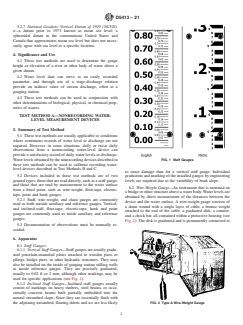
6.1.1 Vertical Staff Gauges—Staff gauges are usually gradu-
ated porcelain-enameled plates attached to wooden piers or
pilings, bridge piers, or other hydraulic structures. They may
also be installed on the inside of gauging station stilling wells
as inside reference gauges. They are precisely graduated,
usually to 0.02 ft or 2 mm, although other markings may be
used for specific applications (see Fig. 1).
6.1.2 Inclined Staff Gauges—Inclined staff gauges usually
consist of markings on heavy timbers, steel beams, or occa-
sionally concrete beams built partially embedded into the
natural streambed slope. Since they are essentially flush with
the adjoining streambed, floating debris and ice are less likely FIG. 2 Type A Wire-Weight Gauge
D5413 − 21
the counter and the shaft of the drum.The cable is guided to its 6.4 Float-Tape Gauge—Consists of a float attached to a
position on the drum by a threading sheave. The reel is stainless steel graduated tape that passes over a suitable pulley
equipped with a pawl and ratchet for holding the weight at any with a counterweight to maintain tension. A pointer or other
desired elevation. A horizontally mounted check bar is index is frequently fabricated as an integral part of the pulley
mountedattheloweredgeoftheinstrument.Differentiallevels assembly (see Fig. 4). Float-tape gauges frequently are com-
are run to the check bar. When the weight is lowered to touch bined with water-level recorders in a manner whereby the
the check bar, readings of the counter are compared to its pulley is the stage drive wheel for the recorder.
known elevation as a calibration procedure.The gauge is set so
6.5 Electric-Tape Gauge—Consists of a graduated steel tape
that when the bottom of the weight is at the water surface, the
and weight attached to a combined tape reel, voltmeter, datum
gauge height is indicated by the combined readings of the
index and electrical circuit, powered by a 4 ⁄2 to 6 volt battery
counter and the graduated disk.
(see Fig. 5). The gauge frame is mounted on a shelf or bracket
6.3 Needle Gauges—Frequently referred to as point or hook over the water surface, usually in a stilling well. The weight is
gauges. A needle gauge consists of a vertically-mounted lowered until the weight touches the water surface closing the
pointed metallic, small-diameter rod, which can be lowered electrical circuit that is indicated by the voltmeter. The gauge
until an exact contact is made with the water surface.Avernier height is read on the tape at the index.
or graduated scale is read to indicate a gauge height. A
6.6 A reference point is frequently selected on a stable
needle-type gauge offers high measurement accuracy, but
memberofabridge,stillingwell,orotherstructurefromwhich
requires some skill and good visibility (light conditions) in
distance vertical measurements to the water surface are made
lowering and raising the device to a position where the point
by steel tape and weight. The reference point is a clearly
just pierces the water surface. These gauges are most com-
defined location, frequently a file mark or paint mark to ensure
monly used in applications where the water surface is calm.
that all readings are from the same location.
6.3.1 PointGauge—Aformofneedlegaugewherethetipor
point approaches the water surface from above.
7. Calibration
6.3.2 Hook Gauge—A form of needle gauge made in the
7.1 Establish a datum. The datum may be a recognized
shape of a hook, where the tip or point approaches the water
datum such as National Geodetic Vertical Datum of 1929
surface from below (see Fig. 3). The hook gauge is easier to
(NGVD), a datum referenced to a recognized datum such as
use in a stilling well application. As the point contacts the
580.00 ft NGVD 1929, a local datum, or an arbitrary datum.A
water surface, overhead light will reflect from a dimple on the
datum is usually selected that will give readings of small
water surface.
positive numbers.
FIG. 3 Hook Gauge FIG. 4 Float-Type Gauge
D5413 − 21
8.2 Gauges that require measurement from a fixed point to
the water surface must follow procedures provided by manu-
facturers of the specific instrument.
8.3 Make a visual inspection of gauges at each reading to
detect apparent damage, which could affect accuracy.
TEST METHOD B—RECORDING WATER-LEVEL
MEASUREMENT DEVICES
9. Summary of Test Method
9.1 These test methods are applicable where continuous
unattended records of water level or discharge are required.
Procedures described in Test Method A are usually used to set
these recording devices to the correct datum.
9.2 Devices,genericallyreferredtoaswater-levelrecorders,
or recorders, included in these test methods must be capable of
recording stage and the time and date at which the stage
occurred.
9.3 Recorders may sense water level by direct mechanical
connection, usually by float-counterweight and tape or cable,
by gas purge manometer systems (bubble gauges), or by
electronic water level sensors (pressure transducer or acoustic
devices).
9.4 Recorders may retain data in graphical, analog, digital,
or other format.
FIG. 5 Electric-Type Gauge
9.5 Recorders are available that can remain unattended for
periods from one week to longer than six months.
7.2 Establish at least three reference marks (RMs). Refer-
ence marks must be located on independent permanent struc- 10. Apparatus
tures that have a good probability of surviving a major flood or
10.1 Types of Sensing Systems:
other event that may destroy the gauge. Select reference marks
10.1.1 Direct Reading Systems:
close enough to the water-level measuring device that the
10.1.1.1 Crest Stage Gauge—Acreststagegaugeisasimple
leveling circuit does not require more than two or three
sensing-recording device that is installed near a water body to
instrument setups to complete elevation verification. If the
recordthehighestwaterlevelthatoccursbetweenvisitsoffield
NGVD datum is used, determine the elevation of the reference
personnel. A wooden rod is encased in a steel or plastic pipe
marks by differential leveling from the nearest NGVD bench-
with holes for water to enter and rise to the outside water level.
mark.
Arecoverablehigh-watermarkisleftonthedevicebyparticles
of ground cork that float to the highest water level (Fig. 6).
7.3 Set the gauges to correct datum by differential leveling
fromthereferencemarks.Uselevelingproceduresdescribedin 10.1.1.2 Tape Gauge Maximum-Minimum Indicators—
a surveying text or “Levels at Streamflow Gauging Stations.” These indicators include magnetic or mechanical accessories
that record maximum or minimum travel of float-drive tape
7.4 Run levels to gauges from RMs annually for the first 3
gauges or recorder-drive tapes.
to 5 years, then if stability is evident, a level frequency of 3 to
10.1.2 Mechanical Sensing Systems:
5 years is acceptable. Rerun levels at any time that a gauge has
10.1.2.1 Float Tape—Consists of a float that floats on the
been disturbed or has unresolved gauge reading inconsisten-
watersurface,usuallyinastillingwell,andasteeltapeorcable
cies. Run levels to all RMs, reference points, index points, and
which passes over a recorder drive pulley. A weight on the
to each staff gauge, and to the water surface. Read the water
opposite end of the tape maintains tension in the tape or cable.
surface at each gauge at the time levels are run. Document
The rise and fall of the water surface is thus directly transmit-
differences found and changes made in a permanent record.
ted to the recorder.
10.1.2.2 Shaft Encoders—These devices consist of a float-
8. Procedure
tape driven shaft and pulley assembly that converts the angular
8.1 Read direct reading gauges by observing the water
shaftpositiontoanelectronicsignalcompatiblewithelectronic
surface on the gauge scale. Manually record this value on an
recorders. Analog output potentiometers and several digital
appropriate form.
format output encoding systems are available.
10.1.3 Gas-Purge System—This system is commonly
known as a bubble gauge. A gas, usually nitrogen, is fed from
Kenney, T. A., “Levels at Streamflow Gauging Stations,” Techniques of Water
Resources Investigations, Book 3, Chapter A-19, U.S. Geological Survey, 2010. a supply tank and pressure regulator through a tube and
D5413 − 21
FIG. 6 Crest-Stage Gauge
bubbled freely into the water body through an orifice at a fixed manometer. The theory and application of these devices are
location on or near the bottom of the water body. The gas given in “Installation and Service Manual for U.S. Geological
pressure in the tube is equal to the piezometric head on the
Survey Manometers.” These devices are being phased out of
bubble orifice corresponding to the water level over the orifice. service because of potential damage to the environment caused
Several methods of sensing this line pressure and converting it
by mercury spills.
to a recordable format are used (Fig. 7).
10.1.3.1 Mercury Manometer—The manometer assembly
converts the gas purge line pressure to a shaft rotation for
Craig, J. D., “Installation and Service Manual for U.S. Geological Survey
driving a recorder. Mercury is used because its specific gravity
Manometers,” Techniques of Water Resources Investigations, Book 8, ChapterA-2,
is 13.6 times that of water, and thus shortens the length of the U.S. Geological Survey, 1983.
FIG. 7 Gas-Purge System
D5413 − 21
10.1.3.2 Balance Beam Manometer—This form of manom-
eter employs a bellows system coupled wit
...
This document is not an ASTM standard and is intended only to provide the user of an ASTM standard an indication of what changes have been made to the previous version. Because
it may not be technically possible to adequately depict all changes accurately, ASTM recommends that users consult prior editions as appropriate. In all cases only the current version
of the standard as published by ASTM is to be considered the official document.
Designation: D5413 − 93 (Reapproved 2013) D5413 − 21
Standard Test Methods for
Measurement of Water Levels in Open-Water Bodies
This standard is issued under the fixed designation D5413; the number immediately following the designation indicates the year of
original adoption or, in the case of revision, the year of last revision. A number in parentheses indicates the year of last reapproval. A
superscript epsilon (´) indicates an editorial change since the last revision or reapproval.
1. Scope
1.1 These test methods cover equipment and procedures used in obtaining water levels of rivers, lakes, and reservoirs or other
water bodies. Three types of equipment are available as follows:
Test Method A—Nonrecording water-level measurement devices
Test Method B—Recording water-level measurement devices
Test Method C—Remote-interrogation water-level measurement devices
1.2 The procedures detailed in these test methods are widely used by those responsible for investigations of streams, lakes,
reservoirs, and estuaries, for example, the U.S. Agricultural Research Service, the U.S. Army Corp of Engineers, and the U.S.
Geological Survey. The referenced ISO standard also furnishes useful information.
1.3 It is the responsibility of the user of these test methods to determine the acceptability of a specific device or procedure to meet
operational requirements. Compatibility between sensors, recorders, retrieval equipment, and operational systems is necessary, and
data requirements and environmental operating conditions must be considered in equipment selection.
1.4 The values stated in inch-pound units are to be regarded as the standard. The values given in parentheses are for information
only.mathematical conversions to SI units that are provided for information only and are not considered standard.
1.5 This standard does not purport to address all of the safety concerns, if any, associated with its use. It is the responsibility
of the user of this standard to establish appropriate safety, health, and environmental practices and determine the applicability of
regulatory limitations prior to use.
1.6 This international standard was developed in accordance with internationally recognized principles on standardization
established in the Decision on Principles for the Development of International Standards, Guides and Recommendations issued
by the World Trade Organization Technical Barriers to Trade (TBT) Committee.
2. Referenced Documents
2.1 ASTM Standards:
D1129 Terminology Relating to Water
These test methods are under the jurisdiction of ASTM Committee D19 on Water and is the direct responsibility of Subcommittee D19.07 on Sediments, Geomorphology,
and Open-Channel Flow.
Current edition approved Jan. 1, 2013Nov. 1, 2021. Published January 2013January 2022. Originally approved in 1993. Last previous edition approved in 20072013 as
D5413 – 93 (2007).(2013). DOI: 10.1520/D5413-93R13.10.1520/D5413-21.
Buchanan, T. J., and Somers, W. P., “Stage Measurement at Gauging Stations,” Techniques of Water Resources Investigations, Book 3, Chapter A-7, U.S. Geological
Survey, 1968.Sauer, V. B., and Turnipseed, D. P., “Stage Measurement at Gauging Stations,” Techniques of Water Resources Investigations, Book 3, Chapter A-7, U.S.
Geological Survey, 2010.
For referenced ASTM standards, visit the ASTM website, www.astm.org, or contact ASTM Customer Service at service@astm.org. For Annual Book of ASTM Standards
volume information, refer to the standard’s Document Summary page on the ASTM website.
Copyright © ASTM International, 100 Barr Harbor Drive, PO Box C700, West Conshohocken, PA 19428-2959. United States
D5413 − 21
D1941 Test Method for Open Channel Flow Measurement of Water with the Parshall Flume
D2777 Practice for Determination of Precision and Bias of Applicable Test Methods of Committee D19 on Water
D5242 Test Method for Open-Channel Flow Measurement of Water with Thin-Plate Weirs
2.2 ISO Standard:
ISO 4373 Measurement of Liquid Flow in Open Channels—Water Level Measuring Devices
3. Terminology
3.1 Definitions—Definitions: For definitions of terms used in these test methods, refer to Terminology
3.1.1 For definitions of terms used in this standard, refer to Terminology D1129.
3.2 Definitions of Terms Specific to This Standard:
3.2.1 elevation—elevation, n—the vertical distance from a datum to a point.
3.2.2 datum—datum, n—a level plane that represents a zero or some defined elevation.
3.2.3 gauge—gauge, n—a generic term that includes water level measuring devices.
3.2.4 gauge datum—datum, n—a datum whose surface is at the zero elevation of all the gauges at a gauging station; this datum
is often at a known elevation referenced to National Geodetic Vertical Datum of 1929 (NGVD).
3.2.5 gauge height—height, n—the height of a water surface above an established or arbitrary datum at a particular gauging
station; also termed stage.
3.2.6 gauging station—station, n—a particular site on a stream, canal, lake, or reservoir where systematic observations of
hydrologic data are obtained.
3.2.7 National Geodetic Vertical Datum of 1929 (NGVD)(NGVD),
—n—a datum prior to 1973 known as mean sea level datum; level; a spheroidal datum in the conterminous United States and
Canada that approximates mean sea level but does not necessarily agree with sea level at a specific location.
4. Significance and Use
4.1 These test methods are used to determine the gauge height or elevation of a river or other body of water above a given datum.
4.2 Water level data can serve as an easily recorded parameter, and through use of a stage-discharge relation provide an indirect
value of stream discharge, often at a gauging station.
4.3 These test methods can be used in conjunction with other determinations of biological, physical, or chemical properties of
waters.
TEST METHOD A—NONRECORDING WATER-LEVEL MEASUREMENT DEVICES
5. Summary of Test Method
5.1 These test methods are usually applicable to conditions where continuous records of water level or discharge are not required.
However, in some situations, daily or twice daily observations from a nonrecording water-level device can provide a satisfactory
record of daily water levels or discharge. Water levels obtained by the nonrecording devices described in these test methods can
be used to calibrate recording water-level devices described in Test Methods B and C.
Available from American National Standards Institute (ANSI), 25 W. 43rd St., 4th Floor, New York, NY 10036, http://www.ansi.org.
D5413 − 21
5.2 Devices included in these test methods are of two general types: those that are read directly, such as a staff gauge; and those
that are read by measurement to the water surface from a fixed point, such as wire-weight, float-tape, electric-tape, point and hook
gauges.
5.2.1 Staff, wire-weight, and chain gauges are commonly used as both outside auxiliary and reference gauges. Vertical- and
inclined-staff, float-tape, electric-tape, hook and point gauges are commonly used as inside auxiliary and reference gauges.
5.3 Documentation of observations must be manually recorded.
6. Apparatus
6.1 Staff Gauges:
6.1.1 Vertical Staff Gauges—Staff gauges are usually graduated porcelain-enameled plates attached to wooden piers or pilings,
bridge piers, or other hydraulic structures. They may also be installed on the inside of gauging station stilling wells as inside
reference gauges. They are precisely graduated, usually to 0.02 ft or 2 mm, although other markings may be used for specific
applications (see Fig. 1).
6.1.2 Inclined Staff Gauges—Inclined staff gauges usually consist of markings on heavy timbers, steel beams, or occasionally
concrete beams built partially embedded into the natural streambed slope. Since they are essentially flush with the adjoining
streambed, floating debris and ice are less likely to cause damage than for a vertical staff gauge. Individual graduation and marking
of the installed gauges by engineering levels are required due to the variability of bank slope.
6.2 Wire-Weight Gauge—An instrument that is mounted on a bridge or other structure above a water body. Water levels are
obtained by direct measurement of the distances between the device and the water surface. A wire-weight gauge consists of a drum
wound with a single layer of cable, a bronze weight attached to the end of the cable, a graduated disk, a counter, and a check bar,
FIG. 1 Staff Gauges
D5413 − 21
all contained within a protective housing (see Fig. 2). The disk is graduated and is permanently connected to the counter and the
shaft of the drum. The cable is guided to its position on the drum by a threading sheave. The reel is equipped with a pawl and
ratchet for holding the weight at any desired elevation. A horizontally mounted check bar is mounted at the lower edge of the
instrument. Differential levels are run to the check bar. When the weight is lowered to touch the check bar, readings of the counter
are compared to its known elevation as a calibration procedure. The gauge is set so that when the bottom of the weight is at the
water surface, the gauge height is indicated by the combined readings of the counter and the graduated disk.
6.3 Needle Gauges—Frequently referred to as point or hook gauges. A needle gauge consists of a vertically-mounted pointed
metallic, small-diameter rod, which can be lowered until an exact contact is made with the water surface. A vernier or graduated
scale is read to indicate a gauge height. A needle-type gauge offers high measurement accuracy, but requires some skill and good
visibility (light conditions) in lowering and raising the device to a position where the point just pierces the water surface. These
gauges are most commonly used in applications where the water surface is calm.
6.3.1 Point Gauge—A form of needle gauge where the tip or point approaches the water surface from above.
6.3.2 Hook Gauge—A form of needle gauge made in the shape of a hook, where the tip or point approaches the water surface from
below (see Fig. 3). The hook gauge is easier to use in a stilling well application. As the point contacts the water surface, overhead
light will reflect from a dimple on the water surface.
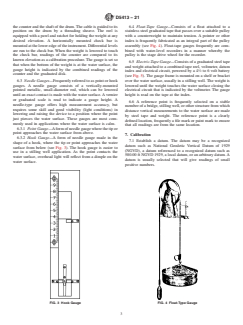
6.4 Float-Tape Gauge—Consists of a float attached to a stainless steel graduated tape that passes over a suitable pulley with a
counterweight to maintain tension. A pointer or other index is frequently fabricated as an integral part of the pulley assembly (see
Fig. 4). Float-tape gauges frequently are combined with water-level recorders in a manner whereby the pulley is the stage drive
wheel for the recorder.
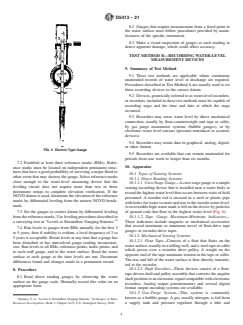
6.5 Electric-Tape Gauge—Consists of a graduated steel tape and weight attached to a combined tape reel, voltmeter, datum index
and electrical circuit, powered by a 4 ⁄2 to 6 volt battery (see Fig. 5). The gauge frame is mounted on a shelf or bracket over the
water surface, usually in a stilling well. The weight is lowered until the weight touches the water surface closing the electrical
circuit that is indicated by the voltmeter. The gauge height is read on the tape at the index.
6.6 A reference point is frequently selected on a stable member of a bridge, stilling well, or other structure from which distance
vertical measurements to the water surface are made by steel tape and weight. The reference point is a clearly defined location,
frequently a file mark or paint mark to ensure that all readings are from the same location.
7. Calibration
7.1 Establish a datum. The datum may be a recognized datum such as National Geodetic Vertical Datum of 1929 (NGVD), a datum
referenced to a recognized datum such as 580.00 ft NGVD 1929, a local datum, or an arbitrary datum. A datum is usually selected
that will give readings of small positive numbers.
7.2 Establish at least three reference marks (RMs). Reference marks must be located on independent permanent structures that
FIG. 2 Type A Wire-Weight Gauge
D5413 − 21
FIG. 3 Hook Gauge
FIG. 4 Float-Type Gauge
have a good probability of surviving a major flood or other event that may destroy the gauge. Reference marks should be Select
D5413 − 21
FIG. 5 Electric-Type Gauge
reference marks close enough to the water-level measuring device that the leveling circuit does not require more than two or three
instrument setups to complete elevation verification. If the NGVD datum is used, determine the elevation of the reference marks
by differential leveling from the nearest NGVD benchmark.
7.3 Set the gauges to correct datum by differential leveling from the reference marks. Use leveling procedures described in a
surveying text or “Levels at Streamflow Gauging Stations.”
7.4 Run levels to gauges from RMs annually for the first 3 to 5 years, then if stability is evident, a level frequency of 3 to 5 years
is acceptable. Rerun levels at any time that a gauge has been disturbed or has unresolved gauge reading inconsistencies. Run levels
to all RMs, reference points, index points, and to each staff gauge, and to the water surface. Read the water surface at each gauge
at the time levels are run. Document differences found and changes made in a permanent record.
8. Procedure
8.1 Read direct reading gauges by observing the water surface on the gauge scale. Manually record this value on an appropriate
form.
8.2 Gauges that require measurement from a fixed point to the water surface must follow procedures provided by manufacturers
of the specific instrument.
8.3 Make a visual inspection of gauges at each reading to detect apparent damage, which could affect accuracy.
Kennedy, E. J., “Levels at Streamflow Gauging Stations,” Techniques of Water Resources Investigations, Book 3, Chapter A-19, U.S. Geological Survey, 1990.Kenney,
T. A., “Levels at Streamflow Gauging Stations,” Techniques of Water Resources Investigations, Book 3, Chapter A-19, U.S. Geological Survey, 2010.
D5413 − 21
TEST METHOD B—RECORDING WATER-LEVEL MEASUREMENT DEVICES
9. Summary of Test Method
9.1 These test methods are applicable where continuous unattended records of water level or discharge are required. Procedures
described in Test Method A are usually used to set these recording devices to the correct datum.
9.2 Devices, generically referred to as water-level recorders, or recorders, included in these test methods must be capable of
recording stage and the time and date at which the stage occurred.
9.3 Recorders may sense water level by direct mechanical connection, usually by float-counterweight and tape or cable, by gas
purge manometer systems (bubble gauges), or by electronic water level sensors (pressure transducer or acoustic devices).
9.4 Recorders may retain data in graphical, analog, digital, or other format.
9.5 Recorders are available that can remain unattended for periods from one week to longer than six months.
10. Apparatus
10.1 Types of Sensing Systems:
10.1.1 Direct Reading Systems:
10.1.1.1 Crest Stage Gauge—A crest stage gauge is a simple sensing-recording device that is installed near a water body to record
the highest water level that occurs between visits of field personnel. A wooden rod is encased in a steel or plastic pipe with holes
for water to enter and rise to the outside water level. A recoverable high-water mark is left on the device by particles of ground
cork that float to the highest water level (Fig. 6).
10.1.1.2 Tape Gauge Maximum-Minimum Indicators—These indicators include magnetic or mechanical accessories that record
maximum or minimum travel of float-drive tape gauges or recorder-drive tapes.
10.1.2 Mechanical Sensing Systems:
10.1.2.1 Float Tape—Consists of a float that floats on the water surface, usually in a stilling well, and a steel tape or cable which
passes over a recorder drive pulley. A weight on the opposite end of the tape maintains tension in the tape or cable. The rise and
fall of the water surface is thus directly transmitted to the recorder.
10.1.2.2 Shaft Encoders—These devices consist of a float-tape driven shaft and pulley assembly that converts the angular shaft
position to an electronic signal compatible with electronic recorders. Analog output potentiometers and several digital format
output encoding systems are available.
10.1.3 Gas-Purge System—This system is commonly known as a bubble gauge. A gas, usually nitrogen, is fed from a supply tank
and pressure regulator through a tube and bubbled freely into the water body through an orifice at a fixed location on or near the
bottom of the water body. The gas pressure in the tube is equal to the piezometric head on the bubble orifice corresponding to the
water level over the orifice. Several methods of sensing this line pressure and converting it to a recordable format are used (Fig.
7).
10.1.3.1 Mercury Manometer—The manometer assembly converts the gas purge line pressure to a shaft rotation for driving a
recorder. Mercury is used because its specific gravity is 13.6 times that of water, and thus shortens the length of the manometer.
The theory and application of these devices are given in “Installation and Service Manual for U.S. Geological Survey
Manometers.” These devices are being phased out of service because of potential damage to the environment should mercury
spills occur.caused by mercury spills.
Craig, J. D., “Installation and Servi
...