

ASTM D1141-98(2021)
(Practice)Standard Practice for Preparation of Substitute Ocean Water
General Information
- Abstract
SIGNIFICANCE AND USE
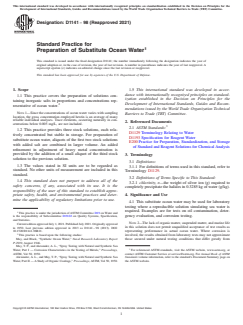
4.1 This substitute ocean water may be used for laboratory testing where a reproducible solution simulating sea water is required. Examples are for tests on oil contamination, detergency evaluation, and corrosion testing.
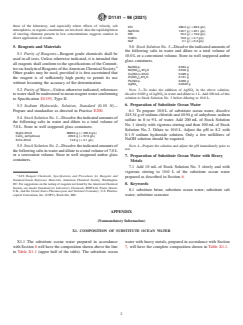
Note 2: The lack of organic matter, suspended matter, and marine life in this solution does not permit unqualified acceptance of test results as representing performance in actual ocean water. Where corrosion is involved, the results obtained from laboratory tests may not approximate those secured under natural testing conditions that differ greatly from those of the laboratory, and especially where effects of velocity, salt atmospheres, or organic constituents are involved. Also the rapid depletion of reacting elements present in low concentrations suggests caution in direct application of results.
SCOPE
1.1 This practice covers the preparation of solutions containing inorganic salts in proportions and concentrations representative of ocean water.2
Note 1: Since the concentrations of ocean water varies with sampling location, the gross concentration employed herein is an average of many reliable individual analyses. Trace elements, occurring naturally in concentrations below 0.005 mg/L, are not included.
1.2 This practice provides three stock solutions, each relatively concentrated but stable in storage. For preparation of substitute ocean water, aliquots of the first two stock solutions with added salt are combined in larger volume. An added refinement in adjustment of heavy metal concentration is provided by the addition of a small aliquot of the third stock solution to the previous solution.
1.3 The values stated in SI units are to be regarded as standard. No other units of measurement are included in this standard.
1.4 This standard does not purport to address all of the safety concerns, if any, associated with its use. It is the responsibility of the user of this standard to establish appropriate safety, health, and environmental practices and determine the applicability of regulatory limitations prior to use.
1.5 This international standard was developed in accordance with internationally recognized principles on standardization established in the Decision on Principles for the Development of International Standards, Guides and Recommendations issued by the World Trade Organization Technical Barriers to Trade (TBT) Committee.
- Status
- Published
- Publication Date
- 30-Jun-2021
- Technical Committee
- D19 - Water
- Drafting Committee
- D19.02 - Quality Systems, Specification, and Statistics


Overview
ASTM D1141-98(2021), Standard Practice for Preparation of Substitute Ocean Water, establishes a reliable approach for creating laboratory solutions that simulate the inorganic composition of average ocean water. Developed by ASTM International, this standard is widely adopted for research, testing, and industrial applications where the reproducibility and consistency of seawater-like properties are essential. Substitute ocean water prepared according to this practice enables uniform test conditions for evaluating materials, processes, and products intended for marine environments.
Key Topics
- Preparation of Substitute Ocean Water: Outlines precise methods for mixing inorganic salts in proportions representative of typical ocean water, based on averaged analytical data from various sampling locations.
- Reproducibility: Emphasizes the importance of consistency in laboratory simulations, ensuring that test results from different times and locations are comparable.
- Use of Stock Solutions: Details the creation and use of three concentrated, stable stock solutions, allowing convenient and reliable preparation of substitute seawater as needed.
- Scope Limitation: Clearly states that this substitute solution lacks organic matter, suspended particles, and marine life, which may limit its ability to fully mimic the complexities of natural ocean water, particularly in corrosion and contamination studies.
- Measurement Standards: All procedures and concentrations are defined in SI units, ensuring global compatibility and consistency in practice.
- Safety and Compliance: Reminds users to employ suitable safety, health, and environmental measures, and to consider regulatory requirements relevant to substitute ocean water and laboratory practices.
Applications
Substitute ocean water as defined by ASTM D1141-98(2021) is integral to a broad range of scientific and industrial activities, including:
- Corrosion Testing: Assessing the durability and corrosion resistance of metals, coatings, and engineered materials in simulated marine conditions before real-world deployment.
- Oil Contamination Studies: Providing a controlled medium for evaluating the environmental and material impacts of oil spills and remediation strategies.
- Detergency Evaluations: Testing the performance of cleaning agents and detergents in saltwater contexts, particularly for products intended for use in marine industries or environments.
- Marine Equipment and Component Testing: Supporting manufacturers and researchers in evaluating the long-term performance of pumps, valves, sensors, and other equipment exposed to oceanic conditions.
- Academic and Government Research: Facilitating standardized, repeatable experiments in marine biology, chemistry, and environmental sciences when real seawater is not accessible or practical.
Related Standards
The following standards are frequently referenced or used in conjunction with ASTM D1141-98(2021):
- ASTM D1129: Terminology Relating to Water, which defines key terms used in this standard.
- ASTM D1193: Specification for Reagent Water, establishing the quality requirements for water used in preparing the solutions.
- ASTM E200: Practice for Preparation, Standardization, and Storage of Standard and Reagent Solutions for Chemical Analysis.
- ISO and Other International Standards: May be referenced for qualification of results, safety protocols, or to align with globally recognized methodologies for marine and laboratory testing.
By providing a standardized procedure for the preparation of substitute ocean water, ASTM D1141-98(2021) is essential for ensuring the consistency, reliability, and global comparability of laboratory testing involving simulated seawater solutions. This enhances the confidence in results derived from corrosion, contamination, and detergency studies relevant to marine environments.
Relations
- Effective Date
- 01-May-2020
- Effective Date
- 01-Mar-2010
- Effective Date
- 01-Sep-2006
- Effective Date
- 01-Sep-2006
- Effective Date
- 01-Mar-2006
- Effective Date
- 15-Feb-2006
- Effective Date
- 01-Mar-2004
- Effective Date
- 01-Mar-2004
- Effective Date
- 10-Aug-2003
- Effective Date
- 10-Mar-2003
- Effective Date
- 10-Jul-2002
- Effective Date
- 10-Jul-2002
- Effective Date
- 10-Feb-2002
- Effective Date
- 10-Feb-2002
- Effective Date
- 10-Feb-1999
Get Certified
Connect with accredited certification bodies for this standard

CIS Institut d.o.o.
Personal Protective Equipment (PPE) certification body. Notified Body NB-2890 for EU Regulation 2016/425 PPE.

Kiwa BDA Testing
Building and construction product certification.
Kmetijski inštitut Slovenije
Agricultural Institute of Slovenia. Soil testing, plant health, agricultural product analysis.
Sponsored listings
Frequently Asked Questions
ASTM D1141-98(2021) is a standard published by ASTM International. Its full title is "Standard Practice for Preparation of Substitute Ocean Water". This standard covers: SIGNIFICANCE AND USE 4.1 This substitute ocean water may be used for laboratory testing where a reproducible solution simulating sea water is required. Examples are for tests on oil contamination, detergency evaluation, and corrosion testing. Note 2: The lack of organic matter, suspended matter, and marine life in this solution does not permit unqualified acceptance of test results as representing performance in actual ocean water. Where corrosion is involved, the results obtained from laboratory tests may not approximate those secured under natural testing conditions that differ greatly from those of the laboratory, and especially where effects of velocity, salt atmospheres, or organic constituents are involved. Also the rapid depletion of reacting elements present in low concentrations suggests caution in direct application of results. SCOPE 1.1 This practice covers the preparation of solutions containing inorganic salts in proportions and concentrations representative of ocean water.2 Note 1: Since the concentrations of ocean water varies with sampling location, the gross concentration employed herein is an average of many reliable individual analyses. Trace elements, occurring naturally in concentrations below 0.005 mg/L, are not included. 1.2 This practice provides three stock solutions, each relatively concentrated but stable in storage. For preparation of substitute ocean water, aliquots of the first two stock solutions with added salt are combined in larger volume. An added refinement in adjustment of heavy metal concentration is provided by the addition of a small aliquot of the third stock solution to the previous solution. 1.3 The values stated in SI units are to be regarded as standard. No other units of measurement are included in this standard. 1.4 This standard does not purport to address all of the safety concerns, if any, associated with its use. It is the responsibility of the user of this standard to establish appropriate safety, health, and environmental practices and determine the applicability of regulatory limitations prior to use. 1.5 This international standard was developed in accordance with internationally recognized principles on standardization established in the Decision on Principles for the Development of International Standards, Guides and Recommendations issued by the World Trade Organization Technical Barriers to Trade (TBT) Committee.
SIGNIFICANCE AND USE 4.1 This substitute ocean water may be used for laboratory testing where a reproducible solution simulating sea water is required. Examples are for tests on oil contamination, detergency evaluation, and corrosion testing. Note 2: The lack of organic matter, suspended matter, and marine life in this solution does not permit unqualified acceptance of test results as representing performance in actual ocean water. Where corrosion is involved, the results obtained from laboratory tests may not approximate those secured under natural testing conditions that differ greatly from those of the laboratory, and especially where effects of velocity, salt atmospheres, or organic constituents are involved. Also the rapid depletion of reacting elements present in low concentrations suggests caution in direct application of results. SCOPE 1.1 This practice covers the preparation of solutions containing inorganic salts in proportions and concentrations representative of ocean water.2 Note 1: Since the concentrations of ocean water varies with sampling location, the gross concentration employed herein is an average of many reliable individual analyses. Trace elements, occurring naturally in concentrations below 0.005 mg/L, are not included. 1.2 This practice provides three stock solutions, each relatively concentrated but stable in storage. For preparation of substitute ocean water, aliquots of the first two stock solutions with added salt are combined in larger volume. An added refinement in adjustment of heavy metal concentration is provided by the addition of a small aliquot of the third stock solution to the previous solution. 1.3 The values stated in SI units are to be regarded as standard. No other units of measurement are included in this standard. 1.4 This standard does not purport to address all of the safety concerns, if any, associated with its use. It is the responsibility of the user of this standard to establish appropriate safety, health, and environmental practices and determine the applicability of regulatory limitations prior to use. 1.5 This international standard was developed in accordance with internationally recognized principles on standardization established in the Decision on Principles for the Development of International Standards, Guides and Recommendations issued by the World Trade Organization Technical Barriers to Trade (TBT) Committee.
ASTM D1141-98(2021) is classified under the following ICS (International Classification for Standards) categories: 13.060.10 - Water of natural resources. The ICS classification helps identify the subject area and facilitates finding related standards.
ASTM D1141-98(2021) has the following relationships with other standards: It is inter standard links to ASTM D1129-13(2020)e2, ASTM D1129-10, ASTM D1129-06a, ASTM D1129-06ae1, ASTM D1193-06, ASTM D1129-06, ASTM D1129-04e1, ASTM D1129-04, ASTM D1129-03a, ASTM D1129-03, ASTM D1129-02a, ASTM D1129-01, ASTM D1129-02, ASTM D1129-99a, ASTM D1193-99. Understanding these relationships helps ensure you are using the most current and applicable version of the standard.
ASTM D1141-98(2021) is available in PDF format for immediate download after purchase. The document can be added to your cart and obtained through the secure checkout process. Digital delivery ensures instant access to the complete standard document.
Standards Content (Sample)
This international standard was developed in accordance with internationally recognized principles on standardization established in the Decision on Principles for the
Development of International Standards, Guides and Recommendations issued by the World Trade Organization Technical Barriers to Trade (TBT) Committee.
Designation: D1141 − 98 (Reapproved 2021)
Standard Practice for
Preparation of Substitute Ocean Water
This standard is issued under the fixed designation D1141; the number immediately following the designation indicates the year of
original adoption or, in the case of revision, the year of last revision. A number in parentheses indicates the year of last reapproval. A
superscript epsilon (´) indicates an editorial change since the last revision or reapproval.
This standard has been approved for use by agencies of the U.S. Department of Defense.
1. Scope 1.5 This international standard was developed in accor-
dance with internationally recognized principles on standard-
1.1 This practice covers the preparation of solutions con-
ization established in the Decision on Principles for the
taining inorganic salts in proportions and concentrations rep-
2 Development of International Standards, Guides and Recom-
resentative of ocean water.
mendations issued by the World Trade Organization Technical
NOTE 1—Since the concentrations of ocean water varies with sampling
Barriers to Trade (TBT) Committee.
location, the gross concentration employed herein is an average of many
reliable individual analyses. Trace elements, occurring naturally in con-
2. Referenced Documents
centrations below 0.005 mg/L, are not included.
2.1 ASTM Standards:
1.2 This practice provides three stock solutions, each rela-
D1129 Terminology Relating to Water
tively concentrated but stable in storage. For preparation of
D1193 Specification for Reagent Water
substitute ocean water, aliquots of the first two stock solutions
E200 Practice for Preparation, Standardization, and Storage
with added salt are combined in larger volume. An added
of Standard and Reagent Solutions for ChemicalAnalysis
refinement in adjustment of heavy metal concentration is
provided by the addition of a small aliquot of the third stock
3. Terminology
solution to the previous solution.
3.1 Definitions:
1.3 The values stated in SI units are to be regarded as
3.1.1 For definitions of terms used in this standard, refer to
standard. No other units of measurement are included in this
Terminology D1129.
standard.
3.2 Definitions of Terms Specific to This Standard:
1.4 This standard does not purport to address all of the
3.2.1 chlorinity, n—the weight of silver ion (g) required to
safety concerns, if any, associated with its use. It is the
completely precipitate the halides in 0.3285 kg of water (g/kg).
responsibility of the user of this standard to establish appro-
priate safety, health, and environmental practices and deter- 4. Significance and Use
mine the applicability of regulatory limitations prior to use.
4.1 This substitute ocean water may be used for laboratory
testing where a reproducible solution simulating sea water is
required. Examples are for tests on oil contamination, deter-
This practice is under the jurisdiction of ASTM Committee D19 on Water and
is the responsibility of Subcommittee D19.02 on Quality Systems, Specification, gency evaluation, and corrosion testing.
and Statistics.
NOTE 2—The lack of organic matter, suspended matter, and marine life
Current edition approved July 1, 2021. Published July 2021. Originally approved
in this solution does not permit unqualified acceptance of test results as
in 1950. Last previous edition approved in 2013 as D1141 – 98 (2013). DOI:
representing performance in actual ocean water. Where corrosion is
10.1520/D1141-98R21.
This practice is based upon the following studies: involved, the results obtained from laboratory tests may not approximate
May, and Black, “Synthetic Ocean Water,” Naval Research Laboratory Report those secured under natural testing conditions that differ greatly from
P-2909, August 1946.
May, T. P., and Alexander, A. L., “Spray Testing with Natural and Synthetic Sea
Water, Part I — Corrosion Characteristics in the Testing of Metals,” Proceedings, For referenced ASTM standards, visit the ASTM website, www.astm.org, or
ASTM, Vol 50, 1950. contact ASTM Customer Service at service@astm.org. For Annual Book of ASTM
Alexander, A. L., and May, T. P., “Spray Testing with Natural and Synthetic Sea Standards volume information, refer to the standard’s Document Summary page on
Water, Part II —AStudy of Organic Coatings,” Proceedings,ASTM, Vol 50, 1950. the ASTM website.
Copyright © ASTM International, 100 Barr Harbor Drive, PO Box C700, West Conshohocken, PA 19428-2959. United States
D1141 − 98 (2021)
those of the laboratory, and especially where effects of velocity, salt
KCl 486.2 g ( = 69.5 g/L)
atmospheres,ororganicconstituentsareinvolved.Alsotherapiddepletion
NaHCO 140.7 g ( = 20.1 g/L)
of reacting elements present in low concentrations suggests caution in KBr 70.4 g ( = 10.0 g/L)
H BO 19.0 g ( = 2.7 g/L)
direct application of results.
3 3
NaF 2.1 g ( = 0.3 g/L)
5.6 Stock Solution No. 3—Dissolvetheindicatedamountsof
5. Reagents and Materials
the follo
...