

ASTM A314-23
(Specification)Standard Specification for Stainless Steel Billets and Bars for Forging
General Information
- Abstract
ABSTRACT
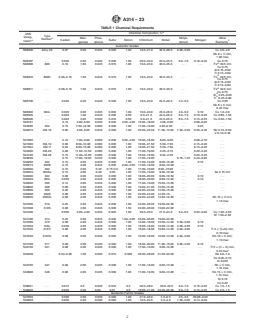
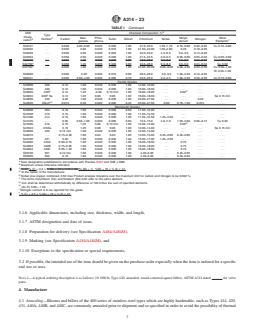
This specification covers stainless steel billets and bars for forging. The steel materials shall be annealed and conditioned by chipping or grinding. The steel specimens shall conform to the required chemical compositions of carbon, manganese, phosphorus, sulfur, silicon, chromium, nickel, molybdenum, nitrogen, and other elements.
SCOPE
1.1 This specification covers stainless steel billets and bars intended only for forging.
1.2 This international standard was developed in accordance with internationally recognized principles on standardization established in the Decision on Principles for the Development of International Standards, Guides and Recommendations issued by the World Trade Organization Technical Barriers to Trade (TBT) Committee.
- Status
- Published
- Publication Date
- 31-Oct-2023
- Technical Committee
- A01 - Steel, Stainless Steel and Related Alloys
- Drafting Committee
- A01.17 - Flat-Rolled and Wrought Stainless Steel
Buy Documents
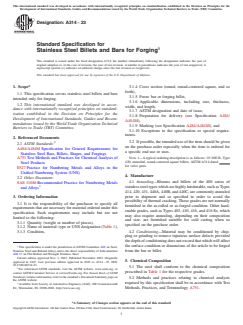
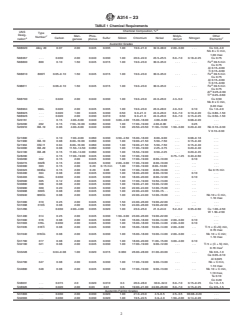
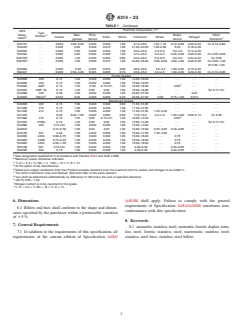

ASTM A314-23 - Standard Specification for Stainless Steel Billets and Bars for Forging
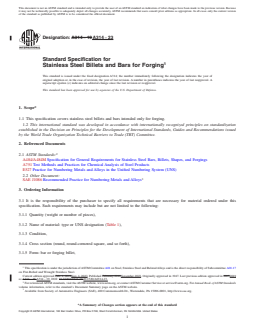

REDLINE ASTM A314-23 - Standard Specification for Stainless Steel Billets and Bars for Forging
Overview
ASTM A314-23 is the recognized standard specification developed by ASTM International for stainless steel billets and bars specifically intended for forging. This standard outlines the requirements regarding the chemical composition, dimensions, condition, preparation, and general quality requirements for these products. Covering different stainless steel types, ASTM A314-23 supports both domestic and international manufacturing and supply of stainless steel forging stock, ensuring materials meet recognized quality and compositional standards.
By adhering to the principles of international standardization as established by the WTO TBT Committee, ASTM A314 helps manufacturers, suppliers, and end-users ensure global compatibility, safety, and material performance. Stainless steel billets and bars produced under this standard are fundamental starting materials used in forging a wide range of precision and structural components.
Key Topics
- Material Scope: Applies exclusively to stainless steel billets and bars produced for subsequent forging processes.
- Chemical Composition: Specifies limits for essential alloying elements, including carbon, manganese, phosphorus, sulfur, silicon, chromium, nickel, molybdenum, and nitrogen. The specification addresses austenitic, austenitic-ferritic (duplex), ferritic, and martensitic stainless steel grades.
- Conditioning Requirements: Materials must be conditioned, typically by chipping or grinding, to remove injurious surface defects, ensuring suitability for forging.
- Annealing: Certain grades, especially of the 400 series, are generally annealed before shipment to avoid thermal cracking; other grades may require specific annealing based on composition and intended use.
- Dimensional Tolerances: The billets and bars must meet buyer-specified shape and dimensional requirements, with a permissible variation as outlined in the standard.
- General Quality Requirements: Compliance with ASTM A484/A484M is mandatory, providing guidance on marking, preparation for delivery, and other generic stainless steel product requirements.
- Ordering Information: The purchaser must specify all critical details, including quantity, grade or UNS designation, condition, dimensions, and any special requirements or exceptions to the specification.
Applications
Stainless steel billets and bars produced in conformity with ASTM A314-23 are essential raw materials for:
- Industrial Forgings: Components in heavy industry, automotive, and aerospace sectors.
- Pressure Vessels and Valves: Forged parts requiring high corrosion resistance and strength for power generation and chemical processing.
- Petrochemical and Energy Equipment: Pipes, fittings, and flanges forged from stainless steel billets, ensuring durability in harsh environments.
- Construction and Infrastructure: Use in critical hardware, connectors, and fasteners that demand reliable mechanical properties and corrosion resistance.
By providing a robust framework for material quality, ASTM A314-23 supports high-performance applications where reliable base materials are essential to final component performance and safety.
Related Standards
When considering ASTM A314-23, it is important to be aware of several closely associated standards:
- ASTM A484/A484M - General Requirements for Stainless Steel Bars, Billets, Shapes, and Forgings, covering common delivery, marking, and quality criteria.
- ASTM A751 - Test Methods and Practices for Chemical Analysis of Steel Products, referenced for verifying compliance with composition limits.
- ASTM E527 - Practice for Numbering Metals and Alloys in the Unified Numbering System (UNS), facilitating standard grade identification.
- SAE J1086 - Recommended Practice for Numbering Metals and Alloys, often referenced in procurement and ordering.
Keywords
Stainless steel billets, stainless steel bars, forging, ASTM A314, chemical composition, annealing, austenitic stainless steel, ferritic stainless steel, martensitic stainless steel, duplex stainless steel forging stock, dimensional tolerances, quality requirements.
Relations
- Effective Date
- 01-Nov-2023
- Effective Date
- 01-Jan-2024
- Effective Date
- 01-Sep-2023
- Effective Date
- 01-Mar-2023
- Effective Date
- 01-Nov-2023
- Referred By
ASTM F899-23 - Standard Specification for Wrought Stainless Steels for Surgical Instruments - Effective Date
- 01-Nov-2023
- Effective Date
- 01-Nov-2023
- Effective Date
- 01-Nov-2023
- Effective Date
- 01-Nov-2023
- Effective Date
- 01-Nov-2023
- Effective Date
- 01-Nov-2023
- Effective Date
- 01-Nov-2023
Buy Documents
ASTM A314-23 - Standard Specification for Stainless Steel Billets and Bars for Forging
REDLINE ASTM A314-23 - Standard Specification for Stainless Steel Billets and Bars for Forging
Get Certified
Connect with accredited certification bodies for this standard

Element Materials Technology
Materials testing and product certification.

Inštitut za kovinske materiale in tehnologije
Institute of Metals and Technology. Materials testing, metallurgical analysis, NDT.
Sponsored listings
Frequently Asked Questions
ASTM A314-23 is a technical specification published by ASTM International. Its full title is "Standard Specification for Stainless Steel Billets and Bars for Forging". This standard covers: ABSTRACT This specification covers stainless steel billets and bars for forging. The steel materials shall be annealed and conditioned by chipping or grinding. The steel specimens shall conform to the required chemical compositions of carbon, manganese, phosphorus, sulfur, silicon, chromium, nickel, molybdenum, nitrogen, and other elements. SCOPE 1.1 This specification covers stainless steel billets and bars intended only for forging. 1.2 This international standard was developed in accordance with internationally recognized principles on standardization established in the Decision on Principles for the Development of International Standards, Guides and Recommendations issued by the World Trade Organization Technical Barriers to Trade (TBT) Committee.
ABSTRACT This specification covers stainless steel billets and bars for forging. The steel materials shall be annealed and conditioned by chipping or grinding. The steel specimens shall conform to the required chemical compositions of carbon, manganese, phosphorus, sulfur, silicon, chromium, nickel, molybdenum, nitrogen, and other elements. SCOPE 1.1 This specification covers stainless steel billets and bars intended only for forging. 1.2 This international standard was developed in accordance with internationally recognized principles on standardization established in the Decision on Principles for the Development of International Standards, Guides and Recommendations issued by the World Trade Organization Technical Barriers to Trade (TBT) Committee.
ASTM A314-23 is classified under the following ICS (International Classification for Standards) categories: 77.140.20 - Stainless steels; 77.140.60 - Steel bars and rods. The ICS classification helps identify the subject area and facilitates finding related standards.
ASTM A314-23 has the following relationships with other standards: It is inter standard links to ASTM A314-19, ASTM A484/A484M-24, ASTM A484/A484M-23a, ASTM A484/A484M-23, ASTM A582/A582M-22, ASTM F899-23, ASTM A276/A276M-23, ASTM D4742-23, ASTM A564/A564M-19a, ASTM D3461-18, ASTM D3104-14a(2018), ASTM D7098-21. Understanding these relationships helps ensure you are using the most current and applicable version of the standard.
ASTM A314-23 is available in PDF format for immediate download after purchase. The document can be added to your cart and obtained through the secure checkout process. Digital delivery ensures instant access to the complete standard document.
Standards Content (Sample)
This international standard was developed in accordance with internationally recognized principles on standardization established in the Decision on Principles for the
Development of International Standards, Guides and Recommendations issued by the World Trade Organization Technical Barriers to Trade (TBT) Committee.
Designation: A314 − 23
Standard Specification for
Stainless Steel Billets and Bars for Forging
This standard is issued under the fixed designation A314; the number immediately following the designation indicates the year of
original adoption or, in the case of revision, the year of last revision. A number in parentheses indicates the year of last reapproval. A
superscript epsilon (´) indicates an editorial change since the last revision or reapproval.
This standard has been approved for use by agencies of the U.S. Department of Defense.
1. Scope* 3.1.4 Cross section (round, round-cornered square, and so
forth),
1.1 This specification covers stainless steel billets and bars
3.1.5 Form: bar or forging billet,
intended only for forging.
3.1.6 Applicable dimensions, including size, thickness,
1.2 This international standard was developed in accor-
width, and length,
dance with internationally recognized principles on standard-
3.1.7 ASTM designation and date of issue,
ization established in the Decision on Principles for the
3.1.8 Preparation for delivery (see Specification A484/
Development of International Standards, Guides and Recom-
A484M),
mendations issued by the World Trade Organization Technical
3.1.9 Marking (see Specification A484/A484M), and
Barriers to Trade (TBT) Committee.
3.1.10 Exceptions to the specification or special require-
ments.
2. Referenced Documents
2 3.2 If possible, the intended use of the item should be given
2.1 ASTM Standards:
on the purchase order especially when the item is ordered for
A484/A484M Specification for General Requirements for
a specific end use or uses.
Stainless Steel Bars, Billets, Shapes, and Forgings
A751 Test Methods and Practices for Chemical Analysis of NOTE 1—A typical ordering description is as follows: 10 000 lb, Type
420, annealed, round-cornered square billets, ASTM A314 dated
Steel Products
for valve parts.
E527 Practice for Numbering Metals and Alloys in the
Unified Numbering System (UNS)
4. Manufacture
2.2 Other Document:
4.1 Annealing—Blooms and billets of the 400 series of
SAE J1086 Recommended Practice for Numbering Metals
stainless steel types which are highly hardenable, such as Types
and Alloys
414, 420, 431, 440A, 440B, and 440C, are commonly annealed
prior to shipment and so specified in order to avoid the
3. Ordering Information
possibility of thermal cracking. Those grades are not normally
3.1 It is the responsibility of the purchaser to specify all
furnished in the as-rolled or as-forged condition. Other hard-
requirements that are necessary for material ordered under this
enable grades, such as Types 403, 410, 416, and 416 Se, which
specification. Such requirements may include but are not
may also require annealing, depending on their composition
limited to the following:
and size, are furnished suitable for cold cutting when so
3.1.1 Quantity (weight or number of pieces),
specified on the purchase order.
3.1.2 Name of material: type or UNS designation (Table 1),
4.2 Conditioning—Material may be conditioned by chip-
3.1.3 Condition,
ping or grinding to remove injurious surface defects provided
the depth of conditioning does not exceed that which will affect
the surface condition or dimensions of the article to be forged
This specification is under the jurisdiction of ASTM Committee A01 on Steel,
Stainless Steel and Related Alloys and is the direct responsibility of Subcommittee
from the bar or billet.
A01.17 on Flat-Rolled and Wrought Stainless Steel.
Current edition approved Nov. 1, 2023. Published November 2023. Originally
5. Chemical Composition
approved in 1947. Last previous edition approved in 2019 as A314 – 19. DOI:
10.1520/A0314-23.
5.1 The steel shall conform to the chemical composition
For referenced ASTM standards, visit the ASTM website, www.astm.org, or
prescribed in Table 1 for the respective grades.
contact ASTM Customer Service at service@astm.org. For Annual Book of ASTM
Standards volume information, refer to the standard’s Document Summary page on
5.2 Methods and practices relating to chemical analysis
the ASTM website.
required by this specification shall be in accordance with Test
Available from Society of Automotive Engineers (SAE), 400 Commonwealth
Dr., Warrendale, PA 15096-0001, http://www.sae.org. Methods, Practices, and Terminology A751.
*A Summary of Changes section appears at the end of this standard
Copyright © ASTM International, 100 Barr Harbor Drive, PO Box C700, West Conshohocken, PA 19428-2959. United States
A314 − 23
TABLE 1 Chemical Requirements
B
Chemical Composition, %
UNS
Type
Desig-
F Man- Phos- Molyb- Other
Number
A Carbon Sulfur Silicon Chromium Nickel Nitrogen
F
nation
ganese phorus denum Elements
Austenitic Grades
N08020 Alloy 20 0.07 2.00 0.045 0.035 1.00 19.0–21.0 32.0–38.0 2.00–3.00 . . . Cu 3.0–4.0
Nb 8 × C min,
1.00 max
N08367 . . . 0.030 2.00 0.040 0.030 1.00 20.0–22.0 23.5–25.5 6.0–7.0 0.18–0.25 Cu 0.75
G
N08800 800 0.10 1.50 0.045 0.015 1.00 19.0–23.0 30.0–35.0 . . . . . . Fe 39.5 min
Cu 0.75
Al 0.15–0.60
Ti 0.15–0.60
G
N08810 800H 0.05–0.10 1.50 0.045 0.015 1.00 19.0–23.0 30.0–35.0 . . . . . . Fe 39.5 min
Cu 0.75
Al 0.15–0.60
Ti 0.15–0.60
G
N08811 . . . 0.06–0.10 1.50 0.045 0.015 1.00 19.0–23.0 30.0–35.0 . . . . . . Fe 39.5 min
Cu 0.75
H
Al 0.25–0.60
H
Ti 0.25–0.60
N08700 . . . 0.040 2.00 0.040 0.030 1.00 19.0–23.0 24.0–26.0 4.3–5.0 . . . Cu 0.50
Nb 8 x C min,
0.40 max
N08904 904L 0.020 2.00 0.045 0.035 1.00 19.0–23.0 23.0–28.0 4.0–5.0 0.10 Cu 1.0–2.0
N08925 . . . 0.020 1.00 0.045 0.030 0.50 9.0–21.0 24.0–26.0 6.0–7.0 0.10–0.20 Cu 0.80–1.50
N08926 . . . 0.020 2.00 0.030 0.010 0.50 9.0–21.0 24.0–26.0 6.0–7.0 0.15–0.25 Cu 0.50–1.50
S20161 . . . 0.15 4.00–6.00 0.040 0.040 3.00–4.00 15.00–18.00 4.00–6.00 . . . 0.08–0.20 . . .
S20200 202 0.15 7.50–10.00 0.060 0.030 1.00 17.00–19.00 4.00–6.00 . . . 0.25 . . .
S20910 XM-19 0.06 4.00–6.00 0.040 0.030 1.00 20.50–23.50 11.50–13.50 1.50–3.00 0.20–0.40 Nb 0.10–0.30
V 0.10–0.30
S21800 . . . 0.10 7.00–9.00 0.060 0.030 3.50–4.50 16.00–18.00 8.00–9.00 . . . 0.08–0.18 . . .
S21900 XM-10 0.08 8.00–10.00 0.060 0.030 1.00 19.00–21.50 5.50–7.50 . . . 0.15–0.40 . . .
S21904 XM-11 0.04 8.00–10.00 0.060 0.030 1.00 19.00–21.50 5.50–7.50 . . . 0.15–0.40 . . .
S24000 XM-29 0.08 11.50–14.50 0.060 0.030 1.00 17.00–19.00 2.25–3.75 . . . 0.20–0.40 . . .
S24100 XM-28 0.15 11.00–14.00 0.060 0.030 1.00 16.50–19.00 0.50–2.25 . . . 0.20–0.45 . . .
S28200 . . . 0.15 17.00–19.00 0.045 0.030 1.00 17.00–19.00 . . . 0.75–1.25 0.40–0.60 . . .
S30200 302 0.15 2.00 0.045 0.030 1.00 17.00–19.00 8.00–10.00 . . . 0.10 . . .
S30215 302B 0.15 2.00 0.045 0.030 2.00–3.00 17.00–19.00 8.00–10.00 . . . . . . . . .
S30300 303 0.15 2.00 0.20 0.15 min 1.00 17.00–19.00 8.00–10.00 . . . . . . . . .
S30323 303Se 0.15 2.00 0.20 0.06 1.00 17.00–19.00 8.00–10.00 . . . . . . Se 0.15 min
S30400 304 0.08 2.00 0.045 0.030 1.00 18.00–20.00 8.00–10.50 . . . 0.10 . . .
S30403 304L 0.030 2.00 0.045 0.030 1.00 18.00–20.00 8.00–12.00 . . . 0.10 . . .
S30500 305 0.12 2.00 0.045 0.030 1.00 17.00–19.00 10.50–13.00 . . . . . . . . .
S30800 308 0.08 2.00 0.045 0.030 1.00 19.00–21.00 10.00–12.00 . . . . . . . . .
S30900 309 0.20 2.00 0.045 0.030 1.00 22.00–24.00 12.00–15.00 . . . . . . . . .
S30908 309S 0.08 2.00 0
...
This document is not an ASTM standard and is intended only to provide the user of an ASTM standard an indication of what changes have been made to the previous version. Because
it may not be technically possible to adequately depict all changes accurately, ASTM recommends that users consult prior editions as appropriate. In all cases only the current version
of the standard as published by ASTM is to be considered the official document.
Designation: A314 − 19 A314 − 23
Standard Specification for
Stainless Steel Billets and Bars for Forging
This standard is issued under the fixed designation A314; the number immediately following the designation indicates the year of
original adoption or, in the case of revision, the year of last revision. A number in parentheses indicates the year of last reapproval. A
superscript epsilon (´) indicates an editorial change since the last revision or reapproval.
This standard has been approved for use by agencies of the U.S. Department of Defense.
1. Scope*
1.1 This specification covers stainless steel billets and bars intended only for forging.
1.2 This international standard was developed in accordance with internationally recognized principles on standardization
established in the Decision on Principles for the Development of International Standards, Guides and Recommendations issued
by the World Trade Organization Technical Barriers to Trade (TBT) Committee.
2. Referenced Documents
2.1 ASTM Standards:
A484/A484M Specification for General Requirements for Stainless Steel Bars, Billets, Shapes, and Forgings
A751 Test Methods and Practices for Chemical Analysis of Steel Products
E527 Practice for Numbering Metals and Alloys in the Unified Numbering System (UNS)
2.2 Other Document:
SAE J1086 Recommended Practice for Numbering Metals and Alloys
3. Ordering Information
3.1 It is the responsibility of the purchaser to specify all requirements that are necessary for material ordered under this
specification. Such requirements may include but are not limited to the following:
3.1.1 Quantity (weight or number of pieces),
3.1.2 Name of material: type or UNS designation (Table 1),
3.1.3 Condition,
3.1.4 Cross section (round, round-cornered square, and so forth),
3.1.5 Form: bar or forging billet,
This specification is under the jurisdiction of ASTM Committee A01 on Steel, Stainless Steel and Related Alloys and is the direct responsibility of Subcommittee A01.17
on Flat-Rolled and Wrought Stainless Steel.
Current edition approved Feb. 1, 2019Nov. 1, 2023. Published February 2019November 2023. Originally approved in 1947. Last previous edition approved in 20152019
as A314 – 15.A314 – 19. DOI: 10.1520/A0314-19.10.1520/A0314-23.
For referenced ASTM standards, visit the ASTM website, www.astm.org, or contact ASTM Customer Service at service@astm.org. For Annual Book of ASTM Standards
volume information, refer to the standard’s Document Summary page on the ASTM website.
Available from Society of Automotive Engineers (SAE), 400 Commonwealth Dr., Warrendale, PA 15096-0001, http://www.sae.org.
*A Summary of Changes section appears at the end of this standard
Copyright © ASTM International, 100 Barr Harbor Drive, PO Box C700, West Conshohocken, PA 19428-2959. United States
A314 − 23
TABLE 1 Chemical Requirements
B
Chemical Composition, %
UNS
Type
Desig-
F Man- Phos- Molyb- Other
Number
A Carbon Sulfur Silicon Chromium Nickel Nitrogen
F
nation
ganese phorus denum Elements
Austenitic Grades
N08020 Alloy 20 0.07 2.00 0.045 0.035 1.00 19.0–21.0 32.0–38.0 2.00–3.00 . . . Cu 3.0–4.0
Nb 8 × C min,
1.00 max
N08367 . . . 0.030 2.00 0.040 0.030 1.00 20.0–22.0 23.5–25.5 6.0–7.0 0.18–0.25 Cu 0.75
G
N08800 800 0.10 1.50 0.045 0.015 1.00 19.0–23.0 30.0–35.0 . . . . . . Fe 39.5 min
Cu 0.75
Al 0.15–0.60
Ti 0.15–0.60
G
N08810 800H 0.05–0.10 1.50 0.045 0.015 1.00 19.0–23.0 30.0–35.0 . . . . . . Fe 39.5 min
Cu 0.75
Al 0.15–0.60
Ti 0.15–0.60
G
N08811 . . . 0.06–0.10 1.50 0.045 0.015 1.00 19.0–23.0 30.0–35.0 . . . . . . Fe 39.5 min
Cu 0.75
H
Al 0.25–0.60
H
Ti 0.25–0.60
N08700 . . . 0.040 2.00 0.040 0.030 1.00 19.0–23.0 24.0–26.0 4.3–5.0 . . . Cu 0.50
Nb 8 x C min,
0.40 max
N08904 904L 0.020 2.00 0.045 0.035 1.00 19.0–23.0 23.0–28.0 4.0–5.0 0.10 Cu 1.0–2.0
N08925 . . . 0.020 1.00 0.045 0.030 0.50 9.0–21.0 24.0–26.0 6.0–7.0 0.10–0.20 Cu 0.80–1.50
N08926 . . . 0.020 2.00 0.030 0.010 0.50 9.0–21.0 24.0–26.0 6.0–7.0 0.15–0.25 Cu 0.50–1.50
S20161 . . . 0.15 4.00–6.00 0.040 0.040 3.00–4.00 15.00–18.00 4.00–6.00 . . . 0.08–0.20 . . .
S20200 202 0.15 7.50–10.00 0.060 0.030 1.00 17.00–19.00 4.00–6.00 . . . 0.25 . . .
S20910 XM-19 0.06 4.00–6.00 0.040 0.030 1.00 20.50–23.50 11.50–13.50 1.50–3.00 0.20–0.40 Nb 0.10–0.30
V 0.10–0.30
S21800 . . . 0.10 7.00–9.00 0.060 0.030 3.50–4.50 16.00–18.00 8.00–9.00 . . . 0.08–0.18 . . .
S21900 XM-10 0.08 8.00–10.00 0.060 0.030 1.00 19.00–21.50 5.50–7.50 . . . 0.15–0.40 . . .
S21904 XM-11 0.04 8.00–10.00 0.060 0.030 1.00 19.00–21.50 5.50–7.50 . . . 0.15–0.40 . . .
S24000 XM-29 0.08 11.50–14.50 0.060 0.030 1.00 17.00–19.00 2.25–3.75 . . . 0.20–0.40 . . .
S24100 XM-28 0.15 11.00–14.00 0.060 0.030 1.00 16.50–19.00 0.50–2.25 . . . 0.20–0.45 . . .
S28200 . . . 0.15 17.00–19.00 0.045 0.030 1.00 17.00–19.00 . . . 0.75–1.25 0.40–0.60 . . .
S30200 302 0.15 2.00 0.045 0.030 1.00 17.00–19.00 8.00–10.00 . . . 0.10 . . .
S30215 302B 0.15 2.00 0.045 0.030 2.00–3.00 17.00–19.00 8.00–10.00 . . . . . . . . .
S30300 303 0.15 2.00 0.20 0.15 min 1.00 17.00–19.00 8.00–10.00 . . . . . . . . .
S30323 303Se 0.15 2.00 0.20 0.06 1.00 17.00–19.00 8.00–10.00 . . . . . . Se 0.15 min
S30400 304 0.08 2.00 0.045 0.030 1.00 18.00–20.00 8.00–10.50 . . . 0.10 . . .
S30403 304L 0.030 2.00 0.045 0.030 1.00 18.00–20.00 8.00–12.00 . . . 0.10 . . .
S30500 305 0.12 2.00 0.045 0.030 1.00 17.00–19.00 10.50–13.00 . . . . . . . . .
S30800 308 0.08 2.00 0.045 0.030 1.00 19.00–21.00 10.00–12.00 . . . . . . . . .
S30900 309 0.20 2.00 0.045 0.030 1.00 22.00–24.00 12.00–15.00 . . . . . . . . .
S30908 309S 0.08 2.00 0.045 0.030 1.00 22.00–24.00 12.00–15. . . . . . . . .
S30940 309Cb 0.08 2.00 0.045 0.030 1.00 22.00–24.00 12.00–16.00 . . . . . . Nb 10 × C min,
1.10 max
S31000 310 0.25 2.00 0.045 0.030 1.50 24.00–26.00 19.00–22.00 . . . . . . . . .
S31008 310S 0.08 2.00 0.045 0.030 1.50 24.00–26.00 19.00–22.00 . . . . . . . . .
S31266 . . . 0.030 2.00–4.00 0.035 0.020 1.00 23.0–25.0 21.0–24.0 5.2–6.2 0.35–0.60 Cu 1.00–2.50
W 1.50–2.50
S31400 314 0.25 2.00 0.045 0.030 1.50–3.00 23.00–26.00 19.00–22.00 . . . . . . . . .
S31600 316 0.08 2.00 0.045 0.030 1.00 16.00–18.00 10.00–14.00 2.00–3.00 0.10 . . .
S31603 316L 0.030 2.00 0.045 0.030 1.00 16.00–18.00 10.00–14.00 2.00–3.00 0.10 . . .
S31635 316Ti 0.08 2.00 0.045 0.030 1.00 16.00–18.00 10.00–14.00 2.00–3.00 . . . Ti 5 × (C+N) min,
0.70 max
S31640 316Cb 0.08 2.00 0.045 0.030 1.00 16.00–18.00 10.00–14.00 2.00–3.00 . . . Nb 10 × C min;
1.10 max
S31700 317 0.08 2.00 0.045 0.030 1.00 18.00–20.00 11.00–15.00 3.00–4.00 0.10
S32100 321 0.08 2.00 0.045 0.030 1.00 17.00–19.00 9.00–12.00 . . . . . . Ti 5 × (C + N) min,
I
0.70 max
S33228 . . . 0.04–0.08 1.00 0.020 0.015 0.030 26.00–28.00 31.00–33.00 . . . . . . Nb 0.6–1.0
Ce 0.05–0.10
Al 0.025
S34700 347 0.08 2.00 0.045 0.030 1.00 17.00–19.00 9.00–13.00 . . . . . . Nb × C min,
1.10 max
S34800 348 0.08 2.00 0.045 0.030 1.00 17.00–19.00 9.00–13.00 . . . . . . Nb 10 × C min,
1.10 max,
Ta 0.10
Co 0.20
S38031 . . . 0.015 2.0 0.020 0.010 0.3 26.0–28.0 30.0–32.0 6.0–7.0 0.15–0.25 Cu 1.0–1.5
S38926 . . . 0.020 2.00 0.03 0.01 0.5 19.00–21.00 24.00–26.00 6.0–7.0 0.15–0.25 Cu 0.5–1.5
Austenitic-Ferritic Grades
S31803 . . . 0.030 2.00 0.030 0.020 1.00 21.0–23.0 4.5–6.5 2.5–3.5 00.08–0.20 . . .
S32003 . . . 0.030 2.00 0.030 0.020 1.00 19.5–22.5 3.0–4.0 1.50–2.00 0.14–0.20 . . .
A314 − 23
TABLE 1 Continued
B
Chemical Composition, %
UNS
Type
Desig-
F Ma
...