

ASTM D4062-11(2016)
(Test Method)Standard Test Method for Leveling of Paints by Draw-Down Method
General Information
- Abstract
SIGNIFICANCE AND USE
4.1 Leveling can affect the hiding and appearance of applied architectural coatings, the presence of brushmarks and surface irregularities being more conspicuous with gloss and semi-gloss finishes than with flat finishes. Instrumental evaluations of leveling by this test method have been shown to correlate with those made by brush application.
SCOPE
1.1 This test method2 covers the laboratory determination of the relative leveling of water and solvent-reducible architectural paints in white and light tints by comparing the ridges produced in a draw-down film to a series of plastic leveling standards.
1.2 Unpigmented, texture, and deep-tint coatings cannot be readily evaluated with the shadowing produced by oblique lighting employed in this test method. Such coatings may be rated by comparing them with the plastic standards at various angles of reflection. For this purpose ordinary room lighting is satisfactory.
1.3 Since other factors may influence the tendency of liquid paints to sag, this test method is not intended to measure sagging.
1.4 The values stated in SI units are to be regarded as the standard. The values given in parentheses are for information only.
1.5 This standard does not purport to address all of the safety concerns, if any, associated with its use. It is the responsibility of the user of this standard to establish appropriate safety and health practices and determine the applicability of regulatory limitations prior to use.
- Status
- Published
- Publication Date
- 31-Mar-2016
- Technical Committee
- D01 - Paint and Related Coatings, Materials, and Applications
- Drafting Committee
- D01.42 - Architectural Coatings

Overview
ASTM D4062-11(2016) - Standard Test Method for Leveling of Paints by Draw-Down Method is an international standard developed by ASTM International. This test method provides a laboratory procedure to determine the relative leveling properties of water and solvent-reducible architectural paints, specifically in white and light tints. Leveling, in this context, refers to a paint’s ability to flow out after application to eliminate surface irregularities such as brush marks or ridges.
Leveling is a critical factor affecting the final appearance and hiding ability of architectural coatings, especially in gloss and semi-gloss paints where imperfections are more noticeable. This method enhances the standardization of paint evaluation and ensures product consistency and quality control for manufacturers, laboratories, and quality assurance professionals in the coatings industry.
Key Topics
- Leveling Definition: Leveling is a measure of a paint’s ability to flow out and smooth surface irregularities after application, significant for both appearance and performance.
- Assessment by Draw-Down Method: The method involves applying a painted film with ridges using a specialized leveling test blade, then evaluating the dried film against a series of plastic leveling standards.
- Scope and Limitations:
- Applicable primarily to white and light-tinted architectural coatings.
- Not suitable for precise evaluation of unpigmented, textured, or deep-tint coatings under oblique lighting; however, these can be compared using standard reflections and room lighting.
- Does not measure the paint’s sagging tendency.
- Apparatus: Requires specific equipment such as leveling test blades, draw-down plates, syringes with needles, sealed test charts, catch papers, and a defined light source for accurate and repeatable results.
- Reproducibility: The standard includes statistical guidelines for inter-laboratory reproducibility, supporting reliable and comparable results across different facilities.
Applications
- Product Development and Quality Control: Paint manufacturers use this standard to evaluate leveling characteristics of their products, ensuring consistently high-quality finishes and customer satisfaction.
- Architectural and Protective Coatings: The assessment of leveling is vital for formulating coatings intended for visible surfaces, where defects such as brush marks are undesirable.
- Specification Compliance: Contractors and regulatory professionals may reference ASTM D4062 when documenting paint performance requirements or certifying products for architectural use.
- Comparative Evaluation: The draw-down method allows effective, repeatable comparisons between different paints and batches, supporting decision-making for procurement and specification.
Related Standards
- ASTM D2805 - Standard Test Method for Hiding Power of Paints by Reflectometry
- ASTM D823 - Standard Practices for Producing Films of Uniform Thickness of Paint, Varnish, and Related Products on Test Panels
- ASTM D1640 - Standard Test Methods for Drying, Curing, or Film Formation of Organic Coatings at Room Temperature
- ASTM D7395 - Standard Practice for Rating Levels of Paint Film Smoothness by Visual Comparison
Practical Value
Implementing ASTM D4062-11(2016) ensures a uniform approach to evaluating paint leveling, directly impacting the visual quality and durability of architectural coatings. Following this standardized test method supports product improvement, customer satisfaction, and regulatory compliance within the coatings industry. For professionals involved in paint testing, quality assurance, and specification, understanding and applying this standard is essential for accurate, reproducible, and meaningful assessment of paint leveling characteristics.
Relations
- Effective Date
- 01-Apr-2016
- Referred By
ASTM D16-23 - Standard Terminology for Paint, Related Coatings, Materials, and Applications - Effective Date
- 01-Apr-2016
- Effective Date
- 01-Apr-2016
- Effective Date
- 01-Apr-2016
- Effective Date
- 01-Apr-2016
- Effective Date
- 01-Apr-2016
- Effective Date
- 01-Apr-2016
- Referred By
ASTM D6763-16(2022) - Standard Guide for Testing Exterior Wood Stains and Clear Water Repellents - Effective Date
- 01-Apr-2016
Frequently Asked Questions
ASTM D4062-11(2016) is a standard published by ASTM International. Its full title is "Standard Test Method for Leveling of Paints by Draw-Down Method". This standard covers: SIGNIFICANCE AND USE 4.1 Leveling can affect the hiding and appearance of applied architectural coatings, the presence of brushmarks and surface irregularities being more conspicuous with gloss and semi-gloss finishes than with flat finishes. Instrumental evaluations of leveling by this test method have been shown to correlate with those made by brush application. SCOPE 1.1 This test method2 covers the laboratory determination of the relative leveling of water and solvent-reducible architectural paints in white and light tints by comparing the ridges produced in a draw-down film to a series of plastic leveling standards. 1.2 Unpigmented, texture, and deep-tint coatings cannot be readily evaluated with the shadowing produced by oblique lighting employed in this test method. Such coatings may be rated by comparing them with the plastic standards at various angles of reflection. For this purpose ordinary room lighting is satisfactory. 1.3 Since other factors may influence the tendency of liquid paints to sag, this test method is not intended to measure sagging. 1.4 The values stated in SI units are to be regarded as the standard. The values given in parentheses are for information only. 1.5 This standard does not purport to address all of the safety concerns, if any, associated with its use. It is the responsibility of the user of this standard to establish appropriate safety and health practices and determine the applicability of regulatory limitations prior to use.
SIGNIFICANCE AND USE 4.1 Leveling can affect the hiding and appearance of applied architectural coatings, the presence of brushmarks and surface irregularities being more conspicuous with gloss and semi-gloss finishes than with flat finishes. Instrumental evaluations of leveling by this test method have been shown to correlate with those made by brush application. SCOPE 1.1 This test method2 covers the laboratory determination of the relative leveling of water and solvent-reducible architectural paints in white and light tints by comparing the ridges produced in a draw-down film to a series of plastic leveling standards. 1.2 Unpigmented, texture, and deep-tint coatings cannot be readily evaluated with the shadowing produced by oblique lighting employed in this test method. Such coatings may be rated by comparing them with the plastic standards at various angles of reflection. For this purpose ordinary room lighting is satisfactory. 1.3 Since other factors may influence the tendency of liquid paints to sag, this test method is not intended to measure sagging. 1.4 The values stated in SI units are to be regarded as the standard. The values given in parentheses are for information only. 1.5 This standard does not purport to address all of the safety concerns, if any, associated with its use. It is the responsibility of the user of this standard to establish appropriate safety and health practices and determine the applicability of regulatory limitations prior to use.
ASTM D4062-11(2016) is classified under the following ICS (International Classification for Standards) categories: 87.040 - Paints and varnishes. The ICS classification helps identify the subject area and facilitates finding related standards.
ASTM D4062-11(2016) has the following relationships with other standards: It is inter standard links to ASTM D4062-11, ASTM D16-23, ASTM D5146-10(2019), ASTM D5324-16(2022), ASTM D3730-17(2022), ASTM D6577-15(2019), ASTM D7394-18(2023), ASTM D6763-16(2022). Understanding these relationships helps ensure you are using the most current and applicable version of the standard.
ASTM D4062-11(2016) is available in PDF format for immediate download after purchase. The document can be added to your cart and obtained through the secure checkout process. Digital delivery ensures instant access to the complete standard document.
Standards Content (Sample)
This international standard was developed in accordance with internationally recognized principles on standardization established in the Decision on Principles for the
Development of International Standards, Guides and Recommendations issued by the World Trade Organization Technical Barriers to Trade (TBT) Committee.
Designation: D4062 − 11 (Reapproved 2016)
Standard Test Method for
Leveling of Paints by Draw-Down Method
This standard is issued under the fixed designation D4062; the number immediately following the designation indicates the year of
original adoption or, in the case of revision, the year of last revision. A number in parentheses indicates the year of last reapproval. A
superscript epsilon (´) indicates an editorial change since the last revision or reapproval.
1. Scope designed to lay down a film with parallel ridges simulating
2 brush marks. After allowing the completed draw-down to dry
1.1 Thistestmethod coversthelaboratorydeterminationof
in a horizontal position, leveling of the test paint is rated by
the relative leveling of water and solvent-reducible architec-
viewing the draw-down under a strong, oblique light source
tural paints in white and light tints by comparing the ridges
and comparing the contrast of lightness and shadow caused by
produced in a draw-down film to a series of plastic leveling
the paint ridges to that of a series of plastic leveling standards
standards.
under the same lighting conditions.
1.2 Unpigmented, texture, and deep-tint coatings cannot be
readily evaluated with the shadowing produced by oblique
4. Significance and Use
lighting employed in this test method. Such coatings may be
4.1 Leveling can affect the hiding and appearance of
rated by comparing them with the plastic standards at various
applied architectural coatings, the presence of brushmarks and
angles of reflection. For this purpose ordinary room lighting is
surface irregularities being more conspicuous with gloss and
satisfactory.
semi-gloss finishes than with flat finishes. Instrumental evalu-
1.3 Since other factors may influence the tendency of liquid
ations of leveling by this test method have been shown to
paints to sag, this test method is not intended to measure
correlate with those made by brush application.
sagging.
1.4 The values stated in SI units are to be regarded as the
5. Apparatus
standard. The values given in parentheses are for information
3, 4
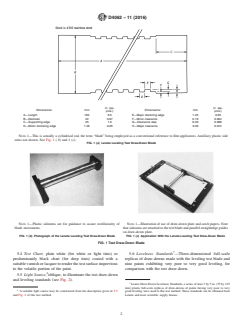
5.1 Leveling Test Blade —A grooved draw-down blade
only.
designed to lay down a wet film with parallel ridges (see Fig.
1.5 This standard does not purport to address all of the
1).
safety concerns, if any, associated with its use. It is the
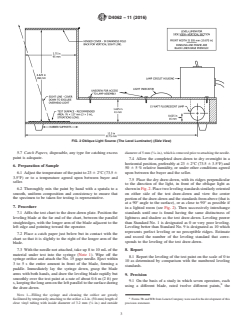
5.2 Draw-Down Plate, with two parallel, smooth-faced
responsibility of the user of this standard to establish appro-
straightedges to guide the blade during film application and
priate safety and health practices and determine the applica-
ensure that the ridges are straight.
bility of regulatory limitations prior to use.
5.3 Syringe and Needle—A 10-mL LuerLok syringe and
2. Terminology
38-mm (1 ⁄2-in.) No. 15 gage needle for placing a fixed amount
2.1 Definitions of Terms Specific to This Standard:
of the paint in front of the blade while simultaneously
2.1.1 leveling, n—of a paint, a measure of its ability to flow
preshearing it (as during brushing) prior to drawing-down.
out after application so as to obliterate any surface irregulari-
Either glass or disposable plastic syringes may be used with
ties such as brush marks, orange peel, peaks, or craters that
water-reducible paints. Glass syringes only may be used with
have been produced by the mechanical process of application.
solvent-reducible paints due to swelling of disposable syringes
by the solvent.
3. Summary of Test Method
3.1 The material to be tested is presheared and then applied
to a sealed chart by means of a special leveling test blade
The Leneta Company, 15 Whitney Road, Mahwah, NJ 07430, is the sole
manufacturer of the leveling test blade. This blade, the drawn-down plate, chart,
This test method is under the jurisdiction of ASTM Committee D01 on Paint light source, and levelness standards are all manufactured solely by the Leneta Co.,
and Related Coatings, Materials, andApplications and is the direct responsibility of and can be obtained from Leneta and most scientific supply houses.
Subcommittee D01.42 on Architectural Coatings. The Leneta LevelingTest Blade used in this test method is a modification of the
Current edition approved April 1, 2016. Published April 2016. Originally threaded draw-down bar described in an article by Dodge, J. S. “Quantitative
approved in 1981. Last previous edition approved in 2011 as D4062 – 11. DOI: Measures of Leveling,” Journal of Paint Technology, Vol 44, No. 564, January
10.1520/D4062-11R16. 1972.
This test method was essentially developed by the Leneta Company as outlined A suitable draw-down plate may be constructed from the description given in
in Leneta Catalog No. 3, pp. 26–7 (1976). 5.2 of this test method.
Copyright © ASTM International, 100 Barr Harbor Drive, PO Box C700, West Conshohocken, PA 19428-2959. United States
D4062 − 11 (2016)
in. (ap- in. (ap-
Dimensions: mm Dimensions: mm
prox.) prox.)
A—Length 165 6.5 E—Major doctoring edge 1.25 0.05
B—Diameter 22 0.87 F—Minor clearance 0.10 0.004
C—Supporting edge 25 1.0 G—Clearance step 0.20 0.008
D—Minor doctoring edge 1.25 0.05 H—Major clearance 0.30 0.012
NOTE 1—This is actually a cylindrical rod, the term “blade” being employed as a conventional reference to film applicators. Auxiliary plastic side
arms not shown. See Fig. 1 ( b)and1(c).
FIG. 1 (a) Leneta Leveling Test Draw-Down Blade
NOTE 1—Plastic sidearms are for guidance to assure rectilinearity of NOTE 1—Illustration of use of draw-down plate and catch papers. Note
blade movements. that sidearms are attached to the test blade and parallel straightedge guides
on draw-down plate.
FIG. 1 (b) Photograph of the Leneta Leveling Test Draw-Down Blade FIG. 1 (c) Application With the Leneta Leveling Test Draw-Down Blade
FIG. 1 Test Draw-Down
...