

ASTM D7394-18(2023)
(Practice)Standard Practice for Rheological Characterization of Architectural Coatings using Three Rotational Bench Viscometers
General Information
- Abstract
SIGNIFICANCE AND USE
5.1 A significant feature of this practice is the ability to survey coating rheology over a broad range of shear rates with the same bench viscometers and test protocol that paint formulators and paint quality control (QC) analysts routinely use. By using this procedure, measurement of the shear rheology of a coating is possible without using an expensive laboratory rheometer, and performance predictions can be made based on those measurements.
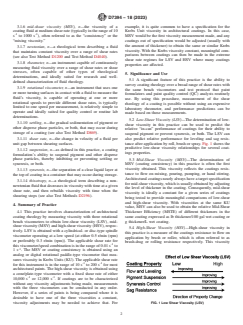
5.2 Low-Shear Viscosity (LSV)—The determination of low-shear viscosity in this practice can be used to predict the relative “in-can” performance of coatings for their ability to suspend pigment or prevent syneresis, or both. The LSV can also predict relative performance for leveling and sag resistance after application by roll, brush or spray. Fig. 1 shows the predictive low-shear viscosity relationships for several coatings properties.
FIG. 1 Low Shear Viscosity (LSV)
5.3 Mid-Shear Viscosity (MSV)—The determination of MSV (coating consistency) in this practice is often the first viscosity obtained. This viscosity reflects the coatings resistance to flow on mixing, pouring, pumping, or hand stirring. Architectural coatings nearly always have a target specification for mid-shear viscosity, which is usually obtained by adjusting the level of thickener in the coating. Consequently, mid-shear viscosity is ideally a constant for a given series of coatings being tested to provide meaningful comparisons of low-shear and high-shear viscosity. With viscosities at the same KU value, MSV can also be used to obtain the relative Mid-Shear Thickener Efficiency (MSTE) of different thickeners in the same coating expressed as lb thickener/100 gal wet coating or g thickener/L wet coating.
5.4 High-Shear Viscosity (HSV)—High-shear viscosity in this practice is a measure of the coatings resistance to flow on application by brush or roller, which is often referred to as brush-drag or rolling resistance respectively. This viscosity rela...
SCOPE
1.1 This practice describes a popular industry protocol for the rheological characterization of waterborne architectural coatings using three commonly used rotational bench viscometers. Each viscometer operates in a different shear rate regime for determination of coating viscosity at low shear rate, mid shear rate, and at high shear rate respectively as defined herein. General guidelines are provided for predicting some coating performance properties from the viscosity measurements made. With appropriate correlations and subsequent modification of the performance guidelines, this practice has potential for characterization of other types of aqueous and non-aqueous coatings.
1.2 The values in common viscosity units (Krebs Units, KU and Poise, P) are to be regarded as standard.
1.3 This standard does not purport to address all of the safety concerns, if any, associated with its use. It is the responsibility of the user of this standard to establish appropriate safety, health, and environmental practices and determine the applicability of regulatory limitations prior to use.
1.4 This international standard was developed in accordance with internationally recognized principles on standardization established in the Decision on Principles for the Development of International Standards, Guides and Recommendations issued by the World Trade Organization Technical Barriers to Trade (TBT) Committee.
- Status
- Published
- Publication Date
- 31-Jan-2023
- Technical Committee
- D01 - Paint and Related Coatings, Materials, and Applications
- Drafting Committee
- D01.24 - Physical Properties of Liquid Paints & Paint Materials
Overview
ASTM D7394-18(2023) is the international standard practice for the rheological characterization of architectural coatings using three rotational bench viscometers. Developed by ASTM International, this standard outlines how to evaluate the viscosity profile of waterborne architectural coatings at different shear rates-low, mid, and high-using standard benchtop viscometers. The practice enables paint formulators and quality control analysts to predict key coating performance properties without the need for costly research-grade rheometers. By following ASTM D7394-18(2023), organizations gain a reliable and accessible methodology for routine coating and paint viscosity characterization, supporting product development and consistency.
Key Topics
Rheological Characterization Across Shear Rates: The standard establishes procedures for measuring low-shear viscosity (LSV), mid-shear viscosity (MSV), and high-shear viscosity (HSV), each using a specific style of rotational bench viscometer:
- Low-Shear Viscosity (LSV): Represents the ability of coatings to suspend pigments and prevent settling or syneresis in storage. Critical for predicting leveling and sag resistance during and after application.
- Mid-Shear Viscosity (MSV): Denotes coating consistency and resistance to flow during mixing, pouring, and application. Most architectural coatings have target specifications for MSV, often controlled via thickener adjustments.
- High-Shear Viscosity (HSV): Measures resistance during application by brush or roller, related to brush-drag and rolling resistance. Influential in determining the ease of application, coverage, and film build.
Test Equipment and Protocols: The practice specifies the use of three commonly available viscometers-cylindrical- or disc-type for LSV, paddle-type for MSV (Krebs Units), and cone/plate-type for HSV. The viscosity measurements are carried out at prescribed speeds and temperatures to maintain consistency and comparability.
Performance Prediction: Viscosity profiles obtained through this method can be correlated to performance attributes, including suspension ability, leveling, sag resistance, and ease of application. The approach supports meaningful product comparisons, especially when MSV is controlled across all samples.
Routine Application: The protocol is designed for daily use in laboratory and quality control settings, allowing for fast assessment and adjustment of paint formulations.
Applications
Adopting ASTM D7394-18(2023) provides practical value to a range of stakeholders:
- Paint Formulation and Development: Enables rapid comparison and optimization of formulations by correlating rheological properties to application performance and in-can behavior, such as pigment suspension and syneresis prevention.
- Quality Control (QC): Offers a standardized, repeatable method for monitoring production consistency, ensuring that viscosity specifications for LSV, MSV, and HSV are reliably met.
- Performance Prediction: Helps anticipate end-use performance characteristics, such as leveling, sag resistance, brush-drag, and hiding power, based on viscosity measurements.
- Cost-Effective Testing: Eliminates the need for expensive laboratory rheometers by leveraging accessible bench viscometers for key viscosity assessments.
- Broader Compatibility: While focused on waterborne architectural coatings, the principles and methods in this standard are suitable for other aqueous and non-aqueous coatings with proper correlation adjustments.
Related Standards
For a comprehensive approach to paint and coating testing, the following ASTM standards are often used alongside ASTM D7394-18(2023):
- ASTM D562 – Consistency of Paints Measuring Krebs Unit (KU) Viscosity
- ASTM D2196 – Rheological Properties of Non-Newtonian Materials by Rotational Viscometer
- ASTM D4287 – High-Shear Viscosity Using Cone/Plate Viscometer
- ASTM D4414 – Measurement of Wet Film Thickness by Notch Gages
- ASTM D4062 – Leveling of Paints by Draw-Down Method
- ASTM D4400 – Sag Resistance of Paints Using a Multinotch Applicator
- ASTM D1005 – Measurement of Dry-Film Thickness of Organic Coatings Using Micrometers
By implementing ASTM D7394-18(2023) in conjunction with these methods, laboratories and manufacturers can optimize both the quality and performance of architectural coatings, ensuring compliance with international testing and quality standards.
Keywords: ASTM D7394-18, rheological characterization, architectural coatings, bench viscometer, paint viscosity, low-shear viscosity, mid-shear viscosity, high-shear viscosity, paint quality control, coating standards.
Relations
- Effective Date
- 01-Feb-2024
- Refers
ASTM D4287-00(2023) - Standard Test Method for High-Shear Viscosity Using a Cone/Plate Viscometer - Effective Date
- 01-Oct-2023
- Effective Date
- 01-Jun-2020
- Effective Date
- 01-Jun-2020
- Refers
ASTM D4287-00(2019) - Standard Test Method for High-Shear Viscosity Using a Cone/Plate Viscometer - Effective Date
- 01-May-2019
- Effective Date
- 01-Jan-2019
- Refers
ASTM D4400-18 - Standard Test Method for Sag Resistance of Paints Using a Multinotch Applicator - Effective Date
- 15-Sep-2018
- Effective Date
- 01-Jun-2018
- Effective Date
- 01-Apr-2016
- Effective Date
- 01-Apr-2016
- Refers
ASTM D4287-00(2014) - Standard Test Method for High-Shear Viscosity Using a Cone/Plate Viscometer - Effective Date
- 01-Dec-2014
- Effective Date
- 01-Dec-2014
- Effective Date
- 01-Dec-2014
- Effective Date
- 01-Jul-2013
- Effective Date
- 15-May-2012
Get Certified
Connect with accredited certification bodies for this standard

BSMI (Bureau of Standards, Metrology and Inspection)
Taiwan's standards and inspection authority.
Sponsored listings
Frequently Asked Questions
ASTM D7394-18(2023) is a standard published by ASTM International. Its full title is "Standard Practice for Rheological Characterization of Architectural Coatings using Three Rotational Bench Viscometers". This standard covers: SIGNIFICANCE AND USE 5.1 A significant feature of this practice is the ability to survey coating rheology over a broad range of shear rates with the same bench viscometers and test protocol that paint formulators and paint quality control (QC) analysts routinely use. By using this procedure, measurement of the shear rheology of a coating is possible without using an expensive laboratory rheometer, and performance predictions can be made based on those measurements. 5.2 Low-Shear Viscosity (LSV)—The determination of low-shear viscosity in this practice can be used to predict the relative “in-can” performance of coatings for their ability to suspend pigment or prevent syneresis, or both. The LSV can also predict relative performance for leveling and sag resistance after application by roll, brush or spray. Fig. 1 shows the predictive low-shear viscosity relationships for several coatings properties. FIG. 1 Low Shear Viscosity (LSV) 5.3 Mid-Shear Viscosity (MSV)—The determination of MSV (coating consistency) in this practice is often the first viscosity obtained. This viscosity reflects the coatings resistance to flow on mixing, pouring, pumping, or hand stirring. Architectural coatings nearly always have a target specification for mid-shear viscosity, which is usually obtained by adjusting the level of thickener in the coating. Consequently, mid-shear viscosity is ideally a constant for a given series of coatings being tested to provide meaningful comparisons of low-shear and high-shear viscosity. With viscosities at the same KU value, MSV can also be used to obtain the relative Mid-Shear Thickener Efficiency (MSTE) of different thickeners in the same coating expressed as lb thickener/100 gal wet coating or g thickener/L wet coating. 5.4 High-Shear Viscosity (HSV)—High-shear viscosity in this practice is a measure of the coatings resistance to flow on application by brush or roller, which is often referred to as brush-drag or rolling resistance respectively. This viscosity rela... SCOPE 1.1 This practice describes a popular industry protocol for the rheological characterization of waterborne architectural coatings using three commonly used rotational bench viscometers. Each viscometer operates in a different shear rate regime for determination of coating viscosity at low shear rate, mid shear rate, and at high shear rate respectively as defined herein. General guidelines are provided for predicting some coating performance properties from the viscosity measurements made. With appropriate correlations and subsequent modification of the performance guidelines, this practice has potential for characterization of other types of aqueous and non-aqueous coatings. 1.2 The values in common viscosity units (Krebs Units, KU and Poise, P) are to be regarded as standard. 1.3 This standard does not purport to address all of the safety concerns, if any, associated with its use. It is the responsibility of the user of this standard to establish appropriate safety, health, and environmental practices and determine the applicability of regulatory limitations prior to use. 1.4 This international standard was developed in accordance with internationally recognized principles on standardization established in the Decision on Principles for the Development of International Standards, Guides and Recommendations issued by the World Trade Organization Technical Barriers to Trade (TBT) Committee.
SIGNIFICANCE AND USE 5.1 A significant feature of this practice is the ability to survey coating rheology over a broad range of shear rates with the same bench viscometers and test protocol that paint formulators and paint quality control (QC) analysts routinely use. By using this procedure, measurement of the shear rheology of a coating is possible without using an expensive laboratory rheometer, and performance predictions can be made based on those measurements. 5.2 Low-Shear Viscosity (LSV)—The determination of low-shear viscosity in this practice can be used to predict the relative “in-can” performance of coatings for their ability to suspend pigment or prevent syneresis, or both. The LSV can also predict relative performance for leveling and sag resistance after application by roll, brush or spray. Fig. 1 shows the predictive low-shear viscosity relationships for several coatings properties. FIG. 1 Low Shear Viscosity (LSV) 5.3 Mid-Shear Viscosity (MSV)—The determination of MSV (coating consistency) in this practice is often the first viscosity obtained. This viscosity reflects the coatings resistance to flow on mixing, pouring, pumping, or hand stirring. Architectural coatings nearly always have a target specification for mid-shear viscosity, which is usually obtained by adjusting the level of thickener in the coating. Consequently, mid-shear viscosity is ideally a constant for a given series of coatings being tested to provide meaningful comparisons of low-shear and high-shear viscosity. With viscosities at the same KU value, MSV can also be used to obtain the relative Mid-Shear Thickener Efficiency (MSTE) of different thickeners in the same coating expressed as lb thickener/100 gal wet coating or g thickener/L wet coating. 5.4 High-Shear Viscosity (HSV)—High-shear viscosity in this practice is a measure of the coatings resistance to flow on application by brush or roller, which is often referred to as brush-drag or rolling resistance respectively. This viscosity rela... SCOPE 1.1 This practice describes a popular industry protocol for the rheological characterization of waterborne architectural coatings using three commonly used rotational bench viscometers. Each viscometer operates in a different shear rate regime for determination of coating viscosity at low shear rate, mid shear rate, and at high shear rate respectively as defined herein. General guidelines are provided for predicting some coating performance properties from the viscosity measurements made. With appropriate correlations and subsequent modification of the performance guidelines, this practice has potential for characterization of other types of aqueous and non-aqueous coatings. 1.2 The values in common viscosity units (Krebs Units, KU and Poise, P) are to be regarded as standard. 1.3 This standard does not purport to address all of the safety concerns, if any, associated with its use. It is the responsibility of the user of this standard to establish appropriate safety, health, and environmental practices and determine the applicability of regulatory limitations prior to use. 1.4 This international standard was developed in accordance with internationally recognized principles on standardization established in the Decision on Principles for the Development of International Standards, Guides and Recommendations issued by the World Trade Organization Technical Barriers to Trade (TBT) Committee.
ASTM D7394-18(2023) is classified under the following ICS (International Classification for Standards) categories: 17.060 - Measurement of volume, mass, density, viscosity. The ICS classification helps identify the subject area and facilitates finding related standards.
ASTM D7394-18(2023) has the following relationships with other standards: It is inter standard links to ASTM D4958-24, ASTM D4287-00(2023), ASTM D1005-95(2020), ASTM D4414-95(2020), ASTM D4287-00(2019), ASTM D4040-10(2019), ASTM D4400-18, ASTM D2196-18, ASTM D4062-11(2016), ASTM D4958-10(2016), ASTM D4287-00(2014), ASTM D562-10(2014), ASTM D1200-10(2014), ASTM D4414-95(2013), ASTM D4400-99(2012)e1. Understanding these relationships helps ensure you are using the most current and applicable version of the standard.
ASTM D7394-18(2023) is available in PDF format for immediate download after purchase. The document can be added to your cart and obtained through the secure checkout process. Digital delivery ensures instant access to the complete standard document.
Standards Content (Sample)
This international standard was developed in accordance with internationally recognized principles on standardization established in the Decision on Principles for the
Development of International Standards, Guides and Recommendations issued by the World Trade Organization Technical Barriers to Trade (TBT) Committee.
Designation: D7394 − 18 (Reapproved 2023)
Standard Practice for
Rheological Characterization of Architectural Coatings
using Three Rotational Bench Viscometers
This standard is issued under the fixed designation D7394; the number immediately following the designation indicates the year of
original adoption or, in the case of revision, the year of last revision. A number in parentheses indicates the year of last reapproval. A
superscript epsilon (´) indicates an editorial change since the last revision or reapproval.
1. Scope D869 Test Method for Evaluating Degree of Settling of Paint
D1005 Test Method for Measurement of Dry-Film Thick-
1.1 This practice describes a popular industry protocol for
ness of Organic Coatings Using Micrometers
the rheological characterization of waterborne architectural
D1200 Test Method for Viscosity by Ford Viscosity Cup
coatings using three commonly used rotational bench viscom-
D2196 Test Methods for Rheological Properties of Non-
eters. Each viscometer operates in a different shear rate regime
Newtonian Materials by Rotational Viscometer
for determination of coating viscosity at low shear rate, mid
D2805 Test Method for Hiding Power of Paints by Reflec-
shear rate, and at high shear rate respectively as defined herein.
tometry
General guidelines are provided for predicting some coating
D4040 Test Method for Rheological Properties of Paste
performance properties from the viscosity measurements
Printing and Vehicles by the Falling-Rod Viscometer
made. With appropriate correlations and subsequent modifica-
D4062 Test Method for Leveling of Paints by Draw-Down
tion of the performance guidelines, this practice has potential
Method
for characterization of other types of aqueous and non-aqueous
D4287 Test Method for High-Shear Viscosity Using a Cone/
coatings.
Plate Viscometer
1.2 The values in common viscosity units (Krebs Units, KU
D4400 Test Method for Sag Resistance of Paints Using a
and Poise, P) are to be regarded as standard.
Multinotch Applicator
1.3 This standard does not purport to address all of the
D4414 Practice for Measurement of Wet Film Thickness by
safety concerns, if any, associated with its use. It is the Notch Gages
responsibility of the user of this standard to establish appro-
D4958 Test Method for Comparison of the Brush Drag of
priate safety, health, and environmental practices and deter- Latex Paints
mine the applicability of regulatory limitations prior to use.
1.4 This international standard was developed in accor-
3. Terminology
dance with internationally recognized principles on standard-
3.1 Definitions:
ization established in the Decision on Principles for the
3.1.1 coating rheology, n—the viscosity profile obtained for
Development of International Standards, Guides and Recom-
a fluid coating over a range of shear rates.
mendations issued by the World Trade Organization Technical
3.1.2 high-shear viscosity (HSV), n—the viscosity of a fluid
Barriers to Trade (TBT) Committee.
-1
coating at high shear rate (typically measured at 10,000 s or
-1
2. Referenced Documents 12,000 s ), and for architectural coatings, it is often referred to
as the “brush-drag” viscosity.
2.1 ASTM Standards:
D562 Test Method for Consistency of Paints Measuring
3.1.3 leveling, n—the ability of a wet coating to flow out to
Krebs Unit (KU) Viscosity Using a Stormer-Type Viscom-
a smooth dry film after application, thereby minimizing or
eter
eliminating coating surface irregularities that occur during
brushing, rolling or spraying (see also Test Method D4062).
3.1.4 low-shear viscosity (LSV), n—the viscosity of a coat-
This practice is under the jurisdiction of ASTM Committee D01 on Paint and
-1
ing fluid at low shear rate (typically in the range of 0.001 s to
Related Coatings, Materials, and Applications and is the direct responsibility of
-1
Subcommittee D01.24 on Physical Properties of Liquid Paints & Paint Materials.
1 s ), often referred to as the “leveling viscosity” or inversely
Current edition approved Feb. 1, 2023. Published February 2023. Originally
as the “suspension viscosity.”
approved in 2008. Last previous edition approved in 2018 as D7394 – 18. DOI:
10.1520/D7394-18R23.
3.1.5 mid-shear thickener effıciency (MSTE), n—the weight
For referenced ASTM standards, visit the ASTM website, www.astm.org, or
of active thickener per unit volume of wet coating required to
contact ASTM Customer Service at service@astm.org. For Annual Book of ASTM
give the target MSV, commonly expressed as lb active
Standards volume information, refer to the standard’s Document Summary page on
the ASTM website. thickener/100 gal wet coating (or in g/L units).
Copyright © ASTM International, 100 Barr Harbor Drive, PO Box C700, West Conshohocken, PA 19428-2959. United States
D7394 − 18 (2023)
3.1.6 mid-shear viscosity (MSV), n—the viscosity of a example, it is quite common to have a specification for the
coating fluid at medium shear rate (typically in the range of 10 Krebs Unit viscosity in architectural coatings. In this case,
-1 -1
s to 1000 s ), often referred to as the “consistency” or the MSV would be the first viscosity measurement made, and any
“mixing viscosity.” coatings out of specification would be adjusted (usually with
the amount of thickener) to obtain the same or similar Krebs
3.1.7 newtonian, n—a rheological term describing a fluid
viscosity. With the Krebs viscosity constant, meaningful com-
that maintains constant viscosity over a range of shear rates
parisons between coatings can then be made in the extreme
(see also Test Method D1200 and Test Method D4040).
shear rate regimes for LSV and HSV where many coatings
3.1.8 rheometer, n—an instrument capable of continuously
properties are affected.
measuring fluid viscosity over a range of shear rates or shear
stresses, often capable of other types of rheological
5. Significance and Use
determinations, and ideally suited for research and well-
5.1 A significant feature of this practice is the ability to
defined characterization of fluid rheology.
survey coating rheology over a broad range of shear rates with
3.1.9 rotational viscometer, n—an instrument that uses one
the same bench viscometers and test protocol that paint
or more turning surfaces in contact with a fluid to measure the
formulators and paint quality control (QC) analysts routinely
fluid’s viscosity, is capable of operating at one or more
use. By using this procedure, measurement of the shear
rotational speeds to provide different shear rates, is typically
rheology of a coating is possible without using an expensive
limited to one speed per measurement, is relatively simple to
laboratory rheometer, and performance predictions can be
operate and ideally suited for quality control or routine lab
made based on those measurements.
determinations.
5.2 Low-Shear Viscosity (LSV)—The determination of low-
3.1.10 settling, n—the gradual sedimentation of pigment or
shear viscosity in this practice can be used to predict the
other disperse phase particles, or both, that may occur during
relative “in-can” performance of coatings for their ability to
storage of a coating (see also Test Method D869).
suspend pigment or prevent syneresis, or both. The LSV can
3.1.11 shear rate, n—the change in velocity of a fluid per also predict relative performance for leveling and sag resis-
unit gap between shearing surfaces.
tance after application by roll, brush or spray. Fig. 1 shows the
predictive low-shear viscosity relationships for several coat-
3.1.12 suspension, n—as defined in this practice, a coating
ings properties.
formulation’s ability to suspend pigment and other disperse
phase particles, thereby inhibiting or preventing settling or
5.3 Mid-Shear Viscosity (MSV)—The determination of
syneresis, or both. MSV (coating consistency) in this practice is often the first
viscosity obtained. This viscosity reflects the coatings resis-
3.1.13 syneresis, n—the separation of a clear liquid layer at
tance to flow on mixing, pouring, pumping, or hand stirring.
the top of coating in a container that may occur during storage.
Architectural coatings nearly always have a target specification
3.1.14 thixotropy, n—a rheological term describing a non-
for mid-shear viscosity, which is usually obtained by adjusting
newtonian fluid that decreases in viscosity with time at a given
the level of thickener in the coating. Consequently, mid-shear
shear rate, and then rebuilds viscosity with time when the
viscosity is ideally a constant for a given series of coatings
shearing stops (see also Test Methods D2196).
being tested to provide meaningful comparisons of low-shear
and high-shear viscosity. With viscosities at the same KU
4. Summary of Practice
value, MSV can also be used to obtain the relative Mid-Shear
4.1 This practice involves characterization of architectural Thickener Efficiency (MSTE) of different thickeners in the
coating rheology by measuring viscosity with three rotational
same coating expressed as lb thickener/100 gal wet coating or
bench viscometers to obtain low-shear viscosity (LSV), mid- g thickener/L wet coating.
shear viscosity (MSV) and high-shear viscosity (HSV), respec-
5.4 High-Shear Viscosity (HSV)—High-shear viscosity in
tively. LSV is obtained with a cylindrical- or disc-type spindle
this practice is a measure of the coatings resistance to flow on
viscometer operating at a low speed (at either 0.5 r/min (rpm)
application by brush or roller, which is often referred to as
or preferably 0.3 r/min (rpm)). The applicable shear rate for
brush-drag or rolling resistance respectively. This viscosity
-1
this viscometer/speed combination is in the range of 0.01 s to
-1
1 s . The MSV or coating consistency is obtained using an
analog or digital rotational paddle-type viscometer that mea-
sures viscosity in Krebs Units (KU). The applicable shear rate
-1 -1
for this instrument is in the range of 10 s to 200 s for most
architectural paints. The high-shear viscosity is obtained using
a cone/plate-type viscometer with a fixed shear rate of either
-1 -1
10,000 s or 12,000 s . If coatings are to be characterized
without any viscosity adjustments being made, measurements
with the three viscometers can be conducted in any order.
However, if a series of paints is being compared where it is
desirable to have one of the three viscosities a constant,
viscosity adjustments may be needed to achieve that. For FIG. 1 Low Shear Viscosity (LSV)
D7394 − 18 (2023)
relates to the coatings ability to provide one-coat hiding, its 8.1.1 A common practice in many architectural coatings
ease of application (brushing or rolling resistance), and its labs is the examination of coating viscosity in three shear rate
spread rate. Fig. 2 shows high-shear viscosity relationship regimes using three different rotational bench viscometers: a
predictions for relative coating performance. cylindrical- or disc-type spindle viscometer at low rotational
speed for low-shear viscosity (LSV), a fixed speed paddle-type
6. Reagents
viscometer for mid-shear viscosity (MSV), and a cone/plate-
6.1 Viscosity Standards—optional, for checking the accu- type viscometer for high-shear viscosity (HSV). This test
racy of each of the three viscometers used in this practice. protocol is described briefly in the ASTM Paint and Coatings
Testing Manual and in more detail in the Handbook of
7. Apparatus and Equipment
Coatings Additives. Although controlled shear rate and con-
7.1 Spatula or Lab Stirrer—optional, for mixing coating trolled shear stress rheometers do provide more complete
samples prior to viscosity measurements. coating rheology profiles, have well defined shear rates and
shear stresses, are often more accurate in their measurements,
7.2 Rotational Viscometer—with cylindrical- or disc-type
and can provide other rheological information such as elastic
spindle and torque co
...