

ASTM E620-18
(Practice)Standard Practice for Reporting Opinions of Scientific or Technical Experts
General Information
- Abstract
SIGNIFICANCE AND USE
3.1 This practice establishes those elements of the expert’s opinion report which will make the report understandable to the intended recipient and focus on the technical aspects germane to the purpose for which the opinion is rendered.
SCOPE
1.1 This practice covers the scope of information to be contained in formal written technical reports which express the opinions of the scientific or technical expert with respect to the study of items that are or may reasonably be expected to be the subject of criminal or civil litigation.
1.2 If compliance with this practice is claimed, the justifications for any deviations from this practice must be documented.
1.3 This standard may involve hazardous materials, operations, and equipment. This standard does not purport to address all of the safety concerns, if any, associated with its use. It is the responsibility of the user of this standard to establish appropriate safety, health, and environmental practices and determine the applicability of regulatory limitations prior to use.
1.4 This international standard was developed in accordance with internationally recognized principles on standardization established in the Decision on Principles for the Development of International Standards, Guides and Recommendations issued by the World Trade Organization Technical Barriers to Trade (TBT) Committee.
- Status
- Published
- Publication Date
- 31-Mar-2018
- Technical Committee
- E30 - Forensic Sciences
- Drafting Committee
- E30.11 - Interdisciplinary Forensic Science Standards



Overview
ASTM E620-18: Standard Practice for Reporting Opinions of Scientific or Technical Experts establishes clear guidelines for the content and organization of expert opinion reports. Developed by ASTM International, this standard ensures that reports by scientific or technical experts-particularly those used in criminal or civil litigation-are understandable, transparent, and focused on relevant technical aspects. Correct implementation of ASTM E620-18 enhances the credibility and reproducibility of expert findings and maintains a consistent approach to documenting complex technical or forensic analysis.
Key Topics
ASTM E620-18 addresses several critical components for preparing and presenting expert opinion reports:
- Required Report Content: The standard specifies essential elements such as clear identification and description of items examined, test methods used (with version and date), results, interpretations, conclusions, and opinions.
- Clarity and Objectivity: Reports must be accurate, clear, unambiguous, and objective, with all relevant data and facts included.
- Report Structure: While the standard does not mandate a fixed format, it requires reports to be organized logically to minimize misunderstandings. Elements include title, scope, unique identifiers, names of involved individuals or organizations, and clear marking of the report’s end.
- Supporting Documentation: Information not in the main report body can be presented in appendices or supporting records, ensuring all pertinent facts are available.
- Interpretations and Conclusions: Conclusions and opinions must be clearly distinguished from factual findings, and any limitations, uncertainties, or deviations from standard methods must be explained.
- Compliance and Documentation: If there are deviations from the standard practice, the report must document the justifications.
- Safety and Regulatory Considerations: Users must ensure appropriate safety, health, and environmental practices, and determine compliance with regulations before applying the standard.
Applications
ASTM E620-18 is widely used in contexts where expert scientific or technical opinion reports are required, particularly in legal and forensic domains:
- Forensic Science Laboratories: Ensuring consistency and clarity in reports submitted as evidence.
- Litigation Support: Providing a standardized approach for professionals presenting technical and scientific opinions in court.
- Research and Testing Laboratories: Documenting investigative or analytical work for legal, regulatory, or compliance matters.
- Consulting Experts: Allowing technical and scientific consultants to communicate opinions clearly to non-expert audiences, such as attorneys, judges, or clients.
- Quality Assurance: Supporting internal and external audits by detailing report content to meet regulatory and industry standards.
Related Standards
ASTM E620-18 is closely related to other industry standards and guidelines that support technical reporting and evaluation:
- ASTM E678 - Practice for Evaluation of Scientific or Technical Data: Guides the assessment of data reliability and validity for reports.
- ASTM E2655 - Guide for Reporting Uncertainty of Test Results: Provides principles for documenting measurement uncertainty.
- ASTM E3016-15 - Standard Guide for Establishing Confidence in Digital Forensic Results by Error Mitigation Analysis: Complements reporting of forensic analyses.
- International Standards: ISO/TS 21748 and guidelines from EURACHEM/CITAC and the Joint Committee for Guides in Metrology (JCGM) are referenced for uncertainty estimation and validity in measurement.
Keywords: expert report, scientific opinion, technical expert, ASTM E620, forensic report, litigation, uncertainty of measurement, report content, technical documentation, test results, compliance
Relations
- Effective Date
- 01-Jan-2020
- Effective Date
- 01-Oct-2008
- Effective Date
- 01-Apr-2007
- Effective Date
- 10-Jun-1998
Get Certified
Connect with accredited certification bodies for this standard

Great Wall Tianjin Quality Assurance Center
Established 1993, first batch to receive national accreditation with IAF recognition.
Hong Kong Quality Assurance Agency (HKQAA)
Hong Kong's leading certification body.

Innovative Quality Certifications Pvt. Ltd. (IQCPL)
Known for integrity, providing ethical & impartial Assessment & Certification. CMMI Institute Partner.
Sponsored listings
Frequently Asked Questions
ASTM E620-18 is a standard published by ASTM International. Its full title is "Standard Practice for Reporting Opinions of Scientific or Technical Experts". This standard covers: SIGNIFICANCE AND USE 3.1 This practice establishes those elements of the expert’s opinion report which will make the report understandable to the intended recipient and focus on the technical aspects germane to the purpose for which the opinion is rendered. SCOPE 1.1 This practice covers the scope of information to be contained in formal written technical reports which express the opinions of the scientific or technical expert with respect to the study of items that are or may reasonably be expected to be the subject of criminal or civil litigation. 1.2 If compliance with this practice is claimed, the justifications for any deviations from this practice must be documented. 1.3 This standard may involve hazardous materials, operations, and equipment. This standard does not purport to address all of the safety concerns, if any, associated with its use. It is the responsibility of the user of this standard to establish appropriate safety, health, and environmental practices and determine the applicability of regulatory limitations prior to use. 1.4 This international standard was developed in accordance with internationally recognized principles on standardization established in the Decision on Principles for the Development of International Standards, Guides and Recommendations issued by the World Trade Organization Technical Barriers to Trade (TBT) Committee.
SIGNIFICANCE AND USE 3.1 This practice establishes those elements of the expert’s opinion report which will make the report understandable to the intended recipient and focus on the technical aspects germane to the purpose for which the opinion is rendered. SCOPE 1.1 This practice covers the scope of information to be contained in formal written technical reports which express the opinions of the scientific or technical expert with respect to the study of items that are or may reasonably be expected to be the subject of criminal or civil litigation. 1.2 If compliance with this practice is claimed, the justifications for any deviations from this practice must be documented. 1.3 This standard may involve hazardous materials, operations, and equipment. This standard does not purport to address all of the safety concerns, if any, associated with its use. It is the responsibility of the user of this standard to establish appropriate safety, health, and environmental practices and determine the applicability of regulatory limitations prior to use. 1.4 This international standard was developed in accordance with internationally recognized principles on standardization established in the Decision on Principles for the Development of International Standards, Guides and Recommendations issued by the World Trade Organization Technical Barriers to Trade (TBT) Committee.
ASTM E620-18 is classified under the following ICS (International Classification for Standards) categories: 03.160 - Law. Administration. The ICS classification helps identify the subject area and facilitates finding related standards.
ASTM E620-18 has the following relationships with other standards: It is inter standard links to ASTM E2655-14(2020), ASTM E2655-08, ASTM E678-07, ASTM E678-98. Understanding these relationships helps ensure you are using the most current and applicable version of the standard.
ASTM E620-18 is available in PDF format for immediate download after purchase. The document can be added to your cart and obtained through the secure checkout process. Digital delivery ensures instant access to the complete standard document.
Standards Content (Sample)
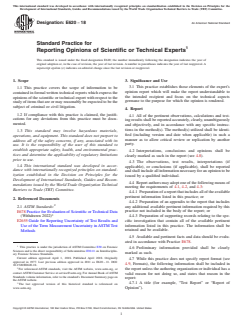
This international standard was developed in accordance with internationally recognized principles on standardization established in the Decision on Principles for the
Development of International Standards, Guides and Recommendations issued by the World Trade Organization Technical Barriers to Trade (TBT) Committee.
Designation: E620 −18 An American National Standard
Standard Practice for
Reporting Opinions of Scientific or Technical Experts
This standard is issued under the fixed designation E620; the number immediately following the designation indicates the year of
original adoption or, in the case of revision, the year of last revision. A number in parentheses indicates the year of last reapproval. A
superscript epsilon (´) indicates an editorial change since the last revision or reapproval.
1. Scope 3. Significance and Use
3.1 This practice establishes those elements of the expert’s
1.1 This practice covers the scope of information to be
opinion report which will make the report understandable to
contained in formal written technical reports which express the
the intended recipient and focus on the technical aspects
opinions of the scientific or technical expert with respect to the
germane to the purpose for which the opinion is rendered.
study of items that are or may reasonably be expected to be the
subject of criminal or civil litigation.
4. Report
1.2 If compliance with this practice is claimed, the justifi-
4.1 All of the pertinent observations, calculations and test-
cations for any deviations from this practice must be docu-
ing results shall be reported accurately, clearly, unambiguously
mented.
and objectively, and in accordance with any specific instruc-
tions in the method(s). The method(s) utilized shall be identi-
1.3 This standard may involve hazardous materials,
fied (including version and date when applicable) in such a
operations, and equipment. This standard does not purport to
manner as to allow critical review or replication by another
address all of the safety concerns, if any, associated with its
party.
use. It is the responsibility of the user of this standard to
establish appropriate safety, health, and environmental prac-
4.2 Interpretations, conclusions and opinions shall be
tices and determine the applicability of regulatory limitations
clearly marked as such in the report (see 4.8).
prior to use.
4.3 The observations, test results, interpretations (if
1.4 This international standard was developed in accor-
applicable), or conclusions (if applicable), shall be reported
dance with internationally recognized principles on standard-
and shall include all information necessary for an opinion to be
ization established in the Decision on Principles for the
issued by a qualified individual.
Development of International Standards, Guides and Recom-
4.4 Reportauthorsmayadoptoneofthefollowingmeansof
mendations issued by the World Trade Organization Technical
meeting the requirements of 4.1, 4.2, and 4.3:
Barriers to Trade (TBT) Committee.
4.4.1 Preparationofareportthatincludesalloftheavailable
pertinent information listed in this practice; or
2. Referenced Documents
4.4.2 Preparation of an appendix to the report that includes
2.1 ASTM Standards: any additional available pertinent information required by this
practice not included in the body of the report; or
E678 Practice for Evaluation of Scientific or Technical Data
(Withdrawn 2022) 4.4.3 Preparation of supporting records relating to the spe-
cific investigation that contain all of the available pertinent
E2655 Guide for Reporting Uncertainty of Test Results and
Use of the Term Measurement Uncertainty inASTM Test information listed in this practice. The information shall be
retained and be available.
Methods
4.5 Available and pertinent facts and data should be evalu-
ated in accordance with Practice E678.
This practice is under the jurisdiction of ASTM Committee E30 on Forensic
4.6 Preliminary information provided shall be clearly
Sciences and is the direct responsibility of Subcommittee E30.11 on Interdisciplin-
marked as such.
ary Forensic Science Standards.
Current edition approved April 1, 2018. Published April 2018. Originally
4.7 While this practice does not specify report format (see
approved in 1977. Last previous edition approved in 2011 as E620 – 11. DOI:
4.9, Formats), the following information shall be included in
10.1520/E0620-18.
the report unless the authoring organization or individual has a
For referenced ASTM standards, visit the ASTM website, www.astm.org, or
contact ASTM Customer Service at service@astm.org. For Annual Book of ASTM
valid reason for not doing so, and states that reason in the
Standards volume information, refer to the standard’s Document Summary page on
report:
theASTM website.
4.7.1 A title (for example, “Test Report” or “Report of
The last approved version of this historical standard is referenced on
www.astm.org. Opinion”).
Copyright © ASTM International, 100 Barr Harbor Drive, PO Box C700, West Conshohocken, PA 19428-2959. United States
E620 − 18
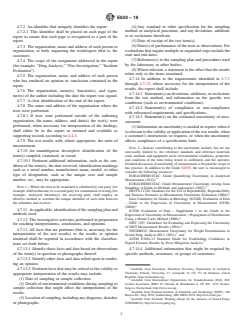
4.7.2 An identifier that uniquely identifies the report: (4) Any standard or other specification for the sampling
method or analytical procedure, and any deviations, additions
4.7.2.1 This identifier shall be placed on each page of the
to or exclusions therefrom.
report to ensure that each page is recognized as a part of the
(5) Date of receipt of the test item(s).
report.
(6) Date(s) of performance of the tests or observations. For
4.7.3 The organization, name and address of each person or
evaluations that require multiple or sequential steps include the
organization, or both, requesting the work/report (that is, the
start and end dates.
customer).
(7) Reference(s) to the sampling plan and procedures used
4.7.4 The scope of the assignment addressed in the report
by the laboratory or other bodies.
(for example, “DrugAnalysis,” “Fire Investigation,” “Incident
(8) Where relevant, a statement to the effect that the results
Evaluation”).
relate only to the items examined.
4.7.5 The organization, name, and address of each person
4.7.14 In addition to the requirements identified in 4.7.1
who has rendered an opinion or conclusion contained in the
through 4.7.13, where necessary for the interpretation of the
report.
results, the report shall include:
4.7.6 The organization, name(s), function(s), and signa-
4.7.14.1 Statement(s)ondeviations,additions,orexclusions
ture(s) of the author including the date the report was signed.
from the test method, and information on the specific test
4.7.7 A clear identification of the end of the report.
conditions (such as environmental conditions).
4.7.8 The name and address of the organization where the
4.7.14.2 Statement(s) of compliance or non-compliance
tests were performed.
with referenced requirements and specifications.
4.7.8.1 If tests were performed outside of the authoring
4.7.14.3 Statement(s) on the estimated uncertainty of mea-
organization, the name, address, and date(s) the test(s) were
surement.
performed, when necessary for interpretation of the findings,
(1) Information on uncertainty is needed in reports when it
shall either be in the report or retained and available as
isrelevanttothevalidityorapplicationofthetestresults,when
supporting records according to 4.4.3.
a customer’s instructions so requires, or when the uncertainty
4.7.9 The test results with, where appropriate, the units of
affects compliance of a specification limit.
measurement.
NOTE 2—Sources contributing to the uncertainty include, but are not
4.7.10 An
...
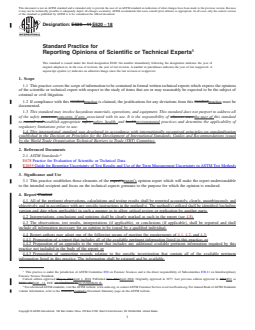
This document is not an ASTM standard and is intended only to provide the user of an ASTM standard an indication of what changes have been made to the previous version. Because
it may not be technically possible to adequately depict all changes accurately, ASTM recommends that users consult prior editions as appropriate. In all cases only the current version
of the standard as published by ASTM is to be considered the official document.
Designation: E620 − 11 E620 − 18
Standard Practice for
Reporting Opinions of Scientific or Technical Experts
This standard is issued under the fixed designation E620; the number immediately following the designation indicates the year of
original adoption or, in the case of revision, the year of last revision. A number in parentheses indicates the year of last reapproval. A
superscript epsilon (´) indicates an editorial change since the last revision or reapproval.
1. Scope
1.1 This practice covers the scope of information to be contained in formal written technical reports which express the opinions
of the scientific or technical expert with respect to the study of items that are or may reasonably be expected to be the subject of
criminal or civil litigation.
1.2 If compliance with this standardpractice is claimed, the justifications for any deviations from this standardpractice must be
documented.
1.3 This standard may involve hazardous materials, operations, and equipment. This standard does not purport to address all
of the safety concerns concerns, if any, associated with its use. It is the responsibility of whoever uses the user of this standard
to consult and establish appropriate safety safety, health, and healthenvironmental practices and determine the applicability of
regulatory limitations prior to use.
1.4 This international standard was developed in accordance with internationally recognized principles on standardization
established in the Decision on Principles for the Development of International Standards, Guides and Recommendations issued
by the World Trade Organization Technical Barriers to Trade (TBT) Committee.
2. Referenced Documents
2.1 ASTM Standards:
E678 Practice for Evaluation of Scientific or Technical Data
E2655 Guide for Reporting Uncertainty of Test Results and Use of the Term Measurement Uncertainty in ASTM Test Methods
3. Significance and Use
3.1 This practice establishes those elements of the expert’sexpert’s opinion report which will make the report understandable
to the intended recipient and focus on the technical aspects germane to the purpose for which the opinion is rendered.
4. Report Content
4.1 All of the pertinent observations, calculations and testing results shall be reported accurately, clearly, unambiguously and
objectively, and in accordance with any specific instructions in the method(s). The method(s) utilized shall be identified (including
version and date when applicable) in such a manner as to allow critical review or replication by another party.
4.2 Interpretations, conclusions and opinions shall be clearly marked as such in the report (see 4.8).
4.3 The observations, test results, interpretations (if applicable), or conclusions (if applicable), shall be reported and shall
include all information necessary for an opinion to be issued by a qualified individual.
4.4 Report authors may adopt one of the following means of meeting the requirements of 4.1, 4.2, and 4.3:
4.4.1 Preparation of a report that includes all of the available pertinent information listed in this practice; or
4.4.2 Preparation of an appendix to the report that includes any additional available pertinent information required by this
practice not included in the body of the report; or
4.4.3 Preparation of supporting records relating to the specific investigation that contain all of the available pertinent
information listed in this practice. The information shall be retained and be available.
This practice is under the jurisdiction of ASTM Committee E30 on Forensic Sciences and is the direct responsibility of Subcommittee E30.11 on Interdisciplinary
Forensic Science Standards.
Current edition approved May 1, 2011April 1, 2018. Published June 2011April 2018. Originally approved in 1977. Last previous edition approved in 20042011 as
E620 – 04.E620 – 11. DOI: 10.1520/E0620-11.10.1520/E0620-18.
For referenced ASTM standards, visit the ASTM website, www.astm.org, or contact ASTM Customer Service at service@astm.org. For Annual Book of ASTM Standards
volume information, refer to the standard’sstandard’s Document Summary page on the ASTM website.
Copyright © ASTM International, 100 Barr Harbor Drive, PO Box C700, West Conshohocken, PA 19428-2959. United States
E620 − 18
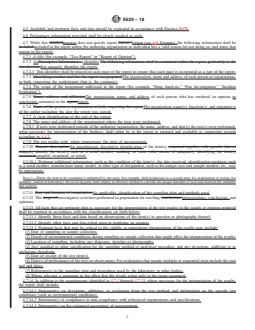
4.5 Available and pertinent facts and data should be evaluated in accordance with Practice E678.
4.6 Preliminary information provided shall be clearly marked as such.
4.7 While this standardpractice does not specify report format, format (see 4.9, Formats), the following information shall be
included:included in the report unless the authoring organization or individual has a valid reason for not doing so, and states that
reason in the report:
4.7.1 A title (for example, “Test Report” or “Report of Opinion”).
4.7.2 AnDescriptive Information— identifier The following information shall be contained within the report, preferably in the
introduction:that uniquely identifies the report:
4.7.2.1 This identifier shall be placed on each page of the report to ensure that each page is recognized as a part of the report.
4.7.3 Identifying number and date the report was prepared,The organization, name and address of each person or organization,
or both, requesting the work/report (that is, the customer).
4.7.4 The scope of the assignment addressed in the report (for example, “Drug Analysis,” “Fire Investigation,” “Incident
Evaluation”).
4.7.5 Name, address, and affiliationThe organization, name, and address of each person who has rendered an opinion or
conclusion contained in the report,report.
4.7.6 Name of the person or organization, or both, requesting the report,The organization, name(s), function(s), and signature(s)
of the author including the date the report was signed.
4.7.7 A clear identification of the end of the report.
4.7.8 The name and address of the organization where the tests were performed.
4.7.8.1 If tests were performed outside of the authoring organization, the name, address, and date(s) the test(s) were performed,
when necessary for interpretation of the findings, shall either be in the report or retained and available as supporting records
according to 4.4.3.
4.7.9 The test results with, where appropriate, the units of measurement.
4.7.10 Generic description An unambiguous descriptive identification of the item(s) examined together with specific data to
uniquely identify the item(s) such as a serial number, marking, or some other means of adequately identifying the item(s)
examined,sampled, examined, or tested.
4.7.10.1 Pertinent additional information, such as the condition of the item(s), the date received, identification markings such
as a serial number, manufacturer name, model, or other type of designation, such as the unique case and sample number, etc., may
be appropriate.
NOTE 1—Where the item to be examined is submitted by one party (for example, field technician) to a second party for examination or testing (for
example., analytical laboratory), the receiving party shall employ an effective method to correlate the unique identifier of each item between the submitter
and receiver.
4.7.11 Date and location of examination,As applicable, identification of the sampling plan and methods used.
4.7.12 The scope of investigative activities performed in preparation for reaching conclusions interpretations, conclusions, and
opinions.
4.7.13 All facts that are pertinent (that is, necessary for the interpretation of the test results) to the results or opinion rendered
shall be reported in accordance with the classifications set forth below:
4.7.13.1 Identify those facts and data based on observations of the item(s) in question or photographs thereof.
4.7.13.2 Identify other facts and data relied upon in rendering an opinion.
4.7.13.3 Pertinent facts that may be critical to the validity or appropriate interpretation of the results may include:
(1) Date of sampling or sample collection.
(2) Details of environmental conditions during sampling or sample collection that might affect the interpretation of the results.
(3) Location of sampling, including any diagrams, sketches or photographs.
(4) Any standard or other specification for the sampling method or analytical procedure, and any deviations, additions to or
exclusions therefrom.
(5) Date of receipt of the test item(s).
(6) Date(s) of performance of the tests or observations. For evaluations that require multiple or sequential steps include the start
and end
...