

ASTM C515-13(2018)
(Specification)Standard Specification for Chemical-Resistant Ceramic Tower Packings
General Information
- Abstract
ABSTRACT
This specification covers fired chemical-resistant ceramic tower installation packings formed from naturally occurring clays or compounded bodies. The number of dumped pieces of cylindrical-type packing material should conform to the requirements for each ring, packing, and saddle size. Material properties such as crushing strength, water absorption, and acid resistance should also fall within the given values for both porcelain and stoneware packings.
SCOPE
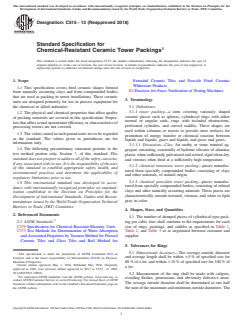
1.1 This specification covers fired ceramic shapes formed from naturally occurring clays and from compounded bodies that are used as packing in tower installations. These ceramic units are designed primarily for use in process equipment for the chemical or allied industries.
1.2 The physical and chemical properties that affect quality of packing materials are covered in this specification. Properties that affect actual operational efficiency or characteristics of processing towers are not covered.
1.3 The values stated in inch-pound units are to be regarded as the standard. The values given in parentheses are for information only.
1.4 The following precautionary statement pertains to the test method portion only, Section 7, of this standard. This standard does not purport to address all of the safety concerns, if any, associated with its use. It is the responsibility of the user of this standard to establish appropriate safety, health, and environmental practices and determine the applicability of regulatory limitations prior to use.
1.5 This international standard was developed in accordance with internationally recognized principles on standardization established in the Decision on Principles for the Development of International Standards, Guides and Recommendations issued by the World Trade Organization Technical Barriers to Trade (TBT) Committee.
- Status
- Published
- Publication Date
- 30-Apr-2018
- Technical Committee
- D32 - Catalysts
- Drafting Committee
- D32.02 - Physical-Mechanical Properties


Overview
ASTM C515-13(2018) is the internationally recognized standard specification for chemical-resistant ceramic tower packings. Issued by ASTM International, this specification outlines the requirements for fired ceramic shapes-formed from naturally occurring clays or compounded ceramic bodies-used primarily as packing in tower installations within the chemical and allied industries. The standard focuses on ensuring the quality and performance of ceramic tower packings by addressing their physical and chemical properties, which include crushing strength, water absorption, and acid resistance.
By standardizing the manufacturing and material characteristics of ceramic packings-including rings, saddles, and other shapes-ASTM C515-13(2018) supports reliable operation in process equipment that demands excellent durability and chemical inertness.
Key Topics
Scope and Coverage
- Covers fired ceramic packings such as rings, saddles, and perforated shapes
- Applicable to both porcelain and stoneware ceramics
- Focuses on material properties vital for chemical process environments
Physical Requirements
- Outlines size, shape, and tolerances for different packing types
- Specifies dimensional accuracy and ovalness limits for rings
- Defines the standard methods for measuring quantities per cubic foot
Performance Criteria
- Crushing strength: Specifies minimum load-bearing capabilities
- Water absorption: Porcelain packings must not exceed 0.5% by weight, stoneware up to 3%
- Acid resistance: Porcelain packings allow up to 4% weight loss, stoneware up to 10% per test methods
Inspection and Testing
- References ASTM-approved test methods for water absorption and crushing strength
- Allows for product inspection procedures agreed upon by supplier and purchaser
Regulatory and Safety Notices
- Emphasizes user responsibility for health, safety, and environmental practices
Applications
Chemical-resistant ceramic tower packings specified by ASTM C515-13(2018) are key components in various chemical processing, petrochemical, and industrial gas installations. Their main functions and application areas include:
- Mass Transfer Operations
- Enhancing contact between gas and liquid phases, promoting absorption, scrubbing, or stripping in packed columns and towers.
- Chemical Resistance
- Utilized in environments where resistance to acids and other corrosive chemicals is essential, such as acid gas removal, fertilizer manufacturing, and chlor-alkali operations.
- Heat Exchange
- Providing high surface area for efficient energy transfer between process streams.
- Durable Media
- Employed as inert and durable fillers in reactors, scrubbers, and heat exchangers.
With standardized properties such as low absorption, high crushing strength, and acid resistance, these packings help ensure safe, reliable, and cost-effective operation under demanding process conditions.
Related Standards
To fully understand the quality and testing of ceramic tower packings, users should consider related ASTM standards, including:
- ASTM C279 - Specification for Chemical-Resistant Masonry Units
- ASTM C373 - Test Methods for Determination of Water Absorption and Associated Properties
- ASTM E4 - Practices for Force Verification of Testing Machines
These references provide complementary procedures for evaluating materials in chemical process equipment and ensuring consistent product quality.
Keywords: ASTM C515, chemical-resistant ceramic tower packing, porcelain, stoneware, acid resistance, water absorption, chemical processing, industrial standards, tower packing, mass transfer.
Relations
- Effective Date
- 01-May-2018
- Effective Date
- 01-Sep-2017
- Effective Date
- 01-Aug-2016
- Effective Date
- 01-Aug-2016
- Effective Date
- 01-Dec-2014
- Effective Date
- 01-Jun-2014
- Effective Date
- 01-Mar-2014
- Effective Date
- 15-Dec-2013
- Effective Date
- 01-Jun-2013
- Effective Date
- 01-Dec-2012
- Effective Date
- 01-Jun-2010
- Effective Date
- 01-Nov-2009
- Effective Date
- 01-Apr-2009
- Effective Date
- 01-Dec-2008
- Effective Date
- 01-Jun-2007
Get Certified
Connect with accredited certification bodies for this standard

DIBt (Deutsches Institut für Bautechnik)
German Institute for Building Technology.
DIN CERTCO
DIN Group product certification.

Aboma Certification B.V.
Specialized in construction, metal, and transport sectors.
Sponsored listings
Frequently Asked Questions
ASTM C515-13(2018) is a technical specification published by ASTM International. Its full title is "Standard Specification for Chemical-Resistant Ceramic Tower Packings". This standard covers: ABSTRACT This specification covers fired chemical-resistant ceramic tower installation packings formed from naturally occurring clays or compounded bodies. The number of dumped pieces of cylindrical-type packing material should conform to the requirements for each ring, packing, and saddle size. Material properties such as crushing strength, water absorption, and acid resistance should also fall within the given values for both porcelain and stoneware packings. SCOPE 1.1 This specification covers fired ceramic shapes formed from naturally occurring clays and from compounded bodies that are used as packing in tower installations. These ceramic units are designed primarily for use in process equipment for the chemical or allied industries. 1.2 The physical and chemical properties that affect quality of packing materials are covered in this specification. Properties that affect actual operational efficiency or characteristics of processing towers are not covered. 1.3 The values stated in inch-pound units are to be regarded as the standard. The values given in parentheses are for information only. 1.4 The following precautionary statement pertains to the test method portion only, Section 7, of this standard. This standard does not purport to address all of the safety concerns, if any, associated with its use. It is the responsibility of the user of this standard to establish appropriate safety, health, and environmental practices and determine the applicability of regulatory limitations prior to use. 1.5 This international standard was developed in accordance with internationally recognized principles on standardization established in the Decision on Principles for the Development of International Standards, Guides and Recommendations issued by the World Trade Organization Technical Barriers to Trade (TBT) Committee.
ABSTRACT This specification covers fired chemical-resistant ceramic tower installation packings formed from naturally occurring clays or compounded bodies. The number of dumped pieces of cylindrical-type packing material should conform to the requirements for each ring, packing, and saddle size. Material properties such as crushing strength, water absorption, and acid resistance should also fall within the given values for both porcelain and stoneware packings. SCOPE 1.1 This specification covers fired ceramic shapes formed from naturally occurring clays and from compounded bodies that are used as packing in tower installations. These ceramic units are designed primarily for use in process equipment for the chemical or allied industries. 1.2 The physical and chemical properties that affect quality of packing materials are covered in this specification. Properties that affect actual operational efficiency or characteristics of processing towers are not covered. 1.3 The values stated in inch-pound units are to be regarded as the standard. The values given in parentheses are for information only. 1.4 The following precautionary statement pertains to the test method portion only, Section 7, of this standard. This standard does not purport to address all of the safety concerns, if any, associated with its use. It is the responsibility of the user of this standard to establish appropriate safety, health, and environmental practices and determine the applicability of regulatory limitations prior to use. 1.5 This international standard was developed in accordance with internationally recognized principles on standardization established in the Decision on Principles for the Development of International Standards, Guides and Recommendations issued by the World Trade Organization Technical Barriers to Trade (TBT) Committee.
ASTM C515-13(2018) is classified under the following ICS (International Classification for Standards) categories: 91.100.25 - Terracotta building products. The ICS classification helps identify the subject area and facilitates finding related standards.
ASTM C515-13(2018) has the following relationships with other standards: It is inter standard links to ASTM C515-13, ASTM C373-17, ASTM C373-16, ASTM C373-16e1, ASTM C373-14a, ASTM E4-14, ASTM C373-14, ASTM C279-13a, ASTM C279-13, ASTM C279-12, ASTM E4-10, ASTM E4-09a, ASTM E4-09, ASTM E4-08, ASTM C279-88(2007). Understanding these relationships helps ensure you are using the most current and applicable version of the standard.
ASTM C515-13(2018) is available in PDF format for immediate download after purchase. The document can be added to your cart and obtained through the secure checkout process. Digital delivery ensures instant access to the complete standard document.
Standards Content (Sample)
This international standard was developed in accordance with internationally recognized principles on standardization established in the Decision on Principles for the
Development of International Standards, Guides and Recommendations issued by the World Trade Organization Technical Barriers to Trade (TBT) Committee.
Designation: C515 −13 (Reapproved 2018)
Standard Specification for
Chemical-Resistant Ceramic Tower Packings
This standard is issued under the fixed designation C515; the number immediately following the designation indicates the year of
original adoption or, in the case of revision, the year of last revision. A number in parentheses indicates the year of last reapproval. A
superscript epsilon (´) indicates an editorial change since the last revision or reapproval.
1. Scope Extruded Ceramic Tiles and Non-tile Fired Ceramic
Whiteware Products
1.1 This specification covers fired ceramic shapes formed
E4 Practices for Force Verification of Testing Machines
from naturally occurring clays and from compounded bodies
that are used as packing in tower installations. These ceramic
3. Terminology
units are designed primarily for use in process equipment for
the chemical or allied industries.
3.1 Definitions:
3.1.1 tower packing—a term covering variously shaped
1.2 The physical and chemical properties that affect quality
ceramic pieces such as spheres, cylindrical rings with either
of packing materials are covered in this specification. Proper-
normal or angular ends, rings with included obstructions,
ties that affect actual operational efficiency or characteristics of
perforated cylinders, and curved saddles. These shapes are
processing towers are not covered.
used within columns or towers to provide inert surfaces for
1.3 The values stated in inch-pound units are to be regarded
promotion of energy transfer or chemical reaction between
as the standard. The values given in parentheses are for
liquids and liquids, gases and liquids, and gases and gases.
information only.
3.1.1.1 Discussion—Clay: An earthy or stony mineral ag-
1.4 The following precautionary statement pertains to the
gregate consisting, essentially of hydrous silicates of alumina,
test method portion only, Section 7, of this standard. This
plasticwhensufficientlypulverizedandwetted,rigidwhendry,
standard does not purport to address all of the safety concerns,
and vitreous when fired at a sufficiently high temperature.
if any, associated with its use. It is the responsibility of the user
3.1.2 chemical stoneware tower packing—pieces manufac-
of this standard to establish appropriate safety, health, and
tured from specially compounded bodies consisting of clays
environmental practices and determine the applicability of
and other minerals, of natural origin.
regulatory limitations prior to use.
3.1.3 chemical porcelain tower packing—pieces manufac-
1.5 This international standard was developed in accor-
tured from specially compounded bodies, consisting of refined
dance with internationally recognized principles on standard-
clays and other naturally occurring minerals. These pieces are
ization established in the Decision on Principles for the
characteristically smooth-textured, vitreous, and white or light
Development of International Standards, Guides and Recom-
gray in color.
mendations issued by the World Trade Organization Technical
Barriers to Trade (TBT) Committee.
4. Shapes, Sizes, and Quantities
2. Referenced Documents
4.1 The number of dumped pieces of cylindrical-type pack-
2.1 ASTM Standards:
ing per cubic foot shall conform to the requirements for each
C279 Specification for Chemical-Resistant Masonry Units size of rings, packings, and saddles as specified in Table 1,
C373 Test Methods for Determination of Water Absorption Table 2, and Table 3 or as negotiated between customer and
andAssociated Properties by Vacuum Method for Pressed supplier.
Ceramic Tiles and Glass Tiles and Boil Method for
5. Tolerances for Rings
5.1 Dimensional Accuracy—The average outside diameter
This specification is under the jurisdiction of ASTM Committee D32 on
and average length shall be within 65 % of specified size for
Catalysts and is the direct responsibility of Subcommittee D32.02 on Physical-
Mechanical Properties.
80 % of a lot, and within 610 % of specified size for 100 % of
Current edition approved May 1, 2018. Published May 2018. Originally
a lot.
approved in 1963. Last previous edition approved in 2013 as C515 – 13. DOI:
10.1520/C0515-13R18.
5.2 Measurement of the ring shall be made with calipers,
For referenced ASTM standards, visit the ASTM website, www.astm.org, or
avoiding flashes, protrusions, and obviously defective areas.
contact ASTM Customer Service at service@astm.org. For Annual Book of ASTM
The average outside diameter shall be determined as one half
Standards volume information, refer to the standard’s Document Summary page on
the ASTM website. the sum of the maximum and minimum outside diameters. The
Copyright © ASTM International, 100 Barr Harbor Drive, PO Box C700, West Conshohocken, PA 19428-2959. United States
C515 − 13 (2018)
TABLE 1 Requirements For Shapes, Sizes, and Quantities TABLE 3 Requirements for Shapes, Sizes, and
A
of Rings Quantities of Saddles
B C
Berl Saddles Square Cut Saddles
Raschig Rings
Minimum Minimum
Approximate
Size, in. Size, in.
Number per Number per
Nominal Wall Number per
A
Size, in. (mm) D D
E E
B
(mm) Cubic Foot (mm) Cubic Foot
Thickness, in. (mm)
Cubic Foot
3 3
(0.03 m ) (0.03 m )
(0.03 m )
1 1 1
1-4 96 050 ⁄4 99 450
⁄4 (6.4) ⁄32 to ⁄16 (0.8 to 1.6) 79 200
1 1
5 1 ⁄2 15 840 ⁄2 18 630
⁄16 (7.9) ⁄16 (1.6) 36 000
3 3
C
3 3 1 ⁄4 4 700 ⁄4 6110
⁄8 (9.5) ⁄32 to ⁄16 (2.4 to 1.6) 22 500
1 3
1 2 070 1 2 240
⁄2 (12.7) ⁄32 (2.4) 9 960
1 1
C
5 3 1 1 ⁄2 630 1 ⁄2 675
⁄8 (15.9) ⁄32 to ⁄8 (2.4 to 3.2) 5 360
C
3 3 1
2 238 2 257
⁄4 (19.1) ⁄32 to ⁄8 (2.4 to 3.2) 2 890
1 (25.4) ⁄8 (3.2) 1 260 A
Saddleshapesandpiececountshallconformtosamplespreviouslyapprovedby
1 3
1 ⁄4 (31.8) ⁄16 (4.8) 640
the consumer.
1 1
1 ⁄2 (38.1) ⁄4 (6.4) 360 B
See United States Patent 1,796,501. This saddle is disclosed in an expired
C
3 1
2 (50.8) ⁄16 to ⁄4 (4.8 to 6.4) 155
patent. Interested parties are invited to submit information regarding the identifi-
3 (76.2) ⁄8 (9.5) 64 to 74
cation of an alternative(s) to this item to ASTM International Headquarters. Your
4 (101.6) ⁄2 (12.7) 27 to 31
comments will receive careful consideration at a meeting of the responsible
6 (152.4) ⁄8 (15.9) 8 to 9 1
technical committee, which you may attend.
C
See United States Patent 2,639,909. This saddle is disclosed in an expired
Lessing Rings
patent. Interested parties
...