

ASTM D8559-24
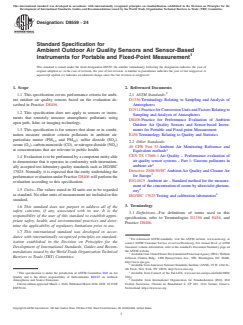
(Specification)Standard Specification for Ambient Outdoor Air Quality Sensors and Sensor-Based Instruments for Portable and Fixed-Point Measurement
General Information
- Abstract
SCOPE
1.1 This specification covers performance criteria for ambient outdoor air quality sensors based on the evaluation described in Practice D8406.
1.2 This specification does not apply to sensors or instruments that remotely measure atmospheric pollutants using open path, lidar, or imaging technology.
1.3 This specification is for sensors that alone or in combination measure outdoor criteria pollutants in ambient air: particulate matter (PM2.5 and PM10), sulfur dioxide (SO2), ozone (O3), carbon monoxide (CO), or nitrogen dioxide (NO2) at concentrations that are relevant to public health.
1.4 Evaluation is to be performed by a competent entity able to demonstrate that it operates in conformity with internationally accepted test laboratory quality standards such as ISO/IEC 17025. Normally, it is expected that the entity undertaking the performance evaluation under Practice D8406 will perform the evaluation according to this specification.
1.5 Units—The values stated in SI units are to be regarded as standard. No other units of measurement are included in this standard.
1.6 This standard does not purport to address all of the safety concerns, if any, associated with its use. It is the responsibility of the user of this standard to establish appropriate safety, health, and environmental practices and determine the applicability of regulatory limitations prior to use.
1.7 This international standard was developed in accordance with internationally recognized principles on standardization established in the Decision on Principles for the Development of International Standards, Guides and Recommendations issued by the World Trade Organization Technical Barriers to Trade (TBT) Committee.
- Status
- Published
- Publication Date
- 29-Feb-2024
- Technical Committee
- D22 - Air Quality
- Drafting Committee
- D22.03 - Ambient Atmospheres and Source Emissions

Overview
ASTM D8559-24: Standard Specification for Ambient Outdoor Air Quality Sensors and Sensor-Based Instruments for Portable and Fixed-Point Measurement establishes comprehensive performance criteria for ambient outdoor air quality sensors. Developed by ASTM International, this standard supports both portable and fixed-point measurement devices that quantify outdoor criteria pollutants such as particulate matter (PM2.5 and PM10), sulfur dioxide (SO₂), ozone (O₃), carbon monoxide (CO), and nitrogen dioxide (NO₂) at levels relevant to public health.
ASTM D8559-24 guides manufacturers, regulators, and users on evaluating sensor performance, ensuring data reliability for air quality monitoring and assessment. Evaluation and classification under this standard must be conducted by competent laboratories conforming to international quality standards such as ISO/IEC 17025.
Key Topics
- Scope of Application: This specification covers performance evaluation but excludes sensors using open path, lidar, or imaging technologies. It focuses on direct measurement devices for outdoor criteria pollutants.
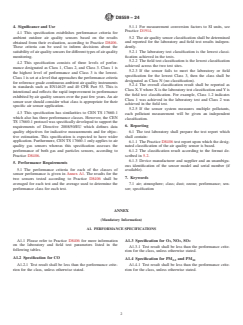
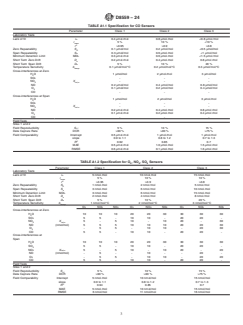
- Performance Criteria: Sensors are classified into three levels-Class 1 (highest performance), Class 2, and Class 3 (minimum acceptable performance). Each pollutant and device receives a classification based on laboratory and field test results in accordance with ASTM Practice D8406.
- Testing Procedures: Performance assessment includes both laboratory and field testing, with specific metrics such as accuracy, repeatability, sensitivity, and resistance to environmental and chemical interferences.
- Reporting Requirements: Test laboratories must provide detailed reports, including sensor identification, manufacturer information, and explicit designation of performance class based on standardized criteria.
- International Principles: The standard aligns with internationally recognized principles of standardization, including those set by the World Trade Organization Technical Barriers to Trade (TBT) Committee.
Applications
ASTM D8559-24 has broad practical value for a range of stakeholders involved in air quality monitoring:
- Regulatory Compliance: Government agencies can use this standard to qualify or approve air quality sensors for environmental compliance and public health monitoring.
- Research Initiatives: Academic and industry researchers benefit from standardized performance assessments, facilitating replicable and reliable data collection across field studies.
- Urban Air Quality Networks: Municipalities, non-profits, and private entities can evaluate sensor suitability for deployment in urban air monitoring networks, supporting real-time pollution monitoring and public information initiatives.
- Product Development: Sensor manufacturers can reference ASTM D8559-24 to design, validate, and market compliant air quality measuring devices that meet recognized performance benchmarks.
- Public Health Initiatives: Data generated using compliant devices helps inform strategies to reduce exposure to air pollutants and supports epidemiological studies.
Related Standards
ASTM D8559-24 references several important related standards and guidelines, including:
- ASTM D8406 - Practice for Performance Evaluation of Ambient Outdoor Air Quality Sensors and Sensor-Based Instruments
- ASTM D1356, D1914, E456 - Terminology and units standards for atmospheric sampling and analysis
- EN14625 - Standard method for measurement of ozone concentration by ultraviolet photometry
- CEN TS 17660-1 - Performance evaluation for air quality sensor systems
- ISO/IEC 17025 - Quality standard for testing and calibration laboratories
- Directive 2008/50/EC - EU Ambient Air Quality and Cleaner Air for Europe Directive
- 40 CFR Part 53 - US EPA Ambient Air Monitoring Reference and Equivalent Methods
By following ASTM D8559-24, organizations can ensure robust, standardized evaluation of ambient outdoor air quality sensor performance, supporting credible environmental decision-making and safeguarding public health.
Relations
- Effective Date
- 01-Apr-2022
- Effective Date
- 01-Apr-2022
Frequently Asked Questions
ASTM D8559-24 is a technical specification published by ASTM International. Its full title is "Standard Specification for Ambient Outdoor Air Quality Sensors and Sensor-Based Instruments for Portable and Fixed-Point Measurement". This standard covers: SCOPE 1.1 This specification covers performance criteria for ambient outdoor air quality sensors based on the evaluation described in Practice D8406. 1.2 This specification does not apply to sensors or instruments that remotely measure atmospheric pollutants using open path, lidar, or imaging technology. 1.3 This specification is for sensors that alone or in combination measure outdoor criteria pollutants in ambient air: particulate matter (PM2.5 and PM10), sulfur dioxide (SO2), ozone (O3), carbon monoxide (CO), or nitrogen dioxide (NO2) at concentrations that are relevant to public health. 1.4 Evaluation is to be performed by a competent entity able to demonstrate that it operates in conformity with internationally accepted test laboratory quality standards such as ISO/IEC 17025. Normally, it is expected that the entity undertaking the performance evaluation under Practice D8406 will perform the evaluation according to this specification. 1.5 Units—The values stated in SI units are to be regarded as standard. No other units of measurement are included in this standard. 1.6 This standard does not purport to address all of the safety concerns, if any, associated with its use. It is the responsibility of the user of this standard to establish appropriate safety, health, and environmental practices and determine the applicability of regulatory limitations prior to use. 1.7 This international standard was developed in accordance with internationally recognized principles on standardization established in the Decision on Principles for the Development of International Standards, Guides and Recommendations issued by the World Trade Organization Technical Barriers to Trade (TBT) Committee.
SCOPE 1.1 This specification covers performance criteria for ambient outdoor air quality sensors based on the evaluation described in Practice D8406. 1.2 This specification does not apply to sensors or instruments that remotely measure atmospheric pollutants using open path, lidar, or imaging technology. 1.3 This specification is for sensors that alone or in combination measure outdoor criteria pollutants in ambient air: particulate matter (PM2.5 and PM10), sulfur dioxide (SO2), ozone (O3), carbon monoxide (CO), or nitrogen dioxide (NO2) at concentrations that are relevant to public health. 1.4 Evaluation is to be performed by a competent entity able to demonstrate that it operates in conformity with internationally accepted test laboratory quality standards such as ISO/IEC 17025. Normally, it is expected that the entity undertaking the performance evaluation under Practice D8406 will perform the evaluation according to this specification. 1.5 Units—The values stated in SI units are to be regarded as standard. No other units of measurement are included in this standard. 1.6 This standard does not purport to address all of the safety concerns, if any, associated with its use. It is the responsibility of the user of this standard to establish appropriate safety, health, and environmental practices and determine the applicability of regulatory limitations prior to use. 1.7 This international standard was developed in accordance with internationally recognized principles on standardization established in the Decision on Principles for the Development of International Standards, Guides and Recommendations issued by the World Trade Organization Technical Barriers to Trade (TBT) Committee.
ASTM D8559-24 has the following relationships with other standards: It is inter standard links to ASTM E456-13a(2022)e1, ASTM E456-13a(2022). Understanding these relationships helps ensure you are using the most current and applicable version of the standard.
ASTM D8559-24 is available in PDF format for immediate download after purchase. The document can be added to your cart and obtained through the secure checkout process. Digital delivery ensures instant access to the complete standard document.
Standards Content (Sample)
This international standard was developed in accordance with internationally recognized principles on standardization established in the Decision on Principles for the
Development of International Standards, Guides and Recommendations issued by the World Trade Organization Technical Barriers to Trade (TBT) Committee.
Designation: D8559 − 24
Standard Specification for
Ambient Outdoor Air Quality Sensors and Sensor-Based
Instruments for Portable and Fixed-Point Measurement
This standard is issued under the fixed designation D8559; the number immediately following the designation indicates the year of
original adoption or, in the case of revision, the year of last revision. A number in parentheses indicates the year of last reapproval. A
superscript epsilon (´) indicates an editorial change since the last revision or reapproval.
1. Scope 2. Referenced Documents
1.1 This specification covers performance criteria for ambi- 2.1 ASTM Standards:
ent outdoor air quality sensors based on the evaluation de- D1356 Terminology Relating to Sampling and Analysis of
scribed in Practice D8406. Atmospheres
D1914 Practice for Conversion Units and Factors Relating to
1.2 This specification does not apply to sensors or instru-
Sampling and Analysis of Atmospheres
ments that remotely measure atmospheric pollutants using
D8406 Practice for Performance Evaluation of Ambient
open path, lidar, or imaging technology.
Outdoor Air Quality Sensors and Sensor-based Instru-
1.3 This specification is for sensors that alone or in combi- ments for Portable and Fixed-point Measurement
nation measure outdoor criteria pollutants in ambient air: E456 Terminology Relating to Quality and Statistics
particulate matter (PM and PM ), sulfur dioxide (SO ),
2.5 10 2
2.2 Other Standards:
ozone (O ), carbon monoxide (CO), or nitrogen dioxide (NO )
3 2
40 CFR Part 53 Ambient Air Monitoring Reference and
at concentrations that are relevant to public health.
Equivalent methods
CEN TS 17660-1 Air Quality – Performance evaluation of
1.4 Evaluation is to be performed by a competent entity able
air quality sensor systems – Part 1: Gaseous pollutants in
to demonstrate that it operates in conformity with internation-
ambient air
ally accepted test laboratory quality standards such as ISO/IEC
Directive 2008/50/EC Ambient Air Quality and Cleaner Air
17025. Normally, it is expected that the entity undertaking the
for Europe
performance evaluation under Practice D8406 will perform the
EN14625 Ambient air – Standard method for the measure-
evaluation according to this specification.
ment of the concentration of ozone by ultraviolet photom-
1.5 Units—The values stated in SI units are to be regarded
etry
as standard. No other units of measurement are included in this
ISO/IEC 17025 Testing and calibration laboratories
standard.
3. Terminology
1.6 This standard does not purport to address all of the
safety concerns, if any, associated with its use. It is the
3.1 Definitions—For definitions of terms used in this
responsibility of the user of this standard to establish appro-
specification, refer to Terminologies D1356 and E456, and
priate safety, health, and environmental practices and deter-
Practice D8406.
mine the applicability of regulatory limitations prior to use.
1.7 This international standard was developed in accor-
dance with internationally recognized principles on standard-
For referenced ASTM standards, visit the ASTM website, www.astm.org, or
ization established in the Decision on Principles for the
contact ASTM Customer Service at service@astm.org. For Annual Book of ASTM
Standards volume information, refer to the standard’s Document Summary page on
Development of International Standards, Guides and Recom-
the ASTM website.
mendations issued by the World Trade Organization Technical
Available from United States Environmental Protection Agency (EPA), William
Barriers to Trade (TBT) Committee.
Jefferson Clinton Bldg., 1200 Pennsylvania Ave., NW, Washington, DC 20460,
http://www.epa.gov.
Available from American National Standards Institute (ANSI), 25 W. 43rd St.,
4th Floor, New York, NY 10036, http://www.ansi.org.
1 5
This specification is under the jurisdiction of ASTM Committee D22 on Air Available from Council of the Eur-LEX, www.eur-lex.europa.eu/eli/dir/2008/
Quality and is the direct responsibility of Subcommittee D22.03 on Ambient 50/oj.
Atmospheres and Source Emissions. Available from International Organization for Standardization (ISO), ISO
Current edition approved March 1, 2024. Published March 2024. DOI: 10.1520/ Central Secretariat, Chemin de Blandonnet 8, CP 401, 1214 Vernier, Geneva,
D8559-24. Switzerland, https://www.iso.org.
Copyright © ASTM International, 100 Barr Harbor Drive, PO Box C700, West Conshohocken, PA 19428-2959. United States
D8559 − 24
4. Significance and Use 5.1.1 For measurement conversion factors to SI units, see
Practice D1914.
4.1 This specification establishes performance criteria for
5.2 The air quality sensor classification shall be determined
ambient outdoor air quality sensors based on the results
and reported for the laboratory and field test results indepen-
obtained from their evaluation, according to Practice D8406.
dently.
These criteria can be used to inform decisions about the
5.2.1 The laboratory test classification is the lowest classi-
suitability of air quality sensors for different types of air quality
fication achieved in the tests.
monitoring.
5.2.2 The field test classification is the lowest classification
4.2 This specification consists of three levels of perfor-
achieved across the two test sites.
mance designated as Class 1, Class 2, and Class 3. Class 1 is
5.2.3 If the sensor fails to meet the laboratory or field
the highest level of performance and Class 3 is the lowest.
specification for the lowest Class 3, then the class shall be
Class 1 is set at a level that approaches the performance criteria
designated as Class N (no classification).
for reference grade continuous ambient air quality instruments
5.2.4 The overall classification result shall be reported as
in standards such as EN14625 and 40 CFR Part 53. This is
Class X.Y where X is the laboratory test classification and Y is
intentional and reflects the rapid improvement in performance
the field test classification. For example, Class 1.2 indicates
exhibited by air quality sensors over the past few years. An air
Class 1 was achieved in the laboratory test and Class 2 was
sensor user should consider what class is appropriate for their
achieved in the field test.
specific air sensor application.
5.2.5 If the sensor system measures multiple pollutants,
4.3 This specification has similarities to CEN TS 17660-1
each pollutant measurement will be given an independent
which also has three performance classes. However, the CEN
classification.
TS 17660-1 protocol was specifically dev
...