


ASTM D6911-15
(Guide)Standard Guide for Packaging and Shipping Environmental Samples for Laboratory Analysis
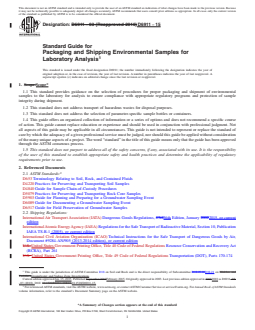
Standard Guide for Packaging and Shipping Environmental Samples for Laboratory Analysis
SIGNIFICANCE AND USE
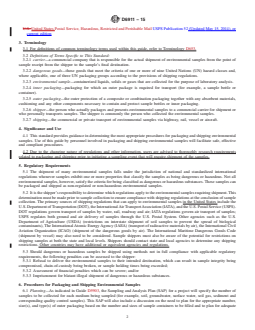
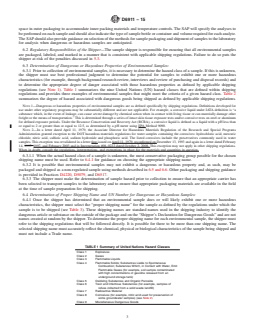
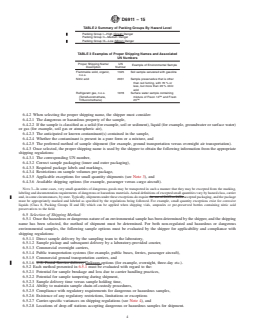
4.1 This standard provides guidance in determining the most appropriate procedures for packaging and shipping environmental samples. Use of this guide by personnel involved in packaging and shipping environmental samples will facilitate safe, effective and compliant procedures.
4.2 Due to the changing nature of regulations and other information, users are advised to thoroughly research requirements related to packaging and shipping prior to initiating a sampling event that will require shipment of the samples.
SCOPE
1.1 This standard provides guidance on the selection of procedures for proper packaging and shipment of environmental samples to the laboratory for analysis to ensure compliance with appropriate regulatory programs and protection of sample integrity during shipment.
1.2 This standard does not address transport of hazardous wastes for disposal purposes.
1.3 This standard does not address the selection of parameter-specific sample bottles or containers.
1.4 This guide offers an organized collection of information or a series of options and does not recommend a specific course of action. This guide cannot replace education or experience and should be used in conjunction with professional judgment. Not all aspects of this guide may be applicable in all circumstances. This guide is not intended to represent or replace the standard of care by which the adequacy of a given professional service must be judged, nor should this guide be applied without consideration of the many unique aspects of a project. The word “standard” in the title of this guide means only that the guide has been approved through the ASTM consensus process.
1.5 This standard does not purport to address all of the safety concerns, if any, associated with its use. It is the responsibility of the user of this standard to establish appropriate safety and health practices and determine the applicability of regulatory requirements prior to use.
General Information
- Status
- Published
- Publication Date
- 14-Jan-2015
- Technical Committee
- D18 - Soil and Rock
- Drafting Committee
- D18.21 - Groundwater and Vadose Zone Investigations
Relations
- Effective Date
- 15-Jan-2015
- Effective Date
- 01-Nov-2023
- Effective Date
- 01-Nov-2023
- Effective Date
- 01-Aug-2019
- Effective Date
- 01-Dec-2018
- Effective Date
- 15-Aug-2018
- Effective Date
- 01-Mar-2015
- Effective Date
- 01-Aug-2014
- Refers
ASTM D5903-96(2012) - Standard Guide for Planning and Preparing for a Groundwater Sampling Event - Effective Date
- 01-Jul-2012
- Effective Date
- 15-May-2012
- Effective Date
- 01-Sep-2011
- Effective Date
- 01-Jul-2010
- Effective Date
- 01-Feb-2010
- Effective Date
- 01-Jan-2009
- Effective Date
- 01-Dec-2008
Overview
ASTM D6911-15, Standard Guide for Packaging and Shipping Environmental Samples for Laboratory Analysis, provides essential guidance for selecting procedures to package and ship environmental samples safely and in compliance with regulatory requirements. The standard ensures the integrity of liquid, solid, or gaseous samples destined for laboratory analysis and supports consistent, effective, and lawful practices. Although the guide is not prescriptive, it helps organizations, laboratories, and environmental professionals implement protective and regulatory-compliant shipping protocols while considering the dynamic nature of shipping regulations.
Key Topics
- Regulatory Compliance: The standard highlights the need to comply with national and international shipping regulations, such as those established by the U.S. Department of Transportation (DOT), International Air Transport Association (IATA), International Civil Aviation Organization (ICAO), and others.
- Sample Integrity: Detailed guidance is included on maintaining the integrity of environmental samples during transit, protecting against breakage, leakage, temperature fluctuations, and tampering.
- Hazard Classification: Shippers must assess if samples are hazardous or dangerous goods, determine the correct hazard class, and select the proper shipping name and UN number according to regulations.
- Packaging Procedures: The guide outlines best practices for packaging both hazardous and non-hazardous samples, including choice of materials, insulation, sealing, secondary containment, and labeling.
- Chain-of-Custody: Recommendations are provided for completing and maintaining chain-of-custody documentation to track and verify sample handling throughout the shipping process.
- Documentation and Manifests: Emphasis is placed on correct completion of shipping manifests and ensuring that all forms required by laboratories and shipping carriers accompany the samples.
Applications
ASTM D6911-15 is vital for a diverse range of professionals and industries involved in environmental testing and analysis, including:
- Environmental Consultants: Assists in planning and executing field sampling and ensuring samples arrive at laboratories in viable condition.
- Laboratory Personnel: Facilitates receipt and documentation of samples, ensuring analysis is conducted within required holding times.
- Regulatory Agencies: Provides guidelines to assess whether organizations comply with transportation laws for environmental materials.
- Hazardous Material Shippers: Ensures that regulations pertaining to the transportation of dangerous goods are met, minimizing legal and safety risks.
Practical uses include the shipment of environmental samples such as soil, groundwater, surface water, sediment, and air to laboratories for chemical, physical, or biological analysis. The guidance is especially beneficial for projects requiring strict chain-of-custody or when shipping across state or international borders.
Related Standards
Several related ASTM and regulatory documents complement the guidance provided in ASTM D6911-15:
- ASTM D4220: Practices for Preserving and Transporting Soil Samples
- ASTM D4840: Guide for Sample Chain-of-Custody Procedures
- ASTM D5079: Practices for Preserving and Transporting Rock Core Samples
- ASTM D5903: Guide for Planning and Preparing for a Groundwater Sampling Event
- ASTM D6089: Guide for Documenting a Groundwater Sampling Event
- ASTM D6517: Guide for Field Preservation of Groundwater Samples
- International Shipping Regulations: IATA Dangerous Goods Regulations, ICAO Technical Instructions, IAEA Regulations for Safe Transport of Radioactive Material
- U.S. Federal Regulations: DOT (49 CFR), USPS Publication 52
Conclusion
ASTM D6911-15 is a critical standard for anyone involved in the sampling, packaging, and shipping of environmental samples for laboratory analysis. Adhering to its guidance helps assure regulatory compliance, protects sample quality, and supports effective documentation and traceability. These practices are essential for generating reliable laboratory results and upholding environmental and public health responsibilities.
Keywords: environmental sample packaging, environmental sample shipping, ASTM D6911, laboratory analysis, regulatory compliance, hazardous material transport, chain of custody, sample integrity.
Buy Documents
ASTM D6911-15 - Standard Guide for Packaging and Shipping Environmental Samples for Laboratory Analysis
REDLINE ASTM D6911-15 - Standard Guide for Packaging and Shipping Environmental Samples for Laboratory Analysis
Get Certified
Connect with accredited certification bodies for this standard
NSF International
Global independent organization facilitating standards development and certification.

BRCGS (Brand Reputation Compliance Global Standards)
Global food safety and quality standards owner.
CIS Institut d.o.o.
Personal Protective Equipment (PPE) certification body. Notified Body NB-2890 for EU Regulation 2016/425 PPE.
Sponsored listings
Frequently Asked Questions
ASTM D6911-15 is a guide published by ASTM International. Its full title is "Standard Guide for Packaging and Shipping Environmental Samples for Laboratory Analysis". This standard covers: SIGNIFICANCE AND USE 4.1 This standard provides guidance in determining the most appropriate procedures for packaging and shipping environmental samples. Use of this guide by personnel involved in packaging and shipping environmental samples will facilitate safe, effective and compliant procedures. 4.2 Due to the changing nature of regulations and other information, users are advised to thoroughly research requirements related to packaging and shipping prior to initiating a sampling event that will require shipment of the samples. SCOPE 1.1 This standard provides guidance on the selection of procedures for proper packaging and shipment of environmental samples to the laboratory for analysis to ensure compliance with appropriate regulatory programs and protection of sample integrity during shipment. 1.2 This standard does not address transport of hazardous wastes for disposal purposes. 1.3 This standard does not address the selection of parameter-specific sample bottles or containers. 1.4 This guide offers an organized collection of information or a series of options and does not recommend a specific course of action. This guide cannot replace education or experience and should be used in conjunction with professional judgment. Not all aspects of this guide may be applicable in all circumstances. This guide is not intended to represent or replace the standard of care by which the adequacy of a given professional service must be judged, nor should this guide be applied without consideration of the many unique aspects of a project. The word “standard” in the title of this guide means only that the guide has been approved through the ASTM consensus process. 1.5 This standard does not purport to address all of the safety concerns, if any, associated with its use. It is the responsibility of the user of this standard to establish appropriate safety and health practices and determine the applicability of regulatory requirements prior to use.
SIGNIFICANCE AND USE 4.1 This standard provides guidance in determining the most appropriate procedures for packaging and shipping environmental samples. Use of this guide by personnel involved in packaging and shipping environmental samples will facilitate safe, effective and compliant procedures. 4.2 Due to the changing nature of regulations and other information, users are advised to thoroughly research requirements related to packaging and shipping prior to initiating a sampling event that will require shipment of the samples. SCOPE 1.1 This standard provides guidance on the selection of procedures for proper packaging and shipment of environmental samples to the laboratory for analysis to ensure compliance with appropriate regulatory programs and protection of sample integrity during shipment. 1.2 This standard does not address transport of hazardous wastes for disposal purposes. 1.3 This standard does not address the selection of parameter-specific sample bottles or containers. 1.4 This guide offers an organized collection of information or a series of options and does not recommend a specific course of action. This guide cannot replace education or experience and should be used in conjunction with professional judgment. Not all aspects of this guide may be applicable in all circumstances. This guide is not intended to represent or replace the standard of care by which the adequacy of a given professional service must be judged, nor should this guide be applied without consideration of the many unique aspects of a project. The word “standard” in the title of this guide means only that the guide has been approved through the ASTM consensus process. 1.5 This standard does not purport to address all of the safety concerns, if any, associated with its use. It is the responsibility of the user of this standard to establish appropriate safety and health practices and determine the applicability of regulatory requirements prior to use.
ASTM D6911-15 is classified under the following ICS (International Classification for Standards) categories: 13.060.45 - Examination of water in general; 13.080.05 - Examination of soils in general; 55.180.99 - Other standards related to freight distribution of goods. The ICS classification helps identify the subject area and facilitates finding related standards.
ASTM D6911-15 has the following relationships with other standards: It is inter standard links to ASTM D6911-03(2010), ASTM D6517-18(2023), ASTM D6089-19(2023), ASTM D6089-19, ASTM D6517-18, ASTM D4840-99(2018)e1, ASTM D6089-15, ASTM D653-14, ASTM D5903-96(2012), ASTM D6517-00(2012)e1, ASTM D653-11, ASTM D6089-97(2010), ASTM D4840-99(2010), ASTM D653-09, ASTM D653-08a. Understanding these relationships helps ensure you are using the most current and applicable version of the standard.
ASTM D6911-15 is available in PDF format for immediate download after purchase. The document can be added to your cart and obtained through the secure checkout process. Digital delivery ensures instant access to the complete standard document.
Standards Content (Sample)
This international standard was developed in accordance with internationally recognized principles on standardization established in the Decision on Principles for the
Development of International Standards, Guides and Recommendations issued by the World Trade Organization Technical Barriers to Trade (TBT) Committee.
Designation: D6911 − 15
Standard Guide for
Packaging and Shipping Environmental Samples for
Laboratory Analysis
This standard is issued under the fixed designation D6911; the number immediately following the designation indicates the year of
original adoption or, in the case of revision, the year of last revision. A number in parentheses indicates the year of last reapproval. A
superscript epsilon (´) indicates an editorial change since the last revision or reapproval.
1. Scope* D4220 Practices for Preserving and Transporting Soil
Samples
1.1 This standard provides guidance on the selection of
D4840 Guide for Sample Chain-of-Custody Procedures
procedures for proper packaging and shipment of environmen-
D5079 Practices for Preserving and Transporting Rock Core
tal samples to the laboratory for analysis to ensure compliance
Samples
with appropriate regulatory programs and protection of sample
D5903 Guide for Planning and Preparing for a Groundwater
integrity during shipment.
Sampling Event
1.2 This standard does not address transport of hazardous
D6089 Guide for Documenting a Groundwater Sampling
wastes for disposal purposes.
Event
D6517 Guide for Field Preservation of Groundwater
1.3 This standard does not address the selection of
parameter-specific sample bottles or containers. Samples
2.2 Shipping Regulations:
1.4 This guide offers an organized collection of information
oraseriesofoptionsanddoesnotrecommendaspecificcourse International Air Transport Association (IATA) Dangerous
Goods Regulations, 56th Edition, January 2015, or current
of action. This guide cannot replace education or experience
and should be used in conjunction with professional judgment. edition
International Atomic Energy Agency (IAEA) Regulations
Not all aspects of this guide may be applicable in all circum-
stances. This guide is not intended to represent or replace the fortheSafeTransportofRadioactiveMaterial,Section10,
Publication IAEA TS-R-1 (2005), or current edition
standard of care by which the adequacy of a given professional
service must be judged, nor should this guide be applied International Civil Aviation Organization (ICAO) Technical
InstructionsfortheSafeTransportofDangerousGoodsby
without consideration of the many unique aspects of a project.
Air, Document #9284-AN/905 (2013-2014 edition), or
The word “standard” in the title of this guide means only that
the guide has been approved through the ASTM consensus current edition
process.
United States Government Printing Office, Title 40 Code of
Federal Regulations Resource Conservation and Recovery
1.5 This standard does not purport to address all of the
Act (RCRA), Part 261
safety concerns, if any, associated with its use. It is the
United States Government Printing Office, Title 49 Code of
responsibility of the user of this standard to establish appro-
Federal Regulations Transportation (DOT), Parts 170-174
priate safety and health practices and determine the applica-
bility of regulatory requirements prior to use. United States Postal Service, Hazardous, Restricted and
Perishable Mail USPS Publication 52 (Updated May 15,
2. Referenced Documents
2014), or current edition
2.1 ASTM Standards:
D653 Terminology Relating to Soil, Rock, and Contained 3. Terminology
Fluids
3.1 For definitions of common terminology terms used
within this guide, refer to Terminology D653.
This guide is under the jurisdiction ofASTM Committee D18 on Soil and Rock
3.2 Definitions of Terms Specific to This Standard:
and is the direct responsibility of Subcommittee D18.21 on Groundwater and
Vadose Zone Investigations.
3.2.1 carrier—a commercial company that is responsible
Current edition approved Jan. 15, 2015. Published February 2015. Originally
for the actual shipment of environmental samples from the
approved in 2003. Last previous edition approved in 2010 as D6911–03 (2010).
point of sample receipt from the shipper to the sample’s final
DOI: 10.1520/D6911-15.
For referenced ASTM standards, visit the ASTM website, www.astm.org, or destination.
contact ASTM Customer Service at service@astm.org. For Annual Book of ASTM
3.2.2 dangerous goods—those goods that meet the criteria
Standards volume information, refer to the standard’s Document Summary page on
the ASTM website. of one or more of nine United Nations (UN) hazard classes
*A Summary of Changes section appears at the end of this standard
Copyright © ASTM International, 100 Barr Harbor Drive, PO Box C700, West Conshohocken, PA 19428-2959. United States
D6911 − 15
and, where applicable, one of three UN packaging groups tional Civil Aviation Organization (ICAO) (shipment of the
according to the provisions of shipping regulations. dangerous goods by air). The International Maritime Danger-
ous Goods Code (shipment by vessel) may also need to be
3.2.3 environmental sample—containerized liquids, solids
considered. Sample shippers must also be aware of the poten-
or gases that are collected for the purpose of laboratory
tial for restrictions on shipping samples at both the state and
analysis.
local levels. Shippers should contact state and local agencies to
3.2.4 inner packaging—packaging for which an outer pack-
determine any shipping restrictions. Other countries may have
age is required for transport (for example, a sample bottle or
additional or equivalent agencies and regulations.
container).
5.3 Should dangerous or hazardous samples be shipped
3.2.5 outer packaging—the outer protection of a composite
using methods not in full compliance with applicable regula-
or combination packaging together with any absorbent
tory requirements, the following penalties can be assessed to
materials, cushioning and any other components necessary to
the shipper:
contain and protect sample bottles or inner packaging.
5.3.1 Refusal to deliver the environmental samples to their
3.2.6 shipper—the person who actually packages and pres-
intendeddestination,whichcanresultinsampleintegritybeing
ents environmental samples to a commercial carrier for ship-
compromised, chain-of-custody being broken, or sample hold-
ment or who personally transports samples. The shipper is
ing times being exceeded;
commonly the person who collected the environmental
5.3.2 Assessmentoffinancialpenaltieswhichcanbesevere;
samples.
and/or
3.2.7 shipping—the commercial or private transport of en-
5.3.3 Imprisonment for blatant illegal shipment of danger-
vironmental samples via highway, rail, vessel or aircraft.
ous or hazardous substances.
4. Significance and Use
6. Procedures for Packaging and Shipping
4.1 This standard provides guidance in determining the
Environmental Samples
most appropriate procedures for packaging and shipping envi-
6.1 Planning—As indicated in Guide D5903, the Sampling
ronmental samples. Use of this guide by personnel involved in
and Analysis Plan (SAP) for a project will specify the number
packaging and shipping environmental samples will facilitate
of samples to be collected for each medium being sampled (for
safe, effective and compliant procedures.
example, soil, groundwater, surface water, soil gas, sediment
4.2 Due to the changing nature of regulations and other
and corresponding quality control samples).This SAPwill also
information, users are advised to thoroughly research require-
include a discussion on the need to plan for the appropriate
ments related to packaging and shipping prior to initiating a
number, size(s), and type(s) of outer packaging based on the
sampling event that will require shipment of the samples.
number and sizes of sample containers to be filled and to plan
for adequate space in outer packaging to accommodate inner
5. Regulatory Requirements
packing materials and temperature controls. The SAP will
5.1 The shipment of many environmental samples falls
specify the analyses to be performed on each sample and
underthejurisdictionofnationalandstandardizedinternational
should also indicate the type of sample bottle or container and
regulations whenever samples exhibit one or more properties
volumerequiredforeachanalyte.TheSAPshouldalsoprovide
that classify the samples as being dangerous or hazardous. Not
guidanceonselectionofthemethodsforsamplepackagingand
all environmental samples, however, satisfy the criteria for
shipment of samples to the laboratory for analysis when
being classified as dangerous or hazardous substances. These
dangerous or hazardous samples are anticipated.
samples can be packaged and shipped as non-regulated or
6.2 Regulatory Responsibilities of the Shipper—The sample
non-hazardous environmental samples.
shipper is responsible for ensuring that all environmental
5.2 It is the shipper’s responsibility to determine which
samples are packaged, labeled, and marked in a manner that is
regulations apply to the environmental samples requiring
consistent with applicable shipping regulations. Failure to do
shipment. This determination must be made prior to sample
so puts the shipper at risk of the penalties discussed in 5.3.
collection to ensure compliance with shipping regulations at
the conclusion of sample collection. The primary sources of 6.3 Determination of Dangerous or Hazardous Properties
of Environmental Samples:
shipping regulations that can apply to environmental samples
in the United States include the U.S. Department of Transpor- 6.3.1 Prior to collection of environmental samples, it is
tation (DOT), the International Air Transport Association necessary to determine the hazard class of a sample. If this is
(IATA), and the U.S. Postal Service (USPS). DOT regulations unknown, the shipper must use best professional judgment to
govern transport of samples by water, rail, roadway and air; determine the potential for samples to exhibit one or more
IATA regulations govern air transport of samples; USPS hazardous characteristics (for example, through background
regulates both ground and air delivery of samples through the research review, interviews and review of purchasing and
U.S. Postal System. Other agencies such as the U.S. Depart- disposal records) and to determine the appropriate degree of
ment of Agriculture (USDA) (restrictions on interstate ship- danger associated with those hazardous properties as defined
ment of soil samples to prevent the spread of biological by applicable shipping regulations (see Note 1). Table 1
contaminants), The International Atomic Energy Agency summarizes the nine United Nations (UN) hazard classes that
(IAEA) (transport of radioactive materials by air), the Interna- are defined within shipping regulations and provides three
D6911 − 15
TABLE 1 Summary of United Nations Hazard Classes
ensure that appropriate packaging materials are available in the
Class 1 Explosives field at the time of sample preparation for shipping.
Class 2 Gases
6.4 Determination of Proper Shipping Name and UN Num-
Class 3 Flammable Liquids
Class 4 Flammable Solids; Substances Liable to Spontaneous
ber for Dangerous or Hazardous Samples:
Combustion; Substances Which, in Contact with Water, Emit
6.4.1 Once the shipper has determined that an environmen-
Flammable Gases (for example, soil sample contaminated
tal sample does or will likely exhibit one or more hazardous
with high concentrations of gasoline released from an
underground storage tank)
characteristics, the shipper must select the “proper shipping
Class 5 Oxidizing Substances and Organic Peroxide
name”forthesampleasdefinedbytheregulationsunderwhich
Class 6 Toxic and Infectious Substances (for example, samples of
the sample is to be shipped (see Table 3). These shipping
refuse collected from a solid waste landfill)
Class 7 Radioactive Material
names are standard names used in the shipping industry to
Class 8 Corrosives (for example, nitric acid used for preservation of
identify the dangerous article or substance on the outside of the
some groundwater samples) (see Note 2)
Class 9 Miscellaneous Dangerous Goods package and on the “Shipper’s Declaration for Dangerous
Goods” and are not names created at random by the shipper.To
determine the proper shipping name for each environmental
sample, the shipper must refer to the shipping regulations that
examplesofenvironmentalsamplesthatmightmeetthecriteria
willbefolloweddirectly.Itispossiblefortheretobemorethan
of a given hazard class. Table 2 summarizes the degree of
one shipping name. The selected shipping name must accu-
hazard associated with dangerous goods being shipped as
rately reflect the chemical, physical or biological characteris-
defined by applicable shipping regulations.
tics of the sample being shipped and must not include a Trade
name.
NOTE 1—Dangerous or hazardous properties of environmental samples
are as defined specifically by shipping regulations. Definitions developed 6.4.2 When selecting the proper shipping name, the shipper
for use under other regulatory programs may be substantially different and
must consider:
are not applicable. For example, a corrosive liquid under IATA definition
6.4.2.1 The dangerous or hazardous property of the sample,
is “a substance which, in the event of leakage, can cause severe damage
6.4.2.2 If the sample is classified as a solid (for example,
by chemical action when in contact with living tissue or can materially
soil or sediment), liquid (for example, groundwater or surface
damage other freight or the means of transportation.” This is determined
through a series of intact skin tissue exposure tests and/or corrosive tests water) or gas (for example, soil gas or atmospheric air),
on steel or aluminum for defined exposure periods. Under the Resource
6.4.2.3 The anticipated or known contaminant(s) contained
Conservation and Recovery Act (RCRA), a corrosive liquid is defined as
in the sample,
a liquid with a pH less than or equal to 2 or greater than or equal to 12.5,
6.4.2.4 Whetherthecontaminantispresentinapureformor
as determined by a pH meter using EPA Method 9090.
a mixture, and
NOTE 2—In a letter dated April 11, 1979, the Associate Director for
Hazardous Materials Regulation of the Research and Special Programs
6.4.2.5 The preferred method of sample shipment (for
Administration granted exception to the DOT hazardous materials regu-
example, ground transportation versus overnight air transpor-
lations for water samples containing the corrosives: hydrochloric acid,
tation).
mercuric chloride, nitric acid, sulfuric acid, sodium hydroxide and
6.4.3 Onceselected,thepropershippingnameisusedbythe
phosphoric acid. The listed corrosives include the preservatives com-
shipper to obtain the following information from the appropri-
monly used in water samples. This exception was revalidated in a letter
first issued on April 11, 1979, reconfirmed on December 13, 1993 and
ate shipping regulations:
again in a letter dated February 14, 1997, and February 2003 and in
6.4.3.1 The corresponding UN number,
Interpretation #08–0222 dated October 2, 2008. This exception may not
6.4.3.2 Correct sample packaging (inner and outer
apply in other shipping regulations. When in doubt, consult the
packaging),
regulations, interpretations, and exemptions in place for the materials and
quantities in question. 6.4.3.3 Required package labels and markings,
6.4.3.4 Restrictions on sample volumes per package,
6.3.1.1 When the actual hazard class of a sample is
6.4.3.5 Applicable exceptions for small quantity shipments
unknown, the most conservative packaging group possible for
(see Note 3), and
the chosen shipping name must be used. Refer to 6.4.1 for
6.4.3.6 Available shipping options (for example, passenger
guidance on choosing the appropriate shipping name.
versus cargo aircraft).
6.3.2 It is possible that environmental samples may not
exhibitadangerousorhazardouspropertyand,assuch,maybe
packaged and shipped as a non-regulated sample using meth-
TABLE 3 Examples of Proper Shipping Names and Associated
ods described in 6.5 and 6.6. Other packaging and shipping
UN Numbers
guidance is provided in Practices D4220, D5079, and D6517.
Proper Shipping Name/ UN
6.3.3 The shipper must make the determination of sample
Example of Environmental Sample
Description Number
hazard prior to collection to ensure that an appropriate carrier
Flammable solid, organic, 1325 Soil sample saturated w
...
This document is not an ASTM standard and is intended only to provide the user of an ASTM standard an indication of what changes have been made to the previous version. Because
it may not be technically possible to adequately depict all changes accurately, ASTM recommends that users consult prior editions as appropriate. In all cases only the current version
of the standard as published by ASTM is to be considered the official document.
Designation: D6911 − 03 (Reapproved 2010) D6911 − 15
Standard Guide for
Packaging and Shipping Environmental Samples for
Laboratory Analysis
This standard is issued under the fixed designation D6911; the number immediately following the designation indicates the year of
original adoption or, in the case of revision, the year of last revision. A number in parentheses indicates the year of last reapproval. A
superscript epsilon (´) indicates an editorial change since the last revision or reapproval.
1. Scope Scope*
1.1 This standard provides guidance on the selection of procedures for proper packaging and shipment of environmental
samples to the laboratory for analysis to ensure compliance with appropriate regulatory programs and protection of sample
integrity during shipment.
1.2 This standard does not address transport of hazardous wastes for disposal purposes.
1.3 This standard does not address the selection of parameter-specific sample bottles or containers.
1.4 This guide offers an organized collection of information or a series of options and does not recommend a specific course
of action. This guide cannot replace education or experience and should be used in conjunction with professional judgment. Not
all aspects of this guide may be applicable in all circumstances. This guide is not intended to represent or replace the standard of
care by which the adequacy of a given professional service must be judged, nor should this guide be applied without consideration
of the many unique aspects of a project. The word “standard” in the title of this guide means only that the guide has been approved
through the ASTM consensus process.
1.5 This standard does not purport to address all of the safety concerns, if any, associated with its use. It is the responsibility
of the user of this standard to establish appropriate safety and health practices and determine the applicability of regulatory
requirements prior to use.
2. Referenced Documents
2.1 ASTM Standards:
D653 Terminology Relating to Soil, Rock, and Contained Fluids
D4220 Practices for Preserving and Transporting Soil Samples
D4840 Guide for Sample Chain-of-Custody Procedures
D5079 Practices for Preserving and Transporting Rock Core Samples
D5903 Guide for Planning and Preparing for a Groundwater Sampling Event
D6089 Guide for Documenting a Groundwater Sampling Event
D6517 Guide for Field Preservation of Groundwater Samples
2.2 Shipping Regulations:
International Air Transport Association (IATA) Dangerous Goods Regulations, 43rd56th Edition, January 20022015, or current
edition
International Atomic Energy Agency (IAEA) Regulations for the Safe Transport of Radioactive Material, Section 10, Publication
IAEA TS-R-1 (2005), or current edition
International Civil Aviation Organization (ICAO) Technical Instructions for the Safe Transport of Dangerous Goods by Air,
Document #9284-AN/905 (2013-2014 edition), or current edition
U.S. United States Government Printing Office, Title 40 Code of Federal Regulations Resource Conservation and Recovery Act
(RCRA), Part 261
U.S. United States Government Printing Office, Title 49 Code of Federal Regulations Transportation (DOT), Parts 170-174
This guide is under the jurisdiction of ASTM Committee D18 on Soil and Rock and is the direct responsibility of Subcommittee D18.25.01D18.21 on Mulches and
TackifiersGroundwater and Vadose Zone Investigations.
Current edition approved Jan. 15, 2015. Published September 2010February 2015. Originally approved in 2003. Last previous edition approved in 20032010 as D6911–03.
–03 (2010). DOI: 10.1520/D6911-03R10.10.1520/D6911-15.
For referenced ASTM standards, visit the ASTM website, www.astm.org, or contact ASTM Customer Service at service@astm.org. For Annual Book of ASTM Standards
volume information, refer to the standard’s Document Summary page on the ASTM website.
*A Summary of Changes section appears at the end of this standard
Copyright © ASTM International, 100 Barr Harbor Drive, PO Box C700, West Conshohocken, PA 19428-2959. United States
D6911 − 15
U.S. United States Postal Service, Hazardous, Restricted and Perishable Mail USPS Publication 52 (Updated May 15, 2014), or
current edition
3. Terminology
3.1 For definitions of common terminology terms used within this guide, refer to Terminology D653.
3.2 Definitions of Terms Specific to This Standard:
3.2.1 carrier—a commercial company that is responsible for the actual shipment of environmental samples from the point of
sample receipt from the shipper to the sample’s final destination.
3.2.2 dangerous goods—those goods that meet the criteria of one or more of nine United Nations (UN) hazard classes and,
where applicable, one of three UN packaging groups according to the provisions of shipping regulations.
3.2.3 environmental sample—containerized liquids, solids or gases that are collected for the purpose of laboratory analysis.
3.2.4 inner packaging—packaging for which an outer package is required for transport (for example, a sample bottle or
container).
3.2.5 outer packaging—the outer protection of a composite or combination packaging together with any absorbent materials,
cushioning and any other components necessary to contain and protect sample bottles or inner packaging.
3.2.6 shipper—the person who actually packages and presents environmental samples to a commercial carrier for shipment or
who personally transports samples. The shipper is commonly the person who collected the environmental samples.
3.2.7 shipping—the commercial or private transport of environmental samples via highway, rail, vessel or aircraft.
4. Significance and Use
4.1 This standard provides guidance in determining the most appropriate procedures for packaging and shipping environmental
samples. Use of this guide by personnel involved in packaging and shipping environmental samples will facilitate safe, effective
and compliant procedures.
4.2 Due to the changing nature of regulations and other information, users are advised to thoroughly research requirements
related to packaging and shipping prior to initiating a sampling event that will require shipment of the samples.
5. Regulatory Requirements
5.1 The shipment of many environmental samples falls under the jurisdiction of national and standardized international
regulations whenever samples exhibit one or more properties that classify the samples as being dangerous or hazardous. Not all
environmental samples, however, satisfy the criteria for being classified as dangerous or hazardous substances. These samples can
be packaged and shipped as non-regulated or non-hazardous environmental samples.
5.2 It is the shipper’s responsibility to determine which regulations apply to the environmental samples requiring shipment. This
determination must be made prior to sample collection to ensure compliance with shipping regulations at the conclusion of sample
collection. The primary sources of shipping regulations that can apply to environmental samples in the United States include the
U.S. Department of Transportation (DOT), the International Air Transport Association (IATA), and the U.S. Postal Service (USPS).
DOT regulations govern transport of samples by water, rail, roadway and air; IATA regulations govern air transport of samples;
USPS regulates both ground and air delivery of samples through the U.S. Postal System. Other agencies such as the U.S.
Department of Agriculture (USDA) (restrictions on interstate shipment of soil samples to prevent the spread of biological
contaminants), The International Atomic Energy Agency (IAEA) (transport of radioactive materials by air), the International Civil
Aviation Organization (ICAO) (shipment of the dangerous goods by air). The International Maritime Dangerous Goods Code
(shipment by vessel) may also need to be considered. Sample shippers must also be aware of the potential for restrictions on
shipping samples at both the state and local levels. Shippers should contact state and local agencies to determine any shipping
restrictions. Other countries may have additional or equivalent agencies and regulations.
5.3 Should dangerous or hazardous samples be shipped using methods not in full compliance with applicable regulatory
requirements, the following penalties can be assessed to the shipper:
5.3.1 Refusal to deliver the environmental samples to their intended destination, which can result in sample integrity being
compromised, chain-of-custody being broken, or sample holding times being exceeded;
5.3.2 Assessment of financial penalties which can be severe; and/or
5.3.3 Imprisonment for blatant illegal shipment of dangerous or hazardous substances.
6. Procedures for Packaging and Shipping Environmental Samples
6.1 Planning—As indicated in Guide D5903, the Sampling and Analysis Plan (SAP) for a project will specify the number of
samples to be collected for each medium being sampled (for example, soil, groundwater, surface water, soil gas, sediment and
corresponding quality control samples). This SAP will also include a discussion on the need to plan for the appropriate number,
size(s), and type(s) of outer packaging based on the number and sizes of sample containers to be filled and to plan for adequate
D6911 − 15
space in outer packaging to accommodate inner packing materials and temperature controls. The SAP will specify the analyses to
be performed on each sample and should also indicate the type of sample bottle or container and volume required for each analyte.
The SAP should also provide guidance on selection of the methods for sample packaging and shipment of samples to the laboratory
for analysis when dangerous or hazardous samples are anticipated.
6.2 Regulatory Responsibilities of the Shipper—The sample shipper is responsible for ensuring that all environmental samples
are packaged, labeled, and marked in a manner that is consistent with applicable shipping regulations. Failure to do so puts the
shipper at risk of the penalties discussed in 5.3.
6.3 Determination of Dangerous or Hazardous Properties of Environmental Samples:
6.3.1 Prior to collection of environmental samples, it is necessary to determine the hazard class of a sample. If this is unknown,
the shipper must use best professional judgment to determine the potential for samples to exhibit one or more hazardous
characteristics (for example, through background research review, interviews and review of purchasing and disposal records) and
to determine the appropriate degree of danger associated with those hazardous properties as defined by applicable shipping
regulations (see Note 1). Table 1 summarizes the nine United Nations (UN) hazard classes that are defined within shipping
regulations and provides three examples of environmental samples that might meet the criteria of a given hazard class. Table 2
summarizes the degree of hazard associated with dangerous goods being shipped as defined by applicable shipping regulations.
NOTE 1—Dangerous or hazardous properties of environmental samples are as defined specifically by shipping regulations. Definitions developed for
use under other regulatory programs may be substantially different and are not applicable. For example, a corrosive liquid under IATA definition is “a
substance which, in the event of leakage, can cause severe damage by chemical action when in contact with living tissue or can materially damage other
freight or the means of transportation.” This is determined through a series of intact skin tissue exposure tests and/or corrosive tests on steel or aluminum
for defined exposure periods. Under the Resource Conservation and Recovery Act (RCRA), a corrosive liquid is defined as a liquid with a pH less than
or equal to 2 or greater than or equal to 12.5, as determined by a pH meter using EPA Method 9090.
NOTE 2—In a letter dated April 11, 1979, the Associate Director for Hazardous Materials Regulation of the Research and Special Programs
Administration granted exception to the DOT hazardous materials regulations for water samples containing the corrosives: hydrochloric acid, mercuric
chloride, nitric acid, sulfuric acid, sodium hydroxide and phosphoric acid. The listed corrosives include the preservatives commonly used in water
samples. This exception was revalidated in a letter first issued on April 11, 1979, reconfirmed on December 13, 1993 and again in a letter dated February
14, 1997. 1997, and February 2003 and in Interpretation #08–0222 dated October 2, 2008. This exception may not apply in other shipping regulations.
When in doubt, consult the regulations, interpretations, and exemptions in place for the materials and quantities in question.
6.3.1.1 When the actual hazard class of a sample is unknown, the most conservative packaging group possible for the chosen
shipping name must be used. Refer to 6.4.1 for guidance on choosing the appropriate shipping name.
6.3.2 It is possible that environmental samples may not exhibit a dangerous or hazardous property and, as such, may be
packaged and shipped as a non-regulated sample using methods described in 6.5 and 6.6. Other packaging and shipping guidance
is provided in Practices D4220, D5079, and D6517.
6.3.3 The shipper must make the determination of sample hazard prior to collection to ensure that an appropriate carrier has
been selected to transport samples to the laboratory and to ensure that appropriate packaging materials are available in the field
at the time of sample preparation for shipping.
6.4 Determination of Proper Shipping Name and UN Number for Dangerous or Hazardous Samples:
6.4.1 Once the shipper has determined that an environmental sample does or will likely exhibit one or more hazardous
characteristics, the shipper must select the “proper shipping name” for the sample as defined by the regulations under which the
sample is to be shipped (see Table 3). These shipping names are standard names used in the shipping industry to identify the
dangerous article or substance on the outside of the package and on the “Shipper’s Declaration for Dangerous Goods” and are not
names created at random by the shipper. To determine the proper shipping name for each environmental sample, the shipper must
refer to the shipping regulations that will be followed directly. It is possible for there to be more than one shipping name. The
selected shipping name must accurately reflect the chemical, physical or biological characteristics of the sample being shipped and
must not include a Trade name.
TABLE 1 Summary of United Nations Hazard Classes
Class 1 Explosives
Class 2 Gases
Class 3 Flammable Liquids
Class 4 Flammable Solids; Substances Liable to Spontaneous
Combustion; Substances Which, in Contact with Water, Emit
Flammable Gases (for example, soil sample contaminated
with high concentrations of gasoline released from an
underground storage tank)
Class 5 Oxidizing Substances and Organic Peroxide
Class 6 Toxic and Infectious Substances (for example, samples of
refuse collected from a solid waste landfill)
Class 7 Radioactive Material
Class 8 Corrosives (for example, nitric acid used for preservation of
some groundwater samples) (see Note 2)
Class 9 Miscellaneous Dangerous Goods
D6911 − 15
TABLE 2 Summary of Packing Groups By Hazard Level
Packing Group I—High (Great) Danger
Packing Group II—Medium Danger
Packing Group III—Low (Minor) Danger
TABLE 3 Examples of Proper Shipping Names and Associated
UN Numbers
Proper Shipping Name/ UN
Example of Environmental Sample
Description Number
Flammable solid, organic, 1325 Soil sample saturated with gasoline
n.o.s.
Nitric acid 2031 Sample preservative that is other
than red fuming, with 70 % or
less, but more than 20 % nitric
acid
Refrigerant gas, n.o.s. 1078 Surface water sample containing
(Tetrafluoromethane, mixture of Freon 14™ and Freon
Trifluoromethane) 23™
6.4.2 When selecting the proper shipping name, the shipper must consider:
6.4.2.1 The dangerous or hazardous property of the sample,
6.4.2.2 If the sample is classified as a solid (for example, soil or sediment), liquid (for example, groundwater or surface water)
or gas (for example, soil gas or atmospheric air),
6.4.2.3 The anticipated or known contaminant(s) contained in the sample,
6.4.2.4 Whether the contaminant is present in a pure form or a mixture,
...
Questions, Comments and Discussion
Ask us and Technical Secretary will try to provide an answer. You can facilitate discussion about the standard in here.
Loading comments...