

ASTM E1620-97(2022)
(Terminology)Standard Terminology Relating to Liquid Particles and Atomization
General Information
- Abstract
SCOPE
1.1 In a broad sense, this terminology covers terminology associated with liquid particles dispersed in gas. The principal emphasis, however, is on particles produced by the process of atomization.
1.2 All terms, followed by their definitions, are arranged alphabetically. In addition, the terminology contains several tables wherein terms related to specific subjects are segregated and identified.
1.3 Within the broad scope, the following specific categories are included:
1.3.1 Terms pertaining to the structure and condition of individual particles or groups of particles as observed in nature.
1.3.2 Terms pertaining to the structure and condition of individual particles or groups of particles produced by an atomizing device.
1.3.3 Terms pertaining to atomizing devices according to the primary energy source responsible for spray development. (When more than one term is used for the same device or class of devices, the alternative term is followed by the preferred term.) Definitions of the devices may refer to their construction, operating principle, or distinctive spray characteristics. The atomizers, however, are not classified by their respective areas of application or end use. Moreover, the listed terms are generic and do not include brand names, trademarks, or proprietary designations.
1.3.4 Terms pertaining to statistical parameters involving particle measurement, particle size, and size distribution functions.
1.3.5 Terms pertaining to instruments and test procedures utilized in the characterization of liquid particles and sprays.
1.4 The values stated in SI units are to be regarded as standard. No other units of measurement are included in this standard.
1.5 This international standard was developed in accordance with internationally recognized principles on standardization established in the Decision on Principles for the Development of International Standards, Guides and Recommendations issued by the World Trade Organization Technical Barriers to Trade (TBT) Committee.
- Status
- Published
- Publication Date
- 31-Jan-2022
- Technical Committee
- E29 - Particle and Spray Characterization
- Drafting Committee
- E29.02 - Non-Sieving Methods
Overview
ASTM E1620-97(2022) - Standard Terminology Relating to Liquid Particles and Atomization provides a comprehensive collection of terms and definitions relevant to liquid particles dispersed in gas, with a focus on atomization processes. Developed by ASTM International, this standard establishes common language for professionals working in fields such as spray engineering, combustion, cooling, humidification, spray coating, and particle measurement. The document aims to promote clear communication, consistent reporting, and a unified approach to the description, assessment, and comparison of particle and atomization technologies.
Key Topics
This standard organizes terms and concepts into several practical categories:
Structure and Condition of Liquid Particles: Terms describe the shape, size, distribution, and arrangement of individual liquid drops or groups of particles, including naturally occurring and device-generated forms.
Atomizer Types: Definitions for a wide variety of atomizing devices, classified primarily by the energy source driving the spray (e.g., pressure, pneumatic, centrifugal, vibratory, and electrostatic atomizers). Terms are generic and do not refer to proprietary designs.
Spray Patterns and Measurements: Terminology for spray geometries and measurement parameters, such as spray angle, particle size distribution, flux, and patternation.
Statistical Parameters: Key definitions for statistical concepts used in particle measurement, including mean diameters (Sauter Mean Diameter, Volume Mean Diameter, etc.), distribution functions (log-normal, normal, Rosin-Rammler), and relative span.
Instrumentation and Test Procedures: Terms for instruments and methodologies used in the characterization and analysis of liquid particles and sprays (e.g., laser diffraction, patternators, phase Doppler particle analyzers).
All terms are presented alphabetically for ease of reference, with tables that group related terminology for comparative analysis.
Applications
ASTM E1620 is invaluable in a range of scientific and industrial applications, including:
- Combustion Systems: Accurate characterization of fuel sprays enhances combustion efficiency and emissions control.
- Spray Drying and Coating: Enables precise control of drop size and distribution, impacting product quality and process efficiency.
- Evaporative Cooling and Humidification: Facilitates optimization of spray nozzles and mist generation devices.
- Pharmaceutical and Agricultural Sprays: Supports stringent requirements for droplet size and uniformity in health, crop protection, and environmental safety.
- Instrumentation Development: Provides the foundational terminology for manufacturers and users of particle measurement equipment, ensuring data comparability and accurate interpretation.
The standard’s terminology also underpins research, regulatory compliance, technical communication, and training within industries relying on liquid atomization and particle measurement.
Related Standards
ASTM E1620 incorporates concepts and definitions that complement other standards, such as:
- ASTM D1356: Terminology Relating to Sampling and Analysis of Atmospheres.
- ASTM E799: Practice for Determining Data Criteria and Processing for Liquid Drop Size Analysis.
By referencing and aligning with these documents, ASTM E1620 supports a coherent and interoperable standards environment for particle and spray characterization.
Keywords: ASTM E1620, atomization, liquid particles, spray terminology, particle size distribution, atomizer, spray characterization, standard terminology, particle measurement, statistical parameters, spray nozzles, industrial sprays, liquid drop analysis.
Relations
- Effective Date
- 01-Sep-2020
- Effective Date
- 01-Apr-2020
- Effective Date
- 15-Mar-2020
- Effective Date
- 15-Oct-2015
- Effective Date
- 01-Jul-2015
- Effective Date
- 01-Mar-2015
- Effective Date
- 01-Dec-2014
- Effective Date
- 01-May-2014
- Effective Date
- 15-Jan-2014
- Effective Date
- 01-Apr-2010
- Effective Date
- 01-Nov-2009
- Effective Date
- 01-May-2005
- Effective Date
- 10-May-2003
- Effective Date
- 10-Nov-2000
- Effective Date
- 10-Jun-1998
Frequently Asked Questions
ASTM E1620-97(2022) is a standard published by ASTM International. Its full title is "Standard Terminology Relating to Liquid Particles and Atomization". This standard covers: SCOPE 1.1 In a broad sense, this terminology covers terminology associated with liquid particles dispersed in gas. The principal emphasis, however, is on particles produced by the process of atomization. 1.2 All terms, followed by their definitions, are arranged alphabetically. In addition, the terminology contains several tables wherein terms related to specific subjects are segregated and identified. 1.3 Within the broad scope, the following specific categories are included: 1.3.1 Terms pertaining to the structure and condition of individual particles or groups of particles as observed in nature. 1.3.2 Terms pertaining to the structure and condition of individual particles or groups of particles produced by an atomizing device. 1.3.3 Terms pertaining to atomizing devices according to the primary energy source responsible for spray development. (When more than one term is used for the same device or class of devices, the alternative term is followed by the preferred term.) Definitions of the devices may refer to their construction, operating principle, or distinctive spray characteristics. The atomizers, however, are not classified by their respective areas of application or end use. Moreover, the listed terms are generic and do not include brand names, trademarks, or proprietary designations. 1.3.4 Terms pertaining to statistical parameters involving particle measurement, particle size, and size distribution functions. 1.3.5 Terms pertaining to instruments and test procedures utilized in the characterization of liquid particles and sprays. 1.4 The values stated in SI units are to be regarded as standard. No other units of measurement are included in this standard. 1.5 This international standard was developed in accordance with internationally recognized principles on standardization established in the Decision on Principles for the Development of International Standards, Guides and Recommendations issued by the World Trade Organization Technical Barriers to Trade (TBT) Committee.
SCOPE 1.1 In a broad sense, this terminology covers terminology associated with liquid particles dispersed in gas. The principal emphasis, however, is on particles produced by the process of atomization. 1.2 All terms, followed by their definitions, are arranged alphabetically. In addition, the terminology contains several tables wherein terms related to specific subjects are segregated and identified. 1.3 Within the broad scope, the following specific categories are included: 1.3.1 Terms pertaining to the structure and condition of individual particles or groups of particles as observed in nature. 1.3.2 Terms pertaining to the structure and condition of individual particles or groups of particles produced by an atomizing device. 1.3.3 Terms pertaining to atomizing devices according to the primary energy source responsible for spray development. (When more than one term is used for the same device or class of devices, the alternative term is followed by the preferred term.) Definitions of the devices may refer to their construction, operating principle, or distinctive spray characteristics. The atomizers, however, are not classified by their respective areas of application or end use. Moreover, the listed terms are generic and do not include brand names, trademarks, or proprietary designations. 1.3.4 Terms pertaining to statistical parameters involving particle measurement, particle size, and size distribution functions. 1.3.5 Terms pertaining to instruments and test procedures utilized in the characterization of liquid particles and sprays. 1.4 The values stated in SI units are to be regarded as standard. No other units of measurement are included in this standard. 1.5 This international standard was developed in accordance with internationally recognized principles on standardization established in the Decision on Principles for the Development of International Standards, Guides and Recommendations issued by the World Trade Organization Technical Barriers to Trade (TBT) Committee.
ASTM E1620-97(2022) is classified under the following ICS (International Classification for Standards) categories: 01.040.07 - Natural and applied sciences (Vocabularies); 07.030 - Physics. Chemistry. The ICS classification helps identify the subject area and facilitates finding related standards.
ASTM E1620-97(2022) has the following relationships with other standards: It is inter standard links to ASTM D1356-20a, ASTM E799-03(2020)e1, ASTM D1356-20, ASTM D1356-15a, ASTM D1356-15, ASTM E799-03(2015), ASTM D1356-14b, ASTM D1356-14a, ASTM D1356-14, ASTM D1356-05(2010), ASTM E799-03(2009), ASTM D1356-05, ASTM E799-03, ASTM D1356-00a, ASTM E799-92(1998). Understanding these relationships helps ensure you are using the most current and applicable version of the standard.
ASTM E1620-97(2022) is available in PDF format for immediate download after purchase. The document can be added to your cart and obtained through the secure checkout process. Digital delivery ensures instant access to the complete standard document.
Standards Content (Sample)
This international standard was developed in accordance with internationally recognized principles on standardization established in the Decision on Principles for the
Development of International Standards, Guides and Recommendations issued by the World Trade Organization Technical Barriers to Trade (TBT) Committee.
Designation: E1620 − 97 (Reapproved 2022)
Standard Terminology
Relating to Liquid Particles and Atomization
This standard is issued under the fixed designation E1620; the number immediately following the designation indicates the year of
original adoption or, in the case of revision, the year of last revision. A number in parentheses indicates the year of last reapproval. A
superscript epsilon (´) indicates an editorial change since the last revision or reapproval.
INTRODUCTION
The transformation of bulk liquid into collections of discrete drops in sprays or mists is required for
many processes including combustion, spray drying, evaporative cooling, humidification, and spray
coating. Several techniques are commonly used to measure and characterize collections of drops as
found in sprays, and a substantial body of terminology has evolved to describe liquid drops, drop
populations, sprays, and spray devices, all of which are of interest to the users of liquid atomizers,
spray instruments, and data. This terminology lists terms commonly encountered in the literature on
liquid drops and sprays and provides definitions specific to the subject area.
1. Scope 1.3.4 Terms pertaining to statistical parameters involving
particle measurement, particle size, and size distribution func-
1.1 In a broad sense, this terminology covers terminology
tions.
associated with liquid particles dispersed in gas. The principal
1.3.5 Terms pertaining to instruments and test procedures
emphasis, however, is on particles produced by the process of
utilized in the characterization of liquid particles and sprays.
atomization.
1.4 The values stated in SI units are to be regarded as
1.2 All terms, followed by their definitions, are arranged
standard. No other units of measurement are included in this
alphabetically. In addition, the terminology contains several
standard.
tables wherein terms related to specific subjects are segregated
1.5 This international standard was developed in accor-
and identified.
dance with internationally recognized principles on standard-
1.3 Within the broad scope, the following specific catego-
ization established in the Decision on Principles for the
ries are included:
Development of International Standards, Guides and Recom-
1.3.1 Terms pertaining to the structure and condition of
mendations issued by the World Trade Organization Technical
individualparticlesorgroupsofparticlesasobservedinnature.
Barriers to Trade (TBT) Committee.
1.3.2 Terms pertaining to the structure and condition of
individual particles or groups of particles produced by an
2. Referenced Documents
atomizing device.
2.1 ASTM Standards:
1.3.3 Terms pertaining to atomizing devices according to
D1356 Terminology Relating to Sampling and Analysis of
the primary energy source responsible for spray development.
Atmospheres
(When more than one term is used for the same device or class
E799 Practice for Determining Data Criteria and Processing
of devices, the alternative term is followed by the preferred
for Liquid Drop Size Analysis
term.) Definitions of the devices may refer to their
construction, operating principle, or distinctive spray charac-
3. Terminology
teristics. The atomizers, however, are not classified by their
respective areas of application or end use. Moreover, the listed
aerating nozzle, n—a device to atomize liquid for the purpose
terms are generic and do not include brand names, trademarks,
of aeration.
or proprietary designations.
DISCUSSION—Although this term is occasionally used to designate
certain types of airblast or internal mixing pneumatic atomizers, it is
ambiguous and is not recommended for describing the latter devices.
This terminology is under the jurisdiction ofASTM Committee E29 on Particle
and Spray Characterization and is the direct responsibility of Subcommittee E29.02
on Non-Sieving Methods. For referenced ASTM standards, visit the ASTM website, www.astm.org, or
Current edition approved Feb. 1, 2022. Published April 2022. Originally contact ASTM Customer Service at service@astm.org. For Annual Book of ASTM
approved in 1994. Last previous edition approved in 2016 as E1620 – 97 (2016). Standards volume information, refer to the standard’s Document Summary page on
DOI: 10.1520/E1620-97R22. the ASTM website.
Copyright © ASTM International, 100 Barr Harbor Drive, PO Box C700, West Conshohocken, PA 19428-2959. United States
E1620 − 97 (2022)
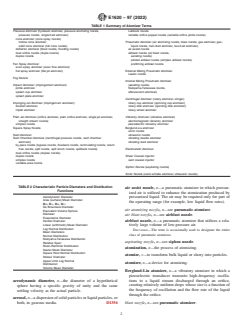
TABLE 1 Summary of Atomizer Terms
Pressure Atomizer (hydraulic atomizer, pressure atomizing nozzle, Lubbock nozzle
pressure nozzle, single-fluid atomizer) variable orifice poppet nozzle (variable orifice pintle nozzle)
cone atomizer (cone spray nozzle)
hollow cone atomizer Pneumatic Atomizer (air atomizing nozzle, blast nozzle, gas atomizer, gas-
solid cone atomizer (full cone nozzle) liquid nozzle, twin-fluid atomizer, two-fluid atomizer)
deflector atomizer (flood nozzle, flooding nozzle) air assist nozzle
dual orifice nozzle (duple nozzle) airblast nozzle (air blast nozzle,
duplex nozzle aerating nozzle)
piloted airblast nozzle (simplex airblast nozzle)
Fan Spray Atomizer: prefilming airblast nozzle
even spray atomizer (even flow atomizer)
flat spray atomizer (flat jet atomizer) External Mixing Pneumatic Atomizer
Laskin nozzle
Fog Nozzle
Internal Mixing Pneumatic Atomizer
Impact Atomizer: (impingement atomizer): (aerating nozzle,
pintle atomizer Nukiyama-Tanasawa nozzle,
splash cup atomizer effervescent atomizer)
splash plate atomizer
Centrifugal Atomizer (rotary atomizer, slinger)
Impinging Jet Atomizer (impingement atomizer): rotary cup atomizer (spinning cup atomizer)
doublet atomizer rotary disk atomizer (spinning disk atomizer)
triplet atomizer rotary wheel atomizer
Plain Jet Atomizer (orifice atomizer, plain orifice atomizer, single jet atomizer, Vibratory Atomizer (vibrative atomizer)
straight stream nozzle) electromagnetic vibratory atomizer
simplex nozzle piezoelectric vibratory atomizer
Square Spray Nozzle Berglund-Liu atomizer
sonic nozzle
Swirl Atomizer ultrasonic nozzle
Swirl Chamber Atomizer (centrifugal pressure nozzle, swirl chamber vibrating needle atomizer
atomizer) vibrating reed atomizer
by-pass nozzle (bypass nozzle, flowback nozzle, recirculating nozzle, return
flow nozzle, spill nozzle, spill return nozzle, spillback nozzle) Electrostatic Atomizer
dual orifice nozzle (duplex nozzle)
duplex nozzle Shear Coaxial Injector
simplex nozzle swirl coaxial injector
variable-area nozzle
Siphon Nozzle (aspirating nozzle)
Sonic Nozzle (sonic-whistle atomizer, ultrasonic nozzle)
TABLE 2 Characteristic Particle Diameters and Distribution
air assist nozzle, n—a pneumatic atomizer in which pressur-
Functions
ized air is utilized to enhance the atomization produced by
Aerodynamic Diameter
pressurized liquid. The air may be required only for part of
Area (surface) Mean Diameter
the operating range (for example, low liquid flow rates).
D , D , D , D
Nf Lf Af Vf
De Brouckere Diameter
air atomizing nozzle, n—see pneumatic atomizer.
Equivalent Volume Sphere
Diameter
air blast nozzle, n—see airblast nozzle.
Evaporative Diameter
airblast nozzle, n—a pneumatic atomizer that utilizes a rela-
Herdan Diameter
Linear (arithmetic) Mean Diameter
tively large volume of low-pressure air.
Log Normal Distribution
DISCUSSION—The term is occasionally used to designate the entire
Mean Diameters
class of pneumatic atomizers.
Normal Distribution
Nukiyama-Tanasawa Distribution
aspirating nozzle, n—see siphon nozzle.
Relative Span
Rosin-Rammler Distribution
atomization, n—the process of atomizing.
Sauter Mean Diameter
Square Root Normal Distribution
atomize, v—to transform bulk liquid or slurry into particles.
Stokes’ Diameter
Upper Limit Log Normal
atomizer, n—a device for atomizing.
Distribution
Volume Mean Diameter
Berglund-Liu atomizer, n—a vibratory atomizer in which a
piezoelectric transducer transmits high-frequency oscilla-
tions to a liquid stream discharged through an orifice,
aerodynamic diameter, n—the diameter of a hypothetical
creating relatively uniform drops whose size is a function of
sphere having a specific gravity of unity and the same
the frequency of oscillation and the flow rate of the liquid
settling velocity as the actual particle.
through the orifice.
aerosol, n—a dispersion of solid particles or liquid particles, or
both, in gaseous media. D1356 blast nozzle, n—see pneumatic atomizer.
E1620 − 97 (2022)
DISCUSSION—For sprays whose drop size distributions are axisym-
breakup, n—liquid disintegration that occurs during atomiza-
metric in space, anAbel inversion procedure has been used to perform
tion.
3,4
the deconvolution.
breakup length, n—the distance between the liquid discharge
deflector atomizer, n—an atomizer in which a liquid jet
point of an atomizing device and the point where liquid
spreads out over a solid surface, forming a spray whose
breakup commences.
shape depends upon the solid surface.
bypass nozzle, n—see by-pass nozzle.
dispersion, n—a system of particles distributed in a solid,
by-pass nozzle, n—a swirl chamber atomizer containing by-
liquid, or gas.
pass orifice(s) or port(s) through which part of the inlet
liquid may be withdrawn from the swirl chamber and
dispersion, n—the spread of values of a frequency distribution
returned to the supply tank or pressure pump suction. The
about an average (in statistics). (Quantitative measures of
discharge flow is modulated by controlling the pressure in
dispersion include range, variance, standard deviation, mean
the bypass line, using a valve in the line.
deviation, and relative span.)
cavitation, n—the formation of vapor-filled cavities in the
doublet injector, n—an impinging jet atomizer in which there
interiororonthesolidboundariesofliquidsinmotionwhere
are two colliding liquid jets.
thepressureisreducedtoacriticalvaluewithoutachangein
drop, n—a single liquid particle having a generally spheroidal
ambient temperature.
shape.
centrifugal atomizer, n—a device wherein a rotating solid
droplet, n—see drop; also a small drop.
surface is the primary source of energy utilized to produce a
dual orifice nozzle, n—a swirl chamber atomizer containing a
spray.
primaryinjectorandaconcentricannularsecondaryinjector,
DISCUSSION—Alternatively, an atomizer that rotates to distribute the
liquid. each injector comprising a separate orifice and set of
tangential slots. The nozzle is normally operated only with
centrifugal pressure nozzle, n—see swirl chamber atomizer.
the primary injector at low flow rates, with secondary liquid
circumferential patternation, n—measurements taken in a
introduced at a specified pressure. (This definition applies to
circumferential direction, showing the variation in liquid
devices used in the gas turbine industry.)
flux about the nozzle axis.
duple nozzle, n—see dual orifice nozzle.
cloud, n—any collection of particulate matter in the atmo-
duplex nozzle, n—a swirl chamber atomizer comprising a
sphere dense enough to be perceptible to the eye, especially
single discharge orifice and two sets of tangential slots, each
a collection of water drops. D1356
with a separately controlled liquid supply. The smaller
coalescence, n—the merging of two or more liquid particles to
(primary) slots supply liquid at low flow rates, and both sets
form a single liquid particle.
(primary and secondary) are utilized as flow increases.
concentration, n—see number density.
effervescent atomizer, n—an internal mixing pneumatic atom-
cone atomizer, n—an atomizer that produces a conical spray
izer in which gas bubbles are dispersed in the liquid stream.
pattern.
electromagnetic vibratory atomizer, n—a vibratory atomizer
cone pattern, n—a diverging spray pattern that is nominally
in which an electromagnetic transducer transmits high-
symmetric about the nozzle axis and whose apex is located
frequency oscillations to the liquid.
at or near the nozzle discharge orifice.
electrostatic atomizer, n—a device wherein an electric charge
cone spray nozzle, n—see cone atomizer.
is the primary source of energy utilized to produce a spray.
convolution, n—the combination of local measurements of
emitting spray angle, n—see initial spray angle.
drop size distribution and number density into equivalent
line-of-sight values of drop size distribution and optical
equivalent volume sphere diameter, n—the diameter of a
extinction.
hypothetical sphere having the same volume as the actual
particle.
D ,D ,D ,D , n—diameters such that the cumulative
Nf Lf Af Vf
number of particles, (N), length of diameter, (L), surface
even flow atomizer, n—see even spray atomizer.
area, (A), or volume, (V), from zero diameter to these
even spray atomizer, n—a fan spray atomizer that produces a
respective diameters is the fraction, (f), of the corresponding
relatively uniform band of liquid, usually by means of
sum for the total distribution.
Example—D is the volume median diameter; that is,
V0.5
50 % of the total volume of liquid is in drops of smaller
Hammond, D.C., “A Deconvolution Technique for Line-Of-Sight Optical
diameter and 50 % is in drops of larger diameter.
Scattering Measurements in Axisymmetric Sprays,” Applied Optics, Vol 20, No. 3,
February 1981, pp. 493–499.
deconvolution, n—a procedure by which line-of-sight mea-
Yule, A.J., Ah Seng, C., Felton, P.G., Ungut, A., and Chigier, N.A., “A Laser
surements of drop size distribution and optical extinction are
Tomographic Investigation of Liquid Fuel Sprays,” Eighteenth Symposium-
converted into local representations of the distribution and
International-on Combustion, Pittsburgh: The Combustion Institute, 1981, pp.
number density. 1501–1510.
E1620 − 97 (2022)
injection, through an elliptical orifice. (This definition ap- impingement atomizer, n—in rocketry, an impinging jet
plies to devices utilized in the agricultural industry.) atomizer; in industrial processing, an impact atomizer.
DISCUSSION—Sincethistermisambiguous,itisnotrecommendedfor
external mixing pneumatic atomizer, n—a pneumatic atom-
describing either device.
izer in which pressurized gas is directed on a liquid film or
impinging jet atomizer, n—a pressure atomizer in which
jet outside the nozzle, so as to form a spray.
atomization is achieved by the external collision of two or
fan pattern, n—a spray pattern in which the liquid flux is
more liquid jets.
concentrated in a narrow oval or ellipse in a plane perpen-
initial spray angle, n—the plane angle of the spray emerging
dicular to the spray axis.
from the nozzle discharge orifice.
fan spray atomizer, n—apressureatomizerthatproducesaflat
internal mixing pneumatic atomizer, n—a pneumatic atom-
sheet of liquid that collapses into particles. The angle or
izer in which gas and liquid are introduced and mixed within
width of the sheet is controlled by the shape of a slot or oval
the nozzle, and are then discharged as a two-phase disper-
discharge orifice, by an external deflector, or by impinging
sion through a common orifice.
jets.
laser diffraction, n—in particle measurement, the creation of a
flat jet atomizer, n—see flat spray atomizer.
spatial pattern of light produced by the impingement of a
flat spray atomizer, n—a fan spray atomizer that produces a
laser beam on one or more dispersed particles, wherein the
planar spray pattern.
particle size distribution may be inferred from the nature of
DISCUSSION—In agricultural applications, the spray patterns have
the pattern.
tapered edges.
flood nozzle, n—see deflector atomizer. Laskin nozzle, n—a type of portable air-operated aerosol
flooding nozzle, n—see deflector atomizer. generator capable of producing droplets in the size range
flowback nozzle, n—see by-pass nozzle. from 1 to 2 µm.
flux, n—the number of particles flowing through a given area
local, n—indicates measurements or observations of a small
per unit time.
part of a larger region of interest.
flux-sensitive, n—a sampling process where the magnitude
log normal distribution, n—drop size distributi
...