

ASTM D662-93(2019)
(Test Method)Standard Test Method for Evaluating Degree of Erosion of Exterior Paints
General Information
- Abstract
SIGNIFICANCE AND USE
4.1 Erosion failure of paint films can occur in use. This test method provides a mean of evaluating the degree of failure by comparing to pictorial standards.
SCOPE
1.1 This test method covers the evaluation of the degree of erosion of exterior paints by comparison with photographic standards.
1.2 This international standard was developed in accordance with internationally recognized principles on standardization established in the Decision on Principles for the Development of International Standards, Guides and Recommendations issued by the World Trade Organization Technical Barriers to Trade (TBT) Committee.
- Status
- Published
- Publication Date
- 30-Sep-2019
- Technical Committee
- D01 - Paint and Related Coatings, Materials, and Applications
- Drafting Committee
- D01.25 - Evaluation of Weathering Effects


Overview
ASTM D662-93(2019) - Standard Test Method for Evaluating Degree of Erosion of Exterior Paints offers a practical approach to assessing the degree of erosion in exterior paint films. Developed by ASTM International, this test method enables the evaluation of paint erosion by direct comparison with standardized photographic references. This process is widely recognized and utilized to ensure quality and durability in architectural coatings, industrial maintenance paints, and related applications. The standard is aligned with international principles on standardization and is referenced for regulatory compliance and quality assurance worldwide.
Key Topics
Erosion Definition: Erosion is defined as the wearing away of a paint film, leading to exposure of the substrate or undercoat. The degree of erosion is evaluated based on the visible amount of substrate or undercoat.
Pictorial Standard Comparison: Evaluation is performed by comparing test surfaces with photographic standards found in the Pictorial Standards of Coating Defects Handbook. These images serve as a primary reference for assessing deterioration levels.
Assessment Procedure:
- Use several surface locations for comparison when testing large areas.
- Pay attention not to confuse erosion with other types of surface failures.
- Ratings are made by averaging observed degrees of erosion.
Precautions:
- Distinguish erosion from other defects, which may be present simultaneously.
- In doubtful cases or severe erosion, assessment may be more reliable on a damp film.
- Ensure reference standards are used as intended, as only specific photographic images represent the primary reference.
Applications
ASTM D662 is essential for industries focused on the longevity and aesthetic quality of exterior coatings. Typical applications include:
- Building and Architectural Coatings: Facilities and structure owners, maintenance teams, and contractors use this standard to monitor and document the wear and tear of exterior paints, ensuring protective functions and appearance are maintained.
- Industrial Asset Management: Oil & gas, chemical, and infrastructure projects rely on standardized methods to assess coating degradation on equipment and facilities, supporting preventive maintenance.
- Quality Control: Paint manufacturers and suppliers reference this standard during product development, production, and field testing to validate performance claims and support warranty decisions.
- Compliance and Specification: Specifiers and regulators may require ASTM D662-compliant evaluation as part of building codes, safety regulations, and maintenance programs.
Related Standards
Professionals using ASTM D662-93(2019) may also reference the following standards and resources for comprehensive coating evaluation:
- ASTM D4214 - Test Methods for Evaluating the Degree of Chalking of Exterior Paint Films: Provides procedures for assessing chalking, often linked to erosion processes in paints.
- Pictorial Standards of Coating Defects Handbook: Used for primary photographic reference during erosion assessments.
- Other paint performance standards addressing durability, weathering, and film integrity.
Practical Value
By standardizing the evaluation of exterior paint erosion, ASTM D662-93(2019) promotes consistency and reliability in paint maintenance decisions. Its clear guidance on the use of pictorial standards enhances communication among manufacturers, contractors, and building owners, helping to protect investments in coatings and infrastructure. Regular reference to this method supports proactive maintenance planning and ensures compliance with recognized industry best practices.
Relations
- Replaces
ASTM D662-93(2011) - Standard Test Method for Evaluating Degree of Erosion of Exterior Paints - Effective Date
- 01-Oct-2019
- Refers
ASTM D4214-23 - Standard Test Methods for Evaluating the Degree of Chalking of Exterior Paint Films - Effective Date
- 01-Oct-2023
- Effective Date
- 01-Jun-2015
- Refers
ASTM D4214-07 - Standard Test Methods for Evaluating the Degree of Chalking of Exterior Paint Films - Effective Date
- 01-Jul-2007
- Effective Date
- 10-Aug-1998
- Effective Date
- 01-Oct-2019
- Referred By
ASTM D6763-16(2022) - Standard Guide for Testing Exterior Wood Stains and Clear Water Repellents - Effective Date
- 01-Oct-2019
- Effective Date
- 01-Oct-2019
- Effective Date
- 01-Oct-2019
- Effective Date
- 01-Oct-2019
- Effective Date
- 01-Oct-2019
- Effective Date
- 01-Oct-2019
- Effective Date
- 01-Oct-2019
- Effective Date
- 01-Oct-2019
- Effective Date
- 01-Oct-2019
Frequently Asked Questions
ASTM D662-93(2019) is a standard published by ASTM International. Its full title is "Standard Test Method for Evaluating Degree of Erosion of Exterior Paints". This standard covers: SIGNIFICANCE AND USE 4.1 Erosion failure of paint films can occur in use. This test method provides a mean of evaluating the degree of failure by comparing to pictorial standards. SCOPE 1.1 This test method covers the evaluation of the degree of erosion of exterior paints by comparison with photographic standards. 1.2 This international standard was developed in accordance with internationally recognized principles on standardization established in the Decision on Principles for the Development of International Standards, Guides and Recommendations issued by the World Trade Organization Technical Barriers to Trade (TBT) Committee.
SIGNIFICANCE AND USE 4.1 Erosion failure of paint films can occur in use. This test method provides a mean of evaluating the degree of failure by comparing to pictorial standards. SCOPE 1.1 This test method covers the evaluation of the degree of erosion of exterior paints by comparison with photographic standards. 1.2 This international standard was developed in accordance with internationally recognized principles on standardization established in the Decision on Principles for the Development of International Standards, Guides and Recommendations issued by the World Trade Organization Technical Barriers to Trade (TBT) Committee.
ASTM D662-93(2019) is classified under the following ICS (International Classification for Standards) categories: 87.040 - Paints and varnishes. The ICS classification helps identify the subject area and facilitates finding related standards.
ASTM D662-93(2019) has the following relationships with other standards: It is inter standard links to ASTM D662-93(2011), ASTM D4214-23, ASTM D4214-07(2015), ASTM D4214-07, ASTM D4214-98, ASTM D5146-10(2019), ASTM D6763-16(2022), ASTM D6577-15(2019), ASTM D5722-20, ASTM D3451-06(2017), ASTM D4587-23, ASTM D7254-21, ASTM D333-01(2021), ASTM D7856-21, ASTM D1014-18. Understanding these relationships helps ensure you are using the most current and applicable version of the standard.
ASTM D662-93(2019) is available in PDF format for immediate download after purchase. The document can be added to your cart and obtained through the secure checkout process. Digital delivery ensures instant access to the complete standard document.
Standards Content (Sample)
This international standard was developed in accordance with internationally recognized principles on standardization established in the Decision on Principles for the
Development of International Standards, Guides and Recommendations issued by the World Trade Organization Technical Barriers to Trade (TBT) Committee.
Designation: D662 − 93 (Reapproved 2019)
Standard Test Method for
Evaluating Degree of Erosion of Exterior Paints
This standard is issued under the fixed designation D662; the number immediately following the designation indicates the year of
original adoption or, in the case of revision, the year of last revision. A number in parentheses indicates the year of last reapproval. A
superscript epsilon (´) indicates an editorial change since the last revision or reapproval.
This standard has been approved for use by agencies of the U.S. Department of Defense.
1. Scope 4. Significance and Use
1.1 This test method covers the evaluation of the degree of
4.1 Erosion failure of paint films can occur in use. This test
erosion of exterior paints by comparison with photographic method provides a mean of evaluating the degree of failure by
standards.
comparing to pictorial standards.
1.2 This international standard was developed in accor-
5. Types of Erosion
dance with internationally recognized principles on standard-
ization established in the Decision on Principles for the
5.1 Only one type of erosion is recognized, as defined in
Development of International Standards, Guides and Recom-
Section 3.
mendations issued by the World Trade Organization Technical
Barriers to Trade (TBT) Committee.
6. Use of Photographic Reference Standards
6.1 The photographic reference standards that are part of
2. Referenced Documents
this test method and are provided in the Pictorial Standards of
2.1 ASTM Standards:
Coating Defects Handbook are representative of the degree of
D4214 Test Methods for Evaluating the Degree of Chalking
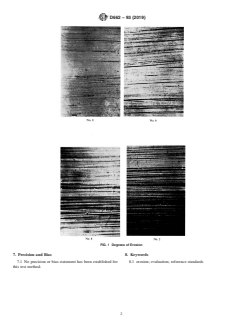
erosion of exterior paint films. Fig. 1 is for illustration purposes
of Exterior Paint Films
only and should not be used for evaluation.
2.2 Other Standards:
6.2 The use of the photographic reference standards illus-
Pictorial Standards of Coating Defects Handbook
trated in Fig. 1 requires the following precautions:
6.2.1 Care must be taken not to confuse various types of
3. Terminology
failure that may be present on the same surface.
3.1 Definitions of Terms Specific to This Standard:
6.2.2 It must be realized that the degree of failure will vary
3.1.1 erosion,n—thatphenomenonmanifestedinpaintfilms
over any given area. Therefore, an average portion of the film
by the wearing away of the finish to expose the substrate or
should be used for comparison. On larger surfaces it is
undercoat.
recommended that ratings be made at several locations and the
3.1.1.1 Discussion—The degree of failure is dependent on
mean and range reported.
the amount of substrate or undercoat visible. Erosion occurs as
6.2.3 The photographic standards used represent various
the result of chalking. (See Test Methods D4214 for evaluation
degrees of erosion of a white brushing type paint over a dark
of chalking.)
primer. This system was necessary to provide sufficient con-
trast for photographic purposes. The erosion of a film to its
normal substrate is, however, readily visible to the naked eye
This test method is under the jurisdiction of ASTM Committee D01 on Paint
so it may easily be compared to the standards and given a
and Related Coatings, Materials, andApplic
...