

ASTM F2925-11(2018)
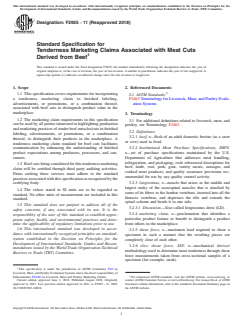
(Specification)Standard Specification for Tenderness Marketing Claims Associated with Meat Cuts Derived from Beef
General Information
- Abstract
ABSTRACT
This specification covers requirements for incorporating a tenderness marketing claim to finished labelling, advertisements, or promotions, or a combination thereof, associated with beef cuts to distinguish product value in the marketplace. The claim requirements are the certified tender and certified very tender. This specification also notes that the beef cuts that are being considered for the tenderness marketing claim will be certified through third party auditing activities.
SCOPE
1.1 This specification covers requirements for incorporating a tenderness marketing claim to finished labeling, advertisements, or promotions, or a combination thereof, associated with beef cuts to distinguish product value in the marketplace.
1.2 The marketing claim requirements in this specification can be used by all parties interested in highlighting production and marketing practices of tender beef muscles/cuts in finished labeling, advertisements, or promotions, or a combination thereof, to distinguish their products in the marketplace. A tenderness marketing claim standard for beef cuts facilitates communication by enhancing the understanding of finished product expectations among producers, processors, and consumers.
1.3 Beef cuts being considered for this tenderness marketing claim will be certified through third party auditing activities. Firms seeking these services must adhere to the standard practices associated with this specification as recognized by the certifying body.
1.4 The values stated in SI units are to be regarded as standard. No other units of measurement are included in this standard.
1.5 This standard does not purport to address all of the safety concerns, if any, associated with its use. It is the responsibility of the user of this standard to establish appropriate safety, health, and environmental practices and determine the applicability of regulatory limitations prior to use.
1.6 This international standard was developed in accordance with internationally recognized principles on standardization established in the Decision on Principles for the Development of International Standards, Guides and Recommendations issued by the World Trade Organization Technical Barriers to Trade (TBT) Committee.
- Status
- Published
- Publication Date
- 31-May-2018
- Technical Committee
- F10 - Livestock, Meat, and Poultry Evaluation Systems
- Drafting Committee
- F10.60 - Livestock, Meat and Poultry Marketing Claims


Overview
ASTM F2925-11(2018), developed by ASTM International, is a standard specification that sets forth requirements for making tenderness marketing claims on labels, advertisements, or promotions for beef meat cuts. This specification provides a framework for applying terms like "certified tender" or "certified very tender" to beef products in the marketplace. By establishing clear criteria and certification requirements, the standard enhances consumer trust and helps producers and processors effectively communicate product value through validated claims related to beef tenderness.
Key Topics
- Tenderness Marketing Claims: The standard specifically governs the use of marketing terms such as "certified tender" or "certified very tender" associated with beef cuts.
- Certification Process: Only beef cuts that are independently certified by third-party auditing can bear tenderness claims. Firms must follow recognized practices that meet the criteria outlined in this standard.
- Tenderness Measurement: The specification outlines instrumental methods for measuring tenderness, primarily using Warner-Bratzler Shear Force (WBSF) and Slice Shear Force (SSF) devices, with established minimum tenderness threshold values (MTTV).
- Qualifying Beef Cuts: Only inherently tender beef muscles/cuts, which have not undergone mechanical or chemical tenderization (except permitted natural processes such as aging or carcass suspension), qualify.
- Product Marking: Use of these marketing claims must be properly referenced to this standard, and is subject to approval by appropriate regulatory authorities.
Applications
- Meat Product Labeling: Food companies, processors, and retailers can use this standard to substantiate and promote beef tenderness claims on packaging and in advertising. This builds consumer trust and allows products to stand out in competitive markets.
- Supply Chain Communication: By defining tenderness expectations, the standard enables clearer communication among beef producers, processors, distributors, and food service providers regarding product quality.
- Regulatory Compliance: The standard assists firms in meeting food labeling regulations by providing recognized, auditable criteria for tenderness claims, thereby reducing risk of misleading or unsubstantiated claims.
- Quality Assurance Programs: Processors and auditors may use the requirements outlined in this standard as part of broader meat quality certification schemes.
Related Standards
- ASTM F2463 - Terminology for Livestock, Meat, and Poultry Evaluation Systems: Provides terminology critical for understanding and implementing F2925-11(2018).
- American Meat Science Association Guidelines: Frequently referenced in instrumentation and validation of meat tenderness measurements.
- Institutional Meat Purchase Specifications (IMPS): Maintained by the U.S. Department of Agriculture, referenced for cut identification and handling.
- World Trade Organization (WTO) TBT Principles: Emphasizes that this international standard aligns with global best practices, promoting consistency in international trade and food labeling.
Keywords: beef tenderness, certified tender, marketing claims, beef cuts, auditing, product labeling, Warner-Bratzler shear force, slice shear force, ASTM F2925-11(2018), beef quality standards.
Relations
- Effective Date
- 01-Jun-2018
- Effective Date
- 15-Nov-2012
- Effective Date
- 15-Nov-2012
- Effective Date
- 01-Sep-2012
- Effective Date
- 01-Aug-2012
- Effective Date
- 01-Mar-2006
- Effective Date
- 01-Dec-2005
- Effective Date
- 01-May-2005
- Referred By
ASTM F2463-15(2021) - Standard Terminology for Livestock, Meat, and Poultry Evaluation Systems - Effective Date
- 01-Jun-2018
Get Certified
Connect with accredited certification bodies for this standard

BSI Group
BSI (British Standards Institution) is the business standards company that helps organizations make excellence a habit.

Bureau Veritas
Bureau Veritas is a world leader in laboratory testing, inspection and certification services.

DNV
DNV is an independent assurance and risk management provider.
Sponsored listings
Frequently Asked Questions
ASTM F2925-11(2018) is a technical specification published by ASTM International. Its full title is "Standard Specification for Tenderness Marketing Claims Associated with Meat Cuts Derived from Beef". This standard covers: ABSTRACT This specification covers requirements for incorporating a tenderness marketing claim to finished labelling, advertisements, or promotions, or a combination thereof, associated with beef cuts to distinguish product value in the marketplace. The claim requirements are the certified tender and certified very tender. This specification also notes that the beef cuts that are being considered for the tenderness marketing claim will be certified through third party auditing activities. SCOPE 1.1 This specification covers requirements for incorporating a tenderness marketing claim to finished labeling, advertisements, or promotions, or a combination thereof, associated with beef cuts to distinguish product value in the marketplace. 1.2 The marketing claim requirements in this specification can be used by all parties interested in highlighting production and marketing practices of tender beef muscles/cuts in finished labeling, advertisements, or promotions, or a combination thereof, to distinguish their products in the marketplace. A tenderness marketing claim standard for beef cuts facilitates communication by enhancing the understanding of finished product expectations among producers, processors, and consumers. 1.3 Beef cuts being considered for this tenderness marketing claim will be certified through third party auditing activities. Firms seeking these services must adhere to the standard practices associated with this specification as recognized by the certifying body. 1.4 The values stated in SI units are to be regarded as standard. No other units of measurement are included in this standard. 1.5 This standard does not purport to address all of the safety concerns, if any, associated with its use. It is the responsibility of the user of this standard to establish appropriate safety, health, and environmental practices and determine the applicability of regulatory limitations prior to use. 1.6 This international standard was developed in accordance with internationally recognized principles on standardization established in the Decision on Principles for the Development of International Standards, Guides and Recommendations issued by the World Trade Organization Technical Barriers to Trade (TBT) Committee.
ABSTRACT This specification covers requirements for incorporating a tenderness marketing claim to finished labelling, advertisements, or promotions, or a combination thereof, associated with beef cuts to distinguish product value in the marketplace. The claim requirements are the certified tender and certified very tender. This specification also notes that the beef cuts that are being considered for the tenderness marketing claim will be certified through third party auditing activities. SCOPE 1.1 This specification covers requirements for incorporating a tenderness marketing claim to finished labeling, advertisements, or promotions, or a combination thereof, associated with beef cuts to distinguish product value in the marketplace. 1.2 The marketing claim requirements in this specification can be used by all parties interested in highlighting production and marketing practices of tender beef muscles/cuts in finished labeling, advertisements, or promotions, or a combination thereof, to distinguish their products in the marketplace. A tenderness marketing claim standard for beef cuts facilitates communication by enhancing the understanding of finished product expectations among producers, processors, and consumers. 1.3 Beef cuts being considered for this tenderness marketing claim will be certified through third party auditing activities. Firms seeking these services must adhere to the standard practices associated with this specification as recognized by the certifying body. 1.4 The values stated in SI units are to be regarded as standard. No other units of measurement are included in this standard. 1.5 This standard does not purport to address all of the safety concerns, if any, associated with its use. It is the responsibility of the user of this standard to establish appropriate safety, health, and environmental practices and determine the applicability of regulatory limitations prior to use. 1.6 This international standard was developed in accordance with internationally recognized principles on standardization established in the Decision on Principles for the Development of International Standards, Guides and Recommendations issued by the World Trade Organization Technical Barriers to Trade (TBT) Committee.
ASTM F2925-11(2018) is classified under the following ICS (International Classification for Standards) categories: 67.120.10 - Meat and meat products. The ICS classification helps identify the subject area and facilitates finding related standards.
ASTM F2925-11(2018) has the following relationships with other standards: It is inter standard links to ASTM F2925-11, ASTM F2463-12b, ASTM F2463-12be1, ASTM F2463-12a, ASTM F2463-12, ASTM F2463-06, ASTM F2463-05a, ASTM F2463-05, ASTM F2463-15(2021). Understanding these relationships helps ensure you are using the most current and applicable version of the standard.
ASTM F2925-11(2018) is available in PDF format for immediate download after purchase. The document can be added to your cart and obtained through the secure checkout process. Digital delivery ensures instant access to the complete standard document.
Standards Content (Sample)
This international standard was developed in accordance with internationally recognized principles on standardization established in the Decision on Principles for the
Development of International Standards, Guides and Recommendations issued by the World Trade Organization Technical Barriers to Trade (TBT) Committee.
Designation:F2925 −11 (Reapproved 2018)
Standard Specification for
Tenderness Marketing Claims Associated with Meat Cuts
Derived from Beef
This standard is issued under the fixed designation F2925; the number immediately following the designation indicates the year of
original adoption or, in the case of revision, the year of last revision. A number in parentheses indicates the year of last reapproval. A
superscript epsilon (´) indicates an editorial change since the last revision or reapproval.
1. Scope 2. Referenced Documents
1.1 This specification covers requirements for incorporating
2.1 ASTM Standards:
a tenderness marketing claim to finished labeling,
F2463 Terminology for Livestock, Meat, and Poultry Evalu-
advertisements, or promotions, or a combination thereof,
ation Systems
associated with beef cuts to distinguish product value in the
marketplace.
3. Terminology
1.2 The marketing claim requirements in this specification
3.1 For additional definitions related to livestock, meat, and
can be used by all parties interested in highlighting production
poultry, see Terminology F2463.
and marketing practices of tender beef muscles/cuts in finished
3.2 Definitions:
labeling, advertisements, or promotions, or a combination
3.2.1 beef, n—flesh of an adult domestic bovine (as a steer
thereof, to distinguish their products in the marketplace. A
or cow) used as food.
tenderness marketing claim standard for beef cuts facilitates
communication by enhancing the understanding of finished 3.2.2 Institutional Meat Purchase Specifications, IMPS,
product expectations among producers, processors, and con- n—set of purchase specifications maintained by the U.S.
sumers. Department of Agriculture that addresses meat handling,
refrigeration, and packaging; code referenced descriptions for
1.3 Beefcutsbeingconsideredforthistendernessmarketing
beef, lamb, veal, pork, goat, variety meats, sausages, and
claim will be certified through third party auditing activities.
cooked meat products; and quality assurance provisions rec-
Firms seeking these services must adhere to the standard
ommended for use by any quality control activity.
practicesassociatedwiththisspecificationasrecognizedbythe
certifying body. 3.2.3 longissimus, n—muscle that arises as the middle and
largest entity of the sacrospinal muscles that is attached by
1.4 The values stated in SI units are to be regarded as
some of its fibers to the lumbar vertebrae, inserted into all the
standard. No other units of measurement are included in this
thoracic vertebrae, and depresses the ribs and extends the
standard.
spinal column and bends it to one side.
1.5 This standard does not purport to address all of the
3.2.3.1 Discussion—Also called longissimus dorsi (LD).
safety concerns, if any, associated with its use. It is the
3.2.4 marketing claim, n—proclamation that identifies a
responsibility of the user of this standard to establish appro-
particular product feature or benefit to distinguish a product
priate safety, health, and environmental practices and deter-
from others in the marketplace.
mine the applicability of regulatory limitations prior to use.
1.6 This international standard was developed in accor-
3.2.5 shear force, n—maximum load required to shear a
dance with internationally recognized principles on standard-
specimen in such a manner that the resulting pieces are
ization established in the Decision on Principles for the
completely clear of each other.
Development of International Standards, Guides and Recom-
3.2.6 slice shear force, SSF, n—mechanical device/
mendations issued by the World Trade Organization Technical
methodology used to determine meat tenderness through shear
Barriers to Trade (TBT) Committee.
force measurements taken from cross-sectional samples of a
specimen (for example, steak).
This specification is under the jurisdiction of ASTM Committee F10 on
Livestock, Meat, and Poultry Evaluation Systems and is the direct responsibility of
Subcommittee F10.60 on Livestock, Meat and Poultry Marketing Claims. For referenced ASTM standards, visit the ASTM website, www.astm.org, or
Current edition approved June 1, 2018. Published August 2018. Originally contact ASTM Customer Service at service@astm.org. For Annual Book of ASTM
approved in 2011. Last previous edition approved in 2011 as F2925 – 11. DOI: Standards volume information, refer to the standard’s Document Summary page on
10.1520/F2925-11R18. the ASTM website.
Copyright © ASTM International, 100 Barr Harbor Drive, PO Box C700, West Conshohocken, PA 19428-2959. United States
F2925−11 (2018)
3.2.7 tenderness,n—degreeofyieldingtexturepossessedby 4.1.2.2 Examples:
a specimen (for example, steak); ease of which a specimen (for (1) IMPS Item No. 191A—Beef loin, tenderloin, butt,
example, steak) is torn, cut, or sheared. defatted.
(2) IMPS Item No. 1185B—Beef loin, bottom sirloin butt,
3.2.8 Warner-Bratzler shear force, WBSF, n—mechanical
ball tip steak.
device/methodology used to determine meat tenderness
4.1.3 Inherently Tender—Only inherently tender meat prod-
through shear force measurements taken from core samples of
ucts shall qualify. Inherently tender meat is that which has not
a specimen (for example, steak).
been subjected to further processes not typically used during
4. Claim Considerations
the conversion of muscle to meat. Examples of these are
enhancement through marination (injection and tumbling),
4.1 Minimum Tenderness Threshold Value (MTTV)—A
mechanical tenderization (blade or needle), and chemical
MTTV for WBSF
...