

ASTM C505-19
(Specification)Standard Specification for Nonreinforced Concrete Irrigation Pipe with Rubber Gasket Joints
General Information
- Abstract
ABSTRACT
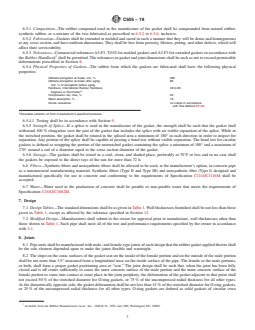
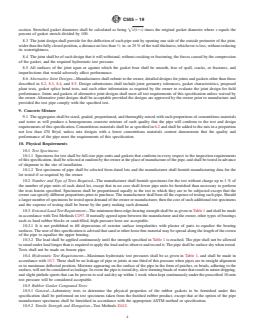
This specification covers reinforced concrete pipe with rubber gasket joints to be used for the conveyance of irrigation water with working pressures, including hydraulic transients. The acceptability of the pipe, joint design, and gaskets shall be determined by the results of the tests prescribed in this specification, if and when required, and by inspection to determine whether the pipe and gaskets conform to the specification as to design and freedom from defects. Pipe manufactured in accordance with this specification shall consist of concrete, cement, fly ash, ground granulated blast furnace slag, allowable combinations of cementitious materials, a combination of Portland cement, admixtures and blends, and aggregates. The rubber compound used in the manufacture of the gasket shall be compounded from natural rubber, synthetic rubber, or a mixture of the two fabricated as prescribed in the specification. The rubber from which the gaskets are fabricated shall have the following physical properties: ultimate elongation at break; ultimate elongation at break after aging; hardness; compression set; water absorption; and ozone resistance. If a splice is used in the manufacture of the gasket, the strength shall be such that the gasket shall withstand elongation over the part of the gasket that includes the splice with no visible separation of the splice. Test specimens shall have the following test requirements: number and type of tests; external load test requirement; and hydrostatic test requirement. Rubber gasket compound tests shall include the following: tensile strength; elongation; aging; hardness; compression set; water absorption; and ozone resistance.
SCOPE
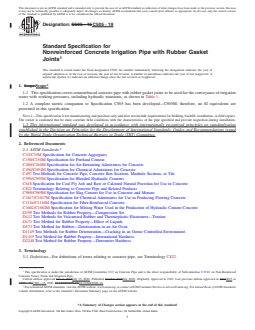
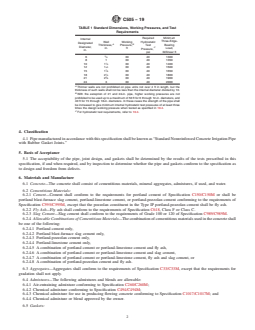
1.1 This specification covers nonreinforced concrete pipe with rubber gasket joints to be used for the conveyance of irrigation water with working pressures, including hydraulic transients, as shown in Table 1.
1.2 A complete metric companion to Specification C505 has been developed—C505M; therefore, no SI equivalents are presented in this specification.
Note 1: This specification is for manufacturing and purchase only and does not include requirements for bedding, backfill, installation, or field repairs. The owner is cautioned that he must correlate field conditions with the characteristics of the pipe specified and provide inspection during installation.
1.3 This international standard was developed in accordance with internationally recognized principles on standardization established in the Decision on Principles for the Development of International Standards, Guides and Recommendations issued by the World Trade Organization Technical Barriers to Trade (TBT) Committee.
- Status
- Published
- Publication Date
- 14-Jul-2019
- Technical Committee
- C13 - Concrete Pipe
- Drafting Committee
- C13.01 - Non-Reinforced Concrete Sewer, Drain and Irrigation Pipe
Buy Documents
ASTM C505-19 - Standard Specification for Nonreinforced Concrete Irrigation Pipe with Rubber Gasket Joints
REDLINE ASTM C505-19 - Standard Specification for Nonreinforced Concrete Irrigation Pipe with Rubber Gasket Joints
Overview
ASTM C505-19 is the standard specification developed by ASTM International for nonreinforced concrete irrigation pipe with rubber gasket joints. This specification details the requirements for manufacturing, material composition, and performance of concrete pipes intended for the conveyance of irrigation water under working pressures, including hydraulic transients. The standard ensures that both the pipe and its rubber gasket joints achieve reliable, watertight performance, supporting long-term durability for irrigation systems. This standard is intended for procurement and quality assurance of products, not for installation, bedding, or field repair.
Key Topics
Scope and Applicability
- Covers nonreinforced concrete pipe with rubber gasket joints for irrigation water conveyance.
- Applicable to systems requiring certain working pressures and performance criteria.
- Focuses on factory manufacturing and purchase standards.
Material Requirements
- Concrete must be made from approved cementitious materials such as Portland cement, blended hydraulic cements, fly ash, and slag cement.
- Aggregates comply with ASTM C33/C33M.
- Admixtures and water used must meet the relevant ASTM standards.
- Rubber gaskets are to be made from natural or synthetic rubber, or their combinations, with specific physical property requirements.
Design and Performance Tests
- Minimum wall thicknesses, working pressures, and hydrostatic test requirements specified in Table 1 of the standard.
- Pipe joints must be male-female designs relying solely on the rubber gasket for watertightness and flexibility.
- Testing includes external load (three-edge bearing), hydrostatic pressure, and specific properties of the rubber gaskets (tensile strength, elongation, aging resistance, hardness, compression set, water absorption, and ozone resistance).
Quality Assurance and Acceptance
- Pipe and gasket acceptance through visual inspections and prescribed tests.
- Defective or non-conforming pipes or gaskets are subject to rejection.
- Marking requirements for traceability, including manufacturer, date, and class.
Applications
ASTM C505-19 pipes are widely used in agricultural and landscaping irrigation systems where nonreinforced concrete pipes are preferred. The specification ensures:
Efficient Water Conveyance
- Reliable transport of irrigation water under controlled working pressure.
- Watertight joints minimize water loss and soil erosion.
Long-Term Durability
- Resistance to hydraulic pressures and environmental degradation.
- High-quality gaskets prevent leaks and withstand aging, ozone, and water exposure.
Adaptability
- Customizable pipe joint solutions, subject to owner approval, for unique system requirements.
- Suitable for installations requiring varying pipe diameters and wall thicknesses.
Related Standards
When considering nonreinforced concrete irrigation pipe with rubber gasket joints, the following ASTM standards are also relevant:
- ASTM C33/C33M: Specification for Concrete Aggregates
- ASTM C150/C150M: Specification for Portland Cement
- ASTM C595/C595M: Specification for Blended Hydraulic Cements
- ASTM C618: Specification for Coal Fly Ash and Raw or Calcined Natural Pozzolan for Use in Concrete
- ASTM C494/C494M: Specification for Chemical Admixtures for Concrete
- ASTM C497: Test Methods for Concrete Pipe, Concrete Box Sections, Manhole Sections, or Tile
- ASTM D412, D1149, D2240: Test Methods for Rubber Properties
Consult the latest version of these standards, as well as C505M for metric requirements, to ensure comprehensive compliance in project specifications and procurement.
Keywords: nonreinforced concrete pipe, rubber gasket joints, ASTM C505-19, irrigation pipe, hydrostatic pressure, concrete pipe standards, watertight joints, agricultural water conveyance, quality assurance, ASTM standards.
Relations
- Effective Date
- 15-Jul-2019
- Effective Date
- 01-Feb-2024
- Effective Date
- 01-Oct-2019
- Effective Date
- 01-Apr-2019
- Effective Date
- 01-Jan-2019
- Effective Date
- 01-Jun-2018
- Effective Date
- 01-May-2018
- Effective Date
- 01-Jan-2018
- Effective Date
- 01-Jan-2018
- Effective Date
- 01-Oct-2017
- Effective Date
- 01-Oct-2017
- Effective Date
- 01-Apr-2017
- Effective Date
- 01-Apr-2017
- Effective Date
- 15-Dec-2016
- Effective Date
- 01-Sep-2016
Buy Documents
ASTM C505-19 - Standard Specification for Nonreinforced Concrete Irrigation Pipe with Rubber Gasket Joints
REDLINE ASTM C505-19 - Standard Specification for Nonreinforced Concrete Irrigation Pipe with Rubber Gasket Joints
Get Certified
Connect with accredited certification bodies for this standard

Institut za varilstvo d.o.o. (Welding Institute)
Slovenia's leading welding institute since 1952. ISO 3834, EN 1090, pressure equipment certification, NDT personnel, welder qualification. Only IIW Au
Sponsored listings
Frequently Asked Questions
ASTM C505-19 is a technical specification published by ASTM International. Its full title is "Standard Specification for Nonreinforced Concrete Irrigation Pipe with Rubber Gasket Joints". This standard covers: ABSTRACT This specification covers reinforced concrete pipe with rubber gasket joints to be used for the conveyance of irrigation water with working pressures, including hydraulic transients. The acceptability of the pipe, joint design, and gaskets shall be determined by the results of the tests prescribed in this specification, if and when required, and by inspection to determine whether the pipe and gaskets conform to the specification as to design and freedom from defects. Pipe manufactured in accordance with this specification shall consist of concrete, cement, fly ash, ground granulated blast furnace slag, allowable combinations of cementitious materials, a combination of Portland cement, admixtures and blends, and aggregates. The rubber compound used in the manufacture of the gasket shall be compounded from natural rubber, synthetic rubber, or a mixture of the two fabricated as prescribed in the specification. The rubber from which the gaskets are fabricated shall have the following physical properties: ultimate elongation at break; ultimate elongation at break after aging; hardness; compression set; water absorption; and ozone resistance. If a splice is used in the manufacture of the gasket, the strength shall be such that the gasket shall withstand elongation over the part of the gasket that includes the splice with no visible separation of the splice. Test specimens shall have the following test requirements: number and type of tests; external load test requirement; and hydrostatic test requirement. Rubber gasket compound tests shall include the following: tensile strength; elongation; aging; hardness; compression set; water absorption; and ozone resistance. SCOPE 1.1 This specification covers nonreinforced concrete pipe with rubber gasket joints to be used for the conveyance of irrigation water with working pressures, including hydraulic transients, as shown in Table 1. 1.2 A complete metric companion to Specification C505 has been developed—C505M; therefore, no SI equivalents are presented in this specification. Note 1: This specification is for manufacturing and purchase only and does not include requirements for bedding, backfill, installation, or field repairs. The owner is cautioned that he must correlate field conditions with the characteristics of the pipe specified and provide inspection during installation. 1.3 This international standard was developed in accordance with internationally recognized principles on standardization established in the Decision on Principles for the Development of International Standards, Guides and Recommendations issued by the World Trade Organization Technical Barriers to Trade (TBT) Committee.
ABSTRACT This specification covers reinforced concrete pipe with rubber gasket joints to be used for the conveyance of irrigation water with working pressures, including hydraulic transients. The acceptability of the pipe, joint design, and gaskets shall be determined by the results of the tests prescribed in this specification, if and when required, and by inspection to determine whether the pipe and gaskets conform to the specification as to design and freedom from defects. Pipe manufactured in accordance with this specification shall consist of concrete, cement, fly ash, ground granulated blast furnace slag, allowable combinations of cementitious materials, a combination of Portland cement, admixtures and blends, and aggregates. The rubber compound used in the manufacture of the gasket shall be compounded from natural rubber, synthetic rubber, or a mixture of the two fabricated as prescribed in the specification. The rubber from which the gaskets are fabricated shall have the following physical properties: ultimate elongation at break; ultimate elongation at break after aging; hardness; compression set; water absorption; and ozone resistance. If a splice is used in the manufacture of the gasket, the strength shall be such that the gasket shall withstand elongation over the part of the gasket that includes the splice with no visible separation of the splice. Test specimens shall have the following test requirements: number and type of tests; external load test requirement; and hydrostatic test requirement. Rubber gasket compound tests shall include the following: tensile strength; elongation; aging; hardness; compression set; water absorption; and ozone resistance. SCOPE 1.1 This specification covers nonreinforced concrete pipe with rubber gasket joints to be used for the conveyance of irrigation water with working pressures, including hydraulic transients, as shown in Table 1. 1.2 A complete metric companion to Specification C505 has been developed—C505M; therefore, no SI equivalents are presented in this specification. Note 1: This specification is for manufacturing and purchase only and does not include requirements for bedding, backfill, installation, or field repairs. The owner is cautioned that he must correlate field conditions with the characteristics of the pipe specified and provide inspection during installation. 1.3 This international standard was developed in accordance with internationally recognized principles on standardization established in the Decision on Principles for the Development of International Standards, Guides and Recommendations issued by the World Trade Organization Technical Barriers to Trade (TBT) Committee.
ASTM C505-19 is classified under the following ICS (International Classification for Standards) categories: 23.040.50 - Pipes and fittings of other materials. The ICS classification helps identify the subject area and facilitates finding related standards.
ASTM C505-19 has the following relationships with other standards: It is inter standard links to ASTM C505-15, ASTM C989/C989M-24, ASTM C497-19a, ASTM C150/C150M-19, ASTM C497-19, ASTM C497-18b, ASTM C497-18a, ASTM C497-18, ASTM C822-18, ASTM C618-17, ASTM C989/C989M-17, ASTM C497-17, ASTM C595/C595M-17, ASTM C989/C989M-16e1, ASTM C497-16a. Understanding these relationships helps ensure you are using the most current and applicable version of the standard.
ASTM C505-19 is available in PDF format for immediate download after purchase. The document can be added to your cart and obtained through the secure checkout process. Digital delivery ensures instant access to the complete standard document.
Standards Content (Sample)
This international standard was developed in accordance with internationally recognized principles on standardization established in the Decision on Principles for the
Development of International Standards, Guides and Recommendations issued by the World Trade Organization Technical Barriers to Trade (TBT) Committee.
Designation:C505 −19
Standard Specification for
Nonreinforced Concrete Irrigation Pipe with Rubber Gasket
Joints
This standard is issued under the fixed designation C505; the number immediately following the designation indicates the year of
original adoption or, in the case of revision, the year of last revision. A number in parentheses indicates the year of last reapproval. A
superscript epsilon (´) indicates an editorial change since the last revision or reapproval.
1. Scope* Natural Pozzolan for Use in Concrete
C822 Terminology Relating to Concrete Pipe and Related
1.1 This specification covers nonreinforced concrete pipe
Products
with rubber gasket joints to be used for the conveyance of
C989/C989M Specification for Slag Cement for Use in
irrigation water with working pressures, including hydraulic
Concrete and Mortars
transients, as shown in Table 1.
C1017/C1017M Specification for Chemical Admixtures for
1.2 Acomplete metric companion to Specification C505 has
Use in Producing Flowing Concrete
been developed—C505M; therefore, no SI equivalents are
C1116/C1116M Specification for Fiber-Reinforced Concrete
presented in this specification.
C1602/C1602M Specification for Mixing Water Used in the
Production of Hydraulic Cement Concrete
NOTE 1—This specification is for manufacturing and purchase only and
does not include requirements for bedding, backfill, installation, or field
D395 Test Methods for Rubber Property—Compression Set
repairs.Theowneriscautionedthathemustcorrelatefieldconditionswith
D412 Test Methods forVulcanized Rubber andThermoplas-
the characteristics of the pipe specified and provide inspection during
tic Elastomers—Tension
installation.
D471 Test Method for Rubber Property—Effect of Liquids
1.3 This international standard was developed in accor-
D573 Test Method for Rubber—Deterioration in an Air
dance with internationally recognized principles on standard-
Oven
ization established in the Decision on Principles for the
D1149 Test Methods for Rubber Deterioration—Cracking in
Development of International Standards, Guides and Recom-
an Ozone Controlled Environment
mendations issued by the World Trade Organization Technical
D1415 Test Method for Rubber Property—International
Barriers to Trade (TBT) Committee.
Hardness
D2240 Test Method for Rubber Property—Durometer Hard-
2. Referenced Documents
ness
2.1 ASTM Standards:
C33/C33M Specification for Concrete Aggregates
3. Terminology
C150/C150M Specification for Portland Cement
3.1 Definitions—Fordefinitionsoftermsrelatingtoconcrete
C260/C260M Specification for Air-Entraining Admixtures
pipe, see Terminology C822.
for Concrete
C494/C494M Specification for Chemical Admixtures for
4. Classification
Concrete
4.1 Pipe manufactured in accordance with this specification
C497 Test Methods for Concrete Pipe, Concrete Box
shallbeknownas“StandardNonreinforcedConcreteIrrigation
Sections, Manhole Sections, or Tile
Pipe with Rubber Gasket Joints.”
C595/C595M Specification for Blended Hydraulic Cements
C618 Specification for Coal Fly Ash and Raw or Calcined
5. Basis of Acceptance
5.1 The acceptability of the pipe, joint design, and gaskets
1 shall be determined by the results of the tests prescribed in this
This specification is under the jurisdiction of ASTM Committee C13 on
Concrete Pipe and is the direct responsibility of Subcommittee C13.01 on
specification, if and when required, and by inspection to
Non-Reinforced Concrete Sewer, Drain and Irrigation Pipe.
determine whether the pipe and gaskets conform to the
Current edition approved July 15, 2019. Published July 2019. Originally
specification as to design and freedom from defects.
approved in 1963. Last previous edition approved in 2015 as C505 – 15. DOI:
10.1520/C0505-19.
For referenced ASTM standards, visit the ASTM website, www.astm.org, or 6. Materials and Manufacture
contact ASTM Customer Service at service@astm.org. For Annual Book of ASTM
6.1 Concrete—The concrete shall consist of cementitious
Standards volume information, refer to the standard’s Document Summary page on
the ASTM website. materials, mineral aggregates, admixtures, if used, and water.
*A Summary of Changes section appears at the end of this standard
Copyright © ASTM International, 100 Barr Harbor Drive, PO Box C700, West Conshohocken, PA 19428-2959. United States
C505−19
TABLE 1 Standard Dimensions, Working Pressures, and Test
6.4.3 Chemical admixture for use in producing flowing
Requirements
concrete conforming to Specification C1017/C1017M; and
Minimum
Required
6.4.4 Chemical admixture or blend approved by the owner.
Internal
Three-Edge-
Wall Working Hydrostatic
Designated
A B
Bearing
Thickness, Pressure, Test 6.5 Gaskets:
Diameter,
C
in. ft
Pressure, Load,
6.5.1 Composition—The rubber compound used in the
in.
psi
lbf/linear ft
manufacture of the gasket shall be compounded from natural
6 ⁄4 30 40 1300
rubber, synthetic rubber, or a mixture of the two fabricated as
8 1 30 40 1350
10 1 ⁄4 30 40 1400
prescribed in 6.5.2 to 6.5.6, inclusive.
12 1 ⁄2 30 40 1500
6.5.2 Fabrication—Gaskets shall be extruded or molded
15 1 ⁄8 30 40 1650
1 and cured in such a manner that they will be dense and
18 2 ⁄4 30 40 1800
21 2 ⁄8 30 40 1900
homogeneous at any cross section, and have uniform dimen-
24 3 30 40 2000
sions. They shall be free from porosity, blisters, pitting, and
A
Thinner walls are not prohibited on pipe units not over 4 ft in length, but the
other defects, which will affect their serviceability.
thickness of such walls shall not be less than the internal diameter divided by 10.
B 6.5.3 Tolerances—Commercial tolerances A3-F3, T.032 for
With the exception of 21 and 24-in. pipe, higher working pressures are not
prohibited to be used up to a maximum of 50 ft for 6 through 12-in. diameters, and molded gaskets and A3-F3 for extruded gaskets in accordance
40 ft for 15 through 18-in. diameters. In these cases the strength of the pipe shall
with the Rubber Handbook shall be permitted. The tolerances
be increased to give minimum internal hydrostatic test pressures of at least three
in gasket and joint dimensions shall be such as not to exceed
times the design working pressure when tested as specified in 10.4.
C
For hydrostatic test requirements, refer to 10.4. permissible deformations prescribed in Section 8.
6.5.4 Physical Properties of Gaskets—The rubber from
which the gaskets are fabricated shall have the following
physical properties:
Ultimate elongation at break, min, % 350
6.2 Cementitious Materials:
Ultimate elongation at break after aging, 80
min, % of elongation before aging
6.2.1 Cement—Cement shall conform to the requirements
Hardness, International Rubber Hardness 40 to 60
for portland cement of Specification C150/C150M or shall be
A
Degrees or Durometer
portland blast-furnace slag cement, portland-limestone cement,
Compression set, max, % 25
Water absorption, % 10
or portland-pozzolan cement conforming to the requirements
Ozone resistance no cracks in accordance
of Specification C595/C595M, except that the pozzolan con-
with Test Method D1149
stituent in the Type IP portland-pozzolan cement shall be fly
A
ash.
Allowable variation ±5 from manufacturer’s specified hardness.
6.2.2 Fly Ash—Fly ash shall conform to the requirements of
6.5.4.1 Testing shall be in accordance with Section 9.
Specification C618, Class F or Class C.
6.5.5 Strength of Splice—If a splice is used in the manufac-
6.2.3 Slag Cement—Slag cement shall conform to the re-
ture of the gasket, the strength shall be such that the gasket
quirementsofGrade100or120ofSpecificationC989/C989M.
shall withstand 100 % elongation over the part of the gasket
6.2.4 Allowable Combinations of Cementitious Materials—
that includes the splice with no visible separation of the splice.
Thecombinationofcementitiousmaterialsusedintheconcrete
While in the stretched position, the gasket shall be rotated in
shall be one of the following:
the spliced area a minimum of 180° in each direction in order
6.2.4.1 Portland cement only,
to inspect for separation. Any portion of the splice shall be
6.2.4.2 Portland blast-furnace slag cement only,
capable of passing a bend test without visible separation. The
6.2.4.3 Portland-pozzolan cement only,
bend test for circular gaskets is defined as wrapping the portion
6.2.4.4 Portland-limestone cement only,
of the unstretched gasket containing the splice a minimum of
6.2.4.5 A combination of portland cement or portland-
180° and a maximum of 270° around a rod of a diameter equal
limestone cement and fly ash,
to the cross section diameter of the gasket.
6.2.4.6 A combination of portland cement or portland-
6.5.6 Storage—The gaskets shall be stored in a cool, clean,
limestone cement and slag cement,
andshadedplace,preferablyat70°Forlessandinnocaseshall
6.2.4.7 A combination of portland cement or portland-
the gaskets be exposed to the direct rays of the sun for more
limestone cement, fly ash and slag cement, or
than 72 h.
6.2.4.8 A combination of portland-pozzolan cement and fly
6.6 Fibers—Syntheticfibersandnonsyntheticfibersshallbe
ash.
allowed to be used, at the manufacturer’s option, in concrete
6.3 Aggregates—Aggregates shall conform to the require-
pipeasanonstructuralmanufacturingmaterial.Syntheticfibers
ments of Specification C33/C33M, except that the require-
(Type II and Type III) and nonsynthetic fiber (Type I) designed
ments for gradation shall not apply.
andmanufacturedspecificallyforuseinconcreteandconform-
6.4 Admixtures—The following admixtures and blends are
ing to the requirements of Specification C1116/C1116M shall
allowable:
be accepted.
6.4.1 Air-entraining admixture conforming to Specification
C260/C260M;
6.4.2 Chemical admixture conforming to Specification
Available from the Rubber Manufacturers Assn., Inc., 1400 K St., NW, suite
C494/C494M; 900, Washington DC, 20005.
C505−19
6.7 Water—Water used in the production of concrete shall proposed plant tests, gasket splice bend tests, and such other
be potable or non-potable water that meets the requirements of information as required by the owner to evaluate the joint
Specification C1602/C1602M. design for field performance. Joints and gaskets of alternative
joint designs shall meet all test requirements of this specifica-
7. Design tion unless waived by the owner.Alternative joint designs shall
be acceptable provided the designs are approved by the owner
7.1 Design Tables—The standard dimensions shall be as
prior to manufacture and provided the test pipe comply with
given in Table 1. Wall thicknesses furnished shall be not less
the specified test.
than those given in Table 1, except as affected by the tolerance
specified in Section 12.
9. Concrete Mixture
7.2 Modified Design—Manufacturers shall submit to the
9.1 The aggregates shall be sized, graded, proportioned, and
owner for approval prior to manufacture, wall thicknesses
thoroughly mixed with such proportions of cementitious ma-
other than those shown in Table 1. Such pipe shall meet all of
terials and water as will produce a homogeneous concrete
the test and performance requirements specified by the owner
mixture of such quality that the pipe will conform to the test
in accordance with 5.1.
and design requirements of this specification. Cementitious
materials shall be as specified in 6.2 and shall be added to the
8. Joints
mix in a proportion not less than 470 lb/yd, unless mix designs
8.1 Pipe units shall be manufactured with male- and female-
with a lower cementitious materials content demonstrate that
type joints of such design that the rubber gasket applied thereto
the quality and performance of the pipe meet the requirements
shall be the sole element depended upon to make the joints
of this specification.
flexible and watertight.
8.2 The slope on the conic surfaces of the gasket seat on the
10. Physical Requirements
inside of the female portion and on the outside of the male
10.1 Test Specimens:
portion shall be not more than 3.5° measured from a longitu-
10.1.1 Specimens for test shall be full-size pipe units and
dinal trace on the inside surface of the pipe. The female or the
gaskets that conform in every respect to the inspection require-
male portions, or both, shall form a proper gasket positioning
ments of this specification, shall be selected at random by the
area
...
This document is not an ASTM standard and is intended only to provide the user of an ASTM standard an indication of what changes have been made to the previous version. Because
it may not be technically possible to adequately depict all changes accurately, ASTM recommends that users consult prior editions as appropriate. In all cases only the current version
of the standard as published by ASTM is to be considered the official document.
Designation: C505 − 15 C505 − 19
Standard Specification for
Nonreinforced Concrete Irrigation Pipe with Rubber Gasket
Joints
This standard is issued under the fixed designation C505; the number immediately following the designation indicates the year of
original adoption or, in the case of revision, the year of last revision. A number in parentheses indicates the year of last reapproval. A
superscript epsilon (´) indicates an editorial change since the last revision or reapproval.
1. Scope Scope*
1.1 This specification covers nonreinforced concrete pipe with rubber gasket joints to be used for the conveyance of irrigation
water with working pressures, including hydraulic transients, as shown in Table 1.
1.2 A complete metric companion to Specification C505 has been developed—C505M; therefore, no SI equivalents are
presented in this specification.
NOTE 1—This specification is for manufacturing and purchase only and does not include requirements for bedding, backfill, installation, or field repairs.
The owner is cautioned that he must correlate field conditions with the characteristics of the pipe specified and provide inspection during installation.
1.3 This international standard was developed in accordance with internationally recognized principles on standardization
established in the Decision on Principles for the Development of International Standards, Guides and Recommendations issued
by the World Trade Organization Technical Barriers to Trade (TBT) Committee.
2. Referenced Documents
2.1 ASTM Standards:
C33/C33M Specification for Concrete Aggregates
C150/C150M Specification for Portland Cement
C260/C260M Specification for Air-Entraining Admixtures for Concrete
C494/C494M Specification for Chemical Admixtures for Concrete
C497 Test Methods for Concrete Pipe, Concrete Box Sections, Manhole Sections, or Tile
C595/C595M Specification for Blended Hydraulic Cements
C618 Specification for Coal Fly Ash and Raw or Calcined Natural Pozzolan for Use in Concrete
C822 Terminology Relating to Concrete Pipe and Related Products
C989/C989M Specification for Slag Cement for Use in Concrete and Mortars
C1017/C1017M Specification for Chemical Admixtures for Use in Producing Flowing Concrete
C1116/C1116M Specification for Fiber-Reinforced Concrete
C1602/C1602M Specification for Mixing Water Used in the Production of Hydraulic Cement Concrete
D395 Test Methods for Rubber Property—Compression Set
D412 Test Methods for Vulcanized Rubber and Thermoplastic Elastomers—Tension
D471 Test Method for Rubber Property—Effect of Liquids
D573 Test Method for Rubber—Deterioration in an Air Oven
D1149 Test Methods for Rubber Deterioration—Cracking in an Ozone Controlled Environment
D1415 Test Method for Rubber Property—International Hardness
D2240 Test Method for Rubber Property—Durometer Hardness
3. Terminology
3.1 Definitions—For definitions of terms relating to concrete pipe, see Terminology C822.
This specification is under the jurisdiction of ASTM Committee C13 on Concrete Pipe and is the direct responsibility of Subcommittee C13.01 on Non-Reinforced
Concrete Sewer, Drain and Irrigation Pipe.
Current edition approved Oct. 1, 2015July 15, 2019. Published October 2015July 2019. Originally approved in 1963. Last previous edition approved in 20112015 as
C505 – 11.C505 – 15. DOI: 10.1520/C0505-15.10.1520/C0505-19.
For referenced ASTM standards, visit the ASTM website, www.astm.org, or contact ASTM Customer Service at service@astm.org. For Annual Book of ASTM Standards
volume information, refer to the standard’s Document Summary page on the ASTM website.
*A Summary of Changes section appears at the end of this standard
Copyright © ASTM International, 100 Barr Harbor Drive, PO Box C700, West Conshohocken, PA 19428-2959. United States
C505 − 19
TABLE 1 Standard Dimensions, Working Pressures, and Test
Requirements
Minimum
Required
Internal
Three-Edge-
Wall Working Hydrostatic
Designated
A B
Bearing
Thickness, Pressure, Test
Diameter,
C
in. ft
Load,
Pressure,
in.
psi lbf/linear ft
6 ⁄4 30 40 1300
8 1 30 40 1350
10 1 ⁄4 30 40 1400
12 1 ⁄2 30 40 1500
15 1 ⁄8 30 40 1650
18 2 ⁄4 30 40 1800
21 2 ⁄8 30 40 1900
24 3 30 40 2000
A
Thinner walls are not prohibited on pipe units not over 4 ft in length, but the
thickness of such walls shall not be less than the internal diameter divided by 10.
B
With the exception of 21 and 24-in. pipe, higher working pressures are not
prohibited to be used up to a maximum of 50 ft for 6 through 12-in. diameters, and
40 ft for 15 through 18-in. diameters. In these cases the strength of the pipe shall
be increased to give minimum internal hydrostatic test pressures of at least three
times the design working pressure when tested as specified in 10.4.
C
For hydrostatic test requirements, refer to 10.4.
4. Classification
4.1 Pipe manufactured in accordance with this specification shall be known as “Standard Nonreinforced Concrete Irrigation Pipe
with Rubber Gasket Joints.”
5. Basis of Acceptance
5.1 The acceptability of the pipe, joint design, and gaskets shall be determined by the results of the tests prescribed in this
specification, if and when required, and by inspection to determine whether the pipe and gaskets conform to the specification as
to design and freedom from defects.
6. Materials and Manufacture
6.1 Concrete—The concrete shall consist of cementitious materials, mineral aggregates, admixtures, if used, and water.
6.2 Cementitious Materials:
6.2.1 Cement—Cement shall conform to the requirements for portland cement of Specification C150/C150M or shall be
portland blast-furnace slag cement, portland-limestone cement, or portland-pozzolan cement conforming to the requirements of
Specification C595/C595M, except that the pozzolan constituent in the Type IP portland-pozzolan cement shall be fly ash.
6.2.2 Fly Ash—Fly ash shall conform to the requirements of Specification C618, Class F or Class C.
6.2.3 Slag Cement—Slag cement shall conform to the requirements of Grade 100 or 120 of Specification C989/C989M.
6.2.4 Allowable Combinations of Cementitious Materials—The combination of cementitious materials used in the concrete shall
be one of the following:
6.2.4.1 Portland cement only,
6.2.4.2 Portland blast-furnace slag cement only,
6.2.4.3 Portland-pozzolan cement only,
6.2.4.4 Portland-limestone cement only,
6.2.4.5 A combination of portland cement or portland-limestone cement and fly ash,
6.2.4.6 A combination of portland cement or portland-limestone cement and slag cement,
6.2.4.7 A combination of portland cement or portland-limestone cement, fly ash and slag cement, or
6.2.4.8 A combination of portland-pozzolan cement and fly ash.
6.3 Aggregates—Aggregates shall conform to the requirements of Specification C33/C33M, except that the requirements for
gradation shall not apply.
6.4 Admixtures—The following admixtures and blends are allowable:
6.4.1 Air-entraining admixture conforming to Specification C260/C260M;
6.4.2 Chemical admixture conforming to Specification C494/C494M;
6.4.3 Chemical admixture for use in producing flowing concrete conforming to Specification C1017/C1017M; and
6.4.4 Chemical admixture or blend approved by the owner.
6.5 Gaskets:
C505 − 19
6.5.1 Composition—The rubber compound used in the manufacture of the gasket shall be compounded from natural rubber,
synthetic rubber, or a mixture of the two fabricated as prescribed in 6.5.2 to 6.5.6, inclusive.
6.5.2 Fabrication—Gaskets shall be extruded or molded and cured in such a manner that they will be dense and homogeneous
at any cross section, and have uniform dimensions. They shall be free from porosity, blisters, pitting, and other defects, which will
affect their serviceability.
6.5.3 Tolerances—Commercial tolerances A3-F3, T.032 for molded gaskets and A3-F3 for extruded gaskets in accordance with
the Rubber Handbook shall be permitted. The tolerances in gasket and joint dimensions shall be such as not to exceed permissible
deformations prescribed in Section 8.
6.5.4 Physical Properties of Gaskets—The rubber from which the gaskets are fabricated shall have the following physical
properties:
Ultimate elongation at break, min, % 350
Ultimate elongation at break after aging, 80
min, % of elongation before aging
Hardness, International Rubber Hardness 40 to 60
A
Degrees or Durometer
Compression set, max, % 25
Water absorption, % 10
Ozone resistance no cracks in accordance
with Test Method D1149
A
Allowable variation ±5 from manufacturer’s specified hardness.
6.5.4.1 Testing shall be in accordance with Section 9.
6.5.5 Strength of Splice—If a splice is used in the manufacture of the gasket, the strength shall be such that the gasket shall
withstand 100 % elongation over the part of the gasket that includes the splice with no visible separation of the splice. While in
the stretched position, the gasket shall be rotated in the spliced area a minimum of 180° in each direction in order to inspect for
separation. Any portion of the splice shall be capable of passing a bend test without visible separation. The bend test for circular
gaskets is defined as wrapping the portion of the unstretched gasket containing the splice a minimum of 180° and a maximum of
270° around a rod of a diameter equal to the cross section diameter of the gasket.
6.5.6 Storage—The gaskets shall be stored in a cool, clean, and shaded place, preferably at 70°F or less and in no case shall
the gaskets be exposed to the direct rays of the sun for more than 72 h.
6.6 Fibers—Synthetic fibers and nonsynthetic fibers shall be allowed to be used, at the manufacturer’s option, in concrete pipe
as a nonstructural manufacturing material. Synthetic fibers (Type II and Type III) and nonsynthetic fiber (Type I) designed and
manufactured specifically for use in concrete and conforming to the requirements of Specification C1116/C1116M shall be
accepted.
6.7 Water—Water used in the production of concrete shall be potable or non-potable water that meets the requirements of
Specification C1602/C1602M.
7. Design
7.1 Design Tables—The standard dimensions shall be as given in Table 1. Wall thicknesses furnished shall be not less than those
given in Table 1, except as affected by the tolerance specified in Section 12.
7.2 Modified Design—Manufacturers shall submit to the owner for approval prior to manufacture, wall thicknesses other than
those shown in Table 1. Such pipe shall meet all of the test and performance requirements specified by the owner in accordance
with 5.1.
8. Joints
8.1 Pipe units shall be manufactured with male- and female-type joints of such design that the rubber gasket applied thereto shall
be the sole element depended upon to make the joints flexible and watertight.
8.2 The slope on the conic surfaces of the gasket seat on the inside of the female portion and on the outside of the male portion
shall be not more than 3.5° measured from a longitudinal trace on the inside surface of the pipe. The female or the male portions,
or both, shall form a proper gasket positioning area or “seat.” The joint design shall be such that, when the joint has been fully
closed and is off center sufficiently to cause the outer concrete surface of the male portion and the inner concrete surface of the
female portion to come into contact at some place in the joint periphery, the deformation of the gasket adjacent to that point shall
not exceed 50 % of the stretched diameter for O-ring gaskets, or 75 % of the uncompressed radial thickness for all other types.
At the diametrically opposite side, the gasket deformation shall be not less than 15 % of the stretched diameter for O-ring gaskets,
or 25 % of the uncompressed radial thickness for all other types. O-ring gaskets are defined as solid gaskets of circular cross
Available from the Rubber Manufacturers Assn., Inc., 1400 K St., NW, suite 900, Washington DC, 20005.
C505 − 19
section. Stretched gasket diameters shall be calculated as being =1/ 11x times the original gasket diameter where x equals the
~ !
percent of gasket stretch divided by 100.
8.3 The joint design shall provide for the deflection of each pipe unit by opening one side of the outside perimeter of the joint,
wider than the fully closed position, a distance no less than ⁄2 in. or 25 % of the wall thickness, whichever i
...