

ASTM F2012-18e1
(Specification)Standard Consumer Safety Performance Specification for Stationary Activity Centers
General Information
- Abstract
SCOPE
1.1 This consumer safety performance specification covers performance requirements, test methods and marking requirements to promote safe use of a stationary activity center by an occupant.
1.2 This consumer safety performance specification is intended to minimize the risk of incidents to an occupant resulting from normal use and reasonably foreseeable misuse or abuse of a stationary activity center.
1.3 No stationary activity center produced after the approval date of this consumer safety performance specification shall, either by label or other means, indicate compliance with this specification unless it conforms to all requirements contained herein.
1.4 This consumer safety performance specification is not intended to address incidents and injuries resulting from the interaction of other persons with the child occupant in the stationary activity center or the incidents resulting from abuse and misuse by children able to walk.
1.5 The values stated in inch-pound units are to be regarded as standard. The values given in parentheses are mathematical conversions to SI units that are provided for information only and are not considered standard.
1.6 The following precautionary caveat pertains only to the test methods portion, Section 7, of this consumer safety performance specification: This standard does not purport to address all of the safety concerns, if any, associated with its use. It is the responsibility of the user of this standard to establish appropriate safety, health, and environmental practices and determine the applicability of regulatory limitations prior to use.
1.7 This international standard was developed in accordance with internationally recognized principles on standardization established in the Decision on Principles for the Development of International Standards, Guides and Recommendations issued by the World Trade Organization Technical Barriers to Trade (TBT) Committee.
- Status
- Published
- Publication Date
- 28-Feb-2018
- Technical Committee
- F15 - Consumer Products
- Drafting Committee
- F15.17 - Carriages, Strollers, Walkers and Stationary Activity Centers
Overview
ASTM F2012-18e1: Standard Consumer Safety Performance Specification for Stationary Activity Centers is a comprehensive international safety standard developed by ASTM International. This standard specifies performance, test methods, and marking and labeling requirements for stationary activity centers designed for infants and young children. The objective is to promote the safe use of these products by minimizing the risk of incidents during normal use and foreseeable misuse.
A "stationary activity center" refers to a freestanding product that enables a child-whose torso is fully surrounded by the device-to stand or sit and engage in play within a limited range of motion. These products are popular alternatives to infant walkers, providing children opportunities for play while remaining in a secure seated or standing position. ASTM F2012-18e1 applies to both open- and closed-base designs, as well as spring-supported variants.
Key Topics
Safety Requirements and Hazards Addressed:
- Structural integrity under dynamic and static loads
- Hazardous sharp edges or points
- Entrapment (leg openings, finger entrapment, small parts)
- Tip-over and seat tilt risk mitigation
- Pinch, shear, and scissoring hazards
- Exposed coil spring protection
- Permanency and removal resistance for labels and warnings
Testing Methods:
- Detailed test protocols for dynamic and static loading
- Methods for evaluating stability, tip-over resistance, and motion resistance
- Procedures for testing the effectiveness of latching, locking, and restraint mechanisms
- Label and warning durability assessments
Labeling and Marking:
- Requirements for clear and permanent labeling of manufacturer details, date of manufacture, and warnings
- Specific warning statements related to fall and strangulation hazards
- Compliance with ANSI Z535.4 for warning design, including signal word visibility and panel layout
Instructional Literature:
- Clear and understandable assembly, maintenance, use, and safety instructions
- Inclusion of all required warnings and cautions
- Guidance on proper use position and recommended age/developmental stage for users
Applications
ASTM F2012-18e1 is essential for manufacturers, importers, retailers, and quality assurance professionals involved in the design, production, or distribution of stationary activity centers. Common applications include:
- Product Design and Engineering: Ensuring new stationary activity centers meet stringent safety, performance, and labeling standards to reduce recall risks and enhance consumer trust.
- Regulatory Compliance: Demonstrating due diligence in meeting internationally recognized safety requirements as demanded by global retailers or regulatory agencies.
- Quality Control: Establishing consistent internal processes for product testing and evaluation based on standardized methods to prevent hazards.
- Product Certification: Providing documentation of compliance for certification, import, or sale in markets that require evidence of standardized safety testing.
- Consumer Education: Supplying factual, clear instruction manuals that promote safe assembly and use, directly impacting product satisfaction and reducing incidents.
Related Standards
- ASTM F963: Consumer Safety Specification for Toy Safety - Covers requirements for toy accessories included with activity centers.
- ANSI Z535.4 & ANSI Z535.6: National standards for product safety signs, labels, and information in manuals.
- 16 CFR 1303/1500/1501: U.S. federal requirements on lead-containing paints, hazardous substances, and small parts in children’s products.
- ASME/ANSI B16.9: Standard for factory-made wrought steel buttwelding fittings, referenced in design specifications.
- CAMI Infant Dummy Mark II: Referenced tool for simulated occupant testing during safety evaluations.
ASTM F2012-18e1 aligns with globally recognized principles as outlined in the WTO Technical Barriers to Trade (TBT) Committee guidelines. Conformance with this standard enhances product safety and acceptance in both domestic and international markets, protecting users and reinforcing manufacturer credibility.
Relations
- Replaces
ASTM F2012-18 - Standard Consumer Safety Performance Specification for Stationary Activity Centers - Effective Date
- 01-Mar-2018
- Effective Date
- 01-Aug-2023
- Effective Date
- 01-Aug-2016
- Effective Date
- 01-Dec-2011
- Effective Date
- 01-Jun-2009
- Effective Date
- 01-Dec-2008
- Effective Date
- 01-Nov-2007
- Effective Date
- 15-Mar-2007
- Effective Date
- 01-Oct-2003
- Effective Date
- 10-Aug-2002
- Effective Date
- 10-Nov-1996
- Effective Date
- 10-Nov-1996
- Effective Date
- 10-Nov-1996
Frequently Asked Questions
ASTM F2012-18e1 is a technical specification published by ASTM International. Its full title is "Standard Consumer Safety Performance Specification for Stationary Activity Centers". This standard covers: SCOPE 1.1 This consumer safety performance specification covers performance requirements, test methods and marking requirements to promote safe use of a stationary activity center by an occupant. 1.2 This consumer safety performance specification is intended to minimize the risk of incidents to an occupant resulting from normal use and reasonably foreseeable misuse or abuse of a stationary activity center. 1.3 No stationary activity center produced after the approval date of this consumer safety performance specification shall, either by label or other means, indicate compliance with this specification unless it conforms to all requirements contained herein. 1.4 This consumer safety performance specification is not intended to address incidents and injuries resulting from the interaction of other persons with the child occupant in the stationary activity center or the incidents resulting from abuse and misuse by children able to walk. 1.5 The values stated in inch-pound units are to be regarded as standard. The values given in parentheses are mathematical conversions to SI units that are provided for information only and are not considered standard. 1.6 The following precautionary caveat pertains only to the test methods portion, Section 7, of this consumer safety performance specification: This standard does not purport to address all of the safety concerns, if any, associated with its use. It is the responsibility of the user of this standard to establish appropriate safety, health, and environmental practices and determine the applicability of regulatory limitations prior to use. 1.7 This international standard was developed in accordance with internationally recognized principles on standardization established in the Decision on Principles for the Development of International Standards, Guides and Recommendations issued by the World Trade Organization Technical Barriers to Trade (TBT) Committee.
SCOPE 1.1 This consumer safety performance specification covers performance requirements, test methods and marking requirements to promote safe use of a stationary activity center by an occupant. 1.2 This consumer safety performance specification is intended to minimize the risk of incidents to an occupant resulting from normal use and reasonably foreseeable misuse or abuse of a stationary activity center. 1.3 No stationary activity center produced after the approval date of this consumer safety performance specification shall, either by label or other means, indicate compliance with this specification unless it conforms to all requirements contained herein. 1.4 This consumer safety performance specification is not intended to address incidents and injuries resulting from the interaction of other persons with the child occupant in the stationary activity center or the incidents resulting from abuse and misuse by children able to walk. 1.5 The values stated in inch-pound units are to be regarded as standard. The values given in parentheses are mathematical conversions to SI units that are provided for information only and are not considered standard. 1.6 The following precautionary caveat pertains only to the test methods portion, Section 7, of this consumer safety performance specification: This standard does not purport to address all of the safety concerns, if any, associated with its use. It is the responsibility of the user of this standard to establish appropriate safety, health, and environmental practices and determine the applicability of regulatory limitations prior to use. 1.7 This international standard was developed in accordance with internationally recognized principles on standardization established in the Decision on Principles for the Development of International Standards, Guides and Recommendations issued by the World Trade Organization Technical Barriers to Trade (TBT) Committee.
ASTM F2012-18e1 is classified under the following ICS (International Classification for Standards) categories: 97.190 - Equipment for children. The ICS classification helps identify the subject area and facilitates finding related standards.
ASTM F2012-18e1 has the following relationships with other standards: It is inter standard links to ASTM F2012-18, ASTM F963-23, ASTM F963-16, ASTM F963-11, ASTM D3359-09e1, ASTM F963-08, ASTM D3359-07, ASTM F963-07e1, ASTM F963-03, ASTM D3359-02, ASTM F963-96ae2, ASTM F963-96ae1, ASTM F963-96a. Understanding these relationships helps ensure you are using the most current and applicable version of the standard.
ASTM F2012-18e1 is available in PDF format for immediate download after purchase. The document can be added to your cart and obtained through the secure checkout process. Digital delivery ensures instant access to the complete standard document.
Standards Content (Sample)
This international standard was developed in accordance with internationally recognized principles on standardization established in the Decision on Principles for the
Development of International Standards, Guides and Recommendations issued by the World Trade Organization Technical Barriers to Trade (TBT) Committee.
´1
Designation:F2012 −18
Standard Consumer Safety Performance Specification for
Stationary Activity Centers
This standard is issued under the fixed designation F2012; the number immediately following the designation indicates the year of
original adoption or, in the case of revision, the year of last revision. A number in parentheses indicates the year of last reapproval. A
superscript epsilon (´) indicates an editorial change since the last revision or reapproval.
ε NOTE—Editorial corrections made throughout in May 2018.
INTRODUCTION
This consumer safety performance specification is intended to mitigate potential safety hazards
associated with a child’s use of a stationary activity center and thereby minimize the risk of injury or
death. The specific hazards addressed by this specification are seat strength to support the occupant,
product tip over, openings for finger entrapment and small parts.
1. Scope address all of the safety concerns, if any, associated with its
use. It is the responsibility of the user of this standard to
1.1 This consumer safety performance specification covers
establish appropriate safety, health, and environmental prac-
performance requirements, test methods and marking require-
tices and determine the applicability of regulatory limitations
ments to promote safe use of a stationary activity center by an
prior to use.
occupant.
1.7 This international standard was developed in accor-
1.2 This consumer safety performance specification is in-
dance with internationally recognized principles on standard-
tended to minimize the risk of incidents to an occupant
ization established in the Decision on Principles for the
resulting from normal use and reasonably foreseeable misuse
Development of International Standards, Guides and Recom-
or abuse of a stationary activity center.
mendations issued by the World Trade Organization Technical
Barriers to Trade (TBT) Committee.
1.3 Nostationaryactivitycenterproducedaftertheapproval
date of this consumer safety performance specification shall,
2. Referenced Documents
either by label or other means, indicate compliance with this
specification unless it conforms to all requirements contained
2.1 ASTM Standards:
herein.
D3359 Test Methods for Rating Adhesion by Tape Test
F963 Consumer Safety Specification for Toy Safety
1.4 This consumer safety performance specification is not
2.2 Federal Regulations:
intended to address incidents and injuries resulting from the
16 CFR 1303 Ban of Lead-Containing Paint and Certain
interaction of other persons with the child occupant in the
Consumer Products Bearing Lead-Containing Paint
stationary activity center or the incidents resulting from abuse
16CFR1500 HazardousSubstancesActRegulationsinclud-
and misuse by children able to walk.
ing sections:
1.5 The values stated in inch-pound units are to be regarded
1500.48 Technical Requirements for Determining a Sharp
as standard. The values given in parentheses are mathematical
Point in Toys or Other Articles Intended for Use by
conversions to SI units that are provided for information only
Children Under Eight Years of Age
and are not considered standard.
1500.49 Technical Requirements for Determining a Sharp
1.6 The following precautionary caveat pertains only to the
MetalorGlassEdgeinToysorOtherArticlesIntendedfor
test methods portion, Section 7, of this consumer safety
Use by Children Under Eight Years of Age
performance specification: This standard does not purport to
1500.50-.52 Test Methods for Simulating Use and Abuse
of Toys and Other Articles Intended for Use by Children
This consumer safety performance specification is under the jurisdiction of
ASTM Committee F15 on Consumer Products and is the direct responsibility of For referenced ASTM standards, visit the ASTM website, www.astm.org, or
Subcommittee F15.17 on Carriages, Strollers, Walkers and Stationary Activity contact ASTM Customer Service at service@astm.org. For Annual Book of ASTM
Centers. Standards volume information, refer to the standard’s Document Summary page on
Current edition approved March 1, 2018. Published March 2018. Originally the ASTM website.
approved in 2000. Last previous edition approved in 2016 as F2012 – 16. DOI: Available from Superintendent of Documents, US Government Printing Office,
10.1520/F2012-18E01. Washington, DC 20402.
Copyright © ASTM International, 100 Barr Harbor Drive, PO Box C700, West Conshohocken, PA 19428-2959. United States
´1
F2012−18
16 CFR 1501 Method for Identifying Toys and Other Ar- 3.1.4 manufacturer’s recommended use position(s), n—any
ticles Intended for Use by Children Under Three Years of position that is presented as a normal, allowable or acceptable
Age Which Present Choking, Aspiration or Ingestion configuration for the use of the product by the manufacturer in
Hazards Because of Small Parts any descriptive or instructional literature. This specifically
excludes positions that the manufacturer shows in a like
2.3 Other Standards:
manner in its literature to be unacceptable, unsafe or not
ASME/ANSI B16.9 Factory-Made Wrought Steel Buttweld-
recommended.
ing Fittings
ANSI Z535.4 American National Standard for Product
3.1.5 non-paper label, n—any label material (such as plastic
Safety Signs and Labels
or metal) which either will not tear without the aid of tools or
ANSI Z535.6 American National Standard for Product
tears leaving a sharply defined edge.
Safety Information in Product Manuals, Instructions, and
3.1.6 occupant, n—thatindividualwhoisinaproductthatis
Other Collateral Materials
set up in one of the manufacturer’s recommended use posi-
2.4 Other References:
tions.
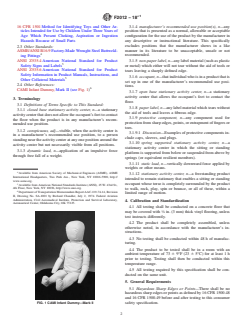
CAMI Infant Dummy, Mark II (see Fig. 1)
3.1.7 open base stationary activity center, n—a stationary
activity center that allows the occupant’s feet to contact the
3. Terminology
floor.
3.1 Definitions of Terms Specific to This Standard:
3.1.8 paper label, n—any label material which tears without
3.1.1 closed base stationary activity center, n—a stationary
the aid of tools and leaves a fibrous edge.
activitycenterthatdoesnotallowtheoccupant’sfeettocontact
3.1.9 protective component, n—any component used for
the floor when the product is in any manufacturer’s recom-
protectionfromsharpedges,points,orentrapmentoffingersor
mended use position.
toes.
3.1.2 conspicuous, adj—visible, when the activity center is
3.1.9.1 Discussion—Examples of protective components in-
in a manufacturer’s recommended use position, to a person
clude caps, sleeves, and plugs.
standing near the activity center at any one position around the
3.1.10 spring supported stationary activity center, n—a
activity center but not necessarily visible from all positions.
stationary activity center in which the sitting or standing
3.1.3 dynamic load, n—application of an impulsive force
platform is supported from below or suspended from above by
through free fall of a weight.
springs (or equivalent resilient members).
3.1.11 static load, n—vertically downward force applied by
weights or other means.
Available from American Society of Mechanical Engineers (ASME), ASME
3.1.12 stationary activity center, n—a freestanding product
International Headquarters, Two Park Ave., New York, NY 10016-5990, http://
intended to remain stationary that enables a sitting or standing
www.asme.org.
occupant whose torso is completely surrounded by the product
Available from American National Standards Institute (ANSI), 25 W. 43rd St.,
4th Floor, New York, NY 10036, http://www.ansi.org.
to walk, rock, play, spin or bounce, or all of these, within a
Department of Transportation Memorandum ReportAAC-119-74-14, Revision
limited range of motion.
II, Drawing No. SA-1001 by Richard Chandler, July 2, 1974. Federal Aviation
Administration, Civil Aeromedical Institute, Protection and Survival Laboratory,
4. Calibration and Standardization
Aeronautical Center, Oklahoma City, OK 73125.
4.1 All testing shall be conducted on a concrete floor that
may be covered with ⁄8 in. (3 mm) thick vinyl flooring, unless
test instructs differently.
4.2 The product shall be completely assembled, unless
otherwise noted, in accordance with the manufacturer’s in-
structions.
4.3 No testing shall be conducted within 48 h of manufac-
turing.
4.4 The product to be tested shall be in a room with an
ambient temperature of 73 6 9°F (23 6 5°C) for at least 1 h
prior to testing. Testing shall then be conducted within this
temperature range.
4.5 All testing required by this specification shall be con-
ducted on the same unit.
5. General Requirements
5.1 Hazardous Sharp Edges or Points—There shall be no
hazardous sharp edges or points as defined by 16 CFR 1500.48
and 16 CFR 1500.49 before and after testing to this consumer
FIG. 1CAMI Infant Dummy—Mark II safety specification.
´1
F2012−18
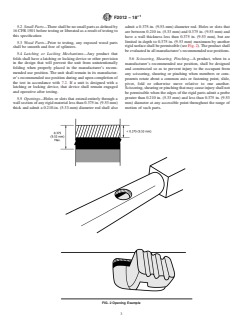
5.2 Small Parts—Thereshallbenosmallpartsasdefinedby admit a 0.375-in. (9.53-mm) diameter rod. Holes or slots that
16 CFR 1501 before testing or liberated as a result of testing to are between 0.210 in. (5.33 mm) and 0.375 in. (9.53 mm) and
this specification
have a wall thickness less than 0.375 in. (9.53 mm), but are
limited in depth to 0.375 in. (9.53 mm) maximum by another
5.3 Wood Parts—Prior to testing, any exposed wood parts
rigidsurfaceshallbepermissible(seeFig.2).Theproductshall
shall be smooth and free of splinters.
be evaluated in all manufacturer’s recommended use positions.
5.4 Latching or Locking Mechanisms—Any product that
folds shall have a latching or locking device or other provision
5.6 Scissoring, Shearing, Pinching—A product, when in a
in the design that will prevent the unit from unintentionally manufacturer’s recommended use position, shall be designed
folding when properly placed in the manufacturer’s recom-
and constructed so as to prevent injury to the occupant from
mended use position. The unit shall remain in its manufactur-
any scissoring, shearing or pinching when members or com-
er’s recommended use position during and upon completion of
ponents rotate about a common axis or fastening point, slide,
the test in accordance with 7.2. If a unit is designed with a
pivot, fold or otherwise move relative to one another.
latching or locking device, that device shall remain engaged
Scissoring,shearingorpinchingthatmaycauseinjuryshallnot
and operative after testing.
be permissible when the edges of the rigid parts admit a probe
greater than 0.210 in. (5.33 mm) and less than 0.375 in. (9.53
5.5 Openings—Holes or slots that extend entirely through a
wall section of any rigid material less than 0.375 in. (9.53 mm) mm) diameter at any accessible point throughout the range of
thick and admit a 0.210-in. (5.33-mm) diameter rod shall also motion of such parts.
FIG. 2Opening Example
´1
F2012−18
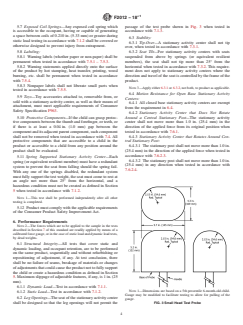
5.7 Exposed Coil Springs—Any exposed coil spring which passage of the test probe shown in Fig. 3 when tested in
is accessible to the occupant, having or capable of generating accordance with 7.1.3.
a space between coils of 0.210 in. (5.33 mm) or greater during
6.3 Stability:
static load testing in accordance with 7.1.2 shall be covered or
6.3.1 Tip-Over—A stationary activity center shall not tip
otherwise designed to prevent injury from entrapment.
over, when tested in accordance with 7.3.1.
5.8 Labeling: 6.3.2 Seat Tilt—For stationary activity centers with seats
5.8.1 Warning labels (whether paper or non-paper) shall be suspended from above by springs (or equivalent resilient
permanent when tested in accordance with 7.5.1 – 7.5.3. members), the seat shall not tip more than 25° from the
5.8.2 Warning statements applied directly onto the surface horizontal when tested in accordance with 7.3.2. This require-
of the product by hot stamping, heat transfer, printing, wood ment does not apply to stationary activity centers where the
burning, etc. shall be permanent when tested in accordance direction and travel of the seat is controlled by the frame of the
with 7.5.4. product.
5.8.3 Nonpaper labels shall not liberate small parts when
NOTE 3—Apply either 6.3.1 or 6.3.2, not both, to product as applicable.
tested in accordance with 7.5.5.
6.4 Motion Resistance for Open Base Stationary Activity
5.9 Toys—Toy accessories attached to, removable from, or
Centers:
sold with a stationary activity center, as well as their means of
6.4.1 All closed base stationary activity centers are exempt
attachment, must meet applicable requirements of Consumer
from the requirement in 6.4.
Safety Specification F963.
6.4.2 Stationary Activity Center that Does Not Rotate
5.10 Protective Components—If the child can grasp protec- Around a Central Stationary Post—The stationary activity
tive components between the thumb and forefinger, or teeth, or center shall not move more than 1.0 in. (25.4 mm) in the
if there is at least a 0.04 in. (1.0 mm) gap between the direction of the applied force from its original position when
componentanditsadjacentparentcomponent,suchcomponent tested in accordance with 7.6.1.
shall not be removed when tested in accordance with 7.4. All 6.4.3 Stationary Activity Center that Rotates Around Cen-
protective components that are accessible to a child in the tral Stationary Post:
product or accessible to a child from any position around the 6.4.3.1 The stationary post shall not move more than 1.0 in.
product shall be evaluated. (25.4 mm) in the direction of the applied force when tested in
accordance with 7.6.2.3.
5.11 Spring Supported Stationary Activity Center—Each
6.4.3.2 The stationary post shall not move more than 1.0 in.
spring (or equivalent resilient member) must have a redundant
(25.4 mm) in any direction when tested in accordance with
system to prevent the seat from falling should the spring fail.
7.6.2.4.
With any one of the springs disabled, the redundant system
must fully support the test weight, the seat must come to rest at
an angle not more than 25° from the horizontal, and a
hazardous condition must not be created as defined in Section
5 when tested in accordance with 7.1.2.
NOTE 1—This test shall be performed independently after all other
testing is completed.
5.12 Product must comply with the applicable requirements
of the Consumer Product Safety Improvement Act.
6. Performance Requirements
NOTE 2—The forces which are to be applied to the sample in the tests
described in Section 7 of this standard are readily applied by means of a
calibrated force gauge, or in the case of static load and dynamic load tests,
by dead weights.
6.1 Structural Integrity—All tests that cover static and
dynamic loading, and occupant retention, are to be performed
on the same product, sequentially and without refurbishing or
repositioning of adjustment, if any. At test conclusion, there
shall be no failure of seams, breakage of materials or changes
of adjustments that could cause the product not to fully support
the child or create a hazardous condition as defined in Section
5. Maximum slippage of adjustable features, if any, is 1 in. (25
mm).
6.1.1 Dynamic Load—Test in accordance with 7.1.1.
NOTE 1—Dimensions are based on a 5th percentile 6-month-old child.
6.1.2 Static Load—Test in accordance with 7.1.2.
Gauge may be modified to facilitate testing to allow for pulling of the
6.2 Leg Openings—The seat of the stationary activity center
gauge.
shall be designed so that the leg openings will not permit the FIG. 3Small Head Test Probe
´1
F2012−18
7. Test Methods Inspect the action of all supporting, locking and adjusting
NOTE 4—Except for the Structural Integrity tests in 7.1, which shall be
components to assure that they do not create a hazardous
performed first, the tests can be performed in any sequence.
condition as defined in Section 5.
7.1 Structural Integrity: 7.1.2.3 Position the stationary activity center in the manu-
7.1.1 Dynamic Load: facturer’s recommended use position. If adjustable, adjust to
7.1.1.1 Position the stationary activity center in the manu- the lowest position.
facturer’s recommended use position. If adjustable, adjust to 7.1.2.4 Center a weight of 50 lb (22.7 kg) for a period of
the highest and most upright position. 1 min on a 6-by-6 in. (150-by-150 mm) wood block ⁄4 in. (19
7.1.1.2 Affix to the stationary activity center seat a 6-by-6 mm) thick affixed to the stationary activity center seat. If the
in. (150-by-150 mm) wood block ⁄4 in. (19 mm) thick. If the unit has a hammock type seat, use a standard 6 in. (150 mm)
unit has a hammock type seat, use a standard 6 in. (150 mm) weld cap, convex surface down, as identified in Fig. 4 instead
weldcap,convexsurfacedown,asidentifiedinFig.4,attached of the specified wood block. Make weight allowance for the
to the bottom of the test weight. weld cap. In this test, DO NOTrestrict the bouncer mechanism
7.1.1.3 Drop a test weight of 33 lb (15 kg), with the mass of from folding or bottoming out. Inspect the action of all
the weld cap shown in Fig. 4 included, onto the seat at least a supporting, locking and adjusting components to assure that
distance of 1 in. (25 mm) one hundred times.
they do not create a hazardous condition as defined in Section
7.1.1.4 When testing an adjustable stationary activity center 5.
where the seat is supported from below by springs (or
7.1.3 Leg Openings Test:
equivalent resilient members), test with the product in the 7.1.3.1 If the seat is adjustable, adjust the seat to obtain the
highest adjustment position and support the frame so that the
largest leg opening.
dropping of the 33 lb (15 kg) weight does not cause the seat to 7.1.3.2 Rotate the test probe shown in Fig. 3 to the orien-
bottom out. When testing stationary activity centers where the
tation most likely to fail and gradually apply a force of 25-lbf
seatissuspendedfromabovebysprings(orequivalentresilient (111 N).Apply the force perpendicular to the base of the probe
members), wait 5 6 1 s between drops of the test weight to
within a period of 5 s and maintain it for an additional 10 s.
allow the seat/seat platform to stop bouncing.
7.2 Latching or Locking Mechanism Activation:
7.1.2 Static Load:
7.2.1 Stationary Activity Centers with Single Action Release
7.1.2.1 Position the stationary activity center as in 7.1.1.1.
Mechanism—With the product in each manufacturer’s recom-
7.1.2.2 Center a weight of 90 lb (41 kg) for a period of
mended use position, gradually apply a 10 lbf (45 N) force to
1 min on a 6-by-6 in. (150-by-150 mm) wood block ⁄4 in.
the latching or locking mechanism in the direction tending to
(19 mm) thick affixed to the stationary activity center seat. If
release it.
the unit has a hammock type seat, use a standard 6 in. (150
7.2.2 Stationary Activity Centers with Double Action Re-
mm) weld cap, convex surface down, as identified in Fig. 4
lease Mechanism—Each double action locking/latching
instead of the specified wood block. Make weight allowance
mechanism shall require two distinct and separate actions for
for the weld cap. If the natural action of a bouncer type
release of the mechanism.
stationaryactivitycenterallowstheseattocontactthefloorand
7.3 Stability:
will not allow the full application of the 90 lb (41 kg) static
7.3.1 Tip Over:
load, then restrict the bouncer mechanism by any means
7.3.1.1 Position the stationary activity center in the most
possible so that the full static load can be applied to the seat or
disadvantageous manufacturer’s recommended use position. If
section of the stationary activity center occupied by the c
...